

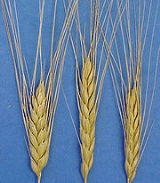
Emmer

Encyclopedia
Emmer wheat also known as farro
especially in Italy, is a low yielding, awned wheat
. It was one of the first crops domesticated
in the Near East
. It was widely cultivated in the ancient world, but is now a relict
crop in mountainous regions of Europe and Asia.
of domesticated emmer (Triticum dicoccum). Because wild and domesticated emmer are interfertile with other tetraploid wheats, some taxonomists consider all tetraploid wheats to belong to one species, T. turgidum. Under this scheme, the two forms are recognized at subspecies
level, thus T. turgidum subsp. dicoccoides and T. turgidum subsp. dicoccom. Either naming system is equally valid; the latter lays more emphasis on genetic similarities.
For a wider discussion, see Wheat#Genetics & Breeding and Wheat taxonomy
of the Near East. It is a tetraploid wheat formed by the hybridization of two diploid wild grasses, Triticum urartu (closely related to wild einkorn (T. boeoticum), and as yet unidentified Aegilops
species related to A. searsii or A. speltoides
.
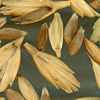 Like einkorn and spelt
wheats, emmer is a hulled wheat. In other words, it has strong glumes (husks) that enclose the grains, and a semi-brittle rachis
. On threshing, a hulled wheat spike breaks up into spikelets. These require milling or pounding to release the grains from the glumes.
Wild emmer wheat spikelets effectively self-cultivate by propelling themselves mechanically into soils with their awns. During a period of increased humidity during the night, the awns of the spikelet become erect and draw together, and in the process push the grain into the soil. During the daytime the humidity drops and the awns slacken back again; however, fine silica hairs on the awns act as hooks in the soil and prevent the spikelets from reversing back out again. During the course of alternating stages of daytime and nighttime humidity, the awns' pumping movements, which resemble a swimming frog kick
, will drill the spikelet as much as an inch or more into the soil.
's discovery of wild emmer wheat growing in Rosh Pina (now in Israel) created a stir in the botanical world. Emmer wheat has been found in archaeological excavations and ancient tombs. Grains of wild emmer discovered at Ohalo II had a radiocarbon dating
of 17,000 BC, and at the Pre Pottery Neolithic A
(PPNA) site of Netiv Hagdud
are 10,000-9,400 years old.
DNA studies on emmer wheat have shown its place of domestication to be near Şanlıurfa
, in southeast Turkey. Domesticated emmer first appears at Pre-Pottery Neolithic sites in the Fertile Crescent
, either in the PPNA period (9800-8800 cal BC) or the early-mid PPNB (8800-7500 cal BC). Small quantities of emmer are present during Period 1 at Mehrgharh on the Indian subcontinent, showing that emmer was already cultivated there by 7000-5000 BC.
In the Near East
, in southern Mesopotamia
in particular, cultivation of emmer wheat began to decline in the Early Bronze Age, from about 3000 BC, and barley
became the standard cereal crop. This has been related to increased salinization of irrigated alluvial soils, of which barley is more tolerant, although this study has been challenged. Emmer had a special place in ancient Egypt
, where it was the main wheat cultivated in Pharaonic times, although cultivated einkorn wheat was grown in great abundance during the Third Dynasty
, and large quantities of it were found preserved, along with cultivated emmer wheat and barleys, in the subterranean chambers beneath the Step Pyramid at Saqqara
. Neighbouring countries also cultivated einkorn, durum
and common wheat. In the absence of any obvious functional explanation, the greater prevalence of emmer wheat in the diet of ancient Egypt may simply reflect a marked culinary or cultural preference, or may reflect growing conditions having changed after the Third Dynasty. Emmer and barley were the primary ingredients in ancient Egyptian bread and beer
. Emmer recovered from the Phoenicia
n settlement at Volubilis
(in present day Morocco
) has been dated to the middle of the first millennium BC.
Emmer wheat is mentioned in ancient rabbinic literature
as one of the five grains to be used by Jews during Passover
as matzah (that is, without leavening agents of any kind). It is often incorrectly translated as spelt
in English translations of the rabbinic literature but spelt did not grow in ancient Israel, and emmer was a significant crop until the end of the Iron Age
. Likewise, references to emmer in Greek
and Latin texts
are traditionally translated as "spelt," even though spelt was not common in the Classical world until very late in its history.
In northeastern Europe
, emmer (in addition to einkorn and barley) was one of the most important cereal species and this importance can be seen to increase from 3400 BC onwards. Pliny the Elder
, notes that although emmer was called far in his time formerly it was called adoreum (or "glory"), providing an etymology explaining that emmer had been held in glory (N.H. 18.3), and later in the same book he describes its role
in sacrifices.
that are prevalent in wet areas. Emmer is grown in Armenia, Morocco, Spain (Asturias), the Carpathian mountains on the border of the Czech and Slovak republics, Albania, Turkey, Switzerland and Italy. It is also grown in the U.S. as a specialty product. A traditional food plant in Ethiopia, this relatively little-known grain has potential to improve nutrition, boost food security, foster rural development and support sustainable landcare.
In Italy, uniquely, emmer cultivation is well established and even expanding. In the mountainous Garfagnana area of Tuscany emmer (known as farro) is grown by farmers as an IGP (Indicazione Geografica Protetta
) product, with its geographic identity protected by law. Production is certified by a co-operative body, the Consorzio Produttori Farro della Garfagnana. IGP-certified farro is widely available in health food shops across Europe, and even in some British supermarkets. The demand for Italian farro has led to competition from non-certified farro, grown in lowland areas and often consisting of a different wheat species, spelt (Triticum spelta).
than common wheat, emmer's use for making pasta is a recent response to the health food market; some consumers, however, judge that emmer pasta has an unattractive texture. Emmer has also been used in beer production and the Riedenburger eco-brewery in Bavaria, Germany currently produces Emmerbier.
As with most varieties of wheat, however, emmer is probably unsuitable for sufferers from wheat allergies
or coeliac disease
.
Origin: species of wheat, from German Emmer, variant of Amelkorn, from amel "starch", from Latin amylum.
Farro
Farro is a food product consisting of the grains of certain wheat species in whole form. The exact definition is debated. It is sold dried and is prepared by cooking in water until soft, but still crunchy . It may be eaten plain, though it is often used as an ingredient in dishes such as salads and...
especially in Italy, is a low yielding, awned wheat
Wheat
Wheat is a cereal grain, originally from the Levant region of the Near East, but now cultivated worldwide. In 2007 world production of wheat was 607 million tons, making it the third most-produced cereal after maize and rice...
. It was one of the first crops domesticated
Neolithic founder crops
The Neolithic founder crops are the eight plant species that were domesticated by early Holocene farming communities in the Fertile Crescent region of southwest Asia, and which formed the basis of systematic agriculture in the Middle East, North Africa, India, Persia and Europe...
in the Near East
Near East
The Near East is a geographical term that covers different countries for geographers, archeologists, and historians, on the one hand, and for political scientists, economists, and journalists, on the other...
. It was widely cultivated in the ancient world, but is now a relict
Relict
A relict is a surviving remnant of a natural phenomenon.* In biology a relict is an organism that at an earlier time was abundant in a large area but now occurs at only one or a few small areas....
crop in mountainous regions of Europe and Asia.
Taxonomy
Strong similarities in morphology and genetics show that wild emmer (Triticum dicoccoides Koern.) is the wild ancestor and a crop wild relativeCrop wild relative
A crop wild relative is a wild plant closely related to a domesticated plant. It may be a wild ancestor of the domesticated plant, or another closely related taxon.-Overview:...
of domesticated emmer (Triticum dicoccum). Because wild and domesticated emmer are interfertile with other tetraploid wheats, some taxonomists consider all tetraploid wheats to belong to one species, T. turgidum. Under this scheme, the two forms are recognized at subspecies
Subspecies
Subspecies in biological classification, is either a taxonomic rank subordinate to species, ora taxonomic unit in that rank . A subspecies cannot be recognized in isolation: a species will either be recognized as having no subspecies at all or two or more, never just one...
level, thus T. turgidum subsp. dicoccoides and T. turgidum subsp. dicoccom. Either naming system is equally valid; the latter lays more emphasis on genetic similarities.
For a wider discussion, see Wheat#Genetics & Breeding and Wheat taxonomy
Wheat taxonomy
During 10,000 years of cultivation, numerous forms of wheat have evolved under human selection. This diversity has led to much confusion in the naming of wheats. This article explains how genetic and morphological characteristics of wheat influence its classification, and gives the most common...
Wild emmer
Wild emmer (Triticum dicoccoides) grows wild in the fertile crescentFertile Crescent
The Fertile Crescent, nicknamed "The Cradle of Civilization" for the fact the first civilizations started there, is a crescent-shaped region containing the comparatively moist and fertile land of otherwise arid and semi-arid Western Asia. The term was first used by University of Chicago...
of the Near East. It is a tetraploid wheat formed by the hybridization of two diploid wild grasses, Triticum urartu (closely related to wild einkorn (T. boeoticum), and as yet unidentified Aegilops
Aegilops
Aegilops is a genus of plants generally known as goatgrasses and belonging to the grass family, Poaceae. There are about 23 species and numerous sub species in the genus. Various members of the genus are classed as agricultural weeds. Growing through the winter, they resemble winter wheat...
species related to A. searsii or A. speltoides
Aegilops speltoides
Aegilops speltoides is an edible plant in the Poaceae family native to Southeastern Europe and Western Asia, which is often used for animal feed, and it has grown in cultivated beds...
.
Morphology
Spelt
Spelt is a hexaploid species of wheat. Spelt was an important staple in parts of Europe from the Bronze Age to medieval times; it now survives as a relict crop in Central Europe and northern Spain and has found a new market as a health food. Spelt is sometimes considered a subspecies of the...
wheats, emmer is a hulled wheat. In other words, it has strong glumes (husks) that enclose the grains, and a semi-brittle rachis
Rachis
Rachis is a biological term for a main axis or "shaft".-In zoology:In vertebrates a rachis can refer to the series of articulated vertebrae, which encase the spinal cord. In this case the rachis usually form the supporting axis of the body and is then called the spine or vertebral column...
. On threshing, a hulled wheat spike breaks up into spikelets. These require milling or pounding to release the grains from the glumes.
Wild emmer wheat spikelets effectively self-cultivate by propelling themselves mechanically into soils with their awns. During a period of increased humidity during the night, the awns of the spikelet become erect and draw together, and in the process push the grain into the soil. During the daytime the humidity drops and the awns slacken back again; however, fine silica hairs on the awns act as hooks in the soil and prevent the spikelets from reversing back out again. During the course of alternating stages of daytime and nighttime humidity, the awns' pumping movements, which resemble a swimming frog kick
Frog kick
The frog kick is a swimming action sometimes used by scuba divers when they are swimming near a soft silty seabed or lakebed which they do not want to stir up damaging the visibility. It is like the swimming action of a frog or the leg part of the breaststroke...
, will drill the spikelet as much as an inch or more into the soil.
History
In 1906, Aaron AaronsohnAaron Aaronsohn
Aaron Aaronsohn was a Jewish agronomist, botanist, and Zionist activist. Aaronsohn was the discoverer of wild emmer , believed to be "the mother of wheat."-Biography:...
's discovery of wild emmer wheat growing in Rosh Pina (now in Israel) created a stir in the botanical world. Emmer wheat has been found in archaeological excavations and ancient tombs. Grains of wild emmer discovered at Ohalo II had a radiocarbon dating
Radiocarbon dating
Radiocarbon dating is a radiometric dating method that uses the naturally occurring radioisotope carbon-14 to estimate the age of carbon-bearing materials up to about 58,000 to 62,000 years. Raw, i.e. uncalibrated, radiocarbon ages are usually reported in radiocarbon years "Before Present" ,...
of 17,000 BC, and at the Pre Pottery Neolithic A
Pre-Pottery Neolithic A
Pre-Pottery Neolithic A denotes the first stage in early Levantine Neolithic culture, dating around 9500 to 8500 BC. Archaeological remains are located in the Levantine and upper Mesopotamian region of the Fertile Crescent...
(PPNA) site of Netiv Hagdud
Netiv HaGdud
Netiv HaGdud is a moshav and Israeli settlement in the West Bank. Located in the Jordan Valley around twenty kilometres north of Jericho, it falls under the jurisdiction of Bik'at HaYarden Regional Council...
are 10,000-9,400 years old.
DNA studies on emmer wheat have shown its place of domestication to be near Şanlıurfa
Sanliurfa
Şanlıurfa, , often simply known as Urfa in daily language , in ancient times Edessa, is a city with 482,323 inhabitants Şanlıurfa, , often simply known as Urfa in daily language (Syriac ܐܘܪܗܝ Urhoy,Armenian Ուռհա Owr'ha, Arabic الرها ar-Ruhā), in ancient times Edessa, is a city with 482,323...
, in southeast Turkey. Domesticated emmer first appears at Pre-Pottery Neolithic sites in the Fertile Crescent
Fertile Crescent
The Fertile Crescent, nicknamed "The Cradle of Civilization" for the fact the first civilizations started there, is a crescent-shaped region containing the comparatively moist and fertile land of otherwise arid and semi-arid Western Asia. The term was first used by University of Chicago...
, either in the PPNA period (9800-8800 cal BC) or the early-mid PPNB (8800-7500 cal BC). Small quantities of emmer are present during Period 1 at Mehrgharh on the Indian subcontinent, showing that emmer was already cultivated there by 7000-5000 BC.
In the Near East
Near East
The Near East is a geographical term that covers different countries for geographers, archeologists, and historians, on the one hand, and for political scientists, economists, and journalists, on the other...
, in southern Mesopotamia
Mesopotamia
Mesopotamia is a toponym for the area of the Tigris–Euphrates river system, largely corresponding to modern-day Iraq, northeastern Syria, southeastern Turkey and southwestern Iran.Widely considered to be the cradle of civilization, Bronze Age Mesopotamia included Sumer and the...
in particular, cultivation of emmer wheat began to decline in the Early Bronze Age, from about 3000 BC, and barley
Barley
Barley is a major cereal grain, a member of the grass family. It serves as a major animal fodder, as a base malt for beer and certain distilled beverages, and as a component of various health foods...
became the standard cereal crop. This has been related to increased salinization of irrigated alluvial soils, of which barley is more tolerant, although this study has been challenged. Emmer had a special place in ancient Egypt
Ancient Egypt
Ancient Egypt was an ancient civilization of Northeastern Africa, concentrated along the lower reaches of the Nile River in what is now the modern country of Egypt. Egyptian civilization coalesced around 3150 BC with the political unification of Upper and Lower Egypt under the first pharaoh...
, where it was the main wheat cultivated in Pharaonic times, although cultivated einkorn wheat was grown in great abundance during the Third Dynasty
Third dynasty of Egypt
For the Sumerian Renaissance, see Third Dynasty of Ur.The Third Dynasty of ancient Egypt is the first dynasty of the Old Kingdom. Other dynasties of the Old Kingdom include the Fourth, Fifth and Sixth...
, and large quantities of it were found preserved, along with cultivated emmer wheat and barleys, in the subterranean chambers beneath the Step Pyramid at Saqqara
Saqqara
Saqqara is a vast, ancient burial ground in Egypt, serving as the necropolis for the Ancient Egyptian capital, Memphis. Saqqara features numerous pyramids, including the world famous Step pyramid of Djoser, sometimes referred to as the Step Tomb due to its rectangular base, as well as a number of...
. Neighbouring countries also cultivated einkorn, durum
Durum
Durum wheat or macaroni wheat is the only tetraploid species of wheat of commercial importance that is widely cultivated today...
and common wheat. In the absence of any obvious functional explanation, the greater prevalence of emmer wheat in the diet of ancient Egypt may simply reflect a marked culinary or cultural preference, or may reflect growing conditions having changed after the Third Dynasty. Emmer and barley were the primary ingredients in ancient Egyptian bread and beer
Beer
Beer is the world's most widely consumed andprobably oldest alcoholic beverage; it is the third most popular drink overall, after water and tea. It is produced by the brewing and fermentation of sugars, mainly derived from malted cereal grains, most commonly malted barley and malted wheat...
. Emmer recovered from the Phoenicia
Phoenicia
Phoenicia , was an ancient civilization in Canaan which covered most of the western, coastal part of the Fertile Crescent. Several major Phoenician cities were built on the coastline of the Mediterranean. It was an enterprising maritime trading culture that spread across the Mediterranean from 1550...
n settlement at Volubilis
Volubilis
Volubilis is an archaeological site in Morocco situated near Meknes between Fez and Rabat along the N13 road. The nearest town is Moulay Idriss. Volubilis features the best preserved Roman ruins in this part of northern Africa...
(in present day Morocco
Morocco
Morocco , officially the Kingdom of Morocco , is a country located in North Africa. It has a population of more than 32 million and an area of 710,850 km², and also primarily administers the disputed region of the Western Sahara...
) has been dated to the middle of the first millennium BC.
Emmer wheat is mentioned in ancient rabbinic literature
Rabbinic literature
Rabbinic literature, in its broadest sense, can mean the entire spectrum of rabbinic writings throughout Jewish history. However, the term often refers specifically to literature from the Talmudic era, as opposed to medieval and modern rabbinic writing, and thus corresponds with the Hebrew term...
as one of the five grains to be used by Jews during Passover
Passover
Passover is a Jewish holiday and festival. It commemorates the story of the Exodus, in which the ancient Israelites were freed from slavery in Egypt...
as matzah (that is, without leavening agents of any kind). It is often incorrectly translated as spelt
Spelt
Spelt is a hexaploid species of wheat. Spelt was an important staple in parts of Europe from the Bronze Age to medieval times; it now survives as a relict crop in Central Europe and northern Spain and has found a new market as a health food. Spelt is sometimes considered a subspecies of the...
in English translations of the rabbinic literature but spelt did not grow in ancient Israel, and emmer was a significant crop until the end of the Iron Age
Iron Age
The Iron Age is the archaeological period generally occurring after the Bronze Age, marked by the prevalent use of iron. The early period of the age is characterized by the widespread use of iron or steel. The adoption of such material coincided with other changes in society, including differing...
. Likewise, references to emmer in Greek
Greek literature
Greek literature refers to writings composed in areas of Greek influence, typically though not necessarily in one of the Greek dialects, throughout the whole period in which the Greek-speaking people have existed.-Ancient Greek literature :...
and Latin texts
Latin literature
Latin literature includes the essays, histories, poems, plays, and other writings of the ancient Romans. In many ways, it seems to be a continuation of Greek literature, using many of the same forms...
are traditionally translated as "spelt," even though spelt was not common in the Classical world until very late in its history.
In northeastern Europe
Europe
Europe is, by convention, one of the world's seven continents. Comprising the westernmost peninsula of Eurasia, Europe is generally 'divided' from Asia to its east by the watershed divides of the Ural and Caucasus Mountains, the Ural River, the Caspian and Black Seas, and the waterways connecting...
, emmer (in addition to einkorn and barley) was one of the most important cereal species and this importance can be seen to increase from 3400 BC onwards. Pliny the Elder
Pliny the Elder
Gaius Plinius Secundus , better known as Pliny the Elder, was a Roman author, naturalist, and natural philosopher, as well as naval and army commander of the early Roman Empire, and personal friend of the emperor Vespasian...
, notes that although emmer was called far in his time formerly it was called adoreum (or "glory"), providing an etymology explaining that emmer had been held in glory (N.H. 18.3), and later in the same book he describes its role
Mola salsa
In ancient Roman religion, mola salsa was a mixture of coarse-ground, toasted emmer flour and salt prepared by the Vestal Virgins and used in every official sacrifice. It was sprinkled on the forehead and between the horns of animal victims before they were sacrificed, as well as on the altar and...
in sacrifices.
Cultivation
Today emmer is primarily a relict crop in mountainous areas. Its value lies in its ability to give good yields on poor soils, and its resistance to fungal diseases such as stem rustStem rust
The stem, black or cereal rusts are caused by the fungus Puccinia graminis and are a significant disease affecting cereal crops. An epidemic of stem rust on wheat caused by race Ug99 is currently spreading across Africa, Asia and most recently into Middle East and is causing major concern due to...
that are prevalent in wet areas. Emmer is grown in Armenia, Morocco, Spain (Asturias), the Carpathian mountains on the border of the Czech and Slovak republics, Albania, Turkey, Switzerland and Italy. It is also grown in the U.S. as a specialty product. A traditional food plant in Ethiopia, this relatively little-known grain has potential to improve nutrition, boost food security, foster rural development and support sustainable landcare.
In Italy, uniquely, emmer cultivation is well established and even expanding. In the mountainous Garfagnana area of Tuscany emmer (known as farro) is grown by farmers as an IGP (Indicazione Geografica Protetta
Protected Geographical Status
Protected Geographical Status is a legal framework defined in European Union law to protect the names of regional foods. Protected Designation of Origin , Protected Geographical Indication and Traditional Speciality Guaranteed are distinct regimes of geographical indications within the framework...
) product, with its geographic identity protected by law. Production is certified by a co-operative body, the Consorzio Produttori Farro della Garfagnana. IGP-certified farro is widely available in health food shops across Europe, and even in some British supermarkets. The demand for Italian farro has led to competition from non-certified farro, grown in lowland areas and often consisting of a different wheat species, spelt (Triticum spelta).
Food uses
Emmer's main use is as a human food, though it is also used for animal feed. Ethnographic evidence from Turkey and other emmer-growing areas suggests that emmer makes good bread (judged by the taste and texture standards of traditional bread), and this is supported by evidence of its widespread consumption as bread in ancient Egypt. Emmer bread is available in Switzerland. In Italy, whole emmer grains can be easily found in most supermarkets and groceries, emmer bread (pane di farro) can be found in bakeries in some areas, and emmer has traditionally been consumed in Tuscany as whole grain in soup. Higher in fiberFiber
Fiber is a class of materials that are continuous filaments or are in discrete elongated pieces, similar to lengths of thread.They are very important in the biology of both plants and animals, for holding tissues together....
than common wheat, emmer's use for making pasta is a recent response to the health food market; some consumers, however, judge that emmer pasta has an unattractive texture. Emmer has also been used in beer production and the Riedenburger eco-brewery in Bavaria, Germany currently produces Emmerbier.
As with most varieties of wheat, however, emmer is probably unsuitable for sufferers from wheat allergies
Wheat allergy
Wheat allergy is a food allergy, but can also be a contact allergy resulting from occupational exposure. Like all allergies wheat allergy involves IgE and mast cell response. Typically the allergy is limited to the seed storage proteins of wheat, some reactions are restricted to wheat proteins,...
or coeliac disease
Coeliac disease
Coeliac disease , is an autoimmune disorder of the small intestine that occurs in genetically predisposed people of all ages from middle infancy onward...
.
Etymology
First use: 1908Origin: species of wheat, from German Emmer, variant of Amelkorn, from amel "starch", from Latin amylum.