


Duomo di Siena

Encyclopedia
Siena
Siena is a city in Tuscany, Italy. It is the capital of the province of Siena.The historic centre of Siena has been declared by UNESCO a World Heritage Site. It is one of the nation's most visited tourist attractions, with over 163,000 international arrivals in 2008...
, central Italy
Italy
Italy , officially the Italian Republic languages]] under the European Charter for Regional or Minority Languages. In each of these, Italy's official name is as follows:;;;;;;;;), is a unitary parliamentary republic in South-Central Europe. To the north it borders France, Switzerland, Austria and...
.
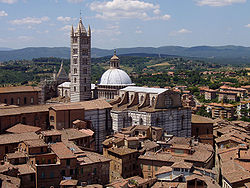
The cathedral itself was originally designed and completed between 1215 and 1263 on the site of an earlier structure. It has the form of a Latin cross with a slightly projecting transept, a dome and a bell tower. The dome rises from a hexagonal base with supporting columns. The lantern atop the dome was added by Gian Lorenzo Bernini
Gian Lorenzo Bernini
Gian Lorenzo Bernini was an Italian artist who worked principally in Rome. He was the leading sculptor of his age and also a prominent architect...
. The nave is separated from the two aisles by semicircular arches. The exterior and interior are constructed of white and greenish-black marble in alternating stripes, with addition of red marble on the façade. Black and white are the symbolic colors of Siena, etiologically
Etiology
Etiology is the study of causation, or origination. The word is derived from the Greek , aitiologia, "giving a reason for" ....
linked to black and white horses of the legendary city's founders, Senius and Aschius.
Early history
The origins of the first structure are obscure and shrouded in legend. There was a 9th century church with bishop's palace at the present location. In December 1058 a synodSynod
A synod historically is a council of a church, usually convened to decide an issue of doctrine, administration or application. In modern usage, the word often refers to the governing body of a particular church, whether its members are meeting or not...
was held in this church resulting in the election of pope Nicholas II
Pope Nicholas II
Pope Nicholas II , born Gérard de Bourgogne, Pope from 1059 to July 1061, was at the time of his election the Bishop of Florence.-Antipope Benedict X:...
and the deposition of the antipope
Antipope
An antipope is a person who opposes a legitimately elected or sitting Pope and makes a significantly accepted competing claim to be the Pope, the Bishop of Rome and leader of the Roman Catholic Church. At times between the 3rd and mid-15th century, antipopes were typically those supported by a...
Benedict X.
In 1196 the cathedral masons’ guild
Guild
A guild is an association of craftsmen in a particular trade. The earliest types of guild were formed as confraternities of workers. They were organized in a manner something between a trade union, a cartel, and a secret society...
, the Opera di Santa Maria, was put in charge of the construction of a new cathedral. By 1215 there were already daily masses said in the new church. There are records from 1226 onwards of the transport of black and white marble, probably for the construction of the façade and the bell tower. The vaults
Vault (architecture)
A Vault is an architectural term for an arched form used to provide a space with a ceiling or roof. The parts of a vault exert lateral thrust that require a counter resistance. When vaults are built underground, the ground gives all the resistance required...
and the transept
Transept
For the periodical go to The Transept.A transept is a transverse section, of any building, which lies across the main body of the building. In Christian churches, a transept is an area set crosswise to the nave in a cruciform building in Romanesque and Gothic Christian church architecture...
were constructed in 1259-1260. In 1259 Manuello di Ranieri and his son Parri carved some wooden choir stalls, which were replaced about 100 years later and have now disappeared. In 1264, Rosso Padellaio was paid for the copper sphere on top of the dome.
A second massive addition was planned in 1339. It would have more than doubled the size of the structure by means of an entirely new nave and two aisles ranged perpendicular to the existing nave and centred on the high altar. The construction was begun under the direction of Giovanni di Agostino
Giovanni di Agostino
Giovanni di Agostino was an Italian sculptor in Siena in a gothic art style. Most of his work was sculptural commissions of the newly built Gothic Siena Cathedral. He sculpted a monument to Bishop Guido Tarlati in 1330...
, better known as a sculptor. Construction was halted by the Black Death
Black Death
The Black Death was one of the most devastating pandemics in human history, peaking in Europe between 1348 and 1350. Of several competing theories, the dominant explanation for the Black Death is the plague theory, which attributes the outbreak to the bacterium Yersinia pestis. Thought to have...
in 1348. Basic errors in the construction were already evident by then, however, and the work was never resumed. The outer walls, remains of this extension, can now be seen to the south of the Duomo. The floor of the uncompleted nave now serves as a parking lot and museum, and, though unfinished, the remains are testament to Sienese power, ambition, and artistic achievement.
Quire (architecture)
Architecturally, the choir is the area of a church or cathedral, usually in the western part of the chancel between the nave and the sanctuary . The choir is occasionally located in the eastern part of the nave...
of the Duomo, a narthex
Narthex
The narthex of a church is the entrance or lobby area, located at the end of the nave, at the far end from the church's main altar. Traditionally the narthex was a part of the church building, but was not considered part of the church proper...
containing important late-13th century frescoes (probably about 1280) was found and excavated in 1999-2003. The fresco
Fresco
Fresco is any of several related mural painting types, executed on plaster on walls or ceilings. The word fresco comes from the Greek word affresca which derives from the Latin word for "fresh". Frescoes first developed in the ancient world and continued to be popular through the Renaissance...
es depict scenes from the Old Testament
Old Testament
The Old Testament, of which Christians hold different views, is a Christian term for the religious writings of ancient Israel held sacred and inspired by Christians which overlaps with the 24-book canon of the Masoretic Text of Judaism...
and the life of Christ
Christ
Christ is the English term for the Greek meaning "the anointed one". It is a translation of the Hebrew , usually transliterated into English as Messiah or Mashiach...
. This was part of the entrance of an earlier church. But when the baptistry was built, this under-church was filled with rubble. The narthex is now open to the public.
Façade
The façadeFacade
A facade or façade is generally one exterior side of a building, usually, but not always, the front. The word comes from the French language, literally meaning "frontage" or "face"....
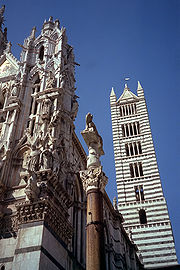
of this cathedral was built in two stages. The lower part in polychrome marble was begun around 1284. It is built in Tuscan Gothic
Gothic architecture
Gothic architecture is a style of architecture that flourished during the high and late medieval period. It evolved from Romanesque architecture and was succeeded by Renaissance architecture....
style by Giovanni Pisano
Giovanni Pisano
Giovanni Pisano was an Italian sculptor, painter and architect. Son of the famous sculptor Nicola Pisano, he received his training in the workshop of his father....
, replete with gargoyle
Gargoyle
In architecture, a gargoyle is a carved stone grotesque, usually made of granite, with a spout designed to convey water from a roof and away from the side of a building thereby preventing rainwater from running down masonry walls and eroding the mortar between...
s. Giovanni Pisano worked on the lower levels until 1296, when he suddenly left Siena. At that time, between 1270 and 1285, the nave of the church had been raised and a higher façade became necessary. Work at the façade continued for another fifteen years and was then stopped. Meanwhile in 1288, the rose window
Rose window
A Rose window is often used as a generic term applied to a circular window, but is especially used for those found in churches of the Gothic architectural style and being divided into segments by stone mullions and tracery...
, a large circular stained-glass window, was installed in the choir, based on designs by Duccio di Buoninsegna
Duccio
Duccio di Buoninsegna was one of the most influential Italian artists of his time. Born in Siena, Tuscany, he worked mostly with pigment and egg tempera and like most of his contemporaries painted religious subjects...
.
The three portals, surmounted by lunette
Lunette
In architecture, a lunette is a half-moon shaped space, either filled with recessed masonry or void. A lunette is formed when a horizontal cornice transects a round-headed arch at the level of the imposts, where the arch springs. If a door is set within a round-headed arch, the space within the...
s and Gothic pediment
Pediment
A pediment is a classical architectural element consisting of the triangular section found above the horizontal structure , typically supported by columns. The gable end of the pediment is surrounded by the cornice moulding...
s, were designed by Giovanni Pisano. The columns between the portals are richly decorated with acanthus
Acanthus (ornament)
The acanthus is one of the most common plant forms to make foliage ornament and decoration.-Architecture:In architecture, an ornament is carved into stone or wood to resemble leaves from the Mediterranean species of the Acanthus genus of plants, which have deeply cut leaves with some similarity to...
scrolls, allegorical figures and biblical scenes.
Work on the upper part of the façade only resumed in 1376 under the direction of Giovanni di Cecco, working on a new elaborate design, inspired by the Orvieto Cathedral. It was to be erected much higher than foreseen, because the nave had, once again, been raised. The division of the upper part does not match the division of the lower part. The pinnacles of the upper part do not continue over the columns flanking the central portal. The weight of the elegant side towers was reduced by adding windows.
The statues of the lavish façade were sculpted by Giovanni Pisano and assistants. They represent prophets, philosophers and apostles. The half-length statues of the patriarchs in the niches around the rose window are the work of other sculptors. Almost all the sculptures on view are copies. The originals are kept in the "Crypt of the Statues" in the Museo dell'Opera del Duomo.
The bronze central door is recent and dates from 1958. It was made by Enrico Manfrini. The scenes on the door represent the Glorification of the Virgin. The three large mosaic
Mosaic
Mosaic is the art of creating images with an assemblage of small pieces of colored glass, stone, or other materials. It may be a technique of decorative art, an aspect of interior decoration, or of cultural and spiritual significance as in a cathedral...
s on the gable
Gable
A gable is the generally triangular portion of a wall between the edges of a sloping roof. The shape of the gable and how it is detailed depends on the structural system being used and aesthetic concerns. Thus the type of roof enclosing the volume dictates the shape of the gable...
s of the façade were made in Venice
Venice
Venice is a city in northern Italy which is renowned for the beauty of its setting, its architecture and its artworks. It is the capital of the Veneto region...
in 1878. The large central mosaic, the Coronation of the Virgin, is the work of Luigi Mussini. The smaller mosaics on each side, Nativity of Jesus and Presentation of Mary in the Temple, were made by Alessandro Franchi.
On the left corner pier of the façade, a 14th century inscription can be found, marking the grave of Giovanni Pisano. Next to the façade stands a column with the she-wolf breast-feeding Romulus
Romulus
- People:* Romulus and Remus, the mythical founders of Rome* Romulus Augustulus, the last Western Roman Emperor* Valerius Romulus , deified son of the Roman emperor Maxentius* Romulus , son of the Western Roman emperor Anthemius...
and Remus
Remus
Remus is the twin brother of the mythical founder of Rome.Remus may also refer to:* Remus , a fictional planet in Star Trek* Remus , a moon of the asteroid 87 Sylvia...
, symbol of Siena (and also of the contrade Lupa). According to legend, Senius and Aschius, sons of Remus, founded Siena. They had stolen the statue of the she-wolf from the Temple of Apollo in Rome.
Interior
In the interior the pictorial effect of the black and white marble stripes on the walls and columns strikes the eye. Black and white are the colours of the civic coat of arms
Coat of arms
A coat of arms is a unique heraldic design on a shield or escutcheon or on a surcoat or tabard used to cover and protect armour and to identify the wearer. Thus the term is often stated as "coat-armour", because it was anciently displayed on the front of a coat of cloth...
of Siena. The capitals of the columns in the west bays of the nave are sculpted with allegorical busts and animals. The horizontal moulding around the nave and the presbytery contains 172 plaster busts of pope
Pope
The Pope is the Bishop of Rome, a position that makes him the leader of the worldwide Catholic Church . In the Catholic Church, the Pope is regarded as the successor of Saint Peter, the Apostle...
s dating from the 15th and 16th centuries starting with St. Peter and ending with Lucius III. The spandrels of the round arches below this cornice
Cornice
Cornice molding is generally any horizontal decorative molding that crowns any building or furniture element: the cornice over a door or window, for instance, or the cornice around the edge of a pedestal. A simple cornice may be formed just with a crown molding.The function of the projecting...
exhibit the busts of 36 emperors. The vaulted roof is decorated in blue with golden stars, replacing frescoes on the ceiling, while the formerets (half ribs) and the tiercerons (secondary ribs) are adorned with richly elaborated motifs.
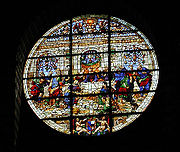
The stained-glass round window in the choir was made in 1288 to the designs of Duccio
Duccio
Duccio di Buoninsegna was one of the most influential Italian artists of his time. Born in Siena, Tuscany, he worked mostly with pigment and egg tempera and like most of his contemporaries painted religious subjects...
. It is one of the earliest remaining examples of Italian stained glass. The round stained-glass window in the façade dates from 1549 and represents the Last Supper
Last Supper
The Last Supper is the final meal that, according to Christian belief, Jesus shared with his Twelve Apostles in Jerusalem before his crucifixion. The Last Supper provides the scriptural basis for the Eucharist, also known as "communion" or "the Lord's Supper".The First Epistle to the Corinthians is...
. It is the work of Pastorino de' Pastorini.
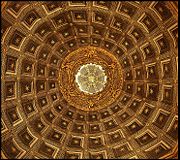
The hexagonal dome is topped with Bernini's gilded lantern
Lantern
A lantern is a portable lighting device or mounted light fixture used to illuminate broad areas. Lanterns may also be used for signaling, as 'torches', or as general light sources outdoors . Low light level varieties are used for decoration. The term "lantern" is also used more generically to...
, like a golden sun. The trompe l'oeil
Trompe l'oeil
Trompe-l'œil, which can also be spelled without the hyphen in English as trompe l'oeil, is an art technique involving extremely realistic imagery in order to create the optical illusion that the depicted objects appear in three dimensions.-History in painting:Although the phrase has its origin in...
coffers were painted in blue with golden stars in the late 15th century. The colonnade in the drum is adorned with images and statues of 42 patriarchs and prophets, painted in 1481 by Guidoccio Cozzarelli and Benvenuto di Giovanni
Benvenuto di Giovanni
Benvenuto di Giovanni, also known as Benvenuto di Giovanni di Meo del Guasta was an Italian painter and artist.Benvenuto was born in Siena and lived and worked there nearly his entire life. Over the course of 43 years he produced numerous panel paintings, frescoes, and manuscripts. He was married...
. The eight stucco statues in the spandrels beneath the dome were sculpted in 1490 by Ventura di Giuliano and Bastiano di Francesco. Originally they were polychromed, but later, in 1704, gilded.
Next to the first two pillars there are two fonts, carved by Antonio Federighi in 1462-1463. His basin for the Blessing of Holy Water was later transferred to the chapel of San Giovanni.
The marble high altar of the presbytery
Presbytery (architecture)
The presbytery is the name for an area in a church building which is reserved for the clergy.In the oldest church it is separated by short walls, by small columns and pilasters in the Renaissance ones; it can also be raised, being reachable by a few steps, usually with railings....
was built in 1532 by Baldassarre Peruzzi. The enormous bronze ciborium
Ciborium (architecture)
In ecclesiastical architecture, a ciborium is a canopy or covering supported by columns, freestanding in the sanctuary, that stands over and covers the altar in a basilica or other church. It may also be known by the more general term of baldachin, though ciborium is often considered more correct...
is the work of Vecchietta
Vecchietta
Francesco di Giorgio e di Lorenzo , known as Vecchietta or Lorenzo di Pietro, was an Italian Sienese School painter, sculptor, goldsmith and architect of the Renaissance...
(1467–1472, originally commissioned for the church of the Hospital of Santa Maria della Scala, across the square, and brought to the cathedral in 1506). At the sides of the high altar the uppermost angels are masterpieces by Francesco di Giorgio Martini (1439–1502).
Against the pillars of the presbytery there are eight candelabra
Candelabra
"Candelabra" is the traditional term for a set of multiple decorative candlesticks, each of which often holds a candle on each of multiple arms or branches connected to a column or pedestal...
s in the form of angels by Domenico Beccafumi (1548–1550), He also painted the frescoes, representing Saints and Paradise, on the walls in the apse. These were partially repainted in 1912. Behind the main altar is a very large painting Assumption of the Virgin by Bartolomeo Cesi
Bartolomeo Cesi
Bartolomeo Cesi was a painter of the Baroque era of the Bolognese School.Born to a wealthy family of Bologna, he studied under Giovanni Francesco Bezzo . In Bologna, he contributed works to the Duomo, Santo Stefano and the Basilica of San Domenico. He collaborated with Ludovico Carracci and...
in 1594.
The presbytery keeps also the beautiful wooden choir stalls, made between 1363–1397 and extended in the 16c. Originally there were more than ninety choir stalls, arranged in double rows. The remaining 36 stalls are each crowned by the bust of a saint in a pointed niche. Their backs are decorated with carved panels, the work of Fra’ Giovanni da Verona in 1503.
Pulpit
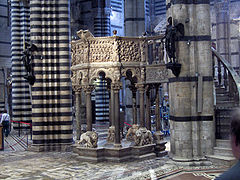
Nicola Pisano
Nicola Pisano was an Italian sculptor whose work is noted for its classical Roman sculptural style. Pisano is sometimes considered to be the founder of modern sculpture.- Early life :His birth date or origins are uncertain...
and several other artists. This pulpit expresses the northern Gothic style adopted by Pisano, while still showing his classical influences. The whole message of the pulpit is concerned with the doctrine of Salvation and the Last Judgment. In the top level seven scenes narrate the Life of Christ. The many figures in each scene with their chiaroscuro effect, show a richness of surface, motion and narrative. On the middle level statuettes of the Evangelists and Prophets announce the salvation of mankind. The pulpit itself is the earliest remaining work in the cathedral. The staircase dates from 1543 and was built by Bartolomeo Neroni. At the same time, the pulpit was moved from the choir to its present location.
Mosaic floor

Sibyl
The word Sibyl comes from the Greek word σίβυλλα sibylla, meaning prophetess. The earliest oracular seeresses known as the sibyls of antiquity, "who admittedly are known only through legend" prophesied at certain holy sites, under the divine influence of a deity, originally— at Delphi and...
s, scenes from the Old Testament
Old Testament
The Old Testament, of which Christians hold different views, is a Christian term for the religious writings of ancient Israel held sacred and inspired by Christians which overlaps with the 24-book canon of the Masoretic Text of Judaism...
, allegories and virtues. Most are still in their original state. The earliest scenes were made by a graffito
Graffiti
Graffiti is the name for images or lettering scratched, scrawled, painted or marked in any manner on property....
technique: drilling tiny holes and scratching lines in the marble and filling these with bitumen or mineral pitch
Pitch (resin)
Pitch is the name for any of a number of viscoelastic, solid polymers. Pitch can be made from petroleum products or plants. Petroleum-derived pitch is also called bitumen. Pitch produced from plants is also known as resin. Products made from plant resin are also known as rosin.Pitch was...
. In a later stage black, white, green, red and blue marble intarsia
Intarsia
Intarsia is a form of wood inlaying that is similar to marquetry. The term is also used for a similar technique used with small, highly polished stones set in a marble matrix .- History :...
were used. This technique of marble inlay also evolved during the years, finally resulting in a vigorous contrast of light and dark, giving it an almost modern, impressionistic
Impressionism
Impressionism was a 19th-century art movement that originated with a group of Paris-based artists whose independent exhibitions brought them to prominence during the 1870s and 1880s...
composition.
The uncovered floor can only be seen for a period of six to ten weeks each year, generally including the month of September. The rest of the year, they are covered and only a few are on display.
The earliest panel was probably the Wheel of Fortune (Ruota della Fortuna), laid in 1372 (restored in 1864). The She-Wolf of Siena with the emblems of the confederate cities (Lupa senese e simboli delle città alleate) probably dates from 1373 (also restored in 1864). The Four Virtues (Temperanza, Prudenza, Giustizia and Fortezza) and Mercy (Misericordia) date from 1406, as established by a payment made to Marchese d'Adamo and his fellow workers. They were the craftsmen who executed the cartoons of Sienese painters.
The first known artist working on the panels, was Domenico di Niccolò dei Cori, who was in charge of the cathedral between 1413 and 1423. We can ascribe to him several panels such as the Story of King David, David the Psalmist and David and Goliath. His successor as superintendent, Paolo di Martino, completed between 1424 and 1426 the Victory of Joshua and Victory of Samson over the Philistines.
In 1434 the renowned painter Domenico di Bartolo
Domenico di Bartolo
Domenico di Bartolo was an Italian painter of the Sienese School.He was born in Asciano. According to Vasari, he was a nephew of Taddeo di Bartolo. He was employed by Vecchietta in the masterpiece fresco The Care of the Sick in the Pellegrinaio of the Ospedale di Santa Maria della Scala in Siena...
continued with a new panel Emperor Sigismund Enthroned (Imperatore Sigismundo in trono). The Holy Roman Emperor Sigismund
Sigismund, Holy Roman Emperor
Sigismund of Luxemburg KG was King of Hungary, of Croatia from 1387 to 1437, of Bohemia from 1419, and Holy Roman Emperor for four years from 1433 until 1437, the last Emperor of the House of Luxemburg. He was also King of Italy from 1431, and of Germany from 1411...
was popular in Siena, because he resided there for ten months on his way to Rome for his coronation. Next to this panel, is the composition in 1447 (probably) by Pietro di Tommaso del Minella of the Death of Absolom (Morte di Assalonne).
The next panel dates from 1473: Stories from the Life of Judith and the Liberation of Bethulia (Liberazione di Betulia) (probably) by Urbano da Cortona.
In 1480 Alberto Aringhieri was appointed superintendent of the works. From then on, the mosaic floor scheme began to make serious progress. Between 1481 and 1483 the ten panels of the Sibyls were worked out. A few are ascribed to eminent artists, such as Matteo di Giovanni
Matteo di Giovanni
Matteo di Giovanni c. 1430 - 1495) was an Italian Renaissance artist from the Sienese school.-Biography:Matteo di Giovanni di Bartolo was born in Borgo Sansepolcro around 1430. His family relocated to Siena and he is firmly associated with the art of that city...
(The Samian Sibyl), Neroccio di Bartolomeo de' Landi
Neroccio di Bartolomeo de' Landi
Neroccio di Bartolomeo de' Landi was an Italian painter and sculptor of the early-Renaissance or Quattrocento period in Siena.He was a student of Vecchietta, and then he shared a workshop with Francesco di Giorgio from 1468...
(Hellespontine Sibyl) and Benvenuto di Giovanni
Benvenuto di Giovanni
Benvenuto di Giovanni, also known as Benvenuto di Giovanni di Meo del Guasta was an Italian painter and artist.Benvenuto was born in Siena and lived and worked there nearly his entire life. Over the course of 43 years he produced numerous panel paintings, frescoes, and manuscripts. He was married...
(Albunenan Sibyl). The Cumaean, Delphic, Persian and Phrygian Sibyls are from the hand of the obscure German artist Vito di Marco. The Erythraean Sibyl
Erythraean Sibyl
The Erythraean Sibyl was the prophetess of classical antiquity presiding over the Apollonian oracle at Erythrae, a town in Ionia opposite Chios, which was built by Neleus, the son of Codrus....
was originally by Antonio Federighi, the Libyan Sibyl by the painter Guidoccio Cozzarelli, but both have been extensively renovated. The large panel in the transept The Slaughter of the Innocents (Strage degli Innocenti) is probably the work of Matteo di Giovanni
Matteo di Giovanni
Matteo di Giovanni c. 1430 - 1495) was an Italian Renaissance artist from the Sienese school.-Biography:Matteo di Giovanni di Bartolo was born in Borgo Sansepolcro around 1430. His family relocated to Siena and he is firmly associated with the art of that city...
in 1481. The large panel below, the Expulsion of Herod (Cacciata di Erode), was designed by Benvenuto di Giovanni
Benvenuto di Giovanni
Benvenuto di Giovanni, also known as Benvenuto di Giovanni di Meo del Guasta was an Italian painter and artist.Benvenuto was born in Siena and lived and worked there nearly his entire life. Over the course of 43 years he produced numerous panel paintings, frescoes, and manuscripts. He was married...
in 1484-1485. The Story of Fortuna, or Hill of Virtue (Allegoria della Fortuna), by Pinturicchio
Pinturicchio
Bernardino di Betto, called Pintoricchio or Pinturicchio was an Italian painter of the Renaissance. He acquired his nickname, Pintoricchio , because of his small stature, and he used it to sign some of his works....
in 1504, was the last one commissioned by Aringhieri. This panel also gives a depiction of Socrates
Socrates
Socrates was a classical Greek Athenian philosopher. Credited as one of the founders of Western philosophy, he is an enigmatic figure known chiefly through the accounts of later classical writers, especially the writings of his students Plato and Xenophon, and the plays of his contemporary ...
.
Domenico Beccafumi, the most renowned Sienese artist of his time, worked on cartoons for the floor during thirty years (1518–1547). Half of the thirteen Scenes from the Life of Elijah, in the transept of the cathedral, were designed by him (two hexagons and two rhombuses). The eight meter long frieze Moses Striking water from the Rock was executed by him in 1525. The bordering panel, Moses on Mount Sinai was laid in 1531. His final contribution was the panel in front of the main altar: the Sacrifice of Isaac (1547).
Works of art
Donatello
Donato di Niccolò di Betto Bardi , also known as Donatello, was an early Renaissance Italian artist and sculptor from Florence...
, and works by Bernini
Gian Lorenzo Bernini
Gian Lorenzo Bernini was an Italian artist who worked principally in Rome. He was the leading sculptor of his age and also a prominent architect...
and the young Michelangelo
Michelangelo
Michelangelo di Lodovico Buonarroti Simoni , commonly known as Michelangelo, was an Italian Renaissance painter, sculptor, architect, poet, and engineer who exerted an unparalleled influence on the development of Western art...
make it an extraordinary museum of Italian sculpture. The Annunciation between St. Ansanus and St. Margaret, a masterwork of Gothic painting by Simone Martini
Simone Martini
Simone Martini was an Italian painter born in Siena.He was a major figure in the development of early Italian painting and greatly influenced the development of the International Gothic style....
and Lippo Memmi
Lippo Memmi
Lippo Memmi was an Italian painter from Siena. He was the foremost follower of Simone Martini, who was his brother-in-law....
, decorated a side altar of the church until 1799, when it was moved to the Uffizi
Uffizi
The Uffizi Gallery , is a museum in Florence, Italy. It is one of the oldest and most famous art museums of the Western world.-History:...
of Florence.
The funeral monument for cardinal Riccardo Petroni (Siena 1250 - Genoa 1314, a jurisconsult of Pope Bonifacio VIII) was erected between 1317 and 1318 by the Sienese sculptor Tino di Camaino
Tino di Camaino
thumb|300px|Tomb of Antonio d'Orso, in [[Santa Maria del Fiore]], [[Florence]].Tino di Camaino was an Italian sculptor....
. He had succeeded his father as the master builder of the Siena cathedral. The marble monument in the left transept is the earliest example of 14th century funeral architecture. It is composed of a richly decorated sarcophagus
Sarcophagus
A sarcophagus is a funeral receptacle for a corpse, most commonly carved or cut from stone. The word "sarcophagus" comes from the Greek σαρξ sarx meaning "flesh", and φαγειν phagein meaning "to eat", hence sarkophagus means "flesh-eating"; from the phrase lithos sarkophagos...
, held aloft on the shoulders of four statues. Above the sarcophagus, two angels draw apart a curtain, revealing the cardinal lying on his deathbed, accompanied by two guardian angels. The monument is crowned by a spired tabernacle
Church tabernacle
A tabernacle is the fixed, locked box in which, in some Christian churches, the Eucharist is "reserved" . A less obvious container, set into the wall, is called an aumbry....
with statues of the Madonna and Child, Saint Peter and Saint Paul.
In the pavement, in front of this monument, lies the bronze tombstone of Bishop Giovanni di Bartolomeo Pecci, bishop of Grosseto, made by Donatello
Donatello
Donato di Niccolò di Betto Bardi , also known as Donatello, was an early Renaissance Italian artist and sculptor from Florence...
in 1427. It shows the dead prelate laid out in a concave bier in highly illusionistic low relief. Looking at it obliquely from the end of the tomb, gives the impression of a three-dimensionality. It was originally located in front of the high altar and moved to the present location in 1506.
The wall tomb of bishop Tommaso Piccolomini del Testa is set above the small door leading to the bell tower. It is the work of the Sienese painter and sculptor Neroccio di Bartolomeo de' Landi
Neroccio di Bartolomeo de' Landi
Neroccio di Bartolomeo de' Landi was an Italian painter and sculptor of the early-Renaissance or Quattrocento period in Siena.He was a student of Vecchietta, and then he shared a workshop with Francesco di Giorgio from 1468...
in 1483.
The Piccolomini altar, left of the entrance to the library, is the work of the Lombard sculptor Andrea Bregno
Andrea Bregno
Andrea di Cristoforo Bregno was an Italian sculptor and architect of the Early Renaissance who worked in Rome from the 1460s and died just as the High Renaissance was getting under way.-Early life:...
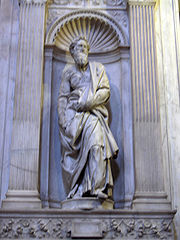
in 1483. This altarpiece is remarkable because of the four sculptures in the lower niches, made by the young Michelangelo
Michelangelo
Michelangelo di Lodovico Buonarroti Simoni , commonly known as Michelangelo, was an Italian Renaissance painter, sculptor, architect, poet, and engineer who exerted an unparalleled influence on the development of Western art...
between 1501 and 1504: Saint Peter, Saint Paul, Saint Gregory (with the help of an assistant) and Saint Pius. On top of the altar is the Madonna and Child, a sculpture (probably) by Jacopo della Quercia
Jacopo della Quercia
Jacopo della Quercia was an Italian sculptor of the Italian Renaissance, a contemporary of Brunelleschi, Ghiberti and Donatello. He is considered a precursor of Michelangelo.-Biography:...
.
Many of the Duomo's original furnishings, such as Duccio di Buoninsegna's
Duccio
Duccio di Buoninsegna was one of the most influential Italian artists of his time. Born in Siena, Tuscany, he worked mostly with pigment and egg tempera and like most of his contemporaries painted religious subjects...
Maestà
Maestà (Duccio)
The Maestà, or Maestà of Duccio is an altarpiece composed of many individual paintings commissioned by the city of Siena in 1308 from the artist Duccio di Buoninsegna. The front panels make up a large enthroned Madonna and Child with saints and angels, and a predella of the Childhood of Christ...
and Cimabue's
Cimabue
Cimabue , also known as Bencivieni di Pepo or in modern Italian, Benvenuto di Giuseppe, was an Italian painter and creator of mosaics from Florence....
stained glass window, have been removed to the nearby Museo dell'Opera del Duomo.
Chapel of Saint John the Baptist

Donatello
Donato di Niccolò di Betto Bardi , also known as Donatello, was an early Renaissance Italian artist and sculptor from Florence...
. In the middle is a 15th c. baptismal font. But most impressive in this chapel are the eight frescoes by Pinturicchio, commissioned by Alberto Aringhieri, and painted between 1504 and 1505. Two are repainted in the 17th c. and a third was completely replaced in 1868. The original paintings in the chapel are: Nativity of John the Baptist, John the Baptist in the desert and John the Baptist preaching. He also painted two portraits: Aringhieri with the cloak of the Order of the Knights of Malta and Kneeling Knight in Armour. These two portraits show us a very detailed background.
The Chigi Chapel
Johann Paul Schor
Johann Paul Schor , known in Rome as "Giovanni Paolo Tedesco" , was an Austrian artist. He was the preeminent designer of decorative arts in Baroque Rome, providing drawings for state beds, fireworks, coaches, silver, textiles and even banquet setpieces executed in sugar...
to the baroque
Baroque
The Baroque is a period and the style that used exaggerated motion and clear, easily interpreted detail to produce drama, tension, exuberance, and grandeur in sculpture, painting, literature, dance, and music...
designs of Gian Lorenzo Bernini
Gian Lorenzo Bernini
Gian Lorenzo Bernini was an Italian artist who worked principally in Rome. He was the leading sculptor of his age and also a prominent architect...
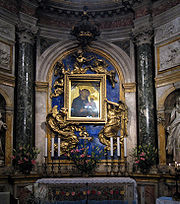
, replacing a 15th century chapel. At the back of the chapel is the Madonna del Voto (by a follower of Guido da Siena, 13th century), that even today is much venerated and receives each year the homages of the contrade. On the eve of the battle of Montaperti
Battle of Montaperti
The Battle of Montaperti was fought on September 4, 1260, between Florence and Siena in Tuscany as part of the conflict between the Guelphs and Ghibellines...
(4 September 1260) against Florence, the city of Siena had dedicated itself to the Madonna. The victory of the Sienese, against all odds, over the much more numerous Florentines was ascribed to her miraculous protection.
Two of the four marble sculptures in the niches, are by Bernini himself: Saint Jerome and Mary Magdalene. The other two are Saint Bernardine (Antonio Raggi
Antonio Raggi
Antonio Raggi , also called Antonio Lombardo, was a sculptor of the Roman Baroque, originating from Ticino.-Biography:He was born in Vico Morcote on the Lake Lugano. His mentor in Rome for nearly three decades was Gianlorenzo Bernini...
) and Saint Catherine of Siena (Ercole Ferrata
Ercole Ferrata
Ercole Ferrata was an Italian sculptor of the Roman Baroque.-Biography:A native of Pellio Inferiore, near Como, Ferrata initially apprenticed with Alessandro Algardi, and became one of his prime assistants...
). The eight marble columns are originally from the Lateran Palace in Rome. The bronze gate at the entrance is by Giovanni Artusi
Giovanni Artusi
Giovanni Maria Artusi was an Italian theorist, composer, and writer.Artusi was one of the most famous reactionaries in musical history, fiercely condemning the new style developing around 1600, the innovations of which defined the early Baroque era...
.
Piccolomini Library
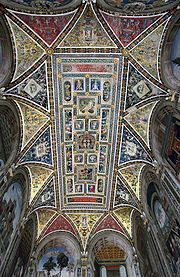

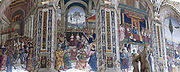
Pinturicchio
Bernardino di Betto, called Pintoricchio or Pinturicchio was an Italian painter of the Renaissance. He acquired his nickname, Pintoricchio , because of his small stature, and he used it to sign some of his works....
, probably based on designs by Raphael
Raphael
Raffaello Sanzio da Urbino , better known simply as Raphael, was an Italian painter and architect of the High Renaissance. His work is admired for its clarity of form and ease of composition and for its visual achievement of the Neoplatonic ideal of human grandeur...
.
The visual impact of these very colourful frescoes is stunning. The frescoes tell the story of the life of Siena's favourite son, cardinal Enea Silvio Piccolomini, who eventually became Pope Pius II. He was the uncle of cardinal Francesco Piccolomini Todeschini (then archbishop of Siena and the future pope Pius III), who commissioned this library in 1492 as a repository of the books and the manuscript
Manuscript
A manuscript or handwrite is written information that has been manually created by someone or some people, such as a hand-written letter, as opposed to being printed or reproduced some other way...
collection of his uncle. The ceiling is covered with painted panels of mythological subjects. They were executed between 1502 and 1503 by Pinturicchio
Pinturicchio
Bernardino di Betto, called Pintoricchio or Pinturicchio was an Italian painter of the Renaissance. He acquired his nickname, Pintoricchio , because of his small stature, and he used it to sign some of his works....
and his assistants.
The entrance is a finely carved marble monument with two openings with round arches, executed in 1497 by Lorenzo di Mariano. It contains a round relief of St. John the Evangelist (probably) by Giovanni di Stefano
Giovanni di Stefano (sculptor)
Giovanni di Stefano was an Italian bronze-caster, engineer, and sculptor. Baptized 20 June 1443, he was the son of Stefano di Giovanni....
and, below the altar, a polychrome Pietà by the sculptor Alberto di Betto da Assisi in 1421. Above this marble monument is a fresco of the Papal Coronation of Pius III by Pinturicchio in 1504.
In the middle of the library is the famous statue Three Graces
Charites
In Greek mythology, a Charis is one of several Charites , goddesses of charm, beauty, nature, human creativity and fertility. They ordinarily numbered three, from youngest to oldest: Aglaea , Euphrosyne , and Thalia . In Roman mythology they were known as the Gratiae, the "Graces"...
, a Roman copy of a Greek original.
Pinturicchio painted this cycle of frescoes around the library between 1502 and 1507, representing Raphael
Raphael
Raffaello Sanzio da Urbino , better known simply as Raphael, was an Italian painter and architect of the High Renaissance. His work is admired for its clarity of form and ease of composition and for its visual achievement of the Neoplatonic ideal of human grandeur...
and himself in several of them. This masterpiece is full of striking detail and vivacious colours. Each scene is explained in Latin by the text below. They depict ten remarkable events from the secular and religious career of pope Pius II, first as a high prelate, then bishop, a cardinal and ultimately pope:
- Enea Silvio Piccolomini (ESP) leaves for the Council of Basel. The storm scene in the background is a first in western art.
- ESP, ambassador at the Scottish Court
- ESP crowned court poet by emperor Frederick III
- ESP makes an act of submission to Pope Eugene IVPope Eugene IVPope Eugene IV , born Gabriele Condulmer, was pope from March 3, 1431, to his death.-Biography:He was born in Venice to a rich merchant family, a Correr on his mother's side. Condulmer entered the Order of Saint Augustine at the monastery of St. George in his native city...
- ESP, bishop of Siena, presents emperor Frederick III with his bride-to-be Eleanora of Portugal at the Porta Camollia in Siena.
- ESP receives the cardinal's hat in 1456
- ESP, enters the Lateran as pontiff in 1458
- Pius II convokes a Diet of Princes at MantuaMantuaMantua is a city and comune in Lombardy, Italy and capital of the province of the same name. Mantua's historic power and influence under the Gonzaga family, made it one of the main artistic, cultural and notably musical hubs of Northern Italy and the country as a whole...
to proclaim a new crusade in 1459 - Pius II canonizes Saint Catherine of Siena in 1461
- Pius II arrives in AnconaAnconaAncona is a city and a seaport in the Marche region, in central Italy, with a population of 101,909 . Ancona is the capital of the province of Ancona and of the region....
to launch the crusade.
Beneath the frescoes, the psalter
Psalter
A psalter is a volume containing the Book of Psalms, often with other devotional material bound in as well, such as a liturgical calendar and litany of the Saints. Until the later medieval emergence of the book of hours, psalters were the books most widely owned by wealthy lay persons and were...
s of the cathedral's sacristy are on display. These exquisite illuminations by Liberale da Verona
Liberale da Verona
Liberale da Verona was an Italian painter of the Renaissance period, active mainly in Verona. He was a pupil of the painter Vincenzo di Stefano, although he was strongly influenced by Andrea Mantegna and Jacopo Bellini. He was featured in the Vite of Giorgio Vasari. In Verona, he painted an...
and Girolamo da Cremona
Girolamo da Cremona
Girolamo da Cremona, also known as Girolamo de'Corradi, was an Italian Renaissance painter, illuminator and miniaturist of manuscripts and early printed books...
were executed between 1466 and 1478 and later carried on by other Sienese illuminators.
Baptistry
Unlike Florence or Pisa, Siena did not build a separate baptistry. The baptistryBaptistery
In Christian architecture the baptistry or baptistery is the separate centrally-planned structure surrounding the baptismal font. The baptistry may be incorporated within the body of a church or cathedral and be provided with an altar as a chapel...
is located underneath the eastern bays of the choir of the Duomo. The construction of the interior was largely performed under Camaino di Crescentino and was completed about 1325.
The main attraction is the hexagonal baptismal font, containing sculptures by Donatello
Donatello
Donato di Niccolò di Betto Bardi , also known as Donatello, was an early Renaissance Italian artist and sculptor from Florence...
, Jacopo della Quercia
Jacopo della Quercia
Jacopo della Quercia was an Italian sculptor of the Italian Renaissance, a contemporary of Brunelleschi, Ghiberti and Donatello. He is considered a precursor of Michelangelo.-Biography:...
and others.