

Gable

Encyclopedia
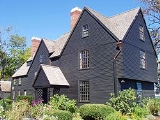
A gable is the generally triangular portion of a wall between the edges of a sloping roof. The shape of the gable and how it is detailed depends on the structural system being used (which is often related to climate and availability of materials) and aesthetic concerns. Thus the type of roof
enclosing the volume dictates the shape of the gable. A gable wall or gable end more commonly refers to the entire wall, including the gable and the wall below it.
In Classic Greek
and Roman
architecture
, the analogous feature is called the tympanum
. Strictly speaking, the tympanum is the infill area, often triangular, of the pediment
, which also consists of the raking cornice
or ends of the sloped roofs (which may appear to bear, but do not actually bear on the tympanum - the fact that many tympana bear intricate and expensive carvings declaring the building's purpose is evidence of its non-structural role), and the cornice
proper, which bears on the architrave
, which in turn is supported at points by columns of a colonnade
.
A variation of the gable is a crow-stepped gable
, which has a stair-step design to accomplish the sloping portion. Crow stepped gables were used in Scotland
and England
as early as the seventeenth century. Examples of the crow stepped gable can be seen at Muchalls Castle
and Monboddo House
, both 17th century Scottish buildings. Other early examples are found in parts of Denmark and Sweden.
A Gothic ornamental gable of the Cathedral architecture over the windows and portal are called in the German and Dutch language Wimperg
too.
Gable ends of more recent buildings are often treated in the same way as the Classic pediment form. But unlike Classical structures, which operate through trabeation
, the gable ends of many buildings are actually bearing-wall structures. Thus, the detailing tends to be ambiguous, misleading, and to some architects "deceitful". See: John Ruskin
and The Seven Lamps of Architecture
.
." When wind flows over a gable roof it behaves much like a wing. Lift is created on the leeward side of the roof. The flatter the roof the more likely this will happen. Steep roofs tend to cause the wind to "stall" as it goes over the roof and breaks up the effect. The addition of a "vertical fin" to low pitched roofs will also help.
Roof
A roof is the covering on the uppermost part of a building. A roof protects the building and its contents from the effects of weather. Structures that require roofs range from a letter box to a cathedral or stadium, dwellings being the most numerous....
enclosing the volume dictates the shape of the gable. A gable wall or gable end more commonly refers to the entire wall, including the gable and the wall below it.
In Classic Greek
Architecture of Ancient Greece
The architecture of Ancient Greece is the architecture produced by the Greek-speaking people whose culture flourished on the Greek mainland and Peloponnesus, the Aegean Islands, and in colonies in Asia Minor and Italy for a period from about 900 BC until the 1st century AD, with the earliest...
and Roman
Ancient Rome
Ancient Rome was a thriving civilization that grew on the Italian Peninsula as early as the 8th century BC. Located along the Mediterranean Sea and centered on the city of Rome, it expanded to one of the largest empires in the ancient world....
architecture
Architecture
Architecture is both the process and product of planning, designing and construction. Architectural works, in the material form of buildings, are often perceived as cultural and political symbols and as works of art...
, the analogous feature is called the tympanum
Tympanum (architecture)
In architecture, a tympanum is the semi-circular or triangular decorative wall surface over an entrance, bounded by a lintel and arch. It often contains sculpture or other imagery or ornaments. Most architectural styles include this element....
. Strictly speaking, the tympanum is the infill area, often triangular, of the pediment
Pediment
A pediment is a classical architectural element consisting of the triangular section found above the horizontal structure , typically supported by columns. The gable end of the pediment is surrounded by the cornice moulding...
, which also consists of the raking cornice
Cornice
Cornice molding is generally any horizontal decorative molding that crowns any building or furniture element: the cornice over a door or window, for instance, or the cornice around the edge of a pedestal. A simple cornice may be formed just with a crown molding.The function of the projecting...
or ends of the sloped roofs (which may appear to bear, but do not actually bear on the tympanum - the fact that many tympana bear intricate and expensive carvings declaring the building's purpose is evidence of its non-structural role), and the cornice
Cornice
Cornice molding is generally any horizontal decorative molding that crowns any building or furniture element: the cornice over a door or window, for instance, or the cornice around the edge of a pedestal. A simple cornice may be formed just with a crown molding.The function of the projecting...
proper, which bears on the architrave
Architrave
An architrave is the lintel or beam that rests on the capitals of the columns. It is an architectural element in Classical architecture.-Classical architecture:...
, which in turn is supported at points by columns of a colonnade
Colonnade
In classical architecture, a colonnade denotes a long sequence of columns joined by their entablature, often free-standing, or part of a building....
.
A variation of the gable is a crow-stepped gable
Crow-stepped gable
A Stepped gable, Crow-stepped gable, or Corbie step is a stair-step type of design at the top of the triangular gable-end of a building...
, which has a stair-step design to accomplish the sloping portion. Crow stepped gables were used in Scotland
Scotland
Scotland is a country that is part of the United Kingdom. Occupying the northern third of the island of Great Britain, it shares a border with England to the south and is bounded by the North Sea to the east, the Atlantic Ocean to the north and west, and the North Channel and Irish Sea to the...
and England
England
England is a country that is part of the United Kingdom. It shares land borders with Scotland to the north and Wales to the west; the Irish Sea is to the north west, the Celtic Sea to the south west, with the North Sea to the east and the English Channel to the south separating it from continental...
as early as the seventeenth century. Examples of the crow stepped gable can be seen at Muchalls Castle
Muchalls Castle
Muchalls Castle stands overlooking the North Sea in the countryside of Kincardine and Mearns, Aberdeenshire, Scotland. The lower course is a well preserved double groined 13th century towerhouse structure, built by the Frasers of Muchalls. Upon this structure, the 17th century castle was begun by...
and Monboddo House
Monboddo House
Monboddo House is a historically famous mansion in The Mearns, Scotland. The structure was generally associated with the Burnett of Leys family. The property itself was owned by the Barclay family from the 13th century, at which time a tower house structure was erected...
, both 17th century Scottish buildings. Other early examples are found in parts of Denmark and Sweden.
A Gothic ornamental gable of the Cathedral architecture over the windows and portal are called in the German and Dutch language Wimperg
Wimperg
A wimperg is a German and Dutch word for a Gothic ornamental gable with tracery over windows or portals, which were often accompanied with pinnacles. It was a typical element in Gothic Architecture especially in cathedral architecture. Wimpergs often had crockets or other decorative elements in the...
too.
Gable ends of more recent buildings are often treated in the same way as the Classic pediment form. But unlike Classical structures, which operate through trabeation
Post and lintel
Post and lintel, or in contemporary usage Post and beam, is a simple construction method using a lintel, header, or architrave as the horizontal member over a building void supported at its ends by two vertical columns, pillars, or posts...
, the gable ends of many buildings are actually bearing-wall structures. Thus, the detailing tends to be ambiguous, misleading, and to some architects "deceitful". See: John Ruskin
John Ruskin
John Ruskin was the leading English art critic of the Victorian era, also an art patron, draughtsman, watercolourist, a prominent social thinker and philanthropist. He wrote on subjects ranging from geology to architecture, myth to ornithology, literature to education, and botany to political...
and The Seven Lamps of Architecture
The Seven Lamps of Architecture
The Seven Lamps of Architecture, published in May 1849, is an extended essay written by the English art critic and theorist John Ruskin. The 'lamps' of the title are Ruskin's principles of architecture, which he later enlarged upon in the three-volume The Stones of Venice. To an extent, they...
.
Drawbacks
Gable end roofs are amongst the worst roof designs for hurricane regions. Not only do gable roofs easily peel off in hurricane winds, but according to one hurricane survival guide book, a gable end "catches wind like a sailSail
A sail is any type of surface intended to move a vessel, vehicle or rotor by being placed in a wind—in essence a propulsion wing. Sails are used in sailing.-History of sails:...
." When wind flows over a gable roof it behaves much like a wing. Lift is created on the leeward side of the roof. The flatter the roof the more likely this will happen. Steep roofs tend to cause the wind to "stall" as it goes over the roof and breaks up the effect. The addition of a "vertical fin" to low pitched roofs will also help.
See also
- Bell-gableBell-gableThe bell gable is an architectural element crowning at the upper end of the wall of church buildings, usually in lieu of a church tower. It consists of a gable end in stone, with small hollow semi-circular arches where the church bells are placed...
- Espadaña - Crow-stepped gableCrow-stepped gableA Stepped gable, Crow-stepped gable, or Corbie step is a stair-step type of design at the top of the triangular gable-end of a building...
- Dutch gableDutch gableA Dutch gable or Flemish gable is a gable whose sides have a shape made up of one or more curves and has a pediment at the top. The gable may be an entirely decorative projection above a flat section of roof line, or may be the termination of a roof, like a normal gable...
- FacadeFacadeA facade or façade is generally one exterior side of a building, usually, but not always, the front. The word comes from the French language, literally meaning "frontage" or "face"....
- Gablet roofGablet roofA gablet roof or Dutch gable is a roof with a small gable at the top of a hip roof. The term Dutch gable is also used to mean a gable with parapets....
- Hip roofHip roofA hip roof, or hipped roof, is a type of roof where all sides slope downwards to the walls, usually with a fairly gentle slope. Thus it is a house with no gables or other vertical sides to the roof. A square hip roof is shaped like a pyramid. Hip roofs on the houses could have two triangular side...
- Cape Dutch architectureCape Dutch architecture-Introduction:Cape Dutch architecture is an architectural style found in the Western Cape of South Africa. The style was prominent in the early days of the Cape Colony, and the name derives from the fact that the initial settlers of the Cape were primarily Dutch...