
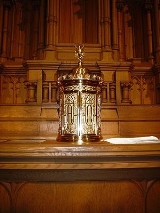
A
tabernacle is the fixed, locked box in which, in some Christian churches, the
EucharistThe Eucharist , also called Holy Communion, the Sacrament of the Altar, the Blessed Sacrament, the Lord's Supper, and other names, is a Christian sacrament or ordinance...
is "reserved" (stored). A less obvious container, set into the wall, is called an
aumbryIn the Middle Ages an aumbry was a cabinet in the wall of a Christian church or in the sacristy which was used to store chalices and other vessels, as well as for the reserved sacrament, the consecrated elements from the Eucharist. This latter use was infrequent in pre-Reformation churches,...
.
Within Catholicism, Eastern Orthodoxy and in some congregations of
AnglicanismAnglicanism is a tradition within Christianity comprising churches with historical connections to the Church of England or similar beliefs, worship and church structures. The word Anglican originates in ecclesia anglicana, a medieval Latin phrase dating to at least 1246 that means the English...
and
LutheranismLutheranism is a major branch of Western Christianity that identifies with the theology of Martin Luther, a German reformer. Luther's efforts to reform the theology and practice of the church launched the Protestant Reformation...
, a tabernacle is a box-like vessel for the exclusive reservation of the consecrated
EucharistThe Eucharist , also called Holy Communion, the Sacrament of the Altar, the Blessed Sacrament, the Lord's Supper, and other names, is a Christian sacrament or ordinance...
. It is normally made of metal, stone or wood, is lockable and secured to its altar to prevent the consecrated elements within from being removed without authorization. The "reserved Eucharist" is secured there for distribution at services, for availability to bring Holy Communion to the sick, and, especially in the Western Church, as the center of attention for meditation and prayer. The term "tabernacle" arose for this item as a reference to the Old Testament tabernacle which was the locus of God's presence among the Jewish people - hence, it was formerly required (and is still generally customary) that the tabernacle be covered with a tent-like veil or curtains across its door when the Eucharist is present within.
By way of metaphor, Catholics and Orthodox alike also refer to the Blessed Virgin Mary as the Tabernacle in their devotions (such as the Akathist Hymn or Catholic Litanies to Mary), as she carried within her the body of Christ in her role as
TheotokosTheotokos is the Greek title of Mary, the mother of Jesus used especially in the Eastern Orthodox, Oriental Orthodox, and Eastern Catholic Churches. Its literal English translations include God-bearer and the one who gives birth to God. Less literal translations include Mother of God...
.
History
The following historical information is found, for instance, in the article
The casing of the Eucharist by the Secretary of the
Congregation for the ClergyThe Sacred Congregation for the Clergy is the congregation of the Roman Curia responsible for overseeing matters regarding priests and deacons not belonging to religious orders...
, Archbishop
Mauro PiacenzaMauro Piacenza JCD is an Italian cardinal of the Roman Catholic Church. He currently serves as Prefect of the Congregation for the Clergy in the Roman Curia since his appointment by Pope Benedict XVI on 7 October 2010. He had previously served as Secretary from 2007 until becoming Prefect.Piacenza...
, who also heads the Pontifical Commission for the Cultural Patrimony of the Catholic Church, in
30DAYS, No.6 Year XXIII – June 2005.
In early
ChristianityChristianity is a monotheistic religion based on the life and teachings of Jesus as presented in canonical gospels and other New Testament writings...
, priests and even lay people took bread consecrated at their
EucharistThe Eucharist , also called Holy Communion, the Sacrament of the Altar, the Blessed Sacrament, the Lord's Supper, and other names, is a Christian sacrament or ordinance...
ic to their homes, in order to give it to the sick and others unable to attend the celebration. But when the
Edict of MilanThe Edict of Milan was a letter signed by emperors Constantine I and Licinius that proclaimed religious toleration in the Roman Empire...
ended persecution, the practice was established of keeping the Eucharist only in churches and no longer in people’s homes.
The preferred container then had the form of a (usually gold) dove within a (usually silver) tower. There is mention of a gift of these two vessels, both of gold and adorned with 250 white pearls, that the Emperor Constantine gave to Saint Peter’s Basilica in Rome, and of silver towers and golden doves given to particular churches by
Pope Innocent I-Biography:He was, according to his biographer in the Liber Pontificalis, the son of a man called Innocens of Albano; but according to his contemporary Jerome, his father was Pope Anastasius I , whom he was called by the unanimous voice of the clergy and laity to succeed -Biography:He was,...
and
Pope HilariusPope Saint Hilarius was Pope of the Roman Catholic Church from 461 to February 28, 468. He was canonized as a saint after his death....
.
The vessels were kept in a place called the "sacrarium" or "pastophorium" away from the central body of the church or were suspended by fine chains from the middle of the canopy (hence called a "ciborium" or bread store) above the altar of the church.
Gian Lorenzo BerniniGian Lorenzo Bernini was an Italian artist who worked principally in Rome. He was the leading sculptor of his age and also a prominent architect...
’s 29-metre-high
BaroqueThe Baroque is a period and the style that used exaggerated motion and clear, easily interpreted detail to produce drama, tension, exuberance, and grandeur in sculpture, painting, literature, dance, and music...
baldacchino over the main altar in today’s Saint Peter’s Basilica is at present the best-known such structure. Later, simpler vessels replaced to some extent the dove and the tower.
By the thirteenth century, the Eucharist was most often kept in a highly embellished cabinet inserted into the wall to the right or left of the altar. The
Sanctuary lampA sanctuary lamp, altar lamp, everlasting light or eternal flame is a light that shines before the altar of sanctuaries in many denominations of Jewish and Christian places of worship. Prescribed in ] 27:20-21] of the Hebrew Bible, this icon has taken on different meanings in each of the religions...
indicated the Presence of Christ. This was a means of following the decree of the 1215 Fourth Lateran Council requiring that the reserved sacrament be kept in a locked receptacle.
In the late fourteenth century, special stone constructions for the Eucharistic bread began to be built, especially in northern Europe. In German and Netherlands churches of the period, such structures can still be seen: tall towers, known in
GermanGerman is a West Germanic language, related to and classified alongside English and Dutch. With an estimated 90 – 98 million native speakers, German is one of the world's major languages and is the most widely-spoken first language in the European Union....
as
Sakramentshäuser, in
DutchDutch is a West Germanic language and the native language of the majority of the population of the Netherlands, Belgium, and Suriname, the three member states of the Dutch Language Union. Most speakers live in the European Union, where it is a first language for about 23 million and a second...
as
sacramentstorens, usually placed to the north of the altar and often reaching almost to the ceiling. They were in use until the mid-nineteenth century. As the presence of the
sanctuary lampA sanctuary lamp, altar lamp, everlasting light or eternal flame is a light that shines before the altar of sanctuaries in many denominations of Jewish and Christian places of worship. Prescribed in ] 27:20-21] of the Hebrew Bible, this icon has taken on different meanings in each of the religions...
in the picture to the right shows, some have been returned to their traditional use.
German examples are found in the church of St Laurence in Nuremberg (18.70 metres), the minster of Salem (16 metres), Saints Peter and Paul city church in Weil der Stadt (over 11 metres), the church of Our Lady in Lübeck (9.5 metres), and St Mary's cathedral in Fürstenwalde on the Spree. Belgian churches include St Catherine's in Zuurbemde, St Martin's in Kortrijk,
St Peter'sSaint Peter's Church of Leuven, Belgium, is situated on the city's Grote Markt , right across the ornate Town Hall...
and St James's in
LeuvenLeuven is the capital of the province of Flemish Brabant in the Flemish Region, Belgium...
, and
St Leonard'sThe Saint Leonard's Church in Zoutleeuw, Belgium, stands on the former site of a Romanesque chapel erected in 1125 by Benedictines from the Abbey of Vlierbeek near Leuven. Construction of the present church began around 1231, and additions continued into the 16th century...
in
ZoutleeuwZoutleeuw is a municipality and city in the Hageland, in the extreme east of the Belgian province of Flemish Brabant. On 1 January 2006 the municipality had 7,947 inhabitants...
.
In the early losh century, Bishop Matteo Giberti ordered that, in his diocese of Verona, in Italy, the container case for the consecrated bread should be placed on an altar. The custom spread through northern Italy. Saint
Charles BorromeoCharles Borromeo was the cardinal archbishop of the Catholic Archdiocese of Milan from 1564 to 1584. He was a leading figure during the Counter-Reformation and was responsible for significant reforms in the Catholic Church, including the founding of seminaries for the education of priests...
, who became Archbishop of Milan, Italy in 1560, had the Sacrament moved from the sacristy to an altar (not the main altar) of his cathedral. The edition of the
Roman MissalThe Roman Missal is the liturgical book that contains the texts and rubrics for the celebration of the Mass in the Roman Rite of the Catholic Church.-Situation before the Council of Trent:...
revised and promulgated by
Pope Pius VPope Saint Pius V , born Antonio Ghislieri , was Pope from 1566 to 1572 and is a saint of the Catholic Church. He is chiefly notable for his role in the Council of Trent, the Counter-Reformation, and the standardization of the Roman liturgy within the Latin Church...
in 1570 (see
Tridentine MassThe Tridentine Mass is the form of the Roman Rite Mass contained in the typical editions of the Roman Missal that were published from 1570 to 1962. It was the most widely celebrated Mass liturgy in the world until the introduction of the Mass of Paul VI in December 1969...
) still did not envisage placing the tabernacle on an altar: it laid down instead that the altar card containing some of the principal prayers of the Mass should rest against a cross placed midway on the altar (
Rubricae generales Missalis, XX - De Praeparatione Altaris, et Ornamentorum eius). However, in 1614
Pope Paul V-Theology:Paul met with Galileo Galilei in 1616 after Cardinal Bellarmine had, on his orders, warned Galileo not to hold or defend the heliocentric ideas of Copernicus. Whether there was also an order not to teach those ideas in any way has been a matter for controversy...
imposed on the churches of his diocese of
RomeRome is the capital of Italy and the country's largest and most populated city and comune, with over 2.7 million residents in . The city is located in the central-western portion of the Italian Peninsula, on the Tiber River within the Lazio region of Italy.Rome's history spans two and a half...
the rule of putting the tabernacle on some altar. Reaction to
ProtestantismProtestantism is one of the three major groupings within Christianity. It is a movement that began in Germany in the early 16th century as a reaction against medieval Roman Catholic doctrines and practices, especially in regards to salvation, justification, and ecclesiology.The doctrines of the...
's denial of the reality and permanence of the
Real PresenceReal Presence is a term used in various Christian traditions to express belief that in the Eucharist, Jesus Christ is really present in what was previously just bread and wine, and not merely present in symbol, a figure of speech , or by his power .Not all Christian traditions accept this dogma...
of Christ in the Eucharist then led to the spread of the placing of the tabernacle even on the high altar, so as to make it more evidently visible. Whether on the main altar of the church or in a special chapel, the tabernacle became more and more large and ornate, to the extent of dominating the altar.
Catholic Church
The Catholic Church holds the doctrine of
transubstantiationIn Roman Catholic theology, transubstantiation means the change, in the Eucharist, of the substance of wheat bread and grape wine into the substance of the Body and Blood, respectively, of Jesus, while all that is accessible to the senses remains as before.The Eastern Orthodox...
, i.e. that Christ is "truly present, Body and Blood, Soul and Divinity," though under the appearance of bread or wine. This presence perdures after the consecration, so that even after Mass is concluded, the Eucharistic elements are still Christ's Body and Blood. A tabernacle serves as a secure place in which to store the Blessed Sacrament for carrying to the sick who cannot participate in Mass, or as a focus for the prayers of those who visit the church.
The renewal of the Roman-rite
liturgyLiturgy is either the customary public worship done by a specific religious group, according to its particular traditions or a more precise term that distinguishes between those religious groups who believe their ritual requires the "people" to do the "work" of responding to the priest, and those...
following the
Second Vatican CouncilThe Second Vatican Council addressed relations between the Roman Catholic Church and the modern world. It was the twenty-first Ecumenical Council of the Catholic Church and the second to be held at St. Peter's Basilica in the Vatican. It opened under Pope John XXIII on 11 October 1962 and closed...
(see
Mass of Paul VIThe Mass of Pope Paul VI is the liturgy of the Catholic Mass of the Roman Rite promulgated by Paul VI in 1969, after the Second Vatican Council...
) was to highlight the primacy of the Eucharistic celebration itself, more than just a means for providing the permanent Eucharistic presence. The altar, it was decided, should be "truly the centre to which the attention of the whole congregation of the faithful naturally turns". Before Vatican II, Mass was often celebrated directly in front of the tabernacle . Today, most often, the altar for the celebration of Mass stands on its own, and the tabernacle is given its own, usually smaller, altar or it stands nearby on a pedestal or in its own separate chapel. This allows the faithful to focus on the celebration of the Eucharistic action during Mass, but preserves a dignity of place and fosters
prayer and meditation outside of Mass by giving the tabernacle its own space.
The same Instruction lays down that:
- 314. In accordance with the structure of each church and legitimate local customs, the Most Blessed Sacrament should be reserved in a tabernacle in a part of the church that is truly noble, prominent, readily visible, beautifully decorated, and suitable for prayer.
- The one tabernacle should be immovable, be made of solid and inviolable material that is not transparent, and be locked in such a way that the danger of profanation is prevented to the greatest extent possible. Moreover, it is appropriate that, before it is put into liturgical use, it be blessed according to the rite described in the Roman Ritual.
- 315. It is more in keeping with the meaning of the sign that the tabernacle in which the Most Holy Eucharist is reserved not be on an altar on which Mass is celebrated. Consequently, it is preferable that the tabernacle be located, according to the judgment of the Diocesan Bishop,
- a. either in the sanctuary, apart from the altar of celebration, in a form and place more appropriate, not excluding on an old altar no longer used for celebration;
- b. or even in some chapel suitable for the faithful’s private adoration and prayer and which is organically connected to the church and readily visible to the Christian faithful.
- 316. In accordance with traditional custom, near the tabernacle a special lamp, fuelled by oil or wax, should be kept alight to indicate and honor the presence of Christ.
Tabernacles have generally been made of metal (such as bronze or brass), or sometimes of heavy wood. They are traditionally lined in white cloth (often silk), and are always securely lockable and generally permanently affixed or bolted to their support. Some Tabernacles are veiled when the Eucharist is present in them. These veils are often of cloth and design similar to the priest's vestments (that is, to create a harmony of design), and are either white (the color of the Eucharist), gold (which may be substituted for white), or of violet, green or red depending on the liturgical color of the day or season.
Reserved sacrament
In the
Eastern Orthodox ChurchThe Orthodox Church, officially called the Orthodox Catholic Church and commonly referred to as the Eastern Orthodox Church, is the second largest Christian denomination in the world, with an estimated 300 million adherents mainly in the countries of Belarus, Bulgaria, Cyprus, Georgia, Greece,...
, the Holy Mysteries (reserved sacrament) are kept in a tabernacle or
ark (Slavonic:
Kovtchég) on the altar at all times. The tabernacle is normally wrought of gold, silver, or wood and elaborately decorated. It is often shaped like a miniature church building, and usually has a cross on the top of it. It may be opened using small doors, or a drawer that pulls out. Some churches keep the tabernacle under a glass dome to protect it (and the Holy Mysteries) from dust and changes in humidity.
Orthodox do not have a concept of
Eucharistic adorationEucharistic adoration is a practice in the Roman Catholic Church, and in a few Anglican and Lutheran churches, in which the Blessed Sacrament is exposed to and adored by the faithful....
as a devotion separated from the reception of Holy Communion. But the Holy Mysteries are treated with utmost respect, as they believe in the
Real presenceReal Presence is a term used in various Christian traditions to express belief that in the Eucharist, Jesus Christ is really present in what was previously just bread and wine, and not merely present in symbol, a figure of speech , or by his power .Not all Christian traditions accept this dogma...
of the Body and Blood of Christ. The clergy must be vested whenever they handle the Holy Mysteries. During the
Liturgy of the Presanctified GiftsThe Liturgy of the Presanctified Gifts, informally Presanctified Liturgy, is an Eastern Christian liturgical service for the distribution of communion on the weekdays of Great Lent....
(wherein Communion is received from the reserved Sacrament), when the consecrated Holy Mysteries are brought out during the Great Entrance, everyone makes a full prostration—even the
chanterA cantor is the chief singer employed in a church with responsibilities for the ecclesiastical choir; also called the precentor....
s stop singing and prostrate themselves while the entrance is made in silence.
When Orthodox Christians receive Holy Communion, they always receive in both species: the Body and the Blood of Christ. This includes Communion taken to the sick. Therefore, both are reserved in the tabernacle. Every year on Holy Thursday, the reserved Mysteries are renewed. The priest will cut an extra Lamb (host) for that liturgy and after the consecration, just before the clergy receive communion, the priest will take the extra Lamb and carefully pour a little of the Blood of Christ over it. This Lamb will then be cut into very small portions, allowed to dry thoroughly, and be placed in the tabernacle. The deacon (or priest, if there is no deacon) will consume whatever remains of the previous year's reserved sacrament when he performs the ablutions.
Typically, a
sanctuary lampA sanctuary lamp, altar lamp, everlasting light or eternal flame is a light that shines before the altar of sanctuaries in many denominations of Jewish and Christian places of worship. Prescribed in ] 27:20-21] of the Hebrew Bible, this icon has taken on different meanings in each of the religions...
is kept burning in the Holy Place (sanctuary) when the Mysteries are reserved. This may be a separate lamp hanging from the ceiling, or it may be the top lamp of the seven-branch candlestick which sits either on top of the Holy Table or behind it.
Communion for the Sick
A small receptacle called a
pyxA pyx or pix is a small round container used in the Catholic, Old Catholic and Anglican Churches to carry the consecrated host , to the sick or invalid or those otherwise unable to come to a church in order to receive Holy Communion...
is used for taking communion to the sick. While designs may differ, this often consists of a metal case with a chain attached so it can be hung around the neck. Inside the case are several compartments. One compartment contains a small box with a tightly-fitting lid into which some of the reserved Holy Mysteries will be placed. There is also a place for a very small
chaliceA chalice is a goblet or footed cup intended to hold a drink. In general religious terms, it is intended for drinking during a ceremony.-Christian:...
, just enough to hold a small amount of wine and a particle of the reserved Mysteries. There will be a small bottle to hold ordinary wine (not consecrated) which is used to soften the particle before it is consumed, a small pair of tweezers with which the priest removes a particle of the Mysteries from the box to place it in the chalice without touching it, and finally a small
communion spoonThe Spoon is a liturgical implement used to distribute Holy Communion to the laity during the Divine Liturgy of the Eastern Orthodox Church and those Eastern Catholic Churches which follow the Byzantine Rite...
with which to administer Holy Communion. This sick call kit is normally kept on the Holy Table, or sometimes on the Table of Oblation.
Rather than using a kit like the one described above, a priest may use a small chalice with a tight-fitting lid. He pours a little wine into the chalice, places a particle of the reserved Mysteries in the wine, and attaches the lid. He will take the chalice and a communion spoon to administer Holy Communion to the sick..
Presanctified gifts
A smaller tabernacle, sometimes referred to as a
pyxA pyx or pix is a small round container used in the Catholic, Old Catholic and Anglican Churches to carry the consecrated host , to the sick or invalid or those otherwise unable to come to a church in order to receive Holy Communion...
, is used during
Great LentGreat Lent, or the Great Fast, is the most important fasting season in the church year in Eastern Christianity, which prepares Christians for the greatest feast of the church year, Pascha . In many ways Great Lent is similar to Lent in Western Christianity...
. This tends to be a rectangular, gold-plated box, often with a cross on top, with a hinged lid. On Sundays during Great Lent, the priest will consecrate extra Lambs (in the same manner as on Holy Thursday), for use during the Presanctified Liturgy. These Lambs will be kept in the pyx on the Holy Table, or sometimes on the Prothesis (Table of Oblation).
Anglican Churches
Many Anglican parishes use tabernacles, either fixed on the altar, placed behind or above it, or off to one side. As in Roman Catholic churches, the presence of the reserved sacrament is indicated by a "
presence lampA sanctuary lamp, altar lamp, everlasting light or eternal flame is a light that shines before the altar of sanctuaries in many denominations of Jewish and Christian places of worship. Prescribed in ] 27:20-21] of the Hebrew Bible, this icon has taken on different meanings in each of the religions...
" – an oil or wax-based flame in a clear glass vessel placed close to the tabernacle. Normally, only
ciboriathumb|250px|[[Silver-gilt]] ciboriumA ciborium is a vessel, normally in metal...
and Blessed Sacrament are placed in the tabernacle, although it is not uncommon for the wine or consecrated oils to be placed there as well. When the tabernacle is vacant, it is common practice to leave it open so that the faithful will not inadvertently perform an act of devotion (such as bowing or
genuflectingGenuflection , bending at least one knee to the ground, was from early times a gesture of deep respect for a superior. In 328 BC, Alexander the Great introduced into his court etiquette some form of genuflection already in use in Persia. In the Byzantine Empire even senators were required to...
). Tabernacles are customarily lined with, if not constructed from, cedar wood, whose aromatic qualities discourage insect life.
Anglicanism's Articles of Religion forbade the use of reserved sacraments, solemn benediction services, or exaggerated displays of the consecrated host. The nineteenth-century revival of interest in Medieval Catholicism among some Anglicans (the Catholic Revival), particularly in England and North America, however, led to a reinterpretation of the Articles in many places, or the outright denial of them (they have never been considered binding). Among those Anglicans who identify as "Anglo-Catholics," the Protestant Reformation is often considered one episode in church history which no longer defines their faith as Anglicans. Reservation has become commonplace in large parts of the
Anglican CommunionThe Anglican Communion is an international association of national and regional Anglican churches in full communion with the Church of England and specifically with its principal primate, the Archbishop of Canterbury...
, and some parishes also perform services of solemn benediction and/or other forms of
Eucharistic adorationEucharistic adoration is a practice in the Roman Catholic Church, and in a few Anglican and Lutheran churches, in which the Blessed Sacrament is exposed to and adored by the faithful....
.
External links
- Tabernacle article in the Catholic Encyclopedia
The Catholic Encyclopedia, also referred to as the Old Catholic Encyclopedia and the Original Catholic Encyclopedia, is an English-language encyclopedia published in the United States. The first volume appeared in March 1907 and the last three volumes appeared in 1912, followed by a master index...
at Newadvent.org
- Tabernacle (liturgical) article in Orthodoxwiki.org