


De Havilland Canada DHC-6 Twin Otter

Unanswered Questions


Encyclopedia
The DHC-6 Twin Otter is a Canadian 19-passenger STOL
STOL
STOL is an acronym for short take-off and landing, a term used to describe aircraft with very short runway requirements.-Definitions:There is no one accepted definition of STOL and many different definitions have been used by different authorities and nations at various times and for a myriad of...
(Short Takeoff and Landing) utility
Bush plane
A bush airplane is a general aviation aircraft serving remote, undeveloped areas of a country, usually the African bush, Alaskan and Canadian tundra or the Australian Outback...
aircraft
Aircraft
An aircraft is a vehicle that is able to fly by gaining support from the air, or, in general, the atmosphere of a planet. An aircraft counters the force of gravity by using either static lift or by using the dynamic lift of an airfoil, or in a few cases the downward thrust from jet engines.Although...
developed by de Havilland Canada
De Havilland Canada
The de Havilland Aircraft of Canada Ltd. company was an aircraft manufacturer with facilities based in what is now the Downsview area of Toronto, Ontario, Canada...
and currently produced by Viking Air
Viking Air
Viking Air Ltd. is a manufacturer of aircraft, as well as aircraft parts and systems, based in Victoria, British Columbia. The company produces new versions of the DHC-6 Twin Otter, upgraded versions of the DHC-2 Beaver, spare parts for older de Havilland Canada aircraft, and components for Bell...
. The aircraft's fixed tricycle undercarriage, STOL abilities and high rate of climb have made it a successful cargo, regional passenger airliner and MEDEVAC
MEDEVAC
Medical evacuation, often termed Medevac or Medivac, is the timely and efficient movement and en route care provided by medical personnel to the wounded being evacuated from the battlefield or to injured patients being evacuated from the scene of an accident to receiving medical facilities using...
aircraft. In addition, the Twin Otter has been popular with commercial skydiving operations, and it is used by the United States Army Parachute Team
United States Army Parachute Team
The United States Army Parachute Team, nicknamed and commonly known as the Golden Knights, is a demonstration and competition parachute team of the United States Army...
.
Design and development

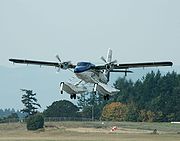
De Havilland Canada DHC-3 Otter
The de Havilland Canada DHC-3 Otter is a single-engined, high-wing, propeller-driven, STOL aircraft developed by de Havilland Canada. It was conceived to be capable of performing the same roles as the earlier and highly successful Beaver, but was overall a larger aircraft.-Design and...
had been planned by de Havilland Canada. Twin engines not only provided improved safety but also allowed for an increase in payload while retaining the renowned STOL qualities. Design features included double slotted trailing edge flaps and ailerons that work in unison with the flaps to boost STOL performance. The availability of the 550 shp Pratt and Whitney Canada PT6A-20 propeller turbine engine in the early 1960s made the concept of a twin more feasible. To bush operators, the improved reliability of turboprop power and the improved performance of a twin-engined configuration made it an immediately popular alternative to the single engine, piston-powered Otter
De Havilland Canada DHC-3 Otter
The de Havilland Canada DHC-3 Otter is a single-engined, high-wing, propeller-driven, STOL aircraft developed by de Havilland Canada. It was conceived to be capable of performing the same roles as the earlier and highly successful Beaver, but was overall a larger aircraft.-Design and...
which had been flying since 1951.
The first six aircraft produced were designated Series 1, indicating that they were prototype aircraft. The initial production run consisted of Series 100 aircraft, serial number seven to 115 inclusive. In 1968, Series 200 production began with serial number 116. Changes made at the beginning of Series 200 production included improving the STOL performance, adding a longer nose that was equipped with a larger baggage compartment (except to aircraft fitted with floats) and fitting a larger door to the rear baggage compartment. All Series 1, 100 and 200 aircraft and their variants (110, 210) were fitted with the 550 shaft horsepower PT6A-20 engines.
In 1969, the Series 300 was introduced, beginning with serial number 231. Both aircraft performance and payload were improved by fitting more powerful PT6A-27 engines. This was a 680 hp engine that was flat-rated to 620 hp for use in the Series 300 Twin Otter. The Series 300 proved to be the most successful variant by far, with 614 Series 300 aircraft and their sub-variants (Series 310 for United Kingdom operators, Series 320 for Australian operators, etc.) sold before production ended in 1988.
New production
After Series 300 production ended, the remaining tooling was purchased by Viking AirViking Air
Viking Air Ltd. is a manufacturer of aircraft, as well as aircraft parts and systems, based in Victoria, British Columbia. The company produces new versions of the DHC-6 Twin Otter, upgraded versions of the DHC-2 Beaver, spare parts for older de Havilland Canada aircraft, and components for Bell...
of Victoria, British Columbia
Victoria, British Columbia
Victoria is the capital city of British Columbia, Canada and is located on the southern tip of Vancouver Island off Canada's Pacific coast. The city has a population of about 78,000 within the metropolitan area of Greater Victoria, which has a population of 360,063, the 15th most populous Canadian...
, who manufacture replacement parts for all of the out of production de Havilland Canada aircraft. On February 24, 2006 Viking purchased the type certificate
Type certificate
A Type Certificate, is awarded by aviation regulating bodies to aerospace manufacturers after it has been established that the particular design of a civil aircraft, engine, or propeller has fulfilled the regulating bodies' current prevailing airworthiness requirements for the safe conduct of...
s from Bombardier Aerospace
Bombardier Aerospace
Bombardier Aerospace is a division of Bombardier Inc. and is the third-largest airplane manufacturer in the world. It is headquartered in Dorval, Quebec, Canada.- History :...
for all the out of production de Havilland DHC-1 through DHC-7 aircraft. The ownership of the certificates gives Viking the exclusive right to manufacture new aircraft.
On July 17, 2006, at the Farnborough Air Show
Farnborough Air Show
The Farnborough International Airshow is a seven-day international trade fair for the aerospace industry which is held in even-numbered years in mid-July at Farnborough Airfield in Hampshire, England....
, Viking Air announced its intention to offer a Series 400 Twin Otter. On April 2, 2007 Viking announced that with 27 orders and options in hand, it was restarting production of the Twin Otter, equipped with a more powerful Pratt & Whitney Canada PT6A-34/35
Pratt & Whitney Canada PT6
The Pratt & Whitney Canada PT6 is one of the most popular turboprop aircraft engines in history, and is produced by Pratt & Whitney Canada. The PT6 family is particularly well known for its extremely high reliability, with MTBO's on the order of 9000 hours in some models. In US military use, they...
engine. As of November 2007, 40 firm orders and 10 options had been taken and a new final assembly plant established in Calgary
Calgary
Calgary is a city in the Province of Alberta, Canada. It is located in the south of the province, in an area of foothills and prairie, approximately east of the front ranges of the Canadian Rockies...
, Alberta
Alberta
Alberta is a province of Canada. It had an estimated population of 3.7 million in 2010 making it the most populous of Canada's three prairie provinces...
. Zimex Aviation
Zimex Aviation
Zimex Aviation Ltd. is an airline based in Glattbrugg, Switzerland. It provides aircraft leases worldwide to the oil and mining industries and to humanitarian organisations...
of Switzerland received the first new production aircraft, serial number 845, in July 2010.
Major changes introduced with the Series 400 include Honeywell
Honeywell Aerospace
Honeywell Aerospace is a major provider of aircraft engines, APUs, avionics, and other systems in the aerospace industry. Headquartered in Phoenix, Arizona, it is a division of the Honeywell International conglomerate.-Aircraft engines:...
Primus Apex fully integrated avionics, deletion of the AC electrical system, deletion of the beta backup system, modernization of the electrical and lighting system, and use of composites for non-load-bearing structures such as doors.
Announced orders
- Peruvian Air ForcePeruvian Air ForceThe Peruvian Air Force is the branch of the Peruvian Armed Forces tasked with defending the nation and its interests through the use of air power...
(12) - Air Loyaute (2)
- Air MooreaAir MooreaAir Moorea is an airline based on the grounds of Faa'a International Airport in Faaa, Tahiti, French Polynesia, near Papeete. It operates passenger services within the Polynesian islands...
(2) - Air SeychellesAir SeychellesAir Seychelles is the national airline of the Seychelles, with its head office on the property of Seychelles International Airport on the island of Mahé. It operates inter-island services and international flights...
(2) - Airfast IndonesiaAirfast IndonesiaAirfast Indonesia is an air carrier based in Jakarta, Indonesia. It specialises in contract operations, aviation management services and charter passenger and cargo services to the oil, mining and construction industries in Indonesia and other countries in the area. It is also involved in aerial...
(4) - European Coastal AirlinesEuropean Coastal AirlinesEuropean Coastal Airlines is an air taxi operator based in Croatia. Founded in 2000, the company launched scheduled services in 2008. Their fleet at this point consists of three seaplanes and they operate on routes around Croatian islands in the Adriatic Sea....
(6) - Global Aerospace Logistics (GAL) (10), Order placed June 16, 2009
- Loch Ard Otters (6 plus 6 options)
- Montenegro Charter Company (1)
- Maldivian Air TaxiMaldivian Air TaxiMaldivian Air Taxi is the largest domestic carrier in the Maldives and is also one of the largest seaplane operators in the world operating over 500 flights a week during the peak tourist season...
(2) - Petro AirPetro Air-Fleet:The Petro Air fleet includes the following aircraft :...
(1) - Trans Maldivian AirwaysTrans Maldivian AirwaysTrans Maldivian Airways is a private airline based in Malé International Airport and is the oldest air transfer operator operating in the Maldives. It operates seaplanes to resort islands.- History :...
(5) - United States Army Parachute TeamUnited States Army Parachute TeamThe United States Army Parachute Team, nicknamed and commonly known as the Golden Knights, is a demonstration and competition parachute team of the United States Army...
(3) - Vietnamese People's Navy (6)
- Vityaz Avia Corporation (2)
- Zimex AviationZimex AviationZimex Aviation Ltd. is an airline based in Glattbrugg, Switzerland. It provides aircraft leases worldwide to the oil and mining industries and to humanitarian organisations...
(1)
Possible international Twin Otter production
Over the decades several organizations were interested in production of the versatile DHC-6 Twin Otter, the rights to which were acquired in 2006, with several other de Havilland Type Certificates, by Viking AirViking Air
Viking Air Ltd. is a manufacturer of aircraft, as well as aircraft parts and systems, based in Victoria, British Columbia. The company produces new versions of the DHC-6 Twin Otter, upgraded versions of the DHC-2 Beaver, spare parts for older de Havilland Canada aircraft, and components for Bell...
of Victoria, British Columbia. In February 2011, PT Dirgantara Indonesia of Indonesia
Indonesia
Indonesia , officially the Republic of Indonesia , is a country in Southeast Asia and Oceania. Indonesia is an archipelago comprising approximately 13,000 islands. It has 33 provinces with over 238 million people, and is the world's fourth most populous country. Indonesia is a republic, with an...
discussed the possibility of Twin Otter production at their facilities.
Operational history
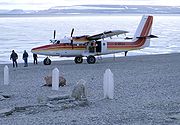
Ski
A ski is a long, flat device worn on the foot, usually attached through a boot, designed to help the wearer slide smoothly over snow. Originally intended as an aid to travel in snowy regions, they are now mainly used for recreational and sporting purposes...
s or tricycle landing gear fittings, making them adaptable bush plane
Bush plane
A bush airplane is a general aviation aircraft serving remote, undeveloped areas of a country, usually the African bush, Alaskan and Canadian tundra or the Australian Outback...
s for remote and northern areas including Canada and the United States
United States
The United States of America is a federal constitutional republic comprising fifty states and a federal district...
, specifically Alaska
Alaska
Alaska is the largest state in the United States by area. It is situated in the northwest extremity of the North American continent, with Canada to the east, the Arctic Ocean to the north, and the Pacific Ocean to the west and south, with Russia further west across the Bering Strait...
. Many Twin Otters still serve in the far north, but they can also be found in Africa, Australia, Antarctica and other regions where bush planes are the optimum means of travel. Their versatility and maneuverability have made them popular in areas with difficult flying environments, including Papua New Guinea. In Norway
Norway
Norway , officially the Kingdom of Norway, is a Nordic unitary constitutional monarchy whose territory comprises the western portion of the Scandinavian Peninsula, Jan Mayen, and the Arctic archipelago of Svalbard and Bouvet Island. Norway has a total area of and a population of about 4.9 million...
, the Twin Otter paved the way for the network of short-field airports, connecting the rural areas with the larger towns with outstanding reliability, and remained in service until 2000 on certain routes. Widerøe
Widerøe
Widerøe's Flyveselskap AS, trading as Widerøe, is a regional airline in Norway and part of the SAS Group. It operates a fleet of 34 Bombardier Dash 8 aircraft , serving 41 domestic and 6 international destinations...
of Norway was, at one time, the world's largest operator of Twin Otters. During one period of its tenure in Norway, the Twin Otter fleet achieved over 96,000 cycles (takeoff, flight and landing) per year.
Twin Otters are a staple of Antarctic transportation. Four Twin Otters are employed by the British Antarctic Survey
British Antarctic Survey
The British Antarctic Survey is the United Kingdom's national Antarctic operation and has an active role in Antarctic affairs. BAS is part of the Natural Environment Research Council and has over 400 staff. It operates five research stations, two ships and five aircraft in and around Antarctica....
on research and supply flights, and several are employed by the United States Antarctic Program
United States Antarctic Program
United States Antarctic Program is an organization of the United States government which has presence in the continent of Antarctica. It co-ordinates research and the operational support for research in the region...
via contract with Kenn Borek Air
Kenn Borek Air
Kenn Borek Air is an airline based in Calgary, Alberta, Canada. It operates regional passenger and cargo services, contract operations in the Arctic and Antarctic and aircraft leasing. Its main base is Calgary International Airport...
. On April 24–25, 2001, two Twin Otters performed the only winter flight to Amundsen-Scott South Pole Station
Amundsen-Scott South Pole Station
The Amundsen–Scott South Pole Station is the American scientific research station on the high plateau of Antarctica. This station is located at the southernmost place on the Earth, the Geographic South Pole, at an elevation of 2,835 meters above sea level.The original Amundsen-Scott Station was...
to perform a medical evacuation.
The Argentine Air Force
Argentine Air Force
The Argentine Air Force is the national aviation branch of the Armed Forces of the Argentine Republic. , it had 14,606 military and 6,854 civilian staff.-History:...
used them on Antarctica since the 1970s with at least one of them deployed the whole year at Marambio Base
Marambio Base
Prior to the base's foundation a team led by Vice-Commodore Mario Luis Olezza built the 1200 m long, 40 m wide landing track, the first one in the continent. Nowadays, the track, oriented 05/23, is equipped with VOR, DME and NDB electronic landing systems. It also has a radio beacon,...
The Chilean Air Force also operates the type from 1980, usually having an example based at Presidente Frei antarctic base of South Shetland islands.
As of August 2006, a total of 584 Twin Otter aircraft (all variants) remain in service worldwide. Major operators include: Libyan Arab Airlines
Libyan Arab Airlines
Libyan Airlines , known as Libyan Arab Airlines over several decades, is the national flag carrier airline of Libya. Based in Tripoli, it operates scheduled passenger and cargo services within Libya and to Europe, North Africa and the Middle East, the majority of which leave from Tripoli...
(16), Maldivian Air Taxi
Maldivian Air Taxi
Maldivian Air Taxi is the largest domestic carrier in the Maldives and is also one of the largest seaplane operators in the world operating over 500 flights a week during the peak tourist season...
(22), Trans Maldivian Airways
Trans Maldivian Airways
Trans Maldivian Airways is a private airline based in Malé International Airport and is the oldest air transfer operator operating in the Maldives. It operates seaplanes to resort islands.- History :...
(23), Kenn Borek Air
Kenn Borek Air
Kenn Borek Air is an airline based in Calgary, Alberta, Canada. It operates regional passenger and cargo services, contract operations in the Arctic and Antarctic and aircraft leasing. Its main base is Calgary International Airport...
(42) and Scenic Airlines
Scenic Airlines
Scenic Airlines is an American regional airline based in Paradise, Nevada, USA. It operates sightseeing flights from Boulder City Airport in Boulder City, Nevada.-History:...
(11). Some 115 airlines operate smaller numbers of the aircraft including Yeti Airlines
Yeti Airlines
Yeti Airlines Domestic Pvt. Ltd. is an airline based in Nepal. The airline was established in May 1998 and received its Air Operators Certificate on 17 August 1998. Yeti Airlines is the parent company of Tara Air. Together the two airlines form the largest domestic flight operator in Nepal...
in Nepal, Malaysia Airlines
Malaysia Airlines
Malaysian Airline System Berhad , DBA Malaysia Airlines , is the government-owned flag carrier of Malaysia. Malaysia Airlines operates flights from its home base, Kuala Lumpur International Airport, and its eastern hub in Kota Kinabalu. It has its headquarters on the grounds of Sultan Abdul Aziz...
which uses the Twin Otter exclusively for passenger and freight transportation to the Kelabit Highlands
Kelabit Highlands
The Kelabit Highlands are a mountain range located in the northernmost part of Sarawak, on the island of Borneo. The highest mountains in this range are Mount Murud at 2,423 m , Bukit Batu Buli at 2,082 m , and Bukit Batu Lawi at 2,046 m .In the Kelabit Highlands, there are 14...
region in Sarawak, and in the United Kingdom the FlyBe franchise operator Loganair
Loganair
Loganair is a Scottish airline with its registered office on the grounds of Glasgow International Airport and in Paisley, Renfrewshire, Scotland. Loganair operates scheduled services under a Flybe franchise in mainland Scotland and to Orkney, Shetland and the Western Isles. In addition it operates...
which uses the aircraft to service the island of Barra
Barra
The island of Barra is a predominantly Gaelic-speaking island, and apart from the adjacent island of Vatersay, to which it is connected by a causeway, is the southernmost inhabited island of the Outer Hebrides in Scotland.-Geography:The 2001 census showed that the resident population was 1,078...
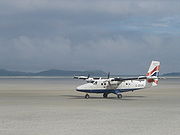
in the Hebrides islands. This scheduled service is unique as the aircraft lands on the beach and the schedule is partly influenced by the tide tables. The Twin Otter is also used for landing at the world's shortest commercial runway on the Caribbean island of Saba, Netherlands Antilles
Netherlands Antilles
The Netherlands Antilles , also referred to informally as the Dutch Antilles, was an autonomous Caribbean country within the Kingdom of the Netherlands, consisting of two groups of islands in the Lesser Antilles: Aruba, Bonaire and Curaçao , in Leeward Antilles just off the Venezuelan coast; and Sint...
.
Ontario
Ontario
Ontario is a province of Canada, located in east-central Canada. It is Canada's most populous province and second largest in total area. It is home to the nation's most populous city, Toronto, and the nation's capital, Ottawa....
's Ministry of Natural Resources
Ministry of Natural Resources (Ontario)
The Ministry of Natural Resources is a government ministry of the Canadian province of Ontario that responsible for Ontario’s provincial parks, forests, fisheries, wildlife, mineral aggregates and the Crown lands and waters that make up 87 per cent of the province...
is also a long-time operator of the Otter.
Transport Canada
Transport Canada
Transport Canada is the department within the government of Canada which is responsible for developing regulations, policies and services of transportation in Canada. It is part of the Transportation, Infrastructure and Communities portfolio...
still owns three DHC-6 Twin Otters, but they now see very limited flying time, as their role in Coastal Surveillance has been replaced by a fleet of DHC-8 aircraft.
The Twin Otter has been popular with commercial skydiving operations. It is able to carry up to 22 skydivers to over 13,500 ft (a large load compared to most other aircraft in the industry); presently, the Twin Otter is used in skydiving operations in many countries. The United States Air Force
United States Air Force
The United States Air Force is the aerial warfare service branch of the United States Armed Forces and one of the American uniformed services. Initially part of the United States Army, the USAF was formed as a separate branch of the military on September 18, 1947 under the National Security Act of...
operates three Twin Otters for the United States Air Force Academy
United States Air Force Academy
The United States Air Force Academy is an accredited college for the undergraduate education of officer candidates for the United States Air Force. Its campus is located immediately north of Colorado Springs in El Paso County, Colorado, United States...
's skydiving team.
On September 25, 2008, the Series 400 Technology Demonstrator achieved "power on" status in advance of an official rollout. First flight of the Series 400 technical demonstrator, C-FDHT, took place October 1, 2008 at Victoria Airport. Two days later, the aircraft departed Victoria for a ferry flight to Orlando, Florida, site of the 2008 National Business Aviation Association
National Business Aviation Association
National Business Aviation Association or NBAA, is a non-profit and nonpartisan 5016 corporation based in Washington, DC, United States. The Association represents more than 8,000 companies....
(NBAA) Conference and exhibition. The first new build Series 400 Twin Otter (SN 845) made its first flight on February 16, 2010 in Calgary
Calgary
Calgary is a city in the Province of Alberta, Canada. It is located in the south of the province, in an area of foothills and prairie, approximately east of the front ranges of the Canadian Rockies...
, Alberta
Alberta
Alberta is a province of Canada. It had an estimated population of 3.7 million in 2010 making it the most populous of Canada's three prairie provinces...
. Transport Canada
Transport Canada
Transport Canada is the department within the government of Canada which is responsible for developing regulations, policies and services of transportation in Canada. It is part of the Transportation, Infrastructure and Communities portfolio...
presented Viking Air Limited with an amended DHC-6 Type Certificate including the Series 400 on July 21, 2010.
Variants

Pratt & Whitney Canada
Pratt & Whitney Canada is a Canadian aircraft engine manufacturer. PWC's headquarters are in Longueuil, Quebec, just outside Montreal. It is a division of the larger US-based Pratt & Whitney , itself a business unit of United Technologies...
PT6A20 turboprop engines.
DHC-6 Series 110 : Variant of the Series 100 built to conform to BCAR (British Civil Air Regulations)
: Improved version.
: Twin-engined STOL utility transport aircraft, powered by two 620 shp (462 kW) Pratt & Whitney Canada
Pratt & Whitney Canada
Pratt & Whitney Canada is a Canadian aircraft engine manufacturer. PWC's headquarters are in Longueuil, Quebec, just outside Montreal. It is a division of the larger US-based Pratt & Whitney , itself a business unit of United Technologies...
PT6A-27 turboprop engines.
DHC-6 Series 300M : Multi-role military transport aircraft. Two of these were produced as "proof-of-concept" demonstrators
DHC-6 Series 310 : Variant of the Series 300 built to conform to BCAR (British Civil Air Regulations)
DHC-6 Series 320 : Variant of the Series 300 built to conform to Australian Civil Air Regulations
DHC-6 Series 300M : Military version.
DHC-6 Series 300S : Six demonstrator aircraft fitted with 11 seats, wing spoilers and an anti-skid braking system.
DHC-6 Series 400 : First delivered in July 2010, powered by two Pratt & Whitney Canada
Pratt & Whitney Canada
Pratt & Whitney Canada is a Canadian aircraft engine manufacturer. PWC's headquarters are in Longueuil, Quebec, just outside Montreal. It is a division of the larger US-based Pratt & Whitney , itself a business unit of United Technologies...
PT6A-34 or optional PT6A-35 Hot & High Performance engines, and available on standard landing gear, straight floats, amphibious floats, skis, wheel skis, or intermediate flotation landing gear.
: Twin-engined STOL utility transport, search and rescue aircraft for the Canadian Forces
Canadian Forces
The Canadian Forces , officially the Canadian Armed Forces , are the unified armed forces of Canada, as constituted by the National Defence Act, which states: "The Canadian Forces are the armed forces of Her Majesty raised by Canada and consist of one Service called the Canadian Armed Forces."...
.
UV-18A : Twin-engined STOL utility transport aircraft for the U.S. Army Alaska National Guard
Alaska National Guard
The Alaska Department of Military and Veterans Affairs manages military and veterans affairs for the U.S. state of Alaska. It comprises a number of subdepartments, including the Alaska National Guard, Veterans Affairs, the Division of Homeland Security and Emergency Management, Alaska Naval...
. Six built. It has been replaced by the C-23 Sherpa
C-23 Sherpa
|-C-23B/C:-See also:-External links:*****...
in US Army service.
UV-18B : Parachute training aircraft for the United States Air Force Academy. The United States Air Force Academy's 98th Flying Training Squadron maintains three UV-18s in its inventory as freefall parachuting training aircraft, and by the Academy Parachute Team, the Wings of Blue, for year-round parachuting operations.
Civil operators
- Aeronaves Alimentadoras (defunct)
- Aviastar Mandiri
- Eastern Metro Express/Metro Airlines (USVI)
- Frontier Airlines (1950–1986)
- Presidencia de la República del Paraguay
- Volcanic Air Safaris
 Antigua and Barbuda
- Carib AviationCarib Aviation- History :Founded in 1972 with a single prop engine aircraft, Carib Aviation provided charter and scheduled flights throughout the Caribbean from its main base in Antigua. The company employed 63 personnel, including some 15 pilots and 22 engineering staff...
- Ansett AustraliaAnsett AustraliaAnsett Australia, Ansett, Ansett Airlines of Australia, or ANSETT-ANA as it was commonly known in earlier years, was a major Australian airline group, based in Melbourne. The airlines flew domestically within Australia and to destinations in Asia during its operation in 1996...
- Former operator. - East-West Airlines (Australia)East-West Airlines (Australia)East-West Airlines was an Australian regional airline founded in Tamworth, New South Wales in 1947. It operated to major regional city-centres and connected these centres to various provincial capitals. It was purchased from its original founders in a share buy-out by Bryan Grey and Duke Minks...
- Former operator. - MacRobertson Miller AirlinesMacRobertson Miller AirlinesMacRobertson Miller Airlines Ltd. , callsign "Miller", IATA code "MV", was established in Australia in late 1927, by pilot Horrie Miller with the backing of chocolate millionaire Sir Macpherson Robertson....
- Former operator. - Trans Australia AirlinesTrans Australia AirlinesTrans Australia Airlines or TAA, was one of the two major Australian domestic airlines between its inception in 1946 and its sale to Qantas in May 1996. During that period TAA played a major part in the development of the Australian air transport industry...
- Former operator.
- Adlair AviationAdlair AviationAdlair Aviation Ltd. was founded in 1983 as a family-owned charter airline in Cambridge Bay, Nunavut, Canada. Adlair Aviation was established by one of the north's pilots, Willy Laserich. It is based in Cambridge Bay and has administrative offices in Yellowknife, Northwest Territories. It operates...
- Air InuitAir InuitAir Inuit Ltd is an airline based in Dorval, Quebec, Canada. It operates domestic passenger services and charter and cargo services in Nunavik and Nunavut. Its main base is Kuujjuaq Airport.-History:...
- Air LabradorAir LabradorLabrador Airways Limited, operating as Air Labrador, is a regional airline based in Goose Bay , Newfoundland and Labrador, Canada. It operates scheduled daily passenger and freight services throughout Labrador and Quebec, as well as charter operations with the options of landing in remote and off...
- Air TindiAir TindiAir Tindi is an airline based in Yellowknife, Northwest Territories, Canada. Now owned by Discovery Air, it operates scheduled and on demand charter services. Its main base is Yellowknife Airport and the airline was formerly owned by the Arychuk family...
- Airtransit (defunct)
- Arctic Sunwest ChartersArctic Sunwest Charters171817 Canada Inc operating as Arctic Sunwest Charters is a charter airline based in Yellowknife, Northwest Territories, Canada. It operates passenger and cargo charter services to Arctic Canada, with wheel, ski and float equipped aircraft...
- Kenn Borek AirKenn Borek AirKenn Borek Air is an airline based in Calgary, Alberta, Canada. It operates regional passenger and cargo services, contract operations in the Arctic and Antarctic and aircraft leasing. Its main base is Calgary International Airport...
- Manitoba Government Air Services
- Ministry of Natural Resources (Ontario)Ministry of Natural Resources (Ontario)The Ministry of Natural Resources is a government ministry of the Canadian province of Ontario that responsible for Ontario’s provincial parks, forests, fisheries, wildlife, mineral aggregates and the Crown lands and waters that make up 87 per cent of the province...
- forest firefighting - Nakina Air ServiceNakina Air ServiceNakina Air Service is a small Canadian airline based in Nakina, Ontario.- Fleet :In December 2009, the Nakina Air Service fleet consisted of 9 aircraft:...
- NorOntairNorOntairNorOntair is a defunct airline from Canada that operated its first scheduled flight October 18, 1971 and its last flight March 29, 1996.-Dash 8 service:* Fort Frances* Kapuskasing* North Bay* Sault Ste...
- Former operator. - North-Wright AirwaysNorth-Wright AirwaysNorth-Wright Airways is an airline based in Norman Wells, Northwest Territories, Canada. It operates commuter services to several communities in the Northwest Territories, as well as charter services...
- North Cariboo AirNorth Cariboo AirNorth Cariboo Air is an airline based in Fort St. John, British Columbia. It operates general charter services and support flights for oil and geological exploration companies. Its head office is Fort St. John Airport, Fort St. John, British Columbia. ....
- Former operator. - Provincial AirlinesProvincial AirlinesProvincial Airlines is an airline based in St John's, Newfoundland and Labrador, Canada. It operates passenger and cargo services, maritime surveillance and remote sensing and environmental monitoring operations. Its main base is St. John's International Airport. - History :The airline was...
- Sander Geophysics
- Transport CanadaTransport CanadaTransport Canada is the department within the government of Canada which is responsible for developing regulations, policies and services of transportation in Canada. It is part of the Transportation, Infrastructure and Communities portfolio...
- Transwest AirTranswest Airthumb|Transwest Air Terminal at [[Stony Rapids Airport]]thumb|Transwest Air Beech 1900D C-GTWG at [[Regina International Airport]]thumb|Transwest Air Bell 206B helicopter at Regina International Airport...
- Viking AirViking AirViking Air Ltd. is a manufacturer of aircraft, as well as aircraft parts and systems, based in Victoria, British Columbia. The company produces new versions of the DHC-6 Twin Otter, upgraded versions of the DHC-2 Beaver, spare parts for older de Havilland Canada aircraft, and components for Bell...
- West Coast AirWest Coast AirWest Coast Air is a scheduled airline operating de Havilland Canada float planes, with scheduled flights from downtown Vancouver and the Richmond Floatplane base at Vancouver International Airport to Victoria, Nanaimo, Comox, the Sunshine Coast, and Whistler. The company also flies tours and...
 Cape Verde
- TACV Cabo Verde Airlines - Former Operator
 Cayman Islands
- Cayman AirwaysCayman AirwaysCayman Airways is the national flag carrier of the Cayman Islands. With its head office in Grand Cayman, it operates mainly as an international and domestic scheduled passenger carrier, with cargo services available on all routes...
 Chile
Chile
- Aerocord -operates former Los Cedros Aviacion Vistaliner
- BarrickBarrickBarrick is a name that may refer to:Companies*Barrick Gold, the world's largest gold mining company*Barrick Gaming Corporation, a Las Vegas-based gambling companyPeople*Barrick Nealy, a football quarterback in the CFL...
- Aerovías DAPAerovias DAPAerovías DAP is an airline based in Punta Arenas, Chile. It operates scheduled and charterservices in the southern Patagonia area, Antarctic continent and also operates flights on behalf of the state-owned oil company, ENAP. Its main baseIs Carlos Ibanez Del Campo International Airport, Punta...
- LAN-Chile -former operator, passed aircraft onto Chilean AF
- Varmontt Air never operated though painted aircraft at Los Cerrillos during the early 2000 years.
- China Flying Dragon AviationChina Flying Dragon AviationChina Flying Dragon Aviation is an airline based in Harbin, Heilongjiang, People's Republic of China. It operates short-haul passenger and cargo charter flights, as well as maritime surveillance, aerial photography and forestry protection services. Its main base is Harbin Taiping International...
- Civil Aviation Administration of ChinaCivil Aviation Administration of ChinaThe Civil Aviation Administration of China , formerly the General Administration of Civil Aviation of China , is the aviation authority under the Ministry of Transport of the People's Republic of China. It oversees civil aviation and investigates aviation accidents and incidents...
- Former operator.
- Aerolínea de AntioquiaAerolínea de AntioquiaADA S.A., operating as Aerolínea de Antioquia , is a regional airline with its headquarters on the property of Olaya Herrera Airport in Medellín, Colombia. It started operations in 1987. The airline operates scheduled domestic services from Medellín to over 20 destinations...
- Policia Nacional Colombiana
 Costa Rica
- Nature AirNature AirNature Air is an airline based in San José, Costa Rica. It operates scheduled international and domestic services, as well as regional charter services. Its main base is Tobías Bolaños International Airport, San José...
 Independent State of Croatia
- European Coastal AirlinesEuropean Coastal AirlinesEuropean Coastal Airlines is an air taxi operator based in Croatia. Founded in 2000, the company launched scheduled services in 2008. Their fleet at this point consists of three seaplanes and they operate on routes around Croatian islands in the Adriatic Sea....
East African Community
East African Community
The East African Community is an intergovernmental organisation comprising the five east African countries Burundi, Kenya, Rwanda, Tanzania, and Uganda. Pierre Nkurunziza, the President of the Republic of Burundi, is the current Chairman of the East African Community. The EAC was originally...
- East African AirwaysEast African AirwaysEast African Airways Corp. was an airline jointly run by three countries in East Africa: Kenya, Tanzania; and Uganda, which were then part of an East African Community. The airline was headquartered in the Sadler House in Nairobi, Kenya...
- Former operator.
- Kar-Air
- Malmilento
 Fiji
Fiji
- Pacific SunPacific SunThe Pacific Sun was founded in 1963 in California, and is the second longest running alternative weekly in the nation, behind only The Village Voice...
- AirSea LinesAirSea LinesAirSea Lines was an airline based in Gouvia, Corfu, Greece. It was the first scheduled services seaplane operator in Greece in recent years. Its main base was Gouvia Marina The airline ceased operations in 2008, citing bureaucratic and infrastructure hurdles...
 Greenland
- Air GreenlandAir GreenlandAir Greenland A/S is the flag carrier airline of Greenland, jointly owned by the government of Greenland, the SAS Group, and the government of Denmark...
 Guadeloupe
- Air Antilles ExpressAir Antilles ExpressAir Antilles Express is an airline based in Guadeloupe, an important economic link for the French Antilles and a way out of Port au Prince. It is a regional airline operating scheduled and seasonal services.- History :...
- Guyana AirwaysGuyana AirwaysGuyana Airways was the national airline of Guyana from 1973 to 2001. During this period, it operated services to destinations throughout the Caribbean, the U.S. and Canada. It was declared insolvent in 2001....
- Former operator.
 Iceland
- Air IcelandAir IcelandAir Iceland is a regional airline with its head office on the property of Reykjavík Airport in Reykjavík, Iceland. It operates scheduled services to domestic destinations and to Greenland. Its main bases are Reykjavík Airport and Akureyri Airport...
- NorlandairNorlandairNorlandair is an Icelandic airline founded in 2008. Norlandair's fleet consists of three DHC-6 Twin Otter aircraft, including one on lease from Air Greenland. Additionally it operates one King Air....
- Airfast IndonesiaAirfast IndonesiaAirfast Indonesia is an air carrier based in Jakarta, Indonesia. It specialises in contract operations, aviation management services and charter passenger and cargo services to the oil, mining and construction industries in Indonesia and other countries in the area. It is also involved in aerial...
- Merpati Nusantara AirlinesMerpati Nusantara AirlinesMerpati Nusantara Airlines is a commuter airline based in Central Jakarta, Jakarta, Indonesia. It is a major domestic airline operating scheduled services to more than 25 destinations in Indonesia, as well as scheduled international services to East Timor and Malaysia. Its main base is...
 Israel
- SkyKef
 Jamaica
- Air Jamaica ExpressAir Jamaica ExpressAir Jamaica Express was an airline based in Kingston, Jamaica and before folding operated as a subsidiary of Air Jamaica. It operated domestic and inter island scheduled flights and charter services...
- Former operator
- Air Kenya
- KAL Aviation (KALAIR)
- Skytrail Air Safaris
 Madagascar
- Air MadagascarAir MadagascarSociété Nationale Malgache de Transports Aériens, Société Anonyme, operating as Air Madagascar, is an airline based in Antananarivo, Madagascar. It is the national airline operating services to Europe, Asia and neighbouring African and Indian Ocean island destinations. It also operates an extensive...
 Malaysia
- MASWingsMASwingsMASwings Sdn. Berhad is a regional airline operating the Rural Air Services in East Malaysia. It took over the RAS previously operated by FlyAsianXpress. The first flight was on 1 October 2007,which is also the anniversary of the founding of Malaysia Airlines in 1972. Its headquarters are in Jalan...
a subsidiary of Malaysia AirlinesMalaysia AirlinesMalaysian Airline System Berhad , DBA Malaysia Airlines , is the government-owned flag carrier of Malaysia. Malaysia Airlines operates flights from its home base, Kuala Lumpur International Airport, and its eastern hub in Kota Kinabalu. It has its headquarters on the grounds of Sultan Abdul Aziz...
 Maldives
- Maldivian Air TaxiMaldivian Air TaxiMaldivian Air Taxi is the largest domestic carrier in the Maldives and is also one of the largest seaplane operators in the world operating over 500 flights a week during the peak tourist season...
- Trans Maldivian AirwaysTrans Maldivian AirwaysTrans Maldivian Airways is a private airline based in Malé International Airport and is the oldest air transfer operator operating in the Maldives. It operates seaplanes to resort islands.- History :...
 Mali
Mali
- Air Mali (1960-1985)
 Malta
Malta
- Harbourair (Malta)
 Mauritius
- Air MauritiusAir MauritiusAir Mauritius Limited, stylised as Air Mauritius, is the flag carrier of Mauritius. The airline is headquartered at the Air Mauritius Centre in Port Louis, Mauritius. Its main base is Sir Seewoosagur Ramgoolam International Airport...
- Nepal Airlines
- Yeti AirlinesYeti AirlinesYeti Airlines Domestic Pvt. Ltd. is an airline based in Nepal. The airline was established in May 1998 and received its Air Operators Certificate on 17 August 1998. Yeti Airlines is the parent company of Tara Air. Together the two airlines form the largest domestic flight operator in Nepal...
 Netherlands Antilles
- ALM Antillean Airlines - Former operator
- Dutch Caribbean AirlinesDutch Caribbean AirlinesDutch Caribbean Airlines was an airline based in Curaçao, part of the Kingdom of the Netherlands. It was founded after the demise of Curaçao's first airline, Air ALM...
- Former operator - Windward Islands AirwaysWindward Islands AirwaysWinair, an abbreviation of Windward Islands Airways, is a government-owned airline based in the Netherlands Antilles. Founded in 1961 by Georges Greaux, It has a fleet of four aircraft serving ten destinations, all within the Leeward Islands group of the Lesser Antilles in the North East Caribbean...
 Early Modern France
- Air Loyauté
- Mount Cook AirlineMount Cook AirlineMount Cook Airline is an airline based in Christchurch, New Zealand. It is wholly owned by Air New Zealand and operates scheduled services throughout the country under the Air New Zealand Link brand...
- Former operator
- WiderøeWiderøeWiderøe's Flyveselskap AS, trading as Widerøe, is a regional airline in Norway and part of the SAS Group. It operates a fleet of 34 Bombardier Dash 8 aircraft , serving 41 domestic and 6 international destinations...
- Pakistan International AirlinesPakistan International AirlinesPakistan International Airlines Corporation commonly known as PIA, is the flag carrier airline of Pakistan. The airline has its head office on the grounds of Jinnah International Airport in Karachi. and operates scheduled services to 24 domestic destinations and 38 international destinations in 27...
- Former operator
- AeroperlasAeroperlasAeroperlas is an airline based in Panama City, Panama. It is a regional airline operating over 50 daily flights to 15 domestic destinations, as well as charter flights. It operates services as part of the Grupo TACA Regional Airlines system. Its main base is Marcos A...
- Air PanamaAir PanamaAir Panama is an airline based in Panama City, Panama, which offers scheduled and chartered passenger flights out of its hub at Albrook "Marcos A. Gelabert" International Airport, mostly on domestic routes with a low passenger volume...
- Airlines PNG
- Mission Aviation FellowshipMission Aviation FellowshipMission Aviation Fellowship is a Christian organization that provides aviation, communications, and learning technology services to more than 1,000 Christian and humanitarian agencies, as well as thousands of isolated missionaries and indigenous villagers in the world's most remote areas...
- TAP PortugalTAP PortugalTAP Portugal, commonly known as TAP, is the national airline of Portugal. It has its head office in Building 25 on the grounds of Portela Airport in Lisbon, and has been a member of the Star Alliance since 14 March 2005, the same day on which the company celebrated its 60th anniversary...
- Former operator
 Puerto Rico
- Crown Air
- Dorado WingsDorado WingsDorado Wings was a small airline that operated from Luis Muñoz Marín International Airport in San Juan, Puerto Rico to Dorado Airport in the tourist center of Dorado. Dorado Wings was the only commercial operator at Dorado Airport. Dorado Wings existed from 1964 to 1982. In early 1982, the airline...
 São Tomé and Príncipe
- Air São Tomé and PríncipeAir São Tomé and PríncipeAir São Tomé and Príncipe was an airline based in São Tomé, São Tomé and Príncipe. It operated scheduled services within the islands and to neighbouring Gabon. Its main base was São Tomé International Airport. It lost its only aircraft in an accident in 2006.- History :The airline was established...
 Seychelles
- Air SeychellesAir SeychellesAir Seychelles is the national airline of the Seychelles, with its head office on the property of Seychelles International Airport on the island of Mahé. It operates inter-island services and international flights...
 Solomon Islands
- Solomon AirlinesSolomon AirlinesSolomon Airlines is the national airline of the Solomon Islands, based in Honiara.- History :Solomon Airlines was established in 1962 as a charter airline by Laurie Crowley. Crowley had been flying around Papua New Guinea when he started to fly charter flights on a single Piper Aztec plane to the...
 Sri Lanka
- Sri Lankan Airlines
- Surinam AirwaysSurinam AirwaysSurinam Airways is the national airline of Suriname, based in Paramaribo. It operates regional and long-haul scheduled passenger services. Its hub is at Johan Adolf Pengel International Airport.On 16 September 2008, Surinam Airways had 400 employees....
 Turkey
- Seabird Airlines
 Turks and Caicos Islands
- Air Turks and CaicosAir Turks and CaicosAir Turks and Caicos is a passenger airline based on the Turks and Caicos Islands. The airline offers scheduled domestic and short-haul international services, as well as charter flights. In 2008, Air Turks and Caicos bought its direct competitor SkyKing...
- Aurigny Air ServicesAurigny Air ServicesAurigny Air Services was founded by Sir Derrick Bailey and started operations on 1 March 1968 after British United Airways withdrew the Alderney to Guernsey route...
(Channel IslandsChannel IslandsThe Channel Islands are an archipelago of British Crown Dependencies in the English Channel, off the French coast of Normandy. They include two separate bailiwicks: the Bailiwick of Guernsey and the Bailiwick of Jersey...
) - former operator - British Antarctic SurveyBritish Antarctic SurveyThe British Antarctic Survey is the United Kingdom's national Antarctic operation and has an active role in Antarctic affairs. BAS is part of the Natural Environment Research Council and has over 400 staff. It operates five research stations, two ships and five aircraft in and around Antarctica....
- Jersey European Airways on some services from the Channel IslandsChannel IslandsThe Channel Islands are an archipelago of British Crown Dependencies in the English Channel, off the French coast of Normandy. They include two separate bailiwicks: the Bailiwick of Guernsey and the Bailiwick of Jersey...
in the 1980s - former operator - Isles of Scilly SkybusIsles of Scilly SkybusIsles of Scilly Skybus is a British airline which operates seasonal and year round domestic scheduled services to the Isles of Scilly from Land's End Airport and Newquay Airport in Cornwall, and from Exeter, Bristol and Southampton...
- LoganairLoganairLoganair is a Scottish airline with its registered office on the grounds of Glasgow International Airport and in Paisley, Renfrewshire, Scotland. Loganair operates scheduled services under a Flybe franchise in mainland Scotland and to Orkney, Shetland and the Western Isles. In addition it operates...
operating a franchise from FlyBeFlybeFlybe Group PLC is a British low-cost regional airline headquartered at the Jack Walker House at Exeter International Airport in Devon, England...
. - North London Skydiving Centre
- Air IllinoisAir IllinoisAir Illinois was a commuter airline based in Carbondale, Illinois.-History:Founded in 1970 in Carbondale, Illinois, Air Illinois primarily operated small twin turboprop aircraft such as the DeHavilland Twin Otter...
- Air Serv InternationalAir Serv InternationalAir Serv International is a nonprofit humanitarian organization that uses aircraft to fly relief workers and supplies to help victims of disasters in some of the most remote and challenging areas in the world. It flies where other air carriers cannot, or will not, fly...
- Air WisconsinAir WisconsinAir Wisconsin Airlines Corporation is an airline based at Outagamie County Regional Airport in the town of Greenville, Wisconsin, United States, near Appleton. Air Wisconsin is the largest privately held regional airline in the United States...
- Allegheny Commuter
- Continental ExpressContinental ExpressContinental Express is the operating brand name used by a number of independently owned regional airlines providing regional jet feeder service under agreement with Continental Airlines...
- Crown AirwaysCrown AirwaysCrown Airways was a regional airline operating for USAir Express with its headquarters on the grounds of DuBois Regional Airport in Washington Township, Jefferson County, Pennsylvania, near Falls Creek....
(Falls Creek, PA) - Golden West AirlinesGolden West AirlinesGolden West Airlines was a commuter airline that operated flights on a heavy schedule in California. It ceased operations in 1983.- History :...
- Grand Canyon AirlinesGrand Canyon AirlinesGrand Canyon Airlines is an FAR Part 135 airline headquartered on the grounds of Grand Canyon National Park Airport in the Tusayan census-designated place in unincorporated Coconino County, Arizona, United States. It operates sightseeing tours over the Grand Canyon...
- NewAir (Formally New Haven Air)
- Ozark Airlines
- Pilgrim Airlines - Former operator.
- Rocky Mountain AirwaysRocky Mountain AirwaysRocky Mountain Airways was an American commuter airline headquartered in Hangar No. 6 of Stapleton International Airport in Denver, Colorado. It was sold to Texas Air Corporation/Continental Airlines in 1986....
- Scenic AirlinesScenic AirlinesScenic Airlines is an American regional airline based in Paradise, Nevada, USA. It operates sightseeing flights from Boulder City Airport in Boulder City, Nevada.-History:...
 United States Virgin Islands
- Seaborne AirlinesSeaborne AirlinesSeaborne Airlines is an FAR Part 121 airline based in Christiansted, St. Croix, United States Virgin Islands. It was established in 1992 and operates domestic services within the U.S. Virgin Islands to Puerto Rico and international services within the British Virgin Islands and Puerto Rico. In...
 Vanuatu
- Air VanuatuAir VanuatuAir Vanuatu is an airline with its head office in the Air Vanuatu House, Port Vila, Vanuatu. It is Vanuatu's national flag carrier, operating to Australia, New Zealand and points in the South Pacific...
 Venezuela
- Aeropostal - Former operator.
- Aereotuy - Former operator.
- Yemenia Airlines
Military and police operators
- Argentine Air ForceArgentine Air ForceThe Argentine Air Force is the national aviation branch of the Armed Forces of the Argentine Republic. , it had 14,606 military and 6,854 civilian staff.-History:...
(Marambio BaseMarambio BasePrior to the base's foundation a team led by Vice-Commodore Mario Luis Olezza built the 1200 m long, 40 m wide landing track, the first one in the continent. Nowadays, the track, oriented 05/23, is equipped with VOR, DME and NDB electronic landing systems. It also has a radio beacon,...
) / LADELadeLade may refer to:People* Brendon Lade , Australian rules footballer* Sir John Lade , baronet and Regency horse-breeder* Heinrich Eduard von Lade , German banker and amateur astronomer... - Argentine ArmyArgentine ArmyThe Argentine Army is the land armed force branch of the Armed Forces of the Argentine Republic and the senior military service of the country.- History :...
- Argentine NavyArgentine NavyThe Navy of the Argentine Republic or Armada of the Argentine Republic is the navy of Argentina. It is one of the three branches of the Armed Forces of the Argentine Republic, together with the Army and the Air Force....
- Australian ArmyAustralian ArmyThe Australian Army is Australia's military land force. It is part of the Australian Defence Force along with the Royal Australian Navy and the Royal Australian Air Force. While the Chief of Defence commands the Australian Defence Force , the Army is commanded by the Chief of Army...
- Australian Army AviationAustralian Army AviationAustralian Army Aviation is a corps of the Australian Army, and was formed on 1 July 1968 with a strength of 106 officer pilots, although it has a history dating back to 1911, when the Minister of Defence at the time, Senator George Pearce, decided there should be a flying school in the Defence...
- Australian Army Aviation
- Military of BeninMilitary of BeninThe Benin Armed Forces constitutes the army, navy, air force, and national gendarmerie of Benin. For a number of years, the Belgian Armed Forces have had an active programme of co-operation with Benin, offering training and coaching, donating redundant military equipment and using the county for...
- Royal Canadian Air ForceRoyal Canadian Air ForceThe history of the Royal Canadian Air Force begins in 1920, when the air force was created as the Canadian Air Force . In 1924 the CAF was renamed the Royal Canadian Air Force and granted royal sanction by King George V. The RCAF existed as an independent service until 1968...
- CC-138 - Operated by 440 Transport Squadron in Yellowknife, NTNorthwest TerritoriesThe Northwest Territories is a federal territory of Canada.Located in northern Canada, the territory borders Canada's two other territories, Yukon to the west and Nunavut to the east, and three provinces: British Columbia to the southwest, and Alberta and Saskatchewan to the south... - Royal Canadian Mounted PoliceRoyal Canadian Mounted PoliceThe Royal Canadian Mounted Police , literally ‘Royal Gendarmerie of Canada’; colloquially known as The Mounties, and internally as ‘The Force’) is the national police force of Canada, and one of the most recognized of its kind in the world. It is unique in the world as a national, federal,...
- Chilean Air ForceChilean Air ForceThe Chilean Air Force is the air force of Chile, a branch of the Chilean military.-History:The first step towards the current FACh was taken by Teniente Coronel Pedro Pablo Dartnell, when he founded the Servicio de Aviación Militar de Chile on December 20, 1910, being trained as a pilot in France...
- Colombian National PoliceColombian National PoliceThe National Police of Colombia is the national police force of Colombia. Although the National Police is not part of the Military of Colombia , it constitutes along with them the "Public Force" and is also controlled by the Ministry of Defense. They are the largest police force in Colombia...
- Ecuadorian Air ForceEcuadorian Air ForceThe Ecuadorian Air Force is the Air arm of the Military of Ecuador and responsible for the protection of the Ecuadorian airspace.-Mission:To develop the military air wing, in order to execute institutional objectives which guarantee sovereignty and contribute towards the nation's security and...
- Ethiopian Air ForceEthiopian Air ForceThe Ethiopian Air Force is the air arm of the Ethiopian National Defense Forces and is tasked with protecting the air space, providing support to the ground forces as well as assisting during national emergencies.- Early years :...
- French Air ForceFrench Air ForceThe French Air Force , literally Army of the Air) is the air force of the French Armed Forces. It was formed in 1909 as the Service Aéronautique, a service arm of the French Army, then was made an independent military arm in 1933...
- French ArmyFrench ArmyThe French Army, officially the Armée de Terre , is the land-based and largest component of the French Armed Forces.As of 2010, the army employs 123,100 regulars, 18,350 part-time reservists and 7,700 Legionnaires. All soldiers are professionals, following the suspension of conscription, voted in...
- Armed Forces of HaitiArmed Forces of HaitiThe Armed Forces of Haiti, , consisted of the Haitian Army, Haitian Navy , Haitian Coast Guard, the Haitian Air Force, and some police forces . The Army was always the dominant service with the others serving primarily in a support role...
- Jamaica Defence ForceJamaica Defence ForceThe Jamaica Defence Force is the combined military forces of Jamaica, consisting of an Army, Air Wing and Coast Guard. The JDF is based upon the British military model with organisation, training, weapons and traditions closely aligned with Commonwealth Realm countries...
- Mexican Air ForceMexican Air ForceThe Mexican Air Force is the aviation branch of the Mexican Army and depends on the National Defense Secretariat . Since 2008, its commander is Gen...
- Former operator. - Mexican NavyMexican NavyThe Mexican Navy is the naval branch of the Mexican military responsible for conducting naval operations. Its stated mission is "to use the naval force of the federation for the exterior defense, and to help with internal order". The Navy consists of about 56,000 men and women plus reserves, over...
- Former operator.
(Sint Maarten)
 Nicaragua
- Nicaraguan Air ForceNicaraguan Air ForceThe Nicaraguan Air Force continues the former Sandinista air units. Before 1979 the Nicaraguan National Guard had some air units .-Air force:...
- Royal Norwegian Air ForceRoyal Norwegian Air ForceThe Royal Norwegian Air Force is the air force of Norway. It was established as a separate arm of the Norwegian armed forces on 10 November 1944. The RNoAF's peace force is approximately 1,430 employees . 600 personnel also serve their draft period in the RNoAF...
(Retired from active service)
- Panamanian Air ForceMilitary of PanamaThe Panamanian Public Forces are the national defense forces of Panama. Panama is the second country in Latin America to permanently abolish standing armies, leaving it with only small para-military forces. This came as a result of a US invasion that overthrew a military dictatorship which ruled...
(until 1988)
- Philippine Air ForcePhilippine Air ForceThe Philippine Air Force is the air force of the Republic of the Philippines, and one of the three main services of the Armed Forces of the Philippines. Its official name in Filipino is Hukbong Himpapawid ng Pilipinas....
- Paraguayan Air Force
- Peruvian Air ForcePeruvian Air ForceThe Peruvian Air Force is the branch of the Peruvian Armed Forces tasked with defending the nation and its interests through the use of air power...
(12 series-400 recently purchase + 5 legacy series) - Peruvian NavyPeruvian NavyThe Peruvian Navy is the branch of the Peruvian Armed Forces tasked with surveillance, patrol and defense on lakes, rivers and the Pacific Ocean up to 200 nautical miles from the Peruvian littoral...
- Sudanese Air ForceSudanese Air ForceThe Sudanese Air Force is the air force operated by the Republic of the Sudan. As such it is part of the Sudanese Armed Forces.-History:The Sudanese Air Force was founded immediately after Sudan gained independence from the United Kingdom in 1956. The British assisted in the Air Force's...
- Swiss Air ForceSwiss Air ForceThe Swiss Air Force is the air component of the Swiss Armed Forces, established on July 31, 1914, as part of the Army and as of January 1966 an independent service.In peacetime, Dübendorf is the operational Air Force HQ...
- Uganda Police ForceUganda Police ForceThe Uganda Police Force is the national police force of Uganda. The head of the Force is called the Inspector General of Police . The current IGP is Major General Edward Kale Kayihura. He is a soldier of the UPDF....
Air Wing
- United States Air ForceUnited States Air ForceThe United States Air Force is the aerial warfare service branch of the United States Armed Forces and one of the American uniformed services. Initially part of the United States Army, the USAF was formed as a separate branch of the military on September 18, 1947 under the National Security Act of...
- United States ArmyUnited States ArmyThe United States Army is the main branch of the United States Armed Forces responsible for land-based military operations. It is the largest and oldest established branch of the U.S. military, and is one of seven U.S. uniformed services...
- National Oceanic and Atmospheric AdministrationNational Oceanic and Atmospheric AdministrationThe National Oceanic and Atmospheric Administration , pronounced , like "noah", is a scientific agency within the United States Department of Commerce focused on the conditions of the oceans and the atmosphere...
- Ordered by Vietnamese Navy, delivery expected 2012-2014
Notable accidents and incidents
- On March 20, 1963, a DHC-6 operated by the Saudi government crashed into a mountain in ItalyItalyItaly , officially the Italian Republic languages]] under the European Charter for Regional or Minority Languages. In each of these, Italy's official name is as follows:;;;;;;;;), is a unitary parliamentary republic in South-Central Europe. To the north it borders France, Switzerland, Austria and...
, killing all 18 people on board. - On June 29, 1972, a DHC-6 operating as Air WisconsinAir WisconsinAir Wisconsin Airlines Corporation is an airline based at Outagamie County Regional Airport in the town of Greenville, Wisconsin, United States, near Appleton. Air Wisconsin is the largest privately held regional airline in the United States...
Flight 671 with eight people on board collided1972 Lake Winnebago mid-air collisionOn June 29, 1972, North Central Airlines Flight 290 collided in mid-air with Air Wisconsin Flight 671 over Lake Winnebago near Appleton, Wisconsin, in the United States...
in mid-air over Lake WinnebagoLake WinnebagoLake Winnebago is a freshwater lake in eastern Wisconsin, United States. It is the largest lake entirely within the state.-Statistics:...
near AppletonAppleton, WisconsinAppleton is a city in Outagamie, Calumet, and Winnebago Counties in the U.S. state of Wisconsin. It is situated on the Fox River, 30 miles southwest of Green Bay and 100 miles north of Milwaukee. Appleton is the county seat of Outagamie County. The population was 78,086 at the 2010 census...
, WisconsinWisconsinWisconsin is a U.S. state located in the north-central United States and is part of the Midwest. It is bordered by Minnesota to the west, Iowa to the southwest, Illinois to the south, Lake Michigan to the east, Michigan to the northeast, and Lake Superior to the north. Wisconsin's capital is...
, with North Central AirlinesNorth Central AirlinesNorth Central Airlines was founded as Wisconsin Central Airlines in 1944 in Clintonville, Wisconsin. It was headquartered in Minneapolis, Minnesota.-Early history:...
Flight 290, a Convair CV-580 carrying five people. Both aircraft crashed into the lake, killing all 13 people on board. - On July 11, 1972, a Norwegian Air Force DHC-6 crashed into a mountain on GrytøyaGrytøyaGrytøya is an island situated just north of Hinnøya and south of Bjarkøya in Northern Norway. It belongs to the municipalities of Harstad and Bjarkøy in Troms county, Norway. It is surrounded by the Vågsfjorden and the Andsfjorden. The island has an area of , and the highest peak is Nona at ...
, killing all 17 people on board. The pilot was later discovered to have been drunk. - On January 18, 1978, a Frontier AirlinesFrontier Airlines (1950-1986)Frontier Airlines was formed from a merger of Arizona Airways, Challenger Airlines, and Monarch Airlines on June 1, 1950. They established their headquarters at Stapleton Airport in Denver. However, the airline dated itself to November 27, 1946, when Monarch Airlines began service in Colorado,...
DHC-6 crashed during a training flight in Pueblo, ColoradoPueblo, ColoradoPueblo is a Home Rule Municipality that is the county seat and the most populous city of Pueblo County, Colorado, United States. The population was 106,595 in 2010 census, making it the 246th most populous city in the United States....
killing all three crew members. - On November 18, 1978, a DHC-6 flown to GuyanaGuyanaGuyana , officially the Co-operative Republic of Guyana, previously the colony of British Guiana, is a sovereign state on the northern coast of South America that is culturally part of the Anglophone Caribbean. Guyana was a former colony of the Dutch and of the British...
to rescue Americans from the JonestownJonestownJonestown was the informal name for the Peoples Temple Agricultural Project, an intentional community in northwestern Guyana formed by the Peoples Temple led by Jim Jones. It became internationally notorious when, on November 18, 1978, 918 people died in the settlement as well as in a nearby...
cult was shot up by cultists and abandoned on the Port KaitumaPort KaitumaPort Kaituma is a small town within the Barima-Waini administrative region of Guyana, located at .- History :Although an Amerindian settlement has existed along the Kaituma River for some time, it was only after the discovery of manganese at nearby Matthew's Ridge that Port Kaituma was developed...
airstrip. - On July 31, 1981 a Panamanian Air Force (FAP-205) DHC-6 crashed during flight, killing all 7 people on board including President Omar TorrijosOmar TorrijosOmar Efraín Torrijos Herrera was the Commander of the Panamanian and National Guard and the de facto leader of Panama from 1968 to 1981...
(seePanamanian Air Force FAP-205 crashPanamanian Air Force FAP-205 crashThe Panamanian Air Force FAP-205 crash occurred in July 31, 1981 when a DeHavilland Twin Otter, owned by the Panamanian Air Force and registered as FAP-205, crashed in the Marta Hill, in the community of Coclesito in very bad weather while on final approaching to the airport and killing all 7...
). - On June 18, 1986, a Grand Canyon AirlinesGrand Canyon AirlinesGrand Canyon Airlines is an FAR Part 135 airline headquartered on the grounds of Grand Canyon National Park Airport in the Tusayan census-designated place in unincorporated Coconino County, Arizona, United States. It operates sightseeing tours over the Grand Canyon...
DHC-6 collided with a Bell 206Bell 206The Bell 206 is a family of two-bladed, single- or twin-engine helicopters, manufactured by Bell Helicopter at its Mirabel, Quebec plant. Originally developed as the Bell YOH-4 for the United States Army's Light Observation Helicopter program, the 206 failed to be selected...
helicopter, resulting in the death of all 20 people on board the DHC-6 and all five people on board the helicopter. - On April 12, 1990, Widerøe Flight 839Widerøe Flight 839Widerøe Flight 839, also known as the Værøy Accident , was a crash into water of a de Havilland Canada DHC-6-300 Twin Otter just after take-off from Værøy Airport in Norway. The incident occurred on 12 April 1990 at 14:44, and killed all five people on board...
crashed in the ocean outside VærøyVærøyVærøy is an island and municipality in Nordland county, Norway. It is part of the Lofoten traditional region. The administrative centre of the municipality is the village of Sørland. Værøy was established as a municipality on 1 January 1838...
, NorwayNorwayNorway , officially the Kingdom of Norway, is a Nordic unitary constitutional monarchy whose territory comprises the western portion of the Scandinavian Peninsula, Jan Mayen, and the Arctic archipelago of Svalbard and Bouvet Island. Norway has a total area of and a population of about 4.9 million...
due to wind, killing all the five people on board. Værøy AirportVærøy AirportVærøy Airport is a closed regional airport on the island of Værøy in Norway. It was used between 1986 and 1990 and was operated by the Municipality of Værøy. It was plagued with low regularity caused by difficult wind conditions. Following the fatal Widerøe Flight 839 accident, the airport was...
was closed following the accident. - On February 14, 1991, an Ecuadorian Air ForceEcuadorian Air ForceThe Ecuadorian Air Force is the Air arm of the Military of Ecuador and responsible for the protection of the Ecuadorian airspace.-Mission:To develop the military air wing, in order to execute institutional objectives which guarantee sovereignty and contribute towards the nation's security and...
DHC-6 crashed into a mountain, killing the pilot and all 21 passengers on board. - On April 22, 1992, a Perris Valley Skydiving DHC-6 lost power at Perris Valley AirportPerris Valley AirportPerris Valley Airport is a privately owned and operated airport open to public use and located one mile southeast of Perris serving Riverside County, California. The airport has one runway and is used for general aviation and extensive skydiving. The airport operates from dawn to dusk daily...
in CaliforniaCaliforniaCalifornia is a state located on the West Coast of the United States. It is by far the most populous U.S. state, and the third-largest by land area...
, crashing 200 feet (61 m) past the runway, killing 14 skydivers and two crew on board; six skydivers survived. - On 27 October 1993, Widerøe Flight 744Widerøe Flight 744Widerøe Flight 744, also known as the Namsos Accident , was a controlled flight into terrain of a de Havilland Canada DHC-6-300 Twin Otter during approach to Namsos Airport, Høknesøra in Norway. The incident occurred on 27 October 1993 at 19:16:48 and killed six of the nineteen people on board,...
, operated by a Twin Otter, crashed while approaching Namsos Airport, Høknesøra en route from Trondheim Airport, Værnes, killing the crew and four passengers. A total of 13 survived the crash. - On 10 January 1995, a Merpati Nusantara AirlinesMerpati Nusantara AirlinesMerpati Nusantara Airlines is a commuter airline based in Central Jakarta, Jakarta, Indonesia. It is a major domestic airline operating scheduled services to more than 25 destinations in Indonesia, as well as scheduled international services to East Timor and Malaysia. Its main base is...
Twin Otter (Flight 6715) disappeared on a scheduled flight from Bima AirportBima AirportBima Airport , also known as Muhammad Salahuddin Airport, is an airport located in southern outskirt of Bima, West Nusa Tenggara, Indonesia.- Airlines and destinations :...
to Satartacik Airport, RutengRutengRuteng is a small town on the western end of Flores Island, Indonesia. It is the capital of West Manggarai regency. The population is predominantly Roman Catholic, but still preserve the ancient Manggarai custom of caci , which is usually practiced at weddings, and serves as a tourist attraction....
, IndonesiaIndonesiaIndonesia , officially the Republic of Indonesia , is a country in Southeast Asia and Oceania. Indonesia is an archipelago comprising approximately 13,000 islands. It has 33 provinces with over 238 million people, and is the world's fourth most populous country. Indonesia is a republic, with an...
with the loss of 4 crew and 10 passengers. It appears to have crashed in the Molo Strait in bad weather. - On March 24, 2001, an Air CaraïbesAir CaraïbesAir Caraïbes is the regional airline of the French Caribbean which comprises two overseas departments of France: Guadeloupe and Martinique. The airline is headquartered in Les Abymes in Guadeloupe. It operates scheduled and charter services serving 13 islands in the West Indies...
DHC-6 crashed in the mountains near Gustaf III AirportGustaf III Airport-Charter:-Incidents and accidents:*A Piper PA-23 Aztec attempted the tricky runway 10 landing on May 23, 2009, eventually touching down from the departure end of the runway. Amateur video of the crash sequence shows the plane approaching higher and faster than usual before making the dive for the...
on Saint BarthélemySaint BarthélemySaint Barthélemy , officially the Territorial collectivity of Saint Barthélemy , is an overseas collectivity of France. Often abbreviated to Saint-Barth in French, or St. Barts in English, the indigenous people called the island Ouanalao...
in the French West IndiesFrench West IndiesThe term French West Indies or French Antilles refers to the seven territories currently under French sovereignty in the Antilles islands of the Caribbean: the two overseas departments of Guadeloupe and Martinique, the two overseas collectivities of Saint Martin and Saint Barthélemy, plus...
, resulting in the death of 17 passengers, two crew and one person on the ground. - On August 9, 2007, Air MooreaAir MooreaAir Moorea is an airline based on the grounds of Faa'a International Airport in Faaa, Tahiti, French Polynesia, near Papeete. It operates passenger services within the Polynesian islands...
Flight 1121Air Moorea Flight 1121On 9 August 2007, Air Moorea Flight 1121, operated on an Air Moorea de Havilland Canada DHC-6 Twin Otter airplane, crashed shortly after taking off from Temae Airport on Moorea island in French Polynesia; the plane was bound for Tahiti....
crashed shortly after taking off from Moorea Temae AirportMoorea Témaé AirportMoorea Airport is an airport serving the island of Moorea in French Polynesia.It is also known as Temae Airport or Moorea Temae Airport for its location near the village of Temae in northeastern Moorea. The airport is located northeast of Afareitu, the island's main village. It is also west of...
in French PolynesiaFrench PolynesiaFrench Polynesia is an overseas country of the French Republic . It is made up of several groups of Polynesian islands, the most famous island being Tahiti in the Society Islands group, which is also the most populous island and the seat of the capital of the territory...
; the plane was bound for TahitiTahitiTahiti is the largest island in the Windward group of French Polynesia, located in the archipelago of the Society Islands in the southern Pacific Ocean. It is the economic, cultural and political centre of French Polynesia. The island was formed from volcanic activity and is high and mountainous...
. All 20 occupants, including 19 passengers and one crew member, were killed. - On May 6, 2007, a French Air ForceFrench Air ForceThe French Air Force , literally Army of the Air) is the air force of the French Armed Forces. It was formed in 1909 as the Service Aéronautique, a service arm of the French Army, then was made an independent military arm in 1933...
DHC-6 in support of the Multinational Force and ObserversMultinational Force and ObserversThe Multinational Force and Observers is an international peacekeeping force overseeing the terms of the peace treaty between Egypt and Israel.-Background:...
in the Sinai PeninsulaSinai PeninsulaThe Sinai Peninsula or Sinai is a triangular peninsula in Egypt about in area. It is situated between the Mediterranean Sea to the north, and the Red Sea to the south, and is the only part of Egyptian territory located in Asia as opposed to Africa, effectively serving as a land bridge between two...
crashed, killing one Canadian and eight French peacekeepers. - On October 8, 2008, a Yeti AirlinesYeti AirlinesYeti Airlines Domestic Pvt. Ltd. is an airline based in Nepal. The airline was established in May 1998 and received its Air Operators Certificate on 17 August 1998. Yeti Airlines is the parent company of Tara Air. Together the two airlines form the largest domestic flight operator in Nepal...
DHC-6 was destroyed on landing at LuklaLukla Airport-Incidents and accidents:*On 15 October 1973, on landing at the airport, a Royal Nepal Airlines DHC-6 Twin Otter 300, registration 9N-ABG, was damaged beyond repair...
in NepalNepalNepal , officially the Federal Democratic Republic of Nepal, is a landlocked sovereign state located in South Asia. It is located in the Himalayas and bordered to the north by the People's Republic of China, and to the south, east, and west by the Republic of India...
; 16 passengers and 2 crew died in the incident, only the pilot survived. - On August 2, 2009, Merpati Nusantara AirlinesMerpati Nusantara AirlinesMerpati Nusantara Airlines is a commuter airline based in Central Jakarta, Jakarta, Indonesia. It is a major domestic airline operating scheduled services to more than 25 destinations in Indonesia, as well as scheduled international services to East Timor and Malaysia. Its main base is...
Flight 9760Merpati Nusantara Airlines Flight 9760Merpati Nusantara Airlines Flight 9760 was a commercial flight between Jayapura and Oksibil in Indonesia operated by a de Havilland Canada DHC-6 Twin Otter 300 on August 2, 2009. The aircraft went missing en route and its wreckage was found a few miles from Oksibil two days later. All 13 passengers...
crashed in IndonesiaIndonesiaIndonesia , officially the Republic of Indonesia , is a country in Southeast Asia and Oceania. Indonesia is an archipelago comprising approximately 13,000 islands. It has 33 provinces with over 238 million people, and is the world's fourth most populous country. Indonesia is a republic, with an...
about 22 kilometres (13.7 mi) north of Oksibil. All 16 people on board were killed. - On August 11, 2009, Airlines PNG Flight 4684Airlines PNG Flight 4684Airlines PNG Flight 4684 was a passenger flight which crashed near Kokoda Airport, Oro Province, Papua New Guinea on 11 August 2009, killing all eleven passengers and two crew....
crashed whilst en route from Port MoresbyPort MoresbyPort Moresby , or Pot Mosbi in Tok Pisin, is the capital and largest city of Papua New Guinea . It is located on the shores of the Gulf of Papua, on the southeastern coast of the island of New Guinea, which made it a prime objective for conquest by the Imperial Japanese forces during 1942–43...
to KokodaKokodaKokoda is a station town in the Oro Province of Papua New Guinea. It is famous as the northern end of the Kokoda Track, site of the eponymous Kokoda Track campaign of World War II. In that campaign, it had strategic significance because it had the only airfield along the Track...
in Papua New GuineaPapua New GuineaPapua New Guinea , officially the Independent State of Papua New Guinea, is a country in Oceania, occupying the eastern half of the island of New Guinea and numerous offshore islands...
, killing all 13 on board. - On December 15, 2010, a DHC-6 Crashed in Nepal. All 22 passengers and crew on board were killed.
- On January 20, 2011, a Twin Otter Crashed in Ecuador. Six military passengers died.
- On August 24, 2011, a DHC-6 Twin Otter (9M-MDM), operating as MH3516 from Miri to Lawas crash landed 5 meters short off the river at the end of the Lawas Airport runway; however, all 18 persons on board the aircraft survived, with no serious injuries.
- On September 22, 2011, a DHC-6 float plane crashed in Yellowknife, Northwest Territories, clipping a condominium and crashing in the street killing 2 and injuring 7.
Specifications (300 series)
