


City of Derry Airport

Encyclopedia
City of Derry Airport is an airport located 7 mi (11.3 km) northeast of Derry
, Northern Ireland
. It is located on the south bank of Lough Foyle
, a short distance from the village of Eglinton
and 8 mi (12.9 km) from the city centre
. The location of the airport beside a RSPB bird sanctuary has been a matter of concern for some time following several reported bird strike
s, the latest being on 3 August 2009.
Passenger numbers in 2009 were 345,857, a 21.2% decrease compared with 2008.
Eglinton Aerodrome, as it is known locally, has a CAA Ordinary Licence (Number P620) that allows flights for the public transport of passengers or for flying instruction as authorised by the licensee (Derry City Council
).
has its origins in World War II
. In 1941 RAF Eglinton air base was established as the home to No. 133 Squadron RAF
which flew Hurricane fighters in defence of the city. In 1942 the base was occupied by the No. 41 Squadron RAF
. In 1943 the airfield became a Fleet Air Arm
base called HMS Gannet and was home to the No. 1847 Fleet Air Arm Squadron which provided convoy air cover as part of the Second Battle of the Atlantic.
After the war the base remained a military establishment until the 1950s when the Ministry of Defence
returned much of the land to the original landowners. The original name of the airport was Londonderry Eglinton Airport and was usually just referred to as Eglinton. Some limited commercial activities were undertaken at the airfield during the 1960s when Emerald Airways operated a Glasgow service. During most of the 1970s the only flying at Eglinton was carried out by Eglinton Flying Club which is still based at the airport. In 1978 Londonderry City Council decided to purchase the airfield with a view to improving the transport infrastructure for the north-west of Ireland
. The airport has slowly developed since then with private short-haul charters to various destinations within the British Isles
, a service which still continues including the recent addition of helicopter pilot training and charter services. Loganair
introduced the first scheduled flight between Derry and Glasgow
in 1979, a route which was recently dropped due to rising fuel costs. This route was the only route for ten years until Loganair introduced an additional daily Manchester
service in 1989.
A major redevelopment programme was undertaken by the Council from 1989 to 1993 with grant aid from the European Regional Development Fund
. £10.5 million was spent upgrading all of the facilities at the airport including runway
s, taxiway
s, access roads, navigation equipment and runway lighting, as well as a new purpose-built terminal
and fire station. The new terminal was officially opened in March 1994. The name of the airport was officially changed from Londonderry Eglinton to the City of Derry Airport by Derry City Council following Nationalist support within the newly renamed council. However, as of July 2009, the Aeronautical Information Publication
published by the UK's air navigation service provider
, National Air Traffic Services
, still shows Londonderry/Eglinton. At that time there were still only two scheduled routes carrying about 40,000 passenger each year. 1995 saw the arrival of Jersey European Airways
who attempted to operate a short-lived shuttle link between Derry and Belfast City Airport
.
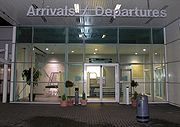
 During 1998 and 1999 safety improvements were undertaken at the airport as a matter of priority. As the airport served Northern Ireland
and Donegal
in the Republic of Ireland
, funding was sourced and thereafter provided by the Irish Government in addition to that provided by the British Government and Derry City Council. These improvements meant that larger aircraft could use the airport, thus, Falcon Holidays started holiday charter flights in May 1999, followed in July by Ryanair
who operated scheduled flights. The Ryanair service to London Stansted
grew substantially and the Loganair routes continued to operate until October 2008 as a British Airways
franchise, including a sector to Dublin, initiated as a public service obligation route, subsidised by the Irish Government. Soaring fuel costs have now seen all British Airways operations to Northern Ireland suspended indefinitely.
Aer Arann
operated services to Manchester and Birmingham for a short time.
In May 2006, the European Commission
gave its approval for the British
and Irish
governments to invest €15 million in the airport. Although this work did not include for the lengthening of the single serviceable runway, it included the expansion of the safety zones at each end which would allow jets to land and take off with full passenger capacities. Operators of Boeing 737
jets were previously limited to 80% capacity as a safety feature due to the short length of the runway. Other works included the expansion of the apron
immediately in front of the control tower
which would allow for the parking of several aircraft at any one time. As a prelude to the expansion at the airport several families were removed from their homes under a Government Compulsory Purchase scheme
before the buildings and outbuildings were levelled.
At the end of 2008, British Airways, operated by Loganair as a franchise agreement, ceased the Glasgow International
route which had operated for 30 years, following the loss in July 2008 of their public service obligation route to Dublin. This route is now operated by Aer Arann. Aer Lingus Commuter had previously operated the route until 1994.
Ryanair also discontinued the Bristol
route and changed its Derry - East Midlands
route to Derry - Birmingham
announcing new flights to London Luton
and the airport's first scheduled international service to Alicante
which commenced in June 2009. The London Luton
route was however subsequently terminated on 27 March 2010.
The decrease in operational hours at the airport as a direct consequence of the challenging economic conditions have caused problems for Eglinton Flying Club and the helicopter flight training facility who in turn have threatened to leave the airport if the decisions are not reversed. They have claimed that this would cost the airport some £250,000 in annual revenue while the owners, Derry City Council, have countered that the decrease in operational hours was necessary as part of the implementation of the £600,000 budget reduction plan.
In January 2009 the council appointed Albert Harrison, the former head of Belfast International Airport
, as the new manager of the airport. He had been tasked with turning the loss making facility around and has been given just six months to implement savings of £600,000 per annum and increase the number of carriers, destinations and passengers. However more recently, newly appointed City of Derry Airport manager, Damien Tierney has taken control of this cost saving project.
to lift the capacity restriction on aircraft operating out of the airport. This has increased seat availability and passenger throughput at the airport. It has also enabled Ryanair to establish their first international route from the airport to Alicante
. Also announced was a new charter flight to Burgas
in Bulgaria to be operated by BH Air
. The Burgas flight will not operate for summer 2011 as PAX numbers for 2010 were not as expected.
In April 2009 the council issued tender documents for a multi-million pound expansion of the terminal to improve passenger flow and meet current EU customs and immigration regulations. The arrivals hall has recently been improved and tax free shopping, WHSmith and the Amelia Earhart Business lounge in the departure area are open during operational hours.
In mid-2009 work commenced on dualling the A2
from Maydown to Eglinton and the airport, which now provides a high speed dual carriageway connection to the city. This project was intended to be the first of several schemes including the "A5
dualling Derry to Aughnacloy " planned to commence in 2012 and the "A6
dualling Dungiven
to Derry" due to commence in 2013. It is projected that these schemes will greatly increase the catchment area for the airport rendering it a viable alternative to Northern Ireland's two other main airports.
Plans have also been announced that Derry City Council, who own and operate the airport are tendering for a development plan which could see a Hotel, Aircraft Painting Hangars, Freight Buildings and Office Accommodation built in the next 10 years.
2010 saw the commencement of a new route to Faro with Ryanair, the airport's second scheduled international destination. Routes were also announced to Edinburgh and Manchester with Aer Arann, however due to lower than expected public demand the routes have been suspended until market conditions are more favourable. It has also been announced that the Irish Government will no longer subsidise the Derry-Dublin route from July 2011.
The airport is to develop further Ryanair routes from the airport to European cities such as Barcelona
and Paris
. In addition discussions are under way with a third operator about re-establishing flights to Bristol
and, possibly, into one of the business hubs in London such as Gatwick or Heathrow.
As of April 2010, it has been reported that the airport has emerged from passenger recession, with passenger numbers released for February of the same year showing an increase over that of the same period for the year before. This increase is reported as 562 passengers and however modest this may appear, it has been further reported that the first flights for Faro began fully booked.
A report by Ilex-URC in September 2010, pointed out that there is intentions to grow and increase the number of scheduled routes out of the airport from 7 as of 2010, to 10 by 2015, and 15 by 2020.
Ryanair have confirmed that the Stansted route will operate 2x daily on a Monday and Friday from 15 April 2011.
Flybe commenced operation from the airport to Manchester on 19th May 2010.
who own and operate the airport began the process which will lead to the privatisation of the facility. Initially a holding company will be set up by the council which will own 100% of the shares, thereafter the council intends to do market research to seek the level of interest in private sector investors. As part of the privatisation plan two subsidiaries will be formed that will operate the airport and manage the estate.
In June 2010 it was announced that the Airport was in the final stages of discussion with the Balfour Beatty Group about a management contract, with the objective of bringing additional commercial experience and resources to the Airport for the economic benefit of the region and to reduce the subvention from the City Council.
Passenger numbers for 2005 fell following a reduction in Ryanair services to London Stansted
due to safety restrictions over the absence of a runway overshoot area. Services were then restored following the commencement of work on a runway extension. In 2006 new Ryanair services commenced to East Midlands, Liverpool and Glasgow Prestwick, with Bristol
commencing in November 2007.
Passenger numbers for 2008 were 438,996, but fell 21.2% in 2009 to 345,857 due to flight and route cancellations despite the announcement of new flights and removal of passenger number limits on existing flights following the completion of the runway extension.
Derry
Derry or Londonderry is the second-biggest city in Northern Ireland and the fourth-biggest city on the island of Ireland. The name Derry is an anglicisation of the Irish name Doire or Doire Cholmcille meaning "oak-wood of Colmcille"...
, Northern Ireland
Northern Ireland
Northern Ireland is one of the four countries of the United Kingdom. Situated in the north-east of the island of Ireland, it shares a border with the Republic of Ireland to the south and west...
. It is located on the south bank of Lough Foyle
Lough Foyle
Lough Foyle, sometimes Loch Foyle , is the estuary of the River Foyle in Ulster. It starts where the Foyle leaves Derry. It separates the Inishowen Peninsula in County Donegal, Republic of Ireland from County Londonderry in Northern Ireland.-Transport:...
, a short distance from the village of Eglinton
Eglinton, County Londonderry
Eglinton is a village in County Londonderry, Northern Ireland. It lies east of Derry, to which it serves as a sleeper village, and west of Limavady. Many inhabitants of the village work in Derry city and send their children to school there. Eglinton had a population of 3,165 people in the 2001...
and 8 mi (12.9 km) from the city centre
Central business district
A central business district is the commercial and often geographic heart of a city. In North America this part of a city is commonly referred to as "downtown" or "city center"...
. The location of the airport beside a RSPB bird sanctuary has been a matter of concern for some time following several reported bird strike
Bird strike
A bird strike—sometimes called birdstrike, avian ingestion , bird hit, or BASH —is a collision between an airborne animal and a man-made vehicle, especially aircraft...
s, the latest being on 3 August 2009.
Passenger numbers in 2009 were 345,857, a 21.2% decrease compared with 2008.
Eglinton Aerodrome, as it is known locally, has a CAA Ordinary Licence (Number P620) that allows flights for the public transport of passengers or for flying instruction as authorised by the licensee (Derry City Council
Derry City Council
Derry City Council is a district council in County Londonderry in Northern Ireland. The Council is is responsible for the city of Derry and the immediate environ, providing services to an estimated population of , making it the third largest district council in Northern Ireland by population.The...
).
History
The airportAirport
An airport is a location where aircraft such as fixed-wing aircraft, helicopters, and blimps take off and land. Aircraft may be stored or maintained at an airport...
has its origins in World War II
World War II
World War II, or the Second World War , was a global conflict lasting from 1939 to 1945, involving most of the world's nations—including all of the great powers—eventually forming two opposing military alliances: the Allies and the Axis...
. In 1941 RAF Eglinton air base was established as the home to No. 133 Squadron RAF
No. 133 Squadron RAF
133 Squadron RAF was one of the famous Eagle squadrons formed from American volunteers serving with the RAF during World War II.-History:133 Squadron was first formed in 1918 at RAF Ternhill. It was a training unit for the Handley Page O/400, flying the Royal Aircraft Factory F.E.2, that was...
which flew Hurricane fighters in defence of the city. In 1942 the base was occupied by the No. 41 Squadron RAF
No. 41 Squadron RAF
No. 41 Squadron of the Royal Air Force is currently the RAF's Test and Evaluation Squadron , based at RAF Coningsby, Lincolnshire. Its official title is "41 TES". The Squadron celebrates its 95th anniversary in 2011, and is one of the oldest RAF squadrons in existence.-First World War, 1916–1919:No...
. In 1943 the airfield became a Fleet Air Arm
Fleet Air Arm
The Fleet Air Arm is the branch of the British Royal Navy responsible for the operation of naval aircraft. The Fleet Air Arm currently operates the AgustaWestland Merlin, Westland Sea King and Westland Lynx helicopters...
base called HMS Gannet and was home to the No. 1847 Fleet Air Arm Squadron which provided convoy air cover as part of the Second Battle of the Atlantic.
After the war the base remained a military establishment until the 1950s when the Ministry of Defence
Ministry of Defence (United Kingdom)
The Ministry of Defence is the United Kingdom government department responsible for implementation of government defence policy and is the headquarters of the British Armed Forces....
returned much of the land to the original landowners. The original name of the airport was Londonderry Eglinton Airport and was usually just referred to as Eglinton. Some limited commercial activities were undertaken at the airfield during the 1960s when Emerald Airways operated a Glasgow service. During most of the 1970s the only flying at Eglinton was carried out by Eglinton Flying Club which is still based at the airport. In 1978 Londonderry City Council decided to purchase the airfield with a view to improving the transport infrastructure for the north-west of Ireland
Ireland
Ireland is an island to the northwest of continental Europe. It is the third-largest island in Europe and the twentieth-largest island on Earth...
. The airport has slowly developed since then with private short-haul charters to various destinations within the British Isles
British Isles
The British Isles are a group of islands off the northwest coast of continental Europe that include the islands of Great Britain and Ireland and over six thousand smaller isles. There are two sovereign states located on the islands: the United Kingdom of Great Britain and Northern Ireland and...
, a service which still continues including the recent addition of helicopter pilot training and charter services. Loganair
Loganair
Loganair is a Scottish airline with its registered office on the grounds of Glasgow International Airport and in Paisley, Renfrewshire, Scotland. Loganair operates scheduled services under a Flybe franchise in mainland Scotland and to Orkney, Shetland and the Western Isles. In addition it operates...
introduced the first scheduled flight between Derry and Glasgow
Glasgow
Glasgow is the largest city in Scotland and third most populous in the United Kingdom. The city is situated on the River Clyde in the country's west central lowlands...
in 1979, a route which was recently dropped due to rising fuel costs. This route was the only route for ten years until Loganair introduced an additional daily Manchester
Manchester
Manchester is a city and metropolitan borough in Greater Manchester, England. According to the Office for National Statistics, the 2010 mid-year population estimate for Manchester was 498,800. Manchester lies within one of the UK's largest metropolitan areas, the metropolitan county of Greater...
service in 1989.
A major redevelopment programme was undertaken by the Council from 1989 to 1993 with grant aid from the European Regional Development Fund
European Regional Development Fund
The European Regional Development Fund is a fund allocated by the European Union.-History:During the 1960s, the European Commission occasionally tried to establish a regional fund. Only Italy ever supported this, however, and nothing came of it. Britain made it an issue for their accession in...
. £10.5 million was spent upgrading all of the facilities at the airport including runway
Runway
According to ICAO a runway is a "defined rectangular area on a land aerodrome prepared for the landing and take-off of aircraft." Runways may be a man-made surface or a natural surface .- Orientation and dimensions :Runways are named by a number between 01 and 36, which is generally one tenth...
s, taxiway
Taxiway
A taxiway is a path on an airport connecting runways with ramps, hangars, terminals and other facilities. They mostly have hard surface such as asphalt or concrete, although smaller airports sometimes use gravel or grass....
s, access roads, navigation equipment and runway lighting, as well as a new purpose-built terminal
Airport terminal
An airport terminal is a building at an airport where passengers transfer between ground transportation and the facilities that allow them to board and disembark from aircraft....
and fire station. The new terminal was officially opened in March 1994. The name of the airport was officially changed from Londonderry Eglinton to the City of Derry Airport by Derry City Council following Nationalist support within the newly renamed council. However, as of July 2009, the Aeronautical Information Publication
Aeronautical Information Publication
In aviation, an Aeronautical Information Publication is defined by the International Civil Aviation Organization as a publication issued by or with the authority of a state and containing aeronautical information of a lasting character essential to air navigation...
published by the UK's air navigation service provider
Air Navigation Service Provider
An Air Navigation Service Provider is the organisation that separates aircraft on the ground or in flight in a dedicated block of airspace on behalf of a state or a number of states....
, National Air Traffic Services
National Air Traffic Services
NATS Ltd. is the main air navigation service provider in the United Kingdom. It provides en-route air traffic control services to flights within the UK Flight Information Regions and the Shanwick Oceanic Control Area, and provides air traffic control services to fifteen UK airports and Gibraltar...
, still shows Londonderry/Eglinton. At that time there were still only two scheduled routes carrying about 40,000 passenger each year. 1995 saw the arrival of Jersey European Airways
Flybe
Flybe Group PLC is a British low-cost regional airline headquartered at the Jack Walker House at Exeter International Airport in Devon, England...
who attempted to operate a short-lived shuttle link between Derry and Belfast City Airport
George Best Belfast City Airport
George Best Belfast City Airport is a single-runway airport in Belfast, County Antrim, Northern Ireland. Situated adjacent to the Port of Belfast it is from Belfast City Centre. It shares the site with the Short Brothers/Bombardier aircraft manufacturing facility...
.
Northern Ireland
Northern Ireland is one of the four countries of the United Kingdom. Situated in the north-east of the island of Ireland, it shares a border with the Republic of Ireland to the south and west...
and Donegal
Donegal
Donegal or Donegal Town is a town in County Donegal, Ireland. Its name, which was historically written in English as Dunnagall or Dunagall, translates from Irish as "stronghold of the foreigners" ....
in the Republic of Ireland
Republic of Ireland
Ireland , described as the Republic of Ireland , is a sovereign state in Europe occupying approximately five-sixths of the island of the same name. Its capital is Dublin. Ireland, which had a population of 4.58 million in 2011, is a constitutional republic governed as a parliamentary democracy,...
, funding was sourced and thereafter provided by the Irish Government in addition to that provided by the British Government and Derry City Council. These improvements meant that larger aircraft could use the airport, thus, Falcon Holidays started holiday charter flights in May 1999, followed in July by Ryanair
Ryanair
Ryanair is an Irish low-cost airline. Its head office is at Dublin Airport and its primary operational bases at Dublin Airport and London Stansted Airport....
who operated scheduled flights. The Ryanair service to London Stansted
London Stansted Airport
-Cargo:-Statistics:-Infrastructure:-Terminal and satellite buildings:Stansted is the newest passenger airport of all the main London airports. The terminal is an oblong glass building, and is separated in to three areas: Check-in concourse, arrivals and departures...
grew substantially and the Loganair routes continued to operate until October 2008 as a British Airways
British Airways
British Airways is the flag carrier airline of the United Kingdom, based in Waterside, near its main hub at London Heathrow Airport. British Airways is the largest airline in the UK based on fleet size, international flights and international destinations...
franchise, including a sector to Dublin, initiated as a public service obligation route, subsidised by the Irish Government. Soaring fuel costs have now seen all British Airways operations to Northern Ireland suspended indefinitely.
Aer Arann
Aer Arann
Aer Arann is a regional airline based in Dublin, Ireland. Aer Arann operates scheduled services from Ireland and the Isle of Man to destinations in Ireland, the United Kingdom, and France, with a fleet of 18 aircraft. Aer Arann has expanded from a single aircraft to Ireland's third largest airline...
operated services to Manchester and Birmingham for a short time.
In May 2006, the European Commission
European Commission
The European Commission is the executive body of the European Union. The body is responsible for proposing legislation, implementing decisions, upholding the Union's treaties and the general day-to-day running of the Union....
gave its approval for the British
Politics of the United Kingdom
The politics of the United Kingdom takes place within the framework of a constitutional monarchy, in which the Monarch is the head of state and the Prime Minister of the United Kingdom is the head of government...
and Irish
Politics of the Republic of Ireland
Ireland is a parliamentary, representative democratic republic and a member state of the European Union. While the head of state is the popularly elected President of Ireland, this is a largely ceremonial position with real political power being vested in the indirectly elected Taoiseach who is...
governments to invest €15 million in the airport. Although this work did not include for the lengthening of the single serviceable runway, it included the expansion of the safety zones at each end which would allow jets to land and take off with full passenger capacities. Operators of Boeing 737
Boeing 737
The Boeing 737 is a short- to medium-range, twin-engine narrow-body jet airliner. Originally developed as a shorter, lower-cost twin-engine airliner derived from Boeing's 707 and 727, the 737 has developed into a family of nine passenger models with a capacity of 85 to 215 passengers...
jets were previously limited to 80% capacity as a safety feature due to the short length of the runway. Other works included the expansion of the apron
Airport ramp
The airport ramp or apron is part of an airport. It is usually the area where aircraft are parked, unloaded or loaded, refueled or boarded. Although the use of the apron is covered by regulations, such as lighting on vehicles, it is typically more accessible to users than the runway or taxiway...
immediately in front of the control tower
Control tower
A control tower, or more specifically an Air Traffic Control Tower , is the name of the airport building from which the air traffic control unit controls the movement of aircraft on and around the airport. Control towers are also used to control the traffic for other forms of transportation such...
which would allow for the parking of several aircraft at any one time. As a prelude to the expansion at the airport several families were removed from their homes under a Government Compulsory Purchase scheme
Compulsory purchase order
A compulsory purchase order is a legal function in the United Kingdom and the Republic of Ireland that allows certain bodies which need to obtain land or property to do so without the consent of the owner. It may be enforced if a proposed development is considered one for public betterment - for...
before the buildings and outbuildings were levelled.
At the end of 2008, British Airways, operated by Loganair as a franchise agreement, ceased the Glasgow International
Glasgow International Airport
Glasgow International Airport is an international airport in Scotland, located west of Glasgow city centre, near the towns of Paisley and Renfrew in Renfrewshire...
route which had operated for 30 years, following the loss in July 2008 of their public service obligation route to Dublin. This route is now operated by Aer Arann. Aer Lingus Commuter had previously operated the route until 1994.
Ryanair also discontinued the Bristol
Bristol
Bristol is a city, unitary authority area and ceremonial county in South West England, with an estimated population of 433,100 for the unitary authority in 2009, and a surrounding Larger Urban Zone with an estimated 1,070,000 residents in 2007...
route and changed its Derry - East Midlands
East Midlands
The East Midlands is one of the regions of England, consisting of most of the eastern half of the traditional region of the Midlands. It encompasses the combined area of Nottinghamshire, Derbyshire, Leicestershire, Rutland, Northamptonshire and most of Lincolnshire...
route to Derry - Birmingham
Birmingham
Birmingham is a city and metropolitan borough in the West Midlands of England. It is the most populous British city outside the capital London, with a population of 1,036,900 , and lies at the heart of the West Midlands conurbation, the second most populous urban area in the United Kingdom with a...
announcing new flights to London Luton
London Luton Airport
London Luton Airport is an international airport located east of the town centre in the Borough of Luton in Bedfordshire, England and is north of Central London. The airport is from Junction 10a of the M1 motorway...
and the airport's first scheduled international service to Alicante
Alicante
Alicante or Alacant is a city in Spain, the capital of the province of Alicante and of the comarca of Alacantí, in the south of the Valencian Community. It is also a historic Mediterranean port. The population of the city of Alicante proper was 334,418, estimated , ranking as the second-largest...
which commenced in June 2009. The London Luton
London Luton Airport
London Luton Airport is an international airport located east of the town centre in the Borough of Luton in Bedfordshire, England and is north of Central London. The airport is from Junction 10a of the M1 motorway...
route was however subsequently terminated on 27 March 2010.
The decrease in operational hours at the airport as a direct consequence of the challenging economic conditions have caused problems for Eglinton Flying Club and the helicopter flight training facility who in turn have threatened to leave the airport if the decisions are not reversed. They have claimed that this would cost the airport some £250,000 in annual revenue while the owners, Derry City Council, have countered that the decrease in operational hours was necessary as part of the implementation of the £600,000 budget reduction plan.
In January 2009 the council appointed Albert Harrison, the former head of Belfast International Airport
Belfast International Airport
Belfast International Airport is a major airport located northwest of Belfast in Northern Ireland. It was formerly known and is still referred to as Aldergrove Airport, after the village of the same name lying immediately to the west of the airport. Belfast International shares its runways with...
, as the new manager of the airport. He had been tasked with turning the loss making facility around and has been given just six months to implement savings of £600,000 per annum and increase the number of carriers, destinations and passengers. However more recently, newly appointed City of Derry Airport manager, Damien Tierney has taken control of this cost saving project.
The future
The recently completed runway safety zone extension and apron works has allowed the CAACAA
-Arts:*China Academy of Art, the highest university of art in China which founded in 1928*College Art Association, a professional association in the United States for scholars of art, art history, and art criticism...
to lift the capacity restriction on aircraft operating out of the airport. This has increased seat availability and passenger throughput at the airport. It has also enabled Ryanair to establish their first international route from the airport to Alicante
Alicante Airport
Alicante Airport , , originally named El Altet, is the sixth busiest airport in Spain, and the main airport for the Province of Alicante and the Region of Murcia. The airport is situated southwest of Alicante and east of Elche in the municipality of Elche on Mediterranean coast. Up to eighty...
. Also announced was a new charter flight to Burgas
Burgas
-History:During the rule of the Ancient Romans, near Burgas, Debeltum was established as a military colony for veterans by Vespasian. In the Middle Ages, a small fortress called Pyrgos was erected where Burgas is today and was most probably used as a watchtower...
in Bulgaria to be operated by BH Air
BH Air
BH Air Ltd., or Balkan Holidays Airlines, is an airline headquartered in Sofia, Bulgaria. It is a branch of tour operator Balkan Holidays International and as such offers charter flights to the United Kingdom, Scandinavia, Germany, Israel and Switzerland, as well as ad hoc charters to other...
. The Burgas flight will not operate for summer 2011 as PAX numbers for 2010 were not as expected.
In April 2009 the council issued tender documents for a multi-million pound expansion of the terminal to improve passenger flow and meet current EU customs and immigration regulations. The arrivals hall has recently been improved and tax free shopping, WHSmith and the Amelia Earhart Business lounge in the departure area are open during operational hours.
In mid-2009 work commenced on dualling the A2
A2 road (Northern Ireland)
The A2 is a major road in Northern Ireland, a large section of which is often called the Antrim Coast Road because it follows the scenic coastline of County Antrim....
from Maydown to Eglinton and the airport, which now provides a high speed dual carriageway connection to the city. This project was intended to be the first of several schemes including the "A5
A5 road (Northern Ireland)
The A5 is a major primary route in Northern Ireland. It travels through County Londonderry and County Tyrone, commencing in the city of Derry, passing the large towns of Strabane and Omagh before it meets the N2 across the border in the Republic of Ireland towards the final destination of...
dualling Derry to Aughnacloy " planned to commence in 2012 and the "A6
A6 road (Northern Ireland)
The A6 road in Northern Ireland runs from the Belfast to Derry, via Antrim. Mostly single carriageway, there is a short dual carriageway section forming the Toome bypass. Towards Derry, there is also a short section of dual carriageway at Altnagelvin. This is one of Northern Ireland's most...
dualling Dungiven
Dungiven
Dungiven is a small town and townland in County Londonderry, Northern Ireland. It is on the main A6 Belfast to Derry road. It lies where the rivers Roe, Owenreagh and Owenbeg meet at the foot of the Benbradagh. Nearby is the Glenshane Pass, where the road rises to over...
to Derry" due to commence in 2013. It is projected that these schemes will greatly increase the catchment area for the airport rendering it a viable alternative to Northern Ireland's two other main airports.
Plans have also been announced that Derry City Council, who own and operate the airport are tendering for a development plan which could see a Hotel, Aircraft Painting Hangars, Freight Buildings and Office Accommodation built in the next 10 years.
2010 saw the commencement of a new route to Faro with Ryanair, the airport's second scheduled international destination. Routes were also announced to Edinburgh and Manchester with Aer Arann, however due to lower than expected public demand the routes have been suspended until market conditions are more favourable. It has also been announced that the Irish Government will no longer subsidise the Derry-Dublin route from July 2011.
The airport is to develop further Ryanair routes from the airport to European cities such as Barcelona
Barcelona
Barcelona is the second largest city in Spain after Madrid, and the capital of Catalonia, with a population of 1,621,537 within its administrative limits on a land area of...
and Paris
Paris
Paris is the capital and largest city in France, situated on the river Seine, in northern France, at the heart of the Île-de-France region...
. In addition discussions are under way with a third operator about re-establishing flights to Bristol
Bristol
Bristol is a city, unitary authority area and ceremonial county in South West England, with an estimated population of 433,100 for the unitary authority in 2009, and a surrounding Larger Urban Zone with an estimated 1,070,000 residents in 2007...
and, possibly, into one of the business hubs in London such as Gatwick or Heathrow.
As of April 2010, it has been reported that the airport has emerged from passenger recession, with passenger numbers released for February of the same year showing an increase over that of the same period for the year before. This increase is reported as 562 passengers and however modest this may appear, it has been further reported that the first flights for Faro began fully booked.
A report by Ilex-URC in September 2010, pointed out that there is intentions to grow and increase the number of scheduled routes out of the airport from 7 as of 2010, to 10 by 2015, and 15 by 2020.
Ryanair have confirmed that the Stansted route will operate 2x daily on a Monday and Friday from 15 April 2011.
Flybe commenced operation from the airport to Manchester on 19th May 2010.
Privatisation
On 9 October 2009, Derry City CouncilDerry City Council
Derry City Council is a district council in County Londonderry in Northern Ireland. The Council is is responsible for the city of Derry and the immediate environ, providing services to an estimated population of , making it the third largest district council in Northern Ireland by population.The...
who own and operate the airport began the process which will lead to the privatisation of the facility. Initially a holding company will be set up by the council which will own 100% of the shares, thereafter the council intends to do market research to seek the level of interest in private sector investors. As part of the privatisation plan two subsidiaries will be formed that will operate the airport and manage the estate.
In June 2010 it was announced that the Airport was in the final stages of discussion with the Balfour Beatty Group about a management contract, with the objective of bringing additional commercial experience and resources to the Airport for the economic benefit of the region and to reduce the subvention from the City Council.
Airlines and destinations
Note: † denotes charter airlines and their destinationsPassenger statistics
| ||||||||||||||||||||||||||||||||||||||||||||||||||
Passenger numbers for 2005 fell following a reduction in Ryanair services to London Stansted
London Stansted Airport
-Cargo:-Statistics:-Infrastructure:-Terminal and satellite buildings:Stansted is the newest passenger airport of all the main London airports. The terminal is an oblong glass building, and is separated in to three areas: Check-in concourse, arrivals and departures...
due to safety restrictions over the absence of a runway overshoot area. Services were then restored following the commencement of work on a runway extension. In 2006 new Ryanair services commenced to East Midlands, Liverpool and Glasgow Prestwick, with Bristol
Bristol International Airport
Bristol Airport , located at Lulsgate Bottom in North Somerset, is the commercial airport serving the city of Bristol, England and the surrounding area. At first it was named Bristol Lulsgate Airport and from March 1997 to March 2010 it was known as Bristol International Airport...
commencing in November 2007.
Passenger numbers for 2008 were 438,996, but fell 21.2% in 2009 to 345,857 due to flight and route cancellations despite the announcement of new flights and removal of passenger number limits on existing flights following the completion of the runway extension.
| Rank | Airport | Passengers handled | 2009-2010 Change | Airlines that serve(d) |
|---|---|---|---|---|
| 1 |  United Kingdom - London Stansted Airport United Kingdom - London Stansted AirportLondon Stansted Airport -Cargo:-Statistics:-Infrastructure:-Terminal and satellite buildings:Stansted is the newest passenger airport of all the main London airports. The terminal is an oblong glass building, and is separated in to three areas: Check-in concourse, arrivals and departures... |
89,827 | 12.8% | Ryanair |
| 2 | United Kingdom - Liverpool Airport |
71,582 | 3.6% | Ryanair |
| 3 | United Kingdom - Glasgow-Prestwick Airport |
55,049 | 7.2% | Ryanair |
| 4 | United Kingdom - Birmingham Airport |
49,300 | 27.1% | Ryanair |
| 5 |  Portugal - Faro Airport Portugal - Faro AirportFaro Airport -Incidents and accidents:*On 21 December 1992, Martinair Flight 495 skidded off the runway in bad weather at Faro Airport killing 54 passengers and two crew out of a total of 340 people on board.... |
19,937 | -- | Ryanair (seasonal) New route 2010 |
| 6 |  Spain - Alicante Airport Spain - Alicante AirportAlicante Airport Alicante Airport , , originally named El Altet, is the sixth busiest airport in Spain, and the main airport for the Province of Alicante and the Region of Murcia. The airport is situated southwest of Alicante and east of Elche in the municipality of Elche on Mediterranean coast. Up to eighty... |
15,933 | 21.8% | Ryanair (seasonal) |
| 7 | - Dublin Airport Dublin Airport Dublin Airport, , is operated by the Dublin Airport Authority. Located in Collinstown, in the Fingal part of County Dublin, 18.4 million passengers passed through the airport in 2010, making it the busiest airport in the Republic of Ireland, followed by Cork and Shannon... |
14,961 | 29.9% | Aer Arann |
| Source: UK Civil Aviation Authority United Kingdom Civil Aviation Authority The Civil Aviation Authority is the public corporation which oversees and regulates all aspects of aviation in the United Kingdom. The CAA head office is located in the CAA House on Kingsway in Holborn, London Borough of Camden... http://www.caa.co.uk/default.aspx?categoryid=80&pagetype=88&pageid=3&sglid=3 |
||||
Incidents and accidents
- 29 March 2006 - the Irish airlineAirlineAn airline provides air transport services for traveling passengers and freight. Airlines lease or own their aircraft with which to supply these services and may form partnerships or alliances with other airlines for mutual benefit...
EirjetEirjetEirjet was a charter airline with its head office on the grounds of Shannon International Airport in Shannon, County Clare, Ireland. They operated charter services to sun and ski destinations throughout Europe...
issued an apology after a flight it operated from Liverpool John Lennon AirportLiverpool John Lennon AirportLiverpool John Lennon Airport is an international airport serving the city of Liverpool and the North West of England. Formerly known as Speke Airport, RAF Speke, and Liverpool Airport the airport is located within the City of Liverpool adjacent to the estuary of the River Mersey some southeast...
to City of Derry Airport on behalf of Ryanair landed at the wrong airfield, touching down at Ballykelly AirfieldShackleton BarracksShackleton Barracks, Ballykelly, County Londonderry, Northern Ireland, was a British Army base that was originally known as RAF Ballykelly, a Royal Air Force station which opened in 1941...
, a former RAFRoyal Air ForceThe Royal Air Force is the aerial warfare service branch of the British Armed Forces. Formed on 1 April 1918, it is the oldest independent air force in the world...
base and more recently an ArmyBritish ArmyThe British Army is the land warfare branch of Her Majesty's Armed Forces in the United Kingdom. It came into being with the unification of the Kingdom of England and Scotland into the Kingdom of Great Britain in 1707. The new British Army incorporated Regiments that had already existed in England...
base some 10 km (6.2 mi) away from its intended destination. The statement explained that the incident was caused by an "error by the Eirjet pilot who mistakenly believed he was on a visual approach to City of Derry airport". An air accident investigation report in January 2007 reported that the pilot had been unable to obtain the correct set of charts prior to the flight, only obtaining them the day after the incident. The pilot stated that if he had seen the charts, he would have been fully aware of the existence of Ballykelly and would not have landed there. The crew believed the instrument landing aid system at City of Derry was malfunctioning as what they saw of the runway did not match the instrument readings and the presence of an instrument calibrating aircraft close by added to their belief that there was a technical fault. The report also stated that although an air traffic controller thought the jet was "slightly low" he did not warn the crew about the other runway.
- 24 May 2007 - The airport was closed by Civil Aviation Authority following an inspection. Problems found include lack of an effective bird controlBird controlBird control is the generic name for methods to eliminate or deter pest birds from landing, roosting and nesting.Bird control is important because pest birds can create health-related problems through their feces, including histoplasmosis, cryptococcosis, and psittacosis. Bird droppings may also...
plan, unsuitable temporary repairs to the area where planes park and poor runway drainage. Four days later, after reinspection, the CAA allowed the airport to be reopened. Changes made to the airport included placing nets over culverts and ponds nearby, repairs to the aircraft parking apron and minor drainage work carried out on the runway. All cancelled airlines, including British Airways and Ryanair subsequently resumed full services.