

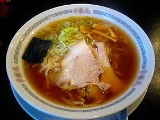
Ramen

Encyclopedia
Noodle
The noodle is a type of food, made from any of a variety of doughs, formed into long thin ribbons, strips, curly-cues, waves, helices, pipes, tubes, strings, or other various shapes, sometimes folded. They are usually cooked in a mixture of boiling water and/or oil. Depending upon the type, noodles...
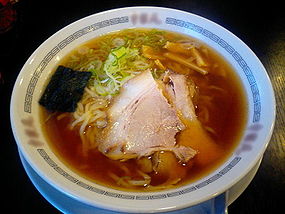
dish. It consists of Chinese-style wheat noodles served in a meat- or fish-based broth
Broth
Broth is a liquid food preparation, typically consisting of either water or an already flavored stock, in which bones, meat, fish, cereal grains, or vegetables have been simmered. Broth is used as a basis for other edible liquids such as soup, gravy, or sauce. It can be eaten alone or with garnish...
, often flavored with soy sauce
Soy sauce
Soy sauce is a condiment produced by fermenting soybeans with Aspergillus oryzae or Aspergillus sojae molds, along with water and salt...
or miso
Miso
is a traditional Japanese seasoning produced by fermenting rice, barley and/or soybeans, with salt and the fungus , the most typical miso being made with soy. The result is a thick paste used for sauces and spreads, pickling vegetables or meats, and mixing with dashi soup stock to serve as miso...
, and uses toppings
Topping
Topping may refer to:* Hill-topping, a mate-acquisition strategy amongst insects* Topping, slang term for capital punishment, especially hanging or beheading* Topping , the name of several people...
such as , , kamaboko
Kamaboko
is a type of cured surimi, a Japanese processed seafood product, in which various white fish are pureed, combined with additives such as MSG, formed into distinctive loaves, and then steamed until fully cooked and firm. The steamed loaves are then sliced and served unheated with various dipping...
, green onions
Scallion
Scallions , are the edible plants of various Allium species, all of which are "onion-like", having hollow green leaves and lacking a fully developed root bulb.-Etymology:The words...
, and occasionally corn
Corn
Corn is the name used in the United States, Canada, and Australia for the grain maize.In much of the English-speaking world, the term "corn" is a generic term for cereal crops, such as* Barley* Oats* Wheat* Rye- Places :...
. Almost every locality in Japan has its own variation of ramen, from the tonkotsu (pork bone broth) ramen of Kyushu
Kyushu
is the third largest island of Japan and most southwesterly of its four main islands. Its alternate ancient names include , , and . The historical regional name is referred to Kyushu and its surrounding islands....
to the miso ramen of Hokkaido
Hokkaido
, formerly known as Ezo, Yezo, Yeso, or Yesso, is Japan's second largest island; it is also the largest and northernmost of Japan's 47 prefectural-level subdivisions. The Tsugaru Strait separates Hokkaido from Honshu, although the two islands are connected by the underwater railway Seikan Tunnel...
.
History
Ramen is of ChineseChinese cuisine
Chinese cuisine is any of several styles originating in the regions of China, some of which have become highly popular in other parts of the world – from Asia to the Americas, Australia, Western Europe and Southern Africa...
origin, however it is unclear when ramen was introduced to Japan
Japan
Japan is an island nation in East Asia. Located in the Pacific Ocean, it lies to the east of the Sea of Japan, China, North Korea, South Korea and Russia, stretching from the Sea of Okhotsk in the north to the East China Sea and Taiwan in the south...
. Even the etymology of the word ramen is a topic of debate. One theory is that ramen is the Japanese pronunciation of the Chinese lamian
Lamian
Lamian is a type of hand-made or hand-pulled Chinese noodle. It is also the name of the dishes that use these noodles.-Etymology and preparation:...
(拉麺), meaning "hand-pulled noodles." A second theory proposes 老麺 (laomian, "old noodles") as the original form, while another states that ramen was initially 鹵麺 (lǔmiàn), noodles cooked in a thick, starchy sauce. A fourth theory is that the word derives from 撈麵 (lāomiàn, "lo mein
Lo mein
Lo mein is a Chinese dish with wheat flour noodles. It often contains vegetables and some type of meat or seafood, usually beef, chicken, pork, shrimp or wontons.-Etymology:...
"), which in Cantonese
Cantonese
Cantonese is a dialect spoken primarily in south China.Cantonese may also refer to:* Yue Chinese, the Chinese language that includes Cantonese* Cantonese cuisine, the cuisine of Guangdong province...
撈 means to "stir", and the name refers to the method of preparation by stirring the noodles with a sauce.
Until the 1950s, ramen was called shina
Shina (word)
are Romanized Japanese transliterations for the Chinese character compound "支那" which is viewed by most Chinese people as an offensive term for China...
soba
Soba
is the Japanese name for buckwheat. It is synonymous with a type of thin noodle made from buckwheat flour, and in Japan can refer to any thin noodle . Soba noodles are served either chilled with a dipping sauce, or in hot broth as a noodle soup...
(支那そば, literally "Chinese buckwheat noodle") but today chūka soba (中華そば, also meaning "Chinese buckwheat noodle") or just Ramen (ラーメン) are more common, as the word "支那" (shina, meaning "China") is considered offensive by many.
By 1900, restaurants serving Chinese cuisine
Chinese cuisine
Chinese cuisine is any of several styles originating in the regions of China, some of which have become highly popular in other parts of the world – from Asia to the Americas, Australia, Western Europe and Southern Africa...
from Canton
Guangzhou
Guangzhou , known historically as Canton or Kwangchow, is the capital and largest city of the Guangdong province in the People's Republic of China. Located in southern China on the Pearl River, about north-northwest of Hong Kong, Guangzhou is a key national transportation hub and trading port...
and Shanghai
Shanghai
Shanghai is the largest city by population in China and the largest city proper in the world. It is one of the four province-level municipalities in the People's Republic of China, with a total population of over 23 million as of 2010...
offered a simple ramen dish of noodles (cut rather than hand pulled), a few toppings, and a broth flavored with salt and pork bones. Many Chinese also pulled portable food stalls, selling ramen and gyōza
Jiaozi
Jiǎozi 餃子 or 饺子 , bánh bột luộc , gyōza , Mo:Mo: or Momocha म:म: or ममचा , or pot sticker is a Chinese dumpling widely spread to Japan, Eastern and Western Asia.Jiaozi typically consist of a ground meat and/or vegetable filling wrapped into...
dumpling
Dumpling
Dumplings are cooked balls of dough. They are based on flour, potatoes or bread, and may include meat, fish, vegetables, or sweets. They may be cooked by boiling, steaming, simmering, frying, or baking. They may have a filling, or there may be other ingredients mixed into the dough. Dumplings may...
s to workers. By the mid 1900s, these stalls used a type of a musical horn
Horn (instrument)
The horn is a brass instrument consisting of about of tubing wrapped into a coil with a flared bell. A musician who plays the horn is called a horn player ....
called a charumera (チャルメラ, from the Portuguese charamela) to advertise their presence, a practice some vendors still retain via a loudspeaker and a looped recording. By the early Shōwa period
Showa period
The , or Shōwa era, is the period of Japanese history corresponding to the reign of the Shōwa Emperor, Hirohito, from December 25, 1926 through January 7, 1989.The Shōwa period was longer than the reign of any previous Japanese emperor...
, ramen had become a popular dish when eating out.
After World War II
World War II
World War II, or the Second World War , was a global conflict lasting from 1939 to 1945, involving most of the world's nations—including all of the great powers—eventually forming two opposing military alliances: the Allies and the Axis...
, cheap flour imported from the U.S. swept the Japanese market. At the same time, millions of Japanese troops had returned from China and continental East Asia. Many of these returnees had become familiar with Chinese cuisine and subsequently set up Chinese restaurants across Japan. Eating ramen, while popular, was still a special occasion that required going out.
In 1958, instant noodles
Instant noodles
Instant noodles are dried or precooked noodles and are often sold with packets of flavoring including seasoning oil. Dried noodles are usually eaten after being cooked or soaked in boiling water for 2 to 5 minutes, while precooked noodles can be reheated or eaten straight from the packet...
were invented by Momofuku Ando
Momofuku Ando
, ORS, was a Taiwanese-Japanese businessman who founded Nissin Food Products Co., Ltd. He is famed as the inventor of instant noodles and cup noodles.- Early life :...
, the Taiwanese-Japanese founder and chairman of Nissin Foods, now run by his son Koki Ando
Koki Ando
is the son of the inventor of instant Ramen noodles, Momofuku Ando. Following his fathers death in 2007, Koki Ando is now the president and the CEO of Nissin Foods Holdings Co. Ltd..- References :...
. Named the greatest Japanese invention
Invention
An invention is a novel composition, device, or process. An invention may be derived from a pre-existing model or idea, or it could be independently conceived, in which case it may be a radical breakthrough. In addition, there is cultural invention, which is an innovative set of useful social...
of the 20th century in a Japanese poll, instant ramen allowed anyone to make this dish simply by adding boiling water.
Beginning in the 1980s, ramen became a Japanese cultural icon and was studied around the world from many perspectives. At the same time, local varieties of ramen were hitting the national market and could even be ordered by their regional names. A ramen museum opened in Yokohama
Yokohama
is the capital city of Kanagawa Prefecture and the second largest city in Japan by population after Tokyo and most populous municipality of Japan. It lies on Tokyo Bay, south of Tokyo, in the Kantō region of the main island of Honshu...
in 1994.
Types
A wide variety of ramen exists in Japan, with geographical and vendor-specific differences even in varieties that share the same name. Ramen can be broadly categorized by its two main ingredients: noodles and broth.Noodles
Sodium carbonate
Sodium carbonate , Na2CO3 is a sodium salt of carbonic acid. It most commonly occurs as a crystalline heptahydrate, which readily effloresces to form a white powder, the monohydrate. Sodium carbonate is domestically well-known for its everyday use as a water softener. It can be extracted from the...
and usually potassium carbonate
Potassium carbonate
Potassium carbonate is a white salt, soluble in water , which forms a strongly alkaline solution. It can be made as the product of potassium hydroxide's absorbent reaction with carbon dioxide. It is deliquescent, often appearing a damp or wet solid...
, as well as sometimes a small amount of phosphoric acid
Phosphoric acid
Phosphoric acid, also known as orthophosphoric acid or phosphoric acid, is a mineral acid having the chemical formula H3PO4. Orthophosphoric acid molecules can combine with themselves to form a variety of compounds which are also referred to as phosphoric acids, but in a more general way...
. Originally, kansui was named after the water from Inner Mongolia
Inner Mongolia
Inner Mongolia is an autonomous region of the People's Republic of China, located in the northern region of the country. Inner Mongolia shares an international border with the countries of Mongolia and the Russian Federation...
's Lake Kan which contained large amounts of these minerals and was said to be perfect for making these noodles. Making noodles with kansui lends them a yellowish hue as well as a firm texture. For a brief time after World War II
World War II
World War II, or the Second World War , was a global conflict lasting from 1939 to 1945, involving most of the world's nations—including all of the great powers—eventually forming two opposing military alliances: the Allies and the Axis...
, low-quality tainted kansui was sold, though kansui is now manufactured according to JAS
Japanese Agricultural Standards
Japanese Agricultural Standards are industrial standards for the agriculture industry maintained by the Japanese Government. They are comparable to Japanese Industrial Standards but for food and agricultural products. Also included is the grading of lumber for import into Japan. JAS #1 lumber,...
standards. Eggs may also be substituted for kansui. Some noodles are made with neither eggs nor kansui and should only be used for yakisoba
Yakisoba
', literally "fried noodles", is a dish often sold at festivals in Japan, but originates in China. The dish was derived by the Chinese from the traditional chow mein, but has been more heavily integrated into Japanese cuisine like ramen...
.
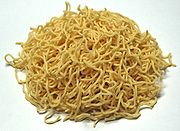
Ramen noodles come in various shapes and lengths. They may be fat, thin, or even ribbon-like, as well as straight or wrinkled.
Soup
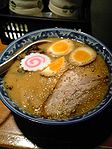
Kombu
Kombu or konbu , also called dashima or haidai , is edible kelp from the family Laminariaceae widely eaten in East Asia....
(kelp), katsuobushi
Katsuobushi
is the Japanese name for dried, fermented, and smoked skipjack tuna .Shaved Katsuobushi and dried kelp - kombu - are the main ingredients of dashi, a broth that forms the basis of many soups and sauces in Japanese cuisine.Katsuobushi's distinct umami flavor comes from its high...
(skipjack tuna
Skipjack tuna
The skipjack tuna, Katsuwonus pelamis, is a medium-sized perciform fish in the tuna family, Scombridae. It is otherwise known as the aku, arctic bonito, mushmouth, oceanic bonito, striped tuna, or victor fish...
flakes), niboshi
Niboshi
Niboshi are Japanese dried baby sardines . They are one of many varieties of small dried fish used throughout Asia in snacks and as seasoning for soup stocks and other foods....
(dried baby sardines), beef
Beef
Beef is the culinary name for meat from bovines, especially domestic cattle. Beef can be harvested from cows, bulls, heifers or steers. It is one of the principal meats used in the cuisine of the Middle East , Australia, Argentina, Brazil, Europe and the United States, and is also important in...
bones, shiitake
Shiitake
The Shiitake is an edible mushroom native to East Asia, which is cultivated and consumed in many Asian countries, as well as being dried and exported to many countries around the world. It is a feature of many Asian cuisines including Vietnamese, Chinese, Japanese, Korean and Thai...
, and onion
Onion
The onion , also known as the bulb onion, common onion and garden onion, is the most widely cultivated species of the genus Allium. The genus Allium also contains a number of other species variously referred to as onions and cultivated for food, such as the Japanese bunching onion The onion...
s, and then flavored with salt, miso
Miso
is a traditional Japanese seasoning produced by fermenting rice, barley and/or soybeans, with salt and the fungus , the most typical miso being made with soy. The result is a thick paste used for sauces and spreads, pickling vegetables or meats, and mixing with dashi soup stock to serve as miso...
, or soy sauce
Soy sauce
Soy sauce is a condiment produced by fermenting soybeans with Aspergillus oryzae or Aspergillus sojae molds, along with water and salt...
. Other styles that have emerged later on include curry ramen and other flavors.
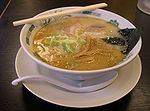
The resulting combination is generally divided into four categories (although new and original variations often make this categorisation less clear-cut):
- Shio ("salt") ramen is probably the oldest of the four and is a pale, clear, yellowish broth made with plenty of salt and any combination of chicken, vegetables, fish, and seaweed. Occasionally pork bones are also used, but they are not boiled as long as they are for tonkotsu ramen, so the soup remains light and clear. Chāshū is sometimes swapped for lean chicken meatballs, and pickled plums and kamabokoKamabokois a type of cured surimi, a Japanese processed seafood product, in which various white fish are pureed, combined with additives such as MSG, formed into distinctive loaves, and then steamed until fully cooked and firm. The steamed loaves are then sliced and served unheated with various dipping...
are popular toppings as well. Noodle texture and thickness varies among shio ramen, but they are usually straight rather than curly. - (豚骨, "pork bone"; not to be confused with tonkatsuTonkatsuTonkatsu , invented in the late 19th century, is a popular dish in Japan. It consists of a breaded, deep-fried pork cutlet one to two centimeters thick and sliced into bite-sized pieces, generally served with shredded cabbage and/or miso soup...
) ramen usually has a cloudy white colored broth. It is similar to the Chinese baitang (白湯) and has a thick broth made from boiling pork bones, fat, and collagen over high heat for many hours, which suffuses the broth with a hearty pork flavor and a creamy consistency that rivals milk or melted butter or gravy (depending on the shop). Most shops, but not all, blend this pork broth with a small amount of chicken and vegetable stock and/or soy sauce. The noodles are thin and straight, and it is often served with beni shogaBeni shogais a type of tsukemono . It is made from ginger cut into thin strips, colored red, and pickled in umezu , the pickling solution used to make umeboshi; the red color is derived from red perilla. It is served with many Japanese dishes, including gyūdon, okonomiyaki, and yakisoba.Beni shōga is not the...
(pickled ginger). Currently the latest trend in tonkotsu toppings is māyu (マー油/麻油Sesame oilSesame oil is an edible vegetable oil derived from sesame seeds. Besides being used as a cooking oil in South India, it is often used as a flavor enhancer in Chinese, Japanese, Korean, and to a lesser extent Southeast Asian cuisine.The oil from the nutrient rich seed is popular in alternative...
), a blackish, aromatic oil made from either charred crushed garlic or Sesame seeds. It is a specialty of KyūshūKyushuis the third largest island of Japan and most southwesterly of its four main islands. Its alternate ancient names include , , and . The historical regional name is referred to Kyushu and its surrounding islands....
, particularly Hakata-ku, FukuokaHakata-ku, Fukuokais one of the seven wards of Fukuoka City, Fukuoka Prefecture, Japan. It is best known as the location of Fukuoka's main train station, Hakata Station.-Geography:...
(hence sometimes called "Hakata ramen"). - Shōyu ("soy sauce") ramen typically has a brown and clear color broth, based on a chicken and vegetable (or sometimes fish or beef) stock with plenty of soy sauce added resulting in a soup that’s tangy, salty, and savory yet still fairly light on the palate. Shōyu ramen usually has curly noodles rather than straight ones, but this is not always the case. It is often adorned with marinated bamboo shoots or menmaMenmais a Japanese condiment made from lactate-fermented bamboo shoots. It is a common topping for noodle soup and ramen.Menma is also known as shinachiku ....
, green onions, kamaboko (fish cakes), nori (seaweed), boiled eggs, bean sprouts and/or black pepperBlack pepperBlack pepper is a flowering vine in the family Piperaceae, cultivated for its fruit, which is usually dried and used as a spice and seasoning. The fruit, known as a peppercorn when dried, is approximately in diameter, dark red when fully mature, and, like all drupes, contains a single seed...
; occasionally the soup will also contain chili oil or Chinese spices, and some shops serve sliced beef instead of the usual chāshū. - Miso ramen is a relative newcomer, having reached national prominence around 1965. This uniquely Japanese ramen, which was developed in HokkaidoHokkaido, formerly known as Ezo, Yezo, Yeso, or Yesso, is Japan's second largest island; it is also the largest and northernmost of Japan's 47 prefectural-level subdivisions. The Tsugaru Strait separates Hokkaido from Honshu, although the two islands are connected by the underwater railway Seikan Tunnel...
, features a broth that combines copious amounts of misoMisois a traditional Japanese seasoning produced by fermenting rice, barley and/or soybeans, with salt and the fungus , the most typical miso being made with soy. The result is a thick paste used for sauces and spreads, pickling vegetables or meats, and mixing with dashi soup stock to serve as miso...
and is blended with oily chicken or fish broth – and sometimes with tonkotsu or lard – to create a thick, nutty, slightly sweet and very hearty soup. Miso ramen broth tends to have a robust, tangy flavor, so it stands up to a variety of flavorful toppings: spicy bean paste or tōbanjanDoubanjiangDoubanjiang is a spicy, salty paste made from fermented broad beans, soybeans, salt, rice, and various spices. Doubanjiang exists in plain and spicy versions, with the latter containing red chili peppers and called la doubanjiang .It is used particularly in Sichuan cuisine, and in fact, the people...
(豆瓣醤), butter and corn, leeks, onions, bean sprouts, ground pork, cabbage, sesame seeds, white pepper, and chopped garlic are common. The noodles are typically thick, curly, and slightly chewy.
Seasonings commonly added to ramen are black pepper
Black pepper
Black pepper is a flowering vine in the family Piperaceae, cultivated for its fruit, which is usually dried and used as a spice and seasoning. The fruit, known as a peppercorn when dried, is approximately in diameter, dark red when fully mature, and, like all drupes, contains a single seed...
, butter
Butter
Butter is a dairy product made by churning fresh or fermented cream or milk. It is generally used as a spread and a condiment, as well as in cooking applications, such as baking, sauce making, and pan frying...
, chili pepper
Chili pepper
Chili pepper is the fruit of plants from the genus Capsicum, members of the nightshade family, Solanaceae. The term in British English and in Australia, New Zealand, India, Malaysia and other Asian countries is just chilli without pepper.Chili peppers originated in the Americas...
, sesame seeds, and crushed garlic
Garlic
Allium sativum, commonly known as garlic, is a species in the onion genus, Allium. Its close relatives include the onion, shallot, leek, chive, and rakkyo. Dating back over 6,000 years, garlic is native to central Asia, and has long been a staple in the Mediterranean region, as well as a frequent...
. Soup recipe
Recipe
A recipe is a set of instructions that describe how to prepare or make something, especially a culinary dish.-Components:Modern culinary recipes normally consist of several components*The name of the dish...
s and methods of preparation tend to be closely guarded secrets.
Some restaurants also offer a system known as kae-dama (替え玉), where customers who have finished their noodles can request a "refill" (for a few hundred yen more) to be put into their remaining soup.
Regional variations
While standard versions of ramen are available throughout Japan since the Taisho eraTaisho period
The , or Taishō era, is a period in the history of Japan dating from July 30, 1912 to December 25, 1926, coinciding with the reign of the Taishō Emperor. The health of the new emperor was weak, which prompted the shift in political power from the old oligarchic group of elder statesmen to the Diet...
, the last few decades have shown a proliferation of regional variations. Some of these which have gone on to national prominence are:
Sapporo, the capital of Hokkaido
Hokkaido
, formerly known as Ezo, Yezo, Yeso, or Yesso, is Japan's second largest island; it is also the largest and northernmost of Japan's 47 prefectural-level subdivisions. The Tsugaru Strait separates Hokkaido from Honshu, although the two islands are connected by the underwater railway Seikan Tunnel...
, is especially famous for its ramen. Most people in Japan associate Sapporo with its rich miso ramen, which was invented there and which is ideal for Hokkaidō's harsh, snowy winters. Sapporo miso ramen is typically topped with sweetcorn, butter, bean sprouts, finely chopped pork, and garlic, and sometimes local seafood such as scallop
Scallop
A scallop is a marine bivalve mollusk of the family Pectinidae. Scallops are a cosmopolitan family, found in all of the world's oceans. Many scallops are highly prized as a food source...
, squid
Squid
Squid are cephalopods of the order Teuthida, which comprises around 300 species. Like all other cephalopods, squid have a distinct head, bilateral symmetry, a mantle, and arms. Squid, like cuttlefish, have eight arms arranged in pairs and two, usually longer, tentacles...
, and crab
Crab
True crabs are decapod crustaceans of the infraorder Brachyura, which typically have a very short projecting "tail" , or where the reduced abdomen is entirely hidden under the thorax...
. Hakodate, another city of Hokkaidō, is famous for its salt flavored ramen, while Asahikawa, in the north of the island, offers soy sauce flavored ones.
Kitakata
Kitakata, Fukushima
is a city located in Fukushima, in northern Honshū, Japan. Kitakata was once written '北方', which meant 'northern place'.As of May 2011, the city had an estimated population of 51,955. The total area is 554.67km².The city was founded on March 31, 1954....
in northern Honshu
Honshu
is the largest island of Japan. The nation's main island, it is south of Hokkaido across the Tsugaru Strait, north of Shikoku across the Inland Sea, and northeast of Kyushu across the Kanmon Strait...
is known for its rather thick, flat, curly noodles served in a pork-and-niboshi
Niboshi
Niboshi are Japanese dried baby sardines . They are one of many varieties of small dried fish used throughout Asia in snacks and as seasoning for soup stocks and other foods....
broth. The area within its former city boundaries has the highest per-capita number of ramen establishments. Ramen has such prominence in the region that locally, the word soba usually refers to ramen, and not to actual soba
Soba
is the Japanese name for buckwheat. It is synonymous with a type of thin noodle made from buckwheat flour, and in Japan can refer to any thin noodle . Soba noodles are served either chilled with a dipping sauce, or in hot broth as a noodle soup...
which is referred to as nihon soba ("Japanese soba").
Tokyo
Tokyo
, ; officially , is one of the 47 prefectures of Japan. Tokyo is the capital of Japan, the center of the Greater Tokyo Area, and the largest metropolitan area of Japan. It is the seat of the Japanese government and the Imperial Palace, and the home of the Japanese Imperial Family...
style ramen consists of slightly thin, curly noodles served in a soy-flavoured chicken broth. The broth typically has a touch of dashi
Dashi
Dashi is a class of soup and cooking stock, considered fundamental to Japanese cooking. In 1980, Shizuo Tsuji wrote: "Many substitutes for dashi are possible, but without dashi, dishes are merely à la japonaise and lack the authentic flavor." Dashi forms the base for miso soup, clear broth, noodle...
, as old ramen establishments in Tokyo often originate from soba eateries. Standard toppings on top are chopped scallion, menma
Menma
is a Japanese condiment made from lactate-fermented bamboo shoots. It is a common topping for noodle soup and ramen.Menma is also known as shinachiku ....
, sliced pork, kamaboko, egg, nori, and spinach. Ikebukuro
Ikebukuro
is a commercial and entertainment district in Toshima, Tokyo, Japan. Toshima ward offices, Ikebukuro station, and several shops, restaurants, and enormous department stores are located within city limits....
, Ogikubo
Ogikubo
Ogikubo is an outlying area of Tokyo in Suginami ward, approximately 8 km west of Shinjuku. Ogikubo has the Ogikubo Station on the JR Chūō Line , the JR Chūō-Sōbu Line, the Tokyo Metro Marunouchi Line and the Tokyo Metro Tōzai Line extension...
and Ebisu are three areas in Tokyo known for their ramen.
Yokohama
Yokohama
is the capital city of Kanagawa Prefecture and the second largest city in Japan by population after Tokyo and most populous municipality of Japan. It lies on Tokyo Bay, south of Tokyo, in the Kantō region of the main island of Honshu...
ramen specialty is called Ie-kei
Ie-kei
is a ramen bar chain originates from a ramen bar called "Yoshimura-ya" located in Yokohama, Japan. The name Iekei literally means "house-type" and has its roots in the word "ya", meaning "house"....
(家系). It consists of thick, straight-ish noodles served in a soy flavored pork broth similar to tonkotsu. The standard toppings are roasted pork (char siu
Char siu
Char siu , otherwise known as barbecued meat in China or Chinese-flavored barbecued meat outside China, is a popular way to flavor and prepare pork in Cantonese cuisine. It is classified as a type of siu mei, Cantonese roasted meat...
), boiled spinach, sheets of nori, with often shredded Welsh onion
Welsh onion
Allium fistulosum L. is a perennial onion. Other names that may be applied to this plant include green onion, spring onion, escallion, and salad onion...
(negi) and a soft or hard boiled egg. It is traditional for customers to call the softness of the noodles, the richness of the broth and the amount of oil they want.
Hakata
Hakata-ku, Fukuoka
is one of the seven wards of Fukuoka City, Fukuoka Prefecture, Japan. It is best known as the location of Fukuoka's main train station, Hakata Station.-Geography:...
ramen originates from Hakata district of Fukuoka
Fukuoka, Fukuoka
is the capital city of Fukuoka Prefecture and is situated on the northern shore of the island of Kyushu in Japan.Voted number 14 in a 2010 poll of the World's Most Livable Cities, Fukuoka is praised for its green spaces in a metropolitan setting. It is the most populous city in Kyushu, followed by...
city in Kyushu
Kyushu
is the third largest island of Japan and most southwesterly of its four main islands. Its alternate ancient names include , , and . The historical regional name is referred to Kyushu and its surrounding islands....
. It has a rich, milky, pork-bone tonkotsu broth and rather thin, non-curly and resilient noodles. Often, distinctive toppings such as crushed garlic
Garlic
Allium sativum, commonly known as garlic, is a species in the onion genus, Allium. Its close relatives include the onion, shallot, leek, chive, and rakkyo. Dating back over 6,000 years, garlic is native to central Asia, and has long been a staple in the Mediterranean region, as well as a frequent...
, beni shoga
Beni shoga
is a type of tsukemono . It is made from ginger cut into thin strips, colored red, and pickled in umezu , the pickling solution used to make umeboshi; the red color is derived from red perilla. It is served with many Japanese dishes, including gyūdon, okonomiyaki, and yakisoba.Beni shōga is not the...
(pickled ginger), sesame seeds, and spicy pickle
Tsukemono
are Japanese pickles. They are served with rice as okazu with drinks as an otsumami , as an accompaniment to or garnish for meals, and as a course in the kaiseki portion of a Japanese tea ceremony....
d mustard greens (karashi takana) are left on tables for customers to serve themselves. Ramen stall
Yatai
A is a small, mobile food stall in Japan typically selling ramen or other hot food. The name literally means "shop stand."The stall is set up in the early evening on pedestrian walkways and removed late at night or in the early morning hours before commuters begin to fill the streets...
s in Hakata and Tenjin
Tenjin
Tenjin may be:* Tenjin , the Shinto kami of scholarship* Tenjin, Fukuoka, the downtown region of the city...
are well-known within Japan. Recent trends have made Hakata ramen one of the most popular types in Japan, and several chain restaurants specializing in Hakata ramen can be found all over the country.
Related dishes
There are a number of related, Chinese-influencedChinese cuisine
Chinese cuisine is any of several styles originating in the regions of China, some of which have become highly popular in other parts of the world – from Asia to the Americas, Australia, Western Europe and Southern Africa...
noodle dishes in Japan. The following are often served alongside ramen in ramen establishments. They do not include noodle dishes considered traditionally Japanese, such as soba
Soba
is the Japanese name for buckwheat. It is synonymous with a type of thin noodle made from buckwheat flour, and in Japan can refer to any thin noodle . Soba noodles are served either chilled with a dipping sauce, or in hot broth as a noodle soup...
or udon
Udon
is a type of thick wheat-flour noodle of Japanese cuisine.Udon is usually served hot as noodle soup in its simplest form as kake udon, in a mildly flavoured broth called kakejiru which is made of dashi, soy sauce , and mirin. It is usually topped with thinly chopped scallions...
, which are almost never served in the same establishments as ramen.
- Nagasaki champonChampon, also known as Chanpon, is a noodle dish that is a regional cuisine of Nagasaki, Japan. Due to the inspiration from Chinese cuisine, it is also a form of Japanese Chinese cuisine. Champon is made by frying pork, seafood and vegetables with lard; a soup made with chicken and pig bones is added. A...
. Champon is topped with a variety of ingredients, mostly seafoodSeafoodSeafood is any form of marine life regarded as food by humans. Seafoods include fish, molluscs , crustaceans , echinoderms . Edible sea plants, such as some seaweeds and microalgae, are also seafood, and are widely eaten around the world, especially in Asia...
, stir-fried and dressed in a starchy sauce. The stir-fried ingredients are poured directly over the cooked noodles without soup. - Tan-men is a mild, usually salt tasted soup, served with a mix of sauteed vegetables and seafood. Not to be confused with the tantan-men (see after).
- Wantan-men has long straight noodles and wontonWontonNot to be confused with WantonA wonton is a type of dumpling commonly found in a number of Chinese cuisines.-Filling:...
, served in a mild, usually salt tasted soup. - Abura soba ("oil-noodles"). Essentially ramen and toppings served without the soup, but with a small quantity of oily soy-based sauce instead.
- Tsuke-men ("dipping noodles"). The noodles and soup are served in separate bowls. The diner dips the noodles in the soup before eating. Can be served hot or chilled.
- Tantan-men (担担麺). Japanese version of dan dan noodlesDan dan noodlesDandan noodles or Dan Dan Mian is a classic dish originating from Chinese Sichuan cuisine...
, a SichuanSzechuan cuisineSzechuan cuisine, Sichuan cuisine, or Szechwan cuisine is a style of Chinese cuisine originating in the Sichuan Province of southwestern China famed for bold flavors, particularly the pungency and spiciness resulting from liberal use of garlic and chili peppers, as well as the unique flavour of...
specialty. Ramen in a reddish, spicy chilli and sesame soup, usually containing minced pork, garnished with chopped scallionScallionScallions , are the edible plants of various Allium species, all of which are "onion-like", having hollow green leaves and lacking a fully developed root bulb.-Etymology:The words...
and chiliChili pepperChili pepper is the fruit of plants from the genus Capsicum, members of the nightshade family, Solanaceae. The term in British English and in Australia, New Zealand, India, Malaysia and other Asian countries is just chilli without pepper.Chili peppers originated in the Americas...
and occasionally topped with the likes of spinach or Chinese cabbage (chingensai). - Sanratanmen is very similar to SichuanSzechuan cuisineSzechuan cuisine, Sichuan cuisine, or Szechwan cuisine is a style of Chinese cuisine originating in the Sichuan Province of southwestern China famed for bold flavors, particularly the pungency and spiciness resulting from liberal use of garlic and chili peppers, as well as the unique flavour of...
hot and sour soupHot and sour soupHot and sour soup can refer to soups from several Asian culinary traditions. In all cases the soup contains ingredients to make it both spicy and sour.-United States:Soup preparation may use chicken or pork broth, or may be meat-free...
served with long noodles. The topping ingredients are sauteed and a thickener is added, before the mix is poured on the soup and the noodles. - Hiyashi-chūkaHiyashi chukais a Japanese dish consisting of chilled ramen noodles with various toppings served in the summer. Toppings are usually colorful cold ingredients and a tare dressing....
(冷やし中華, "chilled Chinese"). Also known as reimen, esp. in western Japan. A summer dish of chilled ramen on a plate with various toppings (typically thin strips of omelette, ham, cucumber and tomato) and served with a vinegary soy dressing and karashiKarashiis a type of mustard used as a condiment or as a seasoning in Japanese cuisine. Karashi is made from the crushed seeds of Brassica juncea. Karashi is usually sold in powder form or paste form in tubes...
(Japanese mustard). It was first produced at the Ryutei, a Chinese restaurant in Sendai.
Restaurants in Japan

Izakaya
An is a type of Japanese drinking establishment which also serves food to accompany the drinks. They are popular, casual places for after-work drinking.-Name:...
drinking establishments, karaoke
Karaoke
is a form of interactive entertainment or video game in which amateur singers sing along with recorded music using a microphone and public address system. The music is typically a well-known pop song minus the lead vocal. Lyrics are usually displayed on a video screen, along with a moving symbol,...
halls, and amusement parks offer ramen - but the best quality ramen is usually only available in ramen-ya restaurants.
The menus in ramen-ya restaurants offer mainly ramen dishes, so they lack much variety. Besides ramen, some of the dishes generally available in a ramen-ya restaurant include fried rice
Fried rice
Fried rice is a popular component of Asian cuisine, especially Chinese food. It is made from steamed rice stir-fried in a wok, often with other ingredients such as eggs, vegetables, and meat. It is sometimes served as the penultimate dish in Chinese banquets...
(called Chahan or Yakimeshi), Gyōza (Chinese dumplings), and beer.
Outside Japan
-
- For Instant ramen outside Japan, see Instant noodles worldwide.
Ramen has become popular in China in recent years where it is known as rìshì lāmiàn (日式拉面, "Japanese Style lamian
Lamian
Lamian is a type of hand-made or hand-pulled Chinese noodle. It is also the name of the dishes that use these noodles.-Etymology and preparation:...
"). Popular Japanese ramen chains serve ramen alongside distinctly Japanese dishes
Japanese cuisine
Japanese cuisine has developed over the centuries as a result of many political and social changes throughout Japan. The cuisine eventually changed with the advent of the Medieval age which ushered in a shedding of elitism with the age of shogun rule...
such as tempura
Tempura
], is a Japanese dish of seafood or vegetables that have been battered and deep fried.-Batter:A light batter is made of cold water and soft wheat flour . Eggs, baking soda or baking powder, starch, oil, and/or spices may also be added...
and yakitori
Yakitori
, grilled chicken, is commonly a Japanese type of skewered chicken. The term Yakitori can also refer to skewered food in general. Kushiyaki , is a formal term that encompasses both poultry and non-poultry items, skewered and grilled...
, something which would be seen as odd in Japan.
Wagamama
Wagamama
Wagamama is a British-headquartered restaurant chain, serving pan-Asian food in the style of a modern Japanese Ramen bar.-History:Created by Alan Yau, who subsequently created the Chinese restaurants Hakkasan and Yauatcha in London, the first Wagamama opened in 1992 off Gower Street in...
, a successful UK-based chain serving pan-Asian food mainly in Europe, is known for its noodle soups marketed as ramen (but which are quite different from ramen in Japan).
Ramyeon (라면) is the Korean version of ramen, usually in the form of instant noodles. Ramyeon in Korea is a popular instant meal, and Koreans lead the world in per capita instant ramen consumption at 75 meals per year. Korean ramyeon is known to be hot and spicy, as its soup is usually flavored with chili peppers. There are many varieties of Korean ramyeon, such as kimchi
Kimchi
Kimchi , also spelled gimchi, kimchee, or kim chee, is a traditional fermented Korean dish made of vegetables with varied seasonings. There are hundreds of varieties of kimchi made with a main vegetable ingredient such as napa cabbage, radish, green onions or cucumber. It is the most common...
-flavored, seafood-flavored and beef-flavored. Some restaurants serve variations of ramyeon containing additional ingredients such as dumplings, tteok
Tteok
Tteok is a class of Korean rice cakes made with glutinous rice flour , by steaming. Normal rice flour can be used for some kinds of tteok. There are hundreds of different kinds of tteok eaten year round...
, cheese, etc. It is usually served with vegetables, such as carrots and green onions, and eggs on top.
In Central Asia the dish has thicker noodles, is significantly spicier, and is known as laghman.
In North America, Japanese instant noodles
Instant noodles
Instant noodles are dried or precooked noodles and are often sold with packets of flavoring including seasoning oil. Dried noodles are usually eaten after being cooked or soaked in boiling water for 2 to 5 minutes, while precooked noodles can be reheated or eaten straight from the packet...
were imported starting in the 1970s bearing the name "ramen", causing the term "ramen" to be often used in North America to refer to instant noodles. Many restaurants now exist, however, that specialize in Japanese-style ramen, especially in major urban areas with large demand for Asian cuisine
Asian cuisine
Asian cuisine styles can be broken down into several tiny regional styles that have roots in the peoples and cultures of those regions. The major types can be roughly defined as East Asian with its origins in Imperial China and now encompassing modern Japan and the Korean peninsula; Southeast Asian...
.
Health concerns
A serving of ramen is high in carbohydrates and low in vitamins and mineralsDietary mineral
Dietary minerals are the chemical elements required by living organisms, other than the four elements carbon, hydrogen, nitrogen, and oxygen present in common organic molecules. Examples of mineral elements include calcium, magnesium, potassium, sodium, zinc, and iodine...
. Ramen soup tends to be high in sodium
Sodium
Sodium is a chemical element with the symbol Na and atomic number 11. It is a soft, silvery-white, highly reactive metal and is a member of the alkali metals; its only stable isotope is 23Na. It is an abundant element that exists in numerous minerals, most commonly as sodium chloride...
. Ramen noodles themselves contain very little sodium so one can avoid drinking the soup if a low-sodium diet
Diet (nutrition)
In nutrition, diet is the sum of food consumed by a person or other organism. Dietary habits are the habitual decisions an individual or culture makes when choosing what foods to eat. With the word diet, it is often implied the use of specific intake of nutrition for health or weight-management...
is recommended for health reasons.
Museum
Canned version
In AkihabaraAkihabara
, also known as , is an area of Tokyo, Japan. It is located less than five minutes by rail from Tokyo Station. Its name is frequently shortened to in Japan...
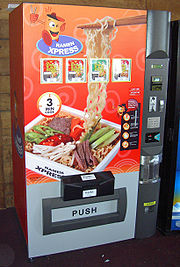
, vending machines distribute warm ramen in an aluminum can, known as . It is produced by a popular ramen restaurant and contains noodles, soup, menma
Menma
is a Japanese condiment made from lactate-fermented bamboo shoots. It is a common topping for noodle soup and ramen.Menma is also known as shinachiku ....
, and pork. It is intended as a quick snack, and includes a small folded plastic fork. There are few kinds of flavor such as tonkotsu and curry.
Tampopo
The production and consumption of ramen was a large part of the 1985 Japanese comedy film TampopoTampopo
is a 1985 Japanese comedy film by director Juzo Itami, starring Tsutomu Yamazaki, Nobuko Miyamoto and Ken Watanabe. The publicity for the film calls it the first ramen western, a play on the term Spaghetti Western .-Plot summary:Tampopo begins when a pair of truck drivers, an experienced one named...
by director Juzo Itami
Juzo Itami
, born , was an actor and a popular modern Japanese film director. Many critics came to regard him as Japan's greatest director since Akira Kurosawa. His 10 movies, all of which he wrote himself, are comic satires on elements of Japanese culture....
. Two truck drivers, Goro and Gun (Tsutomu Yamazaki and Ken Watanabe
Ken Watanabe
is a Japanese stage, film, and television actor. To English-speaking audiences he is known for playing tragic hero characters, such as General Tadamichi Kuribayashi in Letters from Iwo Jima and Lord Katsumoto Moritsugu in The Last Samurai, for which he was nominated for the Academy Award for Best...
), help the widowed Tampopo (Nobuko Miyamoto
Nobuko Miyamoto
is a Japanese actress. She was born in Otaru, Hokkaidō, and raised in Nagoya. She was married to director Jūzō Itami from 1969 until his death in 1997, and regularly starred in his films....
) with her failing ramen shop. Food in every aspect of life is the overarching theme, but the art of good ramen is touched upon several times throughout the film as Goro and Gun help her learn how to make the best ramen.
The Ramen Girl
The dish is featured in the 2008 comedy The Ramen GirlThe Ramen Girl
The Ramen Girl is an American-Japanese movie starring Brittany Murphy about a girl who goes to Japan and decides to learn how to cook ramen.-Plot:...
starring Brittany Murphy
Brittany Murphy
Brittany Anne Murphy-Monjack , known professionally as Brittany Murphy, was an American actress and singer. She starred in films such as Clueless, Just Married, Girl Interrupted, Spun, 8 Mile, Uptown Girls, Sin City, Happy Feet, and Riding in Cars with Boys...
as Abby, an American woman stuck in Tokyo after her boyfriend leaves her. One rainy night, feeling lonely and depressed, she wanders over to the local restaurant, is served a bowl of ramen by Maezumi, the owner, played by Toshiyuki Nishida
Toshiyuki Nishida
is a Japanese actor. Outside of Japan, Nishida is best known for his portrayal of Pigsy in the TV series Monkey.Toshiyuki Nishida has received ten Japanese Academy Award nominations, winning twice, for Dun-Huang in 1988 and Gakko and Tsuribaka Nisshi 6 in 1993...
. Maezumi is himself mourning the loss of his son to French, rather than Japanese, cuisine, and reluctantly agrees to train Abby in the art of making ramen, but is an overbearing master, whom she cannot understand but tries so hard to please, in between complaining about how hard she has to work.
See also
- Noodle soupNoodle soupNoodle soup refers to a variety of soups with noodles and other ingredients served in a light broth. Noodle soup is an East and Southeast Asian staple. Less well known, a form of fresh noodle is used in soup in certain parts of Europe , and in northern China; usually, it is served for breakfast...
- Lo meinLo meinLo mein is a Chinese dish with wheat flour noodles. It often contains vegetables and some type of meat or seafood, usually beef, chicken, pork, shrimp or wontons.-Etymology:...
- Hawaiian saiminSaiminSaimin is a noodle soup dish unique to Hawaii. Inspired by Japanese udon, Chinese mein, and Filipino pancit, saimin was developed during Hawaii's plantation era. It is a soup dish of soft wheat egg noodles served in hot dashi garnished with green onions...
- Shirataki noodlesShirataki noodlesare very low carbohydrate, low calorie, thin, translucent, gelatinous traditional Japanese noodles made from devil's tongue yam . The word "shirataki" means "white waterfall", describing the appearance of these noodles...
- Kagoshima ramenKagoshima ramenis a kind of ramen which is offered in Kagoshima Prefecture, in southern Japan.-Outline:Its soup is mainly based on tonkotsu . It is a little cloudy, and chicken stock, vegetables, dried sardines, kelp, and dried mushrooms are added. Kagoshima Ramen is the only ramen which is not influenced by...