


Jiaozi

Encyclopedia
Jiǎozi 餃子 or 饺子, bánh bột luộc (Vietnamese
transliteration), gyōza (Japanese
transliteration), Mo:Mo: or Momocha म:म: or ममचा (Nepali transliteration
), or pot sticker is a Chinese dumpling
widely spread to Japan, Eastern and Western Asia.
Jiaozi typically consist of a ground meat
and/or vegetable
filling wrapped into a thinly rolled piece of dough
, which is then sealed by pressing the edges together or by crimp
ing. Jiaozi should not be confused with wonton
: jiaozi have a thicker, chewier skin and a flatter, more oblate, double-saucer like shape (similar in shape to ravioli
), and are usually eaten with a soy-vinegar dipping sauce (and/or hot chili sauce
); while wontons have thinner skin, are sphere-shaped, and are usually served in broth. The dough for the jiaozi and wonton wrapper also consist of different ingredients.
Dumplings that use egg
rather than dough to wrap the filling are called "egg dumplings" or (蛋餃; pinyin
: dànjiǎo).
Cantonese style Chinese dumplings (gaau) are standard fare in dim sum
. Gaau is simply the Cantonese pronunciation for 餃 (pinyin
: jiǎo). The immediate noted difference to jiǎozi is that they are smaller and wrapped in a thinner translucent skin, and usually steamed. In other words, these are steamed dumplings. The smaller size and the thinner pastry make the dumplings easier to cook through with steaming. Fillings include shrimp, scallop, chicken, tofu, mixed vegetables, and others. The most common type are shrimp dumplings (har gow). In contrast to jiǎozi, gaau are rarely home-made. Similar to jiaozi, many types of fillings exist, and dim sum
restaurants often feature their own house specials or innovations. Dim sum chefs and artists often use ingredients in new or creative ways, or draw inspiration from other Chinese culinary traditions, such as Chiuchow, Hakka
, or Shanghai
. More daring chefs may even incorporate a fusion
from other cultures, such as Japanese (teriyaki
) or Southeast Asian (satay
, curry
), while upscale restaurants may use expensive or exotic ingredients such as lobster
, shark fin
and bird's nest
. Another Cantonese dumpling is the jau gok
.
, mutton, beef
, chicken
, fish
, and shrimp
which are usually mixed with chopped vegetables. Popular vegetable fillings include cabbage
, scallion
(spring onions), leek
, and garlic chives
. Dumplings are eaten with a soy sauce
-based dipping sauce that may include vinegar
, garlic
, ginger
, rice wine
, hot sauce
, and sesame oil.
and year round in the northern provinces. They look like the golden ingots yuan bao used during the Ming Dynasty
for money and the name sounds like the word for the earliest paper money, so serving them is believed to bring prosperity. Many families eat these at midnight on Chinese New Year's Eve. Some cooks will even hide a clean coin for the lucky to find.
Jiaozi were so named because they were horn shaped. The Chinese for "horn" is jiǎo (角), and jiaozi was originally written with the Chinese character
for "horn", but later it was replaced by a specific character 餃, which has the food radical on the left and the phonetic component jiāo (交) on the right.
According to folk tales, jiaozi were invented by Zhang Zhongjing
, one of the greatest practitioners of traditional Chinese medicine
in history. They were originally called "tender ears" (娇耳; pinyin
: jiao'er) because they were used to treat frostbitten ears.
Jiaozi are eaten all year round and can be eaten at any time of the day – breakfast, lunch or dinner. They can constitute one course, starter or side dish, or the main meal. Every family has its own preferred method of making them, with favourite fillings, and of course, jiaozi types and preparation vary widely according to region.
word Gyōza (ギョーザ, ギョウザ) was derived from the reading of 餃子 in the Shandong
Chinese dialect (giaozi) and is written using the same Chinese characters.
The most prominent differences of Japanese-style gyōza from Chinese style jiaozi are the rich garlic
flavor, which is less noticeable in the Chinese version, and the fact that Japanese gyōza are very lightly flavored with salt, soy, and that the gyōza wrappers are much thinner. They are usually served with soy-based tare sauce
seasoned with rice vinegar
and/or Rāyu
(known as chili oil
in English, làyóu (辣油) in China
). The most common recipe found is a mixture of minced
pork
, cabbage
, and Nira (Chinese chives), and sesame oil
, and/or garlic
, and/or ginger
, which is then wrapped into thinly-rolled dough
skins. In essence, gyōza are similar in shape to pierogi
.
Gyōza can be found in supermarkets and restaurants throughout Japan. Pan-fried Gyōza are sold as a side dish in almost all ramen
and Chinese restaurant
s.
The most popular preparation method is the pan-fried style called Yaki-gyōza , in which the dumpling is first fried
on one flat side, creating a crispy skin. Then, water is added and the pan sealed with a lid, until the upper part of the gyōza is steamed
. Other popular methods include boiled Sui-gyōza and deep fried
Age-gyōza .
Store bought frozen dumplings are often prepared at home by first placing them in a pot of water which is brought to a boil, and then transferring them to a pan with oil to fry the skin.
. The word "Momo" comes from a Chinese loanword "Momo" (馍馍). which translates to "Steamed Bread". When preparing Momo, flour is filled, most commonly with ground Water Buffalo
meat. Often, ground lamb or chicken meats are used as alternate to water buffalo meat. Finely chopped onion, minced garlic, fresh minced ginger, turmeric, cumin powder, coriander
/cilantro, etc are added to meat for flavoring. Sauce made from cooked tomatoes flavored with timur (Szechwan pepper), minced red chilies is often served along with momo.
popular as a street food
, appetizer, or side order in Chinese
. This dish is sometimes served on a dim sum
menu, but may be offered independently. The filling for this dish usually contains pork
(sometimes chicken
, or beef in Muslim
areas), cabbage
(or Chinese cabbage
and sometimes spinach
), scallion
s (spring or green onions), ginger
, Chinese rice wine or cooking wine, and sesame seed oil.
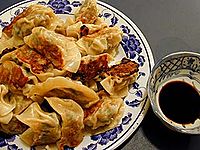
Guotie are shallow-fried in a wok (Mandarin "guo"). A small quantity of water is added and the wok is covered. While the base of the dumplings is fried, the upper part is steamed and this gives a texture contrast typical of Chinese cuisine.
An alternative method is to steam in a wok
and then fry to crispness on one side in a shallow frying pan.
Exactly the same dumpling is boiled in plenty of water to make jiaozi and both are eaten with a dipping sauce.
Three or five folds are made on one side of the round wrapper that is rolled so that the edges are thinner than the middle. This gives the base a large surface area that helps to give the dumpling stability to stand up in the pan.
The Chinese method of preparing the dough is to pour boiling water onto the flour and letting stand for five minutes and then adding a small quantity of cold water. This helps to activate the gluten in the dough.
Other names for guotie:
(960-1280 AD) in ancient China reporting the guotie as being exceptionally good for the human soul.
Vietnamese language
Vietnamese is the national and official language of Vietnam. It is the mother tongue of 86% of Vietnam's population, and of about three million overseas Vietnamese. It is also spoken as a second language by many ethnic minorities of Vietnam...
transliteration), gyōza (Japanese
Japanese language
is a language spoken by over 130 million people in Japan and in Japanese emigrant communities. It is a member of the Japonic language family, which has a number of proposed relationships with other languages, none of which has gained wide acceptance among historical linguists .Japanese is an...
transliteration), Mo:Mo: or Momocha म:म: or ममचा (Nepali transliteration
Transliteration
Transliteration is a subset of the science of hermeneutics. It is a form of translation, and is the practice of converting a text from one script into another...
), or pot sticker is a Chinese dumpling
Dumpling
Dumplings are cooked balls of dough. They are based on flour, potatoes or bread, and may include meat, fish, vegetables, or sweets. They may be cooked by boiling, steaming, simmering, frying, or baking. They may have a filling, or there may be other ingredients mixed into the dough. Dumplings may...
widely spread to Japan, Eastern and Western Asia.
Jiaozi typically consist of a ground meat
Ground meat
Ground meat is meat finely chopped by a meat grinder or a chopping knife. It is called minced meat or more usually mince outside North America....
and/or vegetable
Vegetable
The noun vegetable usually means an edible plant or part of a plant other than a sweet fruit or seed. This typically means the leaf, stem, or root of a plant....
filling wrapped into a thinly rolled piece of dough
Dough
Dough is a paste made out of any cereals or leguminous crops by mixing flour with a small amount of water and/or other liquid. This process is a precursor to making a wide variety of foodstuffs, particularly breads and bread-based items , flatbreads, noodles, pastry, and similar items)...
, which is then sealed by pressing the edges together or by crimp
Crimp (joining)
Crimping is joining two pieces of metal or other malleable material by deforming one or both of them to hold the other. The bend or deformity is called the crimp.- Uses :...
ing. Jiaozi should not be confused with wonton
Wonton
Not to be confused with WantonA wonton is a type of dumpling commonly found in a number of Chinese cuisines.-Filling:...
: jiaozi have a thicker, chewier skin and a flatter, more oblate, double-saucer like shape (similar in shape to ravioli
Ravioli
Ravioli are a traditional type of Italian filled pasta. They are composed of a filling sealed between two layers of thin egg pasta dough and are served either in broth or with a pasta sauce. The word ravioli is reminiscent of the Italian verb riavvolgere , though the two words are not...
), and are usually eaten with a soy-vinegar dipping sauce (and/or hot chili sauce
Chili sauce
Chili sauce is a condiment, similar to ketchup but with onion, garlic, and spice. Despite its name, it does not contain chili peppers and thus is not hot....
); while wontons have thinner skin, are sphere-shaped, and are usually served in broth. The dough for the jiaozi and wonton wrapper also consist of different ingredients.
Types
Chinese dumplings (jiaozi) may be divided into various types depending on how they are cooked:- Boiled dumplings; (shuijiao) literally "water dumplings" (水餃; pinyinPinyinPinyin is the official system to transcribe Chinese characters into the Roman alphabet in China, Malaysia, Singapore and Taiwan. It is also often used to teach Mandarin Chinese and spell Chinese names in foreign publications and used as an input method to enter Chinese characters into...
: shuǐjiǎo).
- Steamed dumplings; (zhengjiao) literally "steam-dumpling" (蒸餃; pinyinPinyinPinyin is the official system to transcribe Chinese characters into the Roman alphabet in China, Malaysia, Singapore and Taiwan. It is also often used to teach Mandarin Chinese and spell Chinese names in foreign publications and used as an input method to enter Chinese characters into...
: zhēngjiǎo).
- Shallow fried dumplings (guotie) lit. "pan stick", known as "potstickers" in N. America, (鍋貼; pinyinPinyinPinyin is the official system to transcribe Chinese characters into the Roman alphabet in China, Malaysia, Singapore and Taiwan. It is also often used to teach Mandarin Chinese and spell Chinese names in foreign publications and used as an input method to enter Chinese characters into...
: guōtiē), also referred to as "dry-fried dumplings" (煎餃; pinyinPinyinPinyin is the official system to transcribe Chinese characters into the Roman alphabet in China, Malaysia, Singapore and Taiwan. It is also often used to teach Mandarin Chinese and spell Chinese names in foreign publications and used as an input method to enter Chinese characters into...
: jiānjiǎo).
Dumplings that use egg
Egg (food)
Eggs are laid by females of many different species, including birds, reptiles, amphibians, and fish, and have probably been eaten by mankind for millennia. Bird and reptile eggs consist of a protective eggshell, albumen , and vitellus , contained within various thin membranes...
rather than dough to wrap the filling are called "egg dumplings" or (蛋餃; pinyin
Pinyin
Pinyin is the official system to transcribe Chinese characters into the Roman alphabet in China, Malaysia, Singapore and Taiwan. It is also often used to teach Mandarin Chinese and spell Chinese names in foreign publications and used as an input method to enter Chinese characters into...
: dànjiǎo).
Cantonese style Chinese dumplings (gaau) are standard fare in dim sum
Dim sum
Dim sum refers to a style of Chinese food prepared as small bite-sized or individual portions of food traditionally served in small steamer baskets or on small plates...
. Gaau is simply the Cantonese pronunciation for 餃 (pinyin
Pinyin
Pinyin is the official system to transcribe Chinese characters into the Roman alphabet in China, Malaysia, Singapore and Taiwan. It is also often used to teach Mandarin Chinese and spell Chinese names in foreign publications and used as an input method to enter Chinese characters into...
: jiǎo). The immediate noted difference to jiǎozi is that they are smaller and wrapped in a thinner translucent skin, and usually steamed. In other words, these are steamed dumplings. The smaller size and the thinner pastry make the dumplings easier to cook through with steaming. Fillings include shrimp, scallop, chicken, tofu, mixed vegetables, and others. The most common type are shrimp dumplings (har gow). In contrast to jiǎozi, gaau are rarely home-made. Similar to jiaozi, many types of fillings exist, and dim sum
Dim sum
Dim sum refers to a style of Chinese food prepared as small bite-sized or individual portions of food traditionally served in small steamer baskets or on small plates...
restaurants often feature their own house specials or innovations. Dim sum chefs and artists often use ingredients in new or creative ways, or draw inspiration from other Chinese culinary traditions, such as Chiuchow, Hakka
Hakka cuisine
Hakka cuisine is the cooking style of the Hakka people, who are primarily found in southeastern China , but also may be found in many other parts of China, as well as in the Chinese diaspora...
, or Shanghai
Shanghai cuisine
Shanghai cuisine , also known as Hu cai is a popular style of Chinese cuisine. The city of Shanghai itself does not have a separate and unique cuisine of its own, but modifies those of the surrounding provinces, is Jiangsu and Zhejiang coastal provinces. What can be called Shanghai cuisine is...
. More daring chefs may even incorporate a fusion
Fusion cuisine
Fusion cuisine combines elements of various culinary traditions while not being categorized per any one particular cuisine style, and can pertain to innovations in many contemporary restaurant cuisines since the 1970s.-Categories and types:...
from other cultures, such as Japanese (teriyaki
Teriyaki
Teriyaki is a cooking technique used in Japanese cuisine in which foods are broiled or grilled in a sweet soy sauce marinade...
) or Southeast Asian (satay
Satay
Satay , or sate, is a dish of marinated, skewered and grilled meat, served with a sauce. Satay may consist of diced or sliced chicken, goat, mutton, beef, pork, fish, other meats, or tofu; the more authentic version uses skewers from the midrib of the coconut palm frond, although bamboo skewers are...
, curry
Curry
Curry is a generic description used throughout Western culture to describe a variety of dishes from Indian, Pakistani, Bangladeshi, Sri Lankan, Thai or other Southeast Asian cuisines...
), while upscale restaurants may use expensive or exotic ingredients such as lobster
Lobster
Clawed lobsters comprise a family of large marine crustaceans. Highly prized as seafood, lobsters are economically important, and are often one of the most profitable commodities in coastal areas they populate.Though several groups of crustaceans are known as lobsters, the clawed lobsters are most...
, shark fin
Shark Fin
Shark Fin is the peak which has the triangular shape of a shark fin when viewed from the south....
and bird's nest
Bird's nest soup
Bird's nest soup is a delicacy in Chinese cuisine. A few species of swift, the cave swifts, are renowned for building the saliva nests used to produce the unique texture of this soup....
. Another Cantonese dumpling is the jau gok
Jau gok
Jau gok are traditional dumplings found within Cantonese cuisine originating from Guangdong Province in China. They are most common during Chinese New Year and are consumed in Cantonese-speaking regions and communities, including Hong Kong.-Names:...
.
Fillings in Dumplings
Common dumpling meat fillings include porkPork
Pork is the culinary name for meat from the domestic pig , which is eaten in many countries. It is one of the most commonly consumed meats worldwide, with evidence of pig husbandry dating back to 5000 BC....
, mutton, beef
Beef
Beef is the culinary name for meat from bovines, especially domestic cattle. Beef can be harvested from cows, bulls, heifers or steers. It is one of the principal meats used in the cuisine of the Middle East , Australia, Argentina, Brazil, Europe and the United States, and is also important in...
, chicken
Chicken (food)
Chicken is the most common type of poultry in the world, and is prepared as food in a wide variety of ways, varying by region and culture.- History :...
, fish
Fish (food)
Fish is a food consumed by many species, including humans. The word "fish" refers to both the animal and to the food prepared from it. Fish has been an important source of protein for humans throughout recorded history.-Terminology:...
, and shrimp
Shrimp
Shrimp are swimming, decapod crustaceans classified in the infraorder Caridea, found widely around the world in both fresh and salt water. Adult shrimp are filter feeding benthic animals living close to the bottom. They can live in schools and can swim rapidly backwards. Shrimp are an important...
which are usually mixed with chopped vegetables. Popular vegetable fillings include cabbage
Cabbage
Cabbage is a popular cultivar of the species Brassica oleracea Linne of the Family Brassicaceae and is a leafy green vegetable...
, scallion
Scallion
Scallions , are the edible plants of various Allium species, all of which are "onion-like", having hollow green leaves and lacking a fully developed root bulb.-Etymology:The words...
(spring onions), leek
Leek
The leek, Allium ampeloprasum var. porrum , also sometimes known as Allium porrum, is a vegetable which belongs, along with the onion and garlic, to family Amaryllidaceae, subfamily Allioideae...
, and garlic chives
Garlic chives
Garlic chives, Allium tuberosum, is a vegetable related to onion. The plant has a distinctive growth habit with strap-shaped leaves unlike either onion or garlic, and straight thin white-flowering stalks that are much taller than the leaves. The flavor is more like garlic than chives. It grows in...
. Dumplings are eaten with a soy sauce
Soy sauce
Soy sauce is a condiment produced by fermenting soybeans with Aspergillus oryzae or Aspergillus sojae molds, along with water and salt...
-based dipping sauce that may include vinegar
Vinegar
Vinegar is a liquid substance consisting mainly of acetic acid and water, the acetic acid being produced through the fermentation of ethanol by acetic acid bacteria. Commercial vinegar is produced either by fast or slow fermentation processes. Slow methods generally are used with traditional...
, garlic
Garlic
Allium sativum, commonly known as garlic, is a species in the onion genus, Allium. Its close relatives include the onion, shallot, leek, chive, and rakkyo. Dating back over 6,000 years, garlic is native to central Asia, and has long been a staple in the Mediterranean region, as well as a frequent...
, ginger
Ginger
Ginger is the rhizome of the plant Zingiber officinale, consumed as a delicacy, medicine, or spice. It lends its name to its genus and family . Other notable members of this plant family are turmeric, cardamom, and galangal....
, rice wine
Rice wine
Rice wine is an alcoholic beverage made from rice. Unlike wine, which is made by fermentation of naturally sweet grapes and other fruit, rice "wine" results from the fermentation of rice starch converted to sugars...
, hot sauce
Hot sauce
Hot sauce, chili sauce or pepper sauce refers to any spicy sauce made from chili peppers and other ingredients.-Ingredients:There are many recipes for hot sauces - the common ingredient being any kind of peppers. A group of chemicals called capsaicinoids are responsible for the heat in chili peppers...
, and sesame oil.
Jiaozi's origin and development
Jiaozi are one of the major foods eaten during the Chinese New YearChinese New Year
Chinese New Year – often called Chinese Lunar New Year although it actually is lunisolar – is the most important of the traditional Chinese holidays. It is an all East and South-East-Asia celebration...
and year round in the northern provinces. They look like the golden ingots yuan bao used during the Ming Dynasty
Ming Dynasty
The Ming Dynasty, also Empire of the Great Ming, was the ruling dynasty of China from 1368 to 1644, following the collapse of the Mongol-led Yuan Dynasty. The Ming, "one of the greatest eras of orderly government and social stability in human history", was the last dynasty in China ruled by ethnic...
for money and the name sounds like the word for the earliest paper money, so serving them is believed to bring prosperity. Many families eat these at midnight on Chinese New Year's Eve. Some cooks will even hide a clean coin for the lucky to find.
Jiaozi were so named because they were horn shaped. The Chinese for "horn" is jiǎo (角), and jiaozi was originally written with the Chinese character
Chinese character
Chinese characters are logograms used in the writing of Chinese and Japanese , less frequently Korean , formerly Vietnamese , or other languages...
for "horn", but later it was replaced by a specific character 餃, which has the food radical on the left and the phonetic component jiāo (交) on the right.
According to folk tales, jiaozi were invented by Zhang Zhongjing
Zhang Zhongjing
Zhang Zhongjing , formal name Zhang Ji, was a Han Dynasty physician and one of the most eminent Chinese physicians during the later years of the Han Dynasty...
, one of the greatest practitioners of traditional Chinese medicine
Traditional Chinese medicine
Traditional Chinese Medicine refers to a broad range of medicine practices sharing common theoretical concepts which have been developed in China and are based on a tradition of more than 2,000 years, including various forms of herbal medicine, acupuncture, massage , exercise , and dietary therapy...
in history. They were originally called "tender ears" (娇耳; pinyin
Pinyin
Pinyin is the official system to transcribe Chinese characters into the Roman alphabet in China, Malaysia, Singapore and Taiwan. It is also often used to teach Mandarin Chinese and spell Chinese names in foreign publications and used as an input method to enter Chinese characters into...
: jiao'er) because they were used to treat frostbitten ears.
Jiaozi are eaten all year round and can be eaten at any time of the day – breakfast, lunch or dinner. They can constitute one course, starter or side dish, or the main meal. Every family has its own preferred method of making them, with favourite fillings, and of course, jiaozi types and preparation vary widely according to region.
Japanese version
The JapaneseJapanese language
is a language spoken by over 130 million people in Japan and in Japanese emigrant communities. It is a member of the Japonic language family, which has a number of proposed relationships with other languages, none of which has gained wide acceptance among historical linguists .Japanese is an...
word Gyōza (ギョーザ, ギョウザ) was derived from the reading of 餃子 in the Shandong
Shandong
' is a Province located on the eastern coast of the People's Republic of China. Shandong has played a major role in Chinese history from the beginning of Chinese civilization along the lower reaches of the Yellow River and served as a pivotal cultural and religious site for Taoism, Chinese...
Chinese dialect (giaozi) and is written using the same Chinese characters.
The most prominent differences of Japanese-style gyōza from Chinese style jiaozi are the rich garlic
Garlic
Allium sativum, commonly known as garlic, is a species in the onion genus, Allium. Its close relatives include the onion, shallot, leek, chive, and rakkyo. Dating back over 6,000 years, garlic is native to central Asia, and has long been a staple in the Mediterranean region, as well as a frequent...
flavor, which is less noticeable in the Chinese version, and the fact that Japanese gyōza are very lightly flavored with salt, soy, and that the gyōza wrappers are much thinner. They are usually served with soy-based tare sauce
Tare sauce
Tare is a general term in Japanese cuisine for dipping sauces often used in grilling as well as with sushi, nabemono and gyoza. The sauce is best described as sweetened, thickened soy sauce for grilling and flavored soy sauce with dashi, vinegar, etc., for nabemono and natto such as ponzu but...
seasoned with rice vinegar
Rice vinegar
Rice vinegar is a vinegar made from fermented rice or rice wine in China, Japan, Korea, and Vietnam.-Chinese:Chinese rice vinegars are stronger than Japanese ones, and range in colour from clear to various shades of red and brown...
and/or Rāyu
Rayü
-See also:*List of towns and villages in Tibet...
(known as chili oil
Chili oil
Chili oil is a condiment made from vegetable oil that has been infused with dried chili peppers and sometimes also additional ingredients. It is commonly used in Chinese cuisine, East and Southeast Asia and elsewhere. Particularly popular in Sichuan cuisine, it is used as an ingredient in cooked...
in English, làyóu (辣油) in China
China
Chinese civilization may refer to:* China for more general discussion of the country.* Chinese culture* Greater China, the transnational community of ethnic Chinese.* History of China* Sinosphere, the area historically affected by Chinese culture...
). The most common recipe found is a mixture of minced
Mincing
Mincing is a food preparation technique in which food ingredients are finely divided. The effect is to create a closely bonded mixture of ingredients and a soft or pasty texture. Flavoring ingredients such as garlic, ginger, and fresh herbs may be minced to distribute flavor more evenly in a mixture...
pork
Pork
Pork is the culinary name for meat from the domestic pig , which is eaten in many countries. It is one of the most commonly consumed meats worldwide, with evidence of pig husbandry dating back to 5000 BC....
, cabbage
Cabbage
Cabbage is a popular cultivar of the species Brassica oleracea Linne of the Family Brassicaceae and is a leafy green vegetable...
, and Nira (Chinese chives), and sesame oil
Sesame oil
Sesame oil is an edible vegetable oil derived from sesame seeds. Besides being used as a cooking oil in South India, it is often used as a flavor enhancer in Chinese, Japanese, Korean, and to a lesser extent Southeast Asian cuisine.The oil from the nutrient rich seed is popular in alternative...
, and/or garlic
Garlic
Allium sativum, commonly known as garlic, is a species in the onion genus, Allium. Its close relatives include the onion, shallot, leek, chive, and rakkyo. Dating back over 6,000 years, garlic is native to central Asia, and has long been a staple in the Mediterranean region, as well as a frequent...
, and/or ginger
Ginger
Ginger is the rhizome of the plant Zingiber officinale, consumed as a delicacy, medicine, or spice. It lends its name to its genus and family . Other notable members of this plant family are turmeric, cardamom, and galangal....
, which is then wrapped into thinly-rolled dough
Dough
Dough is a paste made out of any cereals or leguminous crops by mixing flour with a small amount of water and/or other liquid. This process is a precursor to making a wide variety of foodstuffs, particularly breads and bread-based items , flatbreads, noodles, pastry, and similar items)...
skins. In essence, gyōza are similar in shape to pierogi
Pierogi
Pierogi are dumplings of unleavened dough - first boiled, then they are baked or fried usually in butter with onions - traditionally stuffed with potato filling, sauerkraut, ground meat, cheese, or fruit...
.
Gyōza can be found in supermarkets and restaurants throughout Japan. Pan-fried Gyōza are sold as a side dish in almost all ramen
Ramen
is a Japanese noodle dish. It consists of Chinese-style wheat noodles served in a meat- or fish-based broth, often flavored with soy sauce or miso, and uses toppings such as , , kamaboko, green onions, and occasionally corn...
and Chinese restaurant
Chinese cuisine
Chinese cuisine is any of several styles originating in the regions of China, some of which have become highly popular in other parts of the world – from Asia to the Americas, Australia, Western Europe and Southern Africa...
s.
The most popular preparation method is the pan-fried style called Yaki-gyōza , in which the dumpling is first fried
Frying
Frying is the cooking of food in oil or another fat, a technique that originated in ancient Egypt around 2500 BC. Chemically, oils and fats are the same, differing only in melting point, but the distinction is only made when needed. In commerce, many fats are called oils by custom, e.g...
on one flat side, creating a crispy skin. Then, water is added and the pan sealed with a lid, until the upper part of the gyōza is steamed
Steaming
Steaming is a method of cooking using steam. Steaming is considered a healthy cooking technique and capable of cooking almost all kinds of food.-Method:...
. Other popular methods include boiled Sui-gyōza and deep fried
Deep frying
Deep frying is a cooking method in which food is submerged in hot oil or fat. This is normally performed with a deep fryer or chip pan; industrially, a pressure fryer or vacuum fryer may be used....
Age-gyōza .
Store bought frozen dumplings are often prepared at home by first placing them in a pot of water which is brought to a boil, and then transferring them to a pan with oil to fry the skin.
Nepali version of Momo
The Nepali version is known as Momo (म:म)Momo (food)
Momo is a type of pastry native to Nepal as well as among the Tibetans. It is similar to the Mongolian buuz or the Chinese jiaozi.The Tibetan word momo is a loanword from the Chinese mómo .-Production:...
. The word "Momo" comes from a Chinese loanword "Momo" (馍馍). which translates to "Steamed Bread". When preparing Momo, flour is filled, most commonly with ground Water Buffalo
Water Buffalo
The water buffalo or domestic Asian water buffalo is a large bovine animal, frequently used as livestock in southern Asia, and also widely in South America, southern Europe, northern Africa, and elsewhere....
meat. Often, ground lamb or chicken meats are used as alternate to water buffalo meat. Finely chopped onion, minced garlic, fresh minced ginger, turmeric, cumin powder, coriander
Coriander
Coriander is an annual herb in the family Apiaceae. Coriander is native to southern Europe and North Africa to southwestern Asia. It is a soft, hairless plant growing to tall. The leaves are variable in shape, broadly lobed at the base of the plant, and slender and feathery higher on the...
/cilantro, etc are added to meat for flavoring. Sauce made from cooked tomatoes flavored with timur (Szechwan pepper), minced red chilies is often served along with momo.
Guotie
Guotie is pan-fried jiaozi, also known as potstickers in North America, or yaki-gyoza in Japan. They are a Northern Chinese style dumplingDumpling
Dumplings are cooked balls of dough. They are based on flour, potatoes or bread, and may include meat, fish, vegetables, or sweets. They may be cooked by boiling, steaming, simmering, frying, or baking. They may have a filling, or there may be other ingredients mixed into the dough. Dumplings may...
popular as a street food
Street food
Street food is ready-to-eat food or drink sold in a street or other public place, such as a market or fair, by a hawker or vendor, often from a portable stall. While some street foods are regional, many are not, having spread beyond their region of origin. Most street food are both finger and fast...
, appetizer, or side order in Chinese
Chinese cuisine
Chinese cuisine is any of several styles originating in the regions of China, some of which have become highly popular in other parts of the world – from Asia to the Americas, Australia, Western Europe and Southern Africa...
. This dish is sometimes served on a dim sum
Dim sum
Dim sum refers to a style of Chinese food prepared as small bite-sized or individual portions of food traditionally served in small steamer baskets or on small plates...
menu, but may be offered independently. The filling for this dish usually contains pork
Pork
Pork is the culinary name for meat from the domestic pig , which is eaten in many countries. It is one of the most commonly consumed meats worldwide, with evidence of pig husbandry dating back to 5000 BC....
(sometimes chicken
Chicken
The chicken is a domesticated fowl, a subspecies of the Red Junglefowl. As one of the most common and widespread domestic animals, and with a population of more than 24 billion in 2003, there are more chickens in the world than any other species of bird...
, or beef in Muslim
Muslim
A Muslim, also spelled Moslem, is an adherent of Islam, a monotheistic, Abrahamic religion based on the Quran, which Muslims consider the verbatim word of God as revealed to prophet Muhammad. "Muslim" is the Arabic term for "submitter" .Muslims believe that God is one and incomparable...
areas), cabbage
Cabbage
Cabbage is a popular cultivar of the species Brassica oleracea Linne of the Family Brassicaceae and is a leafy green vegetable...
(or Chinese cabbage
Chinese cabbage
Chinese cabbage can refer to two distinct varieties of Chinese leaf vegetables used often in Chinese cuisine. These vegetables are both related to the Western cabbage, and are of the same species as the common turnip...
and sometimes spinach
Spinach
Spinach is an edible flowering plant in the family of Amaranthaceae. It is native to central and southwestern Asia. It is an annual plant , which grows to a height of up to 30 cm. Spinach may survive over winter in temperate regions...
), scallion
Scallion
Scallions , are the edible plants of various Allium species, all of which are "onion-like", having hollow green leaves and lacking a fully developed root bulb.-Etymology:The words...
s (spring or green onions), ginger
Ginger
Ginger is the rhizome of the plant Zingiber officinale, consumed as a delicacy, medicine, or spice. It lends its name to its genus and family . Other notable members of this plant family are turmeric, cardamom, and galangal....
, Chinese rice wine or cooking wine, and sesame seed oil.
Guotie are shallow-fried in a wok (Mandarin "guo"). A small quantity of water is added and the wok is covered. While the base of the dumplings is fried, the upper part is steamed and this gives a texture contrast typical of Chinese cuisine.
An alternative method is to steam in a wok
Wok
A wok is a versatile round-bottomed cooking vessel originating in China. It is used especially in East and Southeast Asia.Woks are most often used for stir frying, but can also be used in other Chinese cooking techniques, such as in steaming, deep frying, braising, stewing, smoking, or making soup...
and then fry to crispness on one side in a shallow frying pan.
Exactly the same dumpling is boiled in plenty of water to make jiaozi and both are eaten with a dipping sauce.
Three or five folds are made on one side of the round wrapper that is rolled so that the edges are thinner than the middle. This gives the base a large surface area that helps to give the dumpling stability to stand up in the pan.
The Chinese method of preparing the dough is to pour boiling water onto the flour and letting stand for five minutes and then adding a small quantity of cold water. This helps to activate the gluten in the dough.
Other names for guotie:
- Peking Ravioli In BostonBostonBoston is the capital of and largest city in Massachusetts, and is one of the oldest cities in the United States. The largest city in New England, Boston is regarded as the unofficial "Capital of New England" for its economic and cultural impact on the entire New England region. The city proper had...
, guotie are known as "Peking ravioliRavioliRavioli are a traditional type of Italian filled pasta. They are composed of a filling sealed between two layers of thin egg pasta dough and are served either in broth or with a pasta sauce. The word ravioli is reminiscent of the Italian verb riavvolgere , though the two words are not...
", a name first coined at the Joyce Chen RestaurantJoyce ChenJoyce Chen was a Chinese chef, restaurateur, and entrepreneur. Born in Beijing, China, Chen and husband Thomas left Shanghai in 1949 as the communists were taking over the country. Chen ultimately settled in Cambridge, Massachusetts.Chen opened her first restaurant, "Joyce Chen Restaurant", in 1958...
in Cambridge, MACambridge, MassachusettsCambridge is a city in Middlesex County, Massachusetts, United States, in the Greater Boston area. It was named in honor of the University of Cambridge in England, an important center of the Puritan theology embraced by the town's founders. Cambridge is home to two of the world's most prominent...
, in 1958. - Wor tip (Cantonese JyutpingJyutpingJyutping is a romanization system for Cantonese developed by the Linguistic Society of Hong Kong in 1993. Its formal name is The Linguistic Society of Hong Kong Cantonese Romanization Scheme...
: wo1 tip3) is the Cantonese name for guotie'
History
The guotie is said to date back over four millennia. However, the first mention in literature dates back to the Song DynastySong Dynasty
The Song Dynasty was a ruling dynasty in China between 960 and 1279; it succeeded the Five Dynasties and Ten Kingdoms Period, and was followed by the Yuan Dynasty. It was the first government in world history to issue banknotes or paper money, and the first Chinese government to establish a...
(960-1280 AD) in ancient China reporting the guotie as being exceptionally good for the human soul.
See also
- DumplingDumplingDumplings are cooked balls of dough. They are based on flour, potatoes or bread, and may include meat, fish, vegetables, or sweets. They may be cooked by boiling, steaming, simmering, frying, or baking. They may have a filling, or there may be other ingredients mixed into the dough. Dumplings may...
- Har gow Chinese shrimpShrimpShrimp are swimming, decapod crustaceans classified in the infraorder Caridea, found widely around the world in both fresh and salt water. Adult shrimp are filter feeding benthic animals living close to the bottom. They can live in schools and can swim rapidly backwards. Shrimp are an important...
dumpling - Jau gokJau gokJau gok are traditional dumplings found within Cantonese cuisine originating from Guangdong Province in China. They are most common during Chinese New Year and are consumed in Cantonese-speaking regions and communities, including Hong Kong.-Names:...
- Fish ballFish ballFish balls are a common food in southern China and overseas Chinese communities made from surimi . They are also common in Scandinavia, where they are usually made from cod or haddock.-Terminology:...
- Beef ballBeef ballBeef ball is a commonly cooked food in southern China and overseas Chinese communities. As the name suggests, the ball is made of beef that has been finely pulverized. They are easily distinguishable from fish balls due to the beef balls' darker color...
- WontonWontonNot to be confused with WantonA wonton is a type of dumpling commonly found in a number of Chinese cuisines.-Filling:...
- PierogiPierogiPierogi are dumplings of unleavened dough - first boiled, then they are baked or fried usually in butter with onions - traditionally stuffed with potato filling, sauerkraut, ground meat, cheese, or fruit...
- PelmeniPelmeniPelmeni are dumplings consisting of a filling wrapped in thin, unleavened dough that originated in Siberia and is a dish of Russian cuisine. Pelmeni are common in Russia and have similar names in other languages: , pyal’meni; pilmän; , pel’meni; ; .- Ingredients :The dough is made from flour and...
- RavioliRavioliRavioli are a traditional type of Italian filled pasta. They are composed of a filling sealed between two layers of thin egg pasta dough and are served either in broth or with a pasta sauce. The word ravioli is reminiscent of the Italian verb riavvolgere , though the two words are not...
- Varenyky
- MantıMantiMantu are a type of dumpling in Turkish and various Central Asian and Northwest China and Caucasian cuisines, closely related to the east Asian mantou, baozi, and mandu and the Nepali momo. Manti dumplings archetypically consist of a spiced meat mixture, usually lamb or ground beef, in a dough...
- Mandu (dumpling)Mandu (dumpling)Mandu are dumplings in Korean cuisine. They are similar to pelmeni and pierogi in some Slavic cultures. The name is a cognate to the names of similar types of meat-filled dumplings in Central Asia, such as Turkish manti, Kazakh manty, and Uzbek manti.In Korean cuisine, mandu generally denotes a...
and MandugwaMandugwaMandugwa is a variety of hangwa traditional Korean confectionery, consisting of a fried dumpling stuffed with a sweetened filling and coated with jocheong, or liquid candy. Its dough is prepared kneaded with wheat flour, honey, and sesame oil. The filling is made with filtered steamed jujubes mixed... - KreplachKreplachKreplach are small dumplings filled with ground meat, mashed potatoes or another filling, usually boiled and served in chicken soup. They are similar to Italian tortellini and Chinese wontons. The dough is traditionally made of flour, water and eggs, kneaded and rolled out thin...
- BaoziBaoziA bāozi or simply known as bao, bau, humbow, nunu, bausak, pow or pau is a type of steamed, filled bun or bread-like item in various Chinese cuisines, as there is much variation as to the fillings and the preparations...
(steamed) - KhinkaliKhinkaliKhinkali are Caucasian dumplings filled with various fillings such as mushrooms or cheese, but mostly with spiced meat with greens, onions and garlic. They are eaten plain, or with coarse black pepper. The meat filling is uncooked when the Khinkali is assembled, so when cooked the meat's juices...
- Momo (food)Momo (food)Momo is a type of pastry native to Nepal as well as among the Tibetans. It is similar to the Mongolian buuz or the Chinese jiaozi.The Tibetan word momo is a loanword from the Chinese mómo .-Production:...
- BuuzBuuzBuuz are a type of Mongolian steamed dumpling filled with minced mutton, or beef meat. The meat is flavoured with onion or garlic and salted. Occasionally, they are flavoured with sprouted fennel seeds and other seasonal herbs...
, KhuushuurKhuushuurKhuushuur is a kind of meat pastry or dumpling popular in Mongolia, similar to Russian and other cuisines' chiburekki. The meat, either beef or mutton, is ground up and mixed with onion salt and other spices. The cook rolls the dough into circles, then places the meat inside the dough and folds...
, Bansh, the MongolianMongolian cuisineMongolian cuisine refers to the local culinary traditions of Mongolia and Mongolian styled dishes. The extreme continental climate has affected the traditional diet, so the Mongolian cuisine primarily consists of dairy products, meat, and animal fats. Use of vegetables and spices is limited...
variants (steamed, fried, boiled, respectively)