

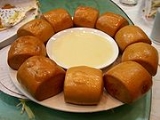
Mantou

Encyclopedia
Mantou, often referred to as Chinese steamed bun/bread, is a kind of steamed
bun
originating in China
. They are typically eaten as a staple in northern parts of China where wheat, rather than rice, is grown. They are made with milled wheat
flour
, water
and leavening agent
s. In size and texture, they range from 4 cm, soft and fluffy in the most elegant restaurant
s, to over 15 cm, firm and dense for the working man's lunch. (As white flour, being more heavily processed, was once more expensive, white mantou were somewhat of a luxury in preindustrial China.)
Traditionally, mantou, bing
, and wheat noodles were the staple carbohydrate
s of the northern Chinese diet, analogous to the rice
, which forms the mainstay of the southern Chinese diet. They are also known in the south, but are often served as street food or a restaurant dish, rather than as a staple or home cooking. Restaurant mantou are often smaller and more delicate and can be further manipulated, for example, by deep-frying and dipping in sweetened condensed milk
.
They are often sold precooked in the frozen section of Asian supermarket
s, ready for preparation by steaming
or heating in the microwave oven
.
A similar food, but with a filling inside, is baozi
. In some regions, mainly in Southern China, mantou can be used to indicate both the filled and unfilled buns.
 A popular story in China
relates that the name mantou actually originated from the identically written and pitched, but more heavily pronounced word mántóu meaning "barbarian
's head".
This story originates from the Three Kingdoms Period, when the strategist Zhuge Liang
led the Shu Army in an invasion of the southern lands
(roughly modern-day Yunnan and northern Burma). After subduing the barbarian king Meng Huo
, Zhuge Liang led the army back to Shu, but met a swift-flowing river which defied all attempts to cross it. A barbarian lord informed him, in olden days, the barbarians would sacrifice 50 men and throw their heads into the river to appease the river spirit and allow them to cross; Zhuge Liang, however, did not want to cause any more bloodshed, and instead killed the cows and horses the army brought along, and filled their meat into buns shaped roughly like human heads - round with a flat base - to be made and then thrown into the river. After a successful crossing, he named the buns "barbarian's head" (mántóu, 蠻頭, which evolved into the present day 饅頭).
, the word mantou meant both filled and unfilled buns. The term baozi
arose in the Song Dynasty to indicate filled buns only. As a result, mantou gradually came to indicate only unfilled buns in Mandarin and other varieties of Chinese
.
In many areas, however, mantou still retains its meaning of filled buns. In the Jiangnan
region, it usually means both filled and unfilled buns. In the province of Shanxi (山西) mantou is often called momo (饃饃), which is simply the character for "steamed bun".
The name mantou is cognate to manty and mantı
; these are filled dumplings in Turkish
, Persian, Central Asian, and Pakistan
i cuisines. In Japan
, manjū
(饅頭) usually indicates filled buns, which traditionally contain bean paste or minced meat-vegetable mixture (nikuman
肉まん "meat manjū"). Filled mantou are called siopao
in Tagalog
. In Korea, mandu
(饅頭) can refer to both baozi or jiaozi
(餃子). In Mongolia
, mantuu are basically the same as the Chinese mantou.
Steaming
Steaming is a method of cooking using steam. Steaming is considered a healthy cooking technique and capable of cooking almost all kinds of food.-Method:...
bun
Bun
A bun is a small, usually sweet, bread. Commonly they are hand-sized or smaller, domed in shape, with a flat bottom. A bun can also be a savory bread roll similar to a bap or barmcake....
originating in China
China
Chinese civilization may refer to:* China for more general discussion of the country.* Chinese culture* Greater China, the transnational community of ethnic Chinese.* History of China* Sinosphere, the area historically affected by Chinese culture...
. They are typically eaten as a staple in northern parts of China where wheat, rather than rice, is grown. They are made with milled wheat
Wheat
Wheat is a cereal grain, originally from the Levant region of the Near East, but now cultivated worldwide. In 2007 world production of wheat was 607 million tons, making it the third most-produced cereal after maize and rice...
flour
Flour
Flour is a powder which is made by grinding cereal grains, other seeds or roots . It is the main ingredient of bread, which is a staple food for many cultures, making the availability of adequate supplies of flour a major economic and political issue at various times throughout history...
, water
Water
Water is a chemical substance with the chemical formula H2O. A water molecule contains one oxygen and two hydrogen atoms connected by covalent bonds. Water is a liquid at ambient conditions, but it often co-exists on Earth with its solid state, ice, and gaseous state . Water also exists in a...
and leavening agent
Leavening agent
A leavening agent is any one of a number of substances used in doughs and batters that cause a foaming action which lightens and softens the finished product...
s. In size and texture, they range from 4 cm, soft and fluffy in the most elegant restaurant
Restaurant
A restaurant is an establishment which prepares and serves food and drink to customers in return for money. Meals are generally served and eaten on premises, but many restaurants also offer take-out and food delivery services...
s, to over 15 cm, firm and dense for the working man's lunch. (As white flour, being more heavily processed, was once more expensive, white mantou were somewhat of a luxury in preindustrial China.)
Traditionally, mantou, bing
Bing (Chinese flat bread)
Bing is a Chinese term used to describe wheat flour based Chinese foods with a flattened or disk-like shape, similar to the French concept of a Galette. These foods may resemble the flatbreads, pancakes, unleavened dough foods of non-Chinese and western cuisines...
, and wheat noodles were the staple carbohydrate
Carbohydrate
A carbohydrate is an organic compound with the empirical formula ; that is, consists only of carbon, hydrogen, and oxygen, with a hydrogen:oxygen atom ratio of 2:1 . However, there are exceptions to this. One common example would be deoxyribose, a component of DNA, which has the empirical...
s of the northern Chinese diet, analogous to the rice
Rice
Rice is the seed of the monocot plants Oryza sativa or Oryza glaberrima . As a cereal grain, it is the most important staple food for a large part of the world's human population, especially in East Asia, Southeast Asia, South Asia, the Middle East, and the West Indies...
, which forms the mainstay of the southern Chinese diet. They are also known in the south, but are often served as street food or a restaurant dish, rather than as a staple or home cooking. Restaurant mantou are often smaller and more delicate and can be further manipulated, for example, by deep-frying and dipping in sweetened condensed milk
Condensed milk
Condensed milk, also known as sweetened condensed milk, is cow's milk from which water has been removed and to which sugar has been added, yielding a very thick, sweet product which when canned can last for years without refrigeration if unopened. The two terms, condensed milk and sweetened...
.
They are often sold precooked in the frozen section of Asian supermarket
Supermarket
A supermarket, a form of grocery store, is a self-service store offering a wide variety of food and household merchandise, organized into departments...
s, ready for preparation by steaming
Steaming
Steaming is a method of cooking using steam. Steaming is considered a healthy cooking technique and capable of cooking almost all kinds of food.-Method:...
or heating in the microwave oven
Microwave oven
A microwave oven is a kitchen appliance that heats food by dielectric heating, using microwave radiation to heat polarized molecules within the food...
.
A similar food, but with a filling inside, is baozi
Baozi
A bāozi or simply known as bao, bau, humbow, nunu, bausak, pow or pau is a type of steamed, filled bun or bread-like item in various Chinese cuisines, as there is much variation as to the fillings and the preparations...
. In some regions, mainly in Southern China, mantou can be used to indicate both the filled and unfilled buns.
Etymology
China
Chinese civilization may refer to:* China for more general discussion of the country.* Chinese culture* Greater China, the transnational community of ethnic Chinese.* History of China* Sinosphere, the area historically affected by Chinese culture...
relates that the name mantou actually originated from the identically written and pitched, but more heavily pronounced word mántóu meaning "barbarian
Barbarian
Barbarian and savage are terms used to refer to a person who is perceived to be uncivilized. The word is often used either in a general reference to a member of a nation or ethnos, typically a tribal society as seen by an urban civilization either viewed as inferior, or admired as a noble savage...
's head".
This story originates from the Three Kingdoms Period, when the strategist Zhuge Liang
Zhuge Liang
Zhuge Liang was a chancellor of the state of Shu Han during the Three Kingdoms period of Chinese history. He is often recognised as the greatest and most accomplished strategist of his era....
led the Shu Army in an invasion of the southern lands
Zhuge Liang's Southern Campaign
Zhuge Liang's Southern Campaign, also known as the War of Pacification in Nanzhong, refers to a military campaign led by Shu Han chancellor Zhuge Liang to suppress opposing forces in the south in 225 during the Three Kingdoms period of Chinese history...
(roughly modern-day Yunnan and northern Burma). After subduing the barbarian king Meng Huo
Meng Huo
Meng Huo was popularly regarded as a local leader representing the gentries of the Nanzhong region during the Three Kingdoms era of Chinese history...
, Zhuge Liang led the army back to Shu, but met a swift-flowing river which defied all attempts to cross it. A barbarian lord informed him, in olden days, the barbarians would sacrifice 50 men and throw their heads into the river to appease the river spirit and allow them to cross; Zhuge Liang, however, did not want to cause any more bloodshed, and instead killed the cows and horses the army brought along, and filled their meat into buns shaped roughly like human heads - round with a flat base - to be made and then thrown into the river. After a successful crossing, he named the buns "barbarian's head" (mántóu, 蠻頭, which evolved into the present day 饅頭).
Variations in meaning outside northern China
Prior to the Song DynastySong Dynasty
The Song Dynasty was a ruling dynasty in China between 960 and 1279; it succeeded the Five Dynasties and Ten Kingdoms Period, and was followed by the Yuan Dynasty. It was the first government in world history to issue banknotes or paper money, and the first Chinese government to establish a...
, the word mantou meant both filled and unfilled buns. The term baozi
Baozi
A bāozi or simply known as bao, bau, humbow, nunu, bausak, pow or pau is a type of steamed, filled bun or bread-like item in various Chinese cuisines, as there is much variation as to the fillings and the preparations...
arose in the Song Dynasty to indicate filled buns only. As a result, mantou gradually came to indicate only unfilled buns in Mandarin and other varieties of Chinese
Varieties of Chinese
Chinese comprises many regional language varieties sometimes grouped together as the Chinese dialects, the primary ones being Mandarin, Wu, Cantonese, and Min. These are not mutually intelligible, and even many of the regional varieties are themselves composed of a number of...
.
In many areas, however, mantou still retains its meaning of filled buns. In the Jiangnan
Jiangnan
Jiangnan or Jiang Nan is a geographic area in China referring to lands immediately to the south of the lower reaches of the Yangtze River, including the southern part of the Yangtze Delta...
region, it usually means both filled and unfilled buns. In the province of Shanxi (山西) mantou is often called momo (饃饃), which is simply the character for "steamed bun".
The name mantou is cognate to manty and mantı
Manti
Mantu are a type of dumpling in Turkish and various Central Asian and Northwest China and Caucasian cuisines, closely related to the east Asian mantou, baozi, and mandu and the Nepali momo. Manti dumplings archetypically consist of a spiced meat mixture, usually lamb or ground beef, in a dough...
; these are filled dumplings in Turkish
Turkish cuisine
Turkish cuisine is largely the heritage of Ottoman cuisine, which can be described as a fusion and refinement of Central Asian, Middle Eastern and Balkan cuisines. Turkish cuisine has in turn influenced those and other neighbouring cuisines, including that of western Europe...
, Persian, Central Asian, and Pakistan
Pakistan
Pakistan , officially the Islamic Republic of Pakistan is a sovereign state in South Asia. It has a coastline along the Arabian Sea and the Gulf of Oman in the south and is bordered by Afghanistan and Iran in the west, India in the east and China in the far northeast. In the north, Tajikistan...
i cuisines. In Japan
Japan
Japan is an island nation in East Asia. Located in the Pacific Ocean, it lies to the east of the Sea of Japan, China, North Korea, South Korea and Russia, stretching from the Sea of Okhotsk in the north to the East China Sea and Taiwan in the south...
, manjū
Manju (food)
is a popular traditional Japanese confection. There are many varieties of manjū, but most have an outside made from flour, rice powder and buckwheat and a filling of an , made from boiled azuki beans and sugar. They are boiled together again and kneaded...
(饅頭) usually indicates filled buns, which traditionally contain bean paste or minced meat-vegetable mixture (nikuman
Nikuman
Nikuman is a Japanese food made from flour dough, and filled with cooked ground pork or other ingredients. It is a kind of chūka man similar to the Chinese baozi , also known in English as pork buns.Nikuman are steamed and often sold as street food...
肉まん "meat manjū"). Filled mantou are called siopao
Siopao
Siopao is a Hokkien term for bāozi , literally meaning "steamed buns". It has also been incorporated in to Thai cuisine where it is called salapao ....
in Tagalog
Tagalog language
Tagalog is an Austronesian language spoken as a first language by a third of the population of the Philippines and as a second language by most of the rest. It is the first language of the Philippine region IV and of Metro Manila...
. In Korea, mandu
Mandu (dumpling)
Mandu are dumplings in Korean cuisine. They are similar to pelmeni and pierogi in some Slavic cultures. The name is a cognate to the names of similar types of meat-filled dumplings in Central Asia, such as Turkish manti, Kazakh manty, and Uzbek manti.In Korean cuisine, mandu generally denotes a...
(饅頭) can refer to both baozi or jiaozi
Jiaozi
Jiǎozi 餃子 or 饺子 , bánh bột luộc , gyōza , Mo:Mo: or Momocha म:म: or ममचा , or pot sticker is a Chinese dumpling widely spread to Japan, Eastern and Western Asia.Jiaozi typically consist of a ground meat and/or vegetable filling wrapped into...
(餃子). In Mongolia
Mongolian cuisine
Mongolian cuisine refers to the local culinary traditions of Mongolia and Mongolian styled dishes. The extreme continental climate has affected the traditional diet, so the Mongolian cuisine primarily consists of dairy products, meat, and animal fats. Use of vegetables and spices is limited...
, mantuu are basically the same as the Chinese mantou.
See also
- Mandarin rollMandarin rollMandarin rolls or Steamed Mandarin rolls are a kind of steamed bun originating from China. The rolls are cooked by steaming. It is another one of the staples of Chinese cuisine which is similar to white bread in western cuisine. Because Southern varieties of mandarin rolls are slightly sweet,...
- MantıMantiMantu are a type of dumpling in Turkish and various Central Asian and Northwest China and Caucasian cuisines, closely related to the east Asian mantou, baozi, and mandu and the Nepali momo. Manti dumplings archetypically consist of a spiced meat mixture, usually lamb or ground beef, in a dough...
- BaoziBaoziA bāozi or simply known as bao, bau, humbow, nunu, bausak, pow or pau is a type of steamed, filled bun or bread-like item in various Chinese cuisines, as there is much variation as to the fillings and the preparations...
- ManjūManjuManju is a Sanskrit word with following associated meanings - pleasant, sweet, snow, beautiful, Lord Shiva's name, clouds, morning dew and is predominantly an Indian male/female/given name.Manju, means a language of clouds.That is Rain...
- ManduMandu (dumpling)Mandu are dumplings in Korean cuisine. They are similar to pelmeni and pierogi in some Slavic cultures. The name is a cognate to the names of similar types of meat-filled dumplings in Central Asia, such as Turkish manti, Kazakh manty, and Uzbek manti.In Korean cuisine, mandu generally denotes a...
- DampfnudelDampfnudelDampfnudel is a sort of white bread eaten as a meal or as a dessert in Germany and in France . It is a typical dish in southern Germany.-Ingredients and preparation:...