

Camp Gurs

Encyclopedia
Camp Gurs was an internment and refugee camp constructed by the French government in 1939. The camp was originally set up in southwestern France after the fall of Catalonia
at the end of the Spanish Civil War
to control those who fled Spain
out of fear of retaliation from Francisco Franco
's regime. At the start of the World War II, the French government interned Germans
and citizens of other Axis Powers
, as well as French nationals who were considered to have dangerous political ideas or who were imprisoned for ordinary crimes.
After the Vichy government
signed an armistice with the Nazis
in 1940, it became an Internment camp for Jews
of any nationality except French, as well as people considered dangerous by the government. After France's liberation, Gurs housed German prisoners of war and French collaborators.
Before its final closure in 1946, the camp also held former Spanish Republican fighters who participated
in the Resistance
against the German occupation, because their decided will to end the fascist dictatorship imposed by Franco made them threatening in the eyes of the Allies
.
's forces over the Spanish Republic
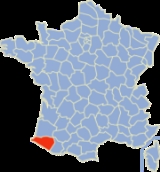
on 1 April 1939, many combatants, together with their relatives and other people who feared Franco's repression, fled to France. The French government built various camps to give shelter to these refugees. The most important camp was the one at Gurs, built adjacent to the city of Gurs
, in the region of Aquitaine
in the department of Pyrénées-Atlantiques
, 84 kilometres east of the Atlantic coast and 34 kilometres north of the Spanish border.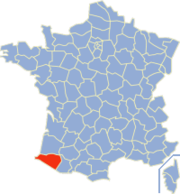 For the site they chose an extended hill with a flat back, of clay soil, whose agricultural use was virtually nil: a little bit of corn and pasture for cattle. Construction began on 15 March 1939, and was still incomplete when the first group of refugees arrived on 4 April.
s. The only street spanned the length of the camp. Both sides of the street were surrounded by parcels of 200 metres by 100 metres, named îlots (blocks
; literally, "islets"). There were seven îlots on one side and six on the other. The parcels were separated from the street and from each other by wire fences. The fences were doubled in the back part of the parcels, forming a passageway in which the exterior guards circulated.
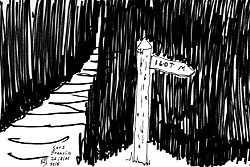 In each parcel stood about 30 cabins; there were 382 cabins altogether. This particular type of cabin had been invented for the French army during the First World War; they had been built close to the front but outside the range of the enemy artillery
, and they served to accommodate soldiers during the few days between when the soldiers arrived at their barracks and awaited their trench assignment. They were assembled from thin planks of wood and covered with tarred fabric, all identical in construction and size. They were not provided with windows or other insulation. They did not offer protection from the cold, and the tarred fabric soon began to deteriorate, allowing rainwater to enter the cabins. Closets were nonexistent, and residents slept on sacks of straw gathered place on the floor. Despite the fact that each cabin had an area of only 25 square metres, each cabin had to lodge up to 60 people during times of peak occupancy.
Food was scarce and poor in quality; there was no sanitation, running water, or plumbing. The camp had poor drainage. The area, due to its proximity to the Atlantic Ocean, receives a great deal of rain, which made the clay campgrounds permanently muddy. The inmates made paths with the few stones they could find in a vain attempt to keep the mud in check. Pieces of wire that had been stripped of their barbs were placed between the cabins and the toilets and used by the refugees like the railing of a staircase, to maintain balance on the unsteady ground.
In each îlot there were rudimentary toilets, not very different from the sort of troughs that would be used to feed animals. There was also a platform about 2 metres high, which one climbed using steps, and upon which were built additional toilets. Under the platform there were large tubs that collected excrement. Once they were full they were transported out of the camp in carts.
One feature of the camp was that the wire fences were only two metres high; they were not electrified, and they did not have lookout towers filled with guards pointing their machine guns at the internees. The atmosphere was radically different from an extermination camp: there were no executions (murders) or displays of sadism on the part of the guards.
Around the camp there were small buildings that housed the administration and the guard corps. The administration and care of the camp was conducted under military auspices until the fall of 1940, when a civil administration was installed by the Vichy regime.
Brigadists
: They had belonged to the International Brigades
fighting for the Second Spanish Republic
. Because of their nationalities (German, Austrian, Czech, Russians etc.) it was not possible for them to return to their countries of origin. Some managed to flee and many others ended up enlisting in the French Foreign Legion
.
Basques: They were gudari
s (Basque nationalists) who had escaped from the siege of Santander
and, transferred by sea to the Republican side, had continued fighting outside of their homeland. Due to the proximity of Gurs to their homeland, practically all managed to find local backing that permitted them to abandon the camp and find work and refuge in France.
Pilots: They were members of the ground personnel of the Republican air force. Possessing a mechanical trade, it was easy for them to find French businessmen who gave them work, allowing them to leave the camp.
Spaniards: They were farmers and had trades that were in low demand. They had no one in France who was interested in them. They were a burden for the French government and therefore they were encouraged, in agreement with the Francoist government, to return to Spain. The great majority did so and were turned over to the Francoist authorities in Irún
. From there they were transferred to the Miranda de Ebro
camp for purification according to the Law of Political Responsibilities
.
From 1939 to the autumn of 1940, the language that dominated in the camp was Spanish. The inmates created an orchestra and constructed a sports field. On July 14, 1939, Bastille Day
, the 17,000 internees of Spanish origin arranged themselves in military formation in the sports field and sang La Marseillaise
, followed by sports presentations and choral and instrumental concerts.
The German members of the International Brigade edited a newspaper in German by the name of "Lagerstimme K.Z. Gurs" of which there were more than 100 editions. The inhabitants of neighboring places could come to the camp and sell food to the inmates. For a time, the commander permitted some imprisoned women to rent a horse and cart and let them leave to camp to buy provisions more economically. There was a postal service and visits were also occasionally permitted.
In contrast to the Spaniards, for whom there was generally sympathy, the internees from the second waves were known as "les indésirables", the undesirables.
between France and Germany in June 1940, the region in which the camp was situated formed part of the territory governed by the Vichy government, passing over to the civil authority. The military commander, before turning over command, burned the records in order to make it difficult for the new French government to locate and persecute many of the inmates who, informed of the change in command, had fled, disappearing among the French population who gave them shelter. A later consequence of the burning of the records however, was that once the war was over it made it difficult for many ex-prisoners to claim the compensation that was due to them for having been incarcerated.
Seven hundred of the prisoners, interned only for the reason of their nationality or for being sympathetical to the Nazi regime, were liberated between August 21 — the date of the arrival of the inspection commission sent by the German government to Gurs — and October. The Vichy government used the camp to lock up:
("governor") from the Baden
region of Germany had also been named Gauleiter of the neighboring French region of Alsace
. In Baden resided some 7,500 Jews; they were mainly women, children, and the elderly, given that the young and middle-aged men had fled from Germany or had disappeared in the Nazi concentration camps.
The Gauleiter received word that the camp at Gurs was mostly empty, and on October 25, 1940, it was decided to evacuate the Jews from Baden (between 6,500 and 7,500) to Gurs as part of Operation Wagner-Bürckel. There, they remained locked up under French administration. The living conditions were even more difficult, and during the year that they remained in the camp, more than a thousand fell victim to illness, especially typhus
and dysentery
.
Of the survivors, some 700 managed to escape and almost 2,000 obtained visas that permitted them to emigrate. The rest, numbering several thousand, remained in the camp, and males in the best physical condition were imprisoned in French work gangs.
The deportation of the German Jews to Gurs in October 1940 is a unique case in the history of the Holocaust
. On one hand, it deals with the only deportation of Jews carried out toward the west of Germany by the Nazi regime. On the other hand, the Wannsee conference
in which the above mentioned extermination program was delineated, did not take place until January 1942.
Precise information on the motive of this deportation have not been found. There only exists the suspicion that it could have involved setting into motion the Madagascar Plan
, an initiative of Adolf Eichmann
designed to transport the entire Jewish population of Europe
to the island of that name
. If this was the case, this deportation would be the only known attempt to carry this plan forward. The protests of the French government avoided subsequent actions in this direction.
in exile, posts were set up in Gurs belonging to the Swiss Humanitarian Aid Unit, Jewish French organizations tolerated by the Vichy regime, and Protestant organizations such as the Quakers, CIMADE
, and the YMCA
. Despite the fact that the camp was situated in a region where the great majority of the population was Catholic, not one Catholic organization offered its help to the inmates. On February 15, 1941, the Oeuvre de Secours aux Enfants (Children’s Aid Society) installed a medical post and obtained permission to take numerous children away from Gurs, who would be housed in private homes throughout France.
, inspected the camp and then ordered that they prepare themselves to be transported to Eastern Europe. Beginning on August 6, they were sent in convoys to the Drancy deportation camp, on the outskirts of Paris, and later many were murdered in extermination camps. The majority of them were sent to Auschwitz.
against the German occupation. These men were not trying to enter into an armed conflict on the French-Spanish border and were not interested in confronting Franco, but the French feared they might and so held these Spaniards in Gurs for a short time. The camp also briefly housed German prisoners of war.
Since this date, a commemorative ceremony has been held annually. Some of the main participants in this ceremony have been Jewish organizations, representatives of citizens of Baden, former exiles, their relatives, and people of diverse nationalities who, by their presence, hope to point out the duty of every generation to remember the criminal acts of the dictatorial regimes that assaulted Europe during the 20th century.
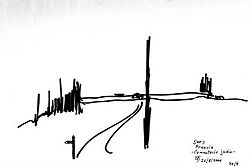 After the liberation in 1944, The French Association of Jewish communities of the Basses-Pyrénées took charge of Gurs' upkeep and erected a monument to the camp's victims. As the years passed, though, the cemetery itself fell into disrepair. Hearing of this disrepair, the mayor of Karlsruhe
in 1957 took the initiative to have his city assume responsibility for the conservation of the camp, supported by the Jewish associations of Baden. He got in touch with the parts of Baden that had deported their Jewish citizens to Gurs so that they could participate in the project. The French state, for its part, gave the federation of Jewish organizations of Baden the right to control the cemetery for the next 99 years. The German cities of Karlsruhe, Freiburg
, Mannheim
, Heidelberg
, Pforzheim
, Konstanz
and Weinheim
now pay the economic costs of the cemetery's upkeep.
Since the year 1985, the camp has had a memorial to the fighters of the Spanish Civil War
who were interned in the camp; the camp's cemetery has a section set aside for the members of this group who have died. In the year 2000, the German War Graves Commission
performed major renovations on this cemetery.
Catalonia
Catalonia is an autonomous community in northeastern Spain, with the official status of a "nationality" of Spain. Catalonia comprises four provinces: Barcelona, Girona, Lleida, and Tarragona. Its capital and largest city is Barcelona. Catalonia covers an area of 32,114 km² and has an...
at the end of the Spanish Civil War
Spanish Civil War
The Spanish Civil WarAlso known as The Crusade among Nationalists, the Fourth Carlist War among Carlists, and The Rebellion or Uprising among Republicans. was a major conflict fought in Spain from 17 July 1936 to 1 April 1939...
to control those who fled Spain
Spain
Spain , officially the Kingdom of Spain languages]] under the European Charter for Regional or Minority Languages. In each of these, Spain's official name is as follows:;;;;;;), is a country and member state of the European Union located in southwestern Europe on the Iberian Peninsula...
out of fear of retaliation from Francisco Franco
Francisco Franco
Francisco Franco y Bahamonde was a Spanish general, dictator and head of state of Spain from October 1936 , and de facto regent of the nominally restored Kingdom of Spain from 1947 until his death in November, 1975...
's regime. At the start of the World War II, the French government interned Germans
Germany
Germany , officially the Federal Republic of Germany , is a federal parliamentary republic in Europe. The country consists of 16 states while the capital and largest city is Berlin. Germany covers an area of 357,021 km2 and has a largely temperate seasonal climate...
and citizens of other Axis Powers
Axis Powers
The Axis powers , also known as the Axis alliance, Axis nations, Axis countries, or just the Axis, was an alignment of great powers during the mid-20th century that fought World War II against the Allies. It began in 1936 with treaties of friendship between Germany and Italy and between Germany and...
, as well as French nationals who were considered to have dangerous political ideas or who were imprisoned for ordinary crimes.
After the Vichy government
Vichy France
Vichy France, Vichy Regime, or Vichy Government, are common terms used to describe the government of France that collaborated with the Axis powers from July 1940 to August 1944. This government succeeded the Third Republic and preceded the Provisional Government of the French Republic...
signed an armistice with the Nazis
Nazi Germany
Nazi Germany , also known as the Third Reich , but officially called German Reich from 1933 to 1943 and Greater German Reich from 26 June 1943 onward, is the name commonly used to refer to the state of Germany from 1933 to 1945, when it was a totalitarian dictatorship ruled by...
in 1940, it became an Internment camp for Jews
Jews
The Jews , also known as the Jewish people, are a nation and ethnoreligious group originating in the Israelites or Hebrews of the Ancient Near East. The Jewish ethnicity, nationality, and religion are strongly interrelated, as Judaism is the traditional faith of the Jewish nation...
of any nationality except French, as well as people considered dangerous by the government. After France's liberation, Gurs housed German prisoners of war and French collaborators.
Before its final closure in 1946, the camp also held former Spanish Republican fighters who participated
Spain in World War II
The Spanish State under General Franco was officially non-belligerent during World War II. This status, although not recognised by international law, was intended to express the regime's sympathy and material support for the Axis Powers, to which Spain offered considerable material, economic, and...
in the Resistance
Resistance during World War II
Resistance movements during World War II occurred in every occupied country by a variety of means, ranging from non-cooperation, disinformation and propaganda to hiding crashed pilots and even to outright warfare and the recapturing of towns...
against the German occupation, because their decided will to end the fascist dictatorship imposed by Franco made them threatening in the eyes of the Allies
Allies
In everyday English usage, allies are people, groups, or nations that have joined together in an association for mutual benefit or to achieve some common purpose, whether or not explicit agreement has been worked out between them...
.
Background
After the victory of Francisco FrancoFrancisco Franco
Francisco Franco y Bahamonde was a Spanish general, dictator and head of state of Spain from October 1936 , and de facto regent of the nominally restored Kingdom of Spain from 1947 until his death in November, 1975...
's forces over the Spanish Republic
Second Spanish Republic
The Second Spanish Republic was the government of Spain between April 14 1931, and its destruction by a military rebellion, led by General Francisco Franco....
on 1 April 1939, many combatants, together with their relatives and other people who feared Franco's repression, fled to France. The French government built various camps to give shelter to these refugees. The most important camp was the one at Gurs, built adjacent to the city of Gurs
Gurs
Gurs is a commune in the Pyrénées-Atlantiques department in south-western France.Gurs was the site of the Camp Gurs concentration camp. Nothing remains of the camp; after World War II, a forest was planted on the site where it stood.-Geography:...
, in the region of Aquitaine
Aquitaine
Aquitaine , archaic Guyenne/Guienne , is one of the 27 regions of France, in the south-western part of metropolitan France, along the Atlantic Ocean and the Pyrenees mountain range on the border with Spain. It comprises the 5 departments of Dordogne, :Lot et Garonne, :Pyrénées-Atlantiques, Landes...
in the department of Pyrénées-Atlantiques
Pyrénées-Atlantiques
Pyrénées-Atlantiques is a department in the southwest of France which takes its name from the Pyrenees mountains and the Atlantic Ocean.- History :...
, 84 kilometres east of the Atlantic coast and 34 kilometres north of the Spanish border.
Conditions
The camp measured about 1,400 metres in length and 200 in width, an area of 28 hectareHectare
The hectare is a metric unit of area defined as 10,000 square metres , and primarily used in the measurement of land. In 1795, when the metric system was introduced, the are was defined as being 100 square metres and the hectare was thus 100 ares or 1/100 km2...
s. The only street spanned the length of the camp. Both sides of the street were surrounded by parcels of 200 metres by 100 metres, named îlots (blocks
City block
A city block, urban block or simply block is a central element of urban planning and urban design. A city block is the smallest area that is surrounded by streets. City blocks are the space for buildings within the street pattern of a city, they form the basic unit of a city's urban fabric...
; literally, "islets"). There were seven îlots on one side and six on the other. The parcels were separated from the street and from each other by wire fences. The fences were doubled in the back part of the parcels, forming a passageway in which the exterior guards circulated.
Artillery
Originally applied to any group of infantry primarily armed with projectile weapons, artillery has over time become limited in meaning to refer only to those engines of war that operate by projection of munitions far beyond the range of effect of personal weapons...
, and they served to accommodate soldiers during the few days between when the soldiers arrived at their barracks and awaited their trench assignment. They were assembled from thin planks of wood and covered with tarred fabric, all identical in construction and size. They were not provided with windows or other insulation. They did not offer protection from the cold, and the tarred fabric soon began to deteriorate, allowing rainwater to enter the cabins. Closets were nonexistent, and residents slept on sacks of straw gathered place on the floor. Despite the fact that each cabin had an area of only 25 square metres, each cabin had to lodge up to 60 people during times of peak occupancy.
Food was scarce and poor in quality; there was no sanitation, running water, or plumbing. The camp had poor drainage. The area, due to its proximity to the Atlantic Ocean, receives a great deal of rain, which made the clay campgrounds permanently muddy. The inmates made paths with the few stones they could find in a vain attempt to keep the mud in check. Pieces of wire that had been stripped of their barbs were placed between the cabins and the toilets and used by the refugees like the railing of a staircase, to maintain balance on the unsteady ground.
In each îlot there were rudimentary toilets, not very different from the sort of troughs that would be used to feed animals. There was also a platform about 2 metres high, which one climbed using steps, and upon which were built additional toilets. Under the platform there were large tubs that collected excrement. Once they were full they were transported out of the camp in carts.
One feature of the camp was that the wire fences were only two metres high; they were not electrified, and they did not have lookout towers filled with guards pointing their machine guns at the internees. The atmosphere was radically different from an extermination camp: there were no executions (murders) or displays of sadism on the part of the guards.
Around the camp there were small buildings that housed the administration and the guard corps. The administration and care of the camp was conducted under military auspices until the fall of 1940, when a civil administration was installed by the Vichy regime.
Originating from Spain
Those arriving from Spain were grouped into four categories(here translated into English):Brigadists
International Brigades
The International Brigades were military units made up of volunteers from different countries, who traveled to Spain to defend the Second Spanish Republic in the Spanish Civil War between 1936 and 1939....
: They had belonged to the International Brigades
International Brigades
The International Brigades were military units made up of volunteers from different countries, who traveled to Spain to defend the Second Spanish Republic in the Spanish Civil War between 1936 and 1939....
fighting for the Second Spanish Republic
Second Spanish Republic
The Second Spanish Republic was the government of Spain between April 14 1931, and its destruction by a military rebellion, led by General Francisco Franco....
. Because of their nationalities (German, Austrian, Czech, Russians etc.) it was not possible for them to return to their countries of origin. Some managed to flee and many others ended up enlisting in the French Foreign Legion
French Foreign Legion
The French Foreign Legion is a unique military service wing of the French Army established in 1831. The foreign legion was exclusively created for foreign nationals willing to serve in the French Armed Forces...
.
Basques: They were gudari
Euzko Gudarostea
Euzko Gudarostea was the name of the army commanded by the Basque Government during the Spanish civil war. It was formed by Basque nationalists, socialists and communists under the direction of lendakari José Antonio Aguirre and coordinating with the army of the Second Spanish Republic...
s (Basque nationalists) who had escaped from the siege of Santander
Santander, Cantabria
The port city of Santander is the capital of the autonomous community and historical region of Cantabria situated on the north coast of Spain. Located east of Gijón and west of Bilbao, the city has a population of 183,446 .-History:...
and, transferred by sea to the Republican side, had continued fighting outside of their homeland. Due to the proximity of Gurs to their homeland, practically all managed to find local backing that permitted them to abandon the camp and find work and refuge in France.
Pilots: They were members of the ground personnel of the Republican air force. Possessing a mechanical trade, it was easy for them to find French businessmen who gave them work, allowing them to leave the camp.
Spaniards: They were farmers and had trades that were in low demand. They had no one in France who was interested in them. They were a burden for the French government and therefore they were encouraged, in agreement with the Francoist government, to return to Spain. The great majority did so and were turned over to the Francoist authorities in Irún
Irun
Irun is a town of the Bidasoa-Txingudi region in the province of Gipuzkoa in the Basque Autonomous Community, Spain...
. From there they were transferred to the Miranda de Ebro
Miranda de Ebro
Miranda de Ebro is a city on the Ebro river in the province of Burgos in the autonomous community of Castile and León, Spain. It is located in the north-eastern part of the province, on the border with the province of Álava and the autonomous community of La Rioja...
camp for purification according to the Law of Political Responsibilities
Law of Political Responsibilities
The Law of Political Responsibilities was a law issued by the Francoist dictatorship on February 1939, two months before the end of Spanish Civil War...
.
From 1939 to the autumn of 1940, the language that dominated in the camp was Spanish. The inmates created an orchestra and constructed a sports field. On July 14, 1939, Bastille Day
Bastille Day
Bastille Day is the name given in English-speaking countries to the French National Day, which is celebrated on 14 July of each year. In France, it is formally called La Fête Nationale and commonly le quatorze juillet...
, the 17,000 internees of Spanish origin arranged themselves in military formation in the sports field and sang La Marseillaise
La Marseillaise
"La Marseillaise" is the national anthem of France. The song, originally titled "Chant de guerre pour l'Armée du Rhin" was written and composed by Claude Joseph Rouget de Lisle in 1792. The French National Convention adopted it as the Republic's anthem in 1795...
, followed by sports presentations and choral and instrumental concerts.
The German members of the International Brigade edited a newspaper in German by the name of "Lagerstimme K.Z. Gurs" of which there were more than 100 editions. The inhabitants of neighboring places could come to the camp and sell food to the inmates. For a time, the commander permitted some imprisoned women to rent a horse and cart and let them leave to camp to buy provisions more economically. There was a postal service and visits were also occasionally permitted.
"Undesirables"
At the start of World War II, the French government decided to use the camp also to house ordinary prisoners and citizens of enemy countries. The first contingent of these arrived at Gurs May 21, 1940, eleven days after the German government initiated its western campaign with the invasion of the Netherlands. To the Spaniards and Brigadists who still remained in the camp, were added:- Germans who were found in France, without regard to ethnicity or political orientation, as foreign citizens of an enemy power. Among them stands out a significant number of German Jews who had fled the Nazi regime.
- citizens of countries who were in the orbit of the Reich, like AustriaAnschlussThe Anschluss , also known as the ', was the occupation and annexation of Austria into Nazi Germany in 1938....
, CzechoProtectorate of Bohemia and MoraviaThe Protectorate of Bohemia and Moravia was the majority ethnic-Czech protectorate which Nazi Germany established in the central parts of Bohemia, Moravia and Czech Silesia in what is today the Czech Republic...
-Slovakia, Fascist ItalyKingdom of Italy (1861–1946)The Kingdom of Italy was a state forged in 1861 by the unification of Italy under the influence of the Kingdom of Sardinia, which was its legal predecessor state...
, or PolandGeneral GovernmentThe General Government was an area of Second Republic of Poland under Nazi German rule during World War II; designated as a separate region of the Third Reich between 1939–1945...
. - French activists of the leftLeft-wing politicsIn politics, Left, left-wing and leftist generally refer to support for social change to create a more egalitarian society...
(trade unionists, socialistsSocialismSocialism is an economic system characterized by social ownership of the means of production and cooperative management of the economy; or a political philosophy advocating such a system. "Social ownership" may refer to any one of, or a combination of, the following: cooperative enterprises,...
, anarchistsAnarchismAnarchism is generally defined as the political philosophy which holds the state to be undesirable, unnecessary, and harmful, or alternatively as opposing authority in the conduct of human relations...
, and especially, communistsCommunismCommunism is a social, political and economic ideology that aims at the establishment of a classless, moneyless, revolutionary and stateless socialist society structured upon common ownership of the means of production...
), who were considered dangerous under the Molotov-Ribbentrop PactMolotov-Ribbentrop PactThe Molotov–Ribbentrop Pact, named after the Soviet foreign minister Vyacheslav Molotov and the German foreign minister Joachim von Ribbentrop, was an agreement officially titled the Treaty of Non-Aggression between Germany and the Soviet Union and signed in Moscow in the late hours of 23 August 1939...
; the first of these arrived June 21, 1940, and the majority were relocated in other camps before the end of the year. - pacifists who refused to work in the war industry.
- representatives of the French extreme right who sympathized with the Nazi regime.
- ordinary prisoners evacuated from prisons in the north of the country ahead of the German advance.
- prisoners waiting trial for common crimes.
In contrast to the Spaniards, for whom there was generally sympathy, the internees from the second waves were known as "les indésirables", the undesirables.
Regime de Vichy
With the armisticeArmistice
An armistice is a situation in a war where the warring parties agree to stop fighting. It is not necessarily the end of a war, but may be just a cessation of hostilities while an attempt is made to negotiate a lasting peace...
between France and Germany in June 1940, the region in which the camp was situated formed part of the territory governed by the Vichy government, passing over to the civil authority. The military commander, before turning over command, burned the records in order to make it difficult for the new French government to locate and persecute many of the inmates who, informed of the change in command, had fled, disappearing among the French population who gave them shelter. A later consequence of the burning of the records however, was that once the war was over it made it difficult for many ex-prisoners to claim the compensation that was due to them for having been incarcerated.
Seven hundred of the prisoners, interned only for the reason of their nationality or for being sympathetical to the Nazi regime, were liberated between August 21 — the date of the arrival of the inspection commission sent by the German government to Gurs — and October. The Vichy government used the camp to lock up:
- political dissidents.
- Jews who were not French nationals.
- German Jews deported by the SSSchutzstaffelThe Schutzstaffel |Sig runes]]) was a major paramilitary organization under Adolf Hitler and the Nazi Party. Built upon the Nazi ideology, the SS under Heinrich Himmler's command was responsible for many of the crimes against humanity during World War II...
from Germany. - persons who had illegally crossed the border of the zone occupied by the Germans.
- Spaniards fleeing Francoist Spain.
- Spaniards who had already been in the camp, released in the fall of 1940, roamed around the country unemployed.
- Spaniards coming from other camps that had been condemned for being inhabitable or due to their scarce contingent.
- stateless persons.
- people involved in prostitution.
- homosexuals.
- Gypsies.
- indigents.
Jews deported from Baden
The most painful period in the camp's history began in October of 1940. The Nazi GauleiterGauleiter
A Gauleiter was the party leader of a regional branch of the NSDAP or the head of a Gau or of a Reichsgau.-Creation and Early Usage:...
("governor") from the Baden
Baden
Baden is a historical state on the east bank of the Rhine in the southwest of Germany, now the western part of the Baden-Württemberg of Germany....
region of Germany had also been named Gauleiter of the neighboring French region of Alsace
Alsace
Alsace is the fifth-smallest of the 27 regions of France in land area , and the smallest in metropolitan France. It is also the seventh-most densely populated region in France and third most densely populated region in metropolitan France, with ca. 220 inhabitants per km²...
. In Baden resided some 7,500 Jews; they were mainly women, children, and the elderly, given that the young and middle-aged men had fled from Germany or had disappeared in the Nazi concentration camps.
The Gauleiter received word that the camp at Gurs was mostly empty, and on October 25, 1940, it was decided to evacuate the Jews from Baden (between 6,500 and 7,500) to Gurs as part of Operation Wagner-Bürckel. There, they remained locked up under French administration. The living conditions were even more difficult, and during the year that they remained in the camp, more than a thousand fell victim to illness, especially typhus
Typhus
Epidemic typhus is a form of typhus so named because the disease often causes epidemics following wars and natural disasters...
and dysentery
Dysentery
Dysentery is an inflammatory disorder of the intestine, especially of the colon, that results in severe diarrhea containing mucus and/or blood in the faeces with fever and abdominal pain. If left untreated, dysentery can be fatal.There are differences between dysentery and normal bloody diarrhoea...
.
Of the survivors, some 700 managed to escape and almost 2,000 obtained visas that permitted them to emigrate. The rest, numbering several thousand, remained in the camp, and males in the best physical condition were imprisoned in French work gangs.
The deportation of the German Jews to Gurs in October 1940 is a unique case in the history of the Holocaust
Shoah
Shoah may refer to:*The Holocaust*Shoah , documentary directed by Claude Lanzmann * A Shoah Foundation...
. On one hand, it deals with the only deportation of Jews carried out toward the west of Germany by the Nazi regime. On the other hand, the Wannsee conference
Wannsee Conference
The Wannsee Conference was a meeting of senior officials of the Nazi German regime, held in the Berlin suburb of Wannsee on 20 January 1942. The purpose of the conference was to inform administrative leaders of Departments responsible for various policies relating to Jews, that Reinhard Heydrich...
in which the above mentioned extermination program was delineated, did not take place until January 1942.
Precise information on the motive of this deportation have not been found. There only exists the suspicion that it could have involved setting into motion the Madagascar Plan
Madagascar Plan
The Madagascar Plan was a suggested policy of the Nazi government of Germany to relocate the Jewish population of Europe to the island of Madagascar.-Origins:The evacuation of European Jews to the island of Madagascar was not a new concept...
, an initiative of Adolf Eichmann
Adolf Eichmann
Adolf Otto Eichmann was a German Nazi and SS-Obersturmbannführer and one of the major organizers of the Holocaust...
designed to transport the entire Jewish population of Europe
Europe
Europe is, by convention, one of the world's seven continents. Comprising the westernmost peninsula of Eurasia, Europe is generally 'divided' from Asia to its east by the watershed divides of the Ural and Caucasus Mountains, the Ural River, the Caspian and Black Seas, and the waterways connecting...
to the island of that name
Madagascar
The Republic of Madagascar is an island country located in the Indian Ocean off the southeastern coast of Africa...
. If this was the case, this deportation would be the only known attempt to carry this plan forward. The protests of the French government avoided subsequent actions in this direction.
Aid Organizations
Beginning December 20, 1940, various humanitarian aid organizations intervened to lend their services: in addition to the Basque governmentBasque Government
The Basque Government is the governing body of the Basque Autonomous Community of Spain. The head of this government is the lehendakari or Basque president that is appointed by the Basque Parliament every four years...
in exile, posts were set up in Gurs belonging to the Swiss Humanitarian Aid Unit, Jewish French organizations tolerated by the Vichy regime, and Protestant organizations such as the Quakers, CIMADE
Cimade
The Cimade is a French NGO founded at the beginning of the WWII by French Protestant student groups, in particular the Christian activist and member of the French Resistance Madeleine Barot, to give assistance and support to people uprooted by war, in the first instance those who were evacuated...
, and the YMCA
YMCA
The Young Men's Christian Association is a worldwide organization of more than 45 million members from 125 national federations affiliated through the World Alliance of YMCAs...
. Despite the fact that the camp was situated in a region where the great majority of the population was Catholic, not one Catholic organization offered its help to the inmates. On February 15, 1941, the Oeuvre de Secours aux Enfants (Children’s Aid Society) installed a medical post and obtained permission to take numerous children away from Gurs, who would be housed in private homes throughout France.
Daily Conditions
Security infrastructure in the camp was not as developed as many of its more eastern counterparts. However, inhabitants that were poorly dressed, lacking money and were without knowledge of local dialects were quickly located and returned to the camp. Reclaimed prisoners were subsequently held for a time as punishment in an îlot called de los represaliados (of those suffering reprisals). In case of recidivism, they were sent to another camp. But an internee who could count on outside help could successfully escape, whether to Spain or a shelter on a flat in France. There were 755 who managed to escape.Deportations to the East
Once the program for the eradication of the Jews was put into motion in the camps in German occupied Poland, the Vichy regime turned over the 5,500 Jews who were located in Gurs to the Nazis. On July 18, 1942, the SS captain, Theodor DanneckerTheodor Dannecker
Theodor Dannecker was an SS Hauptsturmführer and one of Adolf Eichmann's associates....
, inspected the camp and then ordered that they prepare themselves to be transported to Eastern Europe. Beginning on August 6, they were sent in convoys to the Drancy deportation camp, on the outskirts of Paris, and later many were murdered in extermination camps. The majority of them were sent to Auschwitz.
Liberated France
Upon the withdrawal of the Germans from the region due to the advance of the Allied invasion of France, the French who took charge of Gurs locked up their countrymen accused of collaborating with the German occupiers as well as Spaniards, who having found refuge in France, had been fighting in the French ResistanceFrench Resistance
The French Resistance is the name used to denote the collection of French resistance movements that fought against the Nazi German occupation of France and against the collaborationist Vichy régime during World War II...
against the German occupation. These men were not trying to enter into an armed conflict on the French-Spanish border and were not interested in confronting Franco, but the French feared they might and so held these Spaniards in Gurs for a short time. The camp also briefly housed German prisoners of war.
Dismantling
The camp was dismantled in 1946, and fell into obscurity. The hill has since been covered in dense vegetation that still does not manage to absorb the water that flows from the clay soil. One can see a few stones that were paths and the bases of cabins. Groups of volunteers have begun to remove the overgrown weeds to expose the misery in which some 64,000 people were forced to live during the various époques of the camp.L'Amicale and L'Apell de Gurs
In 1979, on the 40th anniversary of the creation of the camp, the region's youth started to air the forgotten history of the camp by inviting old inmates to conferences and lectures. The event was well-publicized by the French, German, and Spanish press; as a result, the next year there was a reunion at Gurs on June 20—21. The reunion drew a hundred former detainees, who came from many different countries. Also in attendance were people associated with the French resistance and survivors of the Nazi death camps. Together, these people created an organization called L'Amicale de Gurs. This organization developed an official newsletter called L'Apell de Gurs, which was full of emphatic catchphrases such as, "Gurs, a symbol of combat and the suffering of the peoples of Europe," and "Gurs, a concentration camp, calls for vigilance, for unity, and for action; actions taken so that man can live in freedom and dignity."Since this date, a commemorative ceremony has been held annually. Some of the main participants in this ceremony have been Jewish organizations, representatives of citizens of Baden, former exiles, their relatives, and people of diverse nationalities who, by their presence, hope to point out the duty of every generation to remember the criminal acts of the dictatorial regimes that assaulted Europe during the 20th century.
Current State
Today the camp contains a reconstruction of a triangular cabin as a testimony to the hundreds of identical cabins that were lived in by the inmates. Like the original cabins, the reconstruction was made from thin slabs of wood covered in tarred cardboard. A few monuments recall the camp of the Gursiens, a name that was first used by the inhabitants of nearby towns to refer to the inmates and that was ultimately adopted by the inmates themselves.Cemetery
The thick vegetation that covers the area occupied by the Gurs ilots contrasts sharply with the tranquility of the large Jewish cemetery, which is paid for and exquisitely maintained by the governments of German cities that once deported their German-Jewish populations.Karlsruhe
The City of Karlsruhe is a city in the southwest of Germany, in the state of Baden-Württemberg, located near the French-German border.Karlsruhe was founded in 1715 as Karlsruhe Palace, when Germany was a series of principalities and city states...
in 1957 took the initiative to have his city assume responsibility for the conservation of the camp, supported by the Jewish associations of Baden. He got in touch with the parts of Baden that had deported their Jewish citizens to Gurs so that they could participate in the project. The French state, for its part, gave the federation of Jewish organizations of Baden the right to control the cemetery for the next 99 years. The German cities of Karlsruhe, Freiburg
Freiburg
Freiburg im Breisgau is a city in Baden-Württemberg, Germany. In the extreme south-west of the country, it straddles the Dreisam river, at the foot of the Schlossberg. Historically, the city has acted as the hub of the Breisgau region on the western edge of the Black Forest in the Upper Rhine Plain...
, Mannheim
Mannheim
Mannheim is a city in southwestern Germany. With about 315,000 inhabitants, Mannheim is the second-largest city in the Bundesland of Baden-Württemberg, following the capital city of Stuttgart....
, Heidelberg
Heidelberg
-Early history:Between 600,000 and 200,000 years ago, "Heidelberg Man" died at nearby Mauer. His jaw bone was discovered in 1907; with scientific dating, his remains were determined to be the earliest evidence of human life in Europe. In the 5th century BC, a Celtic fortress of refuge and place of...
, Pforzheim
Pforzheim
Pforzheim is a town of nearly 119,000 inhabitants in the state of Baden-Württemberg, southwest Germany at the gate to the Black Forest. It is world-famous for its jewelry and watch-making industry. Until 1565 it was the home to the Margraves of Baden. Because of that it gained the nickname...
, Konstanz
Konstanz
Konstanz is a university city with approximately 80,000 inhabitants located at the western end of Lake Constance in the south-west corner of Germany, bordering Switzerland. The city houses the University of Konstanz.-Location:...
and Weinheim
Weinheim
Weinheim is a town in the north west of the state of Baden-Württemberg in Germany with 43 000 inhabitants, approximately 15 km north of Heidelberg and 10 km northeast of Mannheim. Together with these cities, it makes up the Rhine-Neckar triangle...
now pay the economic costs of the cemetery's upkeep.
Since the year 1985, the camp has had a memorial to the fighters of the Spanish Civil War
Spanish Civil War
The Spanish Civil WarAlso known as The Crusade among Nationalists, the Fourth Carlist War among Carlists, and The Rebellion or Uprising among Republicans. was a major conflict fought in Spain from 17 July 1936 to 1 April 1939...
who were interned in the camp; the camp's cemetery has a section set aside for the members of this group who have died. In the year 2000, the German War Graves Commission
German War Graves Commission
The German War Graves Commission is responsible for the maintenance and upkeep of German war graves in Europe and North Africa...
performed major renovations on this cemetery.
Figures on Internees at Gurs
| Basques | 6,555 |
|---|---|
| Brigadists | 6,808 |
| Pilots | 5,397 |
| Spaniards | 5,760 |
| Total | 24,520 |
| Total | 2,820 |
|---|
| Spaniards | 3,695 |
|---|---|
| Germans and Austrians | 9,771 |
| French | 1,329 |
| Total | 14,795 |
| Germans from Baden | 6,538 |
|---|---|
| Arrivals from Saint Cyprien camp | 3,870 |
| Spaniards | 1,515 |
| Others | 6,262 |
| Total | 18,185 |
| Total | 229 |
|---|
| German prisoners of war | 310 |
|---|---|
| Anti-Franco Spaniards | 1,475 |
| Collaborators with the German occupiers | 1,585 |
| Total | 3,370 |
| Total before the liberation | 60,559 |
|---|---|
| Total after the liberation | 3,370 |
| Total people interned (1939-1945) | 63,929 |