


Cathay

Encyclopedia
Names of China
In China, common names for China include Zhonghua and Zhongguo , while Han and Tang are common names given for the Chinese ethnicity. Other names include Huaxia, Shenzhou and Jiuzhou...
for China
China
Chinese civilization may refer to:* China for more general discussion of the country.* Chinese culture* Greater China, the transnational community of ethnic Chinese.* History of China* Sinosphere, the area historically affected by Chinese culture...
in English. It originates from the word Khitan
Khitan people
thumb|250px|Khitans [[Eagle hunting|using eagles to hunt]], painted during the Chinese [[Song Dynasty]].The Khitan people , or Khitai, Kitan, or Kidan, were a nomadic Mongolic people, originally located at Mongolia and Manchuria from the 4th century...
, the name of a nomadic people who founded the Liao Dynasty
Liao Dynasty
The Liao Dynasty , also known as the Khitan Empire was an empire in East Asia that ruled over the regions of Manchuria, Mongolia, and parts of northern China proper between 9071125...
which ruled much of Northern China from 907 to 1125, and who had a state of their own (Kara-Khitan Khanate
Kara-Khitan Khanate
The Kara-Khitan Khanate, or Western Liao was a Khitan empire in Central Asia. The dynasty was founded by Yelü Dashi, who led the remnants of the Liao Dynasty to Central Asia after fleeing from the Jurchen conquest of their homeland in North and Northeast of modern day China...
) centered around today's Kyrgyzstan
Kyrgyzstan
Kyrgyzstan , officially the Kyrgyz Republic is one of the world's six independent Turkic states . Located in Central Asia, landlocked and mountainous, Kyrgyzstan is bordered by Kazakhstan to the north, Uzbekistan to the west, Tajikistan to the southwest and China to the east...
for another century thereafter.
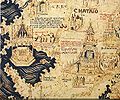
Originally, Catai was the name applied by Central and Western Asians and Europeans to northern China; it obtained wide currency in Europe after the publication of Marco Polo
Marco Polo
Marco Polo was a Venetian merchant traveler from the Venetian Republic whose travels are recorded in Il Milione, a book which did much to introduce Europeans to Central Asia and China. He learned about trading whilst his father and uncle, Niccolò and Maffeo, travelled through Asia and apparently...
's book (he referred to southern China as Manji). For centuries Cathay and China were believed by Europeans to be distinct nations with distinct cultures. However, by the late 1600s Europeans had mostly become aware that these were in fact the same nation.
History
Uyghur language
Uyghur , formerly known as Eastern Turk, is a Turkic language with 8 to 11 million speakers, spoken primarily by the Uyghur people in the Xinjiang Uyghur Autonomous Region of Western China. Significant communities of Uyghur-speakers are located in Kazakhstan and Uzbekistan, and various other...
Manichaean document circa 1000. Soon the name became known in Muslim Central Asia as well: when in 1026, the Ghaznavid court
Ghaznavid Empire
The Ghaznavids were a Persianate Muslim dynasty of Turkic slave origin which existed from 975 to 1187 and ruled much of Persia, Transoxania, and the northern parts of the Indian subcontinent. The Ghaznavid state was centered in Ghazni, a city in modern-day Afghanistan...
(in Ghazna, in today's Afghanistan) was visited by envoys from the Liao ruler, he was described as a "Qatā Khan", i.e. the ruler of Qatā; Qatā or Qitā appears in writings of al-Biruni
Al-Biruni
Abū al-Rayḥān Muḥammad ibn Aḥmad al-BīrūnīArabic spelling. . The intermediate form Abū Rayḥān al-Bīrūnī is often used in academic literature...
and Abu Said Gardezi in the following decades. The Persian scholar and administrator Nizam al-Mulk
Nizam al-Mulk
Abu Ali al-Hasan al-Tusi Nizam al-Mulk, better known as Khwaja Nizam al-Mulk Tusi ; born in 1018 – 14 October 1092) was a Persian scholar and vizier of the Seljuq Empire...
(1018–1092) mentions Khita and China in his Book on the Administration of the State, apparently as two separate countries (presumably, referring to the Liao and Song Empires, respectively).
The name's currency in the Muslim world survived the replacement of the Khitan Liao Dynasty with the Jurchen Jin Dynasty in the early 12th century. When describing the fall of the Jin Empire to the Mongols (1234), Persian history described the conquered country as Khitāy or Djerdaj Khitāy(i.e., "Jurchen Cathay"). The Mongols themselves, in their Secret History
The Secret History of the Mongols
The Secret History of the Mongols is the oldest surviving Mongolian-language literary work...
(13th century) talk of both Khitans and Kara-Khitans.
As European and Arab travelers started reaching the Mongol Empire
Mongol Empire
The Mongol Empire , initially named as Greater Mongol State was a great empire during the 13th and 14th centuries...
, they described the Mongol-controlled Northern China as Cathay (in a number of spelling variants) as well. The name occurs in the writings of Giovanni da Pian del Carpine
Giovanni da Pian del Carpine
Giovanni da Pian del Carpine, or John of Plano Carpini or John of Pian de Carpine or Joannes de Plano was one of the first Europeans to enter the court of the Great Khan of the Mongol Empire. He is the author of the earliest important Western account of northern and central Asia, Rus, and other...
(ca. 1180 - 1252) (as Kitaia), William of Rubruck
William of Rubruck
William of Rubruck was a Flemish Franciscan missionary and explorer. His account is one of the masterpieces of medieval geographical literature comparable to that of Marco Polo....
(ca. 1220 - ca. 1293) (as Cataya or Cathaia). Rashid-al-Din Hamadani, ibn Battuta
Ibn Battuta
Abu Abdullah Muhammad Ibn Battuta , or simply Ibn Battuta, also known as Shams ad–Din , was a Muslim Moroccan Berber explorer, known for his extensive travels published in the Rihla...
, Marco Polo
Marco Polo
Marco Polo was a Venetian merchant traveler from the Venetian Republic whose travels are recorded in Il Milione, a book which did much to introduce Europeans to Central Asia and China. He learned about trading whilst his father and uncle, Niccolò and Maffeo, travelled through Asia and apparently...
all were referring to Northern China as Cathay, while Southern China was Mangi, Manzi, Chin, or Sin.
Identifying China as Cathay
The division of China into northern and southern parts ruled by, in succession, the Liao, Jin and Mongol Yuan dynasties in the north, and the Song dynasty in the south, ended in the late 13th century with the conquest of southern China by the Mongol Yuan dynasty.While Central Asia had long known China under names similar to Cathay, that country was known to the peoples of South-East Asia and India under names similar to China (cf. e.g. Cina in modern Malay). Meanwhile in China itself, people usually referred to their nation state based on the name of the ruling dynasty, e.g. Da Ming Guo
Ming Dynasty
The Ming Dynasty, also Empire of the Great Ming, was the ruling dynasty of China from 1368 to 1644, following the collapse of the Mongol-led Yuan Dynasty. The Ming, "one of the greatest eras of orderly government and social stability in human history", was the last dynasty in China ruled by ethnic...
("the state of the Great Ming"), or as the "Middle Kingdom" (Zhongguo 中國); see also Names of China
Names of China
In China, common names for China include Zhonghua and Zhongguo , while Han and Tang are common names given for the Chinese ethnicity. Other names include Huaxia, Shenzhou and Jiuzhou...
for details.
When in the early 16th century the Portuguese reached South-East Asia (Afonso de Albuquerque
Afonso de Albuquerque
Afonso de Albuquerque[p][n] was a Portuguese fidalgo, or nobleman, an admiral whose military and administrative activities as second governor of Portuguese India conquered and established the Portuguese colonial empire in the Indian Ocean...
conquering Malacca in 1511) and the southern coast of China (Jorge Álvares
Jorge Álvares
Jorge Álvares is credited as the first Portuguese explorer to have reached China and Hong Kong. The Fundação Jorge Álvares , founded by Vasco Joaquim Rocha Vieira prior to the handover of Macau, got its name from him also having reached there.-Exploration:In May 1513 Álvares sailed under the...
reaching the Pearl River
Pearl River (China)
The Pearl River or less commonly, the "Guangdong River" or "Canton River" etc., , is an extensive river system in southern China. The name Pearl River is usually used as a catchment term to refer to the watersheds of the Xi Jiang , the Bei Jiang , and the Dong Jiang...
estuary in 1513), they started calling the country by the name used in South and South-East Asia. It was not immediately clear to the Europeans whether this China is the same country as Cathay known from Marco Polo
Marco Polo
Marco Polo was a Venetian merchant traveler from the Venetian Republic whose travels are recorded in Il Milione, a book which did much to introduce Europeans to Central Asia and China. He learned about trading whilst his father and uncle, Niccolò and Maffeo, travelled through Asia and apparently...
. Therefore, it would not be uncommon for 16th-century map to apply the label "China" just to the coastal region already well known to the Europeans (e.g., just Guangdong
Guangdong
Guangdong is a province on the South China Sea coast of the People's Republic of China. The province was previously often written with the alternative English name Kwangtung Province...
on Abraham Ortelius
Abraham Ortelius
thumb|250px|Abraham Ortelius by [[Peter Paul Rubens]]Abraham Ortelius thumb|250px|Abraham Ortelius by [[Peter Paul Rubens]]Abraham Ortelius (Abraham Ortels) thumb|250px|Abraham Ortelius by [[Peter Paul Rubens]]Abraham Ortelius (Abraham Ortels) (April 14, 1527 – June 28,exile in England to take...
' 1570 map), and to place the mysterious Cathay somewhere inland.
It was a small group of Jesuits
Jesuit China missions
The history of the missions of the Jesuits in China is part of the history of relations between China and the Western world. The missionary efforts and other work of the Society of Jesus, or Jesuits, between the 16th and 17th century played a significant role in continuing the transmission of...
, led by Matteo Ricci
Matteo Ricci
Matteo Ricci, SJ was an Italian Jesuit priest, and one of the founding figures of the Jesuit China Mission, as it existed in the 17th-18th centuries. His current title is Servant of God....
who, being able both to travel throughout China and to read, learned about the country from Chinese books and from conversation with people of all walks of life. During his first 15 years in China (1583–1598) Matteo Ricci formed a strong suspicion that Marco Polo's "Cathay" is simply the "Tatar" (i.e., Mongol) name for the
country he was in, i.e. China. Ricci supported his arguments by numerous correspondences between Marco Polo's accounts and his own observations:
- The River "Yangtze" divides the empire into two halves, with 9 provinces ("kingdoms") south of the river and 6 to the north;
- Marco Polo's "Cathay" was just south of "TartaryTartaryTartary or Great Tartary was a name used by Europeans from the Middle Ages until the twentieth century to designate the Great Steppe, that is the great tract of northern and central Asia stretching from the Caspian Sea and the Ural Mountains to the Pacific Ocean inhabited mostly by Turkic, Mongol...
", and Ricci learned that there was no other country between the Ming EmpireMing DynastyThe Ming Dynasty, also Empire of the Great Ming, was the ruling dynasty of China from 1368 to 1644, following the collapse of the Mongol-led Yuan Dynasty. The Ming, "one of the greatest eras of orderly government and social stability in human history", was the last dynasty in China ruled by ethnic...
and "Tartary" (i.e., the lands of Mongols and Manchus). - People in China had not heard of any place called "Cathay".
Most importantly, when the Jesuits first arrived to Beijing 1598, they also met a number of "Mohammedans" or "Arabian Turks" - visitors or immigrants from the Muslim countries to the west of China, who told Ricci that now they were living in the Great Cathay. This all made them quite convinced that Cathay is indeed China.
China-based Jesuits
Jesuit China missions
The history of the missions of the Jesuits in China is part of the history of relations between China and the Western world. The missionary efforts and other work of the Society of Jesus, or Jesuits, between the 16th and 17th century played a significant role in continuing the transmission of...
promptly informed their colleagues in Goa
Goa
Goa , a former Portuguese colony, is India's smallest state by area and the fourth smallest by population. Located in South West India in the region known as the Konkan, it is bounded by the state of Maharashtra to the north, and by Karnataka to the east and south, while the Arabian Sea forms its...
(Portuguese India) and Europe about their discovery of the Cathay-China identity. This was stated e.g. in a 1602 letter of Ricci's comrade Diego de Pantoja
Diego de Pantoja
Diego de Pantoja or Diego Pantoja, Chinese: 龐迪我, or Pang Diwo 龐迪我 , was a Spanish Jesuit and missionary to China who is best known for having accompanied Matteo Ricci in Beijing. His name also appears in some sources as Didaco Pantoia.He came to Macao on 20 July 1597...
, which was published in Europe along with other Jesuits' letters in 1605. The Jesuits in India, however, were not convinced, because, according to their informants (merchants who visited the Mughal
Mughal Empire
The Mughal Empire , or Mogul Empire in traditional English usage, was an imperial power from the Indian Subcontinent. The Mughal emperors were descendants of the Timurids...
capitals Agra
Agra
Agra a.k.a. Akbarabad is a city on the banks of the river Yamuna in the northern state of Uttar Pradesh, India, west of state capital, Lucknow and south from national capital New Delhi. With a population of 1,686,976 , it is one of the most populous cities in Uttar Pradesh and the 19th most...
and Lahore
Lahore
Lahore is the capital of the Pakistani province of Punjab and the second largest city in the country. With a rich and fabulous history dating back to over a thousand years ago, Lahore is no doubt Pakistan's cultural capital. One of the most densely populated cities in the world, Lahore remains a...
), Cathay - a country that could be reached via Kashgar
Kashgar
Kashgar or Kashi is an oasis city with approximately 350,000 residents in the western part of the Xinjiang Uyghur Autonomous Region of the People's Republic of China. Kashgar is the administrative centre of Kashgar Prefecture which has an area of 162,000 km² and a population of approximately...
- had a large Christian population, while the Jesuits in China had not found any Christians there.
Gregorian chant
Gregorian chant is the central tradition of Western plainchant, a form of monophonic liturgical music within Western Christianity that accompanied the celebration of Mass and other ritual services...
- which would make the two religions appear externally similar to a Muslim merchant.
To resolve the China-Cathay controversy, the India Jesuits sent a Portuguese lay brother, Bento de Góis on an overland expedition north and east, with the goal of reaching Cathay and finding out once and for all whether it is China or some other country. Góis spent almost three years (1603–1605) crossing Afghanistan
Afghanistan
Afghanistan , officially the Islamic Republic of Afghanistan, is a landlocked country located in the centre of Asia, forming South Asia, Central Asia and the Middle East. With a population of about 29 million, it has an area of , making it the 42nd most populous and 41st largest nation in the world...
, Badakhshan
Badakhshan
Badakhshan is an historic region comprising parts of what is now northeastern Afghanistan and southeastern Tajikistan. The name is retained in Badakhshan Province which is one of the thirty-four provinces of Afghanistan, in the far northeast of Afghanistan, and contains the Wakhan Corridor...
, Kashgaria, and Kingdom of Cialis
Karasahr
Yanqi , or Karasahr , is an ancient town on the Silk Road and capital of Yanqi Hui Autonomous County in the Bayin'gholin Mongol Autonomous Prefecture of Xinjiang, in northwestern China...
with Muslim trade caravans
Camel train
A camel train is a series of camels carrying goods or passengers in a group as part of a regular or semi-regular service between two points. Although they rarely travelled faster than the walking speed of a man, camels' ability to handle harsh conditions made camel trains a vital part of...
. In 1605, in Cialis
Karasahr
Yanqi , or Karasahr , is an ancient town on the Silk Road and capital of Yanqi Hui Autonomous County in the Bayin'gholin Mongol Autonomous Prefecture of Xinjiang, in northwestern China...
, he, too, became convinced that his destination is China, as he met the members of a caravan returning from Beijing to Kashgar, who told them about staying in the same Beijing inn with Portuguese Jesuits. (In fact, those were the same very "Saracens" who had, a few months earlier, confirmed it to Ricci that they were in "Cathay"). De Góis died in Suzhou, Gansu
Suzhou District
The Suzhou District is an administrative district in Gansu, the People's Republic of China. It is one of 17 districts of Gansu.Suzhou District is part of the Jiuquan prefecture, and the seat of the prefecture government. Therefore, less-detailed modern maps typically mark Suzhou's location...
- the first Ming China
Ming Dynasty
The Ming Dynasty, also Empire of the Great Ming, was the ruling dynasty of China from 1368 to 1644, following the collapse of the Mongol-led Yuan Dynasty. The Ming, "one of the greatest eras of orderly government and social stability in human history", was the last dynasty in China ruled by ethnic...
city he reached - while waiting for an entry permit to proceed toward Beijing; but, in the words of Henry Yule
Henry Yule
Sir Henry Yule was a Scottish Orientalist.He was born at Inveresk, Scotland, near Edinburgh, the son of Major William Yule , translator of the Apothegms of Ali. Henry Yule was educated at Edinburgh, Addiscombe, and Chatham, and joined the Bengal Engineers in 1840...
, it was his expedition that made "Cathay... finally disappear from view, leaving China only in the mouths and minds of men".
Ricci's and de Gois' conclusion was not, however, completely convincing for everybody in Europe yet.
Samuel Purchas
Samuel Purchas
Samuel Purchas , was an English travel writer, a near-contemporary of Richard Hakluyt.Purchas was born at Thaxted, Essex, and graduated at St John's College, Cambridge, in 1600; later he became a B.D., and with this degree was admitted at Oxford in 1615. In 1604 he was presented by James I to the...
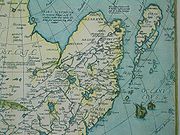
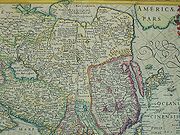
, who in 1625 published an English translation of Pantoja's letter and Ricci's account, thought that perhaps, Cathay still can be found somewhere north of China. In this period, many cartographers were placing Cathay on the Pacific coast, north of Beijing (Pekin) which was already well-known to Europeans. The borders drawn on some of these maps would first make Cathay the northeastern section of China (e.g. 1595 map by Gerardus Mercator
Gerardus Mercator
thumb|right|200px|Gerardus MercatorGerardus Mercator was a cartographer, born in Rupelmonde in the Hapsburg County of Flanders, part of the Holy Roman Empire. He is remembered for the Mercator projection world map, which is named after him...
), or, later, a region separated by China by the Great Wall and possibly some mountains and/or wilderness (as in a 1610 map by Jodocus Hondius
Jodocus Hondius
Jodocus Hondius , sometimes called Jodocus Hondius the Elder to distinguish him from his son Henricus Hondius II, was a Flemish artist, engraver, and cartographer...
, or a 1626 map by John Speed
John Speed
John Speed was an English historian and cartographer.-Life:He was born at Farndon, Cheshire, and went into his father's tailoring business where he worked until he was about 50...
).
J.J.L. Duyvendak hypothesized that it was the ignorance of the fact that "China" is the mighty "Cathay" of Marco Polo that allowed the Dutch governor of East Indies
Governor-General of the Dutch East Indies
The Governor-General of the Dutch East Indies represented the Dutch rule in the Dutch East Indies between 1610 and Dutch recognition of the independence of Indonesia in 1949.The first Governors-General were appointed by the Dutch East India Company...
Jan Pieterszoon Coen
Jan Pieterszoon Coen
Jan Pieterszoon Coen was a officer of the Dutch East India Company in the early seventeenth century, holding two terms as its Governor-General of the Dutch East Indies....
to embark on an "unfortunate" (for the Dutch) policy of treating the Ming Empire as "merely another 'oriental' kingdom".
The last nail into the coffin of the idea of there being a Cathay as a country separate from China was, perhaps, driven in 1654, when the Dutch Orientalist
Oriental studies
Oriental studies is the academic field of study that embraces Near Eastern and Far Eastern societies and cultures, languages, peoples, history and archaeology; in recent years the subject has often been turned into the newer terms of Asian studies and Middle Eastern studies...
Jacobus Golius
Jacobus Golius
Jacob Golius , was a Dutch Orientalist and mathematician....
met with the China-based Jesuit Martino Martini
Martino Martini
Martino Martini was an Italian Jesuit missionary, cartographer and historian, mainly working on ancient Imperial China.-Early years:Martini was born in Trento, in the Bishopric of Trent...
, who was passing through Leyden. Golius knew no Chinese, but he was familiar with Zij-i Ilkhani
Zij-i Ilkhani
Zīj-i Īlkhānī or Ilkhanic Tables is a Zij book with astronomical tables of planetary movements. It was compiled by the Persian astronomer Nasir al-Din al-Tusi in collaboration with his research team of astronomers at the Maragha observatory...
, a work by the Persian astronomer Nasir al-Din al-Tusi
Nasir al-Din al-Tusi
Khawaja Muḥammad ibn Muḥammad ibn Ḥasan Ṭūsī , better known as Naṣīr al-Dīn al-Ṭūsī , was a Persian polymath and prolific writer: an astronomer, biologist, chemist, mathematician, philosopher, physician, physicist, scientist, theologian and Marja Taqleed...
, completed in 1272, in which he described the Chinese ("Cathayan") Calendar
Chinese calendar
The Chinese calendar is a lunisolar calendar, incorporating elements of a lunar calendar with those of a solar calendar. It is not exclusive to China, but followed by many other Asian cultures as well...
. Upon meeting Martini, Golius started reciting the names of the 12 divisions
Earthly Branches
The Earthly Branches provide one Chinese system for reckoning time.This system was built from observations of the orbit of Jupiter. Chinese astronomers divided the celestial circle into 12 sections to follow the orbit of Suìxīng . Astronomers rounded the orbit of Suixing to 12 years...
into which, according to Nasir al-Din, the "Cathayans" were dividing the day - and Martini, who of course knew no Persian, was able to continue the list. The names of the 24 solar term
Solar term
A solar term is any of 24 points in traditional East Asian lunisolar calendars that matches a particular astronomical event or signifies some natural phenomenon. The points are spaced 15° apart along the ecliptic and are used by lunisolar calendars to stay synchronized with the seasons. Solar terms...
s matched as well. The story, soon published by Martini in the "Additamentum" to his Atlas of China, seemed to have finally convinced most European scholars that China and Cathay were the same.
Even then, some people still viewed Cathay as distinct from China, as did John Milton
John Milton
John Milton was an English poet, polemicist, a scholarly man of letters, and a civil servant for the Commonwealth of England under Oliver Cromwell...
in the 11th Book of his Paradise Lost
Paradise Lost
Paradise Lost is an epic poem in blank verse by the 17th-century English poet John Milton. It was originally published in 1667 in ten books, with a total of over ten thousand individual lines of verse...
(1667).
Etymological progression
Below is the etymological progression from Khitan to Cathay as the word travelled westward:- MongolianMongolian languageThe Mongolian language is the official language of Mongolia and the best-known member of the Mongolic language family. The number of speakers across all its dialects may be 5.2 million, including the vast majority of the residents of Mongolia and many of the Mongolian residents of the Inner...
/Classical Mongolian: Khyatad (Хятад) / Kitad - UyghurUyghur languageUyghur , formerly known as Eastern Turk, is a Turkic language with 8 to 11 million speakers, spoken primarily by the Uyghur people in the Xinjiang Uyghur Autonomous Region of Western China. Significant communities of Uyghur-speakers are located in Kazakhstan and Uzbekistan, and various other...
(Western China): خىتاي, Xitay - KazakhKazakh languageKazakh is a Turkic language which belongs to the Kipchak branch of the Turkic languages, closely related to Nogai and Karakalpak....
: قىتاي, Қытай, Qıtay - KazanKazanKazan is the capital and largest city of the Republic of Tatarstan, Russia. With a population of 1,143,546 , it is the eighth most populous city in Russia. Kazan lies at the confluence of the Volga and Kazanka Rivers in European Russia. In April 2009, the Russian Patent Office granted Kazan the...
Tatar (Central Russia): Qıtay - RussianRussian languageRussian is a Slavic language used primarily in Russia, Belarus, Uzbekistan, Kazakhstan, Tajikistan and Kyrgyzstan. It is an unofficial but widely spoken language in Ukraine, Moldova, Latvia, Turkmenistan and Estonia and, to a lesser extent, the other countries that were once constituent republics...
: Kitay (Китай) - BulgarianBulgarian languageBulgarian is an Indo-European language, a member of the Slavic linguistic group.Bulgarian, along with the closely related Macedonian language, demonstrates several linguistic characteristics that set it apart from all other Slavic languages such as the elimination of case declension, the...
: Kitay (Китай) - PolishPolish languagePolish is a language of the Lechitic subgroup of West Slavic languages, used throughout Poland and by Polish minorities in other countries...
: Kitaj - Medieval LatinMedieval LatinMedieval Latin was the form of Latin used in the Middle Ages, primarily as a medium of scholarly exchange and as the liturgical language of the medieval Roman Catholic Church, but also as a language of science, literature, law, and administration. Despite the clerical origin of many of its authors,...
: Cataya, Kitai - SpanishSpanish languageSpanish , also known as Castilian , is a Romance language in the Ibero-Romance group that evolved from several languages and dialects in central-northern Iberia around the 9th century and gradually spread with the expansion of the Kingdom of Castile into central and southern Iberia during the...
: Catay - ItalianItalian languageItalian is a Romance language spoken mainly in Europe: Italy, Switzerland, San Marino, Vatican City, by minorities in Malta, Monaco, Croatia, Slovenia, France, Libya, Eritrea, and Somalia, and by immigrant communities in the Americas and Australia...
: Catai - PortuguesePortuguese languagePortuguese is a Romance language that arose in the medieval Kingdom of Galicia, nowadays Galicia and Northern Portugal. The southern part of the Kingdom of Galicia became independent as the County of Portugal in 1095...
: Cataio - EnglishEnglish languageEnglish is a West Germanic language that arose in the Anglo-Saxon kingdoms of England and spread into what was to become south-east Scotland under the influence of the Anglian medieval kingdom of Northumbria...
, GermanGerman languageGerman is a West Germanic language, related to and classified alongside English and Dutch. With an estimated 90 – 98 million native speakers, German is one of the world's major languages and is the most widely-spoken first language in the European Union....
, DutchDutch languageDutch is a West Germanic language and the native language of the majority of the population of the Netherlands, Belgium, and Suriname, the three member states of the Dutch Language Union. Most speakers live in the European Union, where it is a first language for about 23 million and a second...
, ScandinavianNorth Germanic languagesThe North Germanic languages or Scandinavian languages, the languages of Scandinavians, make up one of the three branches of the Germanic languages, a sub-family of the Indo-European languages, along with the West Germanic languages and the extinct East Germanic languages...
: Cathay
In many Turkic
Turkic languages
The Turkic languages constitute a language family of at least thirty five languages, spoken by Turkic peoples across a vast area from Eastern Europe and the Mediterranean to Siberia and Western China, and are considered to be part of the proposed Altaic language family.Turkic languages are spoken...
and Slavic languages
Slavic languages
The Slavic languages , a group of closely related languages of the Slavic peoples and a subgroup of Indo-European languages, have speakers in most of Eastern Europe, in much of the Balkans, in parts of Central Europe, and in the northern part of Asia.-Branches:Scholars traditionally divide Slavic...
a form of "Cathay" (e.g., , Kitay) remains the usual modern name for China.
Use in English
Travels in the Land of Kublai Khan by Marco Polo has a story called "The Road to Cathay". In the English languageEnglish language
English is a West Germanic language that arose in the Anglo-Saxon kingdoms of England and spread into what was to become south-east Scotland under the influence of the Anglian medieval kingdom of Northumbria...
, the word Cathay was sometimes used for China, although increasingly only in a poetic sense, until the 19th century when it was completely replaced by "China". However the terms "China" and "Cathay" have histories of approximately equal length in English. The term may still be used poetically or in certain proper nouns, such as Cathay Pacific Airways
Cathay Pacific
Cathay Pacific is the flag carrier of Hong Kong, with its head office and main hub located at Hong Kong International Airport, although the airline's registered office is on the 33rd floor of One Pacific Place...
or Cathay Hotel. A person from Cathay (i.e., a Chinese
Chinese people
The term Chinese people may refer to any of the following:*People with Han Chinese ethnicity ....
) was also written in English as a Cathayan or a Cataian.
In the names of institutions
The flagship airline of Hong KongHong Kong
Hong Kong is one of two Special Administrative Regions of the People's Republic of China , the other being Macau. A city-state situated on China's south coast and enclosed by the Pearl River Delta and South China Sea, it is renowned for its expansive skyline and deep natural harbour...
is called Cathay Pacific
Cathay Pacific
Cathay Pacific is the flag carrier of Hong Kong, with its head office and main hub located at Hong Kong International Airport, although the airline's registered office is on the 33rd floor of One Pacific Place...
because the founders envisioned that one day, the airline would cross the Pacific Ocean
Pacific Ocean
The Pacific Ocean is the largest of the Earth's oceanic divisions. It extends from the Arctic in the north to the Southern Ocean in the south, bounded by Asia and Australia in the west, and the Americas in the east.At 165.2 million square kilometres in area, this largest division of the World...
from China
China
Chinese civilization may refer to:* China for more general discussion of the country.* Chinese culture* Greater China, the transnational community of ethnic Chinese.* History of China* Sinosphere, the area historically affected by Chinese culture...
.
Cathay Bank
Cathay Bank
Cathay Bank is a Chinese American bank based in Los Angeles, California. Founded in 1962, it has since expanded its network throughout California and into Massachusetts, New York, Texas, Washington, Illinois, and New Jersey...
is a successful bank with multiple branches throughout the United States and overseas.
Literature
- Karl A. Wittfogel and Feng Chia-Sheng, History of Chinese Society: Liao (907-1125). in Transactions of American Philosophical Society (vol. 36, Part 1, 1946). Available on Google Books.
- Trigault, NicolasNicolas TrigaultNicolas Trigault was a Flemish Jesuit, and a missionary to China. He was also known by his latinised name Trigautius or Trigaultius, and his Chinese name Jīn Nígé .-Life and work:...
S. J. "China in the Sixteenth Century: The Journals of Mathew Ricci: 1583-1610". English translation by Louis J. GallagherLouis J. GallagherLouis J. Gallagher, SJ was an American Jesuit, known for his educational and literary work.-Biography:Born in Boston, Louis J...
, S.J. (New York: Random House, Inc. 1953) of the Latin work, De Christiana expeditione apud SinasDe Christiana expeditione apud SinasDe Christiana expeditione apud Sinas suscepta ab Societate Jesu is a book based on an Italian manuscript written by the most important founding figure of the Jesuit China mission, Matteo Ricci , expanded and translated into Latin by his colleague Nicolas Trigault...
based on Matteo RicciMatteo RicciMatteo Ricci, SJ was an Italian Jesuit priest, and one of the founding figures of the Jesuit China Mission, as it existed in the 17th-18th centuries. His current title is Servant of God....
's journals completed by Nicolas TrigaultNicolas TrigaultNicolas Trigault was a Flemish Jesuit, and a missionary to China. He was also known by his latinised name Trigautius or Trigaultius, and his Chinese name Jīn Nígé .-Life and work:...
. Of particular relevance are Book Five, Chapter 11, "Cathay and China: The Extraordinary Odyssey of a Jesuit Lay Brother" and Chapter 12, "Cathay and China Proved to Be Identical." (pp. 499–521 in 1953 edition). There is also full Latin text available on Google Books. - "The Journey of Benedict Goës from Agra to Cathay" - Henry YuleHenry YuleSir Henry Yule was a Scottish Orientalist.He was born at Inveresk, Scotland, near Edinburgh, the son of Major William Yule , translator of the Apothegms of Ali. Henry Yule was educated at Edinburgh, Addiscombe, and Chatham, and joined the Bengal Engineers in 1840...
's translation of the relevant chapters of De Christiana expeditione apud SinasDe Christiana expeditione apud SinasDe Christiana expeditione apud Sinas suscepta ab Societate Jesu is a book based on an Italian manuscript written by the most important founding figure of the Jesuit China mission, Matteo Ricci , expanded and translated into Latin by his colleague Nicolas Trigault...
, with detailed notes and an introduction. In: . Volume III, "A Century of Advance", Book Four, "East Asia".