


Bristol Grammar School

Encyclopedia
Bristol Grammar School is a co-educational independent school
in Clifton, Bristol
, England. The school was founded in 1532 by two brothers, Robert and Nicholas Thorne.
The school's current Headmaster, Roderick MacKinnon, is a member of the Headmasters' and Headmistresses' Conference
.
The modern school is in three separate sections: the Infant and Junior School takes children from the ages of 4 to 11, the Senior School is for students aged between 11 and 16 studying for GCSEs
, and the Sixth Form is for students from 16 to 18 studying for their 'A' levels
. There are around 1,130 children in the school, of which around 40 percent are girls, since its switch from boys-only to co-educational in 1980.
, as part of the new founding of schools after Henry VIII
's closure of the monasteries, where previously a large proportion of England's education had occurred. The school motto Ex Spinis Uvas, which translates as "From Thorns Grapes", is a play upon the names of the school founders Robert and Nicholas Thorne.
The school became a direct grant grammar school in 1946 as a result of the Education Act 1944
and chose to become independent when direct grants were abolished by the 1974–9 Labour Government.
The Grammar School over the Frome Gate was in the care of its first schoolmaster, Thomas Moffat, when good fortune stepped in to secure its future. The Thorne family were wealthy Bristol merchants, friends of men like John Cabot
and known to royalty. They wished to endow a school where the sons of Bristol merchants and tradesmen could receive a good education before settling down to the important business of making money. On 17 March 1532, Henry VIII
issued a Charter
under which the Thornes could endow the Grammar School and establish it in larger premises at St Bartholomew's Hospital
near the bottom of Christmas Steps
. There the boys learnt Latin
and Greek
, Divinity
and some Hebrew.
By 1767, the buildings were too cramped. Charles Lee, the Master, persuaded the Corporation that the Grammar School should be allowed to exchange premises with the other City School, Queen Elizabeth's Hospital
, which had a pleasant, new site on Unity Street, further up the hill. This exchange was carried out, and Charles Lee proceeded to enjoy his new School by greatly reducing the numbers of boys. The School was set to rights in 1812, but education was moving away from the classics and this caused further problems resulting in the school being closed in 1844. It received a new Scheme in 1847 and re-opened in January 1848 with 300 pupils.
By 1870 the headmaster (Rev John William Caldicott) told the Endowed Schools Commission that the school was "full to overflowing" with 240 boys and very successful with university entries. However, it was significantly less well endowed than Bristol's other secondary schools (Queen Elizabeth's
, Red Maids' and Colston's), and its now dilapidated buildings were located in the wrong area of the city for pupils who mostly lived in Clifton
and Redland
. At that time, Bristol had substantial hospital endowments (second only to London and Edinburgh) but these were mostly spent on charity rather than education. The assistant charity commissioner proposed a scheme that would reorganise the objectives of the endowed schools and secure funding for the Grammar School and the new Clifton High School for Girls
. After several years of debate and negotiation the initiative was approved in 1875, and in 1877 a new location in Tyndalls Park
was agreed.
The first buildings in Tyndalls Park were occupied in 1879: the Big School, with its remarkable Great Hall, and the Headmaster’s House, a modest dwelling which is now the Junior School. Further classrooms were added, a Gym
nasium and a Fives Court
and a Rifle Range. These have been rebuilt as art rooms and rehearsal rooms, but the Winterstoke wing still houses the Laboratories which were added in 1914. The Preparatory School began in 1900, and in 1928 moved into its own building on Elton Road, but this was destroyed on the night of 24 November 1940 by incendiary bombs.
The Prep Hall, which survived, is now the Mackay Theatre. The Elton Road ruin was rebuilt as classrooms under John Garrett, who added the University Road block and began to colonise the other side of Elton Road. Since then, the School has built yet more classroom accommodation and a new Sports Hall; Modern Languages, Classics/Geography, Art and Music have their own Elton Road Houses, and the former playing field is now the Technology Centre.
The House names and colours are:
School colours are awarded to pupils typically in their final year, who perform exceptionally well in sport or any other school activity. They would be expected to compete in a school team (such as Cricket, Rugby, Hockey or Football) and show continued commitment. This was extended to include performing arts, awarding several students colours for their contribution to concert
s, play
s and taking House assemblies.
. Today, all students have access to computer
s with internet access
.
The school offers Ancient Greek
as a subject from Year 9 onwards, and Classical Civilisation is also available now as a GCSE.
and Football
for the boys and hockey
for the girls
During the spring term, it is dominated by hockey, football and Rugby for the boys and netball
for the girls
During the summer term, there is a division between Cricket
for the boys and Rounders
for the girls. Both sexes may participate in sports such as Tennis
and Athletics
The school owns a small area of land in Failand which features an AstroTurf hockey/netball pitch, tarmac tennis courts and multiple cricket pitches which are swapped around season to season to rugby pitches. There is also an athletics track as well as shot and javelin areas marked out. Full time grounds staff are employed to keep the area at its best and sport is compulsory one afternoon a week for every year-group up to, and including, year 11. A new pavilion has been built as part of the 475th Anniversary expansion of the school, replacing the old pavilion. There is now a larger car park and better coach access. The new pavilion provides facilities for up to 350 pupils and staff at a time with improved showering and changing facilities as well as an attractive hospitality area for spectators. The total cost of the project will be £2.4 million.
This is in addition to the sports hall on the Tyndall's Park campus, which supplements the one afternoon a week pupils spend doing sport with around another hour or so a week of PE within the school day.
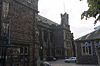 Bristol Grammar School occupies a triangle
of land between the University of Bristol
on the University Road side, what used to be Dingle's department store
on the lower side and a series of houses on the Elton Road side known as Tyndalls Park. The school has been expanding of late, and while it has always owned all the houses to one side of the main campus until recently only four (Barton's, Norwood's, Martin's and Garrett's) were occupied. Lately, two or more have been converted into specialist subject areas. The School is waiting for the leases (which date from before the current Rent Act) to be relinquished by the tenants before they can use other buildings.
The school has a theatre and extensive IT facilities, as well as large playing fields outside Bristol in Failand
. New school buildings have been erected in recent times, but despite the introduction of modern technology, the external appearance and locations of many of the classrooms has remained unchanged for a long time.
. In 1996, the old servery was removed and the hall was restored to its old layout; the roof was also renewed during this time. There is a full kitchen between the Great Hall and the Science Wing, as well as two classrooms and an office belonging to the history department. Underneath the Great Hall is the Staff Room, the Pople Room, and the school offices. It has been designated by English Heritage
as a grade II listed building.
To one side of the Great Hall, sitting separate from the Hall itself and the Junior School, is another building designed to blend in. During the 1940s/1950s, this was the woodworking department, and later a staff work room. It is now a Music room which is also used for House Assemblies.
The Great Hall foundation stone has never been found. Inside the foundation stone there is a time capsule, reported to contain "Copies of The Times and of the Bristol newspapers and a parchment document containing an account of the ceremony". However, despite extensive searches of the outer walls, it has not been found to date. One of two possibilities exist: 1) That the foundation stone was placed at the far end of the building where the Science wing now is, and was destroyed or covered up when that building was erected; or 2) that the stone is buried under tarmac towards the front of the building. The foundation stone was laid on the 10th of June 1877.
This Big School was designed in the late Perpendicular Gothic style, by the Bristol firm of Foster and Wood. Sometimes known as the Long Room, but now usually as the Great Hall, it was designed as a teaching room, and the Masters’ stalls are still in place.
The room is 140 feet (42.7 m) long, 50 feet (15.2 m) wide and 50 feet (15.2 m) high. Downstairs there are now, as in 1879, the Headmaster’s Study, the Senior Common Room, offices and classrooms. Originally these would have accommodated the Sixth Form, while the rest of the School had lessons together in the Hall.
The organ, which was built by Vowles & Son of St James’ Square, was presented by Mr W H Wills, later Lord Winterstoke, in January 1880. It cost over £1,000 and it is still played for assemblies and concerts.
The main stairs leading out of the Great Hall have been recently modified to fulfil fire and safety regulations and in preparation for the new library and Sixth Form building known as The Hub. When the whole school assembled in the Great Hall for the official opening of the new staircase, the invited guests included people who donated large sums of money to help get the project on its way and some of the OBs, including John Pople, who have supported the school over the years. The work was allowed to be completed because of work done by the schools archivist who demonstrated that this was the way that the original staircase was likely to have been. This satisfied authorities to grant permission to make structural alterations to the Grade II listed building.
The staircase was originally one big staircase that started at ground level, led up and split into two smaller ones which doubled back to reach the Great Hall. This has changed to the opposite; two smaller ones lead up and merge into a larger one which doubles back to reach the Great Hall. This meant that the wall between the two smaller staircases could be knocked through to insert a modern automated double glass door allowing pupils to reach the Great Hall with greater ease from within the campus. The old entrance with the great wooden doors at the front still remains. Previously a small door to the campus side of the building was for visitors, teachers and Prefects only.
Independent school (UK)
An independent school is a school that is not financed through the taxation system by local or national government and is instead funded by private sources, predominantly in the form of tuition charges, gifts and long-term charitable endowments, and so is not subject to the conditions imposed by...
in Clifton, Bristol
Clifton, Bristol
Clifton is a suburb of the City of Bristol in England, and the name of both one of the city's thirty-five council wards. The Clifton ward also includes the areas of Cliftonwood and Hotwells...
, England. The school was founded in 1532 by two brothers, Robert and Nicholas Thorne.
The school's current Headmaster, Roderick MacKinnon, is a member of the Headmasters' and Headmistresses' Conference
Headmasters' and Headmistresses' Conference
The Headmasters' and Headmistresses' Conference is an association of the headmasters or headmistressess of 243 leading day and boarding independent schools in the United Kingdom, Crown Dependencies and the Republic of Ireland...
.
The modern school is in three separate sections: the Infant and Junior School takes children from the ages of 4 to 11, the Senior School is for students aged between 11 and 16 studying for GCSEs
General Certificate of Secondary Education
The General Certificate of Secondary Education is an academic qualification awarded in a specified subject, generally taken in a number of subjects by students aged 14–16 in secondary education in England, Wales and Northern Ireland and is equivalent to a Level 2 and Level 1 in Key Skills...
, and the Sixth Form is for students from 16 to 18 studying for their 'A' levels
GCE Advanced Level
The Advanced Level General Certificate of Education, commonly referred to as an A-level, is a qualification offered by education institutions in England, Northern Ireland, Wales, Cameroon, and the Cayman Islands...
. There are around 1,130 children in the school, of which around 40 percent are girls, since its switch from boys-only to co-educational in 1980.
History
The school was founded in 1532 by two brothers, Robert and Nicholas Thorne, when it was housed in the St Bartholomew's HospitalSt Bartholomew's Hospital, Bristol
St Bartholomew's Hospital is at the bottom of Christmas Steps, in Lewin's Mead, Bristol, England.This 12th century town house was incorporated into a monastery hospital founded in 1240 by Sir John la Warr, 2nd Baron De La Warr , and became Bristol Grammar School from 1532 to 1767, and then Queen...
, as part of the new founding of schools after Henry VIII
Henry VIII of England
Henry VIII was King of England from 21 April 1509 until his death. He was Lord, and later King, of Ireland, as well as continuing the nominal claim by the English monarchs to the Kingdom of France...
's closure of the monasteries, where previously a large proportion of England's education had occurred. The school motto Ex Spinis Uvas, which translates as "From Thorns Grapes", is a play upon the names of the school founders Robert and Nicholas Thorne.
The school became a direct grant grammar school in 1946 as a result of the Education Act 1944
Education Act 1944
The Education Act 1944 changed the education system for secondary schools in England and Wales. This Act, commonly named after the Conservative politician R.A...
and chose to become independent when direct grants were abolished by the 1974–9 Labour Government.
The Grammar School over the Frome Gate was in the care of its first schoolmaster, Thomas Moffat, when good fortune stepped in to secure its future. The Thorne family were wealthy Bristol merchants, friends of men like John Cabot
John Cabot
John Cabot was an Italian navigator and explorer whose 1497 discovery of parts of North America is commonly held to have been the first European encounter with the continent of North America since the Norse Vikings in the eleventh century...
and known to royalty. They wished to endow a school where the sons of Bristol merchants and tradesmen could receive a good education before settling down to the important business of making money. On 17 March 1532, Henry VIII
Henry VIII of England
Henry VIII was King of England from 21 April 1509 until his death. He was Lord, and later King, of Ireland, as well as continuing the nominal claim by the English monarchs to the Kingdom of France...
issued a Charter
Charter
A charter is the grant of authority or rights, stating that the granter formally recognizes the prerogative of the recipient to exercise the rights specified...
under which the Thornes could endow the Grammar School and establish it in larger premises at St Bartholomew's Hospital
St Bartholomew's Hospital, Bristol
St Bartholomew's Hospital is at the bottom of Christmas Steps, in Lewin's Mead, Bristol, England.This 12th century town house was incorporated into a monastery hospital founded in 1240 by Sir John la Warr, 2nd Baron De La Warr , and became Bristol Grammar School from 1532 to 1767, and then Queen...
near the bottom of Christmas Steps
Christmas Steps (road)
Christmas Steps is a historic street in the city centre of Bristol, England.-Name:The street was originally called Queene Street in medieval times before becoming known as Knyfesmyth Street, after the tradesmen there. The Middle English pronunciation of Knyfesmyth, with the K sounded, may be the...
. There the boys learnt Latin
Latin
Latin is an Italic language originally spoken in Latium and Ancient Rome. It, along with most European languages, is a descendant of the ancient Proto-Indo-European language. Although it is considered a dead language, a number of scholars and members of the Christian clergy speak it fluently, and...
and Greek
Greek language
Greek is an independent branch of the Indo-European family of languages. Native to the southern Balkans, it has the longest documented history of any Indo-European language, spanning 34 centuries of written records. Its writing system has been the Greek alphabet for the majority of its history;...
, Divinity
Divinity
Divinity and divine are broadly applied but loosely defined terms, used variously within different faiths and belief systems — and even by different individuals within a given faith — to refer to some transcendent or transcendental power or deity, or its attributes or manifestations in...
and some Hebrew.
By 1767, the buildings were too cramped. Charles Lee, the Master, persuaded the Corporation that the Grammar School should be allowed to exchange premises with the other City School, Queen Elizabeth's Hospital
Queen Elizabeth's Hospital
Queen Elizabeth's Hospital is an independent school for boys in Clifton, Bristol, England founded in 1586. Stephen Holliday has served as Headmaster since 2000, having succeeded Dr Richard Gliddon...
, which had a pleasant, new site on Unity Street, further up the hill. This exchange was carried out, and Charles Lee proceeded to enjoy his new School by greatly reducing the numbers of boys. The School was set to rights in 1812, but education was moving away from the classics and this caused further problems resulting in the school being closed in 1844. It received a new Scheme in 1847 and re-opened in January 1848 with 300 pupils.
By 1870 the headmaster (Rev John William Caldicott) told the Endowed Schools Commission that the school was "full to overflowing" with 240 boys and very successful with university entries. However, it was significantly less well endowed than Bristol's other secondary schools (Queen Elizabeth's
Queen Elizabeth's Hospital
Queen Elizabeth's Hospital is an independent school for boys in Clifton, Bristol, England founded in 1586. Stephen Holliday has served as Headmaster since 2000, having succeeded Dr Richard Gliddon...
, Red Maids' and Colston's), and its now dilapidated buildings were located in the wrong area of the city for pupils who mostly lived in Clifton
Clifton, Bristol
Clifton is a suburb of the City of Bristol in England, and the name of both one of the city's thirty-five council wards. The Clifton ward also includes the areas of Cliftonwood and Hotwells...
and Redland
Redland, Bristol
Redland is an affluent suburb in Bristol, England. The suburb is situated between Clifton, Cotham, Bishopston and Westbury Park. The boundaries of the district are not precisely defined, but are generally taken to be Whiteladies Road in the west, the Severn Beach railway line in the south and...
. At that time, Bristol had substantial hospital endowments (second only to London and Edinburgh) but these were mostly spent on charity rather than education. The assistant charity commissioner proposed a scheme that would reorganise the objectives of the endowed schools and secure funding for the Grammar School and the new Clifton High School for Girls
Clifton High School (Bristol)
Clifton High School is an independent school in Clifton, Bristol, England, founded as Clifton High School for Girls in 1877 by visionaries including John Percival, the first Headmaster of Clifton College...
. After several years of debate and negotiation the initiative was approved in 1875, and in 1877 a new location in Tyndalls Park
Tyndalls Park
Tyndall's Park is an area of central Bristol, England. It lies north of Park Row and Queen's Road, east of Whiteladies Road and west of St Michael's Hill, between the districts of Clifton, Cotham and Kingsdown...
was agreed.
The first buildings in Tyndalls Park were occupied in 1879: the Big School, with its remarkable Great Hall, and the Headmaster’s House, a modest dwelling which is now the Junior School. Further classrooms were added, a Gym
Gym
The word γυμνάσιον was used in Ancient Greece, that mean a locality for both physical and intellectual education of young men...
nasium and a Fives Court
Fives
Fives is a British sport believed to derive from the same origins as many racquet sports. In fives, a ball is propelled against the walls of a special court using gloved or bare hands as though they were a racquet.-Background:...
and a Rifle Range. These have been rebuilt as art rooms and rehearsal rooms, but the Winterstoke wing still houses the Laboratories which were added in 1914. The Preparatory School began in 1900, and in 1928 moved into its own building on Elton Road, but this was destroyed on the night of 24 November 1940 by incendiary bombs.
The Prep Hall, which survived, is now the Mackay Theatre. The Elton Road ruin was rebuilt as classrooms under John Garrett, who added the University Road block and began to colonise the other side of Elton Road. Since then, the School has built yet more classroom accommodation and a new Sports Hall; Modern Languages, Classics/Geography, Art and Music have their own Elton Road Houses, and the former playing field is now the Technology Centre.
Houses
There are six Houses in the Senior School, each named after its Head of House. Each student is placed in one of the six different House groups at the beginning of their time in the Senior School and remains in the House until they leave the school. House activities include House Plays, music competitions and inter-House sporting tournaments. The school will always place students in the same Houses as any previous family members who have come to the school.The House names and colours are:
- Scott's (black)
- Diamond's (yellow)
- Edwards's (blue)
- Catchpole's (red)
- Gunawardana's (brown)
- Jakobek's (green)
Colours
House colours are also awarded, given at the end of the particular term should that person take part and perform particularly well in a given activity or sporting event.School colours are awarded to pupils typically in their final year, who perform exceptionally well in sport or any other school activity. They would be expected to compete in a school team (such as Cricket, Rugby, Hockey or Football) and show continued commitment. This was extended to include performing arts, awarding several students colours for their contribution to concert
Concert
A concert is a live performance before an audience. The performance may be by a single musician, sometimes then called a recital, or by a musical ensemble, such as an orchestra, a choir, or a musical band...
s, play
Play (theatre)
A play is a form of literature written by a playwright, usually consisting of scripted dialogue between characters, intended for theatrical performance rather than just reading. There are rare dramatists, notably George Bernard Shaw, who have had little preference whether their plays were performed...
s and taking House assemblies.
Tutors and teaching
The size of teaching groups ranges from 25 students per teacher in lower years to occasionally one per teacher (for less popular subjects in the sixth form). Optional subjects include Russian and EconomicsEconomics
Economics is the social science that analyzes the production, distribution, and consumption of goods and services. The term economics comes from the Ancient Greek from + , hence "rules of the house"...
. Today, all students have access to computer
Computer
A computer is a programmable machine designed to sequentially and automatically carry out a sequence of arithmetic or logical operations. The particular sequence of operations can be changed readily, allowing the computer to solve more than one kind of problem...
s with internet access
Internet access
Many technologies and service plans for Internet access allow customers to connect to the Internet.Consumer use first became popular through dial-up connections in the 20th century....
.
The school offers Ancient Greek
Ancient Greek
Ancient Greek is the stage of the Greek language in the periods spanning the times c. 9th–6th centuries BC, , c. 5th–4th centuries BC , and the c. 3rd century BC – 6th century AD of ancient Greece and the ancient world; being predated in the 2nd millennium BC by Mycenaean Greek...
as a subject from Year 9 onwards, and Classical Civilisation is also available now as a GCSE.
Sport
During the autumn term, the sport curriculum is dominated by RugbyRugby football
Rugby football is a style of football named after Rugby School in the United Kingdom. It is seen most prominently in two current sports, rugby league and rugby union.-History:...
and Football
Football (soccer)
Association football, more commonly known as football or soccer, is a sport played between two teams of eleven players with a spherical ball...
for the boys and hockey
Hockey
Hockey is a family of sports in which two teams play against each other by trying to maneuver a ball or a puck into the opponent's goal using a hockey stick.-Etymology:...
for the girls
During the spring term, it is dominated by hockey, football and Rugby for the boys and netball
Netball
Netball is a ball sport played between two teams of seven players. Its development, derived from early versions of basketball, began in England in the 1890s. By 1960 international playing rules had been standardised for the game, and the International Federation of Netball and Women's Basketball ...
for the girls
During the summer term, there is a division between Cricket
Cricket
Cricket is a bat-and-ball game played between two teams of 11 players on an oval-shaped field, at the centre of which is a rectangular 22-yard long pitch. One team bats, trying to score as many runs as possible while the other team bowls and fields, trying to dismiss the batsmen and thus limit the...
for the boys and Rounders
Rounders
Rounders is a game played between two teams of either gender. The game originated in England where it was played in Tudor times. Rounders is a striking and fielding team game that involves hitting a small, hard, leather-cased ball with a round wooden, plastic or metal bat. The players score by...
for the girls. Both sexes may participate in sports such as Tennis
Tennis
Tennis is a sport usually played between two players or between two teams of two players each . Each player uses a racket that is strung to strike a hollow rubber ball covered with felt over a net into the opponent's court. Tennis is an Olympic sport and is played at all levels of society at all...
and Athletics
Athletics (track and field)
Athletics is an exclusive collection of sporting events that involve competitive running, jumping, throwing, and walking. The most common types of athletics competitions are track and field, road running, cross country running, and race walking...
The school owns a small area of land in Failand which features an AstroTurf hockey/netball pitch, tarmac tennis courts and multiple cricket pitches which are swapped around season to season to rugby pitches. There is also an athletics track as well as shot and javelin areas marked out. Full time grounds staff are employed to keep the area at its best and sport is compulsory one afternoon a week for every year-group up to, and including, year 11. A new pavilion has been built as part of the 475th Anniversary expansion of the school, replacing the old pavilion. There is now a larger car park and better coach access. The new pavilion provides facilities for up to 350 pupils and staff at a time with improved showering and changing facilities as well as an attractive hospitality area for spectators. The total cost of the project will be £2.4 million.
This is in addition to the sports hall on the Tyndall's Park campus, which supplements the one afternoon a week pupils spend doing sport with around another hour or so a week of PE within the school day.
Campus
Triangle
A triangle is one of the basic shapes of geometry: a polygon with three corners or vertices and three sides or edges which are line segments. A triangle with vertices A, B, and C is denoted ....
of land between the University of Bristol
University of Bristol
The University of Bristol is a public research university located in Bristol, United Kingdom. One of the so-called "red brick" universities, it received its Royal Charter in 1909, although its predecessor institution, University College, Bristol, had been in existence since 1876.The University is...
on the University Road side, what used to be Dingle's department store
House of Fraser
House of Fraser is a British department store group with over 60 stores across the United Kingdom and Ireland. It was established in Glasgow, Scotland in 1849 as Arthur and Fraser. By 1891 it was known as Fraser & Sons. The company grew steadily during the early 20th century, but after the Second...
on the lower side and a series of houses on the Elton Road side known as Tyndalls Park. The school has been expanding of late, and while it has always owned all the houses to one side of the main campus until recently only four (Barton's, Norwood's, Martin's and Garrett's) were occupied. Lately, two or more have been converted into specialist subject areas. The School is waiting for the leases (which date from before the current Rent Act) to be relinquished by the tenants before they can use other buildings.
The school has a theatre and extensive IT facilities, as well as large playing fields outside Bristol in Failand
Failand
Failand is a village in Somerset, England. It lies within the civil parish of Wraxall and Failand and the unitary authority area of North Somerset....
. New school buildings have been erected in recent times, but despite the introduction of modern technology, the external appearance and locations of many of the classrooms has remained unchanged for a long time.
Great Hall
The foundation stone was laid on 10 June 1877. The school moved here during 1879 and it is the largest first floor hall in the United KingdomUnited Kingdom
The United Kingdom of Great Britain and Northern IrelandIn the United Kingdom and Dependencies, other languages have been officially recognised as legitimate autochthonous languages under the European Charter for Regional or Minority Languages...
. In 1996, the old servery was removed and the hall was restored to its old layout; the roof was also renewed during this time. There is a full kitchen between the Great Hall and the Science Wing, as well as two classrooms and an office belonging to the history department. Underneath the Great Hall is the Staff Room, the Pople Room, and the school offices. It has been designated by English Heritage
English Heritage
English Heritage . is an executive non-departmental public body of the British Government sponsored by the Department for Culture, Media and Sport...
as a grade II listed building.
To one side of the Great Hall, sitting separate from the Hall itself and the Junior School, is another building designed to blend in. During the 1940s/1950s, this was the woodworking department, and later a staff work room. It is now a Music room which is also used for House Assemblies.
The Great Hall foundation stone has never been found. Inside the foundation stone there is a time capsule, reported to contain "Copies of The Times and of the Bristol newspapers and a parchment document containing an account of the ceremony". However, despite extensive searches of the outer walls, it has not been found to date. One of two possibilities exist: 1) That the foundation stone was placed at the far end of the building where the Science wing now is, and was destroyed or covered up when that building was erected; or 2) that the stone is buried under tarmac towards the front of the building. The foundation stone was laid on the 10th of June 1877.
This Big School was designed in the late Perpendicular Gothic style, by the Bristol firm of Foster and Wood. Sometimes known as the Long Room, but now usually as the Great Hall, it was designed as a teaching room, and the Masters’ stalls are still in place.
The room is 140 feet (42.7 m) long, 50 feet (15.2 m) wide and 50 feet (15.2 m) high. Downstairs there are now, as in 1879, the Headmaster’s Study, the Senior Common Room, offices and classrooms. Originally these would have accommodated the Sixth Form, while the rest of the School had lessons together in the Hall.
The organ, which was built by Vowles & Son of St James’ Square, was presented by Mr W H Wills, later Lord Winterstoke, in January 1880. It cost over £1,000 and it is still played for assemblies and concerts.
The main stairs leading out of the Great Hall have been recently modified to fulfil fire and safety regulations and in preparation for the new library and Sixth Form building known as The Hub. When the whole school assembled in the Great Hall for the official opening of the new staircase, the invited guests included people who donated large sums of money to help get the project on its way and some of the OBs, including John Pople, who have supported the school over the years. The work was allowed to be completed because of work done by the schools archivist who demonstrated that this was the way that the original staircase was likely to have been. This satisfied authorities to grant permission to make structural alterations to the Grade II listed building.
The staircase was originally one big staircase that started at ground level, led up and split into two smaller ones which doubled back to reach the Great Hall. This has changed to the opposite; two smaller ones lead up and merge into a larger one which doubles back to reach the Great Hall. This meant that the wall between the two smaller staircases could be knocked through to insert a modern automated double glass door allowing pupils to reach the Great Hall with greater ease from within the campus. The old entrance with the great wooden doors at the front still remains. Previously a small door to the campus side of the building was for visitors, teachers and Prefects only.
School song
The school song is mainly sung at the end of term assembly or on special occasions.Headmasters
Until the 19th century, the Headmaster was known simply as the "Master" and his assistants as "Ushers". Little is known of those of the 16th century and nothing of any before Thomas Moffat, the "scolemaster" of the City Audit Book of 1532 who took the School to the Bartholomews. The first few dates are conjectural.Old Bristolians
- Robert HuntingtonRobert HuntingtonRobert Huntington was an English churchman, orientalist and manuscript collector. He was Provost of Trinity College, Dublin and Bishop of Raphoe.-Life:...
(c.1637–1701), ProvostProvost (education)A provost is the senior academic administrator at many institutions of higher education in the United States, Canada and Australia, the equivalent of a pro-vice-chancellor at some institutions in the United Kingdom and Ireland....
of Trinity College, DublinTrinity College, DublinTrinity College, Dublin , formally known as the College of the Holy and Undivided Trinity of Queen Elizabeth near Dublin, was founded in 1592 by letters patent from Queen Elizabeth I as the "mother of a university", Extracts from Letters Patent of Elizabeth I, 1592: "...we...found and...
and orientalist - Sir John Coxe HippisleyJohn Coxe HippisleySir John Coxe Hippisley, 1st Baronet , was a British diplomat and politician who pursued an ‘unflagging, though wholly unsuccessful, quest for office’ which led King George III of Great Britain to describe him as ‘that busy man’ and ‘the grand intriguer’.-Early life and overseas appointments:Born...
(1745–1825), politician - William GregorWilliam GregorWilliam Gregor was the British clergyman and mineralogist who discovered the elemental metal titanium.-Early years:...
(1761–1817), mineralogistMineralogyMineralogy is the study of chemistry, crystal structure, and physical properties of minerals. Specific studies within mineralogy include the processes of mineral origin and formation, classification of minerals, their geographical distribution, as well as their utilization.-History:Early writing...
, discoverer of titaniumTitaniumTitanium is a chemical element with the symbol Ti and atomic number 22. It has a low density and is a strong, lustrous, corrosion-resistant transition metal with a silver color.... - Jonathan SewellJonathan SewellJonathan Sewell was a lawyer, judge and political figure in Lower Canada.-Early life:He was born in Cambridge, Massachusetts, the son of the last British attorney general of Massachusetts...
(c.1766–1839), Chief Justice and Speaker of the Legislative Council of Lower CanadaLower CanadaThe Province of Lower Canada was a British colony on the lower Saint Lawrence River and the shores of the Gulf of Saint Lawrence...
, 1808–1839, and President of the Executive Council of Lower Canada, 1808–1830 - Stephen SewellStephen Sewell (lawyer)Stephen Sewell was a lawyer and political figure in Lower Canada.He was born Stephen Sewall in Cambridge, Massachusetts in 1770, the son of Jonathan Sewall who was the attorney general of Massachusetts, and returned to England with his family at the start of the American Revolution, where he...
(1770–1832), lawyer and political figure in Lower CanadaLower CanadaThe Province of Lower Canada was a British colony on the lower Saint Lawrence River and the shores of the Gulf of Saint Lawrence... - Thomas Edward BowdichThomas Edward BowdichThomas Edward Bowdich was an English traveller and author.He was born at Bristol and educated at Bristol Grammar School. In 1813 he married Sarah Wallis, who shared his subsequent career. In 1814, through his uncle, J...
(c.1791–1824), writer and AfricaAfricaAfrica is the world's second largest and second most populous continent, after Asia. At about 30.2 million km² including adjacent islands, it covers 6% of the Earth's total surface area and 20.4% of the total land area...
n explorer - Charles KingsleyCharles KingsleyCharles Kingsley was an English priest of the Church of England, university professor, historian and novelist, particularly associated with the West Country and northeast Hampshire.-Life and character:...
(1819–1875), novelistt - Charles WhibleyCharles WhibleyCharles Whibley was an English literary journalist and author. Whibley’s style was described by Matthew as “often acerbic high-tory commentary”.-Life:...
(1859–1930), journalist and author - Thomas Horrocks OpenshawThomas Horrocks OpenshawThomas Horrocks Openshaw CB CMG FRCS LSA TD , was an English Victorian and Edwardian era surgeon perhaps best known for his brief involvement in the notorious Jack the Ripper murders of 1888....
(1856–1929), surgeon - William LaneWilliam LaneWilliam Lane was a journalist, advocate of Australian labour politics and a utopian.-Early life:Lane was born in Bristol, England, eldest son of James Lane,from Ireland a Protestant Master Gardener , and his English wife Caroline, née Hall...
(1861–1917), journalist and pioneer of the Australian labour movement - Leonard WhibleyLeonard WhibleyLeonard Whibley was a Greek scholar who edited ‘A Companion to Greek Studies’ from 1905 to 1931.-Life:Leonard was born 20 April 1864 at Gravesend, Kent, England, the second son of Ambrose Whibley, silk mercer, and his second wife, Mary Jean Davy. Leonard was educated at Bristol Grammar School and...
(1863–1941), classicistClassicsClassics is the branch of the Humanities comprising the languages, literature, philosophy, history, art, archaeology and other culture of the ancient Mediterranean world ; especially Ancient Greece and Ancient Rome during Classical Antiquity Classics (sometimes encompassing Classical Studies or... - Sir Llewellyn Smith (1864–1945), Permanent SecretaryPermanent SecretaryThe Permanent secretary, in most departments officially titled the permanent under-secretary of state , is the most senior civil servant of a British Government ministry, charged with running the department on a day-to-day basis...
of the Board of TradeBoard of TradeThe Board of Trade is a committee of the Privy Council of the United Kingdom, originating as a committee of inquiry in the 17th century and evolving gradually into a government department with a diverse range of functions...
, 1907–1919, and Chief Economic Adviser to the Government, 1919–1927 - Robert ChambersRobert ChambersRobert Chambers was a Scottish publisher, geologist, proto-evolutionary thinker, author and journal editor who, like his elder brother and business partner William Chambers, was highly influential in mid-19th century scientific and political circles.Chambers was an early phrenologist, and was the...
(1802–1871), philanthropistPhilanthropyPhilanthropy etymologically means "the love of humanity"—love in the sense of caring for, nourishing, developing, or enhancing; humanity in the sense of "what it is to be human," or "human potential." In modern practical terms, it is "private initiatives for public good, focusing on quality of...
and peace activistPeace activistThis list of peace activists includes people who proactively advocate diplomatic, non-military resolution of political disputes, usually through nonviolent means.A peace activist is an activist of the peace movement.*Jane Addams*Martti Ahtisaari... - Roland AllenRoland Allen-Life:He was born in Bristol, England, the son of an Anglican priest; but was orphaned early in life. He trained for ministry at Oxford and became a priest in 1893. Allen spent two periods in Northern China working for the Society for the Propagation of the Gospel...
(1868–1947), missionaryMissionaryA missionary is a member of a religious group sent into an area to do evangelism or ministries of service, such as education, literacy, social justice, health care and economic development. The word "mission" originates from 1598 when the Jesuits sent members abroad, derived from the Latin...
in ChinaChinaChinese civilization may refer to:* China for more general discussion of the country.* Chinese culture* Greater China, the transnational community of ethnic Chinese.* History of China* Sinosphere, the area historically affected by Chinese culture... - Cyril Bradley RoothamCyril RoothamCyril Bradley Rootham was an English composer, educator, organist and important figure in Cambridge music life.-Biography:...
(1875–1938), classicistClassicsClassics is the branch of the Humanities comprising the languages, literature, philosophy, history, art, archaeology and other culture of the ancient Mediterranean world ; especially Ancient Greece and Ancient Rome during Classical Antiquity Classics (sometimes encompassing Classical Studies or...
and musicMusicMusic is an art form whose medium is sound and silence. Its common elements are pitch , rhythm , dynamics, and the sonic qualities of timbre and texture...
ian - Frederick William LumsdenFrederick William LumsdenBrigadier General Frederick William Lumsden VC, CB, DSO & Three Bars was a British officer in Royal Marine Artillery and later the General Staff, during the First World War...
(1872–1918), Royal MarinesRoyal MarinesThe Corps of Her Majesty's Royal Marines, commonly just referred to as the Royal Marines , are the marine corps and amphibious infantry of the United Kingdom and, along with the Royal Navy and Royal Fleet Auxiliary, form the Naval Service...
Brigadier GeneralBrigadier GeneralBrigadier general is a senior rank in the armed forces. It is the lowest ranking general officer in some countries, usually sitting between the ranks of colonel and major general. When appointed to a field command, a brigadier general is typically in command of a brigade consisting of around 4,000...
, VCVictoria CrossThe Victoria Cross is the highest military decoration awarded for valour "in the face of the enemy" to members of the armed forces of various Commonwealth countries, and previous British Empire territories....
, CBOrder of the BathThe Most Honourable Order of the Bath is a British order of chivalry founded by George I on 18 May 1725. The name derives from the elaborate mediæval ceremony for creating a knight, which involved bathing as one of its elements. The knights so created were known as Knights of the Bath...
and DSODistinguished Service OrderThe Distinguished Service Order is a military decoration of the United Kingdom, and formerly of other parts of the British Commonwealth and Empire, awarded for meritorious or distinguished service by officers of the armed forces during wartime, typically in actual combat.Instituted on 6 September...
& Three bars - Sir Cyril NorwoodCyril NorwoodSir Cyril M Norwood served as Headmaster of Bristol Grammar School and Harrow School as well as President of St. John's College, Oxford....
(1875–1956) classicistClassicsClassics is the branch of the Humanities comprising the languages, literature, philosophy, history, art, archaeology and other culture of the ancient Mediterranean world ; especially Ancient Greece and Ancient Rome during Classical Antiquity Classics (sometimes encompassing Classical Studies or...
and PoliticianPoliticianA politician, political leader, or political figure is an individual who is involved in influencing public policy and decision making... - Sir Douglas VealeDouglas VealeSir Douglas Veale was a British civil servant and university administrator, who served as Registrar of the University of Oxford from 1930 to 1958.-Life:...
(1891–1973), RegistrarRegistrar (academic)In education outside the United Kingdom, a registrar or registrary is an official in an academic institution who handles student records. Typically, a registrar processes registration requests, schedules classes and maintains class lists, enforces the rules for entering or leaving classes, and...
of the University of OxfordUniversity of OxfordThe University of Oxford is a university located in Oxford, United Kingdom. It is the second-oldest surviving university in the world and the oldest in the English-speaking world. Although its exact date of foundation is unclear, there is evidence of teaching as far back as 1096...
, 1930–1958 - Sir Allen LaneAllen LaneSir Allen Lane was a British publisher who founded Penguin Books, bringing high quality paperback fiction and non-fiction to the mass market.-Early life and family:...
(1902–1970), founder of Penguin BooksPenguin BooksPenguin Books is a publisher founded in 1935 by Sir Allen Lane and V.K. Krishna Menon. Penguin revolutionised publishing in the 1930s through its high quality, inexpensive paperbacks, sold through Woolworths and other high street stores for sixpence. Penguin's success demonstrated that large... - Douglas CleverdonDouglas CleverdonDouglas James Cleverdon was an English bookseller and radio producer, in both fields associated with numerous leading cultural figures in the United Kingdom.-Early life:...
(1903–1987), bookseller and BBC RadioBBC RadioBBC Radio is a service of the British Broadcasting Corporation which has operated in the United Kingdom under the terms of a Royal Charter since 1927. For a history of BBC radio prior to 1927 see British Broadcasting Company...
producer - Sir Ivor Jennings (1903–1965), Downing Professor of the Laws of EnglandDowning Professor of the Laws of EnglandThe Downing Professorship of the Laws of England is one of the senior professorships in law at the University of Cambridge.The chair was founded in 1800 as a bequest of Sir George Downing, the founder of Downing College, Cambridge. The professorship was originally attached solely to Downing College...
, University of CambridgeUniversity of CambridgeThe University of Cambridge is a public research university located in Cambridge, United Kingdom. It is the second-oldest university in both the United Kingdom and the English-speaking world , and the seventh-oldest globally...
, 1962–1965 - Paul DruryPaul DruryPaul Drury was an artist and printmaker born Albert Paul Dalou Drury in Brockley, London, the son of sculptor Alfred Drury.-Early life:...
(1903–1987), artist - Oliver Franks, Baron FranksOliver Shewell FranksOliver Shewell Franks, Baron Franks, OM, GCMG, KCB, CBE, DL was an English civil servant and philosopher who has been described as 'one of the founders of the post-war world'....
(1905–1992), philosopher, diplomat and civil servant - Sir Richard Sheppard (1910–1982), architect
- Douglas Russell FeaverDouglas Russell FeaverDouglas Russell Feaver was a bishop in the Church of England who was known for his rudeness and for not always saying the right thing.-External links:*...
(1914–1987), Bishop of PeterboroughBishop of PeterboroughThe Bishop of Peterborough is the ordinary of the Church of England Diocese of Peterborough in the Province of Canterbury.The diocese covers the counties of Northamptonshire, Rutland and the Soke of Peterborough in Cambridgeshire... - Geoffrey KeenGeoffrey KeenGeoffrey Keen was an English actor who appeared in supporting roles in many famous films.-Early life:Keen was born in Wallingford, Oxfordshire, England, the son of stage actor Malcolm Keen. He was educated at Bristol Grammar School. He then joined the Little Repertory Theatre in Bristol for whom...
(1916–2005), actor - Sir John PopleJohn PopleSir John Anthony Pople, KBE, FRS, was a Nobel-Prize winning theoretical chemist. Born in Burnham-on-Sea, Somerset, England, he attended Bristol Grammar School. He won a scholarship to Trinity College, Cambridge in 1943. He received his B. A. in 1946. Between 1945 and 1947 he worked at the Bristol...
(1925–2004), MathematicianMathematicsMathematics is the study of quantity, space, structure, and change. Mathematicians seek out patterns and formulate new conjectures. Mathematicians resolve the truth or falsity of conjectures by mathematical proofs, which are arguments sufficient to convince other mathematicians of their validity...
, Theoretical chemistTheoretical chemistryTheoretical chemistry seeks to provide theories that explain chemical observations. Often, it uses mathematical and computational methods that, at times, require advanced knowledge. Quantum chemistry, the application of quantum mechanics to the understanding of valency, is a major component of...
and Nobel Laureate - Peter NicholsPeter NicholsPeter Nichols FRSL is an English writer of stage plays, film and television.Born in Bristol, England, he was educated at Bristol Grammar School, and served his compulsory National Service as a clerk in Calcutta and later in the Combined Services Entertainments Unit in Singapore where he...
(born 1927), writer - Timothy WestTimothy WestTimothy Lancaster West, CBE is an English film, stage and television actor.-Career:West's craggy looks ensured a career as a character actor rather than a leading man. He began his career as an Assistant Stage Manager at the Wimbledon Theatre in 1956, and followed this with several seasons of...
(born 1934), actor - Julian GloverJulian GloverJulian Wyatt Glover is a British actor best known for such roles as General Maximilian Veers in Star Wars Episode V: The Empire Strikes Back, the Bond villain Aristotle Kristatos in For Your Eyes Only, and Walter Donovan in Indiana Jones and the Last Crusade.-Personal life:Glover was born in...
(born 1935), actor - David ProwseDavid ProwseDavid Prowse, MBE is an English former bodybuilder, weightlifter and actor, most widely known for playing the role of Darth Vader in physical form. In Britain, he is also remembered as having played the Green Cross Code man...
(born 1935), actor - Sir Nicholas WrightNicholas Wright (academic)Sir Nicholas Wright is a British professor and medical doctor. He is the Warden of Barts and The London School of Medicine and Dentistry.Wright attended Bristol Grammar School and Durham Medical School accepted him straight into the second year before he graduated in 1965 and proceeded to achieve...
, professor of medicine - Keith RobbinsKeith RobbinsProfessor Keith Gilbert Robbins DLitt FRSE FRHistS FLSW is a historian and former Vice-Chancellor of the University of Wales, Lampeter. Robbins was educated at Bristol Grammar School, and Magdalen and St Antony’s Colleges, Oxford....
(born 1940), historian - T.J. Clark (born 1943), historian
- Robert LaceyRobert LaceyRobert Lacey is a British historian and biographer. He is the author of a number of bestselling biographies, including those of Henry Ford and Queen Elizabeth II, as well as works of popular history....
(born 1944), historian and biographer - Jeremy TreglownJeremy TreglownJeremy Treglown is a British author and literary critic, who has written biographies of Roald Dahl, Henry Green and V.S. Pritchett. He is Professor of English at the University of Warwick....
(born 1946), biographer and literary critic - Andrew DalbyAndrew DalbyAndrew Dalby is an English linguist, translator and historian who has written articles and several books on a wide range of topics including food history, language, Classical texts, and Wikipedia.-Education and early career:...
(born 1947), food writer - Nick BrimbleNick BrimbleNick Brimble , is an English actor known for his performance as Little John in the film Robin Hood: Prince of Thieves and his appearances on various television shows....
actor - Clive PontingClive PontingClive Ponting is a British writer, former academic and former senior civil servant. He is the author of a number of revisionist books on British and world history...
(born 1947) Former civil servant and retired university lecturer. - Fred WedlockFred WedlockFred Wedlock was a folk singer best known for his UK hit single "The Oldest Swinger In Town". Wedlock performed at many venues in Britain and Europe, presented programmes for West Country TV and acted with the Bristol Old Vic and the Ministry of Entertainment, as well as undertaking after-dinner...
(1942 – 2010), folk singer, humorist and actor. - Shaun WoodwardShaun WoodwardShaun Anthony Woodward is a British Labour Party politician who has been the Member of Parliament for St Helens South since 2001. He served in the Cabinet from 28 June 2007 to 11 May 2010 as Secretary of State for Northern Ireland...
(born 1958), politician, former Labour Secretary of State for Northern Ireland - Jeremy NorthamJeremy NorthamJeremy Philip Northam is an English actor. He is best known for his roles as Ivor Novello in the 2001 film Gosford Park, as Dean Martin in the 2002 television movie Martin and Lewis, and as Thomas More on the Showtime series The Tudors...
(born 1961), actor - John LennardJohn LennardJohn Lennard is Professor of British and American Literature at the University of the West Indies, Mona, Jamaica, and a freelance academic and writer.-Biography:...
(born 1964), academic - Michelle GoodmanMichelle GoodmanFlight Lieutenant Michelle Jayne Goodman DFC is a Royal Air Force officer. She was the first woman to be awarded the Distinguished Flying Cross , for her actions while serving in Iraq, and the first female officer to be awarded any British combat gallantry medal.-Early life:Born in Bristol on ,...
(born 1976), RAF Officer, first woman to receive the Distinguished Flying CrossDistinguished Flying Cross (United Kingdom)The Distinguished Flying Cross is a military decoration awarded to personnel of the United Kingdom's Royal Air Force and other services, and formerly to officers of other Commonwealth countries, for "an act or acts of valour, courage or devotion to duty whilst flying in active operations against... - Sean MarsdenSean MarsdenSean Marsden is a Bristol Rugby player who was born in Scotland but has spent most of his life in England, being capped by England at U16 Level, even scoring a hat-trick of tries against the land of his birth....
(born 1980), professional rugby player - Mark WatsonMark Watson (comedian)Mark Andrew Watson is an English stand-up comedian and novelist.-Early life:Watson was born in Bristol to Welsh parents and attended Henleaze Junior school and then Bristol Grammar School, where he won the prize of 'Gabbler of the year', before going to Queens' College, Cambridge, where he studied...
(born 1980), comedian - Chris Skidmore (born 1981), Conservative MP
- Michael Coady (rugby league)Michael Coady (rugby league)Michael Coady is an English rugby league footballer for Leeds Rhinos in the European Super League. He plays at .He attended Bristol Grammar School and Loughborough University.-Career:...
(born 1987), professional rugby player