
Home      Discussion      Topics      Dictionary      Almanac
Signup       Login
John Cabot

John Cabot

Overview
John Cabot was an Italian
Italian people
The Italian people are an ethnic group that share a common Italian culture, ancestry and speak the Italian language as a mother tongue. Within Italy, Italians are defined by citizenship, regardless of ancestry or country of residence , and are distinguished from people...

 navigator
Navigator
A navigator is the person on board a ship or aircraft responsible for its navigation. The navigator's primary responsibility is to be aware of ship or aircraft position at all times. Responsibilities include planning the journey, advising the Captain or aircraft Commander of estimated timing to...

 and explorer
Exploration
Exploration is the act of searching or traveling around a terrain for the purpose of discovery of resources or information. Exploration occurs in all non-sessile animal species, including humans...

 whose 1497 discovery of parts of North America
North America
North America is a continent wholly within the Northern Hemisphere and almost wholly within the Western Hemisphere. It is also considered a northern subcontinent of the Americas...

 is commonly held to have been the first European encounter with the continent of North America
North America
North America is a continent wholly within the Northern Hemisphere and almost wholly within the Western Hemisphere. It is also considered a northern subcontinent of the Americas...

 since the Norse Vikings in the eleventh century. The official position of the Canadian and United Kingdom governments is that he landed on the island of Newfoundland.
Discussion
Ask a question about 'John Cabot'
Start a new discussion about 'John Cabot'
Answer questions from other users
Full Discussion Forum
 
Unanswered Questions
Recent Discussions
Encyclopedia
John Cabot was an Italian
Italian people
The Italian people are an ethnic group that share a common Italian culture, ancestry and speak the Italian language as a mother tongue. Within Italy, Italians are defined by citizenship, regardless of ancestry or country of residence , and are distinguished from people...

 navigator
Navigator
A navigator is the person on board a ship or aircraft responsible for its navigation. The navigator's primary responsibility is to be aware of ship or aircraft position at all times. Responsibilities include planning the journey, advising the Captain or aircraft Commander of estimated timing to...

 and explorer
Exploration
Exploration is the act of searching or traveling around a terrain for the purpose of discovery of resources or information. Exploration occurs in all non-sessile animal species, including humans...

 whose 1497 discovery of parts of North America
North America
North America is a continent wholly within the Northern Hemisphere and almost wholly within the Western Hemisphere. It is also considered a northern subcontinent of the Americas...

 is commonly held to have been the first European encounter with the continent of North America
North America
North America is a continent wholly within the Northern Hemisphere and almost wholly within the Western Hemisphere. It is also considered a northern subcontinent of the Americas...

 since the Norse Vikings in the eleventh century. The official position of the Canadian and United Kingdom governments is that he landed on the island of Newfoundland.

Name and origins


Cabot's birthplace is in Italy. In Italy he is known today as Giovanni Caboto, in England as John Cabot, in France as Jean Cabot, and in Spain as Juan Caboto. The non-Italian forms reflect references to him in the related 15th-century documents. Only one set of documents has been found bearing his signature. These are Venetian testamentary documents of 1484, on which he signed as "Zuan Chabotto", Zuan being a form of John typical to Venice
Venice
Venice is a city in northern Italy which is renowned for the beauty of its setting, its architecture and its artworks. It is the capital of the Veneto region...

. That he continued to use this form in England, at least among Italians, is supported by two letters referring to him that were written by others in London in 1497. One, from a London-based Venetian, gives Cabot's first name as Zuam. Another, from the Milanese
Milanese
Milanese is the central variety of the Western Lombard language spoken in the city and province of Milan....

 Ambassador, spells his name Zoane. In a document identified in October 2010, he is described by his Italian banker in London as 'Giovanni Chabbote', this being the only known contemporary document to use this version of his first name.

Gaeta
Gaeta
Gaeta is a city and comune in the province of Latina, in Lazio, central Italy. Set on a promontory stretching towards the Gulf of Gaeta, it is 120 km from Rome and 80 km from Naples....

 (in the Province of Latina
Province of Latina
The Province of Latina is a province in the Lazio region of Italy. Its capital is the city of Latina.It has an area of 2,251 km², and a total population of 519,850...

) and Castiglione Chiavarese
Castiglione Chiavarese
Castiglione Chiavarese is a comune in the Province of Genoa in the Italian region Liguria, located about 50 km southeast of Genoa....

 (in the Province of Genoa
Province of Genoa
The Province of Genoa is a province in the Liguria region of Italy. Its capital is the city of Genoa.It has an area of 1,838 km², and a total population of about 900,000...

) have both been proposed as birthplaces. The main evidence for Gaeta are records of a Caboto family dwelling there until the mid-15th century, but ceasing to be traceable after 1443. Pedro de Ayala
Pedro de Ayala
Don Pedro de Ayala was a 16th-century Spanish diplomat employed by Ferdinand II of Aragon and Isabella I of Castile at the courts of James IV of Scotland and Henry VII of England. His mission to Scotland was concerned with the King's marriage and the international crisis caused by the pretender...

, the Spanish envoy and Cabot's contemporary in London, described him in 1498 as "another Genoese like Columbus". John Cabot's son, Sebastian
Sebastian Cabot (explorer)
Sebastian Cabot was an explorer, born in the Venetian Republic.-Origins:...

, appears to have believed that his father originally came from Genoa
Genoa
Genoa |Ligurian]] Zena ; Latin and, archaically, English Genua) is a city and an important seaport in northern Italy, the capital of the Province of Genoa and of the region of Liguria....

. What is certain is that in 1476 Cabot was made a Venetian citizen, which required a minimum of fifteen years' residency in the city. He must have lived in Venice since at least 1461.

Life until 1499


John Cabot appears in the Venetian records in 1471 when he was accepted into the religious confraternity
Confraternity
A confraternity is normally a Roman Catholic or Orthodox organization of lay people created for the purpose of promoting special works of Christian charity or piety, and approved by the Church hierarchy...

 of St John the Evangelist. Since this was one of the city's prestigious confraternities, this suggests that he was already a respected member of the community. He may have been born slightly earlier than 1450, which is the approximate date most commonly given for his birth.

Following Cabot's acquisition of full Venetian citizenship in 1476, he would have become eligible to engage in maritime trade, including the trade to the eastern Mediterranean, which was the source of much of Venice's wealth. He presumably became engaged in this trade shortly thereafter. He is mentioned in a document of 1483 selling a slave in Crete
Crete
Crete is the largest and most populous of the Greek islands, the fifth largest island in the Mediterranean Sea, and one of the thirteen administrative regions of Greece. It forms a significant part of the economy and cultural heritage of Greece while retaining its own local cultural traits...

 whom he had acquired while in the territories of the Sultan of Egypt, which then comprised most of what is now Palestine
Palestine
Palestine is a conventional name, among others, used to describe the geographic region between the Mediterranean Sea and the Jordan River, and various adjoining lands....

, Syria
Syria
Syria , officially the Syrian Arab Republic , is a country in Western Asia, bordering Lebanon and the Mediterranean Sea to the West, Turkey to the north, Iraq to the east, Jordan to the south, and Israel to the southwest....

 and the Lebanon
Lebanon
Lebanon , officially the Republic of LebanonRepublic of Lebanon is the most common term used by Lebanese government agencies. The term Lebanese Republic, a literal translation of the official Arabic and French names that is not used in today's world. Arabic is the most common language spoken among...

. This is not sufficient to prove Cabot's later assertion that he had visited Mecca
Mecca
Mecca is a city in the Hijaz and the capital of Makkah province in Saudi Arabia. The city is located inland from Jeddah in a narrow valley at a height of above sea level...

, which he said in 1497 to the Milanese ambassador in London. He may have acquired better knowledge of the origins of the oriental merchandise he would have been dealing in (such as spices and silks) than most Europeans at that time.

"Zuan Cabotto" (i.e. John Cabot) is mentioned in a variety of Venetian records of the 1480s. These indicate that by 1484 he was married to Mattea and already had at least two sons. Cabot's sons are named in his 1496 royal patent as Ludovico, Sebastian
Sebastian Cabot (explorer)
Sebastian Cabot was an explorer, born in the Venetian Republic.-Origins:...

, and Sancto. The Venetian sources also contain references to Cabot's being involved in house building during his time there. This may be the experience on which he later promoted himself as a civil engineer in Spain.

Cabot appears to have got into financial trouble in the late 1480s and had left Venice as an insolvent debtor by 5 November 1488. He moved to Valencia where his creditors attempted to have him arrested by sending a lettere di raccomandazione a giustizia ("a letter of recommendation to justice") to the authorities. While in Valencia, "John Cabot Montecalunya" (as he is referred to in local documents) proposed plans for improvements to the harbour. These proposals were rejected, however. Early in 1494 he moved on to Seville
Seville
Seville is the artistic, historic, cultural, and financial capital of southern Spain. It is the capital of the autonomous community of Andalusia and of the province of Seville. It is situated on the plain of the River Guadalquivir, with an average elevation of above sea level...

, where he proposed, was contracted to build and, for five months, worked on the construction of a stone bridge over the Guadalquivir
Guadalquivir
The Guadalquivir is the fifth longest river in the Iberian peninsula and the second longest river to be its whole length in Spain. The Guadalquivir is 657 kilometers long and drains an area of about 58,000 square kilometers...

 river. This project was abandoned following a decision of the City Council on 24 December 1494. After this Cabot appears to have sought support for an Atlantic expedition in Seville and Lisbon
Lisbon
Lisbon is the capital city and largest city of Portugal with a population of 545,245 within its administrative limits on a land area of . The urban area of Lisbon extends beyond the administrative city limits with a population of 3 million on an area of , making it the 9th most populous urban...

, before moving on to England. It therefore seems likely that he would have arrived in England around the middle of 1495.

Sponsorship


Like other Italian explorers, including Christopher Columbus
Christopher Columbus
Christopher Columbus was an explorer, colonizer, and navigator, born in the Republic of Genoa, in northwestern Italy. Under the auspices of the Catholic Monarchs of Spain, he completed four voyages across the Atlantic Ocean that led to general European awareness of the American continents in the...

, Cabot was commissioned by another country, and in Cabot's case it was England. Once Henry the Navigator began searching for a route around Africa
Africa
Africa is the world's second largest and second most populous continent, after Asia. At about 30.2 million km² including adjacent islands, it covers 6% of the Earth's total surface area and 20.4% of the total land area...

, the Iberian peninsula (Portugal and Spain) began to attract Italian navigational talent, especially after Columbus
Christopher Columbus
Christopher Columbus was an explorer, colonizer, and navigator, born in the Republic of Genoa, in northwestern Italy. Under the auspices of the Catholic Monarchs of Spain, he completed four voyages across the Atlantic Ocean that led to general European awareness of the American continents in the...

's discovery of "the Indies" (as all Asia was called at the time) by sailing west. After that voyage, a number of explorers headed in that direction; Cabot had a simple plan, to start from a northerly latitude where the longitudes are much closer together, and where, as a result, the voyage would be much shorter.

Historians have generally assumed that, on arrival in England, Cabot went straight to Bristol to seek backers. This seemed logical, given that his expeditions did, indeed, set out from this port and it was the only English city to have had a prior history of undertaking exploration expeditions out into the Atlantic. Moreover, since Cabot's royal patent (1496), stated that all expeditions should be undertaken from Bristol, it seemed that his primary supporters were likely to have come from that city. Yet, while Bristol may have seemed like the logical place for Cabot to go to seek funding, Dr Alwyn Ruddock
Alwyn Ruddock
Alwyn Ruddock was a noted British historian of the Age of Discovery, best known for her research on the 'English' voyages of the 15th-century explorer John Cabot...

 claimed to have found evidence that Cabot actually went first to London and received backing from the Italian community there. In particular, she suggested he found a patron in the form of Fr. Giovanni Antonio de Carbonariis, an Augustinian friar who was also the deputy to the papal tax collector Adriano Castellesi
Adriano Castellesi
Adriano Castellesi, also known as Cardinal Adrian, Corneto, Adrian of Castello or Adriano de Castello was an Italian cardinal and writer.-Biography:Castellesi was born at Corneto....

. Ruddock suggested that it was Carbonariis, who certainly accompanied Cabot's 1498 expedition and who was on good terms with the King, who introduced the explorer to Henry VII. Beyond this, Ruddock claimed that Cabot received a loan from an Italian banking house in London 'to go and discover new lands'. Determining the basis of Ruddock's claims is difficult, since she ordered the destruction of all her research notes on her death in 2005. However, since that time, researchers on what has now become The Cabot Project , have been engaged in a hunt to relocate her evidence. On the matter of Cabot's sponsorship, Dr Evan Jones (University of Bristol
University of Bristol
The University of Bristol is a public research university located in Bristol, United Kingdom. One of the so-called "red brick" universities, it received its Royal Charter in 1909, although its predecessor institution, University College, Bristol, had been in existence since 1876.The University is...

) reported to the Canadian press in October 2010 that Dr Francesco Guidi Bruscoli (University of Florence
University of Florence
The University of Florence is a higher study institute in Florence, central Italy. One of the largest and oldest universities in the country, it consists of 12 faculties...

), had now found the ledger which contains the loan made to Cabot in 1496. The sum involved was significant, albeit not enough to have completely financed even a single expedition.

On 5 March 1496 King Henry VII of England
Henry VII of England
Henry VII was King of England and Lord of Ireland from his seizing the crown on 22 August 1485 until his death on 21 April 1509, as the first monarch of the House of Tudor....

 gave Cabot letters patent
Letters patent
Letters patent are a type of legal instrument in the form of a published written order issued by a monarch or president, generally granting an office, right, monopoly, title, or status to a person or corporation...

 with the following charge:

Explorations


Cabot went to Bristol to make the preparations for his voyage. Bristol
Bristol
Bristol is a city, unitary authority area and ceremonial county in South West England, with an estimated population of 433,100 for the unitary authority in 2009, and a surrounding Larger Urban Zone with an estimated 1,070,000 residents in 2007...

 was the second-largest seaport in England, and during the years from 1480 onwards several expeditions had been sent out to look for Hy-Brazil
Brazil (mythical island)
Brasil, also known as Hy-Brasil or several other variants, is a phantom island which was said to lie in the Atlantic ocean west of Ireland. In Irish myths it was said to be cloaked in mist, except for one day each seven years, when it became visible but still could not be reached...

, an island said to lie somewhere in the Atlantic Ocean according to Celtic legends. Bristol may have been particularly interested in seeking this island because it appears to have been believed that Bristol men had discovered the island at earlier date but then lost it. Since it was said to be a source of brazilwood
Brazilwood
Caesalpinia echinata is a species of Brazilian timber tree in the pea family, Fabaceae. Common names include Brazilwood, Pau-Brasil, Pau de Pernambuco and Ibirapitanga . This plant has a dense, orange-red heartwood that takes a high shine, and it is the premier wood used for making bows for...

 (from which a valuable red dye could be obtained) the merchants had a sound economic motive for seeking the isle.

First voyage


All that is known about Cabot's first voyage is contained in a letter from John Day (a Bristol merchant) to Christopher Columbus. The letter, written in the winter of 1497/8, mostly concerns the 1497 voyage. However, by way of an aside, Day notes that: "Since your Lordship wants information relating to the first voyage, here is what happened: he went with one ship, his crew confused him, he was short of supplies and ran into bad weather, and he decided to turn back." Since Cabot only received his patent in March 1496, it is generally assumed that this voyage took place in the summer of that year.

Second voyage


Nearly everything that is known about the 1497 voyage comes from four short letters and a brief chronicle
Chronicle
Generally a chronicle is a historical account of facts and events ranged in chronological order, as in a time line. Typically, equal weight is given for historically important events and local events, the purpose being the recording of events that occurred, seen from the perspective of the...

 entry. The chronicle entry, which dates from 1565, states in its entry for 1496/7 that "This year, on St. John the Baptist's Day [24 June 1497], the land of America was found by the Merchants of Bristow in a shippe of Bristowe, called the Mathew; the which said the ship departed from the port of Bristowe, the second day of May, and came home again the 6th of August next following." Although the source is late, some of the details can be corroborated from sources that the Bristol chronicler cannot have known about. It is thus generally considered that he had copied the main details from some earlier chronicle entry, perhaps merely replacing "new found land", or something similar, with "America", which had become a common term by 1565. Given that various of the details in the chronicle can be corroborated, it is generally assumed to be reliable.
If the 1565 chronicle is helpful when it comes to the key dates and the name of the ship, the four letters add more colour. The first is a letter from a Venetian merchant on 23 August 1497. The letter has a slightly gossipy air to it, written by a man who may or may not have talked to Cabot directly.

The author of the second letter is unknown, but would appear from the general content to be from a diplomatic source. It was written on 24 August, apparently to the Duke of Milan. Cabot's voyage is only mentioned very briefly.

The third letter is from Raimondo de Raimondi de Soncino, Milanese ambassador in London to the Duke of Milan on 18 December. It is more serious in tone than Pasqualigo's and is clearly based on conversations the ambassador had with both Cabot, whom the writer claims to have "made friends with" and his Bristol compatriots, who are said to be the "leading men in this enterprise...and great seamen".

The fourth letter is the "John Day letter", which was written during the winter of 1497/8 by a Bristol merchant, John Day (alias Hugh Say of London) to a man who can almost certainly be identified as Christopher Columbus
Christopher Columbus
Christopher Columbus was an explorer, colonizer, and navigator, born in the Republic of Genoa, in northwestern Italy. Under the auspices of the Catholic Monarchs of Spain, he completed four voyages across the Atlantic Ocean that led to general European awareness of the American continents in the...

. The letter is useful in that it is written by a man who would presumably have had access to all the key players and had assembled all the detail of the voyage that he could. Columbus was presumably interested in the voyage because, if the lands Cabot had discovered lay west of the meridian laid down in the Treaty of Tordesillas
Treaty of Tordesillas
The Treaty of Tordesillas , signed at Tordesillas , , divided the newly discovered lands outside Europe between Spain and Portugal along a meridian 370 leagueswest of the Cape Verde islands...

, or if the Venetian intended to sail further west, then the English voyages would have represented a direct challenge to the monopoly rights Columbus possessed for westwards exploration.

In addition to these letters, Dr Alwyn Ruddock
Alwyn Ruddock
Alwyn Ruddock was a noted British historian of the Age of Discovery, best known for her research on the 'English' voyages of the 15th-century explorer John Cabot...

 claimed to have found another, written on 10 August 1497 by the London-based bankers of Fr. Giovanni Antonio de Carbonariis. This letter has yet to be found, since the archive in which Ruddock located it is unknown. From various comments made by Ruddock, the letter did not appear to contain a detailed account of the voyage. On the other hand, she did claim that it contained "new evidence supporting the claim that seamen of Bristol had already discovered land across the ocean before John Cabot's arrival in England." This would make the letter a valuable find. If the letter demonstrated that the bankers believed that Cabot had re-discovered a land previously found by men from Bristol, it does not mean that their belief was correct.

As is often the case, the known sources do not agree with each other on all aspects of the events and none can be assumed to be entirely reliable. The main points suggest that Cabot had only one "little ship", of 50 tons burden, called the Matthew
Matthew (ship)
The Matthew was a caravel sailed by John Cabot in 1497 from Bristol to North America, presumably Newfoundland. After a voyage which had got no further than Iceland, Cabot left again with only one vessel, the Matthew, a small ship , but fast and able. The crew consisted of only 18 people. The...

 of Bristol
(according to the 1565 chronicle). It was said to be laden with sufficient supplies for "seven or eight months". The ship departed in May (the sources do not agree on the precise date), with a crew of either eighteen men according to Soncino or twenty, according to the John Day letter. The crew included Cabot, an unnamed Burgundian and a Genoese barber, who had presumably accompanied the expedition as the ship's surgeon, rather than as a hairdresser. There were also Bristol companions who were of sufficient status to join Cabot at court in London, which suggests that at least two Bristol merchants had accompanied the expedition. One of these was probably William Weston
William Weston (explorer)
William Weston was a 15th-century English merchant from Bristol. Since 2010, he is believed to have been the first Englishman to lead an expedition to North America. Weston was married to Agnes Foster, daughter of prominent merchant John Foster, known in Bristol as the founder of Foster's Almshouses...

, given that he received a reward from the King in January 1498 and Weston is known to have undertaken an independent voyage to the New Found Land, probably under Cabot's patent, in 1499. The typical working crew for a fifty-ton vessel in this period would have been about ten men, although extra mariners may have been taken for such a long voyage.

Leaving Bristol, the expedition sailed past Ireland and across the Atlantic making landfall somewhere on the coast of North America on June 24, 1497. The exact location of the landfall has long been a matter of great controversy, with different communities vying for the status of being the location of the landing. At various times historians have proposed Bonavista, St. John's in Newfoundland, Cape Breton Island
Cape Breton Island
Cape Breton Island is an island on the Atlantic coast of North America. It likely corresponds to the word Breton, the French demonym for Brittany....

, Nova Scotia
Nova Scotia
Nova Scotia is one of Canada's three Maritime provinces and is the most populous province in Atlantic Canada. The name of the province is Latin for "New Scotland," but "Nova Scotia" is the recognized, English-language name of the province. The provincial capital is Halifax. Nova Scotia is the...

, Labrador
Labrador
Labrador is the distinct, northerly region of the Canadian province of Newfoundland and Labrador. It comprises the mainland portion of the province, separated from the island of Newfoundland by the Strait of Belle Isle...

, and Maine
Maine
Maine is a state in the New England region of the northeastern United States, bordered by the Atlantic Ocean to the east and south, New Hampshire to the west, and the Canadian provinces of Quebec to the northwest and New Brunswick to the northeast. Maine is both the northernmost and easternmost...

 as possibilities. Cape Bonavista
Cape Bonavista
Cape Bonavista is a headland located on the east coast of the island of Newfoundland in the Canadian province of Newfoundland and Labrador.It is located at the northeastern tip of the Bonavista Peninsula, which separates Trinity Bay to the south from Bonavista Bay to the north.The nearby town of...

 in Newfoundland is the location recognised by the governments of Canada and the United Kingdom as being Cabot's "official" landing place. As such, it was chosen, as the place where Queen Elizabeth II along with members of the Italian and Canadian governments greeted the replica Matthew of Bristol, following its celebratory crossing of the Atlantic in 1997. Wherever Cabot landed, it is believed that his expedition were the first Europeans to set foot in North American since the Vikings, whose voyages half a millennium earlier were probably unknown to the Bristol explorers.

Cabot is only reported to have landed once during the expedition and did not advance "beyond the shooting distance of a crossbow". Both Paqualigo and Day agree that no contact was made with any native people, but they found the remains of a fire, a human trail, nets and a wooden tool. The crew only appeared to have remained on land long enough to take on fresh water and to raise the Venetian and Papal banners and claim the land for the King of England. By so doing they claimed the land in the name of England, while recognising the religious authority of the Roman Catholic Church. After this landing, Cabot spent some weeks "discovering the coast". Day's letter suggests that "most of the land was discovered after turning back", which suggests the landfall was some way to the west / south of the most easterly point of North America. Both Day's letter and that of Soncino comment on the vast multitude of codfish in the sea, Soncino reporting that "the sea there is swarming with fish, which can be taken not only with the net, but in baskets let down with a stone, so that it sinks in the water." John Day's letter states that the expedition left the New World once they reached a cape said to lie "1800 miles west of Dursey Head
Dursey Island
Dursey Island lies at the southwestern tip of the Beara Peninsula in the west of County Cork in Ireland. Dursey Island is 6.5 km long and 1.5 km wide. The island is separated from the mainland by a narrow stretch of water called Dursey Sound which has a very strong tidal race, with a...

, which is in Ireland". Given that the latitude of Dursey Head is 51° 35' N, this implies that, wherever Cabot made landfall, his departure point was at the northern tip of the Great Northern Peninsula
Great Northern Peninsula
The Great Northern Peninsula is the largest and longest peninsula of the island of Newfoundland, Canada, approximately 225 km long and 80 km wide at its widest point and encompassing an area of 17,483 km²...

 of Newfoundland (51° 36' N). On the homeward voyage Cabot's crew incorrectly thought they were going too far north, so they took a more southerly course, reaching Brittany
Brittany
Brittany is a cultural and administrative region in the north-west of France. Previously a kingdom and then a duchy, Brittany was united to the Kingdom of France in 1532 as a province. Brittany has also been referred to as Less, Lesser or Little Britain...

 instead of England. On August 6 the expedition returned to Bristol.


Final voyage


Back in England, Cabot appears to have ridden directly to see the King. On 10 August, he was given a reward of £10 — equivalent to about two years' pay for an ordinary labourer or craftsman. The explorer was initially feted; Soncino wrote on 23 August that Cabot "is called the Great Admiral and vast honour is paid to him and he goes dressed in silk, and these English run after him like mad". Such adulation was short-lived, for over the next few months the King's attention was occupied entirely by the Second Cornish Uprising of 1497
Second Cornish Uprising of 1497
The Second Cornish Uprising is the name given to the Cornish uprising of September 1497 when the pretender to the throne Perkin Warbeck landed at Whitesand Bay, near Land's End, on 7 September with just 120 men in two ships...

, led by Perkin Warbeck
Perkin Warbeck
Perkin Warbeck was a pretender to the English throne during the reign of King Henry VII of England. By claiming to be Richard of Shrewsbury, Duke of York, the younger son of King Edward IV, one of the Princes in the Tower, Warbeck was a significant threat to the newly established Tudor Dynasty,...

. Once Henry's throne was secure he gave some more thought to Cabot. In December 1497 the explorer was awarded a pension of £20 per year, and in February 1498 he was given a patent to help him prepare a second expedition. In March and April, the King also advanced a number of loans to Lancelot Thirkill of London, Thomas Bradley and John Cair, who were to accompany Cabot's new expedition.
The Great Chronicle of London reports that Cabot departed with a fleet of five ships from Bristol at the beginning of May, one of which had been prepared by the King. Some of the ships were said to be carrying merchandise, including cloth, caps, lace points and other "trifles". This suggests that the expedition hoped to engage in trade. The Spanish envoy in London reported in July that one of the ships had been caught in a storm and been forced to land in Ireland, but the other ships had kept on their way.

No other records have been found (or at least published) that relate to this expedition; it has been assumed that Cabot's fleet was lost at sea. At least one of the men scheduled to accompany the expedition, Lancelot Thirkill of London, is recorded as living in London in 1501. More recently the historian Alwyn Ruddock
Alwyn Ruddock
Alwyn Ruddock was a noted British historian of the Age of Discovery, best known for her research on the 'English' voyages of the 15th-century explorer John Cabot...

 found evidence to suggest that Cabot and his expedition returned to England in the Spring of 1500. She claimed their return followed an epic two-year exploration of the east coast of North America, into the Spanish territories in the Caribbean. Ruddock suggested that a religious colony was established in Newfoundland by Fr. Giovanni Antonio de Carbonariis and the other friars who accompanied the 1498 expedition. That Carbonariis accompanied the expedition has long been known. If Ruddock is correct in thinking that Carbonariis founded a settlement in North America, it would have been the first Christian settlement on the continent, and may have included a church. The church may have been named after San Giovanni a Carbonara
San Giovanni a Carbonara
San Giovanni a Carbonara is a church in Naples, southern Italy. It is located at the northern end of via Carbonara, just outside what used to be the eastern wall of the old city...

in Naples, which was the mother church of the Carbonara, a group of reformed Augustinian friars.

The Cabot Project at the University of Bristol
University of Bristol
The University of Bristol is a public research university located in Bristol, United Kingdom. One of the so-called "red brick" universities, it received its Royal Charter in 1909, although its predecessor institution, University College, Bristol, had been in existence since 1876.The University is...

 has been organized to search for the evidence on which these claims rest, as well as to undertake related studies. The lead researchers on the project, Dr Evan Jones and Margaret Condon, claim to have found further evidence to support aspects of Ruddock's case, particularly in relation to the return of the 1498 expedition, with documents having been located that appear to place John Cabot back in London by May 1500. They have yet to publish their documentation. The Project is to begin an archeological excavation in the fall of 2011 at the community of Carbonear, which Ruddock believed the likely location for Carbonariis' mission settlement.

Ruddock claimed that William Weston of Bristol, a supporter of Cabot, undertook an independent expedition to North America in 1499, sailing north from Newfoundland up to the Hudson Strait
Hudson Strait
Hudson Strait links the Atlantic Ocean to Hudson Bay in Canada. It lies between Baffin Island and the northern coast of Quebec, its eastern entrance marked by Cape Chidley and Resolution Island. It is long...

. If correct, this was probably the first North West Passage expedition. Jones has confirmed that William Weston
William Weston (explorer)
William Weston was a 15th-century English merchant from Bristol. Since 2010, he is believed to have been the first Englishman to lead an expedition to North America. Weston was married to Agnes Foster, daughter of prominent merchant John Foster, known in Bristol as the founder of Foster's Almshouses...

 (who was not previously known to have been involved in the expeditions) led such a voyage to the "new found land" in 1499, making him the first Englishman to lead exploration of America.

Sebastian's voyage


John's son, Sebastian Cabot
Sebastian Cabot (explorer)
Sebastian Cabot was an explorer, born in the Venetian Republic.-Origins:...

, later made at least one voyage to North America, looking for the hoped for Northwest Passage
Northwest Passage
The Northwest Passage is a sea route through the Arctic Ocean, along the northern coast of North America via waterways amidst the Canadian Arctic Archipelago, connecting the Atlantic and Pacific Oceans...

 (1508), as well as another to repeat Magellan
Ferdinand Magellan
Ferdinand Magellan was a Portuguese explorer. He was born in Sabrosa, in northern Portugal, and served King Charles I of Spain in search of a westward route to the "Spice Islands" ....

's voyage around the world, but which instead ended up looking for silver
Silver
Silver is a metallic chemical element with the chemical symbol Ag and atomic number 47. A soft, white, lustrous transition metal, it has the highest electrical conductivity of any element and the highest thermal conductivity of any metal...

 along the Río de la Plata
Río de la Plata
The Río de la Plata —sometimes rendered River Plate in British English and the Commonwealth, and occasionally rendered [La] Plata River in other English-speaking countries—is the river and estuary formed by the confluence of the Uruguay River and the Paraná River on the border between Argentina and...

 (1525-8).

Reception and memorialisation


Examples of the memorialisation of John Cabot and his expeditions include:
  • A 1762 painting of "Giovanni Caboto" on the walls of the Ducal Palace in Venice.
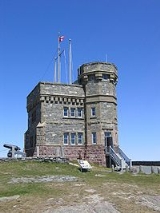
  • Cabot Tower
    Cabot Tower (Newfoundland)
    Cabot Tower is a tower in St. John's, Newfoundland and Labrador, situated on Signal Hill. Construction of tower begun in 1898 to commemorate the 400th anniversary of John Cabot's discovery of Newfoundland, and Queen Victoria's Diamond Jubilee....

     in St. John's, Newfoundland, constructed in 1897 to commemorate the four-hundredth anniversary of Cabot's voyage.
  • Cabot Tower
    Cabot Tower (Bristol)
    Cabot Tower is a tower in Bristol, England, situated in a public park on Brandon Hill, between the city centre, Clifton and Hotwells. It was constructed in memory of John Cabot, 400 years after he set sail in the Matthew from Bristol and landed in what was later to become Canada. The foundation...

    , in Bristol
    Bristol
    Bristol is a city, unitary authority area and ceremonial county in South West England, with an estimated population of 433,100 for the unitary authority in 2009, and a surrounding Larger Urban Zone with an estimated 1,070,000 residents in 2007...

    , England
    England
    England is a country that is part of the United Kingdom. It shares land borders with Scotland to the north and Wales to the west; the Irish Sea is to the north west, the Celtic Sea to the south west, with the North Sea to the east and the English Channel to the south separating it from continental...

    . This is a 30-metre tall red sandstone tower begun in 1897 to mark the 400th anniversary of the landing. It is located on Brandon Hill
    Parks of Bristol
    The English city of Bristol has a number of parks and public open spaces.-Large parks:Bristol City Council own or manage four major parks: The Downs, Blaise Castle, Ashton Court and Stoke Park....

     near the city centre
    Bristol city centre
    Bristol city centre is the commercial, cultural and business centre of Bristol, England. It is the area south of the central ring road and north of the Floating Harbour, bounded north by St Pauls and Easton, east by Temple Meads and Redcliffe, and west by Clifton and Canon's Marsh...

     and was begun as a fraternal response to the earlier decision of Newfoundland to construct their tower.
  • The Giovanni Caboto Club, an Italian club located in Windsor, Ontario, established in 1925.
  • A 1952 statue of the explorer at the entrance to Bristol's Council House
    Council House, Bristol
    The Council House has been the seat of local government in Bristol, England since 1956. It is situated on College Green, opposite the Cathedral and at the foot of Park Street in Bristol city centre . Throughout its history it has been home to Bristol city council.It was designed in the 1930s but...

     — albeit one that the city council decided in 1956 to designate as a "symbolic figure of an Elizabethan seaman". This was despite the fact that the sculptor Charles Wheeler
    Charles Wheeler (sculptor)
    Sir Charles Thomas Wheeler KCVO RA was a British sculptor, and the first sculptor to hold the Presidency of the Royal Academy ....

     exhibited the work in the Royal Academy Summer Exhibition of 1952 as "Number 1423, John Cabot — sketch model for the statue on the New Council House, Bristol". In addition, it may be noted that the figure is dressed in fifteenth-century clothing, has a fifteenth-century navigational instrument (astrolabe) hanging from his belt and is clutching what is clearly meant to be John Cabot's letters patent
    Letters patent
    Letters patent are a type of legal instrument in the form of a published written order issued by a monarch or president, generally granting an office, right, monopoly, title, or status to a person or corporation...

    . Despite all this, the Council still "maintains that the statue does not represent the city's renowned explorer, John Cabot." The reason for the Council's "re-designation" of the statue is not recorded, but may be related to its decision to name the new council house after Elizabeth II, who opened the building in April 1956.
  • John Cabot University
    John Cabot University
    John Cabot University is a private American liberal arts university located in Rome, Italy. Founded in 1972, it was named after the Italian explorer Giovanni Caboto.-Location:...

     is an American university established in 1972 in Rome
    Rome
    Rome is the capital of Italy and the country's largest and most populated city and comune, with over 2.7 million residents in . The city is located in the central-western portion of the Italian Peninsula, on the Tiber River within the Lazio region of Italy.Rome's history spans two and a half...

    , Italy
    Italy
    Italy , officially the Italian Republic languages]] under the European Charter for Regional or Minority Languages. In each of these, Italy's official name is as follows:;;;;;;;;), is a unitary parliamentary republic in South-Central Europe. To the north it borders France, Switzerland, Austria and...

    .
  • A 1985 bronze statue of the explorer by Stephen Joyce, located on the Bristol Harbour
    Bristol Harbour
    Bristol Harbour is the harbour in the city of Bristol, England. The harbour covers an area of . It has existed since the 13th century but was developed into its current form in the early 19th century by installing lock gates on a tidal stretch of the River Avon in the centre of the city and...

     side .
  • A replica of the Matthew of Bristol
    Matthew (ship)
    The Matthew was a caravel sailed by John Cabot in 1497 from Bristol to North America, presumably Newfoundland. After a voyage which had got no further than Iceland, Cabot left again with only one vessel, the Matthew, a small ship , but fast and able. The crew consisted of only 18 people. The...

     built to commemorate the five-hundredth anniversary of the 1497 voyage.
  • The scenic Cabot Trail
    Cabot Trail
    The Cabot Trail is a highway and scenic roadway in the Canadian province of Nova Scotia.It is located in northern Victoria County and Inverness County on Cape Breton Island....

     in the Cape Breton Highlands
    Cape Breton Highlands
    The Cape Breton Highlands, commonly called the Highlands, refer to a highland or mountainous plateau of ancient rock across the northern part of Cape Breton Island in the Canadian province of Nova Scotia....

     is named after the explorer.
  • John Cabot Academy is an independent school in Bristol.
  • Cabot Links - a golf course in Inverness, Nova Scotia
  • Cabot Ward
    Cabot, Bristol
    Cabot is a council ward that covers the centre of Bristol. It gets its name from the Cabot Tower - a memorial tower on Brandon Hill that was built to commemorate John Cabot's voyage and "discovery" of North America.-Areas:...

     is an electoral district in Bristol, albeit one that gets its name from Cabot Tower
    Cabot Tower (Bristol)
    Cabot Tower is a tower in Bristol, England, situated in a public park on Brandon Hill, between the city centre, Clifton and Hotwells. It was constructed in memory of John Cabot, 400 years after he set sail in the Matthew from Bristol and landed in what was later to become Canada. The foundation...

    , which lies in the ward, rather than directly from the explorer.
  • Cabot Square
    Cabot Square
    Cabot Square is one of the central squares of the Canary Wharf Development in London's Docklands.The square includes a fountain and several works of art, and is the address for the London Offices of Credit Suisse and Morgan Stanley....

     in London
    London
    London is the capital city of :England and the :United Kingdom, the largest metropolitan area in the United Kingdom, and the largest urban zone in the European Union by most measures. Located on the River Thames, London has been a major settlement for two millennia, its history going back to its...

     and the smaller Cabot Square, Montreal
    Cabot Square, Montreal
    Cabot Square is an urban square in Montreal, between the former Montreal Forum and the Montreal Children's Hospital.The square is located in the Shaughnessy Village neighbourhood, an area which has been recently re-dubbed the Qurtier des Grands Jardins and has been slated for redevelopment.It is...

    .
  • Cabot Circus
    Cabot Circus
    Cabot Circus is a shopping centre in Bristol, England. It is adjacent to Broadmead, a shopping district in Bristol city centre. The Cabot Circus development area contains shops, offices, a cinema, hotel and 250 apartments. It covers a total of floor space, of which is retail outlets and leisure...

    , a shopping mall
    Shopping mall
    A shopping mall, shopping centre, shopping arcade, shopping precinct or simply mall is one or more buildings forming a complex of shops representing merchandisers, with interconnecting walkways enabling visitors to easily walk from unit to unit, along with a parking area — a modern, indoor version...

     opened in Bristol in 2008 was named following a city-wide poll, thus demonstrating the enduring popularity of the explorer in Bristol
  • John Cabot Road in north Phoenix, Arizona
    Phoenix, Arizona
    Phoenix is the capital, and largest city, of the U.S. state of Arizona, as well as the sixth most populated city in the United States. Phoenix is home to 1,445,632 people according to the official 2010 U.S. Census Bureau data...

    .
  • Cabot Street in St. John's Newfoundland.
  • A bronze statue of the explorer is located at St. John's front of the Confederation Building
    Confederation Building (Newfoundland and Labrador)
    The Confederation Building is located on Confederation Hill overlooking the Newfoundland & Labrador's capital city St. John's, and serves as the home of the Newfoundland and Labrador House of Assembly. The brick and concrete clad building has 11 storeys and is 64 metres tall, it was...

    .
  • A bronze statue of the explorer is located at Cape Bonavista
    Cape Bonavista
    Cape Bonavista is a headland located on the east coast of the island of Newfoundland in the Canadian province of Newfoundland and Labrador.It is located at the northeastern tip of the Bonavista Peninsula, which separates Trinity Bay to the south from Bonavista Bay to the north.The nearby town of...

  • A second replica of the Matthew
    Matthew (ship)
    The Matthew was a caravel sailed by John Cabot in 1497 from Bristol to North America, presumably Newfoundland. After a voyage which had got no further than Iceland, Cabot left again with only one vessel, the Matthew, a small ship , but fast and able. The crew consisted of only 18 people. The...

     located at Cape Bonavista
    Cape Bonavista
    Cape Bonavista is a headland located on the east coast of the island of Newfoundland in the Canadian province of Newfoundland and Labrador.It is located at the northeastern tip of the Bonavista Peninsula, which separates Trinity Bay to the south from Bonavista Bay to the north.The nearby town of...

  • John Cabot Catholic Secondary School in Mississauga, Canada is named after the explorer.

Sources

  • Evan T. Jones, Alwyn Ruddock: John Cabot and the Discovery of America, Historical Research Vol 81, Issue 212 (2008), pp. 224–254. This 15,000-word article provides the most up-to-date introduction to Cabot's life and voyages currently available.
  • Evan T. Jones, Henry VII and the Bristol expeditions to North America: the Condon documents, Historical Research, 27 Aug 2009 relates primarily to the 1499 voyage of William Weston.
  • J.A. Williamson, The Cabot Voyages and Bristol Discovery Under Henry VII (Hakluyt Society, Second Series, No. 120, CUP, 1962). This is the essential source-book for those interested in researching Cabot and his voyages. However, it does not contain reference to any of the documents that have been unearthed since 1962 in the Italian, Spanish and English archives.
  • R. A. Skelton, "CABOT (Caboto), JOHN (Giovanni)", Dictionary of Canadian Biography Online (1966). A short and sensible introduction from a good scholar, which is freely available online. However, it is quite dated.
  • H.P. Biggar (ed.), The Precursors of Jacques Cartier, 1497-1534: a collection of documents relating to the early history of the dominion of Canada (Ottawa, 1911). Remains a useful addition to Williamson, in that it contains transcriptions of many of the original documents in their original languages - i.e. Latin, Spanish and Italian.
  • O. Hartig, "John and Sebastian Cabot", The Catholic Encyclopedia (1908). Freely available but very dated.
  • P D'Epiro, M.D. Pinkowish, "Sprezzatura: 50 ways Italian genius shaped the world" 1st Anchor Book Edition, later printing edition Oct 2 2001), pp. 179–180.

External links