

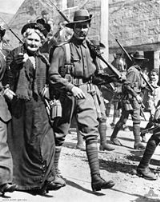
Battle of Bita Paka

Encyclopedia
The Battle of Bita Paka (11 September 1914) was fought south of Kabakaul, on the island of New Britain
, and was a part of the invasion and subsequent occupation of German New Guinea
by the Australian Naval and Military Expeditionary Force
shortly after the outbreak of the First World War. Similar to New Zealand's operation against German Samoa
in August, the main target of the operation was a strategically important wireless station
—one of several used by the German East Asiatic Squadron—which the Australians believed to be located in the area. The powerful German naval fleet threatened British interests and its elimination was an early priority of the British and Australian governments during the war.
After an unopposed landing, a mixed force of German reservists and half-trained Melanesian police mounted a stout resistance and forced the Australians to fight their way to the objective. After a day of fighting during which both sides suffered casualties, Australian forces captured the wireless station. The battle was Australia's first major military engagement of the war and the only significant action of the campaign; in its aftermath the remaining German forces on New Britain fled inland to Toma
. Following a brief siege
there the German garrison capitulated, ending resistance to the Australian occupation of the island.
and several nearby island groups that are now part of Papua New Guinea
. First established in 1884, the main part of the colony was Kaiser-Wilhelmsland
, in north-eastern New Guinea. The islands to the east were known as the Bismarck Archipelago
and consisted of Neu-Pommern (now New Britain
) and Neu-Mecklenburg (now New Ireland). With the exception of German Samoa
, all German islands in the Pacific were administratively part of German New Guinea: the German Solomon Islands (Buka
, Bougainville
and several smaller islands), the Carolines, Palau
, the Marianas (except for Guam
), the Marshall Islands
and Nauru
. Although a relatively minor colony, it covered an extensive land area, totalling around 249500 square kilometres (96,332.5 sq mi).
While the western half of New Guinea had been administered by the Netherlands
since 1828, the eastern half was not annexed by any European power until the 1880s. In 1883, fearful of growing foreign influence—particularly the influence of the Germans—the British
colony of Queensland
annexed the south-eastern part of New Guinea, against the wishes of the British government. This initiated German interest in the remaining third of the island and on 3 November 1884, the German flag was flown over Kaiser-Wilhelmsland, the Bismarck Archipelago (formerly New Britain) and the German Solomon Islands. On 17 May 1885, the German Emperor
granted an Imperial charter to the newly founded Neuguinea-Kompanie (New Guinea Company) for this annexation; this was further extended to the Solomon Islands on 13 November 1886. On 1 April 1899, the German government took formal control, establishing a protectorate. Later a treaty with Spain
, signed on 30 July, ensured German control over several other island groups in the Pacific, and these were added to the protectorate of German New Guinea. The economic life of German New Guinea's small population of European and Asian settlers, as well as that of its Melanesian population, relied heavily on the export
of copra
and the import
of goods and services. It remained a modest outpost as a result, and by August 1914 there were only 1,273 Europeans living in the colony, while there was also a small but significant number of Japanese, Chinese and Malays.
became automatically involved, with Prime Minister
Joseph Cook
stating on 5 August that "...when the Empire is at war, so also is Australia." Within days, Brigadier General
William Bridges
and his staff officer, Major Cyril Brudenell White
, had completed plans for the creation of the Australian Imperial Force
(AIF). White proposed an expeditionary force of 18,000 men, including 12,000 Australians and 6,000 New Zealand
ers. Cook subsequently approved the proposal, although he increased the offer to 20,000 men to serve in any destination desired by the British government. On 6 August 1914, London cabled its acceptance of the force and asked that it be sent as soon as possible. Recruiting offices opened on 10 August and by the end of 1914, 52,561 volunteers had been accepted, despite strict physical fitness guidelines.
Meanwhile, after an additional British request for assistance on 6 August 1914, the Australian government hurriedly prepared another expeditionary force to destroy the German wireless stations at Yap
in the Caroline Islands
, Nauru
, and Rabaul
in New Britain. As with the New Zealand military operation against German Samoa which was completed in late August, the targets of the upcoming action included several strategically important wireless stations used by the German East Asiatic Squadron, under the command of Count Maximilian von Spee
. The existence of the powerful German fleet—including the modern cruisers SMS Scharnhorst
and SMS Gneisenau
—in the Pacific at the outbreak of the war worried the British Admiralty
and the Australian government, and the elimination of its radio network was a key priority. Although the location of the German fleet was unknown it was suspected that they may have been hiding in the excellent natural harbour at Rabaul.
While the Australian Naval and Military Expeditionary Force (AN&MEF) was still being raised for this task, as a prelude to an amphibious landing on the Gazelle Peninsula in New Britain
, ships of the Australian Squadron conducted a reconnaissance of the area, subsequently entering Blanche Bay
on 12 August, while several destroyers also entered Simpson Harbour
. Landing parties went ashore to demolish the telephones in the post offices in Rabaul and at the German gubernatorial capital of Herbertshöhe (present-day Kokopo
), located 20 miles (32.2 km) to the south-east. Enquiries were also made about the location of the radio station, although no information was forthcoming. After threatening to bombard the nearby settlements if the radio station continued to transmit, the Australian warships withdrew.
The AN&MEF comprised one battalion
of infantry
of 1,000 men hurriedly enlisted in Sydney
, plus 500 naval reservists and ex-sailors who would serve as infantry. Another battalion of militia from the Queensland
- based Kennedy Regiment—which had been dispatched to garrison Thursday Island—also contributed 500 volunteers. Under the command of Colonel William Holmes, the force departed Sydney aboard HMAS Berrima
and halted at Palm Island
off Townsville
until a New Zealand force, escorted by the battlecruiser
HMAS Australia
, cruiser HMAS Melbourne
and the French cruiser Montcalm
, occupied Samoa
on 30 August. The AN&MEF then moved to Port Moresby
, where it met the Queensland contingent already aboard the transport Kanowna
. The force sailed for German New Guinea on 7 September, although Kanowna was left behind when her stokers refused to work. The militia were also left in Port Moresby after Holmes decided it was not trained or equipped sufficiently to be committed to the anticipated fighting.
.jpg) At the outbreak of war German New Guinea was only lightly defended, and even after all available reservists had reported for duty and the Melanesian police had been armed, total strength was only 61 German officers
At the outbreak of war German New Guinea was only lightly defended, and even after all available reservists had reported for duty and the Melanesian police had been armed, total strength was only 61 German officers
and non-commissioned officers, and about 240 Melanesian police. To compound the German defensive problems, most of the Germans were reservists with either limited experience, or who had served in the military in some capacity many years earlier. The Bita Paka radio station itself was occupied by eight Germans and 60 Melanesians
, under the command of Hauptmann
(Captain) Hans Wuchert. Wuchert's force was assigned to defend against any hostile landing at a point near the coast, and was authorised to withdraw halfway between Toma and Bita Paka to Tobera
if necessary, but only after demolishing the radio station. Another company of 10 Germans and 140 Melanesians was also stationed at Herbertshöhe, commanded by Leutnant (Lieutenant) Mayer, while at Toma a squad of Melanesians under Leutnant Robert von Blumenthal ("Lord Bob") was charged with digging in and improving defences. Meanwhile section outposts were established at various locations and monitored the coast from St. George's Channel to Rabaul. Despite the limits of manpower, such arrangements proved effective and the reconnaissance of the Australian Squadron on 12 August had been quickly detected, with German forces subsequently directed towards the coast to repel any invasion.
.jpg) Off the eastern tip of New Guinea, Berrima rendezvoused with Australia and the light cruiser HMAS Sydney
Off the eastern tip of New Guinea, Berrima rendezvoused with Australia and the light cruiser HMAS Sydney
plus a number of destroyers, while Melbourne was detached to destroy the wireless station on Nauru
. Melbourne arrived there on 9 September only to find that the radio station had already been disabled by its staff, with Nauru surrendering without opposition. The task force reached Rabaul on 11 September, where they found the port to be free of German forces. Sydney and the destroyer HMAS Warrego landed small parties of naval reservists at the settlements of Kabakaul and at Herbertshöhe. These parties were reinforced firstly by sailors from Warrego and later by infantry from Berrima. Two parties were subsequently landed, one under Sub-Lieutenant C. Webber and the other commanded by Lieutenant Commander J.F. Finlayson. In accordance with German plans, the Australians encountered no opposition at Herbertshöhe, with the German company stationed there having withdrawn to Takubar—between Herbertshöhe and Kabakaul—in the early morning. At 07:00, the Australians raised the Union Jack over the settlement.
The Australians believed that there were probably two radio stations: one under construction 4 miles (6.4 km) directly inland from Herbertshöhe and the other directly inland from Kabakaul, at Bita Paka. Finlayson remained at Herbertshöhe in order to guard the stores being landed from Sydney, while Webber's party began an advance from Herbertshöhe inland along the Toma road. Another party under the command of Lieutenant Rowland Bowen would advance towards Bita Paka, 7 kilometres (4.3 mi) to the south. The party, consisting of two officers and 25 naval reservists was subsequently landed at Kabakaul. Also included were about 15 other personnel to provide medical support and maintain communications.
Realising that his advance was going to be contested by the Germans, Bowen requested reinforcements. Consequently, as an interim measure, 59 men from Warrego and Yarra were landed under Lieutenant G.A. Hill, until infantry could arrive from Berrima, which was still steaming towards Kabakaul from Karavia Bay. Meanwhile Bowen pushed on and the Australians were again fired upon by the well concealed Germans and their Melanesian troops, as well as from snipers in the treetops. By 09:30 the situation had become grave, and the Australians suffered their first casualty of the war, with Able Seaman Billy Williams mortally wounded. Also included among the casualties was the medical officer, who died of his wounds alongside Williams in the afternoon after being evacuated to Berrima.
.jpg) The reinforcements landed earlier from the destroyers reached Bowen by 10:00 however, and the situation was stabilised. The advance was subsequently resumed, however the Australians had not gone more than 500 yards (457.2 m) when they encountered a strongly held German trench dug across the road. Working together, Hill and Bowen attempted to outflank the Germans, during which Bowen was shot and badly wounded by a sniper, leaving Hill in command. Berrima subsequently landed reinforcements, including a half-battalion commanded by Lieutenant Commander Charles Elwell, as well as a machine-gun section and medical detachment. Among the reinforcements was the battalion commander, Commander J.A.H. Beresford, and the intelligence officer.
The reinforcements landed earlier from the destroyers reached Bowen by 10:00 however, and the situation was stabilised. The advance was subsequently resumed, however the Australians had not gone more than 500 yards (457.2 m) when they encountered a strongly held German trench dug across the road. Working together, Hill and Bowen attempted to outflank the Germans, during which Bowen was shot and badly wounded by a sniper, leaving Hill in command. Berrima subsequently landed reinforcements, including a half-battalion commanded by Lieutenant Commander Charles Elwell, as well as a machine-gun section and medical detachment. Among the reinforcements was the battalion commander, Commander J.A.H. Beresford, and the intelligence officer.
that the Germans had buried under a narrow track, and set to detonate using a command wire. These mines had been laid beneath the road with wires leading to an electric battery and a firing key at the bottom of a lookout tree. By 13:00 however, Hill's position was reached and the Australians—now under Elwell's overall command—launched another flanking attack on the main trench blocking the road. Despite suffering heavy casualties they pressed their attack, forcing the defenders to surrender after charging the trench with fixed bayonets. A German officer and 20 Melanesians were subsequently captured. Four Australians were killed, including Elwell, who died leading the charge with his sword drawn. Another five men were wounded.
Now under the command of Hill, and accompanied by two German prisoners acting as interpreters, the Australians proceeded down the road under a flag of truce and persuaded the garrisons of two more trenches to surrender, but not before another skirmish during which the Germans counter-attacked, wounding three more Australians, one fatally; in the firefight, one of the German interpreters was killed by the Australians, as were several Melanesians. The advance continued and another group of defenders was encountered and subsequently disarmed by nightfall. By 19:00 the Australians reached the radio station which was found to have been abandoned; the mast had been dismantled, although the instruments and machinery remained intact. The surviving defenders had abandoned the defences and withdrawn.
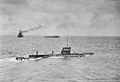
.jpg) During the fighting at Bita Paka, six Australians were killed and five wounded, while casualties among the defenders included one German and about 30 Melanesians killed, and one German and 10 Melanesians wounded; 19 Germans and 56 Melanesians were captured. Later it was alleged that the heavy losses among the Melanesian troops were the result of the Australians bayoneting a number that they had captured. While the casualties suffered by the Australians were light in the context of later operations, they were disproportionately heavy given the modest territorial and strategic gains and were further compounded by the disappearance of the submarine AE1
During the fighting at Bita Paka, six Australians were killed and five wounded, while casualties among the defenders included one German and about 30 Melanesians killed, and one German and 10 Melanesians wounded; 19 Germans and 56 Melanesians were captured. Later it was alleged that the heavy losses among the Melanesian troops were the result of the Australians bayoneting a number that they had captured. While the casualties suffered by the Australians were light in the context of later operations, they were disproportionately heavy given the modest territorial and strategic gains and were further compounded by the disappearance of the submarine AE1
during a patrol off Rabaul on 14 September, with all 35 men aboard. After their defeat the remaining German forces and the civil administration withdrew 19 miles (30.6 km) inland to Toma, believing they would have time to regroup before the Australians arrived.
The German governor—Eduard Haber—continued to hold out for several days hoping that the German East Asiatic Squadron would arrive to relieve them. Unbeknown to the Germans, however, an Australian advanced party consisting of a half-battalion of 200 men and a 12-pounder naval field-gun
had followed them, moving along the Toma road. The Australians surrounded the town and proceeded to bombard it; meanwhile HMAS Encounter arrived on station and fired several shells at a ridge nearby. This show of fire-power scattered the Melanesian police and was sufficient to start negotiations, with Toma subsequently occupied. Haber visited Holmes in Herbertshöhe on 15 September, signing terms two days later. All military resistance subsequently ceased and the remaining 40 German soldiers and 110 Melanesians surrendered on 21 September, leaving no effective opposition to the Australian occupation of the territory.A German officer—Hauptmann Hermann Detzner
—and about 20 Melanesian police managed to evade capture in the interior of New Guinea for the entire war. Unbeknown to Detzner, the war had started while he was still on a surveying expedition to map the border with Australian-held Papua. He later claimed to have penetrated the interior of Kaiser-Wilhelmsland (the German portion of New Guinea) in his 1920 book, "Vier Jahre unter Kannibalen" ("Four Years among Cannibals"). These claims were disputed by various German missionaries however, and Detzner recanted most of his claims in 1932. See Meade 2005, pp. 75–80.
on Kaiser-Wilhelmsland
(the New Guinea mainland) was occupied on 24 September, although the German armed merchant raider SMS Cormoran
—which was lurking nearby—escaped undetected. Over the next two months the remaining outposts were also occupied. Meanwhile, the German East Asiatic Squadron steamed across the Pacific before surprising and sinking a British force off Coronel
on 1 November. After rounding Cape Horn
into the Atlantic and attempting a raid on the Stanley naval station
, the squadron was itself destroyed by a more powerful British force during the Battle of the Falkland Islands
on 8 December 1914. Later it was alleged that widespread looting and destruction of civilian property by Australian troops occurred during this period. Indeed, ill-discipline among the Australian force appears to have been an issue—perhaps due to the haste with which the AN&MEF had been raised and the poor character of some of those that were enlisted. Claims in the Australian media of criminal behaviour caused considerable controversy at the time, and later led to a parliamentary enquiry. In the end a number of soldiers were court martialled
and imprisoned for looting and theft, although more serious allegations, including rape, also arose.The enquiry by Judge Murray, the Lieutenant-Governor of Papua, into allegations of looting of German, Chinese and Japanese properties, and of the manner in which the Melanesians were treated during the period of military administration in German New Guinea was completed after the war in 1919. See
Following the capture of the remaining German possessions in the region, the AN&MEF provided occupation forces for the duration of the war. Holmes subsequently established a military government which continued until 1921, after which Australia received a mandate from the League of Nations
to govern the territory. The early Australian military administration continued the exploitative economic policies of the previous German colonial administration, and official policy was to continue the status quo, including the use of indentured Melanesian labour on plantations, the levy of the "native head tax" and official floggings, or corporal punishment
. Equally, despite previously being protected by the German colonial administration in 1914, the hunting of the native bird of paradise, crowned pigeon and white heron for the lucrative trade in their feathers and skin, was officially condoned and a custom tax levied on their export.As many as 100,000 birds were subsequently killed before they were again protected in 1923, more than double the number killed during the German bird of paradise boom before they were protected in 1914. See Hiery 1995, pp. 47–50. Under the terms of the German surrender Haber was allowed to return to Germany, while German civilians could remain as long as they swore an oath
of neutrality. Those who refused were later transported to Australia from where they could freely travel back to Germany.Hiery suggests that the German colonial policies in the Pacific were liberal when compared to the subsequent policies initiated by the Australians, Japanese and New Zealand administrators that replaced them. He argues that the German administrators had allowed for the conservation or adaptation of traditional lifestyles, in contrast to the later Australian administration.
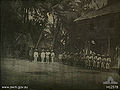 On 9 January 1915, Holmes handed over command of the AN&MEF to Brigadier General Sir Samuel Pethebridge, the former Secretary of the Department of Defence
. Holmes returned to Australia and re-enlisted in the AIF, as did most of his men. They were replaced by the 3rd Battalion, known as the "Tropical Force" because it had been specially enlisted for service in the tropics. Pethebridge established the administrative structures that remained through the period of military occupation. Although required by international law
to follow the German forms of government, the territory gradually acquired the appearance of a British colony. As a result of the peace settlement under the Treaty of Versailles
in 1919 Germany lost all its colonial possessions, including German New Guinea. The colony became the Territory of New Guinea
, a League of Nations
Mandate Territory
under Australian administration. It remained as such until 1949 when it was merged with the Australia
n territory of Papua
to become the Territory of Papua and New Guinea
, which eventually became modern Papua New Guinea
. Ultimately, Australian administration over the territory lasted until 1975 when Papua New Guinea gained its independence.Australian administration over the territory was interrupted by Japanese occupation during the New Guinea campaign
(1942–1945) in the Second World War.
 The AN&MEF had prevailed because of their ability to fight in close terrain, while their outflanking of the German positions had unnerved their opponents. Yet despite ultimately being successful, the Australian operation on New Britain was not well-managed, and they had been effectively delayed by a few reserve officers and a half-trained Melanesian police force. Although the Battle of Bita Paka was Australia's first major military engagement of the war, it soon became little more than a sideshow in a conflict which grew to assume much greater proportions. Later, many men of the AN&MEF volunteered for the AIF and served in Egypt, Gallipoli, Sinai and Palestine
and on the Western Front
and a large number became casualties.
Apart from the very real human suffering of the Melanesian troops killed or wounded at Bita Paka, the reduction in German prestige due to the capture of German New Guinea, and the economic and property losses experienced by some German colonists during the occupation, the battle ultimately held little significance to the Germans either. The fighting yielded few tactical lessons given the very different nature of the fighting there to that of the mass industrialised warfare
into which both the Germans and the Australians experienced in Europe. Meanwhile, just as many Australians felt that "the real war was in Europe", so may have most Germans as the campaign became subsumed by the global conflict of the First World War, and is largely forgotten today as a result.
New Britain
New Britain, or Niu Briten, is the largest island in the Bismarck Archipelago of Papua New Guinea. It is separated from the island of New Guinea by the Dampier and Vitiaz Straits and from New Ireland by St. George's Channel...
, and was a part of the invasion and subsequent occupation of German New Guinea
German New Guinea
German New Guinea was the first part of the German colonial empire. It was a protectorate from 1884 until 1914 when it fell to Australia following the outbreak of the First World War. It consisted of the northeastern part of New Guinea and several nearby island groups...
by the Australian Naval and Military Expeditionary Force
Australian Naval and Military Expeditionary Force
The Australian Naval and Military Expeditionary Force was a small volunteer force of approximately 2,000 men, raised in Australia shortly after the outbreak of the First World War to seize and destroy German wireless stations in German New Guinea in the south-west Pacific...
shortly after the outbreak of the First World War. Similar to New Zealand's operation against German Samoa
Occupation of German Samoa
The Occupation of Samoa was the takeover and subsequent administration of the Pacific colony of German Samoa in August 1914 by an expeditionary force from New Zealand called the Samoa Expeditionary Force and New Zealand's first action in World War I...
in August, the main target of the operation was a strategically important wireless station
Radio
Radio is the transmission of signals through free space by modulation of electromagnetic waves with frequencies below those of visible light. Electromagnetic radiation travels by means of oscillating electromagnetic fields that pass through the air and the vacuum of space...
—one of several used by the German East Asiatic Squadron—which the Australians believed to be located in the area. The powerful German naval fleet threatened British interests and its elimination was an early priority of the British and Australian governments during the war.
After an unopposed landing, a mixed force of German reservists and half-trained Melanesian police mounted a stout resistance and forced the Australians to fight their way to the objective. After a day of fighting during which both sides suffered casualties, Australian forces captured the wireless station. The battle was Australia's first major military engagement of the war and the only significant action of the campaign; in its aftermath the remaining German forces on New Britain fled inland to Toma
Siege of Toma
The Siege of Toma was a bloodless action during the First World War on the island of New Britain between 14–17 September 1914 as part of the occupation of German New Guinea by the Australian Naval and Military Expeditionary Force...
. Following a brief siege
Siege
A siege is a military blockade of a city or fortress with the intent of conquering by attrition or assault. The term derives from sedere, Latin for "to sit". Generally speaking, siege warfare is a form of constant, low intensity conflict characterized by one party holding a strong, static...
there the German garrison capitulated, ending resistance to the Australian occupation of the island.
Background
German New Guinea consisted of north-eastern New GuineaNew Guinea
New Guinea is the world's second largest island, after Greenland, covering a land area of 786,000 km2. Located in the southwest Pacific Ocean, it lies geographically to the east of the Malay Archipelago, with which it is sometimes included as part of a greater Indo-Australian Archipelago...
and several nearby island groups that are now part of Papua New Guinea
Papua New Guinea
Papua New Guinea , officially the Independent State of Papua New Guinea, is a country in Oceania, occupying the eastern half of the island of New Guinea and numerous offshore islands...
. First established in 1884, the main part of the colony was Kaiser-Wilhelmsland
Kaiser-Wilhelmsland
Kaiser-Wilhelmsland was part of the German New Guinea, the South Pacific protectorate of the German Empire. Named in honor of Wilhelm II, who was the German Emperor and King of Prussia, it included the north-eastern part of the present day Papua New Guinea. From 1884 until 1918, the territory...
, in north-eastern New Guinea. The islands to the east were known as the Bismarck Archipelago
Bismarck Archipelago
The Bismarck Archipelago is a group of islands off the northeastern coast of New Guinea in the western Pacific Ocean and is part of the Islands Region of Papua New Guinea.-History:...
and consisted of Neu-Pommern (now New Britain
New Britain
New Britain, or Niu Briten, is the largest island in the Bismarck Archipelago of Papua New Guinea. It is separated from the island of New Guinea by the Dampier and Vitiaz Straits and from New Ireland by St. George's Channel...
) and Neu-Mecklenburg (now New Ireland). With the exception of German Samoa
German Samoa
German Samoa was a German protectorate from 1900 to 1914, consisting of the islands of Upolu, Savai'i, Apolima and Manono, now wholly within the independent state Samoa, formerly Western Samoa...
, all German islands in the Pacific were administratively part of German New Guinea: the German Solomon Islands (Buka
Buka Island
Buka Island is the second largest island in the Papua New Guinean province of Bougainville.- History :Buka was first occupied by humans in paleolithic times, some 30,000 years ago...
, Bougainville
Bougainville Island
Bougainville Island is the main island of the Autonomous Region of Bougainville of Papua New Guinea. This region is also known as Bougainville Province or the North Solomons. The population of the province is 175,160 , which includes the adjacent island of Buka and assorted outlying islands...
and several smaller islands), the Carolines, Palau
Palau
Palau , officially the Republic of Palau , is an island nation in the Pacific Ocean, east of the Philippines and south of Tokyo. In 1978, after three decades as being part of the United Nations trusteeship, Palau chose independence instead of becoming part of the Federated States of Micronesia, a...
, the Marianas (except for Guam
Guam
Guam is an organized, unincorporated territory of the United States located in the western Pacific Ocean. It is one of five U.S. territories with an established civilian government. Guam is listed as one of 16 Non-Self-Governing Territories by the Special Committee on Decolonization of the United...
), the Marshall Islands
Marshall Islands
The Republic of the Marshall Islands , , is a Micronesian nation of atolls and islands in the middle of the Pacific Ocean, just west of the International Date Line and just north of the Equator. As of July 2011 the population was 67,182...
and Nauru
Nauru
Nauru , officially the Republic of Nauru and formerly known as Pleasant Island, is an island country in Micronesia in the South Pacific. Its nearest neighbour is Banaba Island in Kiribati, to the east. Nauru is the world's smallest republic, covering just...
. Although a relatively minor colony, it covered an extensive land area, totalling around 249500 square kilometres (96,332.5 sq mi).
While the western half of New Guinea had been administered by the Netherlands
Netherlands
The Netherlands is a constituent country of the Kingdom of the Netherlands, located mainly in North-West Europe and with several islands in the Caribbean. Mainland Netherlands borders the North Sea to the north and west, Belgium to the south, and Germany to the east, and shares maritime borders...
since 1828, the eastern half was not annexed by any European power until the 1880s. In 1883, fearful of growing foreign influence—particularly the influence of the Germans—the British
United Kingdom
The United Kingdom of Great Britain and Northern IrelandIn the United Kingdom and Dependencies, other languages have been officially recognised as legitimate autochthonous languages under the European Charter for Regional or Minority Languages...
colony of Queensland
Queensland
Queensland is a state of Australia, occupying the north-eastern section of the mainland continent. It is bordered by the Northern Territory, South Australia and New South Wales to the west, south-west and south respectively. To the east, Queensland is bordered by the Coral Sea and Pacific Ocean...
annexed the south-eastern part of New Guinea, against the wishes of the British government. This initiated German interest in the remaining third of the island and on 3 November 1884, the German flag was flown over Kaiser-Wilhelmsland, the Bismarck Archipelago (formerly New Britain) and the German Solomon Islands. On 17 May 1885, the German Emperor
German Emperor
This article is about the emperors of the German Empire. For full list of German monarchs before 1871, see List of German monarchs.The German Emperor was the official title of the Head of State and ruler of the German Empire, beginning with the proclamation of Wilhelm I as emperor during the...
granted an Imperial charter to the newly founded Neuguinea-Kompanie (New Guinea Company) for this annexation; this was further extended to the Solomon Islands on 13 November 1886. On 1 April 1899, the German government took formal control, establishing a protectorate. Later a treaty with Spain
Spain
Spain , officially the Kingdom of Spain languages]] under the European Charter for Regional or Minority Languages. In each of these, Spain's official name is as follows:;;;;;;), is a country and member state of the European Union located in southwestern Europe on the Iberian Peninsula...
, signed on 30 July, ensured German control over several other island groups in the Pacific, and these were added to the protectorate of German New Guinea. The economic life of German New Guinea's small population of European and Asian settlers, as well as that of its Melanesian population, relied heavily on the export
Export
The term export is derived from the conceptual meaning as to ship the goods and services out of the port of a country. The seller of such goods and services is referred to as an "exporter" who is based in the country of export whereas the overseas based buyer is referred to as an "importer"...
of copra
Copra
Copra is the dried meat, or kernel, of the coconut. Coconut oil extracted from it has made copra an important agricultural commodity for many coconut-producing countries. It also yields coconut cake which is mainly used as feed for livestock.-Production:...
and the import
Import
The term import is derived from the conceptual meaning as to bring in the goods and services into the port of a country. The buyer of such goods and services is referred to an "importer" who is based in the country of import whereas the overseas based seller is referred to as an "exporter". Thus...
of goods and services. It remained a modest outpost as a result, and by August 1914 there were only 1,273 Europeans living in the colony, while there was also a small but significant number of Japanese, Chinese and Malays.
Prelude
Following Britain's declaration of war on Germany on 4 August 1914 at the outbreak of the First World War, Australia and the other members of the British EmpireBritish Empire
The British Empire comprised the dominions, colonies, protectorates, mandates and other territories ruled or administered by the United Kingdom. It originated with the overseas colonies and trading posts established by England in the late 16th and early 17th centuries. At its height, it was the...
became automatically involved, with Prime Minister
Prime Minister of Australia
The Prime Minister of the Commonwealth of Australia is the highest minister of the Crown, leader of the Cabinet and Head of Her Majesty's Australian Government, holding office on commission from the Governor-General of Australia. The office of Prime Minister is, in practice, the most powerful...
Joseph Cook
Joseph Cook
Sir Joseph Cook, GCMG was an Australian politician and the sixth Prime Minister of Australia. Born as Joseph Cooke and working in the coal mines of Silverdale, Staffordshire during his early life, he emigrated to Lithgow, New South Wales during the late 1880s, and became General-Secretary of the...
stating on 5 August that "...when the Empire is at war, so also is Australia." Within days, Brigadier General
Brigadier General
Brigadier general is a senior rank in the armed forces. It is the lowest ranking general officer in some countries, usually sitting between the ranks of colonel and major general. When appointed to a field command, a brigadier general is typically in command of a brigade consisting of around 4,000...
William Bridges
William Throsby Bridges
Major General Sir William Throsby Bridges KCB, CMG served with Australian forces during World War I, and was the first Australian to reach general officer rank...
and his staff officer, Major Cyril Brudenell White
Brudenell White
General Sir Cyril Brudenell Bingham White KCB, KCMG, KCVO, DSO was a senior officer in the Australian Army, who served as Chief of the General Staff from 1920 to 1923 and again from March to August 1940, when he was killed in the Canberra air disaster.-Early Life and career:White was born in St...
, had completed plans for the creation of the Australian Imperial Force
Australian Imperial Force
The Australian Imperial Force was the name given to all-volunteer Australian Army forces dispatched to fight overseas during World War I and World War II.* First Australian Imperial Force * Second Australian Imperial Force...
(AIF). White proposed an expeditionary force of 18,000 men, including 12,000 Australians and 6,000 New Zealand
New Zealand
New Zealand is an island country in the south-western Pacific Ocean comprising two main landmasses and numerous smaller islands. The country is situated some east of Australia across the Tasman Sea, and roughly south of the Pacific island nations of New Caledonia, Fiji, and Tonga...
ers. Cook subsequently approved the proposal, although he increased the offer to 20,000 men to serve in any destination desired by the British government. On 6 August 1914, London cabled its acceptance of the force and asked that it be sent as soon as possible. Recruiting offices opened on 10 August and by the end of 1914, 52,561 volunteers had been accepted, despite strict physical fitness guidelines.
Meanwhile, after an additional British request for assistance on 6 August 1914, the Australian government hurriedly prepared another expeditionary force to destroy the German wireless stations at Yap
Yap
Yap, also known as Wa'ab by locals, is an island in the Caroline Islands of the western Pacific Ocean. It is a state of the Federated States of Micronesia. Yap's indigenous cultures and traditions are still strong compared to other neighboring islands. The island of Yap actually consists of four...
in the Caroline Islands
Caroline Islands
The Caroline Islands are a widely scattered archipelago of tiny islands in the western Pacific Ocean, to the north of New Guinea. Politically they are divided between the Federated States of Micronesia in the eastern part of the group, and Palau at the extreme western end...
, Nauru
Nauru
Nauru , officially the Republic of Nauru and formerly known as Pleasant Island, is an island country in Micronesia in the South Pacific. Its nearest neighbour is Banaba Island in Kiribati, to the east. Nauru is the world's smallest republic, covering just...
, and Rabaul
Rabaul
Rabaul is a township in East New Britain province, Papua New Guinea. The town was the provincial capital and most important settlement in the province until it was destroyed in 1994 by falling ash of a volcanic eruption. During the eruption, ash was sent thousands of metres into the air and the...
in New Britain. As with the New Zealand military operation against German Samoa which was completed in late August, the targets of the upcoming action included several strategically important wireless stations used by the German East Asiatic Squadron, under the command of Count Maximilian von Spee
Maximilian von Spee
Vice Admiral Maximilian Reichsgraf von Spee was a German admiral. Although he was born in Copenhagen, Denmark, the counts von Spee belonged to the prominent families of the Rhenish nobility. He joined the Kaiserliche Marine in 1878. In 1887–88 he commanded the Kamerun ports, in German West...
. The existence of the powerful German fleet—including the modern cruisers SMS Scharnhorst
SMS Scharnhorst
SMS Scharnhorst was an armored cruiser of the Imperial German Navy, built at the Blohm & Voss shipyard in Hamburg, Germany. She was the lead ship of her class, which also included her sister . Scharnhorst and her sister were enlarged versions of the preceding ; they were equipped with a greater...
and SMS Gneisenau
SMS Gneisenau
SMS Gneisenau was an armored cruiser of the German navy, part of the two-ship . She was named after August von Gneisenau, a Prussian general of the Napoleonic Wars. The ship was laid down in 1904 at the AG Weser dockyard in Bremen, launched in June 1906, and completed in March 1908, at a cost of...
—in the Pacific at the outbreak of the war worried the British Admiralty
Admiralty
The Admiralty was formerly the authority in the Kingdom of England, and later in the United Kingdom, responsible for the command of the Royal Navy...
and the Australian government, and the elimination of its radio network was a key priority. Although the location of the German fleet was unknown it was suspected that they may have been hiding in the excellent natural harbour at Rabaul.
While the Australian Naval and Military Expeditionary Force (AN&MEF) was still being raised for this task, as a prelude to an amphibious landing on the Gazelle Peninsula in New Britain
New Britain
New Britain, or Niu Briten, is the largest island in the Bismarck Archipelago of Papua New Guinea. It is separated from the island of New Guinea by the Dampier and Vitiaz Straits and from New Ireland by St. George's Channel...
, ships of the Australian Squadron conducted a reconnaissance of the area, subsequently entering Blanche Bay
Blanche Bay
Blanche Bay is a bay near Rabaul, New Britain, Papua New Guinea. The bay is named after which was surveying the bay under the command of Captain Cortland Simpson in 1872.-References:...
on 12 August, while several destroyers also entered Simpson Harbour
Simpson Harbour
Simpson Harbour is a sheltered harbour of Blanche Bay, on the Gazelle Peninsula in the extreme north of New Britain. The harbour is named after Captain Cortland Simpson who was surveying the bay while in command of in 1872. The former capital city of Rabaul is on its shores.The harbour is a huge...
. Landing parties went ashore to demolish the telephones in the post offices in Rabaul and at the German gubernatorial capital of Herbertshöhe (present-day Kokopo
Kokopo
Kokopo is the capital of East New Britain in Papua New Guinea. The capital was moved from Rabaul in 1994 when the volcanoes Tavurvur and Vulcan erupted. As a result, the population of the town increased more than sixfold from 3,150 in 1990 to 20,262 in 2000....
), located 20 miles (32.2 km) to the south-east. Enquiries were also made about the location of the radio station, although no information was forthcoming. After threatening to bombard the nearby settlements if the radio station continued to transmit, the Australian warships withdrew.
The AN&MEF comprised one battalion
Battalion
A battalion is a military unit of around 300–1,200 soldiers usually consisting of between two and seven companies and typically commanded by either a Lieutenant Colonel or a Colonel...
of infantry
Infantry
Infantrymen are soldiers who are specifically trained for the role of fighting on foot to engage the enemy face to face and have historically borne the brunt of the casualties of combat in wars. As the oldest branch of combat arms, they are the backbone of armies...
of 1,000 men hurriedly enlisted in Sydney
Sydney
Sydney is the most populous city in Australia and the state capital of New South Wales. Sydney is located on Australia's south-east coast of the Tasman Sea. As of June 2010, the greater metropolitan area had an approximate population of 4.6 million people...
, plus 500 naval reservists and ex-sailors who would serve as infantry. Another battalion of militia from the Queensland
Queensland
Queensland is a state of Australia, occupying the north-eastern section of the mainland continent. It is bordered by the Northern Territory, South Australia and New South Wales to the west, south-west and south respectively. To the east, Queensland is bordered by the Coral Sea and Pacific Ocean...
HMAS Berrima
HMAS Berrima was an Armed Merchant Cruiser which served in the Royal Australian Navy during World War I.The P&O passenger liner SS Berrima was requisitioned for use by the Navy, refitted and armed at the Cockatoo Island Dockyard and commissioned into the RAN as the auxiliary cruiser HMAS...
and halted at Palm Island
Palm Island, Queensland
Palm Island is an Aboriginal community located on Great Palm Island, also called by the Aboriginal name "Bwgcolman", an island on the Great Barrier Reef in North Queensland, Australia The settlement is also known by a variety of other names including "the Mission", Palm Island Settlement or Palm...
off Townsville
Townsville, Queensland
Townsville is a city on the north-eastern coast of Australia, in the state of Queensland. Adjacent to the central section of the Great Barrier Reef, it is in the dry tropics region of Queensland. Townsville is Australia's largest urban centre north of the Sunshine Coast, with a 2006 census...
until a New Zealand force, escorted by the battlecruiser
Battlecruiser
Battlecruisers were large capital ships built in the first half of the 20th century. They were developed in the first decade of the century as the successor to the armoured cruiser, but their evolution was more closely linked to that of the dreadnought battleship...
HMAS Australia
HMAS Australia (1911)
HMAS Australia was one of three s built for the defence of the British Empire. Ordered by the Australian government in 1909, she was launched in 1911, and commissioned as flagship of the fledgling Royal Australian Navy in 1913...
, cruiser HMAS Melbourne
HMAS Melbourne (1912)
HMAS Melbourne was a Town class light cruiser operated by the Royal Australian Navy . Commissioned in 1913, the cruiser served during World War I. She was paid off in 1928, and broken up for scrap in 1929.-Design and construction:...
and the French cruiser Montcalm
French armoured cruiser Montcalm
The Montcalm was an armoured cruiser of the French Navy.Before even completing her trials, she ferried the President of the Republic, Émile Loubet, to Russia...
, occupied Samoa
Occupation of German Samoa
The Occupation of Samoa was the takeover and subsequent administration of the Pacific colony of German Samoa in August 1914 by an expeditionary force from New Zealand called the Samoa Expeditionary Force and New Zealand's first action in World War I...
on 30 August. The AN&MEF then moved to Port Moresby
Port Moresby
Port Moresby , or Pot Mosbi in Tok Pisin, is the capital and largest city of Papua New Guinea . It is located on the shores of the Gulf of Papua, on the southeastern coast of the island of New Guinea, which made it a prime objective for conquest by the Imperial Japanese forces during 1942–43...
, where it met the Queensland contingent already aboard the transport Kanowna
TSS Kanowna
TSS Kanowna, was an Australian steamer built during 1902. The 6,993-ton, long Kanowna was constructed by William Denny and Brothers of Dumbarton, Scotland, and had a twin screw design.-Operational history:...
. The force sailed for German New Guinea on 7 September, although Kanowna was left behind when her stokers refused to work. The militia were also left in Port Moresby after Holmes decided it was not trained or equipped sufficiently to be committed to the anticipated fighting.
Officer (armed forces)
An officer is a member of an armed force or uniformed service who holds a position of authority. Commissioned officers derive authority directly from a sovereign power and, as such, hold a commission charging them with the duties and responsibilities of a specific office or position...
and non-commissioned officers, and about 240 Melanesian police. To compound the German defensive problems, most of the Germans were reservists with either limited experience, or who had served in the military in some capacity many years earlier. The Bita Paka radio station itself was occupied by eight Germans and 60 Melanesians
Melanesians
Melanesians are an ethnic group in Melanesia. The original inhabitants of the group of islands now named Melanesia were likely the ancestors of the present-day Papuan-speaking people...
, under the command of Hauptmann
Hauptmann
Hauptmann is a German word usually translated as captain when it is used as an officer's rank in the German, Austrian and Swiss armies. While "haupt" in contemporary German means "main", it also has the dated meaning of "head", i.e...
(Captain) Hans Wuchert. Wuchert's force was assigned to defend against any hostile landing at a point near the coast, and was authorised to withdraw halfway between Toma and Bita Paka to Tobera
Tobera
Tobera is situated near Keravat, East New Britain Province, Papua New Guinea. Tobera was used as an airstrip during World War II. Relics remain on the airstrip showing it was an airstrip....
if necessary, but only after demolishing the radio station. Another company of 10 Germans and 140 Melanesians was also stationed at Herbertshöhe, commanded by Leutnant (Lieutenant) Mayer, while at Toma a squad of Melanesians under Leutnant Robert von Blumenthal ("Lord Bob") was charged with digging in and improving defences. Meanwhile section outposts were established at various locations and monitored the coast from St. George's Channel to Rabaul. Despite the limits of manpower, such arrangements proved effective and the reconnaissance of the Australian Squadron on 12 August had been quickly detected, with German forces subsequently directed towards the coast to repel any invasion.
Initial landings
HMAS Sydney (1912)
HMAS Sydney was a Chatham class light cruiser of the Royal Australian Navy . Laid down in 1911 and launched in 1912, the cruiser was commissioned into the RAN in 1913....
plus a number of destroyers, while Melbourne was detached to destroy the wireless station on Nauru
Nauru
Nauru , officially the Republic of Nauru and formerly known as Pleasant Island, is an island country in Micronesia in the South Pacific. Its nearest neighbour is Banaba Island in Kiribati, to the east. Nauru is the world's smallest republic, covering just...
. Melbourne arrived there on 9 September only to find that the radio station had already been disabled by its staff, with Nauru surrendering without opposition. The task force reached Rabaul on 11 September, where they found the port to be free of German forces. Sydney and the destroyer HMAS Warrego landed small parties of naval reservists at the settlements of Kabakaul and at Herbertshöhe. These parties were reinforced firstly by sailors from Warrego and later by infantry from Berrima. Two parties were subsequently landed, one under Sub-Lieutenant C. Webber and the other commanded by Lieutenant Commander J.F. Finlayson. In accordance with German plans, the Australians encountered no opposition at Herbertshöhe, with the German company stationed there having withdrawn to Takubar—between Herbertshöhe and Kabakaul—in the early morning. At 07:00, the Australians raised the Union Jack over the settlement.
The Australians believed that there were probably two radio stations: one under construction 4 miles (6.4 km) directly inland from Herbertshöhe and the other directly inland from Kabakaul, at Bita Paka. Finlayson remained at Herbertshöhe in order to guard the stores being landed from Sydney, while Webber's party began an advance from Herbertshöhe inland along the Toma road. Another party under the command of Lieutenant Rowland Bowen would advance towards Bita Paka, 7 kilometres (4.3 mi) to the south. The party, consisting of two officers and 25 naval reservists was subsequently landed at Kabakaul. Also included were about 15 other personnel to provide medical support and maintain communications.
The advance inland
The advance inland began along the fringe of the dense jungle-edged road to the radio station, with the Australians attempting to avoid the road wherever possible. By 09:00 they had penetrated about 2000 yards (1,828.8 m) and with the scrub becoming denser the scouts pushed away from the road to work their way around the obstacle. In so doing they suddenly surprised a group of about 20 Melanesian soldiers led by three Germans, who were apparently laying an ambush on the road for the advancing Australians. They opened fire, wounding one of the Germans in the hand and capturing him, and scattering the Melanesians. By means of a ruse Wuchert and Mayer were also captured, depriving the defenders of two important commanders, while several significant maps also fell into Australian hands at this time.Realising that his advance was going to be contested by the Germans, Bowen requested reinforcements. Consequently, as an interim measure, 59 men from Warrego and Yarra were landed under Lieutenant G.A. Hill, until infantry could arrive from Berrima, which was still steaming towards Kabakaul from Karavia Bay. Meanwhile Bowen pushed on and the Australians were again fired upon by the well concealed Germans and their Melanesian troops, as well as from snipers in the treetops. By 09:30 the situation had become grave, and the Australians suffered their first casualty of the war, with Able Seaman Billy Williams mortally wounded. Also included among the casualties was the medical officer, who died of his wounds alongside Williams in the afternoon after being evacuated to Berrima.
Fighting for the wireless station
Elwell advanced inland rapidly and was soon engaged also, losing one killed and two wounded in a brief skirmish. During the advance the Australians had also uncovered and defused a large pipe mineLand mine
A land mine is usually a weight-triggered explosive device which is intended to damage a target—either human or inanimate—by means of a blast and/or fragment impact....
that the Germans had buried under a narrow track, and set to detonate using a command wire. These mines had been laid beneath the road with wires leading to an electric battery and a firing key at the bottom of a lookout tree. By 13:00 however, Hill's position was reached and the Australians—now under Elwell's overall command—launched another flanking attack on the main trench blocking the road. Despite suffering heavy casualties they pressed their attack, forcing the defenders to surrender after charging the trench with fixed bayonets. A German officer and 20 Melanesians were subsequently captured. Four Australians were killed, including Elwell, who died leading the charge with his sword drawn. Another five men were wounded.
Now under the command of Hill, and accompanied by two German prisoners acting as interpreters, the Australians proceeded down the road under a flag of truce and persuaded the garrisons of two more trenches to surrender, but not before another skirmish during which the Germans counter-attacked, wounding three more Australians, one fatally; in the firefight, one of the German interpreters was killed by the Australians, as were several Melanesians. The advance continued and another group of defenders was encountered and subsequently disarmed by nightfall. By 19:00 the Australians reached the radio station which was found to have been abandoned; the mast had been dismantled, although the instruments and machinery remained intact. The surviving defenders had abandoned the defences and withdrawn.
Siege of Toma
HMAS AE1
HMAS AE1 was an E-class submarine of the Royal Australian Navy . She was the first submarine to serve in the RAN, and was lost at sea with all hands near East New Britain, Papua New Guinea, on 14 September 1914, after less than seven months in service...
during a patrol off Rabaul on 14 September, with all 35 men aboard. After their defeat the remaining German forces and the civil administration withdrew 19 miles (30.6 km) inland to Toma, believing they would have time to regroup before the Australians arrived.
The German governor—Eduard Haber—continued to hold out for several days hoping that the German East Asiatic Squadron would arrive to relieve them. Unbeknown to the Germans, however, an Australian advanced party consisting of a half-battalion of 200 men and a 12-pounder naval field-gun
QF 12 pounder 12 cwt naval gun
The QF 12 pounder 12 cwt gun was a common calibre naval gun introduced in 1894 and used until the middle of the 20th century. It was produced by Armstrong Whitworth, Elswick and used on Royal Navy warships, and exported to allied countries...
had followed them, moving along the Toma road. The Australians surrounded the town and proceeded to bombard it; meanwhile HMAS Encounter arrived on station and fired several shells at a ridge nearby. This show of fire-power scattered the Melanesian police and was sufficient to start negotiations, with Toma subsequently occupied. Haber visited Holmes in Herbertshöhe on 15 September, signing terms two days later. All military resistance subsequently ceased and the remaining 40 German soldiers and 110 Melanesians surrendered on 21 September, leaving no effective opposition to the Australian occupation of the territory.A German officer—Hauptmann Hermann Detzner
Hermann Detzner
Hermann Philipp Detzner was an officer in the German colonial security force in Kamerun and German New Guinea, as well as a surveyor, an engineer, an adventurer, and a writer....
—and about 20 Melanesian police managed to evade capture in the interior of New Guinea for the entire war. Unbeknown to Detzner, the war had started while he was still on a surveying expedition to map the border with Australian-held Papua. He later claimed to have penetrated the interior of Kaiser-Wilhelmsland (the German portion of New Guinea) in his 1920 book, "Vier Jahre unter Kannibalen" ("Four Years among Cannibals"). These claims were disputed by various German missionaries however, and Detzner recanted most of his claims in 1932. See Meade 2005, pp. 75–80.
Occupation of German New Guinea
The German colony at MadangMadang
Madang is the capital of Madang Province and is a town with a population of 27,420 on the north coast of Papua New Guinea. It was first settled by the Germans in the 19th century....
on Kaiser-Wilhelmsland
Kaiser-Wilhelmsland
Kaiser-Wilhelmsland was part of the German New Guinea, the South Pacific protectorate of the German Empire. Named in honor of Wilhelm II, who was the German Emperor and King of Prussia, it included the north-eastern part of the present day Papua New Guinea. From 1884 until 1918, the territory...
(the New Guinea mainland) was occupied on 24 September, although the German armed merchant raider SMS Cormoran
SMS Cormoran
SMS Cormoran or SMS Cormoran II was built at Danzig, Germany in 1909 for the Russian merchant fleet and named SS Ryazan...
—which was lurking nearby—escaped undetected. Over the next two months the remaining outposts were also occupied. Meanwhile, the German East Asiatic Squadron steamed across the Pacific before surprising and sinking a British force off Coronel
Battle of Coronel
The First World War naval Battle of Coronel took place on 1 November 1914 off the coast of central Chile near the city of Coronel. German Kaiserliche Marine forces led by Vice-Admiral Graf Maximilian von Spee met and defeated a Royal Navy squadron commanded by Rear-Admiral Sir Christopher...
on 1 November. After rounding Cape Horn
Cape Horn
Cape Horn is the southernmost headland of the Tierra del Fuego archipelago of southern Chile, and is located on the small Hornos Island...
into the Atlantic and attempting a raid on the Stanley naval station
Stanley, Falkland Islands
Stanley is the capital and only true cityin the Falkland Islands. It is located on the isle of East Falkland, on a north-facing slope in one of the wettest parts of the islands. At the 2006 census, the city had a population of 2,115...
, the squadron was itself destroyed by a more powerful British force during the Battle of the Falkland Islands
Battle of the Falkland Islands
The Battle of the Falkland Islands was a British naval victory over the Imperial German Navy on 8 December 1914 during the First World War in the South Atlantic...
on 8 December 1914. Later it was alleged that widespread looting and destruction of civilian property by Australian troops occurred during this period. Indeed, ill-discipline among the Australian force appears to have been an issue—perhaps due to the haste with which the AN&MEF had been raised and the poor character of some of those that were enlisted. Claims in the Australian media of criminal behaviour caused considerable controversy at the time, and later led to a parliamentary enquiry. In the end a number of soldiers were court martialled
Court-martial
A court-martial is a military court. A court-martial is empowered to determine the guilt of members of the armed forces subject to military law, and, if the defendant is found guilty, to decide upon punishment.Most militaries maintain a court-martial system to try cases in which a breach of...
and imprisoned for looting and theft, although more serious allegations, including rape, also arose.The enquiry by Judge Murray, the Lieutenant-Governor of Papua, into allegations of looting of German, Chinese and Japanese properties, and of the manner in which the Melanesians were treated during the period of military administration in German New Guinea was completed after the war in 1919. See
Following the capture of the remaining German possessions in the region, the AN&MEF provided occupation forces for the duration of the war. Holmes subsequently established a military government which continued until 1921, after which Australia received a mandate from the League of Nations
League of Nations
The League of Nations was an intergovernmental organization founded as a result of the Paris Peace Conference that ended the First World War. It was the first permanent international organization whose principal mission was to maintain world peace...
to govern the territory. The early Australian military administration continued the exploitative economic policies of the previous German colonial administration, and official policy was to continue the status quo, including the use of indentured Melanesian labour on plantations, the levy of the "native head tax" and official floggings, or corporal punishment
Corporal punishment
Corporal punishment is a form of physical punishment that involves the deliberate infliction of pain as retribution for an offence, or for the purpose of disciplining or reforming a wrongdoer, or to deter attitudes or behaviour deemed unacceptable...
. Equally, despite previously being protected by the German colonial administration in 1914, the hunting of the native bird of paradise, crowned pigeon and white heron for the lucrative trade in their feathers and skin, was officially condoned and a custom tax levied on their export.As many as 100,000 birds were subsequently killed before they were again protected in 1923, more than double the number killed during the German bird of paradise boom before they were protected in 1914. See Hiery 1995, pp. 47–50. Under the terms of the German surrender Haber was allowed to return to Germany, while German civilians could remain as long as they swore an oath
Oath
An oath is either a statement of fact or a promise calling upon something or someone that the oath maker considers sacred, usually God, as a witness to the binding nature of the promise or the truth of the statement of fact. To swear is to take an oath, to make a solemn vow...
of neutrality. Those who refused were later transported to Australia from where they could freely travel back to Germany.Hiery suggests that the German colonial policies in the Pacific were liberal when compared to the subsequent policies initiated by the Australians, Japanese and New Zealand administrators that replaced them. He argues that the German administrators had allowed for the conservation or adaptation of traditional lifestyles, in contrast to the later Australian administration.
Department of Defence (Australia)
The Australian Department of Defence is a Federal Government Department. It forms part of the Australian Defence Organisation along with the Australian Defence Force . The Defence mission is to defend Australia and its national interests...
. Holmes returned to Australia and re-enlisted in the AIF, as did most of his men. They were replaced by the 3rd Battalion, known as the "Tropical Force" because it had been specially enlisted for service in the tropics. Pethebridge established the administrative structures that remained through the period of military occupation. Although required by international law
International law
Public international law concerns the structure and conduct of sovereign states; analogous entities, such as the Holy See; and intergovernmental organizations. To a lesser degree, international law also may affect multinational corporations and individuals, an impact increasingly evolving beyond...
to follow the German forms of government, the territory gradually acquired the appearance of a British colony. As a result of the peace settlement under the Treaty of Versailles
Treaty of Versailles
The Treaty of Versailles was one of the peace treaties at the end of World War I. It ended the state of war between Germany and the Allied Powers. It was signed on 28 June 1919, exactly five years after the assassination of Archduke Franz Ferdinand. The other Central Powers on the German side of...
in 1919 Germany lost all its colonial possessions, including German New Guinea. The colony became the Territory of New Guinea
Territory of New Guinea
The Territory of New Guinea was the Australia-controlled, League of Nations-mandated territory in the north eastern part of the island of New Guinea, and surrounding islands, between 1920 and 1949...
, a League of Nations
League of Nations
The League of Nations was an intergovernmental organization founded as a result of the Paris Peace Conference that ended the First World War. It was the first permanent international organization whose principal mission was to maintain world peace...
Mandate Territory
League of Nations mandate
A League of Nations mandate was a legal status for certain territories transferred from the control of one country to another following World War I, or the legal instruments that contained the internationally agreed-upon terms for administering the territory on behalf of the League...
under Australian administration. It remained as such until 1949 when it was merged with the Australia
Australia
Australia , officially the Commonwealth of Australia, is a country in the Southern Hemisphere comprising the mainland of the Australian continent, the island of Tasmania, and numerous smaller islands in the Indian and Pacific Oceans. It is the world's sixth-largest country by total area...
n territory of Papua
Papua (Australian territory)
The Territory of Papua comprised the southeastern quarter of the island of New Guinea from 1883 to 1949. It became a British Protectorate in the year 1884, and four years later it was formally annexed as British New Guinea...
to become the Territory of Papua and New Guinea
Territory of Papua and New Guinea
The Territory of Papua and New Guinea was established by an administrative union between the Australian-administered territories of Papua and New Guinea in 1949...
, which eventually became modern Papua New Guinea
Papua New Guinea
Papua New Guinea , officially the Independent State of Papua New Guinea, is a country in Oceania, occupying the eastern half of the island of New Guinea and numerous offshore islands...
. Ultimately, Australian administration over the territory lasted until 1975 when Papua New Guinea gained its independence.Australian administration over the territory was interrupted by Japanese occupation during the New Guinea campaign
New Guinea campaign
The New Guinea campaign was one of the major military campaigns of World War II.Before the war, the island of New Guinea was split between:...
(1942–1945) in the Second World War.
Assessment
Sinai and Palestine Campaign
The Sinai and Palestine Campaigns took place in the Middle Eastern Theatre of World War I. A series of battles were fought between British Empire, German Empire and Ottoman Empire forces from 26 January 1915 to 31 October 1918, when the Armistice of Mudros was signed between the Ottoman Empire and...
and on the Western Front
Western Front (World War I)
Following the outbreak of World War I in 1914, the German Army opened the Western Front by first invading Luxembourg and Belgium, then gaining military control of important industrial regions in France. The tide of the advance was dramatically turned with the Battle of the Marne...
and a large number became casualties.
Apart from the very real human suffering of the Melanesian troops killed or wounded at Bita Paka, the reduction in German prestige due to the capture of German New Guinea, and the economic and property losses experienced by some German colonists during the occupation, the battle ultimately held little significance to the Germans either. The fighting yielded few tactical lessons given the very different nature of the fighting there to that of the mass industrialised warfare
Industrial warfare
Industrial warfare is a period in the history of warfare ranging roughly from the early nineteenth century and the start of the Industrial Revolution to the beginning of the Atomic Age, which saw the rise of nation-states, capable of creating and equipping large armies and navies through the...
into which both the Germans and the Australians experienced in Europe. Meanwhile, just as many Australians felt that "the real war was in Europe", so may have most Germans as the campaign became subsumed by the global conflict of the First World War, and is largely forgotten today as a result.