
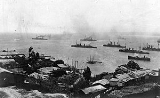
The
World War IWorld War I , also known as the First World War, the Great War, and the War to End All Wars, was a global military conflict which involved most of the world's great powers, assembled in two opposing alliances: the Triple Entente and the Triple Alliance...
naval
Battle of Coronel took place on 1 November 1914 off the coast of central
ChileChile, officially the Republic of Chile , is a country in South America occupying a long, narrow coastal strip between the Andes mountains to the east and the Pacific Ocean to the west. It borders Peru to the north, Bolivia to the northeast, Argentina to the east, and the Drake Passage in the far...
near the city of Coronel. German
Kaiserliche MarineThe Kaiserliche Marine or Imperial Navy was the German Navy created by the formation of the German Empire. It existed between 1871 and 1919, growing out of the Prussian Navy and Norddeutsche Bundesmarine. Kaiser Wilhelm II greatly expanded the Navy, causing a naval arms race between the German...
forces led by Vice-Admiral
Graf Maximilian von SpeeVice Admiral Maximilian Graf von Spee was a German admiral. Although he was born in Copenhagen, Denmark, the counts von Spee belonged to the prominent families of the Rhenish nobility. He joined the Kaiserliche Marine in 1878. In 1887–88 he commanded the Kamerun ports, in German West Africa...
met and defeated a
Royal NavyThe Royal Navy of the United Kingdom is the oldest of HM Armed Forces . From the beginning of the 18th century until well into the 20th century, it was the most powerful navy in the world, playing a key part in establishing the British Empire as the dominant world power from 1815 until the early...
squadron commanded by Rear-Admiral Sir
Christopher CradockRear Admiral Sir Christopher George Francis Maurice Cradock KCVO CB RN was a British admiral.He entered the Royal Navy in 1875, and saw action in the Mediterranean, serving with distinction....
.
The engagement probably took place as a result of a series of misunderstandings. Neither admiral expected to meet the other in full force. Once the two met, Cradock understood his orders were to fight to the end, despite the odds heavily against him. Although Spee had an easy victory, destroying two enemy armoured cruisers for just three men injured, the engagement also cost him half his supply of ammunition, which it was impossible to replace. Shock at the British losses led to an immediate reaction and the sending of more ships which in turn destroyed Spee and the majority of his squadron at the
Battle of the Falkland IslandsThe Battle of the Falkland Islands was a British naval victory over the Imperial German Navy on 8 December 1914 during the First World War in the South Atlantic...
.
Prelude
The
Royal NavyThe Royal Navy of the United Kingdom is the oldest of HM Armed Forces . From the beginning of the 18th century until well into the 20th century, it was the most powerful navy in the world, playing a key part in establishing the British Empire as the dominant world power from 1815 until the early...
, with assistance from other Allied navies, had spent the early months of the war searching for Spee's
German East Asia SquadronThe German East Asia Squadron was a German Kaiserliche Marine cruiser squadron which operated mainly in the Pacific Ocean between the 1870s and 1914...
, fearing its potential for
commerce raidingCommerce raiding use naval forces to destroy the logistics of an enemy on the open sea, rather than engaging the combatants themselves or enforcing a blockade against them....
in the Pacific. Spee had abandoned his base at the German
concessionConcessions in China were a group of concession territories within China that were governed and occupied by foreign powers. They are frequently associated with colonialism. Most had extraterritoriality and were enclaves inside key cities that were treaty ports. Other than other minor...
at
Tsingtao' , best known in the West by its postal map spelling Tsingtao, is a major city in eastern Shandong province, People's Republic of China. It borders Yantai to the northeast, Weifang to the west and Rizhao to the southwest. Lying across the Shandong Peninsula while looking out to the Yellow Sea,...
in
ChinaChina is a cultural region, an ancient civilization, and, depending on perspective, a national or multinational entity extending over a large area in East Asia....
once
Japanis an island country in East Asia. Located in the Pacific Ocean, it lies to the east of the Sea of Japan, People's Republic of China, North Korea, South Korea and Russia, stretching from the Sea of Okhotsk in the north to the East China Sea and Taiwan in the south...
entered the war on Britain's side.
The British learned from an intercepted radio communication in early October of Spee's plan to prey upon shipping in the crucial trading routes along the west coast of South America. Patrolling in the area at that time was Admiral Cradock's West Indies Squadron, consisting of two armoured cruisers,
HMS Good HopeHMS Good Hope was a 14,100-ton Drake-class armoured cruiser of the British Royal Navy; she was originally planned to be named Africa, but was renamed before she was launched...
(Cradock's flagship) and
HMS MonmouthThe sixth HMS Monmouth of the British Royal Navy was the lead ship of a class of armoured cruisers of 9,800 tons displacement. She was sunk at the Battle of Coronel in 1914....
, the modern light cruiser
HMS GlasgowHMS Glasgow, the sixth ship of that name, was launched on the Clyde at Govan in 1909 and was a Town-class light cruiser.On the outbreak of the First World War, she was operating off the coast of South America, and on 16 August 1914 she captured the German merchant ship SS Catherina...
, and a converted liner,
HMS OtrantoHMS Otranto was a First World War Royal Navy armed merchant cruiser. She was originally the SS Otranto and was built in 1909 by the Belfast yard of Workman Clark for the Orient Steam Navigation Company.-History:...
.
Cradock's squadron was by no means modern or particularly strong, and most of the crew were inexperienced. Spee had a formidable force of five vessels, led by the armoured cruisers
SMS ScharnhorstSMS Scharnhorst was an 11,616 ton armored cruiser of the Imperial German Navy, built at the Blohm & Voss Shipyard in Hamburg, Germany. She was named after the Prussian reformer general Gerhard von Scharnhorst and commissioned on 24 October 1907....
and
SMS GneisenauSMS Gneisenau was an armoured cruiser of the German navy. She was named after August von Gneisenau, a Prussian general of the Napoleonic Wars.-Service history:...
plus a further three light cruisers, SMS
Dresden,
SMS LeipzigSMS Leipzig was a Bremen class light cruiser, of the German Imperial Navy. It was named after the German city of Leipzig.The ship was stationed off the west coast of Mexico at the outbreak of war in 1914...
and SMS
Nürnberg, all modern ships with officers handpicked by Grand Admiral
Alfred von TirpitzAlfred von Tirpitz was a German Admiral, Secretary of State of the Imperial Naval Office, the powerful administrative branch of the Kaiserliche Marine from 1897 until 1916....
. Nevertheless Cradock was ordered to deal with Spee.
Opening gambit
On 18 October 1914 Spee, having learned of the presence of the
Glasgow, set off with all five warships from
ValparaísoValparaíso is a city in central Chile and one of that country's most important seaports and an increasingly vital cultural center in the hemisphere's Pacific Southwest. The city is the capital of the Region of Valparaíso...
with the intention of destroying her.
Cradock, aware that his ships were outgunned by Spee's, had been waiting in the hope of reinforcements. The Admiralty dispatched the armoured cruiser
HMS DefenceHMS Defence was a Minotaur-class armoured cruiser of the Royal Navy, launched in 1907. She was the last armoured cruiser built for the Royal Navy...
and the elderly battleship
HMS CanopusHMS Canopus was a Canopus-class predreadnought battleship of the British Royal Navy. She was named after Canopus, the second brightest star in the sky after Sirius.-Technical Description:...
, the latter sent from London. Neither reached Cradock before battle commenced on 1 November 1914.
Deciding that he could wait no longer, Cradock sailed from the
Falkland IslandsThe Falkland Islands are an archipelago in the South Atlantic Ocean, located approximately from the coast of mainland South America, from mainland Antarctica, and from Africa. There are two main islands, East Falkland and West Falkland, as well as 776 smaller islands...
to a predetermined rendezvous point with
Glasgow at Coronel, the latter having been sent there to gather intelligence.
At this point, the First Lord of the Admiralty,
Winston ChurchillSir Winston Leonard Spencer Churchill KG, OM, CH, TD, FRS, PC was a British politician known chiefly for his leadership of the United Kingdom during World War II. He served as Prime Minister from 1940 to 1945 and again from 1951 to 1955. A noted statesman and orator, Churchill was also an officer...
, issued orders to Cradock on 28 October instructing him to halt, pending possible reinforcement from the
Japanese navyThe Imperial Japanese Navy , literally Navy of the Empire of Greater Japan was the navy of the Empire of Japan from 1869 until 1947, when it was dissolved following Japan's constitutional renunciation of the use of force as a means of settling international disputes...
. It is a moot point as to whether Cradock actually received Churchill's instructions; in any event, he shortly afterwards ordered his squadron to adopt an attacking formation.
Battle
On 31 October
Glasgow entered Coronel harbour to collect messages and news from the British consul. Also in harbour was a supply ship,
Gottingen working for Spee, which immediately radioed with the news of the British ship entering harbour.
Glasgow meanwhile was listening to radio traffic which suggested that German warships were close. Matters were confused, because the German ships had been instructed to all use the same call sign, that of
Leipzig. Spee decided to move his ships to Coronel, to trap
Glasgow, while Admiral Cradock hurried north to catch
Leipzig. Neither side realised the other's main force was nearby.
At 09:15 on the morning of 1 November
Glasgow left port to meet Craddock at noon, 40 miles west of Coronel. Seas were stormy so that it was impossible to send a boat between the ships to deliver the messages, which had to be transferred on a line floated in the sea. At 13:50 the ships formed into a
line of battleIn naval warfare, the line of battle is a tactic in which the ships of the fleet form a line, end-to-end. Its origins are traditionally ascribed to the navy of the Commonwealth of England, especially to General at Sea Robert Blake who wrote the Sailing and Fighting Instructions of 1653...
fifteen miles apart and started to steam north at 10 knots searching for
Leipzig. At 4.17 pm
Leipzig, accompanied by the other German ships, spotted smoke from the British line. Spee ordered full speed so that
Scharnhorst,
Gneisenau and
Leipzig were approaching the British at 20 knots, with the slower light cruisers
Dresden and
Nürnberg some way behind.
At 4.20
Glasgow and
Otranto saw smoke to the north, and then three ships at a range of twelve miles. The British reversed direction, so that both fleets were moving south, and a chase began which lasted 90 minutes. Cradock was faced with a choice, either to take his three cruisers capable of twenty knots, abandon
Otranto and run from the Germans, or stay and fight with
Otranto which could only manage sixteen knots. The German ships slowed at a range of 15,000 yards to reorganise themselves for best positions, and to await best visibility, when the British to their west would be outlined against the setting sun.
At this stage, it is probable that the British could have escaped by sailing towards
Canopus, then some 300 miles to the south. With the failing light, Spee would most likely have lost contact with the British squadron.
At 5.10 pm Cradock decided he must fight, and drew his ships closer together. He changed course to south-east and attempted to close upon the German ships while the sun remained high, which from behind his ships would dazzle the German gunners. Spee declined to engage and turned his faster ships away, maintaining the distance between the forces which sailed roughly parallel at a distance of 14,000 yards. At 6.18 Cradock again attempted to close, steering directly towards the enemy, which once again turned away to a greater range of 18,000 yards. At 6.50 pm the sun set, Spee closed to 12,000 yards and commenced firing.
The German ships had sixteen 8.2 inch guns of comparable range to the two 9.2 inch guns on
Good Hope. One of these was hit within five minutes of the engagement starting. Of the remaining 6 in guns on the British ships, most were in casemates along the sides of the ships, which in the heavy seas continuously flooded if the gun doors were opened to fire. The merchant cruiser
Otranto, having only 4-inch guns and being a much larger target than the other ships, retired west at full speed.
With the British 6-inch guns having insufficient range to match the German 8-inch, Cradock still attempted to close on the German ships. By 7.30 he had reached 6000 yards, but as he closed, so the German fire became more accurate. Both
Good Hope and
Monmouth were on fire, presenting convenient targets to the German gunners now that darkness had fallen, whereas the German ships had disappeared into the dark.
Monmouth was first to be silenced.
Good Hope continued firing, continuing to close on the German ships receiving more and more fire. By 7.50 pm she had also ceased firing, subsequently her forward section exploded, then she broke apart and sank; with no one actually witnessing the sinking.
Scharnhorst switched firing towards
Monmouth, while
Gneisenau joined
Leipzig and
Dresden which had been engaging
Glasgow. German light cruisers had only 4.1 inch guns which had left
Glasgow relatively unscathed, but these were now joined by the 8.2 inch guns of
Gneisenau. John Luce, captain of the
Glasgow, determined that nothing was to be gained by staying and attempting to fight. It was noticed that each time he fired, the flash of his guns was used by the Germans to aim a new salvo, so he also ceased firing. One compartment of the ship was flooded, but she could still manage 24 knots. He returned first to
Monmouth, which was now dark but still afloat. Nothing was to be done for the ship, which was sinking slowly but would attempt to beach on the Chilean coast.
Glasgow turned south and departed.
There was some confusion amongst the German ships as to the fate of the two armoured cruisers, which had disappeared into the dark once they ceased firing, and a hunt began.
Leipzig saw something burning, but on approaching found only wreckage.
Nürnberg, slower than the other German ships arrived late at the battle, but sighted
Monmouth, listing and badly damaged but still moving. After pointedly directing his searchlights at the ship's
ensignThe White Ensign or St George's Ensign is an ensign flown on British Royal Navy ships and shore establishments. It consists of a red St George's Cross on a white field with the Union Flag in the upper canton....
, an invitation to surrender which was declined, he opened fire, finally sinking the ship. Without firm information, Spee decided that
Good Hope had escaped and called off the search at 10.15 pm. Mindful of the reports that a British battleship was around somewhere, he turned north.
There were no survivors of either ship (1,654 officers and men).
Glasgow and
Otranto both escaped (the former suffering five hits but no casualties). Just two shells had struck
Scharnhorst, neither of which exploded, whereas she had managed at least 35 hits on
Good Hope. Four shells had struck
Gneisenau, but had done little damage. The greatest difficulty for the German ships was that they had used approximately half their ammunition, with no means of replacing it. There were no German deaths and only three men had been wounded, on
Gneisenau.
Aftermath
Admiral Spee afterwards commented on the British tactics. He had been misinformed that the battleship
Canopus sighted in the area was a modern
Queen-class ship, whereas it was a similar appearing, old and barely seaworthy
Canopus class battleshipThe Canopus-class was a six-ship class of predreadnought battleships of the Royal Navy designed by Sir William White.-Technical Description:...
, but nonetheless had four 12in guns and ten 6 in. Spee believed he would have lost the engagement had all the British ships been together. Despite his victory he was pessimistic of the real harm done to the British navy, and also of his own chances of survival. Cradock had been less convinced of the value of the
Canopus, being too slow at 12 knots to allow his other ships freedom of movement and manned only by inexperienced reservists.
The official explanation of the defeat as presented to the House of Commons by Winston Churchill stated:
feeling he could not bring the enemy immediately to action as long as he kept with Canopus, he decided to attack them with his fast ships alone, in the belief that even if he himself were destroyed... he would inflict damage on them which ...would lead to their certain subsequent destruction.
On 3 November,
Scharnhorst,
Gneisenau and
Nürnberg entered Valparaiso harbour and were welcomed as heroes by the German population. Spee refused to join in the celebrations: presented with a bunch of flowers he commented,
'these will do nicely for my grave'. He was to die with most of the men on his ships approximately one month later at the
Battle of the Falkland IslandsThe Battle of the Falkland Islands was a British naval victory over the Imperial German Navy on 8 December 1914 during the First World War in the South Atlantic...
, on 8 December 1914.
Lines of communication
On 30 October, before the battle but due to communications delays too late to have any effect, Admiral Jackie Fisher was re-appointed
First Sea LordThe First Sea Lord is the professional head of the Royal Navy and the whole Naval Service; it was formerly known as First Naval Lord. He also holds the title of Chief of Naval Staff, and is known by the abbreviations 1SL/CNS...
, replacing Battenberg. Battenberg and Churchill had been considerably preoccupied with fighting to retain Battenberg, a German prince, as first sea lord against widespread concerns that the senior British Admiral was running a war against his country of birth. Battenberg was a proven and reliable admiral, but eventually had to be replaced in the face of public opinion. However, the whole crisis drew the attention of the most senior officers of the admiralty away from events in South America. Churchill later admitted that if he had not been distracted, he would have questioned more deeply the intentions of his admiral at sea.
A signal from Cradock was received by Churchill on 27 October, advising his intention to leave
Canopus behind, because of her slow speed, and as previously instructed to take his remaining ships in search of Spee. He re-stated that he was still expecting reinforcements in the form of
HMS DefenceHMS Defence was a Minotaur-class armoured cruiser of the Royal Navy, launched in 1907. She was the last armoured cruiser built for the Royal Navy...
, which he had previously been told was coming, and that he had given orders for her to follow him as soon as possible. Although
Defence had once been sent to reinforce Cradock, it had then been recalled part way, returned to the Mediterranean and then been sent again to form part of a new squadron patrolling the eastern coast of South America. A misunderstanding had arisen between Cradock and the admiralty over how ships were to be assigned and used. Cradock believed he was expected to advance against Spee with those forces he had, whereas the admiralty expected him to exercise caution, centering upon
Canopus for defence, and merely to scout the enemy or take advantage of any situation where he might come across part of the enemy force. Churchill replied to the signal telling Cradock that
Defence was to remain on the east coast and that Cradock was considered to have sufficient forces for his task, making no comment about his plan to abandon
Canopus. Churchill had passed on the message to the admiralty staff saying he did not properly understand what Cradock intended.
Cradock probably received Churchill's reply on 1 November with the messages collected by
Glasgow at Coronel, giving him time to read it before the battle. Thus Cradock would have taken the message as final confirmation that he was doing what was expected. Departing from
StanleyStanley is the capital and only true cityin the Falkland Islands. It is located on the isle of East Falkland, on a north-facing slope, south of Stanley Harbour, in one of the wettest parts of the islands...
he had left behind a letter to be forwarded to Admiral
Hedworth MeuxThe Honourable Sir Hedworth Meux GCB KCVO , formerly Hedworth Lambton was an English naval officer famous for bringing help to the British forces in the Siege of Ladysmith. He became Admiral of the Fleet during the First World War.-The first forty years:Hedworth Lambton was born in London, son of...
in the event of his death. In this he commented that he did not intend to suffer the fate of Rear Admiral Troubridge, who in August had been court-martialled for failing to engage the enemy despite the odds being severely against him, during the
Pursuit of Goeben and BreslauThe pursuit of Goeben and Breslau was a naval action that occurred in the Mediterranean Sea at the outbreak of the First World War when elements of the British Mediterranean Fleet attempted to intercept the German Mittelmeerdivision comprising the battlecruiser SMS Goeben and the light cruiser SMS...
. In Troubridge's case the German ships had slipped past him and escaped, and it was possible that Spee might do the same, rounding the Horn and heading for Germany if he did not intervene. The governor of the Falklands reported that Cradock had not expected to survive,, as did the governor's aide. Luce reported that
'Cradock was constitutionally incapable of refusing or even postponing action if there was the smallest chance of success'.
On November 3, Fisher in London received news from Valparaiso that Spee had been sighted. He urgently gave orders for
Defence to join Cradock, and stressing the need to keep
Canopus together with the other ships. On November 4, German reports of the battle started to reach London.
British response
This was Britain's first naval defeat since the
Battle of Lake ChamplainThe Battle of Plattsburgh, also known as the Battle of Lake Champlain, ended the final invasion of the northern states during the War of 1812...
in the
War of 1812The War of 1812, between the United States of America and the British Empire , lasted from 1812 to 1815. It was fought chiefly on the Atlantic Ocean and on the land, coasts and waterways of North America.There were several immediate stated causes for the U.S...
and the first of a British naval squadron since the
Battle of Grand PortThe Battle of Grand Port was a naval battle between squadrons of frigates from the French Navy and the British Royal Navy. The battle was fought during 20–27 August 1810 over possession of the harbour of Grand Port on Île de France during the Napoleonic Wars...
in 1810. Six weeks earlier a German submarine had
sunk three British cruisersThe Action of 22 September 1914 was a naval engagement that took place during the First World War, in which three Royal Navy cruisers were sunk by one German submarine while on patrol. Approximately 1450 sailors were killed, and there was a public outcry at the losses...
patrolling the
English ChannelThe English Channel is an arm of the Atlantic Ocean that separates England from northern France, and joins the North Sea to the Atlantic. It is about long and varies in width from at its widest, to only in the Strait of Dover...
.
Once news of the scale of the British defeat, and its consequent humiliation, reached the British Admiralty in London, a new naval force was assembled under
Admiral Sir Frederick SturdeeAdmiral of the Fleet Sir Frederick Charles Doveton Sturdee, 1st Baronet, GCB, KCMG, CVO was a British admiral.Coming from a family of British mariners, and educated at the Royal Naval School at New Cross, Sturdee entered the Royal Navy in July 1871 as a cadet on the training ship Britannia, at the...
. This found and destroyed Spee's force at the
Battle of the Falkland IslandsThe Battle of the Falkland Islands was a British naval victory over the Imperial German Navy on 8 December 1914 during the First World War in the South Atlantic...
.
Glasgow escaping the battle steamed south for three days at 20 knots passing through the Straits of Magellan.
Canopus, warned by
Glasgow's messages, turned about and headed back at the best speed she could manage, 9 knots. On 6 November the two ships met and proceeded slowly towards the Falkland isles. Twice during the voyage
Canopus had to report that the ship was not under control. After coaling, both ships were ordered north, but again
Canopus broke down. She was finally ordered to be beached in the inner part of
Stanley HarbourStanley Harbour is a large inlet on the east coast of East Falkland island. A strait called "the Narrows" leads into Port William.It serves the town of the same name - Stanley - as a harbour. Stanley has sprawled along the south shore of the harbour, to gain shelter from the low hill of Stanley...
, where she could serve as a defensive battery.
Otranto steamed 200 miles out into the Pacific ocean, before turning south and passing around Cape Horn. On 4 November the admiralty issued orders for the surviving ships to move to the Abrolhos Rocks, where a new force was being assembled. Rear Admiral Archibald Stoddart, with armoured cruisers
CarnarvonHMS Carnarvon was a Devonshire-class armoured cruiser of the Royal Navy. She has been the only ship of the navy to be named after the town of Caernarfon in Wales. Launched in 1903, she served with the Mediterranean Fleet in the 3rd Cruiser Squadron until March 1907, and then joined the 2nd Cruiser...
and
CornwallHMS Cornwall was a 9,800 ton Monmouth-class armoured cruiser of the Royal Navy. She was launched at Pembroke, Wales in 1902, and commissioned in 1904....
was to meet them there and await the arrival of
Defence.
SturdeeAdmiral of the Fleet Sir Frederick Charles Doveton Sturdee, 1st Baronet, GCB, KCMG, CVO was a British admiral.Coming from a family of British mariners, and educated at the Royal Naval School at New Cross, Sturdee entered the Royal Navy in July 1871 as a cadet on the training ship Britannia, at the...
was ordered to travel with the battlecruisers
HMS InvincibleHMS Invincible was a battlecruiser of the Royal Navy, the lead ship of her class of three, and the first battlecruiser to be built by any country in the world.- Background :In 1904 the Royal Navy was at a crossroads...
and
HMS InflexibleHMS Inflexible was the second of three Invincible-class battlecruisers built for the British Royal Navy in 1906 to 1908. As such, she was one of the first ships to be designated as a battlecruiser....
then attached to the Grand Fleet in the
North SeaThe North Sea is a marginal, epeiric sea on the European continental shelf. The Dover Strait and the English Channel in the south and the Norwegian Sea in the north connect it to the Atlantic Ocean. It is more than long and wide, with an area of around...
to command a new squadron with clear superiority over Spee.
External links