


HMAS AE1

Encyclopedia
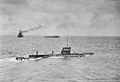
HMAS AE1 (originally known as just AE1) was an E-class
British E class submarine
The British E class submarines started out as improved versions of the British D class submarine. All of the first group and some of the second group were completed before the outbreak of World War I....
submarine of the Royal Australian Navy
Royal Australian Navy
The Royal Australian Navy is the naval branch of the Australian Defence Force. Following the Federation of Australia in 1901, the ships and resources of the separate colonial navies were integrated into a national force: the Commonwealth Naval Forces...
(RAN). She was the first submarine to serve in the RAN, and was lost at sea with all hands near East New Britain
East New Britain
East New Britain is a province of Papua New Guinea, on the north-eastern part of the island of New Britain and it also includes the Duke of York Islands. The capital of the province is Kokopo, not far from the old capital of Rabaul, which was largely destroyed in the 1994 volcanic eruption...
, Papua New Guinea
Papua New Guinea
Papua New Guinea , officially the Independent State of Papua New Guinea, is a country in Oceania, occupying the eastern half of the island of New Guinea and numerous offshore islands...
, on 14 September 1914, after less than seven months in service. The wreck of the submarine has never been found, despite several searches.
Construction
AE1 was laid down by Vickers ArmstrongVickers Armstrong
Vickers-Armstrongs Limited was a British engineering conglomerate formed by the merger of the assets of Vickers Limited and Sir W G Armstrong Whitworth & Company in 1927...
at Barrow-in-Furness
Barrow-in-Furness
Barrow-in-Furness is an industrial town and seaport which forms about half the territory of the wider Borough of Barrow-in-Furness in the county of Cumbria, England. It lies north of Liverpool, northwest of Manchester and southwest from the county town of Carlisle...
, England on 14 November 1911, launched on 22 May 1913 and commissioned into the RAN on 28 February 1914. After commissioning, AE1, accompanied by her sister ship AE2
HMAS AE2
HMAS AE2 was an E class submarine of the Royal Australian Navy . She was commissioned into the RAN at Portsmouth on 28 February 1914 and was scuttled little more than a year later in the Sea of Marmara after being hit by enemy shellfire during the Battle of Gallipoli.-Construction and...
, the other of the Royal Australian Navy's first two submarines, reached Sydney from England on 24 May 1914. Both submarines were manned by Royal Navy
Royal Navy
The Royal Navy is the naval warfare service branch of the British Armed Forces. Founded in the 16th century, it is the oldest service branch and is known as the Senior Service...
(RN) officers with a mixed crew of sailors drawn from the RN and RAN.
Deployment and loss
At the outbreak of World War I, AE1, commanded by Lieutenant Commander Thomas Besant, RN, was sent to capture German New GuineaGerman New Guinea
German New Guinea was the first part of the German colonial empire. It was a protectorate from 1884 until 1914 when it fell to Australia following the outbreak of the First World War. It consisted of the northeastern part of New Guinea and several nearby island groups...
as part of the Australian Naval and Military Expeditionary Force
Australian Naval and Military Expeditionary Force
The Australian Naval and Military Expeditionary Force was a small volunteer force of approximately 2,000 men, raised in Australia shortly after the outbreak of the First World War to seize and destroy German wireless stations in German New Guinea in the south-west Pacific...
. With her sister ship AE2, she took part in the operations leading to the occupation of the German territory, including the surrender of Rabaul
Rabaul
Rabaul is a township in East New Britain province, Papua New Guinea. The town was the provincial capital and most important settlement in the province until it was destroyed in 1994 by falling ash of a volcanic eruption. During the eruption, ash was sent thousands of metres into the air and the...
on 13 September 1914. The submarine's involvement was recognised following an overhaul of the RAN battle honour
Battle honour
A battle honour is an award of a right by a government or sovereign to a military unit to emblazon the name of a battle or operation on its flags , uniforms or other accessories where ornamentation is possible....
s system in 2010: AE1 retroactively received the honour "Rabaul 1914".
Blanche Bay
Blanche Bay is a bay near Rabaul, New Britain, Papua New Guinea. The bay is named after which was surveying the bay under the command of Captain Cortland Simpson in 1872.-References:...
, Rabaul, to patrol off Cape Gazelle with . When she had not returned by 20:00, several ships were dispatched to search for her. No trace of the submarine was ever found, and she was listed as lost with all hands. It is probable that she was wrecked on a reef or other submerged object. As well as LCDR Besant, 2 other officers and 32 sailors were lost in this disaster. The disappearance was Australia's first major loss of World War I.
Searches
The Maritime Museum of Western AustraliaWestern Australian Museum
The Western Australian Museum is the state museum for Western Australia.The Western Australian Museum has seven main sites: two in Perth within the Perth Cultural Centre, two in Fremantle , and one each in Albany, Geraldton, and Kalgoorlie-Boulder...
, sponsored by the Australian Broadcasting Corporation
Australian Broadcasting Corporation
The Australian Broadcasting Corporation, commonly referred to as "the ABC" , is Australia's national public broadcaster...
, launched an unsuccessful attempt to locate the submarine in November 2003. The search area was concentrated to the south-east of the Duke of York Islands
Duke of York Islands
The Duke of York Islands, , are a group of islands located in East New Britain Province, Papua New Guinea. They are found in St George's Channel between New Britain and New Ireland islands and form part of Bismarck Archipelago...
.
In February 2007, a new effort to locate the submarine was mounted by the RAN, when the survey ships and attempted to locate the submarine off East New Britain
East New Britain
East New Britain is a province of Papua New Guinea, on the north-eastern part of the island of New Britain and it also includes the Duke of York Islands. The capital of the province is Kokopo, not far from the old capital of Rabaul, which was largely destroyed in the 1994 volcanic eruption...
, based on data compiled over the previous 30 years. Benalla located an object of the appropriate dimensions using sonar on 1 March. Later identification conducted by confirmed though that this object is a rock with the same approximate dimensions.