

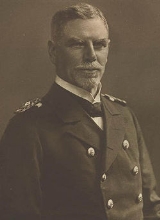
Maximilian von Spee

Encyclopedia
Vice Admiral
Maximilian Reichsgraf von Spee (22 June 1861 – 8 December 1914) was a German
admiral
. Although he was born in Copenhagen
, Denmark
, the counts von Spee belonged to the prominent families of the Rhenish nobility. He joined the Kaiserliche Marine
(Imperial German Navy) in 1878. In 1887–88 he commanded the Kamerun
ports, in German West Africa
. Before World War I
he held a number of senior positions relating to weapons development, before being appointed Chief of Staff of the North Sea Command in 1908, rising to Rear Admiral on 27 January 1910.
He was given command of the German East Asia Squadron
in 1912 with the rank of Vice-Admiral, based at Tsingtao
within the German concession
in China
. The armored cruiser
s of his squadron were among the newest in the fleet. However, his ships would soon be made obsolete by the creation of the battlecruiser
.
his command concentrated on destroying Allied commercial and troop shipping, with considerable success. However, Spee was wary of the Allies' strength, especially the Imperial Japanese Navy
and the Royal Australian Navy
—in fact he described the latter's flagship, the battlecruiser
HMAS Australia
, as being superior to his entire force by itself. Consequently to avoid being trapped at Tsingtao, von Spee planned a return of his squadron to Germany, sailing through the Pacific, rounding Cape Horn, and then forcing his way north through the Atlantic.
Admiral von Spee’s admiralty superiors left him complete freedom of action; "with remarkable wisdom and forbearance they realized in Berlin that any orders would tie his hands in a predicament only he fully understood." However, they also wrote him out of their long-term calculations and hoped he would strike a major blow before he and his ships met their fate. Winston Churchill, First Lord of the Admiralty at London, wrote: "He was a cut flower in a vase, fair to see yet bound to die."
At the beginning of hostilities the East Asia squadron was dispersed on routine inspection missions at Pacific colonies, with the armored cruisers SMS Scharnhorst
and SMS Gneisenau
at Ponape
in the Caroline Islands. The fleet rendezvoused at Pagan Island in the northern Marianas for staff meetings and coaling. Since he was cut off from essential information, Admiral von Spee sent the light cruiser SMS Nürnberg
to Honolulu in the United States Territory of Hawaii to obtain the latest newspapers and wire dispatches from the German consul. Nürnberg rejoined the fleet at Christmas Island. Having thus learned of the occupation of German Samoa
by the New Zealand Expeditionary Force, who at the request of Great Britain had performed their “great and urgent imperial service,” von Spee rushed toward Samoa with Scharnhorst and Gneisenau intent on doing damage to British and Dominion ships at anchor. He arrived off Apia on 14 September 1914, three days after the departure of the Allied cruisers and transports. The admiral was informed that approximately 1,600 New Zealand volunteers were on Upolu, poorly trained and miserable in their woolen winter-weight uniforms, and that he could easily recapture the colony. He determined that a landing would only be of temporary advantage in an Allied dominated sea and headed for Papeete, Tahiti to fire at French shipping
, then rejoined the other ships of his fleet and moved toward South America
.
At the Battle of Coronel
off the coast of Chile
on 1 November 1914, Spee's force engaged and sank two British armored cruisers commanded by Sir Christopher Cradock
; HMS Good Hope
and HMS Monmouth
. Both of the British ships were outclassed in both gunnery and seamanship.
After Coronel at a reception with the German community at Valparaiso, Admiral von Spee was presented a bouquet of flowers—in his thank-you response he stated that it would do nicely for his grave. He understood only too well that the ultimate loss of his command to an overwhelming adversary was inevitable.
On 8 December 1914, Spee's force attempted a raid on the coaling station at Stanley
in the Falkland Islands
, unaware that the previous month the British had sent two modern fast battlecruiser
s HMS Inflexible
and HMS Invincible
to protect the islands and avenge the defeat at Coronel, and there were also five cruisers, HMS Carnarvon, HMS Cornwall
, HMS Kent
, HMS Bristol
and HMS Glasgow
, at the Stanley naval base. In the ensuing Battle of the Falkland Islands
, Spee's flagship, Scharnhorst, together with Gneisenau, Nürnberg and SMS Leipzig
were all lost, together with some 2,200 German sailors, including Spee himself and his two sons. The admiral went down with his flagship. Only SMS Dresden and the auxiliary Seydlitz managed to escape, but Seydlitz was interned and Dresden was eventually discovered in the Juan Fernández Islands and scuttled by her crew during the Battle of Mas a Tierra
.
After the First World War, the German naval officer and spy, Franz von Rintelen
, interviewed Admiral William Reginald Hall
, Director of British Naval Intelligence, and was informed that the Spee Squadron had been lured onto the guns of the British battlecruiser squadron by means of a fake telegram sent in a German naval code that British cryptographers had broken and which "ordered" the German ships to the Falkland Islands to destroy the wireless station there.
battlecruiser
was named Graf Spee in his honour, but construction of the ship had not been completed by the time of the Armistice
in November 1918, and it was subsequently broken up.
In 1934 Germany named the new "pocket battleship" Admiral Graf Spee after him. Coincidentally, in 1939 the Admiral Graf Spee was scuttled by her crew after the Battle of the River Plate
, off the coast of Uruguay
, only a few hundred miles from where Admiral von Spee and his squadron had met their end in the same month a quarter of a century earlier.
Between 1959 and 1967 the Federal German Bundesmarine operated a training frigate named after him.
Children (two sons, one daughter):
Otto von Spee (10 July 1890 at Kiel
– 8 December 1914, South Atlantic, off Falkland Islands, aboard SMS Nürnberg)
Heinrich von Spee (24 April 1893 at Kiel – 8 December 1914, South Atlantic, off Falkland Islands, aboard SMS Gneisenau)
Huberta von Spee (11 July 1894 at Kiel – 18 September 1954, Bonn
)
Vice Admiral
Vice admiral is a senior naval rank of a three-star flag officer, which is equivalent to lieutenant general in the other uniformed services. A vice admiral is typically senior to a rear admiral and junior to an admiral...
Maximilian Reichsgraf von Spee (22 June 1861 – 8 December 1914) was a German
Germany
Germany , officially the Federal Republic of Germany , is a federal parliamentary republic in Europe. The country consists of 16 states while the capital and largest city is Berlin. Germany covers an area of 357,021 km2 and has a largely temperate seasonal climate...
admiral
Admiral
Admiral is the rank, or part of the name of the ranks, of the highest naval officers. It is usually considered a full admiral and above vice admiral and below admiral of the fleet . It is usually abbreviated to "Adm" or "ADM"...
. Although he was born in Copenhagen
Copenhagen
Copenhagen is the capital and largest city of Denmark, with an urban population of 1,199,224 and a metropolitan population of 1,930,260 . With the completion of the transnational Øresund Bridge in 2000, Copenhagen has become the centre of the increasingly integrating Øresund Region...
, Denmark
Denmark
Denmark is a Scandinavian country in Northern Europe. The countries of Denmark and Greenland, as well as the Faroe Islands, constitute the Kingdom of Denmark . It is the southernmost of the Nordic countries, southwest of Sweden and south of Norway, and bordered to the south by Germany. Denmark...
, the counts von Spee belonged to the prominent families of the Rhenish nobility. He joined the Kaiserliche Marine
Kaiserliche Marine
The Imperial German Navy was the German Navy created at the time of the formation of the German Empire. It existed between 1871 and 1919, growing out of the small Prussian Navy and Norddeutsche Bundesmarine, which primarily had the mission of coastal defense. Kaiser Wilhelm II greatly expanded...
(Imperial German Navy) in 1878. In 1887–88 he commanded the Kamerun
Kamerun
German Cameroon was a West African colony of the German Empire from 1884 to 1916 in the region of today's Republic of Cameroon.-History:-1800s:...
ports, in German West Africa
German West African Company
The German West African Company, in German Deutsch-Westafrikanische Gesellschaft / Compagnie, was a German chartered company, founded in 1885...
. Before World War I
World War I
World War I , which was predominantly called the World War or the Great War from its occurrence until 1939, and the First World War or World War I thereafter, was a major war centred in Europe that began on 28 July 1914 and lasted until 11 November 1918...
he held a number of senior positions relating to weapons development, before being appointed Chief of Staff of the North Sea Command in 1908, rising to Rear Admiral on 27 January 1910.
He was given command of the German East Asia Squadron
German East Asia Squadron
The German East Asia Squadron was a German Navy cruiser squadron which operated mainly in the Pacific Ocean between the 1870s and 1914...
in 1912 with the rank of Vice-Admiral, based at Tsingtao
Qingdao
' also known in the West by its postal map spelling Tsingtao, is a major city with a population of over 8.715 million in eastern Shandong province, Eastern China. Its built up area, made of 7 urban districts plus Jimo city, is home to about 4,346,000 inhabitants in 2010.It borders Yantai to the...
within the German concession
Jiaozhou Bay concession
The Kiautschou Bay concession was a German colonial concession in Imperial China which existed from 1898 to 1914. It had an area of 552 km², it was located around Jiaozhou Bay on the southern coast of the Shandong Peninsula, which lay in the imperial province of Shandong in northern China.Jiaozhou...
in China
China
Chinese civilization may refer to:* China for more general discussion of the country.* Chinese culture* Greater China, the transnational community of ethnic Chinese.* History of China* Sinosphere, the area historically affected by Chinese culture...
. The armored cruiser
Armored cruiser
The armored cruiser was a type of warship of the late 19th and early 20th centuries. Like other types of cruiser, the armored cruiser was a long-range, independent warship, capable of defeating any ship apart from a battleship, and fast enough to outrun any battleships it encountered.The first...
s of his squadron were among the newest in the fleet. However, his ships would soon be made obsolete by the creation of the battlecruiser
Battlecruiser
Battlecruisers were large capital ships built in the first half of the 20th century. They were developed in the first decade of the century as the successor to the armoured cruiser, but their evolution was more closely linked to that of the dreadnought battleship...
.
First World War
From the outbreak of the First World WarWorld War I
World War I , which was predominantly called the World War or the Great War from its occurrence until 1939, and the First World War or World War I thereafter, was a major war centred in Europe that began on 28 July 1914 and lasted until 11 November 1918...
his command concentrated on destroying Allied commercial and troop shipping, with considerable success. However, Spee was wary of the Allies' strength, especially the Imperial Japanese Navy
Imperial Japanese Navy
The Imperial Japanese Navy was the navy of the Empire of Japan from 1869 until 1947, when it was dissolved following Japan's constitutional renunciation of the use of force as a means of settling international disputes...
and the Royal Australian Navy
Royal Australian Navy
The Royal Australian Navy is the naval branch of the Australian Defence Force. Following the Federation of Australia in 1901, the ships and resources of the separate colonial navies were integrated into a national force: the Commonwealth Naval Forces...
—in fact he described the latter's flagship, the battlecruiser
Battlecruiser
Battlecruisers were large capital ships built in the first half of the 20th century. They were developed in the first decade of the century as the successor to the armoured cruiser, but their evolution was more closely linked to that of the dreadnought battleship...
HMAS Australia
HMAS Australia (1911)
HMAS Australia was one of three s built for the defence of the British Empire. Ordered by the Australian government in 1909, she was launched in 1911, and commissioned as flagship of the fledgling Royal Australian Navy in 1913...
, as being superior to his entire force by itself. Consequently to avoid being trapped at Tsingtao, von Spee planned a return of his squadron to Germany, sailing through the Pacific, rounding Cape Horn, and then forcing his way north through the Atlantic.
Admiral von Spee’s admiralty superiors left him complete freedom of action; "with remarkable wisdom and forbearance they realized in Berlin that any orders would tie his hands in a predicament only he fully understood." However, they also wrote him out of their long-term calculations and hoped he would strike a major blow before he and his ships met their fate. Winston Churchill, First Lord of the Admiralty at London, wrote: "He was a cut flower in a vase, fair to see yet bound to die."
At the beginning of hostilities the East Asia squadron was dispersed on routine inspection missions at Pacific colonies, with the armored cruisers SMS Scharnhorst
SMS Scharnhorst
SMS Scharnhorst was an armored cruiser of the Imperial German Navy, built at the Blohm & Voss shipyard in Hamburg, Germany. She was the lead ship of her class, which also included her sister . Scharnhorst and her sister were enlarged versions of the preceding ; they were equipped with a greater...
and SMS Gneisenau
SMS Gneisenau
SMS Gneisenau was an armored cruiser of the German navy, part of the two-ship . She was named after August von Gneisenau, a Prussian general of the Napoleonic Wars. The ship was laid down in 1904 at the AG Weser dockyard in Bremen, launched in June 1906, and completed in March 1908, at a cost of...
at Ponape
Ponape
Ponape may refer to:*Pohnpei, an island in the Federated States of Micronesia*Ponape , a German sailing ship...
in the Caroline Islands. The fleet rendezvoused at Pagan Island in the northern Marianas for staff meetings and coaling. Since he was cut off from essential information, Admiral von Spee sent the light cruiser SMS Nürnberg
SMS Nürnberg (1906)
SMS Nürnberg, named after the Bavarian city of Nuremberg, was a Königsberg class light cruiser of 3,450 tons laid down in 1905 and launched in 1907. Nürnberg's was similar in both size and appearance to the famous , differing mainly in its uneven funnel spacing. She was armed with ten guns, eight...
to Honolulu in the United States Territory of Hawaii to obtain the latest newspapers and wire dispatches from the German consul. Nürnberg rejoined the fleet at Christmas Island. Having thus learned of the occupation of German Samoa
Occupation of German Samoa
The Occupation of Samoa was the takeover and subsequent administration of the Pacific colony of German Samoa in August 1914 by an expeditionary force from New Zealand called the Samoa Expeditionary Force and New Zealand's first action in World War I...
by the New Zealand Expeditionary Force, who at the request of Great Britain had performed their “great and urgent imperial service,” von Spee rushed toward Samoa with Scharnhorst and Gneisenau intent on doing damage to British and Dominion ships at anchor. He arrived off Apia on 14 September 1914, three days after the departure of the Allied cruisers and transports. The admiral was informed that approximately 1,600 New Zealand volunteers were on Upolu, poorly trained and miserable in their woolen winter-weight uniforms, and that he could easily recapture the colony. He determined that a landing would only be of temporary advantage in an Allied dominated sea and headed for Papeete, Tahiti to fire at French shipping
Bombardment of Papeete
The Bombardment of Papeete occurred in French Polynesia when German warships attacked on 22 September 1914, during World War I. The German armoured cruisers and entered the port of Papeete on the island of Tahiti and sank the French gunboat and freighter Walkure before bombarding the town's...
, then rejoined the other ships of his fleet and moved toward South America
South America
South America is a continent situated in the Western Hemisphere, mostly in the Southern Hemisphere, with a relatively small portion in the Northern Hemisphere. The continent is also considered a subcontinent of the Americas. It is bordered on the west by the Pacific Ocean and on the north and east...
.
At the Battle of Coronel
Battle of Coronel
The First World War naval Battle of Coronel took place on 1 November 1914 off the coast of central Chile near the city of Coronel. German Kaiserliche Marine forces led by Vice-Admiral Graf Maximilian von Spee met and defeated a Royal Navy squadron commanded by Rear-Admiral Sir Christopher...
off the coast of Chile
Chile
Chile ,officially the Republic of Chile , is a country in South America occupying a long, narrow coastal strip between the Andes mountains to the east and the Pacific Ocean to the west. It borders Peru to the north, Bolivia to the northeast, Argentina to the east, and the Drake Passage in the far...
on 1 November 1914, Spee's force engaged and sank two British armored cruisers commanded by Sir Christopher Cradock
Christopher Cradock
Rear-Admiral Sir Christopher "Kit" George Francis Maurice Cradock KCVO CB was a British officer of the Royal Navy. He was born at Hartforth, Richmond, North Yorkshire...
; HMS Good Hope
HMS Good Hope (1901)
HMS Good Hope was a 14,100-ton Drake-class armoured cruiser of the British Royal Navy; she was originally planned to be named Africa, but was renamed before she was launched...
and HMS Monmouth
HMS Monmouth (1901)
The sixth HMS Monmouth of the British Royal Navy was the lead ship of a class of armoured cruisers of 9,800 tons displacement. She was sunk at the Battle of Coronel in 1914....
. Both of the British ships were outclassed in both gunnery and seamanship.
After Coronel at a reception with the German community at Valparaiso, Admiral von Spee was presented a bouquet of flowers—in his thank-you response he stated that it would do nicely for his grave. He understood only too well that the ultimate loss of his command to an overwhelming adversary was inevitable.
On 8 December 1914, Spee's force attempted a raid on the coaling station at Stanley
Stanley, Falkland Islands
Stanley is the capital and only true cityin the Falkland Islands. It is located on the isle of East Falkland, on a north-facing slope in one of the wettest parts of the islands. At the 2006 census, the city had a population of 2,115...
in the Falkland Islands
Falkland Islands
The Falkland Islands are an archipelago in the South Atlantic Ocean, located about from the coast of mainland South America. The archipelago consists of East Falkland, West Falkland and 776 lesser islands. The capital, Stanley, is on East Falkland...
, unaware that the previous month the British had sent two modern fast battlecruiser
Battlecruiser
Battlecruisers were large capital ships built in the first half of the 20th century. They were developed in the first decade of the century as the successor to the armoured cruiser, but their evolution was more closely linked to that of the dreadnought battleship...
s HMS Inflexible
HMS Inflexible (1907)
HMS Inflexible was an of the British Royal Navy. She was built before World War I and had an active career during the war. She tried to hunt down the German battlecruiser and the light cruiser in the Mediterranean Sea when war broke out and she and her sister ship sank the German armoured...
and HMS Invincible
HMS Invincible (1907)
HMS Invincible was a battlecruiser of the British Royal Navy, the lead ship of her class of three, and the first battlecruiser to be built by any country in the world. She participated in the Battle of Heligoland Bight in a minor role as she was the oldest and slowest of the British battlecruisers...
to protect the islands and avenge the defeat at Coronel, and there were also five cruisers, HMS Carnarvon, HMS Cornwall
HMS Cornwall (1902)
HMS Cornwall was a 9,800 ton Monmouth-class armoured cruiser of the Royal Navy. She was launched at Pembroke, Wales in 1902, and commissioned in 1904....
, HMS Kent
HMS Kent (1901)
HMS Kent was a Monmouth-class armoured cruiser of 9,800 tons displacement, of the British Royal Navy. She was launched on 6 March 1901, with her heaviest guns being 6 inch quick-firers...
, HMS Bristol
HMS Bristol (1910)
The fifth HMS Bristol was a Town-class light cruiser of the Royal Navy launched on 23 February 1910 at John Brown & Company's Clydebank shipyard....
and HMS Glasgow
HMS Glasgow (1909)
HMS Glasgow, the sixth ship of that name, was launched on the Clyde at Govan in 1909 and was a Town-class light cruiser.On the outbreak of the First World War, she was operating off the coast of South America under Captain John Luce, and on 16 August 1914 she captured the German merchant ship SS...
, at the Stanley naval base. In the ensuing Battle of the Falkland Islands
Battle of the Falkland Islands
The Battle of the Falkland Islands was a British naval victory over the Imperial German Navy on 8 December 1914 during the First World War in the South Atlantic...
, Spee's flagship, Scharnhorst, together with Gneisenau, Nürnberg and SMS Leipzig
SMS Leipzig
SMS Leipzig was a Bremen class light cruiser, of the German Imperial Navy. It was named after the German city of Leipzig.The ship was stationed off the west coast of Mexico at the outbreak of war in 1914...
were all lost, together with some 2,200 German sailors, including Spee himself and his two sons. The admiral went down with his flagship. Only SMS Dresden and the auxiliary Seydlitz managed to escape, but Seydlitz was interned and Dresden was eventually discovered in the Juan Fernández Islands and scuttled by her crew during the Battle of Mas a Tierra
Battle of Más a Tierra
The Battle of Más a Tierra was a First World War battle fought on 14 March 1915, near the Chilean island of Más a Tierra, between a British squadron and a German light cruiser...
.
After the First World War, the German naval officer and spy, Franz von Rintelen
Franz von Rintelen
Captain Franz Dagobert Johannes von Rintelen was a German Naval Intelligence officer in the United States during World War I....
, interviewed Admiral William Reginald Hall
William Reginald Hall
Admiral Sir William Reginald Hall, KCMG, CB, RN was the British Director of Naval Intelligence from 1914 to 1919...
, Director of British Naval Intelligence, and was informed that the Spee Squadron had been lured onto the guns of the British battlecruiser squadron by means of a fake telegram sent in a German naval code that British cryptographers had broken and which "ordered" the German ships to the Falkland Islands to destroy the wireless station there.
Ships
In 1917 a Mackensen-classMackensen class battlecruiser
The Mackensen class was the last class of battlecruisers to be built by Germany in World War I. The class was to have comprised four ships: Mackensen, the name ship, Graf Spee, Prinz Eitel Friedrich, and Fürst Bismarck. None of the vessels were completed, as shipbuilding priorities were redirected...
battlecruiser
Battlecruiser
Battlecruisers were large capital ships built in the first half of the 20th century. They were developed in the first decade of the century as the successor to the armoured cruiser, but their evolution was more closely linked to that of the dreadnought battleship...
was named Graf Spee in his honour, but construction of the ship had not been completed by the time of the Armistice
Armistice with Germany (Compiègne)
The armistice between the Allies and Germany was an agreement that ended the fighting in the First World War. It was signed in a railway carriage in Compiègne Forest on 11 November 1918 and marked a victory for the Allies and a complete defeat for Germany, although not technically a surrender...
in November 1918, and it was subsequently broken up.
In 1934 Germany named the new "pocket battleship" Admiral Graf Spee after him. Coincidentally, in 1939 the Admiral Graf Spee was scuttled by her crew after the Battle of the River Plate
Battle of the River Plate
The Battle of the River Plate was the first naval battle in the Second World War. The German pocket battleship had been commerce raiding since the start of the war in September 1939...
, off the coast of Uruguay
Uruguay
Uruguay ,officially the Oriental Republic of Uruguay,sometimes the Eastern Republic of Uruguay; ) is a country in the southeastern part of South America. It is home to some 3.5 million people, of whom 1.8 million live in the capital Montevideo and its metropolitan area...
, only a few hundred miles from where Admiral von Spee and his squadron had met their end in the same month a quarter of a century earlier.
Between 1959 and 1967 the Federal German Bundesmarine operated a training frigate named after him.
Personal
Spouse: Margareta Baroness von der Osten-Sacken (1867–1929)Children (two sons, one daughter):
Otto von Spee (10 July 1890 at Kiel
Kiel
Kiel is the capital and most populous city in the northern German state of Schleswig-Holstein, with a population of 238,049 .Kiel is approximately north of Hamburg. Due to its geographic location in the north of Germany, the southeast of the Jutland peninsula, and the southwestern shore of the...
– 8 December 1914, South Atlantic, off Falkland Islands, aboard SMS Nürnberg)
Heinrich von Spee (24 April 1893 at Kiel – 8 December 1914, South Atlantic, off Falkland Islands, aboard SMS Gneisenau)
Huberta von Spee (11 July 1894 at Kiel – 18 September 1954, Bonn
Bonn
Bonn is the 19th largest city in Germany. Located in the Cologne/Bonn Region, about 25 kilometres south of Cologne on the river Rhine in the State of North Rhine-Westphalia, it was the capital of West Germany from 1949 to 1990 and the official seat of government of united Germany from 1990 to 1999....
)