
See Also

New Britain

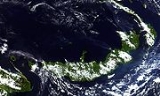
New Britain, formerly Neu Pommern , is the largest island Island

An island or isle is any piece of land that is completely surrounded by water.... 

 in the Bismarck Archipelago Bismarck Archipelago

The Bismarck Archipelago is a group of islands off the coast of New Guinea [i] in the southwestern Pacific Ocean [i] ... 

 of Papua New Guinea Papua New Guinea

Papua New Guinea or PNG, officially the Independent State of Papua New Guinea, is a country ... 

, separated from New Guinea New Guinea

New Guinea, located just north of Australia [i], is the world's second largest [i] ... 

 by Dampier Strait, and has Rabaul Rabaul

Rabaul was the capital of East New Britain [i] province, on New Britain [i] Island, Papua New Guinea [i] ... 

/Kokopo and Kimbe as its two main towns.

Discussions

  Discussion Features

   Ask a question about 'New Britain'

   Start a new discussion about 'New Britain'

   Answer questions about 'New Britain'

   'New Britain' discussion forum

Timeline

1700   The island of New Britain is discovered.


Encyclopedia


New Britain, formerly Neu Pommern , is the largest island Island

An island or isle is any piece of land that is completely surrounded by water.... 

 in the Bismarck Archipelago Bismarck Archipelago

The Bismarck Archipelago is a group of islands off the coast of New Guinea [i] in the southwestern Pacific Ocean [i] ... 

 of Papua New Guinea Papua New Guinea

Papua New Guinea or PNG, officially the Independent State of Papua New Guinea, is a country ... 

, separated from New Guinea New Guinea

New Guinea, located just north of Australia [i], is the world's second largest [i] ... 

 by Dampier Strait, and has Rabaul Rabaul

Rabaul was the capital of East New Britain [i] province, on New Britain [i] Island, Papua New Guinea [i] ... 

/Kokopo and Kimbe as its two main towns.

Description

New Britain extends from 148º to 152º E. longitude and from 4º to 7º S. latitude. It is crescent-shaped, about 600 km  long, around 80 km wide , and has an area of 35,145 km² .

The coasts are in some parts precipitous; in others the mountains recede inland, and the coast is flat and bordered by coral reefs. The formation appears otherwise to be volcanic, and there are some active craters. The greatest elevation occurs towards the westabout 6500 ft. There is a rich tropical vegetation, and a number of considerable streams water the island.

Two geographical regions are distinguishable. Of the broad, irregular north-eastern section, known as the Gazelle Peninsula Gazelle Peninsula

Gazelle Peninsula is a large peninsula in northeastern New Britain [i], Papua New Guinea [i], at . ... 

, a great portion is occupied by wooded mountain chains; otherwise the soil is very fertile and admirably watered by rivers , which yield an abundance of fish. The western and larger section also has extensive mountain chains, which contain numerous active volcanoes.

New Britain comprises two administrative provinces:
  1. East New Britain East New Britain

    East New Britain is a province of Papua New Guinea [i], on the island of New Britain [i]. ... 

     with headquarters in Kokopo
  2. West New Britain West New Britain

    West New Britain is a province of Papua New Guinea [i] on the islands of New Britain [i]. ... 

     with headquarters in Kimbe

History

William Dampier William Dampier

William Dampier was an English [i] buccaneer, sea captain, author and scientific observer. ... 

 became the first known European to visit New Britain on February 27, 1700: he dubbed the island with the Latin name Nova Britannia.

In November 1884, Germany proclaimed its protectorate over the New Britain Archipelago; the German colonial administration gave New Britain and New Ireland the names of Neu-Pommern and Neu-Mecklenburg New Ireland

New Ireland, formerly New Mecklenburg is an island in the Pacific [i], and the most northeastern province [i] ... 

, and the whole group was renamed the Bismarck Archipelago.

In 1909 the indigenous population was estimated at about 190,000; the foreign population at 773 . The white population was practically confined to the northern part of this section, which included the capital, Herbertshöhe. About 13,464 acres were under cultivation, the principal products being copra, cotton, coffee, and rubber. Westerners avoided exploring the interior initially, believing that the indigenous peoples were warlike and would fiercely resist intrusions.

On 11 September 1914, New Britain, became the site of one of the earliest battles of World War World War I

World War I, also known as the First World War, the Great War and "The War to End All War... 

, when Australia Australia

Australia, officially the Commonwealth of Australia, is a country in the Southern Hemisphere [i] c ... 

n forces landed on the island. At that time, it was part -under the name Neu-Pommern- of German New Guinea German New Guinea

German New Guinea was a German [i] protectorate [i] from 1884 [i] to 1914 [i], consisting of the ... 

.

People and culture

The indigenous people of New Britain fall into two main groups, the Papuans, who have inhabited the island for tens of thousands of years, and the Austronesians Austronesian people

The Austronesian people are a population group in Oceania [i] and Southeast Asia [i] who speak or had an ... 

, who arrived around two thousand years ago. There are around ten Papuan languages spoken and about 40 Austronesian languages, as well as Tok Pisin and English.

The population of New Britain was 404,873 in the 2000 census. The major towns are Rabaul Rabaul

Rabaul was the capital of East New Britain [i] province, on New Britain [i] Island, Papua New Guinea [i] ... 

/Kokopo in East New Britain East New Britain

East New Britain is a province of Papua New Guinea [i], on the island of New Britain [i]. ... 

, and Kimbe in West New Britain West New Britain

West New Britain is a province of Papua New Guinea [i] on the islands of New Britain [i]. ... 

.

The traditional cultures of New Britain are diverse and complex. While the Tolai of the Rabaul area of East New Britain have a matrilineal society, other groups are patrilineal in structure. There are numerous traditions which remain active today, such as the dukduk secret society in the Tolai area.

Traditional culture has clashed with European culture and religion, but also has been integrated with it, and indigenous people in New Britain generally respect both aspects to some extent.

In the opinion of explorers and early missionaries , the natives were very superstitious, believing a demon resides in each volcano, and marks his displeasure by sending forth fire against the people. To propitiate the evil spirits, a piece of dewarra is always placed in the grave with the corpse. The celebrated institution of the Duk-Duk, by which justice is executed, and taboos, feasts, taxes etc., can be seen as a piece of imposture, by which the older natives play upon the superstitions of the younger to secure the food they can no longer earn. This "spirit" arrives regularly in a boat at night with the new moon, and receives the offerings of the natives. Their villages are clean and well kept. Unlike their Papuan relatives, the islanders are unskilled in carving and pottery, but are clever farmers and fishermen, constructing ingenious fishing weirs. They perform complicated surgical operations with an obsidian knife or a sharks tooth. The common dead are buried or exposed to sharks on the reefs; bodies of chiefs are exposed in the fork of a tree. The population is divided into two exogamous classes. The children belong to the class of the mother, and when the father dies go to her village for support, the land and fruit trees in each district being divided between the two classes. There are several dialects, the construction resembling Fijian, as in the pronominal suffixes in singular, triad and plural; the numerals, however, are Polynesian in character.

Ecclesiastical history

The vicariate Apostolic of New Pomerania was erected on 1 Janunary, 1889, and entrusted to the Missionaries of the Sacred Heart of Issoudun. Since September 1905, when the Marshall Islands Marshall Islands

The Marshall Islands, officially the Republic of the Marshall Islands , is a Micronesian [i] ... 

 were made a separate vicariate, its territory was confined to the Bismarck Archipelago. The first vicar Apostolic was Mgr Louis Couppé, titular Bishop Titular bishop

A titular bishop is a bishop [i] of the Catholic Church [i] who is not in charge of a diocese [i]. ... 

 of Leros Leros

Lerosis a Greek [i] island [i] in the Dodecanese [i], in the southern Aegean Sea [i].
... 

. The mission soon made remarkable progress, and numbers according to the latest statistics 15,223 Catholics; 28 missionaries; 40 brothers; 27 Sisters of Our Lady of the Sacred Heart; 55 native catechists; 77 churches and chapels; 90 stations ; 29 schools with over 4000 pupils; 13 orphanages.

Postage stamps

When the Australian Naval and Military Expeditionary Force occupied German New Guinea in 1914, it met the need for postage stamp Postage stamp

postage stamp is evidence of pre-paying a fee for postal [i] services. ... 

s by overprint Overprint

An overprint is the addition of text to the face of a postage stamp [i] after it has been printed. ... 

ing existing stocks of the German New Guinea and Marshall Islands Marshall Islands

The Marshall Islands, officially the Republic of the Marshall Islands , is a Micronesian [i] ... 

 stamps with "G.R.I"
The Australians issued a first setting of the overprint on 17 October 1914, followed by a second setting on 16 December. In all, they produced some 50 distinct stamps.

In addition, Australian postal authorities pressed registration labels into service as 3d stamps, overprinted in the same way as the others. Labels of the Friedrich Wilhelmshaven, Herbertshohe, Kawieng, Kieta, Manus Manus Province

Manus Province is the smallest province in Papua New Guinea [i] with a land area of 2100km², but wi ... 

, and Rabaul Rabaul

Rabaul was the capital of East New Britain [i] province, on New Britain [i] Island, Papua New Guinea [i] ... 

 post offices became overprinted in this manner.

In 1915 the Australians superseded these improvised stamps of New Britain with stamps of the "North West Pacific Islands".

Because of the short period of use of the New Britain issues, they occur quite rarely, and command high prices; the most common denominations cost at least $15 US a piece, and the five-shilling overprints fetch prices of over $10,000 on the rare occasions when they come up for sale. In addition, the overprinting process produced a number of errors, and these also command high prices.

Sources and References

  • Australian War Memorial, , 06 August 1914 - 06 November 1914.