


Asian Dust

Encyclopedia
Asian Dust is a seasonal meteorological phenomenon which affects much of East Asia
sporadically during the springtime months. The dust originates in the deserts of Mongolia
, northern China
and Kazakhstan
where high-speed surface winds and intense dust storms kick up dense clouds of fine, dry soil particles. These clouds are then carried eastward by prevailing winds and pass over China, North
and South Korea
, and Japan
, as well as parts of the Russian Far East
. Sometimes, the airborne particulates are carried much further, in significant concentrations which affect air quality as far east as the United States
.
In the last decade or so, it has become a serious problem due to the increase of industrial pollutants
contained in the dust and intensified desertification
in China causing longer and more frequent occurrences, as well as in the last few decades when the Aral Sea
of Kazakhstan and Uzbekistan
started drying up due to the diversion of the Amu River
and Syr River
following a Soviet agricultural program to irrigate Central Asian deserts, mainly for cotton plantations.
component), soot, ash, carbon monoxide, and other toxic pollutants including heavy metals (such as mercury
, cadmium
, chromium
, arsenic
, lead
, zinc
, copper
) and other carcinogens, often accompany the dust storms, as well as viruses, bacteria
, fungi, pesticides, antibiotics, asbestos
, herbicides, plastic ingredients, combustion products as well as hormone
mimicking phthalates
. Though scientists have known that intercontinental dust plumes can ferry bacteria and viruses, "most people had assumed that the [sun's] ultraviolet light would sterilize these clouds," says microbiologist Dale W. Griffin, also with the USGS in St. Petersburg. "We now find that isn't true."
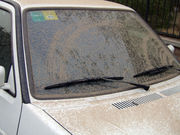 Areas affected by the dust experience decreased visibility and the dust is known to cause a variety of health problems, not limited to sore throat and asthma
in otherwise healthy people. Often, people are advised to avoid or minimize outdoor activities, depending on severity of storms. For those already with asthma or respiratory infections, it can be fatal. The dust has been shown to increase the daily mortality rate in one affected region by 1.7%.
Although sand itself is not necessarily harmful to soil, due to sulphur emissions and the resulting acid rain
, the storms also destroy farmland by degrading the soil, and deposits of ash and soot and heavy metals
as well as potentially dangerous biomatter blanket the ground with contaminants including croplands, aquifer
s, etc. The dust storms also affect wildlife particularly hard, destroying crops, habitat, and toxic metals interfering with reproduction. Coral
are hit particularly hard. Toxic metals propagate up the food chain, e.g. from fish to higher mammals. Air visibility is reduced, including canceled flights, ground travel, outdoor activities, and can be correlated to significant loss of economic activity. Japan has reported washed clothes stained yellow.
Korea Times has reported it costing 3 million won
(US $3,000), 6000 gallons of water, and 6 hours to simply clean one jumbo jet.
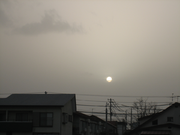 Shanghai
on April 3, 2007 recorded an air quality index
of 500. In the US, a 300 is considered "Hazardous" and anything over 200 is "Unhealthy".
Desertification
has intensified in China, as 1,740,000 km² of land are "dry", it disrupts the lives of 400 million people and causes direct economic losses of 54 billion yuan ($7 billion) a year, SFA figures show. These figures probably vastly underestimate, as they just take into account direct effects, without including medical, pollution, and other secondary effects, as well as effects to neighboring nations.
El Niño plays a role in Asian dust storms, because ice sheets that form in winter can keep dust from sweeping off the land.
and the People's Republic of China
have participated in reforestation
efforts in the source region. However, this has not affected the problem in any significant way. In April 2006, South Korean meteorologists reported the worst yellow dust storm in four years.
China also has taken steps, with international support, to plant trees in desert areas, including a claim of 12 billion trees planted. However, the winds are so strong in some places that the trees simply topple or are buried in sand.
In 2007, South Korea
sent several thousand trees to help block the migration of the yellow dust. These trees, however, were planted only by highways, because the People's Republic of China
stated to South Korea
that they could receive
the trees but that they would decide where the trees would be planted.
(24-32%), aluminum (5.9-7.4%), calcium
(6.2-12%), and iron
, numerous toxic substances were also present, as it is thought that heavier materials (such as poisonous mercury
and cadmium
from coal burning) settle out of the clouds closer to the origin.
However, Sarah O'Hara of the University of Nottingham in England, writing for the Lancet says that this doesn't mean that the effects are worse closer to the source. People further from the source of the dust are more often exposed to nearly invisible, fine dust particles that they can unknowingly inhale deep into their lungs, as coarse dust is too big to be deeply inhaled. After inhalation, it can cause long term scarring of lung tissue as well as induce cancer and lung disease.
An American study analyzing the composition of dust events over Colorado also points to the presence of carbon monoxide
, possibly incorporated in the clouds as they passed over industrialized regions of Asia.
, it rained dust at Bo (Bo is a place in Henan Province in China; in Classical Chinese
: 帝辛五年,雨土于亳).
The first known record of an Asian Dust event in Korea was in 174 AD during the Silla Dynasty
. The dust was known as "Uto (우토, 雨土)", meaning 'Raining Sands', and was believed at the time to be the result of an angry god sending down dust instead of rain or snow.
Specific records referring to Asian Dust events in Korea also exist from the Baekje
, Goguryeo
, and Joseon
periods.
East Asia
East Asia or Eastern Asia is a subregion of Asia that can be defined in either geographical or cultural terms...
sporadically during the springtime months. The dust originates in the deserts of Mongolia
Mongolia
Mongolia is a landlocked country in East and Central Asia. It is bordered by Russia to the north and China to the south, east and west. Although Mongolia does not share a border with Kazakhstan, its western-most point is only from Kazakhstan's eastern tip. Ulan Bator, the capital and largest...
, northern China
China
Chinese civilization may refer to:* China for more general discussion of the country.* Chinese culture* Greater China, the transnational community of ethnic Chinese.* History of China* Sinosphere, the area historically affected by Chinese culture...
and Kazakhstan
Kazakhstan
Kazakhstan , officially the Republic of Kazakhstan, is a transcontinental country in Central Asia and Eastern Europe. Ranked as the ninth largest country in the world, it is also the world's largest landlocked country; its territory of is greater than Western Europe...
where high-speed surface winds and intense dust storms kick up dense clouds of fine, dry soil particles. These clouds are then carried eastward by prevailing winds and pass over China, North
North Korea
The Democratic People’s Republic of Korea , , is a country in East Asia, occupying the northern half of the Korean Peninsula. Its capital and largest city is Pyongyang. The Korean Demilitarized Zone serves as the buffer zone between North Korea and South Korea...
and South Korea
South Korea
The Republic of Korea , , is a sovereign state in East Asia, located on the southern portion of the Korean Peninsula. It is neighbored by the People's Republic of China to the west, Japan to the east, North Korea to the north, and the East China Sea and Republic of China to the south...
, and Japan
Japan
Japan is an island nation in East Asia. Located in the Pacific Ocean, it lies to the east of the Sea of Japan, China, North Korea, South Korea and Russia, stretching from the Sea of Okhotsk in the north to the East China Sea and Taiwan in the south...
, as well as parts of the Russian Far East
Russian Far East
Russian Far East is a term that refers to the Russian part of the Far East, i.e., extreme east parts of Russia, between Lake Baikal in Eastern Siberia and the Pacific Ocean...
. Sometimes, the airborne particulates are carried much further, in significant concentrations which affect air quality as far east as the United States
United States
The United States of America is a federal constitutional republic comprising fifty states and a federal district...
.
In the last decade or so, it has become a serious problem due to the increase of industrial pollutants
Pollution
Pollution is the introduction of contaminants into a natural environment that causes instability, disorder, harm or discomfort to the ecosystem i.e. physical systems or living organisms. Pollution can take the form of chemical substances or energy, such as noise, heat or light...
contained in the dust and intensified desertification
Desertification
Desertification is the degradation of land in drylands. Caused by a variety of factors, such as climate change and human activities, desertification is one of the most significant global environmental problems.-Definitions:...
in China causing longer and more frequent occurrences, as well as in the last few decades when the Aral Sea
Aral Sea
The Aral Sea was a lake that lay between Kazakhstan in the north and Karakalpakstan, an autonomous region of Uzbekistan, in the south...
of Kazakhstan and Uzbekistan
Uzbekistan
Uzbekistan , officially the Republic of Uzbekistan is a doubly landlocked country in Central Asia and one of the six independent Turkic states. It shares borders with Kazakhstan to the west and to the north, Kyrgyzstan and Tajikistan to the east, and Afghanistan and Turkmenistan to the south....
started drying up due to the diversion of the Amu River
Amu Darya
The Amu Darya , also called Oxus and Amu River, is a major river in Central Asia. It is formed by the junction of the Vakhsh and Panj rivers...
and Syr River
Syr Darya
The Syr Darya , also transliterated Syrdarya or Sirdaryo, is a river in Central Asia, sometimes known as the Jaxartes or Yaxartes from its Ancient Greek name . The Greek name is derived from Old Persian, Yakhsha Arta , a reference to the color of the river's water...
following a Soviet agricultural program to irrigate Central Asian deserts, mainly for cotton plantations.
Pollutants
Sulfur (an acid rainAcid rain
Acid rain is a rain or any other form of precipitation that is unusually acidic, meaning that it possesses elevated levels of hydrogen ions . It can have harmful effects on plants, aquatic animals, and infrastructure. Acid rain is caused by emissions of carbon dioxide, sulfur dioxide and nitrogen...
component), soot, ash, carbon monoxide, and other toxic pollutants including heavy metals (such as mercury
Mercury (element)
Mercury is a chemical element with the symbol Hg and atomic number 80. It is also known as quicksilver or hydrargyrum...
, cadmium
Cadmium
Cadmium is a chemical element with the symbol Cd and atomic number 48. This soft, bluish-white metal is chemically similar to the two other stable metals in group 12, zinc and mercury. Similar to zinc, it prefers oxidation state +2 in most of its compounds and similar to mercury it shows a low...
, chromium
Chromium
Chromium is a chemical element which has the symbol Cr and atomic number 24. It is the first element in Group 6. It is a steely-gray, lustrous, hard metal that takes a high polish and has a high melting point. It is also odorless, tasteless, and malleable...
, arsenic
Arsenic
Arsenic is a chemical element with the symbol As, atomic number 33 and relative atomic mass 74.92. Arsenic occurs in many minerals, usually in conjunction with sulfur and metals, and also as a pure elemental crystal. It was first documented by Albertus Magnus in 1250.Arsenic is a metalloid...
, lead
Lead
Lead is a main-group element in the carbon group with the symbol Pb and atomic number 82. Lead is a soft, malleable poor metal. It is also counted as one of the heavy metals. Metallic lead has a bluish-white color after being freshly cut, but it soon tarnishes to a dull grayish color when exposed...
, zinc
Zinc
Zinc , or spelter , is a metallic chemical element; it has the symbol Zn and atomic number 30. It is the first element in group 12 of the periodic table. Zinc is, in some respects, chemically similar to magnesium, because its ion is of similar size and its only common oxidation state is +2...
, copper
Copper
Copper is a chemical element with the symbol Cu and atomic number 29. It is a ductile metal with very high thermal and electrical conductivity. Pure copper is soft and malleable; an exposed surface has a reddish-orange tarnish...
) and other carcinogens, often accompany the dust storms, as well as viruses, bacteria
Bacteria
Bacteria are a large domain of prokaryotic microorganisms. Typically a few micrometres in length, bacteria have a wide range of shapes, ranging from spheres to rods and spirals...
, fungi, pesticides, antibiotics, asbestos
Asbestos
Asbestos is a set of six naturally occurring silicate minerals used commercially for their desirable physical properties. They all have in common their eponymous, asbestiform habit: long, thin fibrous crystals...
, herbicides, plastic ingredients, combustion products as well as hormone
Hormone
A hormone is a chemical released by a cell or a gland in one part of the body that sends out messages that affect cells in other parts of the organism. Only a small amount of hormone is required to alter cell metabolism. In essence, it is a chemical messenger that transports a signal from one...
mimicking phthalates
Phthalates
Phthalates , or phthalate esters, are esters of phthalic acid and are mainly used as plasticizers . They are used primarily to soften polyvinyl chloride...
. Though scientists have known that intercontinental dust plumes can ferry bacteria and viruses, "most people had assumed that the [sun's] ultraviolet light would sterilize these clouds," says microbiologist Dale W. Griffin, also with the USGS in St. Petersburg. "We now find that isn't true."
Effects
Asthma
Asthma is the common chronic inflammatory disease of the airways characterized by variable and recurring symptoms, reversible airflow obstruction, and bronchospasm. Symptoms include wheezing, coughing, chest tightness, and shortness of breath...
in otherwise healthy people. Often, people are advised to avoid or minimize outdoor activities, depending on severity of storms. For those already with asthma or respiratory infections, it can be fatal. The dust has been shown to increase the daily mortality rate in one affected region by 1.7%.
Although sand itself is not necessarily harmful to soil, due to sulphur emissions and the resulting acid rain
Acid rain
Acid rain is a rain or any other form of precipitation that is unusually acidic, meaning that it possesses elevated levels of hydrogen ions . It can have harmful effects on plants, aquatic animals, and infrastructure. Acid rain is caused by emissions of carbon dioxide, sulfur dioxide and nitrogen...
, the storms also destroy farmland by degrading the soil, and deposits of ash and soot and heavy metals
Heavy metals
A heavy metal is a member of a loosely-defined subset of elements that exhibit metallic properties. It mainly includes the transition metals, some metalloids, lanthanides, and actinides. Many different definitions have been proposed—some based on density, some on atomic number or atomic weight,...
as well as potentially dangerous biomatter blanket the ground with contaminants including croplands, aquifer
Aquifer
An aquifer is a wet underground layer of water-bearing permeable rock or unconsolidated materials from which groundwater can be usefully extracted using a water well. The study of water flow in aquifers and the characterization of aquifers is called hydrogeology...
s, etc. The dust storms also affect wildlife particularly hard, destroying crops, habitat, and toxic metals interfering with reproduction. Coral
Coral
Corals are marine animals in class Anthozoa of phylum Cnidaria typically living in compact colonies of many identical individual "polyps". The group includes the important reef builders that inhabit tropical oceans and secrete calcium carbonate to form a hard skeleton.A coral "head" is a colony of...
are hit particularly hard. Toxic metals propagate up the food chain, e.g. from fish to higher mammals. Air visibility is reduced, including canceled flights, ground travel, outdoor activities, and can be correlated to significant loss of economic activity. Japan has reported washed clothes stained yellow.
Korea Times has reported it costing 3 million won
South Korean won
The won is the currency of South Korea. A single won is divided into 100 jeon, the monetary subunit. The jeon is no longer used for everyday transactions, and appears only in foreign exchange rates...
(US $3,000), 6000 gallons of water, and 6 hours to simply clean one jumbo jet.
Severity
Shanghai
Shanghai is the largest city by population in China and the largest city proper in the world. It is one of the four province-level municipalities in the People's Republic of China, with a total population of over 23 million as of 2010...
on April 3, 2007 recorded an air quality index
Air Quality Index
Air quality is defined as a measure of the condition of air relative to the requirements of one or more biotic species or to any human need or purpose. Air quality indices are numbers used by government agencies to characterize the quality of the air at a given location...
of 500. In the US, a 300 is considered "Hazardous" and anything over 200 is "Unhealthy".
Desertification
Desertification
Desertification is the degradation of land in drylands. Caused by a variety of factors, such as climate change and human activities, desertification is one of the most significant global environmental problems.-Definitions:...
has intensified in China, as 1,740,000 km² of land are "dry", it disrupts the lives of 400 million people and causes direct economic losses of 54 billion yuan ($7 billion) a year, SFA figures show. These figures probably vastly underestimate, as they just take into account direct effects, without including medical, pollution, and other secondary effects, as well as effects to neighboring nations.
El Niño plays a role in Asian dust storms, because ice sheets that form in winter can keep dust from sweeping off the land.
Mitigation
In recent years, South KoreaSouth Korea
The Republic of Korea , , is a sovereign state in East Asia, located on the southern portion of the Korean Peninsula. It is neighbored by the People's Republic of China to the west, Japan to the east, North Korea to the north, and the East China Sea and Republic of China to the south...
and the People's Republic of China
People's Republic of China
China , officially the People's Republic of China , is the most populous country in the world, with over 1.3 billion citizens. Located in East Asia, the country covers approximately 9.6 million square kilometres...
have participated in reforestation
Reforestation
Reforestation is the natural or intentional restocking of existing forests and woodlands that have been depleted, usually through deforestation....
efforts in the source region. However, this has not affected the problem in any significant way. In April 2006, South Korean meteorologists reported the worst yellow dust storm in four years.
China also has taken steps, with international support, to plant trees in desert areas, including a claim of 12 billion trees planted. However, the winds are so strong in some places that the trees simply topple or are buried in sand.
In 2007, South Korea
South Korea
The Republic of Korea , , is a sovereign state in East Asia, located on the southern portion of the Korean Peninsula. It is neighbored by the People's Republic of China to the west, Japan to the east, North Korea to the north, and the East China Sea and Republic of China to the south...
sent several thousand trees to help block the migration of the yellow dust. These trees, however, were planted only by highways, because the People's Republic of China
People's Republic of China
China , officially the People's Republic of China , is the most populous country in the world, with over 1.3 billion citizens. Located in East Asia, the country covers approximately 9.6 million square kilometres...
stated to South Korea
South Korea
The Republic of Korea , , is a sovereign state in East Asia, located on the southern portion of the Korean Peninsula. It is neighbored by the People's Republic of China to the west, Japan to the east, North Korea to the north, and the East China Sea and Republic of China to the south...
that they could receive
the trees but that they would decide where the trees would be planted.
Composition
An analysis of Asian Dust clouds conducted in China in 2001 showed them to contain high concentrations of siliconSilicon
Silicon is a chemical element with the symbol Si and atomic number 14. A tetravalent metalloid, it is less reactive than its chemical analog carbon, the nonmetal directly above it in the periodic table, but more reactive than germanium, the metalloid directly below it in the table...
(24-32%), aluminum (5.9-7.4%), calcium
Calcium
Calcium is the chemical element with the symbol Ca and atomic number 20. It has an atomic mass of 40.078 amu. Calcium is a soft gray alkaline earth metal, and is the fifth-most-abundant element by mass in the Earth's crust...
(6.2-12%), and iron
Iron
Iron is a chemical element with the symbol Fe and atomic number 26. It is a metal in the first transition series. It is the most common element forming the planet Earth as a whole, forming much of Earth's outer and inner core. It is the fourth most common element in the Earth's crust...
, numerous toxic substances were also present, as it is thought that heavier materials (such as poisonous mercury
Mercury (element)
Mercury is a chemical element with the symbol Hg and atomic number 80. It is also known as quicksilver or hydrargyrum...
and cadmium
Cadmium
Cadmium is a chemical element with the symbol Cd and atomic number 48. This soft, bluish-white metal is chemically similar to the two other stable metals in group 12, zinc and mercury. Similar to zinc, it prefers oxidation state +2 in most of its compounds and similar to mercury it shows a low...
from coal burning) settle out of the clouds closer to the origin.
However, Sarah O'Hara of the University of Nottingham in England, writing for the Lancet says that this doesn't mean that the effects are worse closer to the source. People further from the source of the dust are more often exposed to nearly invisible, fine dust particles that they can unknowingly inhale deep into their lungs, as coarse dust is too big to be deeply inhaled. After inhalation, it can cause long term scarring of lung tissue as well as induce cancer and lung disease.
An American study analyzing the composition of dust events over Colorado also points to the presence of carbon monoxide
Carbon monoxide
Carbon monoxide , also called carbonous oxide, is a colorless, odorless, and tasteless gas that is slightly lighter than air. It is highly toxic to humans and animals in higher quantities, although it is also produced in normal animal metabolism in low quantities, and is thought to have some normal...
, possibly incorporated in the clouds as they passed over industrialized regions of Asia.
Historical reports
Some of the earliest written records of dust storm activity are recorded in the ancient Chinese literature. It is believed that the earliest Chinese dust storm record was found in the Zhu Shu Ji Nian (Chinese: 竹书纪年; English: the Bamboo Annals). The record said: in the fifth year of Di Xin (1150 BC, Di xin was the Era Name of the King Di Xin of Shang DynastyShang Dynasty
The Shang Dynasty or Yin Dynasty was, according to traditional sources, the second Chinese dynasty, after the Xia. They ruled in the northeastern regions of the area known as "China proper" in the Yellow River valley...
, it rained dust at Bo (Bo is a place in Henan Province in China; in Classical Chinese
Classical Chinese
Classical Chinese or Literary Chinese is a traditional style of written Chinese based on the grammar and vocabulary of ancient Chinese, making it different from any modern spoken form of Chinese...
: 帝辛五年,雨土于亳).
The first known record of an Asian Dust event in Korea was in 174 AD during the Silla Dynasty
Silla
Silla was one of the Three Kingdoms of Korea, and one of the longest sustained dynasties in...
. The dust was known as "Uto (우토, 雨土)", meaning 'Raining Sands', and was believed at the time to be the result of an angry god sending down dust instead of rain or snow.
Specific records referring to Asian Dust events in Korea also exist from the Baekje
Baekje
Baekje or Paekche was a kingdom located in southwest Korea. It was one of the Three Kingdoms of Korea, together with Goguryeo and Silla....
, Goguryeo
Goguryeo
Goguryeo or Koguryŏ was an ancient Korean kingdom located in present day northern and central parts of the Korean Peninsula, southern Manchuria, and southern Russian Maritime province....
, and Joseon
Joseon Dynasty
Joseon , was a Korean state founded by Taejo Yi Seong-gye that lasted for approximately five centuries. It was founded in the aftermath of the overthrow of the Goryeo at what is today the city of Kaesong. Early on, Korea was retitled and the capital was relocated to modern-day Seoul...
periods.
See also
- Asian brown cloudAsian brown cloudThe Asian brown cloud is a layer of air pollution that covers parts of South Asia, namely the northern Indian Ocean, India, and Pakistan. Viewed from satellite photos, the cloud appears as a giant brown stain hanging in the air over much of South Asia and the Indian Ocean every year between January...
- Environment of South KoreaEnvironment of South KoreaThe environment of South Korea is the natural environment of the South Korean nation, which occupies the southern half of the Korean peninsula.-Flora and fauna:...
- Environment of ChinaEnvironment of ChinaThe environment in the People's Republic of China has traditionally been neglected as the country concentrates on its rise as an economic power. Chasing the political gains of economic development, local officials in China often overlook environmental pollution, worker safety and public health...
- 2010 China drought and dust storms2010 China drought and dust stormsThe 2010 China drought and dust storms were a series of severe droughts during the spring of 2010 that affected Yunnan, Guizhou, Guangxi, Sichuan, Shanxi, Henan, Shaanxi, Chongqing, Hebei and Gansu in the People's Republic of China as well as parts of Southeast Asia including Vietnam and Thailand,...
External links
- Asian Dust in Korea accessed April 9, 2006
- Ostapuk, Paul Asian Dust Clouds accessed April 9, 2006
- Szykman, Jim et al.Impact of April 2001 Asian Dust Event on Particulate Matter Concentrations in the United States
- Kwon Ho-Jang et al.Effects of the Asian Dust Events on Daily Mortality in Seoul, Korea
- Zhang, X.Y. et al. Characterization of Soil Dust Aerosol in China, 2001
- Carbon Monoxide Measurements in the Mongolian Desert Dust Cloud at Boulder
- The Bibliography of Aeolian Research
- Youngsin Chun and Soon-Ung Park, From Historical Records to Early Warning System opf Asian Dust (Hwangsa) in Korea