
All Topics  
Reforestation

 
Reforestation

   Email Print
   Bookmark   Link


Reforestation


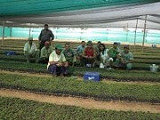
Reforestation is the restocking of existing forests and woodlands which have been depleted, with native tree stock. The term reforestation can also refer to afforestation
Afforestation

Afforestation is the process of establishing a forest on land that is not a forest, or has not been a forest for a long time by planting trees or their seeds....
, the process of restoring and recreating areas of woodland
Woodland

Ecologically, a woodland is an area covered in trees, usually at low density, forming an open habitat, allowing sunlight to penetrate between the trees, and limiting shade....
s or forest
Forest

File:Stara planina suma.jpgA forest is an area with a high density of trees. There are many definitions of a forest, based on various criteria....
 that once existed but were deforested
Deforestation

Deforestation is the logging or burning of trees in forested areas. There are several reasons for doing so: trees or derived charcoal can be sold as a commodity and are used by humans while cleared land is used as pasture, plantations of commodities and human settlement....
 or otherwise removed or destroyed at some point in the past.


Discussion
Ask a question about 'Reforestation'
Start a new discussion about 'Reforestation'
Answer questions from other users
Full Discussion Forum


Encyclopedia


Biodiversity On Clearcut
Reforestation is the restocking of existing forests and woodlands which have been depleted, with native tree stock. The term reforestation can also refer to afforestation
Afforestation

Afforestation is the process of establishing a forest on land that is not a forest, or has not been a forest for a long time by planting trees or their seeds....
, the process of restoring and recreating areas of woodland
Woodland

Ecologically, a woodland is an area covered in trees, usually at low density, forming an open habitat, allowing sunlight to penetrate between the trees, and limiting shade....
s or forest
Forest

File:Stara planina suma.jpgA forest is an area with a high density of trees. There are many definitions of a forest, based on various criteria....
 that once existed but were deforested
Deforestation

Deforestation is the logging or burning of trees in forested areas. There are several reasons for doing so: trees or derived charcoal can be sold as a commodity and are used by humans while cleared land is used as pasture, plantations of commodities and human settlement....
 or otherwise removed or destroyed at some point in the past. The resulting forest can provide both ecosystem
Ecosystem

An ecosystem is a natural unit consisting of all plants, animals and micro-organisms in an area functioning together with all of the non-living physical factors of the environment....
 and resource
Logging

Logging is the process in which certain trees are cut down for forest management and timber....
 benefits such as: pollution control, dust control and has the potential to become a major carbon sink.

Natural reforestation

Reforestation can occur naturally if the area is left largely undisturbed. Native forests are often resilient and may re-establish themselves quickly. Conceptually, it involves taking no active role in reforesting a deforested area, but rather just letting nature take its course.

Managed reforestation

Reforestation of large areas can be done through the use of measuring rope (for accurate plant spacing) and the use of a dibber
Dibber

A dibber or dibble is a pointed wooden stick for making holes in the ground so that seeds, seedlings or small bulbs can be planted. Dibbers come in a variety of designs including the straight dibber, T-handled dibber, trowel dibber, and L-shaped dibber....
s, (or wheeled augers for planting the larger trees) for making the hole in which a seedling or plant can be inserted. Also, Victor Papanek
Victor Papanek

Victor Papanek was a designer and educator who became a strong advocate of the socially and ecologically responsible design of products, tools, and community infrastructures....
 reportedly had an innovative method for dispersing seeds and fertilizer for reforestation in difficult-to-access land.

A debatable issue in managed reforestation is however whether or not the succeeding forest will have the same biodiversity
Biodiversity

Biodiversity is the variation of life forms within a given ecosystem, biome, or for the entire Earth. Biodiversity is often used as a measure of the health of biological systems....
 as the original forest. If the forest is replaced with only one species of tree and all other vegetation is prevented from growing back, a monoculture
Monoculture

Monoculture is the agricultural practice of producing or growing one single crop over a wide area. The term is also applied in several fields. It is usually developed by extensive growing farmers....
 forest similar to agricultural crops would be the result. However, most reforestation involves the planting of different seedlots of seedlings taken from the area. More frequently multiple species are planted as well. Another important factor is the natural regeneration of a wide variety of plant and animal species that can occur on a clearcut. In some areas the suppression of forest fires for hundreds of years has resulted in large single aged and single specied forest stands. The logging of small clearcuts and or prescribed burning, actually increases the biodiversity in these areas by creating a greater variety of treestand ages and species.

Reforestation need not be only used for recovery of accidentally destroyed forests. In some countries, such as Finland
Finland

Finland , officially the Republic of Finland , is a Nordic countries situated in the Fennoscandian region of northern Europe. It borders Sweden on the west, Russia on the east, and Norway on the north, while Estonia lies to its south across the Gulf of Finland....
, the forests are managed by the wood products and pulp and paper industry
Pulp and paper industry

The global pulp and paper industry is dominated by North American , northern European and East Asian countries . Australasia and Latin America also have significant pulp and paper industries....
. In such an arrangement, like other crops, trees are replanted wherever they are cut. In such circumstances, the cutting of trees can be carefully done to allow easier reforestation. In Canada
Canada

Canada is a country occupying most of northern North America, extending from the Atlantic Ocean in the east to the Pacific Ocean in the west and northward into the Arctic Ocean....
, the wood product and pulp and paper industry systematically replaces many of the trees it cuts, employing large numbers of summer workers for treeplanting
Treeplanting

Treeplanting is the process of transplanting tree cultivar, generally for forestry, land reclamation, or landscaping purposes. It differs from the transplantation of larger trees in arboriculture, and the lower cost but slower and less reliable distribution of tree seeds....
 work.

For example, in just 20 years, a teak
Teak

Teak , is a genus of tropics hardwood trees in the family Verbenaceae, native to the south and southeast of Asia, and is commonly found as a component of monsoon forest vegetation....
 plantation in Costa Rica can produce up to about 400 m³ of wood per hectare . As the natural teak forests of Asia become more scarce or difficult to obtain, the prices commanded by plantation-grown teak grow higher every year. Other species such as mahogany
Mahogany

The name mahogany is used when referring to numerous varieties of dark-colored wood, originally the wood of the species Swietenia mahagoni, known as West Indian or Cuban mahogany....
 grow slower than teak in Tropical America but are also extremely valuable. Faster growers include pine
Pine

Pines are Pinophyta trees in the genus Pinus, in the family Pinaceae. They make up the monotypic subfamily Pinoideae. There are about 115 species of pine, although different authorities accept between 105 and 125 species....
, eucalyptus
Eucalyptus

Eucalyptus is a diverse genus of Flowering plant trees in the Myrtus family, Myrtaceae. Members of the genus dominate the tree flora of Australia....
, and gmelina
Gmelina

Gmelina is a genus of plant in family Lamiaceae. It was named in honour of botanist Johann Georg Gmelin.Species include:* Gmelina arborea...
.

Reforestation, if several native species are used, can provide other benefits in addition to financial returns, including restoration of the soil, rejuvenation of local flora and fauna, and the capturing and sequestering of 38 ton
Ton

Units of massThere are several similar units of mass or volume called the ton:Others*The long ton is used for petroleum products such as aviation fuel....
s of carbon dioxide
Carbon dioxide

Carbon dioxide is a chemical compound composed of two oxygen atoms covalent bond to a single carbon atom. It is a gas at standard temperature and pressure and exists in Earth's atmosphere in this state....
 per hectare
Hectare

A hectare is a unit of area equal to , or one square hectometre , and commonly used for surveying.The hectare is used in most countries around the world, especially in domains concerned with land ownership, land planning, and land management, including law , agriculture, forestry, and town planning....
 per year.

Carbon dioxide is one of the greenhouse gases that is responsible for the increase in temperature around the globe. This effect is known as global warming. It has been proven that forests absorb carbon dioxide through their photosynthesis cycle. Using this idea, that increasing forests with reforestation and discouraging deforestation will help mitigate global warming, experts can make people aware of the value of reforestation. Forest ecosystems are one of the most important ecosystems. They are especially important to the global carbon cycle in two important ways (Canadell & Raupach, 2008, p.1456): they are responsible for moving around three billion tons of anthropogenic carbon every year. This amounts to about 30% of all carbon dioxide emissions from fossil fuels (Canadell & Raupach, 2008, p.1456). Another reason why forest ecosystems are important is that they are terrestrial carbon sinks (they store large amounts of carbon.) This accounts for as much as double the amount of carbon in the atmosphere (Canadell & Raupach, 2008, p. 1456).

Canadell and Raupach (2008) believe that there are four major strategies available to mitigate carbon emissions through forestry activities. One of these strategies is to increase the amount of forested land through a reforestation process. Another strategy is to increase the carbon density of existing forests at a stand and landscape scale. Another strategy is to expand the use of forest products that will sustainably replace fossil-fuel emissions. The last strategy is to reduce carbon emissions that are caused from deforestation and degradation (p. 1456).

However, achieving the first strategy requires great effort of land transformation. For example, China has used 24 million ha of new forest plantation and natural forest re-growth to offset 21% of Chinese fossil fuel emissions in 2000 (Canadell & Raupach, 2008, p. 1456). Nonetheless, there are other ideas that support the first strategy. To plant more trees is an eminent solution. In theory, any tree would cover more forest area and absorb more carbon dioxide from the atmosphere. On the other hand, a genetically modified tree specimen might grow much faster than any other regular tree (“A changing climate of opinion?” 2008, p. 93). Some of these trees are already being developed in the lumber and biofuel industries. So these fast-growing trees would not only be planted for those industries but they can also be planted to help absorb carbon dioxide faster than regular trees (“A changing climate of opinion?” 2008, p. 93). The idea of a genetically modified tree will not only help the first strategy, but it will also help with the second by increasing forest area density.

Reducing deforestation is a strategy that will never go wrong. To cut down in deforestation has huge potential towards a cost-effective contribution to protect the atmosphere’s climate. At this point there are 13 Million ha of tropical regions that are deforested every year. These regions can reduce rates of deforestation by 50% by 2050 (Canadell & Raupach, 2008, 1456).

Extensive reforestation

Extensive forest resources placed anywhere in the world will not always have a positive impact. For example, large reforestation programs in boreal regions have a limited impact on climate mitigation. This is because it substitutes a bright snow-dominated region that reflects the sunlight with dark forest canopies. On the other hand, a positive example would be reforestation projects in tropical regions, which would lead to a positive biophysical change such as the formation of clouds. These clouds would then reflect the sunlight, creating a positive impact on climate mitigation (Canadell & Raupach, 2008, p.1457). This is why we need something called forest management. The reestablishment of forests is not just simple tree planting. Forests are made up of a diversity of species and they build dead organic matter into soils over time (Woodwell, Janzen, Wilcox, North, Swartz, & Hoyer, 1988, p.1493). Planting trees in a place like Los Angeles Basin is a good idea. A major tree-planting program in a place like this would enhance the local climate and reduce the demands of burning large amounts of fossil fuels for cooling in the summer. But there still is an important difference between tree planting and reestablishment of forests a management tool for the global climate crisis (Woodwell et al. 1988, p.1493).

Reforestation risks

There are still some drawbacks and risks that are carried from climate mitigation through the uses of forests. There is always the risk that, through a forest fire or insect outbreak, all the stored carbon could make its way back in the atmosphere (Canadell & Raupach, 2008, p.1456). Reduced harvesting rates and fire suppression have caused an increase in the forest biomass in the western United States over the past century. This causes an increase of about a factor of 4 in the frequency of fires due to longer and hotter dry seasons (Canadell & Raupach, 2008, p.1456). Canadell and Raupach (2008) conclude by saying that “These new patters of disturbances are reshaping the view held in the past that vast forest resources anywhere would always play a major role in climate mitigation.” (p. 1456, par. 9).

Encourage reforestation

Some incentives can be as a simple as a financial compensation. Streck and Scholz (2006) talk about how a group of scientists from various institutions have developed a compensated reduction of deforestation approach (p. 875). They explain how this mechanism would award developing countries that disrupt any further act of deforestation. Countries that participate and take the option to reduce their emissions from deforestation during a committed period of time, they would receive financial compensation for the carbon dioxide emissions that they avoided (Streck & Scholz, 2006, p. 875). So in other words, if a country reduces its deforestation rate and achieves the target set, they would get compensation for it. This compensation will come after a technical verification of effective reduction in their emissions, no matter how this reduction was achieved (Streck & Scholz, 2006, p. 876). To raise the payments, the host country would issue government bonds or negotiate some kind of loan with a financial institution that would want to take part in the compensation promised to the other country. These funds received by the country could be invested to help find alternative to the extensive cut down of forests. This whole process of cutting down emissions would be voluntary, but once the country has agreed to lower they emissions they would be obligated to reduce their emissions. However, if a country was not able to meet their obligation, their target would get added to their next commitment period (Streck & Scholz, 2006, p. 876). The authors of these proposals see this as a solely government-to-government agreement. Private entities would not participate in the compensation trades (Streck & Scholz, 2006, p.876). This is an excellent approach. It not only helps maintain the current forests by cutting down on deforestation, but it also encourages countries to invest in reforestation so they can sequester more carbon dioxide emission.

See also

  • Afforestation
    Afforestation

    Afforestation is the process of establishing a forest on land that is not a forest, or has not been a forest for a long time by planting trees or their seeds....
  • Deforestation
    Deforestation

    Deforestation is the logging or burning of trees in forested areas. There are several reasons for doing so: trees or derived charcoal can be sold as a commodity and are used by humans while cleared land is used as pasture, plantations of commodities and human settlement....
  • Forestry
    Forestry

    Forestry is the art and science of managing forests, tree plantations, and related natural resources. Silviculture, a related science, involves the growing and tending of trees and forests....
  • Land rehabilitation
    Land rehabilitation

    Land rehabilitation is the process of returning the land in a given area to some degree of its former state, after some process has resulted in its damage....
  • Restoration ecology
    Restoration ecology

    Restoration ecology is the study of renewing a degraded, damaged, or destroyed ecosystem through active human intervention. Restoration ecology specifically refers to the scientific study that has evolved as recently as the 1980s....
  • Richard St. Barbe Baker
    Richard St. Barbe Baker

    Richard St. Barbe Baker was an England forester, environmental activist, and author who contributed greatly to worldwide reforestation efforts....
  • Treeplanting
    Treeplanting

    Treeplanting is the process of transplanting tree cultivar, generally for forestry, land reclamation, or landscaping purposes. It differs from the transplantation of larger trees in arboriculture, and the lower cost but slower and less reliable distribution of tree seeds....
  • 10,000 Trees for the Rouge Valley
    10,000 Trees for the Rouge Valley

    10,000 Trees for the Rouge Valley is a non-profit environmental organization that has held many Toronto, Ontario-area reforestation. It is a volunteer group that is dedicated to helping the environment, as it has restored more than of fragile land in the Rouge Watershed with the assistance of individuals, families, governments and community...
    , a reforestation program in Toronto, Canada


External links

  • Saimiri Wildlife; Reforestation for endangered wildlife, side provides many pictures.