


Philadelphia Brigade

Encyclopedia
The Philadelphia Brigade (also known as the California Brigade) was a Union Army
brigade
that served in the American Civil War
. It was raised primarily in the city of Philadelphia, Pennsylvania
, with the exception of the 106th regiment which contained men from Lycoming
and Bradford
counties.
The brigade fought with the Army of the Potomac
in the Eastern Theater for the entirety of its existence and fought in several major battles, including the battles of Antietam, Fredericksburg, Gettysburg, and the Overland Campaign. One of its most famous actions was during Pickett's Charge
on July 3rd at the Battle of Gettysburg
, where it defended the Angle on Cemetery Ridge. Half of the brigade was mustered out in June 1864 and the remainder was transferred to another brigade.
s in the Philadelphia Brigade were originally designated as California
regiments. Some residents on the West Coast
wanted California to have a military presence in the Eastern army and asked Oregon
Senator Edward D. Baker
to form a regiment to be credited to that state. Baker was able to recruit a regiment from Philadelphia, designated the 1st California. By October, he increased his command to a brigade, adding the 2nd, 3rd, and 5th California regiments, all of which were from Philadelphia. After his death at the Battle of Ball's Bluff
, Pennsylvania claimed the regiments as its own and renamed them as the following:
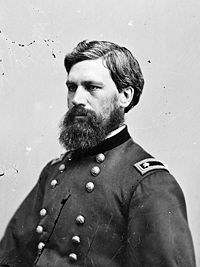 Now commanded by Brig. Gen.
William W. Burns
, it was then assigned to the Army of the Potomac
's II Corps
as the 2nd Brigade, 2nd Division. It fought in the Peninsula Campaign
, during which the 69th was credited by Maj. Gen.
Joseph Hooker
with making "the first successful bayonet charge of the war" at the Battle of Glendale
. It also fought during the Seven Days battles
, including Allen's Farm and Savage Station
; at Malvern Hill
it was posted on the Union right with the rest of the II Corps and consequently wasn't engaged during the battle.
At the Battle of Antietam
, the brigade, now commanded by Brig. Gen. Oliver O. Howard
, was part of Maj. Gen. John Sedgwick
's attack near the West Woods. The division ran into stiff resistance and was then attacked in the flank. Most of the division was routed, including the Philadelphia Brigade; some companies had no time to return fire before being caught up in the rout. The brigade lost 545 men in as little as ten minutes. When Sedwick was wounded during the battle, Howard took command of his division and Colonel Joshua T. Owen of the 69th regiment took command of the brigade. In the Battle of Fredericksburg
the following December, the brigade participated in the assault on Marye's Heights. The 71st regiment was assigned provost duty in the city, so Howard transferred the 127th Pennsylvania to the brigade to replace it. The Philadelphia Brigade made it part way up the slope of the ridge but the rest of division failed to advance at the same time; both this and Confederate fire halted its advance. During the battle, the brigade lost 258 men, with the 127th Pennsylvania suffering 146 casualties. During the Battle of Chancellorsville
in May 1863, Brig. Gen. John Gibbon's division (of which the brigade was a part) initially remained in their winter camps to act "as a decoy while the rest of the army marched." On May 3, the division supported Major General John Sedwick's attack on the Confederate rearguard at Fredericksburg and remained in the city afterwards to guard the city and the bridges across the river.
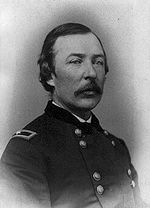 Just before the Battle of Gettysburg
, Brig. Gen. Joshua T. Owen
was relieved of command and replaced by Brig. Gen. Alexander S. Webb
, in the hopes of improving the discipline of the brigade. During the battle, it defended Cemetery Ridge
near the famous Angle on July 2 and July 3, 1863. On the evening of July 2, it helped drive Brig. Gen. Ambrose R. Wright
's brigade back after it captured a portion of the ridge and recaptured a cannon. The 106th advanced as far as the Codori Barn near the Emmitsburg Road and the 72nd advanced just over the stone wall, before both regiments withdrew to their previous positions.
On July 3, eight companies of the 106th were sent to Cemetery Hill
(the other two were deployed along the Emmitsburg Road as pickets); the 71st was briefly sent to Culp's Hill
but was later moved back to the Angle. Half of the regiment was posted at the portion of the wall closest to the Confederates while the other half was 50 yards to its right-rear. The 69th manned the wall to the left of the 71st. The 72nd was posted in reserve behind the copse of trees. Two companies of the 106th returned to the Angle and placed in reserve with the 72nd (the remainder of the regiment stayed on Cemetery Hill). During Pickett's Charge
, the left wing of the 71st retreated from the stone wall, allowing the Confederates to pour over. The 69th refused its right to protect its flank; however, the 59th New York, on its left also retreated and due largely to the overwhelming Confederate numbers, the 69th was unable to hold its position and was slowly pushed back. Company F was accidentally left isolated and was engulfed by the attacking Confederates.
 The 72nd and the two remaining companies of the 106th behind the copse refused to counterattack. Webb was able to rally the 71st and move it in line with these two units; when he attempted to get these units to advance to retake the wall but the regiments refused to move. The delay might have been caused by the color bearers of the 71st being shot down (regiments in the Civil War usually followed the movement of the unit's flag, since orders were hard to hear on the battlefield). After other Union regiments joined in the counterattack on Pickett's Division, Webb was able to get his brigade to charge as well; although he was wounded in the groin, Webb refused to leave the field. The brigade was able to capture four battle flags (of the 3rd, 9th, 53rd, and 56th Virginia Infantry).
After Gettysburg, the brigade continued to serve in the Army of the Potomac, from the Overland Campaign
to the surrender at Appomattox Court House
, often losing heavily. Owen was restored to command of the Philadelphia Brigade (Webb was transferred to command of a different brigade) and the 152nd New York Infantry was added to the brigade. Owen's superiors continued to complain about his performance as a commander; at Spotsylvania Court House
, his brigade was ordered to make a reconnaissance in force against the Confederate lines but Owen was absent for unexplained reasons, forcing another brigade commander to take over. The brigade last fought as a unit at the Battle of Cold Harbor
, where Owen both failed to have his brigade ready for the June 3rd assault on time and also failed to participate in the attack as his division commander intended. As a result for this incident and for the attack at Spotsylvania, Owen was relieved of command and mustered out of service. On July 22, 1864, the brigade was broken up. The majority of the 71st and 106th and the entire 72nd were discharged. The remaining men of the 71st were merged into the 69th and the 106th reformed as a four-company battalion.
During the war, the brigade lost 3,533 men out of a total 5,320 men who served in the unit, a casualty rate of 64%.
Union Army
The Union Army was the land force that fought for the Union during the American Civil War. It was also known as the Federal Army, the U.S. Army, the Northern Army and the National Army...
brigade
Brigade
A brigade is a major tactical military formation that is typically composed of two to five battalions, plus supporting elements depending on the era and nationality of a given army and could be perceived as an enlarged/reinforced regiment...
that served in the American Civil War
American Civil War
The American Civil War was a civil war fought in the United States of America. In response to the election of Abraham Lincoln as President of the United States, 11 southern slave states declared their secession from the United States and formed the Confederate States of America ; the other 25...
. It was raised primarily in the city of Philadelphia, Pennsylvania
Philadelphia, Pennsylvania
Philadelphia is the largest city in the Commonwealth of Pennsylvania and the county seat of Philadelphia County, with which it is coterminous. The city is located in the Northeastern United States along the Delaware and Schuylkill rivers. It is the fifth-most-populous city in the United States,...
, with the exception of the 106th regiment which contained men from Lycoming
Lycoming County, Pennsylvania
-Appalachian Mountains and Allegheny Plateau:Lycoming County is divided between the Appalachian Mountains in the south, the dissected Allegheny Plateau in the north and east, and the valley of the West Branch Susquehanna River between these.-West Branch Susquehanna River:The West Branch of the...
and Bradford
Bradford County, Pennsylvania
-Demographics:As of the census of 2000, there were 62,761 people, 24,453 households, and 17,312 families residing in the county. The population density was 54 people per square mile . There were 28,664 housing units at an average density of 25 per square mile...
counties.
The brigade fought with the Army of the Potomac
Army of the Potomac
The Army of the Potomac was the major Union Army in the Eastern Theater of the American Civil War.-History:The Army of the Potomac was created in 1861, but was then only the size of a corps . Its nucleus was called the Army of Northeastern Virginia, under Brig. Gen...
in the Eastern Theater for the entirety of its existence and fought in several major battles, including the battles of Antietam, Fredericksburg, Gettysburg, and the Overland Campaign. One of its most famous actions was during Pickett's Charge
Pickett's Charge
Pickett's Charge was an infantry assault ordered by Confederate Gen. Robert E. Lee against Maj. Gen. George G. Meade's Union positions on Cemetery Ridge on July 3, 1863, the last day of the Battle of Gettysburg during the American Civil War. Its futility was predicted by the charge's commander,...
on July 3rd at the Battle of Gettysburg
Battle of Gettysburg
The Battle of Gettysburg , was fought July 1–3, 1863, in and around the town of Gettysburg, Pennsylvania. The battle with the largest number of casualties in the American Civil War, it is often described as the war's turning point. Union Maj. Gen. George Gordon Meade's Army of the Potomac...
, where it defended the Angle on Cemetery Ridge. Half of the brigade was mustered out in June 1864 and the remainder was transferred to another brigade.
History
The regimentRegiment
A regiment is a major tactical military unit, composed of variable numbers of batteries, squadrons or battalions, commanded by a colonel or lieutenant colonel...
s in the Philadelphia Brigade were originally designated as California
California
California is a state located on the West Coast of the United States. It is by far the most populous U.S. state, and the third-largest by land area...
regiments. Some residents on the West Coast
West Coast of the United States
West Coast or Pacific Coast are terms for the westernmost coastal states of the United States. The term most often refers to the states of California, Oregon, and Washington. Although not part of the contiguous United States, Alaska and Hawaii do border the Pacific Ocean but can't be included in...
wanted California to have a military presence in the Eastern army and asked Oregon
Oregon
Oregon is a state in the Pacific Northwest region of the United States. It is located on the Pacific coast, with Washington to the north, California to the south, Nevada on the southeast and Idaho to the east. The Columbia and Snake rivers delineate much of Oregon's northern and eastern...
Senator Edward D. Baker
Edward Dickinson Baker
Edward Dickinson Baker was an English-born American politician, lawyer, military leader. In his political career, Baker served in the U.S. House of Representatives from Illinois and later as a U.S. Senator from Oregon. A long-time close friend of U.S. President Abraham Lincoln, Baker served as U.S...
to form a regiment to be credited to that state. Baker was able to recruit a regiment from Philadelphia, designated the 1st California. By October, he increased his command to a brigade, adding the 2nd, 3rd, and 5th California regiments, all of which were from Philadelphia. After his death at the Battle of Ball's Bluff
Battle of Ball's Bluff
The Battle of Ball's Bluff, also known as the Battle of Harrison’s Island or the Battle of Leesburg, was fought on October 21, 1861, in Loudoun County, Virginia, as part of Union Maj. Gen. George B...
, Pennsylvania claimed the regiments as its own and renamed them as the following:
- the 1st California became the 71st regiment71st Pennsylvania InfantryThe 71st Pennsylvania Volunteers was an infantry regiment of the Union Army that participated in the American Civil War.-History:...
; - the 2nd California became the 69th regiment69th Pennsylvania InfantryThe 69th Pennsylvania Infantry was a volunteer regiment in the Union army during the American Civil War. Part of the famed Philadelphia Brigade, it played a key role defending against Pickett's Charge during the Battle of Gettysburg. Companies I and K wore a very americanized zouave uniform...
; - the 3rd California became the 72nd regiment72nd Pennsylvania InfantryThe 72nd Pennsylvania Infantry was a volunteer infantry regiment which served in the Union Army during the American Civil War. It was part of the famous Philadelphia Brigade. They wore a very americanized zouave uniform...
; - the 5th California became the 106th regiment106th Pennsylvania InfantryThe 106th Pennsylvania was a volunteer infantry regiment which served in the Union Army during the American Civil War...
.
Brigadier general (United States)
A brigadier general in the United States Army, Air Force, and Marine Corps, is a one-star general officer, with the pay grade of O-7. Brigadier general ranks above a colonel and below major general. Brigadier general is equivalent to the rank of rear admiral in the other uniformed...
William W. Burns
William Wallace Burns
William Wallace Burns was a career American soldier who served in the Union Army during the American Civil War, reaching the rank of brigadier general in the volunteer army. He was among the commanders of the famed Philadelphia Brigade.-Birth and early years:Burns was born in Coshocton, Ohio, son...
, it was then assigned to the Army of the Potomac
Army of the Potomac
The Army of the Potomac was the major Union Army in the Eastern Theater of the American Civil War.-History:The Army of the Potomac was created in 1861, but was then only the size of a corps . Its nucleus was called the Army of Northeastern Virginia, under Brig. Gen...
's II Corps
II Corps (ACW)
There were five corps in the Union Army designated as II Corps during the American Civil War.* Army of the Cumberland, II Corps commanded by Thomas L. Crittenden , later renumbered XX Corps...
as the 2nd Brigade, 2nd Division. It fought in the Peninsula Campaign
Peninsula Campaign
The Peninsula Campaign of the American Civil War was a major Union operation launched in southeastern Virginia from March through July 1862, the first large-scale offensive in the Eastern Theater. The operation, commanded by Maj. Gen. George B...
, during which the 69th was credited by Maj. Gen.
Major general (United States)
In the United States Army, United States Marine Corps, and United States Air Force, major general is a two-star general-officer rank, with the pay grade of O-8. Major general ranks above brigadier general and below lieutenant general...
Joseph Hooker
Joseph Hooker
Joseph Hooker was a career United States Army officer, achieving the rank of major general in the Union Army during the American Civil War. Although he served throughout the war, usually with distinction, Hooker is best remembered for his stunning defeat by Confederate General Robert E...
with making "the first successful bayonet charge of the war" at the Battle of Glendale
Battle of Glendale
The Battle of Glendale, also known as the Battle of Frayser's Farm, Frazier's Farm, Nelson's Farm, Charles City Crossroads, New Market Road, or Riddell's Shop, took place on June 30, 1862, in Henrico County, Virginia, on the sixth day of the Seven Days Battles of the American Civil War.The...
. It also fought during the Seven Days battles
Seven Days Battles
The Seven Days Battles was a series of six major battles over the seven days from June 25 to July 1, 1862, near Richmond, Virginia during the American Civil War. Confederate General Robert E. Lee drove the invading Union Army of the Potomac, commanded by Maj. Gen. George B. McClellan, away from...
, including Allen's Farm and Savage Station
Battle of Savage's Station
The Battle of Savage's Station took place on June 29, 1862, in Henrico County, Virginia, as fourth of the Seven Days Battles of the American Civil War. The main body of the Union Army of the Potomac began a general withdrawal toward the James River. Confederate Brig. Gen. John B. Magruder pursued...
; at Malvern Hill
Battle of Malvern Hill
The Battle of Malvern Hill, also known as the Battle of Poindexter's Farm, took place on July 1, 1862, in Henrico County, Virginia, on the seventh and last day of the Seven Days Battles of the American Civil War. Gen. Robert E. Lee launched a series of disjointed assaults on the nearly impregnable...
it was posted on the Union right with the rest of the II Corps and consequently wasn't engaged during the battle.
At the Battle of Antietam
Battle of Antietam
The Battle of Antietam , fought on September 17, 1862, near Sharpsburg, Maryland, and Antietam Creek, as part of the Maryland Campaign, was the first major battle in the American Civil War to take place on Northern soil. It was the bloodiest single-day battle in American history, with about 23,000...
, the brigade, now commanded by Brig. Gen. Oliver O. Howard
Oliver O. Howard
Oliver Otis Howard was a career United States Army officer and a Union general in the American Civil War...
, was part of Maj. Gen. John Sedgwick
John Sedgwick
John Sedgwick was a teacher, a career military officer, and a Union Army general in the American Civil War. He was the highest ranking Union casualty in the Civil War, killed by a sniper at the Battle of Spotsylvania Court House.-Early life:Sedgwick was born in the Litchfield Hills town of...
's attack near the West Woods. The division ran into stiff resistance and was then attacked in the flank. Most of the division was routed, including the Philadelphia Brigade; some companies had no time to return fire before being caught up in the rout. The brigade lost 545 men in as little as ten minutes. When Sedwick was wounded during the battle, Howard took command of his division and Colonel Joshua T. Owen of the 69th regiment took command of the brigade. In the Battle of Fredericksburg
Battle of Fredericksburg
The Battle of Fredericksburg was fought December 11–15, 1862, in and around Fredericksburg, Virginia, between General Robert E. Lee's Confederate Army of Northern Virginia and the Union Army of the Potomac, commanded by Maj. Gen. Ambrose E. Burnside...
the following December, the brigade participated in the assault on Marye's Heights. The 71st regiment was assigned provost duty in the city, so Howard transferred the 127th Pennsylvania to the brigade to replace it. The Philadelphia Brigade made it part way up the slope of the ridge but the rest of division failed to advance at the same time; both this and Confederate fire halted its advance. During the battle, the brigade lost 258 men, with the 127th Pennsylvania suffering 146 casualties. During the Battle of Chancellorsville
Battle of Chancellorsville
The Battle of Chancellorsville was a major battle of the American Civil War, and the principal engagement of the Chancellorsville Campaign. It was fought from April 30 to May 6, 1863, in Spotsylvania County, Virginia, near the village of Chancellorsville. Two related battles were fought nearby on...
in May 1863, Brig. Gen. John Gibbon's division (of which the brigade was a part) initially remained in their winter camps to act "as a decoy while the rest of the army marched." On May 3, the division supported Major General John Sedwick's attack on the Confederate rearguard at Fredericksburg and remained in the city afterwards to guard the city and the bridges across the river.
Battle of Gettysburg
The Battle of Gettysburg , was fought July 1–3, 1863, in and around the town of Gettysburg, Pennsylvania. The battle with the largest number of casualties in the American Civil War, it is often described as the war's turning point. Union Maj. Gen. George Gordon Meade's Army of the Potomac...
, Brig. Gen. Joshua T. Owen
Joshua T. Owen
Joshua Thomas Owen was an educator, politician, and soldier from Pennsylvania who served as a Union brigadier general during the American Civil War. He commanded the famed Philadelphia Brigade for part of the war, but was relieved of duty for alleged cowardice during battle.-Early life and...
was relieved of command and replaced by Brig. Gen. Alexander S. Webb
Alexander S. Webb
Alexander Stewart Webb was a career United States Army officer and a Union general in the American Civil War who received the Medal of Honor for gallantry at the Battle of Gettysburg...
, in the hopes of improving the discipline of the brigade. During the battle, it defended Cemetery Ridge
Cemetery Ridge
Cemetery Ridge is a geographic feature in Gettysburg National Military Park south of the town of Gettysburg, Pennsylvania, that figured prominently in the Battle of Gettysburg, July 1 to July 3, 1863. It formed a primary defensive position for the Union Army during the battle, roughly the center of...
near the famous Angle on July 2 and July 3, 1863. On the evening of July 2, it helped drive Brig. Gen. Ambrose R. Wright
Ambrose R. Wright
Ambrose Ransom Wright was a lawyer, Georgia politician, and Confederate general in the American Civil War.-Early life:...
's brigade back after it captured a portion of the ridge and recaptured a cannon. The 106th advanced as far as the Codori Barn near the Emmitsburg Road and the 72nd advanced just over the stone wall, before both regiments withdrew to their previous positions.
On July 3, eight companies of the 106th were sent to Cemetery Hill
Cemetery Hill
Cemetery Hill is a Gettysburg Battlefield landform which had 1863 military engagements each day of the July 1–3 Battle of Gettysburg. The northernmost part of the Army of the Potomac defensive "fish-hook" line, the hill is gently sloped and provided a site for American Civil War artillery...
(the other two were deployed along the Emmitsburg Road as pickets); the 71st was briefly sent to Culp's Hill
Culp's Hill
Culps Hill is a Battle of Gettysburg landform south of Gettysburg, Pennsylvania, with a heavily wooded summit of . The east slope is to Rock Creek , 160 feet lower in elevation, and the west slope is to a saddle with Stevens Knoll with a summit lower than the Culps Hill summit...
but was later moved back to the Angle. Half of the regiment was posted at the portion of the wall closest to the Confederates while the other half was 50 yards to its right-rear. The 69th manned the wall to the left of the 71st. The 72nd was posted in reserve behind the copse of trees. Two companies of the 106th returned to the Angle and placed in reserve with the 72nd (the remainder of the regiment stayed on Cemetery Hill). During Pickett's Charge
Pickett's Charge
Pickett's Charge was an infantry assault ordered by Confederate Gen. Robert E. Lee against Maj. Gen. George G. Meade's Union positions on Cemetery Ridge on July 3, 1863, the last day of the Battle of Gettysburg during the American Civil War. Its futility was predicted by the charge's commander,...
, the left wing of the 71st retreated from the stone wall, allowing the Confederates to pour over. The 69th refused its right to protect its flank; however, the 59th New York, on its left also retreated and due largely to the overwhelming Confederate numbers, the 69th was unable to hold its position and was slowly pushed back. Company F was accidentally left isolated and was engulfed by the attacking Confederates.
After Gettysburg, the brigade continued to serve in the Army of the Potomac, from the Overland Campaign
Overland Campaign
The Overland Campaign, also known as Grant's Overland Campaign and the Wilderness Campaign, was a series of battles fought in Virginia during May and June 1864, in the American Civil War. Lt. Gen. Ulysses S. Grant, general-in-chief of all Union armies, directed the actions of the Army of the...
to the surrender at Appomattox Court House
Appomattox Campaign
The Appomattox Campaign was a series of battles fought March 29 – April 9, 1865, in Virginia that culminated in the surrender of Confederate General Robert E...
, often losing heavily. Owen was restored to command of the Philadelphia Brigade (Webb was transferred to command of a different brigade) and the 152nd New York Infantry was added to the brigade. Owen's superiors continued to complain about his performance as a commander; at Spotsylvania Court House
Battle of Spotsylvania Court House
The Battle of Spotsylvania Court House, sometimes simply referred to as the Battle of Spotsylvania , was the second major battle in Lt. Gen. Ulysses S. Grant's 1864 Overland Campaign of the American Civil War. Following the bloody but inconclusive Battle of the Wilderness, Grant's army disengaged...
, his brigade was ordered to make a reconnaissance in force against the Confederate lines but Owen was absent for unexplained reasons, forcing another brigade commander to take over. The brigade last fought as a unit at the Battle of Cold Harbor
Battle of Cold Harbor
The Battle of Cold Harbor was fought from May 31 to June 12, 1864 . It was one of the final battles of Union Lt. Gen. Ulysses S. Grant's Overland Campaign during the American Civil War, and is remembered as one of American history's bloodiest, most lopsided battles...
, where Owen both failed to have his brigade ready for the June 3rd assault on time and also failed to participate in the attack as his division commander intended. As a result for this incident and for the attack at Spotsylvania, Owen was relieved of command and mustered out of service. On July 22, 1864, the brigade was broken up. The majority of the 71st and 106th and the entire 72nd were discharged. The remaining men of the 71st were merged into the 69th and the 106th reformed as a four-company battalion.
During the war, the brigade lost 3,533 men out of a total 5,320 men who served in the unit, a casualty rate of 64%.
Commanders
- Colonel Edward D. BakerEdward Dickinson BakerEdward Dickinson Baker was an English-born American politician, lawyer, military leader. In his political career, Baker served in the U.S. House of Representatives from Illinois and later as a U.S. Senator from Oregon. A long-time close friend of U.S. President Abraham Lincoln, Baker served as U.S...
— to October 21, 1861 - Brigadier General William W. Burns — October 1861 - August 1862
- Brigadier General Oliver O. HowardOliver O. HowardOliver Otis Howard was a career United States Army officer and a Union general in the American Civil War...
— August 1862 - September 1862 - Brigadier General Joshua T. OwenJoshua T. OwenJoshua Thomas Owen was an educator, politician, and soldier from Pennsylvania who served as a Union brigadier general during the American Civil War. He commanded the famed Philadelphia Brigade for part of the war, but was relieved of duty for alleged cowardice during battle.-Early life and...
— September 1862 - June 1863 - Brigadier General Alexander S. WebbAlexander S. WebbAlexander Stewart Webb was a career United States Army officer and a Union general in the American Civil War who received the Medal of Honor for gallantry at the Battle of Gettysburg...
— July 1863 - Brigadier General Joshua T. Owen — August 1863 - June 1864
Further reading
- Banes, Charles H., History of the Philadelphia Brigade: Sixty-ninth, Seventy-first, Seventy-second, and One hundred and sixth Pennsylvania Volunteers, J.B. Lippincott & Co., 1876.