


Amiga

Encyclopedia

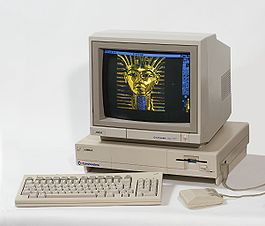
Personal computer
A personal computer is any general-purpose computer whose size, capabilities, and original sales price make it useful for individuals, and which is intended to be operated directly by an end-user with no intervening computer operator...
s that was sold by Commodore
Commodore International
Commodore is the commonly used name for Commodore Business Machines , the U.S.-based home computer manufacturer and electronics manufacturer headquartered in West Chester, Pennsylvania, which also housed Commodore's corporate parent company, Commodore International Limited...
in the 1980s and 1990s. The first model was launched in 1985 as a high-end home computer and became popular for its graphical, audio and multi-tasking abilities. The Amiga provided a significant upgrade from 8-bit computers, such as the Commodore 64
Commodore 64
The Commodore 64 is an 8-bit home computer introduced by Commodore International in January 1982.Volume production started in the spring of 1982, with machines being released on to the market in August at a price of US$595...
, and the platform quickly grew in popularity among computer enthusiasts. The best selling model, the Amiga 500
Amiga 500
The Amiga 500 - also known as the A500 - was the first “low-end” Commodore Amiga 16/32-bit multimedia home/personal computer. It was announced at the winter Consumer Electronics Show in January 1987 - at the same time as the high-end Amiga 2000 - and competed directly against the Atari 520ST...
, was introduced in 1987 and became the leading home computer of the late 1980s and early 1990s in much of Western Europe. In North America
North America
North America is a continent wholly within the Northern Hemisphere and almost wholly within the Western Hemisphere. It is also considered a northern subcontinent of the Americas...
success was more modest. The Amiga went on to sell approximately six million units. Second generation Amiga systems (A1200
Amiga 1200
The Amiga 1200, or A1200 , was Commodore International's third-generation Amiga computer, aimed at the home market...
and A4000
Amiga 4000
The Commodore Amiga 4000, or A4000, is the successor of the A2000 and A3000 computers. There are two models, the A4000/040 released in October 1992 with a Motorola 68040 CPU, and the A4000/030 released in April 1993 with a Motorola 68EC030....
) were released in 1992. However, poor marketing and failure to repeat the technological advances of the first systems meant that the Amiga quickly lost its market share to competing platforms, such as the fourth generation game consoles, Apple Macintosh and IBM PC compatible
IBM PC compatible
IBM PC compatible computers are those generally similar to the original IBM PC, XT, and AT. Such computers used to be referred to as PC clones, or IBM clones since they almost exactly duplicated all the significant features of the PC architecture, facilitated by various manufacturers' ability to...
s.
Based on the Motorola 68000 series of microprocessor
Microprocessor
A microprocessor incorporates the functions of a computer's central processing unit on a single integrated circuit, or at most a few integrated circuits. It is a multipurpose, programmable device that accepts digital data as input, processes it according to instructions stored in its memory, and...
s, the machine sports a custom chipset
Original Amiga chipset
The Original Chip Set was a chipset used in the earliest Commodore Amiga computers and defined the Amiga's graphics and sound capabilities...
with graphics and sound capabilities that were unprecedented for the price, and a pre-emptive multitasking operating system called AmigaOS
AmigaOS
AmigaOS is the default native operating system of the Amiga personal computer. It was developed first by Commodore International, and initially introduced in 1985 with the Amiga 1000...
.
Although early Commodore advertisements attempted to cast the computer as an all-purpose business machine, the Amiga was most commercially successful as a home computer, with a wide range of games and creative software. It was also a less expensive alternative to the Apple Macintosh and IBM-PC as a general-purpose business or home computer. The platform became particularly popular for gaming and demoscene
Demoscene
The demoscene is a computer art subculture that specializes in producing demos, which are non-interactive audio-visual presentations that run in real-time on a computer...
activities. It also found a prominent role in the desktop video
Desktop video
Desktop video refers to a phenomenon lasting from the mid-1980s to the early 1990s when the graphics capabilities of personal computers such as Commodore's Amiga, the Apple Macintosh II and specially-upgraded IBM PC compatibles had advanced to the point where individuals and local broadcasters...
, video production
Video production
Video production is videography, the process of capturing moving images on electronic media even streaming media. The term includes methods of production and post-production...
, and show control
Show control
Show control is the use of automation technology to link together and operate multiple entertainment control systems in a coordinated manner. It is distinguished from entertainment control , which coordinates elements within a single entertainment discipline such as lighting, sound, video, rigging...
business, leading to affordable video editing systems such as the Video Toaster
Video Toaster
The NewTek Video Toaster is a combination of hardware and software for the editing and production of standard-definition and high-definition video in NTSC, PAL, and resolution independent formats on Commodore Amiga computers and subsequently on computers running the Windows operating system...
. The Amiga's native ability to simultaneously play back multiple digital sound samples made it a popular platform for early "tracker" music software. The relatively powerful processor and ability to access several megabytes of memory led to the development of several 3D rendering packages, including LightWave 3D and Aladdin 4D.
Since the demise of Commodore, various groups have marketed successors to the original Amiga line. Eyetech
Eyetech
Eyetech Group Ltd is a company founded in 1983, in order to provide commercial companies with automatical data collection systems. They had already been involved in the provision of the automatic toll collection systems used at the Dartford River Crossing, as well as many of the bar code based...
sold PowerPC based hardware under the AmigaOne
AmigaOne
AmigaOne is a series of computers intended to run AmigaOS 4 developed by Hyperion Entertainment. Earlier models were produced by Eyetech, and were based on the Teron series of PowerPC POP mainboards...
brand from 2002 to 2005, and Acube sells the AmigaOS 3 compatible Minimig
Minimig
Minimig is an open source re-implementation of an Amiga 500 using a field-programmable gate array .Minimig started in secrecy around January 2005 as a proof of concept by Dutch electrical engineer Dennis van Weeren...
systems with a MC68000 compatible CPU and AmigaOS 4 compatible Sam440
Sam440
Sam440, also known by Sam or its codename Samantha, is a line of modular motherboards produced by the Italian company ACube Systems Srl. The Sam440ep version is a Power Architecture motherboard based on the PowerPC 440EP system-on-a-chip processor which includes a double-precision FPU. It is made...
and Sam460 systems with PowerPC processors.
The name Amiga was chosen by the developers specifically from the Spanish word for a female friend, and because it occurred before Apple and Atari
Atari
Atari is a corporate and brand name owned by several entities since its inception in 1972. It is currently owned by Atari Interactive, a wholly owned subsidiary of the French publisher Atari, SA . The original Atari, Inc. was founded in 1972 by Nolan Bushnell and Ted Dabney. It was a pioneer in...
alphabetically. It also gave the message that the Amiga computer line was 'user friendly' as a pun or play on words.
History

Jay Miner
Jay Glenn Miner , was a famous integrated circuit designer, known primarily for his work in multimedia chips and as the "father of the Amiga"...
as the principal hardware designer of Amiga Corporation
Amiga Corporation
Amiga Corporation was a United States computer company formed in the early 1980s as Hi-Toro. It is most famous for having developed the Amiga computer, code named Lorraine.-History:...
. It was initially intended to be a next generation video game machine, but was redesigned as a general purpose computer after the North American video game crash of 1983. A prototype of the full computer was shown to the public for the first time at the Summer Consumer Electronics Show
Consumer Electronics Show
The International Consumer Electronics Show is a major technology-related trade show held each January in the Las Vegas Convention Center, Las Vegas, Nevada, United States. Not open to the public, the Consumer Electronics Association-sponsored show typically hosts previews of products and new...
in 1984. In order to bring the design to market Commodore International
Commodore International
Commodore is the commonly used name for Commodore Business Machines , the U.S.-based home computer manufacturer and electronics manufacturer headquartered in West Chester, Pennsylvania, which also housed Commodore's corporate parent company, Commodore International Limited...
bought Amiga Corporation and funded development. The first model was released in 1985 as simply "The Amiga from Commodore", later to be retroactively dubbed the Amiga 1000
Amiga 1000
The A1000, or Commodore Amiga 1000, was Commodore's initial Amiga personal computer, introduced on July 23, 1985 at the Lincoln Center in New York City....
. The following year the Amiga product line was expanded with the introduction of two new models; the Amiga 2000
Amiga 2000
The Amiga 2000, or A2000, is a personal computer released by Commodore in 1986. It is the successor to the Amiga 1000.-Features:Aimed at the high-end market, the original Europe-only model adds a Zorro II backplane, implemented in programmable logic, to the custom Amiga chipset used in the Amiga 1000...
for high-end graphics and business use, and the Amiga 500
Amiga 500
The Amiga 500 - also known as the A500 - was the first “low-end” Commodore Amiga 16/32-bit multimedia home/personal computer. It was announced at the winter Consumer Electronics Show in January 1987 - at the same time as the high-end Amiga 2000 - and competed directly against the Atari 520ST...
for home use. Commodore later released other Amiga models, both for low-end gaming use and high-end productivity use.
In 1994, Commodore filed for bankruptcy and its assets were purchased by Escom, a German PC manufacturer, who created the subsidiary company Amiga Technologies. They re-released the A1200 and A4000T, and introduced a new 68060 version of the A4000T. However, Escom in turn went bankrupt in 1997. The Amiga brand was then sold to another PC manufacturer, Gateway 2000, which had announced grand plans for it. However, in 2000, Gateway sold the Amiga brand without having released any products. The current owner of the trademark, Amiga, Inc.
Amiga, Inc.
Amiga, Inc. is the company that holds the intellectual property associated with the Amiga personal computer , including the Amiga trademark.-Brief history of Amiga brand:...
, licensed the rights to sell hardware using the AmigaOne
AmigaOne
AmigaOne is a series of computers intended to run AmigaOS 4 developed by Hyperion Entertainment. Earlier models were produced by Eyetech, and were based on the Teron series of PowerPC POP mainboards...
brand to computer vendors Eyetech Group, Ltd. and A-Eon Technology CVBA. Unofficial Amiga clones were developed by Italian hardware company, Acube.
Hardware
At its core, the Amiga has a custom chipset consisting of several coprocessorCoprocessor
A coprocessor is a computer processor used to supplement the functions of the primary processor . Operations performed by the coprocessor may be floating point arithmetic, graphics, signal processing, string processing, or encryption. By offloading processor-intensive tasks from the main processor,...
s, which handle audio, video and direct memory access
Direct memory access
Direct memory access is a feature of modern computers that allows certain hardware subsystems within the computer to access system memory independently of the central processing unit ....
independently of the Central Processing Unit
Central processing unit
The central processing unit is the portion of a computer system that carries out the instructions of a computer program, to perform the basic arithmetical, logical, and input/output operations of the system. The CPU plays a role somewhat analogous to the brain in the computer. The term has been in...
(CPU). This architecture freed up the Amiga's processor for other tasks and gave the Amiga a performance edge over its competitors, particularly in terms of video-intensive applications and games.
The general Amiga architecture uses two distinct bus subsystems, namely, the chipset bus and the CPU bus. The chipset bus allows the custom coprocessors and CPU to address "Chip RAM". The CPU bus provides addressing to other subsystems, such as, conventional RAM, ROM and the Zorro II
Zorro II
Zorro II is the name of the general purpose expansion bus used by the Amiga 2000 computer. The bus is mainly a buffered extension of the Motorola 68000 bus, with support for bus mastering DMA. The expansion slots use a 100-pin connector and the card form factor is the same as the IBM PC...
or Zorro III
Zorro III
Released as the expansion bus of the Commodore Amiga 3000 in 1990, the Zorro III computer bus was used to attach peripheral devices to an Amiga motherboard. Designed by Commodore International lead engineer Dave Haynie, the 32-bit Zorro III replaced the 16-bit Zorro II bus used in the Amiga 2000...
expansion subsystems. This architecture enables independent operation of the subsystems. CPU expansion boards may provide additional custom buses. Additionally, "busboards" or "bridgeboards" may provide ISA
Industry Standard Architecture
Industry Standard Architecture is a computer bus standard for IBM PC compatible computers introduced with the IBM Personal Computer to support its Intel 8088 microprocessor's 8-bit external data bus and extended to 16 bits for the IBM Personal Computer/AT's Intel 80286 processor...
or PCI buses.
Central processing unit
The MotorolaMotorola
Motorola, Inc. was an American multinational telecommunications company based in Schaumburg, Illinois, which was eventually divided into two independent public companies, Motorola Mobility and Motorola Solutions on January 4, 2011, after losing $4.3 billion from 2007 to 2009...
68000 series of microprocessors was used in all Amiga models from Commodore. While the 68000 family has a 32-bit
32-bit
The range of integer values that can be stored in 32 bits is 0 through 4,294,967,295. Hence, a processor with 32-bit memory addresses can directly access 4 GB of byte-addressable memory....
design, the 68000 used in several early models is generally referred to as 16-bit. The 68000 has a 16-bit
16-bit
-16-bit architecture:The HP BPC, introduced in 1975, was the world's first 16-bit microprocessor. Prominent 16-bit processors include the PDP-11, Intel 8086, Intel 80286 and the WDC 65C816. The Intel 8088 was program-compatible with the Intel 8086, and was 16-bit in that its registers were 16...
external data bus so must transfer 32 bits of data in two consecutive steps, a technique called multiplexing
Multiplexing
The multiplexed signal is transmitted over a communication channel, which may be a physical transmission medium. The multiplexing divides the capacity of the low-level communication channel into several higher-level logical channels, one for each message signal or data stream to be transferred...
— all this is transparent to the software, which was 32-bit from the beginning. The 68000 could address 16 MB of physical memory. Later Amiga models featured full 32-bit CPUs with a larger address space and instruction pipeline
Instruction pipeline
An instruction pipeline is a technique used in the design of computers and other digital electronic devices to increase their instruction throughput ....
facilities. Commodore's design choice to remain with the 68000 architecture ensured that code was backward-compatible across the Amiga line.
CPU upgrades were offered by both Commodore and third-party manufacturers. Most Amiga models can be upgraded either by direct CPU replacement or through expansion boards. Such boards often featured faster and higher capacity memory interfaces and hard disk controllers.
Towards the end of Commodore's time in charge of Amiga development there were suggestions that Commodore intended to move away from the 68000 series to higher performance RISC processors, such as the PA-RISC
PA-RISC
PA-RISC is an instruction set architecture developed by Hewlett-Packard. As the name implies, it is a reduced instruction set computer architecture, where the PA stands for Precision Architecture...
. However, these ideas were never developed before Commodore filed for bankruptcy. Despite this, third-party manufacturers designed upgrades featuring a combination of 68000 series and PowerPC processors along with a PowerPC native micro-kernel
Kernel (computing)
In computing, the kernel is the main component of most computer operating systems; it is a bridge between applications and the actual data processing done at the hardware level. The kernel's responsibilities include managing the system's resources...
and software. Later Amiga clones featured PowerPC processors only.
Custom chipset
The custom chipset at the core of the Amiga design appeared in three distinct generations, with a large degree of backward-compatibility. The Original Chip Set (OCS) appeared with the launch of the A1000. OCS was eventually followed by the modestly improved Enhanced Chip SetEnhanced Chip Set
The Enhanced Chip Set is the second generation of the Amiga computer's chipset, offering minor improvements over the original chipset design. ECS was introduced in 1990 with the launch of the Amiga 3000. Amigas produced from 1990 onwards featured a mix of OCS and ECS chips, such as later versions...
(ECS) in 1990 and finally by the 32-bit Advanced Graphics Architecture
Advanced Graphics Architecture
Advanced Graphics Architecture is the third generation Amiga graphic chip set, first used in the Amiga 4000 in 1992. AGA was codenamed the Pandora chipset by Commodore International internally....
(AGA) in 1992. Each chipset consists of several coprocessors which handle graphics acceleration
Blitter
In a computer system, a blitter is a circuit, sometimes as a coprocessor or a logic block on a microprocessor, that is dedicated to the rapid movement and modification of data within that computer's memory...
, digital audio, direct memory access
Direct memory access
Direct memory access is a feature of modern computers that allows certain hardware subsystems within the computer to access system memory independently of the central processing unit ....
and communication between various peripherals (e.g., CPU, memory and floppy disks). In addition, some models featured auxiliary custom chip
Amiga custom chips
In addition to the Amiga chipsets, various specially designed chips have been used in Commodore Amiga computers that do not belong to the 'Amiga chipset' in a tight sense.- Gary :...
s which performed tasks, such as, SCSI
SCSI
Small Computer System Interface is a set of standards for physically connecting and transferring data between computers and peripheral devices. The SCSI standards define commands, protocols, and electrical and optical interfaces. SCSI is most commonly used for hard disks and tape drives, but it...
control and display de-interlacing.
Graphics

The Amiga chipset can genlock
Genlock
Genlock is a common technique where the video output of one source, or a specific reference signal from a signal generator, is used to synchronize other television picture sources together. The aim in video and digital audio applications is to ensure the coincidence of signals in time at a...
— adjust its own screen refresh timing to match an NTSC or PAL video signal. When combined with setting transparency, this allows an Amiga to overlay an external video source with graphics. This ability made the Amiga popular for many applications, and provides the ability to do character generation
Character generator
A character generator, often abbreviated as CG, is a device or software that produces static or animated text for keying into a video stream. Modern character generators are computer-based, and can generate graphics as well as text...
and CGI
Computer-generated imagery
Computer-generated imagery is the application of the field of computer graphics or, more specifically, 3D computer graphics to special effects in art, video games, films, television programs, commercials, simulators and simulation generally, and printed media...
effects far more cheaply than earlier systems. Some frequent users of this ability included wedding videographers, TV stations and their weather forecasting divisions (for weather graphics and radar), advertising channels, music video production, and 'desktop video'. The NewTek
NewTek
NewTek, Inc. is a San Antonio, Texas-based hardware and software company that produces live and post-production video tools and visual imaging software for personal computers...
Video Toaster
Video Toaster
The NewTek Video Toaster is a combination of hardware and software for the editing and production of standard-definition and high-definition video in NTSC, PAL, and resolution independent formats on Commodore Amiga computers and subsequently on computers running the Windows operating system...
was made possible by the genlock ability of the Amiga.
In 1988 the release of the Amiga A2024 fixed-frequency monochrome
Monochrome
Monochrome describes paintings, drawings, design, or photographs in one color or shades of one color. A monochromatic object or image has colors in shades of limited colors or hues. Images using only shades of grey are called grayscale or black-and-white...
monitor with built-in framebuffer and flicker fixer hardware provided the Amiga with a choice of high-resolution graphic modes (1024×800 for NTSC and 1024×1024 for PAL).
Sound
The sound chip, named Paula, supports four sound channels (two for the left speaker and two for the right) with 8-bit resolution for each channel and a 6-bit volume control per channel. The analog output is connected to a low-pass filter, which filters out high-frequency aliases when the Amiga is using a lower sampling rate (see Nyquist limit). The brightness of the Amiga's power LED is used to indicate the status of the Amiga’s low-pass filter. The filter is active when the LED is at normal brightness, and deactivated when dimmed (or off on older A500 Amigas). On Amiga 1000 (and very first Amiga 500 and Amiga 2000 model), the power LED had no relation to the filter's status, a wire needed to be manually soldered between pins on the sound chip to disable the filter. Paula can read directly from the system's RAMRam
-Animals:*Ram, an uncastrated male sheep*Ram cichlid, a species of freshwater fish endemic to Colombia and Venezuela-Military:*Battering ram*Ramming, a military tactic in which one vehicle runs into another...
, using direct memory access (DMA), making sound playback without CPU intervention possible.
Although the hardware is limited to four separate sound channels, software such as OctaMED
OctaMED
OctaMED is a popular sound tracker for the Commodore Amiga, written by Teijo Kinnunen. The first version, 1.12, was released in 1989 under the name MED, which stands for Music EDitor. In April 1990, version 2.00 was released with MIDI support as the main improvement...
uses software mixing to allow eight or more virtual channels, and it was possible for software to mix two hardware channels to achieve a single 14-bit resolution channel by playing with the volumes of the channels in such a way that one of the source channels contributes the most significant bits and the other the least ones.
The quality of the Amiga's sound output, and the fact that the hardware is ubiquitous and easily addressed by software, were standout features of Amiga hardware unavailable on PC platforms for years. Third-party sound cards exist that provide DSP functions, multi-track direct-to-disk recording, multiple hardware sound channels and 16-bit and beyond resolutions. A retargetable sound API called AHI
AHI (Amiga)
AHI is a retargetable audio subsystem for AmigaOS, MorphOS and AROS. It was created by Martin Blom in the mid 1990s to allow standardized operating system support for audio hardware other than just the native Amiga sound chip, for example, 16-bit sound cards.AHI offers improved functionality not...
was developed allowing these cards to be used transparently by the OS and software.
Kickstart firmware
Kickstart is the bootstrapBooting
In computing, booting is a process that begins when a user turns on a computer system and prepares the computer to perform its normal operations. On modern computers, this typically involves loading and starting an operating system. The boot sequence is the initial set of operations that the...
firmware
Firmware
In electronic systems and computing, firmware is a term often used to denote the fixed, usually rather small, programs and/or data structures that internally control various electronic devices...
. Its purpose is to initialize the Amiga hardware and core components of AmigaOS
AmigaOS
AmigaOS is the default native operating system of the Amiga personal computer. It was developed first by Commodore International, and initially introduced in 1985 with the Amiga 1000...
and then attempt to boot from a bootable volume
Volume (computing)
In the context of computer operating systems, volume is the term used to describe a single accessible storage area with a single file system, typically resident on a single partition of a hard disk. Similarly, it refers to the logical interface used by an operating system to access data stored on...
, such as a floppy disk or hard disk drive.
The first production Amiga, the Amiga 1000, required Kickstart to be loaded first from floppy disk into 256 kB
Kilobyte
The kilobyte is a multiple of the unit byte for digital information. Although the prefix kilo- means 1000, the term kilobyte and symbol KB have historically been used to refer to either 1024 bytes or 1000 bytes, dependent upon context, in the fields of computer science and information...
of RAM reserved for this purpose. Later models generally hold Kickstart on an embedded ROM
Read-only memory
Read-only memory is a class of storage medium used in computers and other electronic devices. Data stored in ROM cannot be modified, or can be modified only slowly or with difficulty, so it is mainly used to distribute firmware .In its strictest sense, ROM refers only...
chip, improving start-up times. Models can be upgraded by replacing the ROM. Like the Amiga 1000, early Amiga 3000 systems loaded Kickstart from hard (or floppy) disk as the machine was launched while AmigaOS 2.0 was still in beta development.
Several third-party vendors produced switchable socket doublers to allow two ROM chips to plug into the single ROM socket on the motherboard. These became popular as later Kickstart versions caused some backwards compatibility problems with earlier Amiga software titles. The effect of these switchable doublers was a convenient dual boot
Dual boot
Multi-boot or Multi-booting is the act of installing multiple operating systems on a computer, and being able to choose which one to boot when starting the computer. The term dual-booting refers to the common configuration of exactly two operating systems...
system, with a choice of two distinct OS versions via a pre-determined key sequence at reboot, or via a two way switch installed in the case, depending on the specific version installed.
Peripherals
The Amiga was one of the first home computers for which inexpensive sound sampling and video digitization accessories were available. As a result of this and the Amiga's audio and video capabilities the Amiga became a popular system for editing and producing both music and video.Many expansion boards were produced for Amiga computers to improve the performance and capability of the hardware, such as memory expansions, SCSI
SCSI
Small Computer System Interface is a set of standards for physically connecting and transferring data between computers and peripheral devices. The SCSI standards define commands, protocols, and electrical and optical interfaces. SCSI is most commonly used for hard disks and tape drives, but it...
controllers, CPU boards, and graphics boards. Other upgrades include genlocks, Ethernet cards, modems, sound cards and samplers, video digitizers, extra serial ports, and IDE controllers. Additions after the demise of Commodore company are USB cards.
The most popular upgrades were memory, SCSI controllers and CPU accelerator cards. These were sometimes combined into the one device.
Early CPU accelerator cards feature full 32-bit CPUs of the 68000 family such as the Motorola 68020
Motorola 68020
The Motorola 68020 is a 32-bit microprocessor from Motorola, released in 1984. It is the successor to the Motorola 68010 and is succeeded by the Motorola 68030...
and Motorola 68030
Motorola 68030
The Motorola 68030 is a 32-bit microprocessor in Motorola's 68000 family. It was released in 1987. The 68030 was the successor to the Motorola 68020, and was followed by the Motorola 68040. In keeping with general Motorola naming, this CPU is often referred to as the 030 .The 68030 features on-chip...
, almost always with 32-bit memory and usually with FPUs
Floating point unit
A floating-point unit is a part of a computer system specially designed to carry out operations on floating point numbers. Typical operations are addition, subtraction, multiplication, division, and square root...
and MMUs
Memory management unit
A memory management unit , sometimes called paged memory management unit , is a computer hardware component responsible for handling accesses to memory requested by the CPU...
or the facility to add them. Later designs feature the Motorola 68040
Motorola 68040
The Motorola 68040 is a microprocessor from Motorola, released in 1990. It is the successor to the 68030 and is followed by the 68060. There was no 68050. In keeping with general Motorola naming, the 68040 is often referred to as simply the '040 ....
and Motorola 68060
Motorola 68060
The Motorola 68060 is a 32-bit microprocessor from Motorola released in 1994. It is the successor to the Motorola 68040 and is the highest performing member of the 680x0 family. Two derivatives were produced, the 68LC060 and the 68EC060....
. Both CPUs feature integrated FPUs and MMUs. Many CPU accelerator cards also had integrated SCSI controllers.
Phase5 designed the PowerUP
PowerUP (accelerator)
PowerUP boards were dual-processor 68k–PowerPC accelerator boards designed by Phase5 Digital Products for Amiga computers. They had two different processors working in parallel, sharing the complete address space of the Amiga computer system.-History:...
boards (Blizzard PPC and CyberStorm PPC) featuring both a 68k (a 68040 or 68060) and a PowerPC (603 or 604) CPU, which are able to run the two CPUs at the same time (and share the system memory). The PowerPC CPU on PowerUP boards is usually used as a coprocessor for heavy computations (a powerful CPU is needed to run for example MAME
MAME
MAME is an emulator application designed to recreate the hardware of arcade game systems in software on modern personal computers and other platforms. The intention is to preserve gaming history by preventing vintage games from being lost or forgotten...
, but even decoding JPEG
JPEG
In computing, JPEG . The degree of compression can be adjusted, allowing a selectable tradeoff between storage size and image quality. JPEG typically achieves 10:1 compression with little perceptible loss in image quality....
pictures and MP3
MP3
MPEG-1 or MPEG-2 Audio Layer III, more commonly referred to as MP3, is a patented digital audio encoding format using a form of lossy data compression...
audio was considered heavy computation at the time). It is also possible to ignore the 68k CPU and run Linux
Linux
Linux is a Unix-like computer operating system assembled under the model of free and open source software development and distribution. The defining component of any Linux system is the Linux kernel, an operating system kernel first released October 5, 1991 by Linus Torvalds...
on the PPC (project Linux APUS), but a PowerPC native AmigaOS promised by Amiga Technologies GmbH was not available when the PowerUP boards first appeared.
24-bit graphics cards and video cards were also available. Graphics cards are designed primarily for 2D artwork production, workstation use, and later, gaming. Video cards are designed for inputting and outputting video signals, and processing and manipulating video.
Perhaps the most famous video card in the North American market was the NewTek Video Toaster
Video Toaster
The NewTek Video Toaster is a combination of hardware and software for the editing and production of standard-definition and high-definition video in NTSC, PAL, and resolution independent formats on Commodore Amiga computers and subsequently on computers running the Windows operating system...
. This was a powerful video effects board which turned the Amiga into an affordable video processing computer which found its way into many professional video environments. Due to its NTSC
NTSC
NTSC, named for the National Television System Committee, is the analog television system that is used in most of North America, most of South America , Burma, South Korea, Taiwan, Japan, the Philippines, and some Pacific island nations and territories .Most countries using the NTSC standard, as...
-only design it did not find a market in countries that used the PAL
PAL
PAL, short for Phase Alternating Line, is an analogue television colour encoding system used in broadcast television systems in many countries. Other common analogue television systems are NTSC and SECAM. This page primarily discusses the PAL colour encoding system...
standard, such as in Europe. In PAL countries the OpalVision card was popular, although less featured and supported than the Video Toaster. Low-cost time base correctors (TBCs)
Timebase correction
Time base correction is a technique to reduce or eliminate errors caused by mechanical instability present in analog recordings on mechanical media. Without time base correction, a signal from a videotape recorder or videocassette recorder cannot be mixed with other, more time stable devices...
specifically designed to work with the Toaster quickly came to market, most of which were designed as standard Amiga bus cards.
Various manufacturers started producing PCI busboards for the A1200 and A4000, allowing standard Amiga computers to use PCI cards such as Voodoo graphic cards, Sound Blaster
Sound Blaster
The Sound Blaster family of sound cards was the de facto standard for consumer audio on the IBM PC compatible system platform, until the widespread transition to Microsoft Windows 95, which standardized the programming interface at application level , and the evolution in PC design led to onboard...
sound cards, 10/100 Ethernet cards, and TV tuner cards. Other manufacturers produced hybrid boards which contained an Intel x86 series chip, allowing the Amiga to emulate a PC.
PowerPC upgrades with Wide SCSI controllers, PCI busboards with Ethernet, sound and 3D graphics cards, and tower cases allowed the A1200 and A4000 to survive well into the late nineties.
Expansion boards were made by Richmond Sound Design
Richmond Sound Design
Richmond Sound Design Ltd. is a theatre sound design and show control systems and software developer and manufacturer. It was founded in 1972 by Charlie Richmond. The company began as a manufacturer of specialty mixers and theatre sound design consoles...
that allow their show control
Show control
Show control is the use of automation technology to link together and operate multiple entertainment control systems in a coordinated manner. It is distinguished from entertainment control , which coordinates elements within a single entertainment discipline such as lighting, sound, video, rigging...
and sound design
Sound design
Sound design is the process of specifying, acquiring, manipulating or generating audio elements. It is employed in a variety of disciplines including filmmaking, television production, theatre, sound recording and reproduction, live performance, sound art, post-production and video game software...
software to communicate with their custom hardware frames either by ribbon cable or fiber optic cable for long distances, allowing the Amiga to control up to eight million digitally controlled external audio, lighting, automation, relay and voltage control channels spread around a large theme park, for example. See Amiga software
Amiga software
Amiga software covers a wide range of software for the Amiga computer, both productivity and games, commercial, freeware and hobbyist. The Amiga software market was particularly active in the late 1980s and early 1990s but has since the period 1996/1999 dwindled into almost only a hobbyist...
for more information on these applications.
Other popular devices:
- Trumpcard 500 Zorro-II SCSI interface.
- A590 SCSI hard disk controller.
- A3070 SCSI tape backup unit with a capacity of 250 MB.
- A2065 EthernetEthernetEthernet is a family of computer networking technologies for local area networks commercially introduced in 1980. Standardized in IEEE 802.3, Ethernet has largely replaced competing wired LAN technologies....
Zorro-II interface. The first Ethernet interface for Amiga; uses the AMD Am7990AMD Lance Am7990AMD Lance Am7990 IEEE 802.3 Ethernet Media Access Controller controller were introduced in 1985. Its architecture is the basis for AMD’s PCnet Family of highly integrated single-chip Ethernet controllers...
chip. The same interface chip is used in DECstationDECstationThe DECstation was a brand of computers used by DEC, and refers to three distinct lines of computer systems—the first released in 1978 as a word processing system, and the latter two both released in 1989. These comprised a range of computer workstations based on the MIPS architecture and a...
as well. - Ariadne Zorro IIZorro IIZorro II is the name of the general purpose expansion bus used by the Amiga 2000 computer. The bus is mainly a buffered extension of the Motorola 68000 bus, with support for bus mastering DMA. The expansion slots use a 100-pin connector and the card form factor is the same as the IBM PC...
EthernetEthernetEthernet is a family of computer networking technologies for local area networks commercially introduced in 1980. Standardized in IEEE 802.3, Ethernet has largely replaced competing wired LAN technologies....
interface using AMD Am7990. - A4066 Zorro II Ethernet interface using SMC 91C90QF.
- X-Surf from Individual Computers using Realtek 8019AS.
- A2060 Arcnet.
- A1010 FloppyFloppy disk controllerA floppy disk controller is a special-purpose chip and associated disk controller circuitry that directs and controls reading from and writing to a computer's floppy disk drive . This article contains concepts common to FDCs based on the NEC µPD765 and Intel 8072A or 82072A and their descendants,...
drive. Consists of an 3,5" DDDouble densityDouble density, often shortened DD, is a capacity designation on magnetic storage, usually floppy disks. It describes the use of an encoding of information, which can encode on average twice as many bits per time unit compared to single density...
, , drive unit connected via DB-23D-subminiatureThe D-subminiature or D-sub is a common type of electrical connector. They are named for their characteristic D-shaped metal shield. When they were introduced, D-subs were among the smaller connectors used on computer systems....
connector. Track-to-track delay is on the order of . The default capacity is . Many clone drives were available, and products such as CatWeaselCatWeaselThe Catweasel is a family of enhanced floppy disk controllers from German company Individual Computers. These controllers are designed to allow more recent computers, such as PCs, to access a wide variety of older disk formats using standard floppy drives....
makes it possible to read and write Amiga and other special disc formats on standard x86 PCs. - NE2000NE2000The NE1000/NE2000 is an early line of low cost Ethernet network cards originally produced by Novell. Its popularity had a significant impact on the pervasiveness of networks in computing...
compatible PCMCIA ethernet cards for Amiga 600 and Amiga 1200
Networking
Amiga had three networking interface APIs:- AS225 - Is the official Commodore TCP/IP stack APIApplication programming interfaceAn application programming interface is a source code based specification intended to be used as an interface by software components to communicate with each other...
with hardcoded drivers in revision 1 (AS225r1) for the A2065 EthernetAMD Lance Am7990AMD Lance Am7990 IEEE 802.3 Ethernet Media Access Controller controller were introduced in 1985. Its architecture is the basis for AMD’s PCnet Family of highly integrated single-chip Ethernet controllers...
and the A2060 Arcnet interfaces. In revision 2 (AS225r2) the SANA-II interface was used. - SANA-II — Is a standardized API for hardware of network interfaces. It uses an inefficient buffer handling scheme, and lacks proper support for promiscuousPromiscuous modeIn computer networking, promiscuous mode or promisc mode is a mode for a network interface controller that causes the NIC to pass all traffic it receives to the central processing unit rather than just passing frames the NIC is intended to receive...
and multicastMulticastIn computer networking, multicast is the delivery of a message or information to a group of destination computers simultaneously in a single transmission from the source creating copies automatically in other network elements, such as routers, only when the topology of the network requires...
modes. - Miami Network Interface (MNI) - Is an API that doesn't have the problems which SANA-II suffers from. It requires AmigaOSAmigaOSAmigaOS is the default native operating system of the Amiga personal computer. It was developed first by Commodore International, and initially introduced in 1985 with the Amiga 1000...
v2,04 or higher.
Different network media was used:
| Type | Speed | Example |
|---|---|---|
| Ethernet Ethernet Ethernet is a family of computer networking technologies for local area networks commercially introduced in 1980. Standardized in IEEE 802.3, Ethernet has largely replaced competing wired LAN technologies.... |
10/100 Mbit/s | A2065 |
| ARCNET ARCNET ARCNET is a local area network protocol, similar in purpose to Ethernet or Token Ring. ARCNET was the first widely available networking system for microcomputers and became popular in the 1980s for office automation tasks... |
2.5 Mbit/s | A560, A2060 |
| Floppy disk controller Floppy disk controller A floppy disk controller is a special-purpose chip and associated disk controller circuitry that directs and controls reading from and writing to a computer's floppy disk drive . This article contains concepts common to FDCs based on the NEC µPD765 and Intel 8072A or 82072A and their descendants,... |
250 kbit/s | Amitrix: Amiga-Link |
| Serial port Serial port In computing, a serial port is a serial communication physical interface through which information transfers in or out one bit at a time... |
||
| Parallel port Parallel port A parallel port is a type of interface found on computers for connecting various peripherals. In computing, a parallel port is a parallel communication physical interface. It is also known as a printer port or Centronics port... |
~1600 kbit/s | Village Tronic: Liana |
| Token ring | 1.5 Mbit/s | Nine Tiles: AmigaLink (9 Tiles) |
| AppleTalk AppleTalk AppleTalk is a proprietary suite of protocols developed by Apple Inc. for networking computers. It was included in the original Macintosh released in 1984, but is now unsupported as of the release of Mac OS X v10.6 in 2009 in favor of TCP/IP networking... / LocalTalk LocalTalk LocalTalk is a particular implementation of the physical layer of the AppleTalk networking system from Apple Computer. LocalTalk specifies a system of shielded twisted pair cabling, plugged into self-terminating transceivers, running at a rate of 230.4 kbit/s... |
PPS-Doubletalk |
Casing
Most Amiga cases are made from ABSAcrylonitrile butadiene styrene
Acrylonitrile butadiene styrene is a common thermoplastic. Its melting point is approximately 105 °C ....
plastics which may become brown with time. This can be reversed by using the public domain chemical mix "Retr0bright
Retr0bright
Retr0bright is a public domain chemical mixture used to remove yellowing from ABS plastic computer cases that were popular in the 1980s and 1990s, such as Commodore, Apple and Amiga computers. Yellowing is caused by both bromine and exposure to UV light...
".
Models and variants
The original Amiga models were produced from 1985 to 1996. They are, in order of appearance: 1000Amiga 1000
The A1000, or Commodore Amiga 1000, was Commodore's initial Amiga personal computer, introduced on July 23, 1985 at the Lincoln Center in New York City....
, 2000
Amiga 2000
The Amiga 2000, or A2000, is a personal computer released by Commodore in 1986. It is the successor to the Amiga 1000.-Features:Aimed at the high-end market, the original Europe-only model adds a Zorro II backplane, implemented in programmable logic, to the custom Amiga chipset used in the Amiga 1000...
, 500
Amiga 500
The Amiga 500 - also known as the A500 - was the first “low-end” Commodore Amiga 16/32-bit multimedia home/personal computer. It was announced at the winter Consumer Electronics Show in January 1987 - at the same time as the high-end Amiga 2000 - and competed directly against the Atari 520ST...
, 1500
Amiga 1500
The Commodore Amiga 1500, also known as the A1500, was a 16/32-bit home/personal computer released in 1990. It originally sold for £999. It was a variation of the Amiga 2000, and was released only in the United Kingdom. It differed from the A2000 by having two internal floppy drives instead of one,...
, 2500
Amiga 2500
The Amiga 2500, also known as the A2500, was not a distinct Amiga model, but simply a marketing name for a Commodore Amiga 2000 bundled with a Motorola 68020 or 68030-based accelerator card. The accelerator cards used by the A2500 were also available separately as upgrades for the A2000...
, 3000
Amiga 3000
The Commodore Amiga 3000, or A3000, was the third major release in the Amiga computer family. Released in June 1990, it features improved processing speed, improved rendering of graphics, and a new revision of the operating system...
, 3000UX
Amiga 3000UX
The Commodore Amiga 3000UX is a model of the Amiga computer family that was released with Amiga Unix, a full port of AT&T Unix System V Release 4 , installed along with AmigaOS. The system was otherwise equivalent to the standard A3000, once the Right-Mouse-Button initiated a boot to Kickstart .At...
, 3000T
Amiga 3000T
The Amiga 3000T is the tower version of the Commodore Amiga 3000 computer. Although technically equivalent, it was housed in a large metal tower case repurposed from Commodore's PC compatible line....
, CDTV, 500+
Amiga 500+
The Commodore Amiga 500 Plus is an enhanced version of the original Amiga 500 computer. It was notable for introducing new versions of Kickstart and Workbench, and for some minor improvements in the custom chips, known as the Enhanced Chip Set .- Introduction :The A500+ was released in several...
, 600
Amiga 600
The Amiga 600, also known as the A600 , is a home computer that was introduced at the CeBIT show in March 1992. The A600 was Commodore International's final model based on the Motorola 68000 CPU and the ECS chipset. It is essentially a redesign of the Amiga 500 Plus, with the option of an internal...
, 4000
Amiga 4000
The Commodore Amiga 4000, or A4000, is the successor of the A2000 and A3000 computers. There are two models, the A4000/040 released in October 1992 with a Motorola 68040 CPU, and the A4000/030 released in April 1993 with a Motorola 68EC030....
, 1200
Amiga 1200
The Amiga 1200, or A1200 , was Commodore International's third-generation Amiga computer, aimed at the home market...
, CD32
Amiga CD32
The Amiga CD32, styled "CD32" , was the first 32-bit CD-ROM based video game console released in western Europe, Australia, Canada and Brazil. It was first announced at the Science Museum in London, United Kingdom on 16 July 1993, and was released in September of the same year...
, and 4000T
Amiga 4000T
The Amiga 4000T, also known as A4000T, was a tower version of the A4000 computer. Using the AGA chipset, it was originally released in small quantities in 1994 with a 25 MHz Motorola 68040 CPU, and re-released in greater numbers by Escom in 1995, after Commodore's demise, along with a new...
. The PowerPC based AmigaOne
AmigaOne
AmigaOne is a series of computers intended to run AmigaOS 4 developed by Hyperion Entertainment. Earlier models were produced by Eyetech, and were based on the Teron series of PowerPC POP mainboards...
was later produced from 2002 to 2005. Some companies have also released Amiga clones
Clone (computer science)
In computing, a clone is a hardware or software system that is designed to mimic another system. Compatibility with the original system is usually the explicit purpose of cloning hardware or low-level software such as operating systems...
.
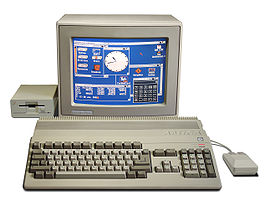
Commodore Amiga
PC World (magazine)
PC World is a global computer magazine published monthly by IDG. It offers advice on various aspects of PCs and related items, the Internet, and other personal-technology products and services...
rated the Amiga 1000 as the seventh greatest PC of all time, stating "Years ahead of its time, the Amiga was the world's first multimedia, multitasking personal computer".
Following the A1000, Commodore updated the desktop line of Amiga computers with the Amiga 2000
Amiga 2000
The Amiga 2000, or A2000, is a personal computer released by Commodore in 1986. It is the successor to the Amiga 1000.-Features:Aimed at the high-end market, the original Europe-only model adds a Zorro II backplane, implemented in programmable logic, to the custom Amiga chipset used in the Amiga 1000...
in 1987, the Amiga 3000
Amiga 3000
The Commodore Amiga 3000, or A3000, was the third major release in the Amiga computer family. Released in June 1990, it features improved processing speed, improved rendering of graphics, and a new revision of the operating system...
in 1990, and the Amiga 4000
Amiga 4000
The Commodore Amiga 4000, or A4000, is the successor of the A2000 and A3000 computers. There are two models, the A4000/040 released in October 1992 with a Motorola 68040 CPU, and the A4000/030 released in April 1993 with a Motorola 68EC030....
in 1992, each offering improved capabilities and expansion options. However, the best selling models were the budget models, particularly the highly successful Amiga 500
Amiga 500
The Amiga 500 - also known as the A500 - was the first “low-end” Commodore Amiga 16/32-bit multimedia home/personal computer. It was announced at the winter Consumer Electronics Show in January 1987 - at the same time as the high-end Amiga 2000 - and competed directly against the Atari 520ST...
(1987) and the Amiga 1200
Amiga 1200
The Amiga 1200, or A1200 , was Commodore International's third-generation Amiga computer, aimed at the home market...
(1992). The Amiga 500+
Amiga 500+
The Commodore Amiga 500 Plus is an enhanced version of the original Amiga 500 computer. It was notable for introducing new versions of Kickstart and Workbench, and for some minor improvements in the custom chips, known as the Enhanced Chip Set .- Introduction :The A500+ was released in several...
(1991) was the shortest lived model, replacing the Amiga 500 and lasting only six months until it was phased out and replaced with the Amiga 600
Amiga 600
The Amiga 600, also known as the A600 , is a home computer that was introduced at the CeBIT show in March 1992. The A600 was Commodore International's final model based on the Motorola 68000 CPU and the ECS chipset. It is essentially a redesign of the Amiga 500 Plus, with the option of an internal...
(1992), which in turn was also quickly replaced by the Amiga 1200.
The CDTV, launched in 1991, was a CD-ROM
CD-ROM
A CD-ROM is a pre-pressed compact disc that contains data accessible to, but not writable by, a computer for data storage and music playback. The 1985 “Yellow Book” standard developed by Sony and Philips adapted the format to hold any form of binary data....
based all-in-one multimedia system. It was an early attempt at a multi-purpose multimedia appliance in an era before multimedia consoles and CD-ROM drives were common. Unfortunately for Commodore, the system never achieved any real commercial success.
Commodore's last Amiga offering before filing for bankruptcy was an attempt to capture a portion of the highly competitive 1990s console market with the Amiga CD32
Amiga CD32
The Amiga CD32, styled "CD32" , was the first 32-bit CD-ROM based video game console released in western Europe, Australia, Canada and Brazil. It was first announced at the Science Museum in London, United Kingdom on 16 July 1993, and was released in September of the same year...
(1993), a 32-bit CD-ROM games console. Though discontinued after Commodore's demise it met with moderate commercial success in Europe.
Following purchase of Commodore's assets by Escom in 1995, the A1200 and A4000T continued to be sold in small quantities until 1996, though the ground lost since the initial launch and the prohibitive expense of these units meant that the Amiga line never regained any real popularity.
Several Amiga models contained references to songs by the rock
Rock music
Rock music is a genre of popular music that developed during and after the 1960s, particularly in the United Kingdom and the United States. It has its roots in 1940s and 1950s rock and roll, itself heavily influenced by rhythm and blues and country music...
band The B-52's
The B-52's
The B-52's are an American rock band, formed in Athens, Georgia in 1976. The original line-up consisted of Fred Schneider , Kate Pierson , Cindy Wilson , Ricky Wilson , and Keith Strickland . Following Ricky Wilson's death in 1985 Strickland switched to guitar...
. Early A500 units, at least, had the words "B52/ROCK LOBSTER" silk-screen printed onto their printed circuit board
Printed circuit board
A printed circuit board, or PCB, is used to mechanically support and electrically connect electronic components using conductive pathways, tracks or signal traces etched from copper sheets laminated onto a non-conductive substrate. It is also referred to as printed wiring board or etched wiring...
, a reference to the popular song "Rock Lobster
Rock lobster
Jasus edwardsii, the southern rock lobster, red rock lobster, or spiny rock lobster, is a species of spiny lobster found throughout coastal waters of southern Australia and New Zealand including the Chatham Islands. This species is commonly called crayfish or crays in New Zealand and in Māori...
" The Amiga 600
Amiga 600
The Amiga 600, also known as the A600 , is a home computer that was introduced at the CeBIT show in March 1992. The A600 was Commodore International's final model based on the Motorola 68000 CPU and the ECS chipset. It is essentially a redesign of the Amiga 500 Plus, with the option of an internal...
referenced "JUNE BUG" (after the song "Junebug") and the Amiga 1200
Amiga 1200
The Amiga 1200, or A1200 , was Commodore International's third-generation Amiga computer, aimed at the home market...
had "CHANNEL Z" (after "Channel Z
Channel Z (song)
"Channel Z" is a single by The B-52's from their 1989 album Cosmic Thing. The song was about a fictional radio station whose motto was "Channel Z: All static, all day, Forever!". Television sets of the era typically had two analog channel selector dials, one for VHF band and one for UHF. The UHF...
").
AmigaOS 4 systems
AmigaOS 4 (OS4) is designed for PowerPC Amiga systems and currently runs on both Amigas equipped with CyberstormPPC or BlizzardPPC accelerator boards, and on the PPC Teron series based AmigaOneAmigaOne
AmigaOne is a series of computers intended to run AmigaOS 4 developed by Hyperion Entertainment. Earlier models were produced by Eyetech, and were based on the Teron series of PowerPC POP mainboards...
computers built by Eyetech
Eyetech
Eyetech Group Ltd is a company founded in 1983, in order to provide commercial companies with automatical data collection systems. They had already been involved in the provision of the automatic toll collection systems used at the Dartford River Crossing, as well as many of the bar code based...
under license by Amiga Inc. AmigaOS 4.0 had been available only in developer pre-releases for numerous years until it was officially released in December 2006. Due to the nature of some provisions of the contract between Amiga Inc. and Hyperion Entertainment
Hyperion Entertainment
Hyperion Entertainment CVBA is a Belgian software company which in its early years focused in porting Windows games to Amiga, Linux and Macintosh. Later on, they were contracted by Amiga Incorporated to develop AmigaOS 4 and retired from the gaming business...
(the Belgian company which is developing the OS), the commercial AmigaOS 4 had been available only to licensed buyers of AmigaOne motherboards.
AmigaOS 4.0 for Amigas equipped with PowerUP accelerator boards was released in November 2007. The most recent release AmigaOS is 4.1.
No new Amiga hardware has been released since the AmigaOne; however Acube Systems has entered an agreement with Hyperion under which it has ported AmigaOS 4 to its Sam440ep and Sam460ex
Sam460ex
Sam460ex is a line of modular motherboards produced by the Italian company ACube Systems Srl. The machine was released in October 2010 and can run AmigaOS 4 or Debian GNU/Linux....
line of PowerPC-based motherboards. In 2009 version for Pegasos II
Pegasos
Pegasos is a MicroATX motherboard powered by a PowerPC 750CXe or PowerPC 7447 microprocessor, featuring three PCI slots, one AGP slot, two Ethernet ports , USB, DDR, AC'97 sound, and FireWire...
from Genesi
Genesi
Genesi is computer company focused on building Power Architecture and ARM architecture computers. The organization is split into two units, Genesi USA, Inc. working out of Texas operating as the primary front-end for sales, customers and developers, and bplan GmbH based in Germany as the primary...
/bPlan GmbH was released in co-operation with Acube Systems. Moreover, in 2009/2010, A-Eon Technology announced the AmigaOne X1000
AmigaOne X1000
AmigaOne X1000 is a PowerPC based computer intended as a high-end platform for AmigaOS 4. It was announced by A-Eon Technology CVBA in partnership with Hyperion Entertainment and is expected in late 2011...
.
Amiga hardware clones
Long-time Amiga developer MacroSystem entered the Amiga-clone market with their DraCo nonlinear video editNon-linear editing system
In video, a non-linear editing system is a video editing or audio editing digital audio workstation system which can perform random access non-destructive editing on the source material...
system. It appears in two versions, initially a tower model and later a cube. DraCo expanded upon and combined a number of earlier expansion cards developed for Amiga (VLabMotion, Toccata, WarpEngine, RetinaIII) into a true Amiga-clone powered by Motorola's 68060
Motorola 68060
The Motorola 68060 is a 32-bit microprocessor from Motorola released in 1994. It is the successor to the Motorola 68040 and is the highest performing member of the 680x0 family. Two derivatives were produced, the 68LC060 and the 68EC060....
processor. The DraCo can run AmigaOS 3.1 up through AmigaOS 3.9. It is the only Amiga-based system to support FireWire for video I/O. DraCo also offers an Amiga-compatible ZORRO-II expansion bus and introduced a faster custom DraCoBus, capable of 30 MB/sec transfer rates (faster than Commodore's ZORRO-III). The technology was later used in the Casablanca system, a set-top-box also designed for non-linear video editing.
In 1998, Index Information released the Access, an Amiga-clone similar to the Amiga 1200, but on a motherboard which could fit into a standard 5 1/4" drive bay. It features either a 68020
Motorola 68020
The Motorola 68020 is a 32-bit microprocessor from Motorola, released in 1984. It is the successor to the Motorola 68010 and is succeeded by the Motorola 68030...
or 68030
Motorola 68030
The Motorola 68030 is a 32-bit microprocessor in Motorola's 68000 family. It was released in 1987. The 68030 was the successor to the Motorola 68020, and was followed by the Motorola 68040. In keeping with general Motorola naming, this CPU is often referred to as the 030 .The 68030 features on-chip...
CPU, with a redesigned AGA chipset, and runs AmigaOS 3.1.
In 1998, former Amiga employees (John Smith, Peter Kittel, Dave Haynie
Dave Haynie
Dave Haynie is the former Commodore International chief engineer on high end and advanced projects. He is still quite vocal in the Amiga community.-Beginnings:...
and Andy Finkel to mention few) formed new company called PIOS. Their hardware platform, PIOS One, was aimed at Amiga, Atari and Macintosh users. The company was renamed to Met@box in 1999 until it folded.
The NatAmi (short for Native Amiga) hardware project began in 2005 with the aim of designing and building an Amiga clone
Home computer remakes
A home computer remake is a re-creation or re-implementation of classic home computer hardware, usually using updated technology, such as FPGAs....
motherboard that is enhanced with modern features. The NatAmi motherboard is a standard Mini-ITX
Mini-ITX
Mini-ITX is a 17 x 17 cm low-power motherboard form factor developed by VIA Technologies in 2001. Mini-ITX is slightly smaller than microATX. Mini-ITX boards can often be passively cooled due to their low power consumption architecture, which makes them useful for home theater PC systems,...
-compatible form factor computer motherboard, powered by a Motorola/Freescale 68060 and its chipset. It is compatible with the original Amiga chipset, which has been inscribed on a programmable FPGA Altera
Altera
Altera Corporation is a Silicon Valley manufacturer of PLDs . The company offered its first programmable logic device in 1984. PLDs can be reprogrammed during the design cycle as well as in the field to perform multiple functions, and they support a fairly fast design process...
chip on the board. The NatAmi is the second Amiga clone project after the Minimig
Minimig
Minimig is an open source re-implementation of an Amiga 500 using a field-programmable gate array .Minimig started in secrecy around January 2005 as a proof of concept by Dutch electrical engineer Dennis van Weeren...
motherboard, and its history is very similar to that of the C-One
C-One
The C-One is a single-board computer designed by Jeri Ellsworth, a self-taught designer, and Jens Schönfeld from Individual Computers, who manufactured the boards themselves...
mainboard developed by Jeri Ellsworth
Jeri Ellsworth
Jeri Ellsworth is an American entrepreneur and self-taught computer chip designer. She is best known for creating a Commodore 64 emulator within a joystick, in 2004, called Commodore 30-in-1 Direct to TV...
and Jens Schönfeld. From a commercial point of view, Natami's circuitry and design are currently Closed Source. One goal of the NatAmi project is to design an Amiga-compatible motherboard that includes up-to-date features but that does not rely on emulation (as in WinUAE), modern PC Intel components, or a modern PowerPC
PowerPC
PowerPC is a RISC architecture created by the 1991 Apple–IBM–Motorola alliance, known as AIM...
mainboard. As such, NatAmi is not intended to become another evolutionary heir to classic Amigas (such as with AmigaOne
AmigaOne
AmigaOne is a series of computers intended to run AmigaOS 4 developed by Hyperion Entertainment. Earlier models were produced by Eyetech, and were based on the Teron series of PowerPC POP mainboards...
or Pegasos
Pegasos
Pegasos is a MicroATX motherboard powered by a PowerPC 750CXe or PowerPC 7447 microprocessor, featuring three PCI slots, one AGP slot, two Ethernet ports , USB, DDR, AC'97 sound, and FireWire...
computers). This "purist" philosophy essentially limits the resulting processor speed but puts the focus on bandwidth and low latencies. The developers also recreated the entire Amiga chipset, freeing it from Classic Amiga legacy limitations such as two megabytes of audio and video graphics RAM as in the AGA chipset, and rebuilt this new chipset by programming a modern FPGA Altera
Altera
Altera Corporation is a Silicon Valley manufacturer of PLDs . The company offered its first programmable logic device in 1984. PLDs can be reprogrammed during the design cycle as well as in the field to perform multiple functions, and they support a fairly fast design process...
Cyclone IV chip. Later, the developers decided to create from scratch a new software-form processor chip, codenamed "N68050" that resides in the physical Altera FPGA programmable chip.
In 2006, two new Amiga clones were announced, both using FPGA
Field-programmable gate array
A field-programmable gate array is an integrated circuit designed to be configured by the customer or designer after manufacturing—hence "field-programmable"...
based hardware synthesis to replace the Amiga OCS custom chipset. The first, the Minimig
Minimig
Minimig is an open source re-implementation of an Amiga 500 using a field-programmable gate array .Minimig started in secrecy around January 2005 as a proof of concept by Dutch electrical engineer Dennis van Weeren...
, is a personal project of Dutch engineer Dennis van Weeren. Referred to as "new Amiga hardware", the original model was built on a Xilinx
Xilinx
Xilinx, Inc. is a supplier of programmable logic devices. It is known for inventing the field programmable gate array and as the first semiconductor company with a fabless manufacturing model....
Spartan-3 development board, but soon a dedicated board was developed. The minimig uses the FPGA to reproduce the custom Denise, Agnus, Paula and Gary chips as well as both 8520 CIAs
MOS Technology CIA
The 6526/8520 Complex Interface Adapter was an integrated circuit made by MOS Technology. It served as a I/O port controller for the 6502 family of microprocessors, providing for parallel and serial I/O capabilities as well as timers and a Time-of-Day clock...
and implements a simple version of Amber. The rest of the chips are an actual 68000 CPU, ram chips, and a PIC microcontroller for BIOS
BIOS
In IBM PC compatible computers, the basic input/output system , also known as the System BIOS or ROM BIOS , is a de facto standard defining a firmware interface....
control. The design for Minimig was released as open source
Open source
The term open source describes practices in production and development that promote access to the end product's source materials. Some consider open source a philosophy, others consider it a pragmatic methodology...
on July 25, 2007. In February, 2008, an Italian company Acube Systems began selling Minimig boards. A third party upgrade replaces the PIC microcontroller with a more powerful ARM processor, providing more functionality such as write access and support for hard disk images. The minimig core is being ported to the FPGArcade "Replay" board. The Replay uses a larger FPGA which will support the AGA chipset and a 63030 soft core. The Replay board is designed to emulate many older computers and classic arcade machines.
The second is the Clone-A system announced by Individual Computers
Individual Computers
Individual Computers is a German computer hardware company specializing in retrocomputing accessories for the Commodore 64, Amiga, and PC platforms. Individual Computers produced the C-One reconfigurable computer in 2003...
. As of mid 2007 it has been shown in its development form, with FPGA-based boards replacing the Amiga chipset and mounted on an Amiga 500 motherboard.
In 2011 by ArcadeRetroGaming, called the Multiple Classic Computer, which emulates the Commodore 64. Support for Amiga software is planned.
Emulation
Like many popular but discontinued platforms, the Amiga has been the target of various emulation projects so that software developed for the Amiga can be run on other computer platforms without the original hardware. Such emulators attempt to replicate the functionality of the Amiga architecture in software. As mentioned above, attempts have also been made to replicate the Amiga chipset in FPGA chips.One of the most challenging aspects of emulation is the design of the Amiga chipset, which relies on cycle-critical timings. As a result, early emulators did not always achieve the intended results though later emulator versions can now accurately reproduce the behavior of Amiga systems.
AmigaOS
AmigaOS is a single-user multitaskingComputer multitasking
In computing, multitasking is a method where multiple tasks, also known as processes, share common processing resources such as a CPU. In the case of a computer with a single CPU, only one task is said to be running at any point in time, meaning that the CPU is actively executing instructions for...
operating system
Operating system
An operating system is a set of programs that manage computer hardware resources and provide common services for application software. The operating system is the most important type of system software in a computer system...
. It was developed first by Commodore International, and initially introduced in 1985 with the Amiga 1000. Original versions run on the Motorola 68000 series of microprocessors, while AmigaOS 4
AmigaOS 4
AmigaOS 4, , is a line of Amiga operating systems which runs on PowerPC microprocessors. It is mainly based on AmigaOS 3.1 source code, and partially on version 3.9 developed by Haage & Partner...
runs only on PowerPC microprocessors. At the time of release AmigaOS put an operating system that was well ahead of its time into the hands of the average consumer. It was one of the first commercially available consumer operating systems for personal computers to implement preemptive
Preemption (computing)
In computing, preemption is the act of temporarily interrupting a task being carried out by a computer system, without requiring its cooperation, and with the intention of resuming the task at a later time. Such a change is known as a context switch...
multitasking.
Another notable feature was the combined use of both a command-line interface
Command-line interface
A command-line interface is a mechanism for interacting with a computer operating system or software by typing commands to perform specific tasks...
and graphical user interface
Graphical user interface
In computing, a graphical user interface is a type of user interface that allows users to interact with electronic devices with images rather than text commands. GUIs can be used in computers, hand-held devices such as MP3 players, portable media players or gaming devices, household appliances and...
. AmigaDOS
AmigaDOS
AmigaDOS is the disk operating system of the AmigaOS, which includes file systems, file and directory manipulation, the command-line interface, and file redirection....
was the disk operating system and command line portion of the OS and Workbench
Workbench (AmigaOS)
-Overview:Commodore named their Amiga computer's first operating system Workbench 1.0 and continued with the Workbench name until version 3.1, when it was changed to AmigaOS, prompted by Apple renaming their propriety OS from "System" to "MacOS"...
the native graphical windowing, icons, menu and pointer environment for file management and launching applications. Notably, AmigaDOS allowed long filename
Filename
The filename is metadata about a file; a string used to uniquely identify a file stored on the file system. Different file systems impose different restrictions on length and allowed characters on filenames.A filename includes one or more of these components:...
s (up to 107 characters) with whitespace
Whitespace (computer science)
In computer science, whitespace is any single character or series of characters that represents horizontal or vertical space in typography. When rendered, a whitespace character does not correspond to a visual mark, but typically does occupy an area on a page...
and did not require file extensions. The windowing system
Windowing system
A windowing system is a component of a graphical user interface , and more specifically of a desktop environment, which supports the implementation of window managers, and provides basic support for graphics hardware, pointing devices such as mice, and keyboards...
and user interface engine which handles all input events is called Intuition
Intuition (Amiga)
Intuition is the windowing system and user interface engine of AmigaOS. It was developed almost entirely by RJ Mical. Intuition should not be confused with Workbench, the AmigaOS spatial file manager, which relies on Intuition for handling windows and input events.Users may remember the initial...
.
The multi-tasking kernel was called Exec
Exec (Amiga)
Exec is the object-oriented multi-tasking kernel of AmigaOS. It enabled pre-emptive multitasking in as little as 256k of memory ....
. It acts as a scheduler for tasks running on the system, providing pre-emptive multitasking with prioritised round-robin scheduling. It enabled true pre-emptive multitasking in as little as 256 kB of free memory.
Like other operating systems of the time, the OS lacks memory protection
Memory protection
Memory protection is a way to control memory access rights on a computer, and is a part of most modern operating systems. The main purpose of memory protection is to prevent a process from accessing memory that has not been allocated to it. This prevents a bug within a process from affecting...
. This was because the 68000
Motorola 68000
The Motorola 68000 is a 16/32-bit CISC microprocessor core designed and marketed by Freescale Semiconductor...
CPU does not include a memory management unit
Memory management unit
A memory management unit , sometimes called paged memory management unit , is a computer hardware component responsible for handling accesses to memory requested by the CPU...
and therefore there is no way to enforce protection of memory. Although this speeds and eases inter-process communication
Inter-process communication
In computing, Inter-process communication is a set of methods for the exchange of data among multiple threads in one or more processes. Processes may be running on one or more computers connected by a network. IPC methods are divided into methods for message passing, synchronization, shared...
(programs can communicate by simply passing a pointer back and forth), the lack of memory protection made the AmigaOS more vulnerable to crashes
Crash (computing)
A crash in computing is a condition where a computer or a program, either an application or part of the operating system, ceases to function properly, often exiting after encountering errors. Often the offending program may appear to freeze or hang until a crash reporting service documents...
from badly behaving programs
Computer program
A computer program is a sequence of instructions written to perform a specified task with a computer. A computer requires programs to function, typically executing the program's instructions in a central processor. The program has an executable form that the computer can use directly to execute...
, and fundamentally incapable of enforcing any form of security model since any program had full access to the system. A co-operational memory protection feature was implemented in AmigaOS 4
AmigaOS 4
AmigaOS 4, , is a line of Amiga operating systems which runs on PowerPC microprocessors. It is mainly based on AmigaOS 3.1 source code, and partially on version 3.9 developed by Haage & Partner...
and could be retrofitted to old AmigaOS systems using Enforcer or CyberGuard tools.
The problem was somewhat exacerbated by Commodore's initial decision to release documentation relating not only to the OS's underlying software routines, but also to the hardware itself, enabling intrepid programmers who cut their teeth on the Commodore 64 to POKE
PEEK and POKE
In computing, PEEK is a BASIC programming language extension used for reading the contents of a memory cell at a specified address. The corresponding command to set the contents of a memory cell is POKE.-Statement syntax:...
the hardware directly, as was done on the older platform. While the decision to release the documentation was a popular one and allowed the creation of fast, sophisticated sound and graphics routines in games and demos, it also contributed to system instability as some programmers lacked the expertise to program at this level. For this reason, when the new AGA
Advanced Graphics Architecture
Advanced Graphics Architecture is the third generation Amiga graphic chip set, first used in the Amiga 4000 in 1992. AGA was codenamed the Pandora chipset by Commodore International internally....
chipset was released, Commodore
Commodore International
Commodore is the commonly used name for Commodore Business Machines , the U.S.-based home computer manufacturer and electronics manufacturer headquartered in West Chester, Pennsylvania, which also housed Commodore's corporate parent company, Commodore International Limited...
declined to release low-level documentation in an attempt to force developers into using the approved software routines.
Influence on other operating systems
AmigaOS directly or indirectly inspired the development of various operating systems. MorphOSMorphOS
MorphOS is an Amiga-compatible computer operating system. It is a mixed proprietary and open source OS produced for the Pegasos PowerPC processor based computer, PowerUP accelerator equipped Amiga computers, and a series of Freescale development boards that use the Genesi firmware, including the...
and AROS
Aros
Aros may refer to:*Aros , a river in J. R. R. Tolkien's Middle-earth legendarium*AROS Research Operating System, a free software implementation of AmigaOS* Aros, the original Viking name of Aarhus, the second largest city in Denmark...
clearly inherit heavily from the structure of AmigaOS as explained directly in articles regarding these two operating systems. AmigaOS also influenced BeOS
BeOS
BeOS is an operating system for personal computers which began development by Be Inc. in 1991. It was first written to run on BeBox hardware. BeOS was optimized for digital media work and was written to take advantage of modern hardware facilities such as symmetric multiprocessing by utilizing...
, which featured a centralized system of Datatypes, similar to that present in AmigaOS. Likewise, DragonFlyBSD was also inspired by AmigaOS as stated by Dragonfly developer Matthew Dillon who is a former Amiga developer. WindowLab
WindowLab
WindowLab is an X window manager for Unix-like systems. It is based on aewm and retains that window manager's small and lightweight nature. In many aspects, WindowLab has looked to the Amiga's user interface for inspiration without cloning it completely...
and amiwm
Amiwm
In computing, the AMIga Window Manager is a stacking window manager for the X Window System.Amwim was written by Marcus Comstedt. "The purpose of amiwm is to make life more pleasant for Amiga-freaks like myself who has/wants to use UNIX workstations once in a while."Amiwm emulates the Amiga...
are among several window manager
Window manager
A window manager is system software that controls the placement and appearance of windows within a windowing system in a graphical user interface. Most window managers are designed to help provide a desktop environment...
s for the X Window System
X Window System
The X window system is a computer software system and network protocol that provides a basis for graphical user interfaces and rich input device capability for networked computers...
seek to mimic the Workbench interface.
Unix and Unix-like systems
Commodore-Amiga produced Amiga UnixAmiga Unix
Commodore-Amiga, Inc., in 1990, did a full port of AT&T Unix System V Release 4 for the Amiga computer family , informally known as Amix. Bundled with the Amiga 3000UX, Commodore's Unix was one of the first ports of SVR4 to the 68k architecture...
, informally known as Amix, based on AT&T SVR4
UNIX System V
Unix System V, commonly abbreviated SysV , is one of the first commercial versions of the Unix operating system. It was originally developed by American Telephone & Telegraph and first released in 1983. Four major versions of System V were released, termed Releases 1, 2, 3 and 4...
. It supports the Amiga 2500
Amiga 2500
The Amiga 2500, also known as the A2500, was not a distinct Amiga model, but simply a marketing name for a Commodore Amiga 2000 bundled with a Motorola 68020 or 68030-based accelerator card. The accelerator cards used by the A2500 were also available separately as upgrades for the A2000...
and Amiga 3000 and was included with the Amiga 3000UX
Amiga 3000UX
The Commodore Amiga 3000UX is a model of the Amiga computer family that was released with Amiga Unix, a full port of AT&T Unix System V Release 4 , installed along with AmigaOS. The system was otherwise equivalent to the standard A3000, once the Right-Mouse-Button initiated a boot to Kickstart .At...
. Among other unusual features of Amix is a hardware-accelerated windowing system which can scroll windows without copying data. Amix is not supported on the later Amiga systems based on 68040
Motorola 68040
The Motorola 68040 is a microprocessor from Motorola, released in 1990. It is the successor to the 68030 and is followed by the 68060. There was no 68050. In keeping with general Motorola naming, the 68040 is often referred to as simply the '040 ....
or 68060
Motorola 68060
The Motorola 68060 is a 32-bit microprocessor from Motorola released in 1994. It is the successor to the Motorola 68040 and is the highest performing member of the 680x0 family. Two derivatives were produced, the 68LC060 and the 68EC060....
processors.
Other, still maintained, operating systems are available for the classic Amiga platform, including Linux and NetBSD
NetBSD
NetBSD is a freely available open source version of the Berkeley Software Distribution Unix operating system. It was the second open source BSD descendant to be formally released, after 386BSD, and continues to be actively developed. The NetBSD project is primarily focused on high quality design,...
. Both require a CPU with MMU such as the 68020
Motorola 68020
The Motorola 68020 is a 32-bit microprocessor from Motorola, released in 1984. It is the successor to the Motorola 68010 and is succeeded by the Motorola 68030...
with 68851
Motorola 68851
The Motorola 68851 is an external Memory Management Unit which is designed to provide paged memory support for the 68020 using that processor's coprocessor interface...
or full versions of the 68030
Motorola 68030
The Motorola 68030 is a 32-bit microprocessor in Motorola's 68000 family. It was released in 1987. The 68030 was the successor to the Motorola 68020, and was followed by the Motorola 68040. In keeping with general Motorola naming, this CPU is often referred to as the 030 .The 68030 features on-chip...
, 68040
Motorola 68040
The Motorola 68040 is a microprocessor from Motorola, released in 1990. It is the successor to the 68030 and is followed by the 68060. There was no 68050. In keeping with general Motorola naming, the 68040 is often referred to as simply the '040 ....
or 68060
Motorola 68060
The Motorola 68060 is a 32-bit microprocessor from Motorola released in 1994. It is the successor to the Motorola 68040 and is the highest performing member of the 680x0 family. Two derivatives were produced, the 68LC060 and the 68EC060....
. There is also a version of Linux for Amigas with PowerPC accelerator cards. Debian
Debian
Debian is a computer operating system composed of software packages released as free and open source software primarily under the GNU General Public License along with other free software licenses. Debian GNU/Linux, which includes the GNU OS tools and Linux kernel, is a popular and influential...
and Yellow Dog Linux
Yellow Dog Linux
Yellow Dog Linux, also known as YDL, is a free and open source operating system for high performance computing on multicore architectures. It focuses on GPU systems and computers using the Power Architecture . YDL is currently developed by Fixstars...
can run on the AmigaOne.
There is an official, older version of OpenBSD
OpenBSD
OpenBSD is a Unix-like computer operating system descended from Berkeley Software Distribution , a Unix derivative developed at the University of California, Berkeley. It was forked from NetBSD by project leader Theo de Raadt in late 1995...
. The last Amiga release is 3.2. Minix
Minix
MINIX is a Unix-like computer operating system based on a microkernel architecture created by Andrew S. Tanenbaum for educational purposes; MINIX also inspired the creation of the Linux kernel....
1.5.10 also runs on Amiga.
Emulating other systems
The Amiga is able to emulate other computer platforms ranging from many 8-bit systems such as the Sinclair ZX Spectrum, Commodore 64, Nintendo Game Boy, Nintendo Entertainment System, Apple IIApple II
The Apple II is an 8-bit home computer, one of the first highly successful mass-produced microcomputer products, designed primarily by Steve Wozniak, manufactured by Apple Computer and introduced in 1977...
and the TRS-80
TRS-80
TRS-80 was Tandy Corporation's desktop microcomputer model line, sold through Tandy's Radio Shack stores in the late 1970s and early 1980s. The first units, ordered unseen, were delivered in November 1977, and rolled out to the stores the third week of December. The line won popularity with...
, up to platforms such as the IBM PC, Apple Macintosh and Atari ST. MAME
MAME
MAME is an emulator application designed to recreate the hardware of arcade game systems in software on modern personal computers and other platforms. The intention is to preserve gaming history by preventing vintage games from being lost or forgotten...
(the arcade machine emulator) is also available for Amiga systems with PPC accelerator card upgrades.
Amiga software
The Amiga was a primary target for productivity and game development during the late 1980s and early 1990s. Software was often developed for the Amiga and the Atari STAtari ST
The Atari ST is a home/personal computer that was released by Atari Corporation in 1985 and commercially available from that summer into the early 1990s. The "ST" officially stands for "Sixteen/Thirty-two", which referred to the Motorola 68000's 16-bit external bus and 32-bit internals...
simultaneously, since the ST had a similar CPU architecture.
Aminet
Aminet
Aminet is the world's largest archive of Amiga-related software and files. Aminet was originally hosted by several universities' FTP sites, and is now available on CD-ROM and on the web.-History:...
was created in 1992 and until around 1996, was the largest public archive of software, art and documents for any platform.
Boing Ball
The Boing Ball has been synonymous with Amiga since its public release in 1985. The bouncing ball (or other graphical elements) has been a popular theme in computer demo effectDemo effect
Demo effects are computer-based real-time visual effects found in demos created by the demoscene.The main purpose of demo effects in demos is to show off the skills of the programmer...
s since the 1950s, when a bouncing ball demo was released for Whirlwind
Whirlwind (computer)
The Whirlwind computer was developed at the Massachusetts Institute of Technology. It is the first computer that operated in real time, used video displays for output, and the first that was not simply an electronic replacement of older mechanical systems...
computers and became the primary theme for early Atari games Pong
Pong
Pong is one of the earliest arcade video games, and is a tennis sports game featuring simple two-dimensional graphics. While other arcade video games such as Computer Space came before it, Pong was one of the first video games to reach mainstream popularity...
and Breakout
Breakout (video game)
Breakout is an arcade game developed by Atari, Inc and introduced on May 13, 1976. It was conceptualized by Nolan Bushnell and Steve Bristow, and influenced by the 1972 arcade game Pong, also by Atari. The game was ported to video game consoles and upgraded to video games such as Super Breakout...
. Commodore
Commodore International
Commodore is the commonly used name for Commodore Business Machines , the U.S.-based home computer manufacturer and electronics manufacturer headquartered in West Chester, Pennsylvania, which also housed Commodore's corporate parent company, Commodore International Limited...
released a bouncing ball demo at the 1978 Consumer Electronics Show
Consumer Electronics Show
The International Consumer Electronics Show is a major technology-related trade show held each January in the Las Vegas Convention Center, Las Vegas, Nevada, United States. Not open to the public, the Consumer Electronics Association-sponsored show typically hosts previews of products and new...
, to illustrate the capabilities of the VIC chip. A similar theme was used by Amiga Corporation to demonstrate the capabilities of the Amiga computer at the 1984 Winter Consumer Electronics Show in January 1984. It was a real-time animation
Animation
Animation is the rapid display of a sequence of images of 2-D or 3-D artwork or model positions in order to create an illusion of movement. The effect is an optical illusion of motion due to the phenomenon of persistence of vision, and can be created and demonstrated in several ways...
showing a red-and-white spinning ball (about 1/4 screen size) bouncing up and down and casting a shadow on a wall behind it. The echoing deep Bong! sound and left-right motion was added soon after the show was over. Since then, the Boing Ball became one of the most well-known symbols for Amiga and compatible computers. Within the context of this tradition of bouncing ball demos at the Consumer Electronics Show, CBS Electronics also showed a Bouncing Ball demo for the Atari
Atari
Atari is a corporate and brand name owned by several entities since its inception in 1972. It is currently owned by Atari Interactive, a wholly owned subsidiary of the French publisher Atari, SA . The original Atari, Inc. was founded in 1972 by Nolan Bushnell and Ted Dabney. It was a pioneer in...
VCS/2600, with a spinning and bouncing ball, at the same event.
The 1984 Boing Ball demo was one of the very first demos shown on the Amiga. It was specifically designed to take advantage of the Amiga's custom graphics, achieving a level of speed and smoothness not previously seen on an affordable computer. The 1984 demo ran standalone as there was no official DOS operating system and Intuition was just a glint in RJ Mical
Robert J. Mical
Robert J. "RJ" Mical was a pioneer in the video game industry and still an influential figure. He created video games at Williams Electronics, helped invent the Amiga computer, co-invented the Atari Lynx and the 3DO Interactive Multiplayer with Dave Needle. He was a central developer of Amiga's...
's eye at the time. A year later this demo was converted to operate in an Intuition
Intuition (Amiga)
Intuition is the windowing system and user interface engine of AmigaOS. It was developed almost entirely by RJ Mical. Intuition should not be confused with Workbench, the AmigaOS spatial file manager, which relies on Intuition for handling windows and input events.Users may remember the initial...
Screen, allowing the higher resolution Amiga Workbench screen to be dragged down to make the Boing Ball visible from behind, bouncing up above the Workbench while the Workbench remained fully active. Since the Boing Ball used almost no CPU time (only to calculate the bounce angles - animation was handled by playfield vertical and horizontal scrolling tricks, the rotation animation was done with color cycling in the graphics chip, and of course the sound chip handled the sound), this made a particularly impressive demonstration of multitasking at the time.
The Boing Ball itself was never adopted as a trademark
Trademark
A trademark, trade mark, or trade-mark is a distinctive sign or indicator used by an individual, business organization, or other legal entity to identify that the products or services to consumers with which the trademark appears originate from a unique source, and to distinguish its products or...
by Commodore
Commodore International
Commodore is the commonly used name for Commodore Business Machines , the U.S.-based home computer manufacturer and electronics manufacturer headquartered in West Chester, Pennsylvania, which also housed Commodore's corporate parent company, Commodore International Limited...
. The official Amiga trademark is a rainbow-colored double checkmark.
Amiga community
When Commodore went bankrupt in 1994, there remained a very active Amiga community, which continued to support the platform long after mainstream commercial vendors abandoned it. The most popular Amiga magazine, Amiga FormatAmiga Format
Amiga Format was a British computer magazine for Amiga computers, published by Future Publishing. The magazine lasted 136 issues from 1989 to 2000. The magazine was formed when, in the wake of selling ACE to EMAP, Future split the dual-format title ST/Amiga Format into two separate publications...
, continued to publish editions until 2000, some six years after Commodore filed for bankruptcy. Another magazine, Amiga Active
Amiga Active
Amiga Active was a monthly computer magazine published by Pinprint Publishing, it launched at a time when most other Amiga magazines had already closed, and as a result only had one major competitor Amiga Format. A large proportion of the Amiga Active staff were from CU Amiga Magazine, which closed...
, was launched in 1999 and was published until 2001. Several magazines are in publication today, notably Amiga Future, which is available in both English and German; Bitplane.it, a bi-monthly magazine in Italian; and AmigaPower, a long-running French magazine.
In spite of declining interest in the platform there was a bi-weekly specialist column in the UK weekly magazine Micro Mart
Micro Mart
Micro Mart is a weekly computer magazine published in the United Kingdom by Dennis Publishing Ltd. It is currently the only national, weekly, computer-trading magazine in the UK and enjoys weekly sales of 13,712 copies...
. There is also a web site, that has served as a community discussion and support resource since the 1994 bankruptcy. Other popular English-language fora
Internet forum
An Internet forum, or message board, is an online discussion site where people can hold conversations in the form of posted messages. They differ from chat rooms in that messages are at least temporarily archived...
also exist, particularly
Amigaworld.net and English Amiga Board.Notable historic uses
The Amiga series of computers found a place in early computer graphic design and television presentation. Below are some examples of notable uses and users:- Season 1 and part of season 2 of the television series Babylon 5Babylon 5Babylon 5 is an American science fiction television series created, produced and largely written by J. Michael Straczynski. The show centers on a space station named Babylon 5: a focal point for politics, diplomacy, and conflict during the years 2257–2262...
were rendered in LightWave 3D on Amigas. Other television series using Amigas for special effects included SeaQuest DSVSeaQuest DSVseaQuest DSV is an American science fiction television series created by Rockne S. O'Bannon. It originally aired on NBC between 1993 and 1996. In its final season, it was renamed seaQuest 2032. Set in "the near future", seaQuest mixes high drama with realistic scientific fiction...
and Max HeadroomMax Headroom (TV series)Max Headroom is a British-produced American science fiction television series by Chrysalis/Lakeside Productions that aired in the United States on ABC from March 1987 to May 1988. The series was based on the Channel 4 British TV pilot Max Headroom: 20 Minutes into the Future...
.
In addition, many other celebrities and notable individuals have made use of the Amiga:
- Andy WarholAndy WarholAndrew Warhola , known as Andy Warhol, was an American painter, printmaker, and filmmaker who was a leading figure in the visual art movement known as pop art...
was an early user of the Amiga and appeared at the launch where he made a computer artwork of Debbie HarryDebbie HarryDeborah Ann "Debbie" Harry is an American singer-songwriter and actress, best known for being the lead singer of the punk rock and new wave band Blondie. She has also had success as a solo artist, and in the mid-1990s she performed and recorded as part of The Jazz Passengers...
. Warhol used the Amiga to create a new style of art made with computers, and was the author of a multimedia opera called "you are the one" which consists of an animated sequence featuring images of actress Marilyn MonroeMarilyn MonroeMarilyn Monroe was an American actress, singer, model and showgirl who became a major sex symbol, starring in a number of commercially successful motion pictures during the 1950s....
assembled in a short movie with a soundtrack. The video was discovered on two old Amiga floppies in a drawer in Warhol's studio and repaired in 2006 by the Detroit Museum of New Art. The pop artist has been quoted as saying: "The thing I like most about doing this kind of work on the Amiga is that it looks like my work in other media." - A pioneer of the Digital ArtDigital artDigital art is a general term for a range of artistic works and practices that use digital technology as an essential part of the creative and/or presentation process...
movement, Laurence GartelLaurence GartelLaurence Gartel is an American artist.His work has been exhibited at the Museum of Modern Art, USA, Joan Whitney Payson Museum, Long Beach Museum of Art, Princeton Art Museum, PS 1, Norton Museum and in the permanent collections of the Smithsonian Institution's Museum of American History and the...
, along with Jeff Bruette, personally taught Andy Warhol how to use the Amiga and relevant software. - Actor Dick Van DykeDick Van DykeRichard Wayne "Dick" Van Dyke is an American actor, comedian, writer, and producer with a career spanning six decades. He is the older brother of Jerry Van Dyke, and father of Barry Van Dyke...
was a self-described "rabid" user of the Amiga, although he has since switched to other platforms and sold most of his Amiga equipment. - Amigas were used in various NASANASAThe National Aeronautics and Space Administration is the agency of the United States government that is responsible for the nation's civilian space program and for aeronautics and aerospace research...
laboratories to keep track of multiple low orbiting satellites, and were still used up to 2003/04 (dismissed and sold in 2006). This is another example of long lifetime reliability of Amiga hardware, as well as professional use. Amigas were also used at Kennedy Space Center to run strip-chart recorders, to format and display data, and control stations of platforms for Delta rocket launches. - Artist Jean "Moebius" GiraudJean GiraudJean Henri Gaston Giraud is a French comics artist. Giraud has earned worldwide fame, not only under his own name but also under the pseudonym Moebius, and to a lesser extent Gir, the latter appearing mostly in the form of a boxed signature at the bottom of the artist's paintings, for instance the...
credits the Amiga he bought for his son as a bridge to learning about "using paint box programs". He uploaded some of his early experiments to the file sharing forums on CompuServeCompuServeCompuServe was the first major commercial online service in the United States. It dominated the field during the 1980s and remained a major player through the mid-1990s, when it was sidelined by the rise of services such as AOL with monthly subscriptions rather than hourly rates...
. - Tom FulpTom FulpThomas Michael "Tom" Fulp is the co-owner of video game company The Behemoth, and the creator and administrator of Newgrounds, a popular website for sharing Flash files...
is noted as saying he used the Amiga as his first computer for creating cartoons and animations. - London Transport Museum developed their own interactive multi-media software for the CD32. The software included a walkthrough of various exhibits and a virtual tour of the museum.
- The "Weird Al" Yankovic"Weird Al" YankovicAlfred Matthew "Weird Al" Yankovic is an American singer-songwriter, music producer, accordionist, actor, comedian, writer, satirist, and parodist. Yankovic is known for his humorous songs that make light of popular culture and that often parody specific songs by contemporary musical acts...
film UHFUHF (film)UHF is a 1989 American comedy film starring "Weird Al" Yankovic, David Bowe, Fran Drescher, Victoria Jackson, Kevin McCarthy, Michael Richards, Gedde Watanabe, Billy Barty, Anthony Geary, Emo Philips and Trinidad Silva, in whose memory the film is dedicated.The title refers to Ultra High Frequency...
contains a computer animated music video parody of the Dire StraitsDire StraitsDire Straits were a British rock band active from 1977 to 1995, composed of Mark Knopfler , his younger brother David Knopfler , John Illsley , and Pick Withers .Dire Straits' sound drew from a variety of musical influences, including jazz, folk, blues, and came closest...
song "Money for NothingMoney for Nothing (song)"Money for Nothing" is a single by British rock band Dire Straits, taken from their 1985 album Brothers in Arms. It was one of Dire Straits' most successful singles, peaking at number one for three weeks in the United States, and it also reached number one for three weeks on the U.S. Mainstream...
", titled "Money For Nothing/Beverly HillbilliesMoney For Nothing/Beverly Hillbillies"Money for Nothing/Beverly Hillbillies*" is a song by "Weird Al" Yankovic. It is a parody/cover of "Money for Nothing" by Dire Straits and The Beverly Hillbillies theme song. The music video, which appeared as part of Yankovic's film UHF, is also a parody of the video for "Money for Nothing" by...
". According to the DVD commentary track, this spoof was created on an Amiga home computer. - Rolf HarrisRolf HarrisRolf Harris, CBE, AM is an Australian musician, singer-songwriter, composer, painter and television personality.Born in Perth, Western Australia, Harris was a champion swimmer before studying art. He moved to England in 1952, where he started to appear on television programmes on which he drew the...
used an Amiga to digitize his hand-drawn art work for animation on his television series, Rolf's Cartoon Club. - Todd RundgrenTodd RundgrenTodd Harry Rundgren is an American multi-instrumentalist, songwriter and record producer. Hailed in the early stage of his career as a new pop-wunderkind, supported by the certified gold solo double LP Something/Anything? in 1972, Todd Rundgren's career has produced a diverse range of recordings...
's video "Change Myself" was produced with Toaster and Lightwave. - An Amiga 1000 can be seen in the movie DisorderliesDisorderliesDisorderlies is a 1987 comedy film starring the rap group, The Fat Boys, and Ralph Bellamy.-Plot summary:Winslow Lowry, the no-good, indebted nephew of elderly, infirm billionaire Albert Dennison seeks to speed his uncle's demise by hiring three of the most inept orderlies he can possibly find...
in the background running a heart animation. - An Amiga 4000 was in Michael Jackson's movie Ghosts. At the left of the screen, an Amiga monitor and keyboard can be easily seen at the end credit. (at exactly 38:40)
- Scottish pop artist Calvin HarrisCalvin HarrisCalvin Harris is a Scottish singer-songwriter, record producer and DJ. His gold-selling debut album, I Created Disco, was released in 2007 and contained the top ten singles "Acceptable in the 80s" and "The Girls"...
composed his debut album I Created DiscoI Created DiscoI Created Disco is the debut album by Scottish recording artist Calvin Harris. It was released in the United Kingdom on 18 June 2007 by Fly Eye Records and Columbia Records, preceded by the singles "Acceptable in the 80s" and "The Girls", which reached numbers ten and three on the UK Singles Chart,...
with an Amiga 1200Amiga 1200The Amiga 1200, or A1200 , was Commodore International's third-generation Amiga computer, aimed at the home market...
. - Susumu HirasawaSusumu Hirasawais a Japanese electropop artist and composer.In 1972, he enrolled at . From 1972 to 1978, he performed in his first band Mandrake, a progressive rock group influenced by King Crimson and Yes. In 1979 he formed a New Wave synth-rock & techno-pop band called P-Model, along with two former members of...
, a JapanJapanJapan is an island nation in East Asia. Located in the Pacific Ocean, it lies to the east of the Sea of Japan, China, North Korea, South Korea and Russia, stretching from the Sea of Okhotsk in the north to the East China Sea and Taiwan in the south...
ese Electropop-artistArtistAn artist is a person engaged in one or more of any of a broad spectrum of activities related to creating art, practicing the arts and/or demonstrating an art. The common usage in both everyday speech and academic discourse is a practitioner in the visual arts only...
is known for using Amigas to compose and perform music. - Electronic musician Max TundraMax TundraBen Jacobs, more commonly known by the stage name Max Tundra, is an English multi-instrumental musician, singer and music producer. His work is predominantly electronic music but incorporates non-electronic styles and instruments...
also created his three albums with an Amiga 500. - A black Commodore Amiga 1200 was seen on an episode of BonesBones (TV series)Bones is an American crime drama television series that premiered on the Fox Network on September 13, 2005. The show is based on forensic anthropology and forensic archaeology, with each episode focusing on an FBI case file concerning the mystery behind human remains brought by FBI Special Agent...
, used as evidence to lead to a murder suspect. A clip of this show hosted on YouTubeYouTubeYouTube is a video-sharing website, created by three former PayPal employees in February 2005, on which users can upload, view and share videos....
became infamous because of the high number of errors in such a minor mention. Among many other errors, an IBM 5150 (the first PC) was shown as its floppy drive, and it was described as using "a homemade operating system" with a "6800 chipset". - Tom Berenger'sTom BerengerTom Berenger is an American actor known mainly for his roles in action films.-Early life:Berenger was born as Thomas Michael Moore in Chicago to an Irish Catholic family. Berenger's father was a printer for the Chicago Sun-Times. Berenger has a sister, Susan...
character Gary Simmons uses an Amiga 500 for his KKK network in the 1988 movie BetrayedBetrayed (1988 film)Betrayed is a 1988 motion picture drama directed by Costa-Gavras, written by Joe Eszterhas and starring Tom Berenger and Debra Winger.-Plot:Set in the American Midwest, the film begins with the murder of a Jewish radio host in Chicago...
. - Amiga 500 motherboards were used, in conjunction with a LaserdiscLaserdiscLaserDisc was a home video format and the first commercial optical disc storage medium. Initially licensed, sold, and marketed as MCA DiscoVision in North America in 1978, the technology was previously referred to interally as Optical Videodisc System, Reflective Optical Videodisc, Laser Optical...
player and GenlockGenlockGenlock is a common technique where the video output of one source, or a specific reference signal from a signal generator, is used to synchronize other television picture sources together. The aim in video and digital audio applications is to ensure the coincidence of signals in time at a...
device, in arcade games manufactured by American Laser GamesAmerican Laser GamesAmerican Laser Games was a company based in Albuquerque, New Mexico that created a wide variety of light gun laserdisc video games. The company was founded in the late 1980s by Robert Grebe, who had originally created the system to train police officers under the company name ICAT , and adapted the...
. - A custom Amiga 4000TAmiga 4000TThe Amiga 4000T, also known as A4000T, was a tower version of the A4000 computer. Using the AGA chipset, it was originally released in small quantities in 1994 with a 25 MHz Motorola 68040 CPU, and re-released in greater numbers by Escom in 1995, after Commodore's demise, along with a new...
motherboard was used in the HDI 1000 medical ultrasound system built by Bothell, Washington based Advanced Technology Labs (now part of Philips Medical Systems).
See also
- Amiga gamesAmiga gamesAmiga games are computer games compatible with the Commodore Amiga.The Amiga was an important platform for games in the late 1980s and early 1990s. Of all the 16-bit home computers, it was the one to gain the greatest success as a games machine due to its graphic and sound subsystems, which were...
- AminetAminetAminet is the world's largest archive of Amiga-related software and files. Aminet was originally hosted by several universities' FTP sites, and is now available on CD-ROM and on the web.-History:...
- Attic Entertainment SoftwareAttic Entertainment SoftwareThe Attic Entertainment Software GmbH was a German computer game developer and publisher that was founded September 1990 by Hans-Jürgen Brändle, Jochen Hamma and Guido Henkel in Albstadt, Baden-Württemberg...
- Hold-And-ModifyHold-and-ModifyHold-And-Modify, usually abbreviated as HAM, is a display mode of the Commodore Amiga computer. It uses a highly unusual technique to express the color of pixels, allowing many more colors to appear on screen than would otherwise be possible....
- MinimigMinimigMinimig is an open source re-implementation of an Amiga 500 using a field-programmable gate array .Minimig started in secrecy around January 2005 as a proof of concept by Dutch electrical engineer Dennis van Weeren...
- Natami
- UAE (emulator)
External links
- History of the Amiga on Ars Technica
- Famous Amiga Uses
- Amiga, Inc.
- Amiga Hardware Database - details of Amiga hardware
- Big Book of Amiga Hardware - Big Book of Amiga Hardware
- Amiga Lorraine: finally, the next generation Atari? John J. AndersonJohn J. AndersonJohn J. Anderson or J.J. Anderson was a writer and editor covering computers and technology. The New Jersey native wrote for publications such as Computer Shopper and Atari Magazine. At the time of his death he was an editor for MacUser magazine in Foster City, California...
, Creative ComputingCreative ComputingCreative Computing was one of the earliest magazines covering the microcomputer revolution. Published from 1974 until December 1985, Creative Computing covered the whole spectrum of hobbyist/home/personal computing in a more accessible format than the rather technically-oriented BYTE. The magazine...
, April 1984 - On the Edge: The Spectacular Rise and Fall of Commodore Bagnall, Brian (2005), Variant Press, ISBN 0-9738649-0-7.
- The Amiga Guru Book by Ralph Babel, Self Published by Ralph Babel for Commodore and Amiga in 1989, 1993 ,
- Amiga community at Amigaworld.net
- Amiga.org - community forums and support
- FC-Jungle Memories.. Amiga Mods in MP3, author's cut
- BoingsWorld.de - German Podcast roundabout AMIGA
- www.cracktros.com Amiga Crackintro and Trainer Database in HD Video, biggest and most complete resource.
- http://www.lemonamiga.com/ An interactive Amiga games database with screenshots, reviews, ratings, docs, cheats, walkthroughs, downloads, videos, emulators, music and a forum.