


AmigaOS

Encyclopedia
Commodore International
Commodore is the commonly used name for Commodore Business Machines , the U.S.-based home computer manufacturer and electronics manufacturer headquartered in West Chester, Pennsylvania, which also housed Commodore's corporate parent company, Commodore International Limited...
, and initially introduced in 1985 with the Amiga 1000
Amiga 1000
The A1000, or Commodore Amiga 1000, was Commodore's initial Amiga personal computer, introduced on July 23, 1985 at the Lincoln Center in New York City....
. Early versions (1.0-3.9) run on the Motorola 68k series of 16-bit and 32-bit microprocessors, while the newer AmigaOS 4
AmigaOS 4
AmigaOS 4, , is a line of Amiga operating systems which runs on PowerPC microprocessors. It is mainly based on AmigaOS 3.1 source code, and partially on version 3.9 developed by Haage & Partner...
runs only on PowerPC microprocessors.
On top of a preemptive multitasking kernel called Exec
Exec (Amiga)
Exec is the object-oriented multi-tasking kernel of AmigaOS. It enabled pre-emptive multitasking in as little as 256k of memory ....
, it includes an abstraction of the Amiga's unique hardware, a disk operating system called AmigaDOS, a windowing system API
Application programming interface
An application programming interface is a source code based specification intended to be used as an interface by software components to communicate with each other...
called Intuition
Intuition (Amiga)
Intuition is the windowing system and user interface engine of AmigaOS. It was developed almost entirely by RJ Mical. Intuition should not be confused with Workbench, the AmigaOS spatial file manager, which relies on Intuition for handling windows and input events.Users may remember the initial...
and a graphical user interface
Graphical user interface
In computing, a graphical user interface is a type of user interface that allows users to interact with electronic devices with images rather than text commands. GUIs can be used in computers, hand-held devices such as MP3 players, portable media players or gaming devices, household appliances and...
called Workbench
Workbench (AmigaOS)
-Overview:Commodore named their Amiga computer's first operating system Workbench 1.0 and continued with the Workbench name until version 3.1, when it was changed to AmigaOS, prompted by Apple renaming their propriety OS from "System" to "MacOS"...
. A command line interface called AmigaShell is also available and integrated into the system. The GUI and the CLI complement each other and share the same privileges.
The current holder of the Amiga intellectual properties is Amiga Inc. In 2001 they contracted AmigaOS 4 development to Hyperion Entertainment and in 2009 they granted Hyperion an exclusive, perpetual, worldwide right to AmigaOS 3.1 in order to develop and market AmigaOS 4 and subsequent versions.
Components
AmigaOS can be divided into two parts: the Kickstart (ROMRead-only memory
Read-only memory is a class of storage medium used in computers and other electronic devices. Data stored in ROM cannot be modified, or can be modified only slowly or with difficulty, so it is mainly used to distribute firmware .In its strictest sense, ROM refers only...
) and Workbench disks. Versions of Kickstart and Workbench used to be released together, for use with each other. Since Workbench 3.5, the first release after Commodore International stopped development, however, new Kickstart revisions stopped being produced, relying instead on a 3.1 ROM that is patched
Patch (computing)
A patch is a piece of software designed to fix problems with, or update a computer program or its supporting data. This includes fixing security vulnerabilities and other bugs, and improving the usability or performance...
during boot.
Kickstart

BIOS
In IBM PC compatible computers, the basic input/output system , also known as the System BIOS or ROM BIOS , is a de facto standard defining a firmware interface....
plus the main operating system
Operating system
An operating system is a set of programs that manage computer hardware resources and provide common services for application software. The operating system is the most important type of system software in a computer system...
kernel in IBM PC compatible
IBM PC compatible
IBM PC compatible computers are those generally similar to the original IBM PC, XT, and AT. Such computers used to be referred to as PC clones, or IBM clones since they almost exactly duplicated all the significant features of the PC architecture, facilitated by various manufacturers' ability to...
s. However, Kickstart provides more functionality available at boot time than would be typically expected on PC, for example, the full windowing environment.
The Kickstart contained many stock parts of the Amiga's operating system, such as Exec
Exec (Amiga)
Exec is the object-oriented multi-tasking kernel of AmigaOS. It enabled pre-emptive multitasking in as little as 256k of memory ....
, Intuition
Intuition (Amiga)
Intuition is the windowing system and user interface engine of AmigaOS. It was developed almost entirely by RJ Mical. Intuition should not be confused with Workbench, the AmigaOS spatial file manager, which relies on Intuition for handling windows and input events.Users may remember the initial...
, the core of AmigaDOS and functionality to use Autoconfig
Autoconfig
Autoconfig is an auto-configuration protocol of Amiga computers which is intended to automatically assign resources to expansion devices without the need for jumper settings...
expansion hardware. This meant that a powered-on Amiga already had a lot of the essential parts of the operating system available. Later versions of the Kickstart contained drivers for IDE and SCSI
SCSI
Small Computer System Interface is a set of standards for physically connecting and transferring data between computers and peripheral devices. The SCSI standards define commands, protocols, and electrical and optical interfaces. SCSI is most commonly used for hard disks and tape drives, but it...
controllers, PC card
PC card
In computing, PC Card is the form factor of a peripheral interface designed for laptop computers. The PC Card standard was defined and developed by the Personal Computer Memory Card International Association which itself was created by a number of computer industry companies in the United States...
ports and various other hardware that came built into Amigas.
Upon start-up or reset the Kickstart performs a number of diagnostic and system checks and then initializes the Amiga chipset
Chipset
A chipset, PC chipset, or chip set refers to a group of integrated circuits, or chips, that are designed to work together. They are usually marketed as a single product.- Computers :...
and some core OS components. It will then examine connected boot devices and attempt to boot from the one with the highest boot priority. If no boot device is present a screen will be displayed asking the user to insert a boot disk - typically a floppy disk.
Workbench
Workbench is the native graphical desktop environment for the AmigaAmiga
The Amiga is a family of personal computers that was sold by Commodore in the 1980s and 1990s. The first model was launched in 1985 as a high-end home computer and became popular for its graphical, audio and multi-tasking abilities...
computer. Workbench is not the operating system, it's just a desktop environment running on top of AmigaOS. The Workbench environment does not have to be loaded for software to run. In fact, to take over the Amiga hardware and keep all memory and resources to themselves, many games boot directly from Kickstart (using a custom bootblock on the floppy disk
Floppy disk
A floppy disk is a disk storage medium composed of a disk of thin and flexible magnetic storage medium, sealed in a rectangular plastic carrier lined with fabric that removes dust particles...
).
As the name suggests, the metaphor
Metaphor
A metaphor is a literary figure of speech that uses an image, story or tangible thing to represent a less tangible thing or some intangible quality or idea; e.g., "Her eyes were glistening jewels." Metaphor may also be used for any rhetorical figures of speech that achieve their effects via...
of a workbench
Workbench
A workbench is sturdy table at which manual work is done. They range from simple flat surfaces to very complex designs that may be considered tools in themselves. Workbenches vary in size from tiny jewelers benches to the huge benches used by staircase makers...
is used, rather than a desktop; directories are depicted as drawers, executable files are tools, data files are projects and GUI widgets are gadgets. In many other aspects the interface resembles Mac OS
Mac OS
Mac OS is a series of graphical user interface-based operating systems developed by Apple Inc. for their Macintosh line of computer systems. The Macintosh user experience is credited with popularizing the graphical user interface...
, with the main desktop showing icons of inserted disks and hard drive partitions, and a single menu bar at the top of every screen. Unlike the Macintosh mouse available at the time, the standard Amiga mouse has two buttons – the right mouse button operates the pull-down menus, with a Macintosh-style "release to select" mechanism.
A unique feature of AmigaOS is multiple screens. AmigaOS screens do not require the Workbench desktop environment. These screens are conceptually similar to X Window System
X Window System
The X window system is a computer software system and network protocol that provides a basis for graphical user interfaces and rich input device capability for networked computers...
virtual desktops or workspaces, but are generated dynamically by application programs as necessary. Each screen can have a different resolution and colour depth. A gadget in the top-right corner of the screen allows screens to be cycled — as the OS stores all screens in memory simultaneously, redrawing is instantaneous. Screens can also be dragged up and down by their title bars. On older Amigas this functionality was provided by the custom chipsets specially designed for the platform, but since AmigaOS4 a new technique is adopted and the screens are draggable in any direction. Drag and drop between different screens is possible too.
Underlying the Workbench is the Intuition windowing system. This controls and draws screens, windows and gadgets, and handles input from the keyboard and mouse, passing messages to programs.
AmigaOS 2.x user interface improvements
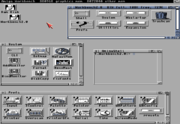
Look and feel
In software design, look and feel is a term used in respect of a graphical user interface and comprises aspects of its design, including elements such as colors, shapes, layout, and typefaces , as well as the behavior of dynamic elements such as buttons, boxes, and menus...
design standard — application developers had to write their own widgets (both buttons and menus), with Intuition providing minimal support. With AmigaOS 2.0 came gadtools.library, which provided standard widget sets, and the Amiga User Interface Style Guide, which explained how applications should be laid out for consistency.
AmigaOS 2.0 also added support for public screens. Instead of the Workbench screen being the only shareable screen, applications could create their own named screens to share with other applications.
AmigaOS 2.0 introduced AmigaGuide
Amigaguide
AmigaGuide is a hypertext document file format designed for the Amiga, files are stored in ASCII so it is possible to read and edit a file without the need for special software.Since Workbench 2.1 an Amiga Guide system for O.S...
, a simple hypertext
Hypertext
Hypertext is text displayed on a computer or other electronic device with references to other text that the reader can immediately access, usually by a mouse click or keypress sequence. Apart from running text, hypertext may contain tables, images and other presentational devices. Hypertext is the...
markup scheme and browser, for providing online help inside applications. It also introduced Installer, a standard software installation program, driven by a LISP
Lisp
A lisp is a speech impediment, historically also known as sigmatism. Stereotypically, people with a lisp are unable to pronounce sibilants , and replace them with interdentals , though there are actually several kinds of lisp...
-like scripting language.
Finally, AmigaOS 2.0 rectified the problem of developers hooking
Hooking
In computer programming, the term hooking covers a range of techniques used to alter or augment the behavior of an operating system, of applications, or of other software components by intercepting function calls or messages or events passed between software components...
directly into the input-events stream to capture keyboard and mouse movements, often locking up the whole system. AmigaOS 2.0 provided Commodities, a standard interface for modifying or scanning input events. This included a standard method for specifying global "hotkey" key-sequences, and a Commodities Exchange registry for the user to see what commodities were running.
AmigaOS 2.1 introduced locale.library and for the first time AmigaOS was translated to different languages.
AmigaDOS
AmigaDOS provides the disk operating systemDisk operating system
Disk Operating System and disk operating system , most often abbreviated as DOS, refers to an operating system software used in most computers that provides the abstraction and management of secondary storage devices and the information on them...
portion of the AmigaOS. This includes file system
File system
A file system is a means to organize data expected to be retained after a program terminates by providing procedures to store, retrieve and update data, as well as manage the available space on the device which contain it. A file system organizes data in an efficient manner and is tuned to the...
s, file and directory manipulation, the command-line interface
Command-line interface
A command-line interface is a mechanism for interacting with a computer operating system or software by typing commands to perform specific tasks...
, file redirection, console windows, and so on. Its interfaces offer facilities such as command redirection, piping
Pipeline (Unix)
In Unix-like computer operating systems , a pipeline is the original software pipeline: a set of processes chained by their standard streams, so that the output of each process feeds directly as input to the next one. Each connection is implemented by an anonymous pipe...
, scripting
Scripting language
A scripting language, script language, or extension language is a programming language that allows control of one or more applications. "Scripts" are distinct from the core code of the application, as they are usually written in a different language and are often created or at least modified by the...
with structured programming
Structured programming
Structured programming is a programming paradigm aimed on improving the clarity, quality, and development time of a computer program by making extensive use of subroutines, block structures and for and while loops - in contrast to using simple tests and jumps such as the goto statement which could...
primitives, and a system of global and local variables
Variable (programming)
In computer programming, a variable is a symbolic name given to some known or unknown quantity or information, for the purpose of allowing the name to be used independently of the information it represents...
.
In AmigaOS 1.x, the AmigaDOS portion was based on TRIPOS
TRIPOS
TRIPOS is a computer operating system. Development started in 1976 at the Computer Laboratory of Cambridge University and it was headed by Dr. Martin Richards. The first version appeared in January 1978 and it originally ran on a PDP-11. Later it was ported to the Computer Automation LSI4 and the...
, which is written in BCPL
BCPL
BCPL is a procedural, imperative, and structured computer programming language designed by Martin Richards of the University of Cambridge in 1966.- Design :...
. Interfacing with it from other languages proved a difficult and error-prone task, and the port of TRIPOS was not very efficient.
From AmigaOS 2.x onwards, AmigaDOS was rewritten in C
C (programming language)
C is a general-purpose computer programming language developed between 1969 and 1973 by Dennis Ritchie at the Bell Telephone Laboratories for use with the Unix operating system....
and Assembler
Assembly language
An assembly language is a low-level programming language for computers, microprocessors, microcontrollers, and other programmable devices. It implements a symbolic representation of the machine codes and other constants needed to program a given CPU architecture...
, retaining full 1.x BCPL program compatibility, and it incorporated parts of the third-party AmigaDOS Resource Project, which had already written replacements for many of the BCPL utilities and interfaces.
ARP also provided one of the first standardized file requester
File dialog
In computing, a file dialog is a dialog box that allows users to choose a file from the file system...
s for the Amiga, and introduced the use of more friendly UNIX-style wildcard (globbing) functions in command line parameters. Other innovations were an improvement in the range of date formats accepted by commands and the facility to make a command resident, so that it only needs to be loaded into memory once and remains in memory to reduce the cost of loading in subsequent uses.
In AmigaOS 4.0, the DOS abandoned the BCPL legacy completely, and starting from AmigaOS 4.1, it has been rewritten with full 64bit support.
File extensions are often used in AmigaOS, but they are not mandatory and they are not handled specially by the DOS, being instead just a conventional part of the file names. Executable programs are recognized using a magic number
Magic number (programming)
In computer programming, the term magic number has multiple meanings. It could refer to one or more of the following:* A constant numerical or text value used to identify a file format or protocol; for files, see List of file signatures...
.
Graphics
Up to version 3, AmigaOS only supported the native Amiga graphics chipsetOriginal Amiga chipset
The Original Chip Set was a chipset used in the earliest Commodore Amiga computers and defined the Amiga's graphics and sound capabilities...
, via graphics.library. This led developers to avoid OS functionality for drawing, and go straight for the underlying hardware. Third-party graphics cards were only supported via unofficial solutions.
The ideal situation, where the AmigaOS could directly support any graphics system, was termed retargetable graphics
ReTargetable Graphics
ReTargetable Graphics is device driver API mainly used by 3rd party graphics hardware to interface with AmigaOS via a set of libraries. The software libraries may include software tools to adjust resolution, screen colors, pointers and screenmodes...
(RTG). With AmigaOS 3.5, some RTG systems were bundled with the OS, allowing the use of common hardware cards other than the native Amiga chipsets. The main RTG systems are CyberGraphX
CyberGraphX
CyberGraphX , is the standard ReTargetable Graphics API available for the Amiga and compatible systems. It was developed by Thomas Sontowski and Frank Mariak and later adopted by Phase5 for use with their graphics cards...
, Picasso 96 and EGS.
The Amiga did not have any official 3D graphics capability, so it had no standard 3D graphics interface. Graphics card manufacturers and 3rd party developers provided their own standards, which include MiniGL
MiniGL
The term MiniGL was applied to a wide range of incomplete OpenGL implementations provided by graphics card hardware companies including 3dfx, PowerVR and Rendition in the late 1990s. They owe their genesis to the computer game Quake....
, Warp3D
Warp3D
Warp3D was a project run by Haage & Partner in 1998, that aimed to provide a standard API which would enable programmers to access, and therefore use, 3D hardware on the Amiga....
, StormMesa
Mesa 3D
Mesa 3D is an open source 3D computer graphics library that provides a generic OpenGL implementation for rendering three-dimensional graphics on multiple platforms. It was initially developed by Brian Paul in August 1993, and is still maintained by him today...
(agl.library) and CyberGL.
The Amiga was born at a time when there was almost no concept of 3D graphics libraries to enhance desktop GUIs and computer rendering capabilities but, thanks to its graphic capabilities, the Amiga was one of the first widespread 3D development platforms. VideoScape 3D was one of the earliest 3D rendering & animation systems, as well as TrueSpace
TrueSpace
TrueSpace is a freeware 3D computer graphics and animation software developed by Caligari Corporation, bought-out by Microsoft. As of May 2009, it has been officially discontinued, but with some 'unofficial support' up to February 2010, at least.- History :The company was founded in 1985 by Roman...
3D. Then Amiga led the 3D software market for years with software like Imagine
Imagine (3D modeling software)
Imagine was the name of a cutting edge 3D modeling and raytracing program, originally for the Amiga computer and later also for MSDOS and Microsoft Windows. It was created by Impulse, Inc. It used the .iob extension for its objects. Imagine was a derivative of the software TurboSilver, which was...
and NewTek's Lightwave
LightWave
LightWave 3D is a high end computer graphics program developed by NewTek. The latest release of LightWave runs on Windows and Mac OS X.- Overview:...
(used to render television shows like Babylon 5
Babylon 5
Babylon 5 is an American science fiction television series created, produced and largely written by J. Michael Straczynski. The show centers on a space station named Babylon 5: a focal point for politics, diplomacy, and conflict during the years 2257–2262...
).
Likewise, while the Amiga is well known for its ability to easily genlock
Genlock
Genlock is a common technique where the video output of one source, or a specific reference signal from a signal generator, is used to synchronize other television picture sources together. The aim in video and digital audio applications is to ensure the coincidence of signals in time at a...
with video, it has no built-in video capture
Video capture
Video capture is the process of converting an analog video signal—such as that produced by a video camera or DVD player—to digital video. The resulting digital data are computer files referred to as a digital video stream, or more often, simply video stream...
interface. In its golden age, the Amiga supported a vast market of third-party interfaces for video capture from American and European manufacturers. There were internal and external hardware solutions, called frame grabbers, for capturing individual or sequences of video frames, including: Newtronic Videon, Newtek
NewTek
NewTek, Inc. is a San Antonio, Texas-based hardware and software company that produces live and post-production video tools and visual imaging software for personal computers...
DigiView http://www.newtek.com/newtek/milestones.php, Graffiti external framebuffer
Framebuffer
A framebuffer is a video output device that drives a video display from a memory buffer containing a complete frame of data.The information in the memory buffer typically consists of color values for every pixel on the screen...
, the Digilab, the Videocruncher, Firecracker 24, Vidi Amiga 12, Vidi Amiga 24-bit and 24RT (Real Time), Newtek Video Toaster
Video Toaster
The NewTek Video Toaster is a combination of hardware and software for the editing and production of standard-definition and high-definition video in NTSC, PAL, and resolution independent formats on Commodore Amiga computers and subsequently on computers running the Windows operating system...
, GVP
Great Valley Products
Great Valley Products is a former third-party Amiga hardware supplier.The company was mostly known for CPU-Accelerators and SCSI-Hostadapters for the Commodore Amiga 500 and the Amiga 2000 computer series. The company liquidated itself in July 1995...
Impact Vision IV24, MacroSystem VLab Motion and VLab PAR, DPS PAR (Personal Animation Recorder), VHI (Video Hardware Interface) by IOSPIRIT GmbH, DVE-10, etc. Some solutions were hardware plug-ins for Amiga graphic cards like the Merlin XCalibur module, or the DV module built for the Amiga clone Draco
Draco
Draco was the first legislator of Athens in Ancient Greece. He replaced the prevailing system of oral law and blood feud by a written code to be enforced only by a court...
from the German firm Macrosystem. Modern PCI
Peripheral Component Interconnect
Conventional PCI is a computer bus for attaching hardware devices in a computer...
bus TV expansion cards and their capture interfaces are supported through tv.library by Elbox Computer and tvcard.library by Guido Mersmann.
The original Amiga graphic engine and graphic widget library
Widget toolkit
In computing, a widget toolkit, widget library, or GUI toolkit is a set of widgets for use in designing applications with graphical user interfaces...
was the intuition.library
Intuition (Amiga)
Intuition is the windowing system and user interface engine of AmigaOS. It was developed almost entirely by RJ Mical. Intuition should not be confused with Workbench, the AmigaOS spatial file manager, which relies on Intuition for handling windows and input events.Users may remember the initial...
, which with AmigaOS v2.0 were enhanced with GadTools. Stefan Stuntz created Magic User Interface
Magic User Interface
The Magic User Interface is an object-oriented system by Stefan Stuntz to generate and maintain graphical user interfaces. With the aid of a preferences program, the user of an application has the ability to customize the outfit according to personal taste....
(MUI) used in all Amiga systems since v2.0 and is now the official widget toolkit in MorphOS
MorphOS
MorphOS is an Amiga-compatible computer operating system. It is a mixed proprietary and open source OS produced for the Pegasos PowerPC processor based computer, PowerUP accelerator equipped Amiga computers, and a series of Freescale development boards that use the Genesi firmware, including the...
while AROS
Aros
Aros may refer to:*Aros , a river in J. R. R. Tolkien's Middle-earth legendarium*AROS Research Operating System, a free software implementation of AmigaOS* Aros, the original Viking name of Aarhus, the second largest city in Denmark...
implements MUI clone called Zune
Zune (GUI toolkit)
Zune is an object-oriented GUI toolkit which is part of the AROS project and nearly a clone, at both an API and look and feel level, of Magic User Interface , a well-known Amiga shareware product by Stefan Stuntz....
, The widget toolkit ClassAct evolved into ReAction GUI
ReAction GUI
ReAction GUI it is the name of the widget toolkit engine that is used in AmigaOS 3.5-4.1.It is an evolution of ClassACT, which is an object oriented system of classes that enhanced the aspect of the Workbench 2.0 GUI of AmigaOS.- History :...
which is used in AmigaOS 3.9 and 4.0. In AmigaOS v4,0 ReAction GUI is the standard one. Cygnix provides Amiga with a full Unix/Linux X11
X Window System
The X window system is a computer software system and network protocol that provides a basis for graphical user interfaces and rich input device capability for networked computers...
compatible graphic environment. Some vector graphic libraries, like Cairo
Cairo (graphics)
cairo is a software library used to provide a vector graphics-based, device-independent API for software developers. It is designed to provide primitives for 2-dimensional drawing across a number of different backends...
and Anti-Grain Geometry
Anti-Grain Geometry
Anti-Grain Geometry is a high-quality 2D rendering library written in C++. It features anti-aliasing and sub-pixel resolution.The library is operating system independent and renders to an abstract memory object. It comes with examples interfaced to the X Window System, Microsoft Windows, Mac OS X,...
are also available.
All modern Amiga systems have made large use of cross-platform SDL
Simple DirectMedia Layer
Simple DirectMedia Layer is a cross-platform, free and open source multimedia library written in C that presents a simple interface to various platforms' graphics, sound, and input devices....
(simple DirectMedia Layer) engine for games and other multimedia programs.
Following modern trends in evolution of graphical interfaces AmigaOS 4.1 uses 3D hardware accelerated Porter-Duff
Alpha compositing
In computer graphics, alpha compositing is the process of combining an image with a background to create the appearance of partial or full transparency. It is often useful to render image elements in separate passes, and then combine the resulting multiple 2D images into a single, final image in a...
image composition engine.
Audio
Up to version 3.1, AmigaOS only supported the original Amiga chipset's sound capabilities, via audio.device. Support for third-party audio cards was vendor-dependent, until the creation and adoption of AHIAHI (Amiga)
AHI is a retargetable audio subsystem for AmigaOS, MorphOS and AROS. It was created by Martin Blom in the mid 1990s to allow standardized operating system support for audio hardware other than just the native Amiga sound chip, for example, 16-bit sound cards.AHI offers improved functionality not...
http://www.lysator.liu.se/ahi/ as a de facto standard. AHI can be installed separately on m68k/AmigaOS v2.0 and higher. AmigaOS itself did not support MIDI until 3.1 when Roger Dannenberg's camd.library
Commodore Amiga MIDI Driver
Commodore Amiga MIDI Driver is a shared library for AmigaOS which provides a general device driver for MIDI data, so that applications can share MIDI data with each other in real-time, and interface to MIDI hardware in a device-independent way....
was adapted as the standard MIDI API. Commodore's version of camd.library also included a built-in driver for the serial port. The later open source version of camd.library by Kjetil Matheussen did not provide a built in driver for the serial port, but provided an external driver instead.
Speech synthesis
The original Amiga was launched with speech synthesisSpeech synthesis
Speech synthesis is the artificial production of human speech. A computer system used for this purpose is called a speech synthesizer, and can be implemented in software or hardware...
software, developed by Softvoice, Inc. http://www.text2speech.com/#aboutsv This could be broken into three main components: narrator.device, which could play and modulate all phoneme
Phoneme
In a language or dialect, a phoneme is the smallest segmental unit of sound employed to form meaningful contrasts between utterances....
s used in American English
American English
American English is a set of dialects of the English language used mostly in the United States. Approximately two-thirds of the world's native speakers of English live in the United States....
, translator.library, which could translate English text to American English phonemes, and the SPEAK: handler, which command-line users could redirect output to have it spoken.
In the original 1.x releases, a Say program in Utilities and a basic demo was also included with AmigaBASIC
AmigaBASIC
AmigaBASIC was an interpreted BASIC programming language implementation for the Amiga, designed and written by Microsoft. AmigaBASIC shipped with AmigaOS versions 1.1 to 1.3...
programming examples.
The speech synthesiser was occasionally used in third-party programs, often educational software. The word processors Prowrite and Excellence! could read out documents using the synthesiser.
Despite the limitation on the narrator.devices phonemes, Francesco Devitt wrote a new version of translator.library which could translate any language to phonemes, given a set of rules for that language, and thus provided multilingual speech synthesis. http://uk.aminet.net/util/libs/translator42.readme
Workbench 2.0 was the last release with speech synthesis support. The speech synthesis software was dropped from the 2.1 release onward.
ARexx
The AmigaOS has support for the RexxREXX
REXX is an interpreted programming language that was developed at IBM. It is a structured high-level programming language that was designed to be both easy to learn and easy to read...
language, called ARexx (short for "Amiga Rexx"), and is a script language which allows for full OS scripting, similar to AppleScript
AppleScript
AppleScript is a scripting language created by Apple Inc. and built into Macintosh operating systems since System 7. The term "AppleScript" may refer to the scripting system itself, or to particular scripts that are written in the AppleScript language....
, intra-application scripting, similar to VBA
Visual Basic for Applications
Visual Basic for Applications is an implementation of Microsoft's event-driven programming language Visual Basic 6 and its associated integrated development environment , which are built into most Microsoft Office applications...
in Microsoft Office
Microsoft Office
Microsoft Office is a non-free commercial office suite of inter-related desktop applications, servers and services for the Microsoft Windows and Mac OS X operating systems, introduced by Microsoft in August 1, 1989. Initially a marketing term for a bundled set of applications, the first version of...
, as well as inter-program communication. Having a single scripting language for any application on the operating system is beneficial to users, instead of having to learn a new language for each application.
Programs can listen on an "ARexx port" for string messages. These messages can then be interpreted by the program in a similar fashion to a user pushing buttons. For example, an ARexx script run in an e-mail program could save the currently displayed email, invoke an external program which could extract and process information, and then invoke a viewer program. This allows applications to control other applications by sending data back and forth directly with memory handles instead of saving files to disk and then reloading.
RAM disk
The AmigaOS has a dynamically-sized RAM diskRAM disk
A RAM disk or RAM drive is a block of RAM that a computer's software is treating as if the memory were a disk drive...
, which resizes itself automatically to its contents. Starting with AmigaOS 2.x, operating System configuration files were loaded into the RAM disk on boot, greatly speeding operating system usage. Other files could be copied to the RAM disk like any standard device for quick modification and retrieval. Also beginning in AmigaOS 2.x, the RAM disk supported file-change notification, which was mostly used to monitor prefs files for changes.
The AmigaOS also has support for a fixed-capacity recoverable RAM disk, which functions as a standard RAM disk, but can maintain its contents on soft restart. It is commonly called the RAD disk, and it can be used as a boot disk (with boot sector).
Bootblock
At start-up KickstartKickstart (Amiga)
Kickstart is a commonly used term for the bootstrap firmware of the Amiga computers developed by Commodore.Most Amiga models were shipped with the Kickstart firmware stored on ROM chips...
attempts to boot from a bootable device (typically, a floppy disk or hard disk drive). In the case of a floppy the system reads the first two sectors of the disk (the bootblock), and executes any boot instructions stored there. Normally this code passes control back to the OS (invoking AmigaDOS and the GUI) and using the disk as the system boot volume. Any such disk, no matter what the other contents of the disk, was referred to as a "Boot disk" or "bootable disk". A bootblock could be added to a blank disk by use of the "install" command. Some entertainment software contained custom bootblocks. This allowed an application, game or demo
Demo (computer programming)
A demo is a non-interactive multimedia presentation made within the computer subculture known as the demoscene. Demogroups create demos to demonstrate their abilities in programming, music, drawing, and 3D modeling...
to take control of memory and resources, effectively disabling AmigaOS.
The bootblock became an obvious target for virus
Computer virus
A computer virus is a computer program that can replicate itself and spread from one computer to another. The term "virus" is also commonly but erroneously used to refer to other types of malware, including but not limited to adware and spyware programs that do not have the reproductive ability...
writers. Some games or demos that used a custom bootblock would not work if infected with a bootblock virus, as the code of the virus replaced the original. The first such virus was the SCA virus. Anti-virus attempts included custom bootblocks. These amended bootblock advertised the presence of the virus checker while checking the system for tell-tale signs of memory resident viruses and then passed control back to the system. Unfortunately these could not be used on disks that already relied on a custom bootblock, but did alert users of potential trouble. Several of them also replicated themselves across other disks, becoming little more than viruses in their own right.
Technical overview
John C. DvorakJohn C. Dvorak
John C. Dvorak is an American columnist and broadcaster in the areas of technology and computing. His writing extends back to the 1980s, when he was a mainstay of a variety of magazines. Dvorak is also the Vice-President of Mevio and well known for his work for Tech TV...
stated in 1996:
Libraries and devices
The main modularisationModularity (programming)
Modular programming is a software design technique that increases the extent to which software is composed of separate, interchangeable components called modules by breaking down program functions into modules, each of which accomplishes one function and contains everything necessary to accomplish...
technique in AmigaOS is based on dynamically-loaded shared libraries
Library (computer science)
In computer science, a library is a collection of resources used to develop software. These may include pre-written code and subroutines, classes, values or type specifications....
, either stored as a file on disk with a "
.library" filename extension, or stored in the Kickstart ROM. All library functions are accessed via an indirect jump table, which is a negative offset to the library base pointer. That way, every library function can be patchedPatch (computing)
A patch is a piece of software designed to fix problems with, or update a computer program or its supporting data. This includes fixing security vulnerabilities and other bugs, and improving the usability or performance...
or hooked
Hooking
In computer programming, the term hooking covers a range of techniques used to alter or augment the behavior of an operating system, of applications, or of other software components by intercepting function calls or messages or events passed between software components...
at run-time, even if the library is stored in ROM.
The most important library in AmigaOS is exec.library (Exec
Exec (Amiga)
Exec is the object-oriented multi-tasking kernel of AmigaOS. It enabled pre-emptive multitasking in as little as 256k of memory ....
), which can be considered a microkernel
Microkernel
In computer science, a microkernel is the near-minimum amount of software that can provide the mechanisms needed to implement an operating system . These mechanisms include low-level address space management, thread management, and inter-process communication...
, as well as a library. It acts as a scheduler
Scheduling (computing)
In computer science, a scheduling is the method by which threads, processes or data flows are given access to system resources . This is usually done to load balance a system effectively or achieve a target quality of service...
for tasks running on the system, providing pre-emptive multitasking with prioritised round-robin scheduling
Round-robin scheduling
Round-robin is one of the simplest scheduling algorithms for processes in an operating system. As the term is generally used, time slices are assigned to each process in equal portions and in circular order, handling all processes without priority . Round-robin scheduling is simple, easy to...
. Exec also provides access to other libraries and high-level inter-process communication
Inter-process communication
In computing, Inter-process communication is a set of methods for the exchange of data among multiple threads in one or more processes. Processes may be running on one or more computers connected by a network. IPC methods are divided into methods for message passing, synchronization, shared...
via message passing
Message passing
Message passing in computer science is a form of communication used in parallel computing, object-oriented programming, and interprocess communication. In this model, processes or objects can send and receive messages to other processes...
. (Other microkernels have had performance problems because of the need to copy messages between address spaces. Since the Amiga has only one address space, Exec message passing is quite efficient.) The only fixed memory address in the Amiga software (address 4) is a pointer to exec.library, which can then be used to access other libraries. Exec was designed and implemented by Carl Sassenrath
Carl Sassenrath
Carl Sassenrath is an architect of operating systems and computer languages. He brought multitasking to personal computers in 1985 with the creation of the Amiga Computer operating system kernel, and he is currently the designer of the REBOL computer language as well as the CTO of REBOL...
.
Unlike traditional operating systems, the exec kernel does not run "privileged". Contemporary operating systems for the 68000 such as Atari TOS
Atari TOS
TOS is the operating system of the Atari ST range of computers. This range includes the 520 and 1040ST, their STF/M/FM and STE variants and the Mega ST/STE. Later, 32-bit machines were developed using a new version of TOS, called MultiTOS, which allowed multitasking...
and SunOS
SunOS
SunOS is a version of the Unix operating system developed by Sun Microsystems for their workstation and server computer systems. The SunOS name is usually only used to refer to versions 1.0 to 4.1.4 of SunOS...
used trap
Exception handling
Exception handling is a programming language construct or computer hardware mechanism designed to handle the occurrence of exceptions, special conditions that change the normal flow of program execution....
instructions for invoking kernel functions. This made the kernel functions run in the 68000's supervisor mode, while user software ran in the unprivileged user mode. Mac OS
Mac OS
Mac OS is a series of graphical user interface-based operating systems developed by Apple Inc. for their Macintosh line of computer systems. The Macintosh user experience is credited with popularizing the graphical user interface...
on the 68000 even used supervisor mode for everything, kernel and application code alike. By contrast, exec function calls are made with the library jump table, and the kernel code normally executes in user mode. Whenever supervisor mode is needed, either by the kernel or user programs, the library functions Supervisor or SuperState are used.
Device driver
Device driver
In computing, a device driver or software driver is a computer program allowing higher-level computer programs to interact with a hardware device....
s are also libraries, but they implement a standardised interface. Applications do not usually call devices directly as libraries, but use the exec.library I/O functions to indirectly access them. Like libraries, devices are either files on disk (with the "
.device" extension), or stored in the Kickstart ROM.Datatypes
Datatypes are a unique method of dealing with data files born on Amiga. It is a centralized system that handles a series of "datatypes" that could be considered as a series of little programs capable of acting as muxer/demuxer and loading and saving any kind of data file for which the corresponding datatype exists.Any Amiga productivity software, such as a "paint" program, does not need to embed its own descriptors for dealing with the enormous number of different image files that exist. Amiga software developers just have to embed in their program the code dealing with datatypes, and the software could then open and save any kind of image file types for which a datatype is present on the computer.
Example: existing Amiga
jpeg.datatype and tiff.datatype will handle correctly the file types they refer to (JPEGJPEG
In computing, JPEG . The degree of compression can be adjusted, allowing a selectable tradeoff between storage size and image quality. JPEG typically achieves 10:1 compression with little perceptible loss in image quality....
and TIFF
Tagged Image File Format
TIFF is a file format for storing images, popular among graphic artists, the publishing industry, and both amateur and professional photographers in general. As of 2009, it is under the control of Adobe Systems...
image files) and any Amiga program that has the datatype system built into it will then be able to deal automatically with these kind of files by loading the features present into the corresponding datatype.
New datatypes can be written by any Amiga programmer to update the existing datatype system with new features or even build a whole new datatype descriptor that will be capable of dealing with emerging file types that never existed before.
Handlers, AmigaDOS and filesystems
The higher-level part of device and resource management is controlled by handlers, which are not libraries, but tasksTask (computers)
A task is an execution path through address space. In other words, a set of program instructions that are loaded in memory. The address registers have been loaded with the initial address of the program. At the next clock cycle, the CPU will start execution, in accord with the program. The sense is...
, and communicate by passing messages.
One important type of handler is a filesystem handler. The AmigaOS can make use of any filesystem for which a handler has been written, a possibility that has been exploited by programs like CrossDOS
CrossDOS
CrossDOS is file system for AmigaDOS. It was bundled with AmigaOS 2.1 and later, though it did work under Amiga OS 2.04. Its function was to allow working with floppy disks formatted for PCs...
and by a few "alternative" file systems to the standard OFS
Amiga Old File System
On the Amiga, the Old File System was the filesystem for Amiga OS before the Amiga Fast File System. Even though it used 512-byte blocks, it reserved the first small portion of each block for metadata, leaving an actual data block capacity of 488 bytes per block...
and FFS
Amiga Fast File System
The Amiga Fast File System is a file system used on the Amiga personal computer. The previous Amiga filesystem upon the release of FFS became known as Amiga Old File System . OFS, while fine on floppy disk, soon proved too slow to keep up with era hard drives...
. These file systems allow one to add new features like journaling
Journaling file system
A journaling file system is a file system that keeps track of the changes that will be made in a journal before committing them to the main file system...
or file privileges, which are not found in the standard operating system.
Handlers typically expose a device name to the DOS
Disk operating system
Disk Operating System and disk operating system , most often abbreviated as DOS, refers to an operating system software used in most computers that provides the abstraction and management of secondary storage devices and the information on them...
, which can be used to access the peripheral (if any) associated with the handler.
As an example of these concepts, the SPEAK: handler can have text sent to it. The handler makes use of translator.library, which converts text into phoneme
Phoneme
In a language or dialect, a phoneme is the smallest segmental unit of sound employed to form meaningful contrasts between utterances....
s, then it writes the phonemes to narrator.device, which translates the phonemes into intoned speech samples and itself uses audio.device to play them through the Amiga's audio hardware.
Device names are case insensitive
Case sensitivity
Text sometimes exhibits case sensitivity; that is, words can differ in meaning based on differing use of uppercase and lowercase letters. Words with capital letters do not always have the same meaning when written with lowercase letters....
(uppercase by convention) strings followed by a colon
Colon (punctuation)
The colon is a punctuation mark consisting of two equally sized dots centered on the same vertical line.-Usage:A colon informs the reader that what follows the mark proves, explains, or lists elements of what preceded the mark....
. After the colon a specifier can be added, which gives the handler additional information about what is being accessed and how. In the case of filesystem, the specifier usually consists of a path
Path (computing)
A path, the general form of a filename or of a directory name, specifies a unique location in a file system. A path points to a file system location by following the directory tree hierarchy expressed in a string of characters in which path components, separated by a delimiting character, represent...
to a file in the filesystem; for other handlers, specifiers usually set characteristics of the desired input/output channel (for the SER: serial port driver, for example, the specifier will contain bit rate
Bit rate
In telecommunications and computing, bit rate is the number of bits that are conveyed or processed per unit of time....
, start and stop bits
Asynchronous start-stop
Asynchronous serial communication describes an asynchronous, serial transmission protocol in which a start signal is sent prior to each byte, character or code word and a stop signal is sent after each code word...
, etc.).
Filesystems expose drive names as their device names. For example, DF0: by default refers to the first floppy drive in the system. On many systems DH0: is used to refer to the first hard drive.
Filesystems also expose volume names, following the same syntax as device names: these identify the specific medium in the file system-managed drive. If DF0: contains a disk named "Workbench", then Workbench: will be a volume name that can be used to access files in DF0:.
If one wanted to access a file named "Amp" located in directory "Win" of the disk with name "Work" in drive DF0:, one could write
DF0:Win/Amp
or
Work:Win/Amp
However, these are not completely equivalent, since when the latter form is used, the system knows that the wanted volume is "Work" and not just any volume in DF0:. Therefore, whenever a requested file on "Work" is being accessed without volume "Work" being present in any drive, it will say something to the effect of:
Please insert volume Work in any drive
Programs
Computer program
A computer program is a sequence of instructions written to perform a specified task with a computer. A computer requires programs to function, typically executing the program's instructions in a central processor. The program has an executable form that the computer can use directly to execute...
often need to access files without knowing their physical location (either the drive or the volume): they only know the "logical path" of the file, i.e. whether the file is a library, a documentation file, a translation of the program's messages, etc.
This is solved in AmigaOS by the use of assigns. An assign follows, again, the same syntax as a device name; however, it already points to a directory inside the filesystem. The place an assign points to can be changed at any time by the user (this behaviour is similar to, but nevertheless distinct from the subst command in MS-DOS
MS-DOS
MS-DOS is an operating system for x86-based personal computers. It was the most commonly used member of the DOS family of operating systems, and was the main operating system for IBM PC compatible personal computers during the 1980s to the mid 1990s, until it was gradually superseded by operating...
for example). Assigns were also convenient because one logical assign could point to more than one different physical location at the same time, thereby allowing an assign′s contents to expand logically, while still maintaining a separate physical organization. Standard assigns that are generally present in an AmigaOS system include
- SYS:, which points to the boot drive's root directory.
- C:, which points to a directory containing shell commands. At boot time, this is SYS:C, if it exists, otherwise SYS:. The command path defaults to C: and the current working directory, so putting executables in C: allows them to be executed simply by typing their name.
- DEVS:, which points to a directory containing the system's devices. At boot time, this is SYS:Devs if that directory exists, otherwise SYS:.
- L:, which points to a directory containing AmigaDOS handlers and filesystems. At boot time, this is SYS:L if it exists, otherwise L: is not automatically created.
- LIBS:, which points to a directory containing the system's libraries. At boot time, this is SYS:Libs if that directory exists, otherwise SYS:.
- S:, which points to a directory with scripts, including the startup-sequence which is executed automatically at boot time, if it exists. At boot time, this is SYS:S if it exists, otherwise S: is not automatically created.
- PROGDIR:, a special assign that always points to the directory containing the currently running executable. So, if you run "SYS:Tools/Multiview" and "SYS:System/Format", PROGDIR: points at SYS:Tools for Multiview while simultaneously pointing at SYS:System for the Format command. This feature was introduced in Workbench 2.0.
Paging Memory and Swap Partition
AmigaOS 4.0 "final update" revision introduced a new intelligent system for allocating RAM and defragmenting it "on the fly" during system inactivities. It is based on slab allocation methodSlab allocation
Slab allocation is a memory management mechanism intended for the efficient memory allocation of kernel objects which displays the desirable property of eliminating fragmentation caused by allocations and deallocations. The technique is used to retain allocated memory that contains a data object of...
and there is also present a memory pager that arbitrates paging memory and thus now allows also on AmigaOS (like in other systems) the swapping of large portions of physical RAM on mass storage devices as a sort of virtual memory
Virtual memory
In computing, virtual memory is a memory management technique developed for multitasking kernels. This technique virtualizes a computer architecture's various forms of computer data storage , allowing a program to be designed as though there is only one kind of memory, "virtual" memory, which...
.
Co-operative paging
Paging
In computer operating systems, paging is one of the memory-management schemes by which a computer can store and retrieve data from secondary storage for use in main memory. In the paging memory-management scheme, the operating system retrieves data from secondary storage in same-size blocks called...
was finally implemented in AmigaOS 4.1.
Clones

- AROS Research Operating SystemAROS Research Operating SystemAROS Research Operating System is a free and open source multi media centric implementation of the AmigaOS 3.1 APIs. Designed to be portable and flexible, ports are currently available for x86-based and PowerPC-based PCs in native and hosted flavors, with other architectures in development...
(AROS) implements the AmigaOS API in a portable open-source operating system. Although not binary compatible with AmigaOS (unless running on 68k), users have reported it to be highly source-code compatible.
- MorphOSMorphOSMorphOS is an Amiga-compatible computer operating system. It is a mixed proprietary and open source OS produced for the Pegasos PowerPC processor based computer, PowerUP accelerator equipped Amiga computers, and a series of Freescale development boards that use the Genesi firmware, including the...
is a PowerPC native operating system which also runs on some Amiga hardware. It implements AmigaOS API and provides binary compatibility with "OS-friendly" AmigaOS applications (that is, those applications which do not access any native, legacy Amiga hardware directly).
- pOSPOS-Business:* Point of sale, the location where a business transaction occurs** POS terminal, a device by which sales transactions can be directly debited to the customer's bank account-Health and medicine:...
was a multiplatform closed-source operating system with source code-level compatibility with existing Amiga software.
Influence on others
- Although not strictly Amiga-related, a fork of the FreeBSDFreeBSDFreeBSD is a free Unix-like operating system descended from AT&T UNIX via BSD UNIX. Although for legal reasons FreeBSD cannot be called “UNIX”, as the direct descendant of BSD UNIX , FreeBSD’s internals and system APIs are UNIX-compliant...
4.8 release, called DragonFly BSDDragonFly BSDDragonFly BSD is a free Unix-like operating system created as a fork of FreeBSD 4.8. Matthew Dillon, an Amiga developer in the late 1980s and early 1990s and a FreeBSD developer between 1994 and 2003, began work on DragonFly BSD in June 2003 and announced it on the FreeBSD mailing lists on July...
, has been created by a former FreeBSD developer and Amiga programmer Matt DillonMatt Dillon (computer scientist)Matthew Dillon is a computer scientist living in Berkeley, California. He is best known for his contributions to FreeBSD and for starting the DragonFly BSD project....
. DragonFly BSD aims to make the FreeBSD kernel more like AmigaOS architecturally, featuring message-passing in the kernel and allowing for very efficient and virtually mutexMutual exclusionMutual exclusion algorithms are used in concurrent programming to avoid the simultaneous use of a common resource, such as a global variable, by pieces of computer code called critical sections. A critical section is a piece of code in which a process or thread accesses a common resource...
-free SMPSymmetric multiprocessingIn computing, symmetric multiprocessing involves a multiprocessor computer hardware architecture where two or more identical processors are connected to a single shared main memory and are controlled by a single OS instance. Most common multiprocessor systems today use an SMP architecture...
support.
- BeOSBeOSBeOS is an operating system for personal computers which began development by Be Inc. in 1991. It was first written to run on BeBox hardware. BeOS was optimized for digital media work and was written to take advantage of modern hardware facilities such as symmetric multiprocessing by utilizing...
features also a centralized datatypes structure similar to Mac OS Easy Open after old Amiga developers requested Be to adopt Amiga datatypes service. It allows the entire OS to recognize all kind of files (text, music, videos, documents, etc.) with standard file descriptorFile descriptorIn computer programming, a file descriptor is an abstract indicator for accessing a file. The term is generally used in POSIX operating systems...
s. Datatype system provides entire system and any productivity tools with standard loaders and savers for these files, without having the necessity to embed multiple file loading capabilities into any single program.
- AtheOSAtheOSAtheOS was a free and open source operating system for x86-based computers. It was initially intended as an AmigaOS clone, but that objective was later abandoned...
was inspired by AmigaOS, and originally intended to be a clone of AmigaOS. SyllableSyllable (operating system)Syllable Desktop is a free and open source operating system for Pentium and compatible processors. Its purpose is to create an easy-to-use desktop operating system for the home and small office user...
is a fork of AtheOS, and includes some AmigaOS and BeOSBeOSBeOS is an operating system for personal computers which began development by Be Inc. in 1991. It was first written to run on BeBox hardware. BeOS was optimized for digital media work and was written to take advantage of modern hardware facilities such as symmetric multiprocessing by utilizing...
like qualities.
- The operating system of the 3DO Interactive Multiplayer3DO Interactive MultiplayerThe 3DO Interactive Multiplayer is a video game console originally produced by Panasonic in 1993. Further renditions of the hardware were released in 1994 by Sanyo and Goldstar. The consoles were manufactured according to specifications created by The 3DO Company, and were originally designed by...
bore a very strong resemblance to AmigaOS, and was developed by RJ Mical, the creator of the Amiga's IntuitionIntuition (Amiga)Intuition is the windowing system and user interface engine of AmigaOS. It was developed almost entirely by RJ Mical. Intuition should not be confused with Workbench, the AmigaOS spatial file manager, which relies on Intuition for handling windows and input events.Users may remember the initial...
user interface.
Easter eggs
Some versions of AmigaOS included Easter eggsEaster egg (media)
Image:Carl Oswald Rostosky - Zwei Kaninchen und ein Igel 1861.jpg|250px|thumb|right|Example of Easter egg hidden within imagerect 467 383 539 434 desc none...
:
- In version 1.x, by holding down both Shift keys and both Alt keyAlt keyThe Alt key on a computer keyboard is used to change the function of other pressed keys. Thus, the Alt key is a modifier key, used in a similar fashion to the Shift key. For example, simply pressing "A" will type the letter a, but if you hold down either Alt key while pressing A, the computer...
s and pressing the function keys F1 through F10, you could see copyright messages in the title bar. As an example, pressing F10 resulted in the message "Moral support: Joe Pillow and the Dancing Fools". Joe PillowJoe PillowJoe Pillow was the name given on the airline ticket for the extra airline seat that was purchased to hold the first Amiga prototype while on the way to the January 1984 CES. The airlines required a name for the airline ticket and Joe Pillow was born...
was the name used to book a seat on a flight which was used to transport a prototype Amiga computer to a computer trade show. - In versions 2.x and 3.0, the secret message was accessed by repeatedly selecting the "About..." option from the Workbench menu, and leaving the resulting dialog boxDialog boxIn a graphical user interface of computers, a dialog box is a type of window used to enable reciprocal communication or "dialog" between a computer and its user. It may communicate information to the user, prompt the user for a response, or both...
open. When there were enough (approximately 20) dialog boxes open at the same time, the next one had a secret message instead of the normal one. In version 3.1 the secret message was openly integrated into the "About..." dialog box. - The Amiga 1000 Kickstart floppy diskette master for AmigaDOS 1.0 was not erased prior to duplication, and contains the remnants of various source code and header text files on the disk.
See also
- AmigaAmigaThe Amiga is a family of personal computers that was sold by Commodore in the 1980s and 1990s. The first model was launched in 1985 as a high-end home computer and became popular for its graphical, audio and multi-tasking abilities...
- History of the AmigaHistory of the AmigaThe following history of the Amiga documents the development and commercial history of the Amiga, a home computer product line manufactured from the middle 1980s up to today.- Amiga Corporation :...
- AmigaOS versionsAmigaOS versionsThere have been many different versions of the AmigaOS operating system during its two decades of history.Initially the Amiga operating system had no strong name and branding, as it was seen as an integral part of the Amiga system as a whole. Early names used for the Amiga operating system included...
- AmigaOS 4AmigaOS 4AmigaOS 4, , is a line of Amiga operating systems which runs on PowerPC microprocessors. It is mainly based on AmigaOS 3.1 source code, and partially on version 3.9 developed by Haage & Partner...
- AminetAminetAminet is the world's largest archive of Amiga-related software and files. Aminet was originally hosted by several universities' FTP sites, and is now available on CD-ROM and on the web.-History:...
- Comparison of operating systemsComparison of operating systemsThese tables compare general and technical information for a number of widely used and currently available operating systems.Because of the large number and variety of available Linux distributions, they are all grouped under a single entry; see comparison of Linux distributions for a detailed...
External links
- Amiga History Guide
- AmigaOS Support homepage
- The Workbench Nostalgia Page – Very detailed information on all known versions of AmigaOS.
- Reference Library
- Amiga Developer Help Site
- Famous Amiga Uses