

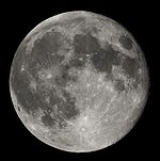

1178 Five Canterbury monks see what is possibly the Giordano Bruno crater being formed. It is believed that the current oscillations of the Moon's distance from the Earth (on the order of metres) are a result of this collision.
1959 Luna 1 becomes the first spacecraft to reach the vicinity of the Moon.
1959 The Soviet probe ''Luna 2'' crashes onto the Moon, becoming the first man-made object to reach it.
1959 The world sees the far side of the Moon for the first time.
1961 Apollo program: U.S. President John F. Kennedy announces before a special joint session of the Congress his goal to initiate a project to put a "man on the Moon" before the end of the decade.
1962 Apollo Project: NASA announces plans to build the C-5 rocket booster. It became better known as the Saturn V moon rocket, which launched every Apollo moon mission.
1962 Ranger program: Ranger 3 is launched to study the moon. The space probe later misses the moon by 22,000 miles (35,400 km).
1962 NASA's Ranger 4 spacecraft crashes into the Moon.
1964 Ranger program: Ranger 7 sends back the first close-up photographs of the moon, with images 1,000 times clearer than anything ever seen from earth-bound telescopes.
1965 Project Ranger: The Ranger 8 probe launches on its mission to photograph the ''Mare Tranquillitatis'' region of the Moon in preparation for the manned Apollo missions. ''Mare Tranquillitatis'' or the "Sea of Tranquility" would become the site chosen for the Apollo 11 lunar landing.
1965 Ranger 8 crashes into the moon after a successful mission of photographing possible landing sites for the Apollo program astronauts.
1965 Ranger program: NASA launches Ranger 9 which is the last in a series of unmanned lunar space probes.
1965 NASA spacecraft Ranger 9, equipped to convert its signals into a form suitable for showing on domestic television, brings images of the Moon into ordinary homes before crash landing.
1965 The Soviet spacecraft ''Luna 5'' crashes on the Moon.
1966 The unmanned Soviet Luna 9 spacecraft makes the first controlled rocket-assisted landing on the Moon.
1966 The Soviet Union launches Luna 10 which later becomes the first space probe to enter orbit around the Moon.
1966 Surveyor program: ''Surveyor 1'' lands in Oceanus Procellarum on the Moon, becoming the first U.S. spacecraft to soft land on another world.
1966 Lunar Orbiter 1 takes the first photograph of Earth from orbit around the Moon.
1968 The Soviet ''Zond 5'' spaceship is launched, becoming the first spacecraft to fly around the Moon and re-enter the Earth's atmosphere.
1968 Apollo program: ''Apollo 8'', the first manned mission to the moon, is launched from the Kennedy Space Center in Florida. At 2h:50m:37s Mission elapsed time (MES), the crew performs the first ever manned Trans Lunar Injection and become the first humans to leave Earth's gravity.
1968 Apollo Program: The crew of ''Apollo 8'' enters into orbit around the Moon, becoming the first humans to do so. They performed 10 lunar orbits and broadcast live TV pictures that became the famous Christmas Eve Broadcast, one of the most watched programs in history.
1968 Apollo Program: Apollo 8 splashes down in the Pacific Ocean, ending the first orbital manned mission to the Moon.
1969 Apollo 10's lunar module flies within 8.4 nautical miles (16 km) of the moon's surface.
1969 Apollo program: Apollo 10 returns to Earth after a successful eight-day test of all the components needed for the forthcoming first manned moon landing.
1969 Apollo program: ''Apollo 11'', the first manned space mission to land on the Moon, is launched from the Kennedy Space Center at Cape Canaveral, Florida.
1969 Apollo Program: Apollo 11 successfully lands on the Moon at 20:17 UTC on July 20.
1969 Neil Armstrong and Edwin "Buzz" Aldrin become the first men to walk on the Moon, during the Apollo 11 mission.
1969 Apollo program: NASA launches Apollo 12, the second manned mission to the surface of the Moon.
1969 Apollo program: Apollo 12 astronauts Pete Conrad and Alan Bean land at Oceanus Procellarum (the "Ocean of Storms") and become the third and fourth humans to walk on the Moon.
1969 Apollo program: The Apollo 12 command module splashes down safely in the Pacific Ocean, ending the second manned mission to the Moon.
1970 An oxygen tank aboard Apollo 13 explodes, putting the crew in great danger and causing major damage to the spacecraft while en route to the Moon.
1970 NASA announces the cancellation of two Apollo missions to the Moon, Apollo 15 (the designation is re-used by a later mission), and Apollo 19.
1970 Luna program: The Soviet Union lands Lunokhod 1 on Mare Imbrium (Sea of Rains) on the Moon. This is the first roving remote-controlled robot to land on another world and is released by the orbiting Luna 17 spacecraft.
1971 Apollo program: Apollo 14 returns to Earth after the third manned moon landing.
1971 Apollo program: Apollo 15 Mission – David Scott and James Irwin on the Apollo Lunar Module module ''Falcon'' land on the Moon with the first Lunar Rover.
1972 The Soviet unmanned spaceship Luna 20 lands on the Moon.
1972 Apollo 17 becomes the sixth and last Apollo mission to land on the Moon.
1977 Voyager I takes first photograph of the Earth and the Moon together.
1977 Because of US budget cuts and dwindling power reserves, the Apollo program's ALSEP experiment packages left on the Moon are shut down.
2002 Near-Earth asteroid 2002 MN misses the Earth by {{convert|75000|mi|km}}, about one-third of the distance between the Earth and the Moon.
2005 ESA's SMART-1 lunar orbiter discovers elements such as calcium, aluminum, silicon, iron, and other surface elements on the moon.
2009 First lunar impact of the Centaur and LCROSS spacecrafts as part of NASA's Lunar Precursor Robotic Program.