
See Also

Ranger 9

Ranger 9 was designed to achieve a lunar impact trajectory and to transmit high-resolution photographs of the lunar surface during the final minutes of flight up to impact. The spacecraft carried six television vidicon cameras, 2 wide angle and 4 narrow angle to accomplish these objectives. The cameras were arranged in two separate chains, or channels, each self-contained with separate power supplies, timers, and transmitters so as to afford the greatest reliability and probability of obtaining high-quality video pictures. No other experiments were carried on the spacecraft.

Discussions

  Discussion Features

   Ask a question about 'Ranger 9'

   Start a new discussion about 'Ranger 9'

   Answer questions about 'Ranger 9'

   'Ranger 9' discussion forum

Timeline

1965   Ranger program Ranger program

The Ranger program was a series of unmanned space mission [i]s by the United States [i] in the 1960s who ... 

: NASA NASA

The National Aeronautics and Space Administration is an agency of the United States Government [i], res ... 

 launches Ranger 9, which is the last in a series of unmanned lunar Moon

The Moon is Earth [i]'s only natural satellite [i]. ... 

 space probes.


Encyclopedia

Ranger 9 was designed to achieve a lunar impact trajectory and to transmit high-resolution photographs of the lunar surface during the final minutes of flight up to impact. The spacecraft carried six television vidicon cameras, 2 wide angle and 4 narrow angle to accomplish these objectives. The cameras were arranged in two separate chains, or channels, each self-contained with separate power supplies, timers, and transmitters so as to afford the greatest reliability and probability of obtaining high-quality video pictures. No other experiments were carried on the spacecraft.

Spacecraft design

Ranger 6 Ranger 6

Ranger 6 was designed to achieve a lunar impact trajectory and to transmit high-resolution photographs o... 

, Ranger 7 Ranger 7

Ranger 7 was designed to achieve a lunar impact trajectory and to transmit high-resolution photographs of the ... 

, Ranger 8 Ranger 8

Ranger 8 was designed to achieve a lunar impact trajectory and to transmit high-resolution photographs o... 

, and Ranger 9 were the so-called Block 3 versions of the Ranger spacecraft Ranger program

The Ranger program was a series of unmanned space mission [i]s by the United States [i] in the 1960s who... 

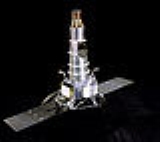
. The spacecraft consisted of a hexagonal aluminum frame base 1.5 m across on which was mounted the propulsion and power units, topped by a truncated conical tower which held the TV cameras. Two solar panel wings, each 739 mm wide by 1537 mm long, extended from opposite edges of the base with a full span of 4.6 m, and a pointable high gain dish antenna was hinge mounted at one of the corners of the base away from the solar panels. A cylindrical quasiomnidirectional antenna was seated on top of the conical tower. The overall height of the spacecraft was 3.6 m.

Propulsion for the mid-course trajectory correction was provided by a 224-N thrust monopropellant hydrazine engine with 4 jet-vane vector control. Orientation and attitude control about 3 axes was enabled by 12 nitrogen gas jets coupled to a system of 3 gyros, 4 primary Sun sensors, 2 secondary Sun sensors, and an Earth sensor. Power was supplied by 9792 Si solar cells contained in the two solar panels, giving a total array area of 2.3 square meters and producing 200 W. Two 1200 watt.hour AgZnO batteries rated at 26.5 V with a capacity for 9 hours of operation provided power to each of the separate communication/TV camera chains. Two 1000 watt.hour AgZnO batteries stored power for spacecraft operations.

Communications were through the quasiomnidirectional low-gain antenna and the parabolic high-gain antenna. Transmitters aboard the spacecraft included a 60 W TV channel F at 959.52 MHz, a 60 W TV channel P at 960.05 MHz, and a 3 W transponder channel 8 at 960.58 MHz. The telecommunications equipment converted the composite video signal from the camera transmitters into an RF signal for subsequent transmission through the spacecraft high-gain antenna. Sufficient video bandwidth was provided to allow for rapid framing sequences of both narrow- and wide-angle television pictures.

Mission Profile

The Atlas 204D Atlas

An atlas is a collection of map [i]s, traditionally bound into book form, but also found in multimedia [i] ... 

 and Agena B 6007 RM-81 Agena

The Agena was a rocket upper stage developed by Lockheed [i] for the ill-fated WS-117L [i] US reconnaissance satellite [i]... 

 boosters performed nominally, injecting the Agena RM-81 Agena

The Agena was a rocket upper stage developed by Lockheed [i] for the ill-fated WS-117L [i] US reconnaissance satellite [i]... 

 and Ranger 9 into an Earth Earth

Earth is the third planet [i] in the solar system [i] in terms of distance from the Sun [i], and the fi ... 

 parking orbit at 185 km altitude. A 90 second Agena RM-81 Agena

The Agena was a rocket upper stage developed by Lockheed [i] for the ill-fated WS-117L [i] US reconnaissance satellite [i]... 

 2nd burn put the spacecraft into lunar transfer trajectory. This was followed by the separation of the Agena RM-81 Agena

The Agena was a rocket upper stage developed by Lockheed [i] for the ill-fated WS-117L [i] US reconnaissance satellite [i]... 

 and Ranger. Seventy minutes after launch the command was given to deploy solar panels, activate attitude control, and switch from the omniantenna to the high-gain antenna. The accuracy of the initial trajectory enabled delay of the planned mid-course correction from 22 March to 23 March when the maneuver was initiated at 12:03 UT. After orientation, a 31 second rocket burn at 12:30 UT, and reorientation, the maneuver was completed at 13:30 UT.

Ranger 9 reached the Moon Moon

The Moon is Earth [i]'s only natural satellite [i]. ... 

 on 24 March 1965. At 13:31 UT a terminal maneuver was executed to orient the spacecraft so the cameras were more in line with the flight direction to improve the resolution of the pictures. Twenty minutes before impact the one-minute camera system warm-up began. The first image was taken at 13:49:41 at an altitude of 2363 km. Transmission of 5,814 good contrast photographs was made during the final 19 minutes of flight. The final image taken before impact has a resolution of 0.3 meters. The spacecraft encountered the lunar surface with an incoming asymptotic direction at an angle of -5.6 degrees from the lunar equator. The orbit plane was inclined 15.6 degrees to the lunar equator. After 64.5 hours of flight, impact occurred at 14:08:19.994 UT at approximately 12.83 S latitude, 357.63 E longitude in the crater Alphonsus Alphonsus (crater)

Alphonsus is an ancient impact crater [i] on Earth [i]'s Moon [i] that dates from the immediate post-Nectarian [i] ... 

. Impact velocity was 2.67 km/s. The spacecraft performance was excellent. Real time television coverage with live network broadcasts of many of the F-channel images were provided for this flight.

External links


Categories: