
| |
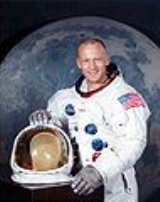
Buzz Aldrin (born Edwin Eugene Aldrin, Jr., January 20, 1930 in Montclair, New Jersey) is an American aviator and astronaut, who was the Lunar Module Pilot on Apollo 11, the first lunar landing. He was, along with Mission Commander Neil Armstrong, the first person to land on the Moon, and shortly afterward became the second person to set foot on the Moon.
in was born to Marion (née Moon) and Edwin Eugene Aldrin, Sr., a military man in Montclair, New Jersey, where he was a Tenderfoot in the Boy Scouts of America.

Discussion
Ask a question about 'Buzz Aldrin'
Start a new discussion about 'Buzz Aldrin'
Answer questions from other users
|
Quotations
Give us a reading on the 1202 program alarm.
During the Apollo 11 Eagle's descent.
Magnificent desolation.
Words said when he first stepped onto the moon.

Encyclopedia
Buzz Aldrin (born Edwin Eugene Aldrin, Jr., January 20, 1930 in Montclair, New Jersey) is an American aviator and astronaut, who was the Lunar Module Pilot on Apollo 11, the first lunar landing. He was, along with Mission Commander Neil Armstrong, the first person to land on the Moon, and shortly afterward became the second person to set foot on the Moon.
Biography
Aldrin was born to Marion (née Moon) and Edwin Eugene Aldrin, Sr., a military man in Montclair, New Jersey, where he was a Tenderfoot in the Boy Scouts of America. He attended Montclair High School in Montclair, New Jersey, and graduated from the U.S. Military Academy at West Point. The nickname "Buzz" originated in childhood: his sister mispronounced "brother" as "buzzer" as a toddler, and this was shortened to Buzz. He made it his legal first name in 1988. He is of Scottish and Swedish ancestry.
Military career
Aldrin graduated third in his class in 1951 from West Point with a B.Sc. degree. He was commissioned as a Second Lieutenant and served as a jet fighter pilot in the U.S. Air Force during the Korean War, where he flew 66 combat missions in F-86 Sabres and shot down two Mikoyan-Gurevich MiG-15 aircraft. The June 8, 1953 issue of LIFE magazine features photos taken by Aldrin of one of the Russian pilots ejecting from his damaged aircraft.
After leaving Korea, Aldrin was an aerial gunnery instructor at Nellis Air Force Base in southern Nevada, and later an aide to the dean of faculty at the U.S. Air Force Academy. Following this assignment, Aldrin flew F-100 Super Sabres as a flight commander at Bitburg, Germany in the 22nd Fighter Squadron. Aldrin earned his D.Sc. degree in Astronautics from Massachusetts Institute of Technology (MIT) in Cambridge, Massachusetts. His graduate thesis was . After leaving MIT, he returned to the Air Force and was assigned to the Gemini Target Office of the Air Force Space Systems Division in Los Angeles, and later to Edwards Air Force Base at the U.S. Air Force Test Pilot School.
Aldrin was selected as part of the third group of NASA astronauts in October 1963. After the deaths of the original Gemini 9 prime crew, Elliot See and Charles Bassett, Aldrin was promoted to back-up crew for the mission. The main objective of the revised mission (Gemini 9A) was to rendezvous and dock with a target vehicle, but when this failed, Aldrin improvised an effective exercise for the craft to rendezvous with a co-ordinate in space. He was confirmed as pilot on Gemini 12, the last Gemini mission and the last chance to prove methods for EVA. He utilized revolutionary techniques during training for that mission, including neutrally-buoyant underwater training. Such techniques are still used today. Aldrin set a record for extra-vehicular activity and proved that astronauts could work outside the spacecraft. And because of the absence of air and gravity on the moon, both Aldrin's and Neil Armstrong's footprints are still there, untouched. Without human interaction or other disturbances the prints will likely be there for an indefinite period of time.
Much has been said about Aldrin's desire at the time to be the first astronaut to walk on the moon. Differing NASA accounts have it that he had originally been proposed as the first, but the configuration of the lunar module was changed, or that protocol demanded that the commander (Armstrong) be the first. (In addition, in a March 1969 meeting between senior NASA personnel Deke Slayton, George Low, Bob Gilruth, and Chris Kraft, it was suggested that Armstrong be the first partly because Armstrong was seen as not having a large ego.) Nonetheless, Aldrin may have had an even more singular contribution. Armstrong's famous "Houston, Tranquility Base here. The Eagle has landed," were the first words intentionally spoken to Mission Control and the world from the lunar surface. However, the actual first words ever spoken on the moon as heard, at approximately 20:17:39 UTC on July 20 1969, were very likely Lunar Module Pilot Aldrin's "Contact Light... Okay, Engine Stop" (although Armstrong leaves open whether he said "Shutdown" first.)
Aldrin is a Presbyterian, and is known for his statements about God. After landing on the moon, Aldrin radioed earth with these words: "I'd like to take this opportunity to ask every person listening in, whoever and wherever they may be, to pause for a moment and contemplate the events of the past few hours, and to give thanks in his or her own way." He received Communion on the surface of the moon, but kept his Communion a secret because of the lawsuit brought by Madalyn Murray O'Hair regarding the reading of Genesis on Apollo 8. Aldrin, a church elder, used a pastor's home Communion kit given to him by Dean Woodruff and recited words used by his pastor at Webster Presbyterian Church. He celebrated Communion alone, without his colleague Armstrong participating. Webster Presbyterian Church, a local congregation in Webster, Texas (a Houston suburb near the Johnson Space Center) possesses the chalice used for communion on the moon, and commemorates the event annually on the Sunday closest to July 20th.
Aldrin is represented by the Executive Speakers Bureau of Memphis, Tennessee, and receives between $30,000-$50,000 per appearance.
Aldrin Cycler
In 1985, Aldrin invented a special spacecraft trajectory now known as the Aldrin cycler. A spacecraft traveling on an Aldrin cycler trajectory would pass near the planets Earth and Mars on a regular (cyclic) basis. The Aldrin cycler is an example of a Mars cycler (of which there are others).
Retirement
In March 1972, Aldrin retired from active duty after 21 years of service, and returned to the Air Force in a managerial role, but his career was blighted by personal problems. His 1973 autobiography Return to Earth provides an account of his struggles with clinical depression and alcoholism in the years following his NASA career. His life improved considerably with his marriage to Lois Aldrin. Since retiring from NASA, he has continued to promote space exploration, including producing a computer strategy game called "Buzz Aldrin's Race into Space" (1992).
Personal life
Aldrin has been married three times. His first wife was Joan Archer, with whom he had three children, James, Janice, and Andrew. His second wife was Beverly Zile. Aldrin married his current wife, Lois Driggs Cannon, on Valentine's Day in 1988. He is also a grandfather.
UFO and Apollo hoax allegations
In 2005, while being interviewed for a documentary titled First on the Moon: The Untold Story, Aldrin told an interviewer that they saw an unidentified flying object. Aldrin told David Morrison, an NAI Senior Scientist, that the documentary cut the crew's conclusion that they were probably seeing one of four detached spacecraft adapter panels. The crew was told that their S-IVB upper stage was 6,000 miles away. However, the panels were jettisoned before the S-IVB made its separation maneuver, so this panel would closely follow the Apollo 11 spacecraft until its first midcourse correction. When Aldrin appeared on The Howard Stern Show on August 15, 2007, Stern asked him about the supposed UFO sighting. Aldrin confirmed that there was no such sighting of anything deemed extraterrestrial, and said they were and are "99.9 percent" sure that the object was the detached panel. On August 4 2007, during his appearance on Larry King Live, Aldrin said he "saw a light moving which was not a star" after they witnessed the "upper stage rocket make a maneuver which missed the moon."
Interviewed by the Science Channel, Aldrin mentioned seeing unidentified objects, and he claims his words were taken out of context; he asked the Science Channel to clarify to viewers he did not see a UFO, but they refused. The Science Channel video can be viewed at this link.
On September 9, 2002, filmmaker Bart Sibrel, a proponent of the Apollo moon landing hoax theory, confronted Aldrin outside a Beverly Hills, California hotel. Sibrel said "You're the one who said you walked on the moon and you didn't" and called Aldrin "a coward and a liar and a thief." Aldrin punched Sibrel in the face. Beverly Hills police and the city's prosecutor declined to file charges. Sibrel suffered no permanent injuries.
Honors and roles in the arts
- Buzz Aldrin made a guest star appearance in an episode of animated sitcom The Simpsons entitled "Deep Space Homer", in which the main character, Homer Simpson, signs up to NASA as their first "Average Joe" astronaut. Aldrin displayed a good sense of humor about his status as second man on the moon, proclaiming "Second comes right after first!", while his introduction to Homer is met with absolute non-recognition.
- The crater Aldrin on the Moon near the Apollo 11 landing site and Asteroid 6470 Aldrin are named in his honor.
- In 1967, Aldrin received an Honorary Doctorate of Science from Gustavus Adolphus College.
- In 2001, President Bush appointed Aldrin to the Commission on the Future of the United States Aerospace Industry.
- Aldrin received the 2003 Humanitarian Award from Variety, the Children's Charity, which, according to the organization, "is given to an individual who has shown unusual understanding, empathy, and devotion to mankind."
- Aldrin is on the National Space Society's Board of Governors, and has served as the organization's Chairman; an inductee of the Astronaut Hall of Fame; and a member of The Planetary Society, with Aldrin's pre-recorded voice appearing on nearly every episode of the Society's Planetary Radio.
- The British television comedy group Monty Python, on October 20 1970, ran an episode called the "Buzz Aldrin Show" with a few references to him and his photo superimposed over the credits while The Star-Spangled Banner was played.
- Cliff Robertson played Aldrin in the 1976 TV-movie Return to Earth based on Aldrin's own memoir.
- In September 2008, Aldrin announced that he was writing a new memoir, entitled "Magnificent Desolation," about his astronaut career and he and his wife's struggle with an addiction to plastic surgery.
- Aldrin was portrayed by Larry Williams in the 1995 film Apollo 13.
- Aldrin played the role of Reverend Woodruff in the 1996 TV movie Apollo 11, while his own character was played by Xander Berkeley, who had previously played the small role of Henry Hurt in Apollo 13.
- The matter of who would make the first step on the moon was dramatized in the 1998 miniseries From the Earth to the Moon, based on Andrew Chaikin's book A Man on the Moon, in which Aldrin was portrayed by Bryan Cranston.
- The popular space ranger character Buzz Lightyear, from Pixar's Toy Story movie series, is named after him, largely due to the suggestion of the film's makers that he has "the coolest name of any astronaut". Aldrin acknowledged the tribute when he pulled a Buzz Lightyear doll out during a speech at NASA, to rapturous cheers (a clip of which can be found on the Toy Story 10th Anniversary DVD).
- He appeared in a 2003 interview with Ali G in the British comedy series Ali G in da USA, during which Ali G referred to him as Buzz Lightyear and asked him if he thought man would ever walk on the sun.
- Aldrin voiced himself in a 1999 episode of Disney's Recess.
 *Aldrin collaborated with science fiction author John Barnes to write Encounter With Tiber and The Return.
- In a 2006 episode of NUMB3RS titled "Killer Chat", Aldrin plays himself and is seen at the end escorting Larry from the FBI headquarters on his way to his launch to the International Space Station.
- On December 26 2006, UK TV channel Channel 4 transmitted a 50 minute opera by British composer Jonathan Dove called Man on the Moon, especially made for television. It tells the story of Aldrin's trip to the moon interleaved with the effects the experience had on him and his marriage. Aldrin was played by Nathan Gunn, and Joan Aldrin by Patricia Racette.
- In 2007, Aldrin participated in the book and documentary In the Shadow of the Moon.
- He plays himself in the 3-D animated film Fly Me to the Moon.
- The story of Apollo 11, through the eyes of Aldrin, was recently reimagined as a musical. 'Moon Landing' was written, composed and directed by Stephen Edwards, and performed at Derby Playhouse, and included inventive scenery, including a floating shuttle capsule.
- In 1986, after the Challenger explosion, he appeared in the Punky Brewster episode "Accidents Happen" as himself to encourage a disheartened Punky to continue pursuing her dream of becoming an astronaut.
- Aldrin is the model for the MTV Video Music Award moonman.
- Psychedelic rock band Bardo Pond released a track called Aldrin on their Lapsed LP*Aldrin was interviewed on the July 31st 2008 episode of The Colbert Report, promoting the film Fly Me to the Moon.
Media
Aldrin is one of the astronauts featured in the book and documentary In the Shadow of the Moon, and the documentary "The Wonder of it All."
External links
- on Time.com (a division of Time Magazine)
- (Popular Mechanics, December 2005)
- by Buzz Aldrin: an article in which Aldrin describes what it was like to walk on the Moon, Cosmos science magazine
- SWINDLE Magazine interview with Buzz Aldrin
- Signature of Buzz Aldrin - Reaching For The Moon
- Cute song from the Apollo 11 era by Bob Crewe and recorded with Bobby Dimple, Lunar Ladies Chorus, Lipple Kutie Kids, Hutch Davie Diggers Band - American Moon (from The Heart's Delight Follies '69)
|