

Ranger 8

Encyclopedia
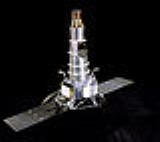
Ranger 8 was a spacecraft
designed to achieve a lunar impact trajectory
and to transmit high-resolution photographs of the lunar surface during the final minutes of flight up to impact. The spacecraft carried six television vidicon
cameras, two wide angle (channel F, cameras A and B) and four narrow angle (channel P) to accomplish these objectives. The cameras were arranged in two separate chains, or channels, each self-contained with separate power supplies, timers, and transmitter
s so as to afford the greatest reliability and probability of obtaining high-quality Television
pictures. No other experiments were carried on the spacecraft.
, 7
, 8, and 9
were called the Block 3 versions of the Ranger spacecraft
. The spacecraft consisted of a hexagonal aluminum
frame base 1.5 m across on which was mounted the propulsion and power units, topped by a truncated conical tower which held the TV cameras. Two solar panel wings, each 739 mm wide by 1537 mm long, extended from opposite edges of the base with a full span of 4.6 m, and a pointable high gain dish antenna was hinge mounted at one of the corners of the base away from the solar panels. A cylindrical quasiomnidirectional antenna
was seated on top of the conical tower. The overall height of the spacecraft was 3.6 m.
Propulsion for the mid-course trajectory correction was provided by a 224 N thrust monopropellant
hydrazine
engine with four jet-vane vector control. Orientation and attitude control about three axes
was enabled by twelve nitrogen gas jets coupled to a system of three gyroscopes, four primary Sun sensors, two secondary Sun sensors, and an Earth sensor. Power was supplied by 9792 silicon solar cells contained in the two solar panels, giving a total array area of 2.3 square meters and producing 200 W. Two 1200 watt.hour AgZnO batteries rated at 26.5 V with a capacity for nine hours of operation provided power to each of the separate communication/TV camera chains. Two 1000 watt.hour AgZnO batteries stored power for spacecraft operations.
Communications were through the quasiomnidirectional low-gain antenna and the parabolic high-gain antenna. Transmitters aboard the spacecraft included a 60 watt TV channel F at 959.52 MHz, a 60 watt TV channel P at 960.05 MHz, and a three watt transponder channel 8 at 960.58 MHz. The telecommunications equipment converted the composite video signal from the camera transmitters into an RF signal for subsequent transmission through the spacecraft's high-gain antenna. Sufficient video bandwidth was provided to allow for rapid framing sequences of both narrow- and wide-angle television pictures.
B 6006 boosters performed nominally, injecting the Agena and Ranger 8 into an Earth
parking orbit
at 185 km altitude
after launch. Fourteen minutes later a 90 second burn of the Agena put the spacecraft into lunar transfer trajectory
, and several minutes later the Ranger and Agena separated. The Ranger solar panel
s were deployed, attitude control activated, and spacecraft transmissions switched from the omniantenna to the high-gain antenna by 21:30 UT. On 18 February at a distance of 160,000 km from Earth the planned mid-course maneuver took place, involving reorientation and a 59 second rocket burn. During the 27 minute maneuver, spacecraft transmitter power dropped severely, so that lock was lost on all telemetry channels. This continued intermittently until the rocket burn, at which time power returned to normal. The telemetry dropout had no serious effects on the mission. A planned terminal sequence to point the cameras more in the direction of flight just before reaching the Moon
was cancelled to allow the cameras to cover a greater area of the Moon's surface.
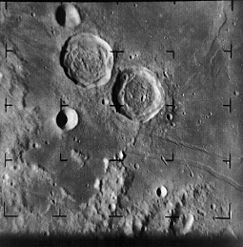 Ranger 8 reached the Moon on February 20, 1965. The first image was taken at 9:34:32 UT at an altitude of 2510 km. Transmission of 7,137 photographs of good quality occurred over the final 23 minutes of flight. The final image taken before impact has a resolution of 1.5 meters. The spacecraft encountered the lunar surface in a direct hyperbolic trajectory
, with incoming asymptotic
direction at an angle of -13.6 degrees from the lunar equator. The orbit plane was inclined 16.5 degrees to the lunar equator. After 64.9 hours of flight, impact occurred at 09:57:36.756 UT on 20 February 1965 in Mare Tranquillitatis
at approximately 2.67 degrees N, 24.65 degrees E. (The impact site is listed as about 2.72° N, 24.61° E in the initial report "Ranger 8 Photographs of the Moon".) Impact velocity was slightly less than 2.68 km/s. The spacecraft performance was excellent.
Spacecraft
A spacecraft or spaceship is a craft or machine designed for spaceflight. Spacecraft are used for a variety of purposes, including communications, earth observation, meteorology, navigation, planetary exploration and transportation of humans and cargo....
designed to achieve a lunar impact trajectory
Trajectory
A trajectory is the path that a moving object follows through space as a function of time. The object might be a projectile or a satellite, for example. It thus includes the meaning of orbit—the path of a planet, an asteroid or a comet as it travels around a central mass...
and to transmit high-resolution photographs of the lunar surface during the final minutes of flight up to impact. The spacecraft carried six television vidicon
Video camera tube
In older video cameras, before the mid to late 1980s, a video camera tube or pickup tube was used instead of a charge-coupled device for converting an optical image into an electrical signal. Several types were in use from the 1930s to the 1980s...
cameras, two wide angle (channel F, cameras A and B) and four narrow angle (channel P) to accomplish these objectives. The cameras were arranged in two separate chains, or channels, each self-contained with separate power supplies, timers, and transmitter
Transmitter
In electronics and telecommunications a transmitter or radio transmitter is an electronic device which, with the aid of an antenna, produces radio waves. The transmitter itself generates a radio frequency alternating current, which is applied to the antenna. When excited by this alternating...
s so as to afford the greatest reliability and probability of obtaining high-quality Television
Television
Television is a telecommunication medium for transmitting and receiving moving images that can be monochrome or colored, with accompanying sound...
pictures. No other experiments were carried on the spacecraft.
Spacecraft design
Rangers 6Ranger 6
Ranger 6 was designed to achieve a lunar impact trajectory and to transmit high-resolution photographs of the lunar surface during the final minutes of flight up to impact. The spacecraft carried six television vidicon cameras, 2 wide angle and 4 narrow angle to accomplish these objectives...
, 7
Ranger 7
Ranger 7 was the first US space probe to successfully transmit close images of the lunar surface back to Earth. It was also the first completely successful flight of the Ranger program. Launched on 28 July 1964, Ranger 7 was designed to achieve a lunar impact trajectory and to transmit...
, 8, and 9
Ranger 9
Ranger 9 was designed to achieve a lunar impact trajectory and to transmit high-resolution photographs of the lunar surface during the final minutes of flight up to impact. The spacecraft carried six television vidicon cameras, 2 wide angle and 4 narrow angle to accomplish these objectives...
were called the Block 3 versions of the Ranger spacecraft
Ranger program
The Ranger program was a series of unmanned space missions by the United States in the 1960s whose objective was to obtain the first close-up images of the surface of the Moon. The Ranger spacecraft were designed to take images of the lunar surface, returning those images until they were destroyed...
. The spacecraft consisted of a hexagonal aluminum
Aluminium
Aluminium or aluminum is a silvery white member of the boron group of chemical elements. It has the symbol Al, and its atomic number is 13. It is not soluble in water under normal circumstances....
frame base 1.5 m across on which was mounted the propulsion and power units, topped by a truncated conical tower which held the TV cameras. Two solar panel wings, each 739 mm wide by 1537 mm long, extended from opposite edges of the base with a full span of 4.6 m, and a pointable high gain dish antenna was hinge mounted at one of the corners of the base away from the solar panels. A cylindrical quasiomnidirectional antenna
Antenna (radio)
An antenna is an electrical device which converts electric currents into radio waves, and vice versa. It is usually used with a radio transmitter or radio receiver...
was seated on top of the conical tower. The overall height of the spacecraft was 3.6 m.
Propulsion for the mid-course trajectory correction was provided by a 224 N thrust monopropellant
Monopropellant
Monopropellants are propellants composed of chemicals or mixtures of chemicals which can be stored in a single container with some degree of safety. While stable under defined storage conditions, they react very rapidly under certain other conditions to produce a large volume of energetic gases...
hydrazine
Hydrazine
Hydrazine is an inorganic compound with the formula N2H4. It is a colourless flammable liquid with an ammonia-like odor. Hydrazine is highly toxic and dangerously unstable unless handled in solution. Approximately 260,000 tons are manufactured annually...
engine with four jet-vane vector control. Orientation and attitude control about three axes
Axes
Axes may refer to:* Axes, woodworking hand tools* The plural of axis* Axes , a 2005 rock album by the British band Electrelane* X and Y axes, or X, Y, and Z axes, perpendicular lines used in the Cartesian coordinate system...
was enabled by twelve nitrogen gas jets coupled to a system of three gyroscopes, four primary Sun sensors, two secondary Sun sensors, and an Earth sensor. Power was supplied by 9792 silicon solar cells contained in the two solar panels, giving a total array area of 2.3 square meters and producing 200 W. Two 1200 watt.hour AgZnO batteries rated at 26.5 V with a capacity for nine hours of operation provided power to each of the separate communication/TV camera chains. Two 1000 watt.hour AgZnO batteries stored power for spacecraft operations.
Communications were through the quasiomnidirectional low-gain antenna and the parabolic high-gain antenna. Transmitters aboard the spacecraft included a 60 watt TV channel F at 959.52 MHz, a 60 watt TV channel P at 960.05 MHz, and a three watt transponder channel 8 at 960.58 MHz. The telecommunications equipment converted the composite video signal from the camera transmitters into an RF signal for subsequent transmission through the spacecraft's high-gain antenna. Sufficient video bandwidth was provided to allow for rapid framing sequences of both narrow- and wide-angle television pictures.
Mission profile
The Atlas 196D and AgenaRM-81 Agena
The RM-81 Agena was an American rocket upper stage and satellite support bus which was developed by Lockheed initially for the canceled WS-117L reconnaissance satellite program...
B 6006 boosters performed nominally, injecting the Agena and Ranger 8 into an Earth
Earth
Earth is the third planet from the Sun, and the densest and fifth-largest of the eight planets in the Solar System. It is also the largest of the Solar System's four terrestrial planets...
parking orbit
Orbit
In physics, an orbit is the gravitationally curved path of an object around a point in space, for example the orbit of a planet around the center of a star system, such as the Solar System...
at 185 km altitude
Altitude
Altitude or height is defined based on the context in which it is used . As a general definition, altitude is a distance measurement, usually in the vertical or "up" direction, between a reference datum and a point or object. The reference datum also often varies according to the context...
after launch. Fourteen minutes later a 90 second burn of the Agena put the spacecraft into lunar transfer trajectory
Trajectory
A trajectory is the path that a moving object follows through space as a function of time. The object might be a projectile or a satellite, for example. It thus includes the meaning of orbit—the path of a planet, an asteroid or a comet as it travels around a central mass...
, and several minutes later the Ranger and Agena separated. The Ranger solar panel
Photovoltaic module
A solar panel is a packaged, connected assembly of solar cells, also known as photovoltaic cells...
s were deployed, attitude control activated, and spacecraft transmissions switched from the omniantenna to the high-gain antenna by 21:30 UT. On 18 February at a distance of 160,000 km from Earth the planned mid-course maneuver took place, involving reorientation and a 59 second rocket burn. During the 27 minute maneuver, spacecraft transmitter power dropped severely, so that lock was lost on all telemetry channels. This continued intermittently until the rocket burn, at which time power returned to normal. The telemetry dropout had no serious effects on the mission. A planned terminal sequence to point the cameras more in the direction of flight just before reaching the Moon
Moon
The Moon is Earth's only known natural satellite,There are a number of near-Earth asteroids including 3753 Cruithne that are co-orbital with Earth: their orbits bring them close to Earth for periods of time but then alter in the long term . These are quasi-satellites and not true moons. For more...
was cancelled to allow the cameras to cover a greater area of the Moon's surface.
Hyperbolic trajectory
In astrodynamics or celestial mechanics a hyperbolic trajectory is a Kepler orbit with the eccentricity greater than 1. Under standard assumptions a body traveling along this trajectory will coast to infinity, arriving there with hyperbolic excess velocity relative to the central body. Similarly to...
, with incoming asymptotic
Asymptote
In analytic geometry, an asymptote of a curve is a line such that the distance between the curve and the line approaches zero as they tend to infinity. Some sources include the requirement that the curve may not cross the line infinitely often, but this is unusual for modern authors...
direction at an angle of -13.6 degrees from the lunar equator. The orbit plane was inclined 16.5 degrees to the lunar equator. After 64.9 hours of flight, impact occurred at 09:57:36.756 UT on 20 February 1965 in Mare Tranquillitatis
Mare Tranquillitatis
Mare Tranquillitatis is a lunar mare that sits within the Tranquillitatis basin on the Moon. The mare material within the basin consists of basalt formed in the intermediate to young age group of the Upper Imbrian epoch. The surrounding mountains are thought to be of the Lower Imbrian epoch, but...
at approximately 2.67 degrees N, 24.65 degrees E. (The impact site is listed as about 2.72° N, 24.61° E in the initial report "Ranger 8 Photographs of the Moon".) Impact velocity was slightly less than 2.68 km/s. The spacecraft performance was excellent.