


Wok

Encyclopedia
Cookware and bakeware
Cookware and bakeware are types of food preparation containers commonly found in the kitchen. Cookware comprises cooking vessels, such as saucepans and frying pans, intended for use on a stove or range cooktop. Bakeware comprises cooking vessels intended for use inside an oven...
originating in China
China
Chinese civilization may refer to:* China for more general discussion of the country.* Chinese culture* Greater China, the transnational community of ethnic Chinese.* History of China* Sinosphere, the area historically affected by Chinese culture...
. It is used especially in East
East Asia
East Asia or Eastern Asia is a subregion of Asia that can be defined in either geographical or cultural terms...
and Southeast Asia
Southeast Asia
Southeast Asia, South-East Asia, South East Asia or Southeastern Asia is a subregion of Asia, consisting of the countries that are geographically south of China, east of India, west of New Guinea and north of Australia. The region lies on the intersection of geological plates, with heavy seismic...
.
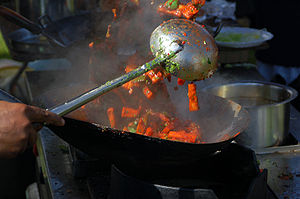
Woks are most often used for stir frying
Stir frying
Stir frying is an umbrella term used to describe two Chinese cooking techniques for preparing food in a wok: chǎo and bào . The term stir-fry was introduced into the English language by Buwei Yang Chao, in her book How to Cook and Eat in Chinese, to describe the chǎo technique...
, but can also be used in other Chinese cooking techniques
Chinese cooking techniques
Chinese cooking techniques are a set of methods and techniques traditionally used in Chinese cuisine. The cooking techniques can either be grouped into ones that use a single cooking method or a combination of wet and dry cooking methods.-Wet:...
, such as in steaming
Steaming
Steaming is a method of cooking using steam. Steaming is considered a healthy cooking technique and capable of cooking almost all kinds of food.-Method:...
, deep frying
Deep frying
Deep frying is a cooking method in which food is submerged in hot oil or fat. This is normally performed with a deep fryer or chip pan; industrially, a pressure fryer or vacuum fryer may be used....
, braising
Braising
Braising , is a combination cooking method using both moist and dry heat; typically the food is first seared at a high temperature and then finished in a covered pot with a variable amount of liquid, resulting in a particular flavour...
, stewing, smoking, or making soup
Soup
Soup is a generally warm food that is made by combining ingredients such as meat and vegetables with stock, juice, water, or another liquid. Hot soups are additionally characterized by boiling solid ingredients in liquids in a pot until the flavors are extracted, forming a broth.Traditionally,...
. They are commonly, almost exclusively, cooked with a long handled chahn (spatula
Spatula
The term spatula is used to refer to various small implements with a broad, flat, flexible blade used to mix, spread and lift materials including foods, drugs, plaster and paints...
) or hoak (ladle
Ladle (spoon)
A ladle is a type of spoon used to scoop up and serve soup, stew, or other foods. Although designs vary, a typical ladle has a long handle terminating in a deep bowl, frequently with the bowl oriented at an angle to the handle to facilitate lifting liquid out of a pot or other vessel and conveying...
). The long extensions of these utensils allow the cook to work with the food without burning the hand.
Regional variants of the wok
Standard Chinese uses different words for wok, guō, guōzi, or chǎocàiguō. In IndonesiaIndonesia
Indonesia , officially the Republic of Indonesia , is a country in Southeast Asia and Oceania. Indonesia is an archipelago comprising approximately 13,000 islands. It has 33 provinces with over 238 million people, and is the world's fourth most populous country. Indonesia is a republic, with an...
the wok is known as a penggorengan or wajan. In Malaysia it is called a kuali (small wok) or kawa (big wok). In the Philippines
Philippines
The Philippines , officially known as the Republic of the Philippines , is a country in Southeast Asia in the western Pacific Ocean. To its north across the Luzon Strait lies Taiwan. West across the South China Sea sits Vietnam...
it is known as a kawali and also called a "wadjang". In Japan
Japan
Japan is an island nation in East Asia. Located in the Pacific Ocean, it lies to the east of the Sea of Japan, China, North Korea, South Korea and Russia, stretching from the Sea of Okhotsk in the north to the East China Sea and Taiwan in the south...
the wok is called a chukanabe (literally, "Chinese pot" or "中華鍋"). In India
India
India , officially the Republic of India , is a country in South Asia. It is the seventh-largest country by geographical area, the second-most populous country with over 1.2 billion people, and the most populous democracy in the world...
, two varieties of the wok exist: a more traditional chinese style wok with a wider diameter called the "cheena chatti" (literally, "Chinese pot" in Malayalam and Tamil
Tamil language
Tamil is a Dravidian language spoken predominantly by Tamil people of the Indian subcontinent. It has official status in the Indian state of Tamil Nadu and in the Indian union territory of Pondicherry. Tamil is also an official language of Sri Lanka and Singapore...
), and a slightly deeper vessel with a narrower diameter and a similar shape, known as a karahi
Karahi
A karahi is a type of thick, circular, and deep cooking pot used in Indian, Pakistani, Bangladeshi and Nepalese cuisine. Karahi are traditionally made out of cast iron, and look like woks with rounded bottoms...
.
Characteristics

Frying pan
A frying pan, frypan, or skillet is a flat-bottomed pan used for frying, searing, and browning foods. It is typically in diameter with relatively low sides that flare outwards, a long handle, and no lid. Larger pans may have a small grab handle opposite the main handle...
. The flat bottom allows the wok to be used on an electric stove, where a rounded wok would not be able to fully contact the stove's heating element. A round bottom wok enables the traditional round spatula or ladle to pick all the food up at the bottom of the wok and toss it around easily; this is difficult with a flat bottom. With a gas hob, or traditional pit stove, the bottom of a round wok can get hotter than a flat wok and so is better for stir frying.
Most woks range from 300 to 2000 mm (11.8 to 78.7 in) or more in diameter
Diameter
In geometry, a diameter of a circle is any straight line segment that passes through the center of the circle and whose endpoints are on the circle. The diameters are the longest chords of the circle...
. Woks of 360 mm (14 in) (suitable for a family of 3 or 4) are the most common, but home woks can be found as small as 200 mm (8 in) and as large as 910 mm (36 in). Smaller woks are typically used for quick cooking techniques at high heat such as stir frying
Stir frying
Stir frying is an umbrella term used to describe two Chinese cooking techniques for preparing food in a wok: chǎo and bào . The term stir-fry was introduced into the English language by Buwei Yang Chao, in her book How to Cook and Eat in Chinese, to describe the chǎo technique...
(Chinese: chǎo, 炒 or bao, 爆). Large woks over a meter wide are mainly used by restaurants or community kitchens for cooking rice
Rice
Rice is the seed of the monocot plants Oryza sativa or Oryza glaberrima . As a cereal grain, it is the most important staple food for a large part of the world's human population, especially in East Asia, Southeast Asia, South Asia, the Middle East, and the West Indies...
or soup
Soup
Soup is a generally warm food that is made by combining ingredients such as meat and vegetables with stock, juice, water, or another liquid. Hot soups are additionally characterized by boiling solid ingredients in liquids in a pot until the flavors are extracted, forming a broth.Traditionally,...
, or for boiling water
Water
Water is a chemical substance with the chemical formula H2O. A water molecule contains one oxygen and two hydrogen atoms connected by covalent bonds. Water is a liquid at ambient conditions, but it often co-exists on Earth with its solid state, ice, and gaseous state . Water also exists in a...
.
Handles
Towel
A towel is a piece of absorbent fabric or paper used for drying or wiping. It draws moisture through direct contact, often using a blotting or a rubbing motion. Common household textile towels are made from cotton, rayon, bamboo, nonwoven fibers or a few other materials.-Types of towels:* A bath...
(though some woks have spool-shaped wooden or plastic covers over the metal of the handle). Cooking with the tossing action in loop-handled woks requires a large amount of hand, arm and wrist strength. Loop handles typically come in pairs on the wok and are riveted, welded or extended from the wok basin.
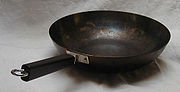
Stick handles are long, made of steel, and are usually welded or riveted to the wok basin, or are an actual direct extension of the metal of the basin. The handle is sometimes covered or ended with a wooden or plastic hand grip, but it is not uncommon to find a bare metal grip. This handle facilitates the tossing action for cooks used to using western saute pans with similar style handles. These kinds of woks are often referred to as "Peking pans". Stick handles are normally not found on cast iron woks since the wok is either too heavy for the handle (thick cast iron wok), or the metal is too thin to handle the tensile stress exerted by the handle. Larger woks with stick type handles usually also have a loop on the other side to aid with handling the wok as well as to counter balance the stick type handle.
Materials
The most common materials used in making woks today are carbon steel and cast ironCast iron
Cast iron is derived from pig iron, and while it usually refers to gray iron, it also identifies a large group of ferrous alloys which solidify with a eutectic. The color of a fractured surface can be used to identify an alloy. White cast iron is named after its white surface when fractured, due...
. Although the latter was the most common type used in the past, cooks tend to be divided on whether carbon steel or cast iron woks are superior.
Currently, carbon steel is the most widely used material. Steel woks are usually inexpensive, relatively light in weight, have quick heat conduction, and reasonable durability. However, carbon steel woks are more difficult to season and the carbonized season is easily removed in newer woks, both making food more prone to sticking to the wok. Carbon steel woks vary widely in price, style, and quality, which is roughly based on ply
Ply
Ply, Pli, Plies or Plying may refer to:* Ply , a turn in game play* PLY or Polygon File Format* Plying, a spinning technique to make yarn* Plies , American rapper* Pli, an academic journal...
and forming technique. The lowest quality woks tend to be single ply and stamped
Stamping (metalworking)
Stamping includes a variety of sheet-metal forming manufacturing processes, such as punching using a machine press or stamping press, blanking, embossing, bending, flanging, and coining. This could be a single stage operation where every stroke of the press produce the desired form on the sheet...
straight from a piece of steel. These woks have a higher tendency to deform and misshape. Cooking with them is also more difficult and precarious since they often have a "hot spot". Higher quality woks are almost always "hand hammered" and made of two sheets of carbon steel which are formed into shape by "ring-forming" or hand forging.
Two types of cast iron woks can be found in the market. Chinese cast iron woks are thin (3 mm (0.118110236220472 in)) and weigh about the same as a carbon steel wok of similar size, while western cast iron woks tend to be thick (9 mm (0.354330708661417 in)), tend to be heavy, and require very long heating times. Cast iron woks are superior to carbon steel woks in heat retention and uniform heat distribution. They also form a more stable carbonized layer of seasoning which makes it less prone to food sticking on the pan. However, both types of cast iron wok also have some disadvantages compared to carbon steel woks. Chinese-style cast iron woks, although quicker in heating and relatively light, are relatively fragile and are prone to shattering if dropped or mishandled. Western-type cast iron woks are slow-heating and slow-cooling, which makes temperature control more difficult. Furthermore, heavy western cast iron makes the tossing action required in stir-frying and bao difficult for smaller chefs.
Non-stick, steel woks coated with Teflon
Polytetrafluoroethylene
Polytetrafluoroethylene is a synthetic fluoropolymer of tetrafluoroethylene that finds numerous applications. PTFE is most well known by the DuPont brand name Teflon....
are common in the western market. These woks are easily scratched and cannot be used to cook in the high heat required for stir frying to excess of 230 °C (446 °F) since the Teflon coating will break down chemically at these temperatures. At 350 °C (662 °F) the burning coating produces vapours which, if inhaled, can cause flu-like symptoms (see Teflon flu). Xylan
Xylan (coating)
Xylan is a fluoropolymer-based industrial coating. Generally, it is applied in a thin film to the target material.-Applications:Xylan is generally used to reduce friction, improve wear resistance, and for non-stick applications. Additionally, it can be used to protect a metal from corrosion...
coated woks are slightly more robust, but still cannot be used for very high heat cooking. Less commonly found are clad woks, which sandwich a thick layer of aluminum or copper between two sheets of stainless steel. These woks are often quite expensive, quite heavy and usually cook no better than carbon steel or cast iron woks. Their biggest advantage lies in the durability and ease of maintenance of a stainless steel exterior and cooking surface. Many of these vessels are dishwasher
Dishwasher
A dishwasher is a mechanical device for cleaning dishes and eating utensils. Dishwashers can be found in restaurants and private homes.Unlike manual dishwashing, which relies largely on physical scrubbing to remove soiling, the mechanical dishwasher cleans by spraying hot water, typically between ...
safe.
Woks can also be made from aluminium
Aluminium
Aluminium or aluminum is a silvery white member of the boron group of chemical elements. It has the symbol Al, and its atomic number is 13. It is not soluble in water under normal circumstances....
. Although an excellent conductor of heat
Heat conduction
In heat transfer, conduction is a mode of transfer of energy within and between bodies of matter, due to a temperature gradient. Conduction means collisional and diffusive transfer of kinetic energy of particles of ponderable matter . Conduction takes place in all forms of ponderable matter, viz....
, aluminium does not retain heat (heat capacity
Heat capacity
Heat capacity , or thermal capacity, is the measurable physical quantity that characterizes the amount of heat required to change a substance's temperature by a given amount...
) as well as cast iron or carbon steel. Although anodized aluminium alloy
Alloy
An alloy is a mixture or metallic solid solution composed of two or more elements. Complete solid solution alloys give single solid phase microstructure, while partial solutions give two or more phases that may or may not be homogeneous in distribution, depending on thermal history...
s can stand up to constant use, plain aluminium woks are too soft and damage easily. Aluminium is mostly used for wok lids.
Cooking
The wok can be used in a large number of cooking methods. Before the introduction of western cookware it was often used for all cooking techniques including:- Boiling: For boiling water, soups, or rice. In the latter case, guobaGuobaGuoba , sometimes known as mi guoba is a Chinese food ingredient consisting of scorched rice. Traditionally guoba forms during the boiling of rice over direct heat from a flame. This results in the formation of a crust of scorched rice on the bottom of the wok or cooking vessel...
often forms - Braising: Braised dishes are commonly made using woks and this is useful when one is reducing sauces.
- Deep frying: Usually accomplished with larger woks to reduce splashing, but for deep frying of less food or small food items, small woks are also used.
- Smoking: Food can be hot smoked by putting the smoking material in the bottom of the wok while food is placed on a rack above.
- Steaming: Done using a dedicated wok for boiling water in combination with steaming baskets
- Stewing: Woks are sometimes used for stewing though it is more common in Chinese cuisine to use either stoneware or porcelain for such purposes, especially when longer stewing times are required.
The most common use for a wok is stir-frying.
Wok hei
Wok hei ' onMouseout='HidePop("4353")' href="/topics/Romanization">romanizationRomanization
In linguistics, romanization or latinization is the representation of a written word or spoken speech with the Roman script, or a system for doing so, where the original word or language uses a different writing system . Methods of romanization include transliteration, for representing written...
based on Cantonese; and when literally translated into English, can be read as "Wok's air". The second character is qi
Qi
In traditional Chinese culture, qì is an active principle forming part of any living thing. Qi is frequently translated as life energy, lifeforce, or energy flow. Qi is the central underlying principle in traditional Chinese medicine and martial arts...
in Mandarin, and thus wok hei is sometimes rendered as wok chi in Western cookbooks) is the flavour, tastes, and "essence" imparted by a hot wok on food during stir frying
Stir frying
Stir frying is an umbrella term used to describe two Chinese cooking techniques for preparing food in a wok: chǎo and bào . The term stir-fry was introduced into the English language by Buwei Yang Chao, in her book How to Cook and Eat in Chinese, to describe the chǎo technique...
. It is particularly important for Chinese dishes requiring high heat for fragrance such as char kuay teow and beef chow fun.
To impart wok hei, the food must be cooked in a wok over a high flame while being stirred and tossed quickly. For this reason it requires cooking over an open flame rather than an electric stove. In practical terms, the flavour imparted by chemical compounds results from caramelization
Caramelization
Caramelization is the browning of sugar, a process used extensively in cooking for the resulting nutty flavor and brown color. As the process occurs, volatile chemicals are released, producing the characteristic caramel flavor....
, Maillard reaction
Maillard reaction
The Maillard reaction is a form of nonenzymatic browning similar to caramelization. It results from a chemical reaction between an amino acid and a reducing sugar, usually requiring heat....
s, and the partial combustion of oil that come from charring and searing of the food at very high heat in excess of 200 °C (392 °F). Aside from flavour, there is also the texture of the cooked items and smell involved that describes wok qi.
Traditional
Woks were designed to be used over the traditional Chinese pit-style stoveKitchen stove
A kitchen stove, cooking stove, cookstove, or cooker is a kitchen appliance designed for the purpose of cooking food. Kitchen stoves rely on the application of direct heat for the cooking process and may also contain an oven, used for baking.In the industrialized world, as stoves replaced open...
with the wok recessed into the stove top, where the heat is fully directed at the bottom of the wok. Round grate rings on the edge of the opening provide stability to the wok. There are two styles of traditional wok stoves. The more primitive style was used outdoors or in well ventilated areas since hot gasses from the firebox exhaust around the wok. The more advanced style, found in better-off households, has a chimney and may be used indoors.
Pit stoves originally burned wood or coal but are now more typically heated by natural gas with the burner recessed below the stovetop. In areas where natural gas is unavailable, LPG may be used instead. With the adoption of gas and its less objectionable combustion products, the chimney has been replaced by the vent hood
Extractor hood
An extractor hood is a device containing a mechanical fan that hangs above the stove or cooktop in the kitchen. It removes airborne grease, combustion products, smoke, odors, heat, and steam from the air by a combination of filtration and evacuation of the air.-Name:The device is known as an...
.
This type of stove allows foods to be stir-fried at a very high heat, sometimes hot enough to deform the wok itself. Professional chefs in Chinese restaurants often use pit stoves since they have the heating power to give food an alluring wok hei.
Gas
Traditionally-shaped woks can be used on some western-style (flat-topped) gas stoves by removing a burner cover and replacing it with a "wok ring," which provides stability and concentrates heat. Although not as ideal as "pit stoves", these allow woks to be used in a manner more suitable for their design and are good enough for most tasks required in home cooking.Wok rings come in cylindrical and conical shapes. For greatest efficiency with the conical wok ring, position it with the wide side up. This allows the base of the wok to sit closer to the heat source.
Professional-style continuous grate stoves (where it's difficult or impossible to remove a single burner cover) have recently become more popular in high-end home stoves. Several manufacturers of such stoves now include a specially-designed wok ring as part of their standard or optional equipment.
Because of the high cost of these kitchen modifications, coupled with increased heat and smoke generated in the kitchen, more and more home chefs are using their wok outdoors on high-heat propane burners with curved wok support grates. Many inexpensive propane burners are easily capable of 17.5 kW - 22 kW or more, easily surpassing most in-home gas stoves.
Electric
Woks, be they round or flat bottomed, do not generally work well for stir-frying or other quick cooking methods when used on an electric cookerElectric cooker
An electric cooker is an electric powered cooking device for heating and cooking of food.an electric cooker often has four stoves and one or two ovens. there will be knobs to determine the temperature of the ovens and stoves. Unlike gas stoves that are powered by gas it is powered by electricity....
. These stoves do not produce the large amounts of quick even heat required for stir-frying. However, it is possible to find round-shaped electric stove elements that will fit the curve of a wok, which allows the wok to be heated at its bottom along with part of its sides. A flat-bottomed wok may also work better on an electric stove.
Coupled with the lower heat retention of woks, meals stir-fried on electric stoves have a tendency to stew and boil when too much food is in the wok rather than "fry" as in traditional woks, thus not producing wok hei. However, a wok can benefit from the slow steady heating of electric stoves when used for slower cooking methods such as stewing, braising, and steaming, and immersion cooking techniques such as frying and boiling. Many Chinese cooks use Western style cast-iron pans for stir-frying on electric stoves, since they hold enough heat for the required sustained high temperatures.
A newer trend in woks is the electric wok, where no stove is needed. This type of wok is plugged into an electrical outlet and the heating element is in the wok. Like stove-mounted non-stick woks, these woks can also only be used at lower temperatures than traditional woks.
Induction
Induction cookerInduction cooker
An induction cooker uses induction heating for cooking. Unlike other forms of cooking, heat is generated directly in the pot or pan , as opposed to being generated in the stovetop by electrical coils or burning gas...
s generate heat in induction-compatible cookware via direct magnetic stimulation of the pan material. While carbon steel and cast iron (the most common wok materials) are induction-compatible metals, induction cooking also requires close contact between the cooking vessel and the induction burner. This presents two problems when using a wok on an induction cooktop: traditionally shaped woks, which are round-bottomed, don't have enough contact with the cooking surface to generate notable heat; and the tossing technique, where the wok is lifted off the burner and agitated, will break contact and turn off the burner.
Flat-bottomed woks make sufficient contact to generate heat. Some cookware makers are now offering round-bottomed woks with a small flat spot to provide induction contact, with a specially-designed support ring; and some induction cooktops are now also available with a rounded burner that is able to make contact with the rounded bottom of a traditional wok. In both cases, the food will need to be stirred with a cooking utensil, instead of being tossed by lifting the wok itself.
Advantages
The main advantage of wok beyond its constructed material is its curved concave shape. The shape produces a small, hot area at the bottom which allows some of the food to be seared by intense heat while using relatively little fuel. The large sloped sides also make it easier for chefs to employ the tossing cooking technique on solid and thick liquid food with less spillage and a greater margin of safety. Curved sides also allows a person to cook without having to "chase the food around the pan" since bite-sized or finely chopped stir-fry ingredients usually tumble back to the center of the wok when agitated.The curve also provides a larger usable cooking surface versus western-styled pots and pans, which typically have vertical edges. This allows large pieces of food seared at the bottom of the wok to be pushed up the gently sloped sides to continue cooking at a slower rate. While this occurs another ingredient for the same dish needing high heat is being cooked at the bottom. The pointed bottom also allows even small amounts of oil to pool. As such, large food items can be shallow fried, while finely chopped garlic
Garlic
Allium sativum, commonly known as garlic, is a species in the onion genus, Allium. Its close relatives include the onion, shallot, leek, chive, and rakkyo. Dating back over 6,000 years, garlic is native to central Asia, and has long been a staple in the Mediterranean region, as well as a frequent...
, hot peppers, green onions
Scallion
Scallions , are the edible plants of various Allium species, all of which are "onion-like", having hollow green leaves and lacking a fully developed root bulb.-Etymology:The words...
, and ginger
Ginger
Ginger is the rhizome of the plant Zingiber officinale, consumed as a delicacy, medicine, or spice. It lends its name to its genus and family . Other notable members of this plant family are turmeric, cardamom, and galangal....
can be essentially deep-fried in both cases with very small amount of cooking oil.
See also
- Chinese cuisineChinese cuisineChinese cuisine is any of several styles originating in the regions of China, some of which have become highly popular in other parts of the world – from Asia to the Americas, Australia, Western Europe and Southern Africa...
- Cantonese cuisineCantonese cuisineCantonese cuisine comes from Guangdong Province in southern China and is one of 8 superdivisions of Chinese cuisine. Its prominence outside China is due to the great numbers of early emigrants from Guangdong. Cantonese chefs are highly sought after throughout the country...
- KarahiKarahiA karahi is a type of thick, circular, and deep cooking pot used in Indian, Pakistani, Bangladeshi and Nepalese cuisine. Karahi are traditionally made out of cast iron, and look like woks with rounded bottoms...
- Qozon
- Wok racingWok racingWok racing has been developed by the German TV host and entertainer Stefan Raab: Modified Chinese woks are used to make timed runs down an Olympic bobsled track. There are competitions for one-person-woksleds and four-person-woksleds, the latter using four woks per sled.- History :Wok racing was...
External links
- Wok Seasoning and Care from thaifoodandtravel.com
- Times Online – Ching He Huang – How to season a wok
- Chinese cooking skill using wok (video)