
Home      Discussion      Topics      Dictionary      Almanac
Signup       Login
Dishwasher

Dishwasher

Overview
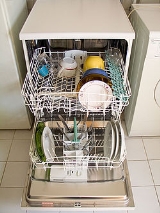
A dishwasher is a mechanical device for cleaning dishes and eating utensil
Cutlery
Cutlery refers to any hand implement used in preparing, serving, and especially eating food in the Western world. It is more usually known as silverware or flatware in the United States, where cutlery can have the more specific meaning of knives and other cutting instruments. This is probably the...

s. Dishwashers can be found in restaurants and private homes.
Discussion
Ask a question about 'Dishwasher'
Start a new discussion about 'Dishwasher'
Answer questions from other users
Full Discussion Forum
 
Unanswered Questions
Encyclopedia
A dishwasher is a mechanical device for cleaning dishes and eating utensil
Cutlery
Cutlery refers to any hand implement used in preparing, serving, and especially eating food in the Western world. It is more usually known as silverware or flatware in the United States, where cutlery can have the more specific meaning of knives and other cutting instruments. This is probably the...

s. Dishwashers can be found in restaurants and private homes.

Unlike manual dishwashing
Dishwashing
Dish-washing is the process of cleaning cooking utensils, dishes, cutlery and other items. This is either achieved by hand in a sink or using dishwasher and may take place in a kitchen, utility room, scullery or elsewhere...

, which relies largely on physical scrubbing to remove soiling, the mechanical dishwasher cleans by spraying hot water, typically between 55 to 75 °C (131 to 167 F) at the dishes, with lower temperatures used for delicate items. A mix of water and detergent is used for cleaning purposes, followed by clean water to remove the detergent residue. Some dishwashers have multiple wash and rinse periods within the complete cycle. In some dishwashers, a rinsing aid (also called rinse aid) can be added to the rinse cycle to improve drying and avoid water spots remaining on dry items.

Manual dishwashers


The word 'dishwasher' (or abbreviated as simply "dish") may also refer to a person who washes dishes in a restaurant, hotel or other private or commercial entities. Pots and pans are also washed by hand by scrubbing them in a detergent and water mix, immersing them in a rinse of plain water, and then immersing them in a water/sanitizer solution for a period. Silverware is washed by placing loose silverware in a tray, washing them several times like this, then sorting them into circular holders, and washing them again in the dishwasher. Colloquially, a dishwasher may be known as a pan-diver, from the French "plongeur", and made famous by George Orwell in Down and Out in Paris and London. Commonly used also is the term "KP
KP duty
KP duty is "kitchen police" or "kitchen patrol" work under the kitchen staff assigned to junior U.S. enlisted military personnel. "KP" can be either the work or the personnel assigned to perform such work. In the latter sense it can be used for either military or civilian personnel assigned or...

" for Kitchen Porter or Kitchen Police, who would have a variety of other duties. The area where dishes are washed, particularly in foodservice is sometimes also called a "dish-pit".

United States


The first reports of a mechanical dishwashing device are of an 1850 patent by Joel Houghton of a hand-powered device. This device was made of wood and was cranked by hand while water sprayed onto the dishes. This device was both slow and unreliable. Another patent was granted to L.A. Alexander in 1865 that was similar to the first but featured a hand-cranked rack system. Neither device was practical or widely accepted.

Modern dishwashers are descended from the 1887 invention of Josephine Cochrane
Josephine Cochrane
Josephine Cochrane made the first practical mechanical dishwasher in 1886, in Shelbyville, Illinois., although a washing machine device was patented in 1850 by Joel Houghton . Mrs. Cochrane was a rich woman who held many fancy dinner parties...

 who invented a new advanced dishwasher, also hand-powered, which she unveiled at the 1893 Chicago
Chicago
Chicago is the largest city in the US state of Illinois. With nearly 2.7 million residents, it is the most populous city in the Midwestern United States and the third most populous in the US, after New York City and Los Angeles...

 World's Fair
World's Columbian Exposition
The World's Columbian Exposition was a World's Fair held in Chicago in 1893 to celebrate the 400th anniversary of Christopher Columbus's arrival in the New World in 1492. Chicago bested New York City; Washington, D.C.; and St...

. Cochrane was quite wealthy and was the granddaughter of John Fitch
John Fitch (inventor)
John Fitch was an American inventor, clockmaker, and silversmith who, in 1787, built the first recorded steam-powered boat in the United States...

, the inventor of the steamboat
Steamboat
A steamboat or steamship, sometimes called a steamer, is a ship in which the primary method of propulsion is steam power, typically driving propellers or paddlewheels...

. She never washed dishes herself and only invented the dishwasher because her servants were chipping her fine china.

Models installed with permanent plumbing
Plumbing
Plumbing is the system of pipes and drains installed in a building for the distribution of potable drinking water and the removal of waterborne wastes, and the skilled trade of working with pipes, tubing and plumbing fixtures in such systems. A plumber is someone who installs or repairs piping...

 arrived in the 1920s. In 1924, William Howard Livens
William Howard Livens
William Howard Livens DSO MC was an engineer, a soldier in the British Army and an inventor particularly known for the design of chemical warfare and flame warfare weapons. Resourceful and clever, Livens’ successful creations were characterised by being very practical and easy to produce in large...

 invented a small dishwasher suitable for domestic use. It had many of the features of a modern dishwasher, including a front door for loading, a wire rack to hold crockery and a rotating sprayer. Livens' invention was not, however, a commercial success. Electric drying elements were added in 1940.

Initially home appliances were standalone or portable devices in a kitchen, along with other sinks and the water heater, but with the development of the wall-to-wall countertop
Countertop
Countertop usually refers to a horizontal worksurface in kitchens or other food preparation areas, bathrooms or lavatories, and workrooms in general. It is frequently installed upon and supported by cabinets...

 and standardized height cabinets, dishwashers evolved into standardized size and shape appliances first integrated with the sink, and then underneath the kitchen countertop as a modular unit.

Adoption was greatest at first in commercial environments, but by the 1970s dishwashers had become commonplace in domestic residences in the US. By 2005, 60 percent of US homes had dishwashers.

Evolution of spray methods


Spray methods, the direction of spray, and the shape of the wash tub has evolved over time due to the difficulty of cleaning some types of dishes. Plates and cutlery tend to be the easiest to clean because of their fairly flat and open shape. Bowls, glasses, pitchers, vases, and other containers are more difficult to clean because of the recessed inner cavity and the need for liquid to drain out of the interior cavity.

The difficulty of cleaning a container in a dishwasher increases as the neck diameter decreases and the interior space width and depth enlarges. This has generally required glasses, pitchers, and other containers to be placed in the device with the opening pointed downward and exposed directly to the spray arm jets or impeller in the base of the unit, so that the liquid is propelled with sufficient force as to reach all the way into the back / top of containers with small mouth openings.

However, for a simple dishwasher with only a single impeller in the base of the unit, glasses and other deep containers both need direct exposure to the jet, and will block liquid from reaching objects behind them. For this reason, glasses usually are placed into an upper basket, and flat open-shaped plates and cutlery that the water can spray through are placed in lower baskets.

Although direct exposure to the impeller spray has the deepest cleaning ability for containers, providing every dish, glass, and pitcher with direct spray in early dishwashers that only had a single impeller in the base of the unit resulted in a fairly light packing of dishware into the device, which may require two or three separate loads to process all the dishware.

In time, dishwashers increased in mechanical complexity to permit more water jets striking dishes directly and unimpeded by other dishware blocking the spray, allowing for much denser packing of dishware into the device.

The first of these mechanical improvements was the top spray arm placed above all dishes and spraying downward, to wet the backsides of bowls and glasses in the top rack. Prior to this, the top rack had to be ring-shaped, to allow impeller water from the base of the unit to reach the top of the chamber unimpeded, and then fall back down onto the dishes from above. The top spray arm provided water to the back of the dishes, allowing the upper rack to enlarge and fill in the open center spray region.

The second was the mid-level spray system, using either a pop-up spray tower extending upward from the base using water pressure to extend the tower during washing, or a fixed tower spray arm supplying water to a secondary rotating arm suspended below the upper rack(s). This mid-level spray system allows for large spray-blocking bowls and pans to be placed in the bottom rack, while still getting water spray up into the undersides of glasses and bowls in the top rack.

However, the pop-up tower or fixed tower method blocks use of the center of the bottom rack, restricting the size of objects that can fit in the bottom rack. A modification has been to reroute water flow to the mid-level spray arm using tubing directed up the back wall of the wash chamber, leaving the center of the bottom rack open and available for use.

Recently there has been the development of fixed or spinning jets on the sidewalls of the wash chamber, as "pot/pan scrubber" jets. Large objects such as cookpots often cannot lay flat if stacked with other plates and dishes, resulting in less than thorough removal of baked-on food due to indirect water spray on the surfaces. The sidewall jets allow water spray from previously unavailable directions, allowing pots and pans to be turned around facing the walls, and receiving individual attention from those specific jets.

Commercial dishwashers are able to deal with the problem of hard-to-clean deep containers by increasing the spray force and liquid volume by using a large pump motor of several horsepower, and large diameter spray arms with larger jet openings, allowing much more water spray than is possible for a residential dishwasher with limited power draw.

Capacity


The international standard for the capacity of a dishwasher is expressed as standard place settings. Dishes or plates of irregular sizes may not fit properly in a dishwasher's cleaning compartment, so it is advisable to check for compatibility before buying a dishwasher.

Commercial dishwashers are rated as plates per hour. The rating is based on standard sized plates of the same size. The same can be said for commercial glass washers, as they are based on standard glasses, normally pint glasses.

Size


Dishwashers that are installed into standard kitchen cabinets have a standard width and depth of 60 cm (Europe) or 24 inches (US), and most dishwashers must be installed into a hole a minimum of 86 cm (Europe) or 34 inches (US) tall. Portable dishwashers exist in 45 and 60 cm (Europe) 18 and 24 inch (US) widths, with casters and attached countertops. Dishwashers may come in standard or tall tub designs; standard tub dishwashers have a service kickplate beneath the dishwasher door that allows for simpler maintenance and installation, but tall tub dishwashers have approximately 20% more capacity and better sound dampening
Soundproofing
Soundproofing is any means of reducing the sound pressure with respect to a specified sound source and receptor. There are several basic approaches to reducing sound: increasing the distance between source and receiver, using noise barriers to reflect or absorb the energy of the sound waves, using...

 from having a continuous front door.

Features


Present-day machines feature a drop-down front panel door, allowing access to the interior, which usually contains two or sometimes three pull-out racks; racks can also be referred to as "baskets". In older U.S. models from the 1950s, the entire tub rolled out when the machine latch was opened, and loading/removing washable items was from the top, with the user reaching deep into the compartment for some items. Today, "dish drawer" models mimic this style, while the half-depth design eliminates the inconvenience of the long reach that was necessary with older full-depth models.

The inside of a dishwasher, called the tub, can be composed of plastic
Plastic
A plastic material is any of a wide range of synthetic or semi-synthetic organic solids used in the manufacture of industrial products. Plastics are typically polymers of high molecular mass, and may contain other substances to improve performance and/or reduce production costs...

 or stainless steel
Stainless steel
In metallurgy, stainless steel, also known as inox steel or inox from French "inoxydable", is defined as a steel alloy with a minimum of 10.5 or 11% chromium content by mass....

. Stainless steel tubs resist hard water
Hard water
Hard water is water that has high mineral content . Hard water has high concentrations of Ca2+ and Mg2+ ions. Hard water is generally not harmful to one's health but can pose serious problems in industrial settings, where water hardness is monitored to avoid costly breakdowns in boilers, cooling...

, provide better sound damping, and preserve heat to dry dishes faster. They also come at a premium price. Older models used a baked enamel on steel and are prone to chipping and erosion; chips in the baked enamel finish must be cleaned of all dirt and corrosion then patched with a special compound or even a good quality two-part epoxy
Epoxy
Epoxy, also known as polyepoxide, is a thermosetting polymer formed from reaction of an epoxide "resin" with polyamine "hardener". Epoxy has a wide range of applications, including fiber-reinforced plastic materials and general purpose adhesives....

. All European-made dishwashers feature a stainless steel interior as standard, even on low end models. The same is true for a built-in water softener.

Mid-to-higher end North America
North America
North America is a continent wholly within the Northern Hemisphere and almost wholly within the Western Hemisphere. It is also considered a northern subcontinent of the Americas...

n dishwashers often come with hard food disposal units, which behave like miniature garbage (waste) disposal
Garbage disposal
A garbage disposal unit or waste disposal unit is a device, usually electrically powered, installed under a kitchen sink between the sink's drain and the trap which shreds food waste into pieces small enough—generally less than —to pass through plumbing.Garbage disposal units are widely used in...

 units that eliminate large pieces of food waste from the wash water. One manufacturer that is known for omitting hard food disposals is Bosch
Robert Bosch GmbH
Robert Bosch GmbH is a multinational engineering and electronics company headquartered in Gerlingen, near Stuttgart, Germany. It is the world's largest supplier of automotive components...

, a German brand; however, Bosch does so in order to reduce noise. If the larger items of food waste are removed before placing in the dishwasher, pre-rinsing is not necessary even without integrated waste disposal units.

Many newer dishwashers feature microprocessor
Microprocessor
A microprocessor incorporates the functions of a computer's central processing unit on a single integrated circuit, or at most a few integrated circuits. It is a multipurpose, programmable device that accepts digital data as input, processes it according to instructions stored in its memory, and...

-controlled, sensor
Sensor
A sensor is a device that measures a physical quantity and converts it into a signal which can be read by an observer or by an instrument. For example, a mercury-in-glass thermometer converts the measured temperature into expansion and contraction of a liquid which can be read on a calibrated...

-assisted wash cycles that adjust the wash duration to the quantity of dirty dishes (sensed by changes in water temperature
Temperature
Temperature is a physical property of matter that quantitatively expresses the common notions of hot and cold. Objects of low temperature are cold, while various degrees of higher temperatures are referred to as warm or hot...

) or the amount of dirt in the rinse water (sensed chemically/optically). This can save water and energy if the user runs a partial load. In such dishwashers the electromechanical rotary switch
Rotary switch
A rotary switch is a switch operated by rotation. These are often chosen when more than 2 positions are needed, such as a three-speed fan or a CB radio with multiple frequencies of reception or "channels"....

 often used to control the washing cycle is replaced by a microprocessor but most sensors and valves are still required to be present. However, pressure switches (some dishwashers use a pressure switch and flow meter) are not required in most microprocessor controlled dishwashers as they use the motor and sometimes a rotational position sensor to sense the resistance of water, when it senses there is no cavitation
Cavitation
Cavitation is the formation and then immediate implosion of cavities in a liquidi.e. small liquid-free zones that are the consequence of forces acting upon the liquid...

 it knows it has the optimal amount of water.

Most dishwashers include a large cone or similar structure in the bottom dish rack to prevent placement of dishes in the center of the rack. The dishwasher directs water from the bottom of the dishwasher up through this structure to the upper wash arm to spray water on the top dish rack. Some dishwashers, including many models from Whirlpool and Kitchenaid
KitchenAid
KitchenAid is a home appliance brand owned by Whirlpool Corporation. The company was started in 1919 by The Hobart Corporation to give restaurants a countertop alternative to their industrial sized mixers. The first model weighed 69 lbs. Each unit is still assembled by hand in Greenville, Ohio...

, use a tube attached to the top rack that connects to a water source at the back of the dishwasher which allows full use of the bottom rack. Late-model Frigidaire
Frigidaire
Frigidaire is a brand of consumer and commercial appliances. Frigidaire was founded as the Guardian Frigerator Company in Fort Wayne, Indiana, and developed the first self-contained refrigerator in 1916. In 1918, William C...

 dishwashers shoot a jet of water from the top of the washer down into the upper wash arm, again allowing full use of the bottom rack (but requiring that a small funnel on the top rack be kept clear).

Some dishwashers include a child-lockout feature to prevent accidental starting or stopping of the wash cycle by children. A child lock can sometimes be included to prevent young children opening the door during a wash cycle. This prevents accidents with hot water and strong detergents used during the wash cycle.

Most dishwashers feature a drying sensor and as such, a dish-washing cycle is always considered complete when a drying indicator, usually in the form of an illuminated "end" light or in more modern models on a digital display, exhibits to the operator that the washing and drying cycle is now over. A dishwasher should never be emptied before a complete process has been signified to be finished by the control system, as this will often leave the contents unwashed or still in a saturated state. It is a common misconception that to empty a dishwasher before the end of a cycle will save energy, as many of the contents may need to be re-run, hence almost doubling running costs.

Plumbing


Dishwashers can be plumbed into either the hot or cold water supply, taking into account the maximum incoming water temperature recommended by the manufacturer. Plumbing a dishwasher into the hot or warm water supply can improve cleaning performance and reduce food debris in the interior of the dishwasher. A few dishwashers may spend much less time on the wash phase if the incoming water is hot, which can compromise cleaning, so results will vary.

Sound damping


Modern dishwashers are quieter than older models. Using blankets, panels, and sound-absorbing materials in various configurations, dishwashers can achieve sound damping levels down to 39 decibels or so. Undamped, low-end dishwashers generally output noise levels of anywhere from 65–70 decibels. Most manufacturers generally use their own nomenclature with trademark for sound damping.

Detergent


Different kinds of dishwashing detergent
Detergent
A detergent is a surfactant or a mixture of surfactants with "cleaning properties in dilute solutions." In common usage, "detergent" refers to alkylbenzenesulfonates, a family of compounds that are similar to soap but are less affected by hard water...

 contain different combinations of the items in the list below. Not all of the ingredients below are used in some detergents.
  • Phosphates
    • Dissolves calcium and magnesium ions to prevent 'hard-water' type limescale deposits . They can cause ecological damage, so their use is starting to be phased out . Phosphate-free detergents are sold as eco-friendly detergents .
  • Oxygen-based bleaching agents (older-style powders and liquids contain chlorine-based bleaching agents)
    • Breaks up and bleaches organic deposits .
  • Non-ionic surfactants
    • Lowers the surface tension of the water, emulsifies oil, lipid and fat food deposits, prevents droplet spotting
      Water spot
      A water spot is an area of dried mineral deposits left on a surface after being allowed to air dry. Water quality, specifically the amount and type of minerals in the local water supply as measured by the total suspended solids or TSS test and other mineral levels such as sodium level, has a big...

       on drying .
  • Alkaline salts
    • These are a primary component, in older & original-style dishwasher detergent powders . Highly alkaline salts attack & dissolve grease, but are extremely corrosive (fatal) if swallowed. Salts used may include metasilicates, alkali metal hydroxides, Sodium carbonate
      Sodium carbonate
      Sodium carbonate , Na2CO3 is a sodium salt of carbonic acid. It most commonly occurs as a crystalline heptahydrate, which readily effloresces to form a white powder, the monohydrate. Sodium carbonate is domestically well-known for its everyday use as a water softener. It can be extracted from the...

       etc.
  • Enzyme
    Enzyme
    Enzymes are proteins that catalyze chemical reactions. In enzymatic reactions, the molecules at the beginning of the process, called substrates, are converted into different molecules, called products. Almost all chemical reactions in a biological cell need enzymes in order to occur at rates...

    s
    • Breaks up and dissolves protein-based food deposits
      Protein adsorption in the food industry
      Protein adsorption refers to the adhesion of proteins to solid surfaces. This phenomenon is an important issue in the food processing industry, particularly in milk processing and wine and beer making. Excessive adsorption, or protein fouling, can lead to health and sanitation issues, as the...

      , and possibly oil, lipid and fat deposits. Proteases do this by breaking down the proteins into smaller peptides that are more easily washed away .
  • Anti-corrosion agent(s)
    Corrosion inhibitor
    A corrosion inhibitor is a chemical compound that, when added to a liquid or gas, decreases the corrosion rate of a material, typically a metal or an alloy. The effectiveness of a corrosion inhibitor depends on fluid composition, quantity of water, and flow regime...

    • Often sodium silicate
      Sodium silicate
      Sodium silicate is the common name for a compound sodium metasilicate, Na2SiO3, also known as water glass or liquid glass. It is available in aqueous solution and in solid form and is used in cements, passive fire protection, refractories, textile and lumber processing, and automobiles...

      , this prevents corrosion of dishwasher components .


Dishwashing detergent may also contain :
  • Anti-foaming agents
    • Foam interferes with the washing action.
  • Additives to slow down the removal of glaze & patterns from glazed ceramics
  • Perfume
    Perfume
    Perfume is a mixture of fragrant essential oils and/or aroma compounds, fixatives, and solvents used to give the human body, animals, objects, and living spaces "a pleasant scent"...

    s
  • Anti-caking agents (in granular detergent)
  • Starch
    Starch
    Starch or amylum is a carbohydrate consisting of a large number of glucose units joined together by glycosidic bonds. This polysaccharide is produced by all green plants as an energy store...

    es (in tablet based detergents)
  • Gelling agents (in liquid/gel based detergents)
  • Sand (inexpensive powdered detergents)


Dishwasher detergents are strongly alkaline (basic
Base (chemistry)
For the term in genetics, see base A base in chemistry is a substance that can accept hydrogen ions or more generally, donate electron pairs. A soluble base is referred to as an alkali if it contains and releases hydroxide ions quantitatively...

).

Inexpensive powders may contain sand, which can be verified by dissolving the powder in boiling water and then passing the solution through a coffee filter
Coffee filter
A coffee filter is a coffee-brewing utensil, usually made of disposable paper. A stainless steel filter is used to prepare Indian filter coffee, the form of coffee common in India....

. Such detergents may harm the dishes and the dishwasher. Powdered detergents are more likely to cause fading on china patterns.

Biodegradable detergent


Besides older style detergents for dishwashers, biodegradable
Biodegradation
Biodegradation or biotic degradation or biotic decomposition is the chemical dissolution of materials by bacteria or other biological means...

 detergents also exist for dishwashers. These detergents may be more environmentally friendly than conventional detergents.

Hand-washing detergent


Prior to the invention of the dishwasher in 1886, hand-washing primarily with simple detergents was common. The invention of the machine prompted the use of stronger detergents and rinse agents, thus saving time. Hand-washing dish detergent (washing up liquid) should not be used in a dishwasher, as it will create a large foam of bubbles which will leak from the dishwasher. If hand-washing detergent is accidentally used, the foam may be removed by spraying with salt, and the dishwasher should be forced into a drain cycle to remove the detergent and water.

Rinse aid


Rinse aid (sometimes called rinse agent) contains surfactant
Surfactant
Surfactants are compounds that lower the surface tension of a liquid, the interfacial tension between two liquids, or that between a liquid and a solid...

s that uses Marangoni stress to prevent droplet formation, so that water drains from the surfaces in thin sheets, rather than forming droplets.

The benefits of using it are that it prevents "spotting" on glassware (caused by droplets of water drying and leaving behind dissolved limescale
Limescale
Limescale is the hard, off-white, chalky deposit found in kettles, hot-water boilers and the inside of inadequately maintained hot-water central heating systems...

 minerals), and can also improve drying performance as there is less water remaining to be dried.

Dishwasher salt


In some countries, especially those in Europe, dishwashers include a built-in water softener that remove calcium
Calcium
Calcium is the chemical element with the symbol Ca and atomic number 20. It has an atomic mass of 40.078 amu. Calcium is a soft gray alkaline earth metal, and is the fifth-most-abundant element by mass in the Earth's crust...

 and magnesium
Magnesium
Magnesium is a chemical element with the symbol Mg, atomic number 12, and common oxidation number +2. It is an alkaline earth metal and the eighth most abundant element in the Earth's crust and ninth in the known universe as a whole...

 ions from the water. Dishwasher salt
Dishwasher salt
Dishwasher salt is a particular grade of crystalline sodium chloride intended for use in dishwashers. Dishwasher salt is used for the same purpose as water softener salt, namely to regenerate ion exchange resins used to remove the hardness ions calcium and magnesium from water...

, which is coarse-grained sodium chloride (table salt
Salt
In chemistry, salts are ionic compounds that result from the neutralization reaction of an acid and a base. They are composed of cations and anions so that the product is electrically neutral...

), is used to recharge the resin in the built-in ion-exchange system. The coarse grains prevent it from clogging the softener unit; unlike certain types of salt used for culinary purposes, it does not contain added insoluble anticaking agent
Anticaking agent
An anticaking agent is an additive placed in powdered or granulated materials, such as table salt, to prevent the formation of lumps, easing packaging, transport, and consumption....

s or magnesium salts. The presence of magnesium salts will defeat the purpose of removing magnesium from the water softener. Anticaking agents may lead to clogging or may contain magnesium. Table salt may contain added iodine in the form of sodium iodide or potassium iodide, but these compounds will not affect the ion-exchange system.

If a dishwasher has a built-in water softener there will be a special compartment inside the dishwasher where the salt is to be added when needed. This salt compartment is separate from the detergent compartment, and generally located at the bottom of the wash cabinet (this is below the bottom basket). On most dishwashers, an automatic sensing system will notify the user when more dishwasher salt is required.

Pouring detergent into the salt compartment will damage the water softening system, however this can be reversed if the user acts very quickly and the dishwasher is NOT used: with a suitable wet and dry vacuum cleaner, remove the foreign substance e.g. detergent, followed by adding water again and removing the water with the wet and dry vacuum and repeating the process several times.

Some dishwasher detergents are marketed for use in hard water areas for dishwashers which do not have a built-in water softener (and therefore do not use any dishwasher salt). These detergents use higher levels of phosphates to increase the solubility of hard water ions. In very hard water areas, the amount of phosphate may still be insufficient and the manual addition of dishwasher salt into the detergent compartment is recommended. Adding salt along with the detergent does not soften the water as does a dishwasher with an ion-exchange water softener, but the water will gain some additional ability to dissolve hard water ions. Note, however, that as water drops remaining on the dishware evaporate, deposits of the salt will likely remain. To combat this, the use of a rinsing agent which cause the water to "sheet" will help eliminate the spotting. Some newer dishwashers allow the use of "all in one" tablets (which include an amount of salt along with detergent and a rinse agent) instead of using separate salt and rinse aid, but dishwasher salt must still be added to the salt compartment in very hard water areas. However, best results are achieved by using separate salt, rinse aid and detergent rather than using the combined "all in one" detergents with these included. Incorrect use of "all in one" tablets/detergents may not be covered under the dishwasher's warranty; it is advisable to check the instruction book when using these types of tablets/detergents.

Hazing of glassware


Glassware washed by dishwashing machines can develop a white haze
Haze
Haze is traditionally an atmospheric phenomenon where dust, smoke and other dry particles obscure the clarity of the sky. The World Meteorological Organization manual of codes includes a classification of horizontal obscuration into categories of fog, ice fog, steam fog, mist, haze, smoke, volcanic...

 on the surface over time. This may be caused by any or all of the below processes, only one of which is reversible:

Limescale deposit


If the dishwasher has run out of the salt that recharges the ion exchange resin
Ion exchange resin
An ion-exchange resin or ion-exchange polymer is an insoluble matrix normally in the form of small beads, usually white or yellowish, fabricated from an organic polymer substrate. The material has highly developed structure of pores on the surface of which are sites with easily trapped and...

 that softens the water, and the water supply is "hard", limescale deposits can appear on all items, but are especially visible on glassware. It can be removed by cleaning with vinegar or lemon juice, or a proprietary limescale removal agent. The dishwasher should either be recharged with salt, adjusted appropriately for the hardness of the supply water—or possibly this is a symptom of failure of the ion exchange resin in the water softener (which is one of the more expensive components). The resin may have stopped working because it has been poisoned by iron or manganese salts in the supply water.

Silicate filming/etching/accelerated crack corrosion


This film starts as an iridescence or "oil-film" effect on glassware, and progresses into a "milky" or "cloudy" appearance (which is not a deposit) that cannot be polished off or removed like limescale. It is formed because the detergent is strongly alkaline (basic) and glass dissolves slowly in alkaline aqueous solution. It becomes less soluble in the presence of silicates in the water (added as anti-metal-corrosion agents in the dishwasher detergent). Since the cloudy appearance is due to nonuniform glass dissolution, it is (somewhat paradoxically) less marked if dissolution is higher, i.e. if a silicate-free detergent is used; also, in certain cases, the etching will primarily be seen in areas that have microscopic surface cracks as a result of the items' manufacturing. Limitation of this undesirable reaction is possible by controlling water hardness, detergent load and temperature. The type of glass is an important factor in determining if this effect is a problem. In hard-water areas more detergent is needed to help prevent etching, and some dishwashers can reduce this etching effect by automatically dispensing the correct amount of detergent throughout the wash cycle based on the level of water hardness programmed.

Physical abrasion


Glassware placed such that it is physically touching can abrade and produce a milky surface.

Devitrification


Components found in dishwasher detergents can chemically scour the glass, causing tiny crystals, which can precipitate further crystal growth that can turn entire glasses cloudy

Items unsuitable for the dishwasher


Lead crystal should not be cleaned in a dishwasher as the corrosive effect of dishwasher detergent is high on such types of glass—that is, it will quickly go 'cloudy'. In addition, the lead in the crystal glass can be converted into a soluble form, which could endanger the health of subsequent users. Some items can be damaged if washed in a dishwasher because of the effects of the chemicals and hot water. Aluminium items will discolour. Saucepan manufacturers often recommend handwashing due to the harsh effects of the chemicals on the pan coatings. Valuable items — such as antiques or hand-painted items, should be washed by hand as they may be dulled or damaged, and detergents will gradually fade the glazing and print. Sterling silver and pewter will oxidize and discolour from the heat. Furthermore, pewter has a low melting point and may warp in some dishwashers. Cast iron is likely to rust in a dishwasher.

Items soiled by wax, cigarette ash or anything which might contaminate the rest of the wash load (such as poisons or mineral oils) should not be put in a dishwasher. Objects contaminated by solvent
Solvent
A solvent is a liquid, solid, or gas that dissolves another solid, liquid, or gaseous solute, resulting in a solution that is soluble in a certain volume of solvent at a specified temperature...

s may explode in a dishwasher. Glued items, such as some cutlery handles or wooden cutting board
Cutting board
A cutting board is a durable board on which to place material for cutting. Common is the kitchen cutting board used in preparing food; other types exist for cutting raw materials such as leather or plastic....

s, may be melted or softened if dishwashed, especially on a hot wash cycle when temperatures can reach 75 °C (167 F); these high temperatures can also damage plastic items which are labelled as not being dishwasher safe, however some plastic items can be distorted or melted if placed in the bottom rack too close to an exposed heating element
Heating element
A heating element converts electricity into heat through the process of Joule heating. Electric current through the element encounters resistance, resulting in heating of the element....

, hence many dishwasher-safe plastic items advise placing in the top rack only (many newer dishwashers have a concealed heating element away from the bottom rack entirely). Squeezing plastic items into small spaces may cause the plastic to distort in shape.

Dishwashers should only be used to wash normal household items, like plates, cutlery, cups, mugs, kitchenware etc. Items such as paintbrushes, tools, furnace filters etc. should not be put into a dishwasher as this will cause the subsequent washes to become contaminated and may cause damage to the appliance.

Drying


The heat inside the dishwasher dries the contents after the final hot rinse. Plastic and non-stick items may not dry properly compared to china and glass, which hold the heat better. Some dishwashers incorporate a fan to improve drying. Older dishwashers with a visible heating element (at the bottom of the wash cabinet, below the bottom basket) may use the heating element to improve drying, however this uses more energy.

Governmental agencies often recommend air-drying dishes by either disabling or stopping the drying cycle to save energy.

Level of sanitizing


Most consumer dishwashers use a 75°C thermostat in the sanitizing process. During the final rinse cycle, the heating element and wash pump are turned on, and the cycle timer (electronic or electromechanical) is stopped until the thermostat is tripped. At this point, the cycle timer resumes and will generally trigger a drain cycle within a few timer increments.

Most consumer dishwashers use 75°C rather than 83°C for reasons of burn risk, energy consumption, total cycle time, and possible damage to plastic items placed inside the dishwasher. With new advances in detergents, lower water temperatures (50–55°C) are needed to prevent premature decay of the enzymes used to eat the grease and other build-ups on the dishes. This also saves energy and can allow the washer to be hooked directly to the hot water supply for the house.

In the US, residential dishwashers can be certified to a NSF International
NSF International
NSF International is an Ann Arbor, Michigan-based not-for-profit public health and environmental organization that provides standards development, product certification, auditing, education and risk management services.-History:...

 testing protocol which verifies the cleaning and sanitation performance of the unit.

Commercial dishwashers


Large heavy-duty dishwashers are available for use in commercial establishments (e.g. hotels, restaurants) where a large number of dishes must be cleaned.

Unlike a home dishwasher, commercial units typically are not multi-level, and only wash a single tray of dishes per cycle. This is not an inconvenience since trays are batch-processed consecutively one after the other. They can wash a rack of dishes, or a rack of 25 glasses in just approximately one minute.

Some commercial dishwashers work similar to a commercial car wash
Car wash
A car wash or auto wash is a facility used to clean the exterior and, in some cases, the interior of motor vehicles.- Categories :...

, with a pulley system that pulls the rack through a small chamber (Known widely as a "crank-back" system). Manual washers require an operator to push the rack into the washer, close the doors, start the cycle, and then open the doors to pull out the cleaned rack, possibly through a second opening into an unloading area.

In the UK, the British Standards Institution set standards for dishwashers. In the US, the NSF International (an independent not-for-profit organization) sets the standards for wash and rinse time along with minimum water temperature for chemical or hot water sanitizing methods. There are many types of commercial dishwashers including under counter, single tank, conveyor, flight type, and carousel machines.

Commercial dishwashers often have significantly different plumbing and operations than a home unit, in that there are often separate spray arms for washing and rinsing/sanitizing. The wash water is heated with an in-tank electric heat element and mixed with a cleaning solution, and is used repeatedly from one load to the next. The wash tank usually has a large strainer basket to collect food debris, and the strainer may not be emptied until the end of the day's kitchen operations.

Water used for rinsing and sanitizing is typically delivered directly from building water supply, and is not reused. The used rinse water falls into the wash tank reservoir, which dilutes some of the used wash water and causes a small amount to drain out through an overflow tube. The system may first rinse with pure water only, and then sanitize with an additive solution that is left on the dishes as they leave the washer to dry.

Additional soap is periodically added to the main wash water tank, from either large soap concentrate tanks or dissolved from a large solid soap block, to maintain wash water cleaning effectiveness.

Environmental impact


In the European Union, the energy consumption of a dishwasher for a standard usage is shown on a European Union energy label
European Union energy label
EU Directive 92/75/EC established an energy consumption labeling scheme. The directive was implemented by several other directives thus most white goods, light bulb packaging and cars must have an EU Energy Label clearly displayed when offered for sale or rent...

.

Comparison with washing by hand


Comparing the efficiency of automatic dishwashers and hand-washing of dishes is difficult because hand-washing techniques vary drastically by individual. According to a peer-reviewed study in 2003, hand washing of an amount of dishes equivalent to a fully loaded automatic dishwasher could use between 20 and 300 liters of water and between 0.1 and 8 kWh of energy, while the numbers for energy-efficient automatic dishwashers were 15 to 22 liters and 1 to 2 kWh, respectively. The study concluded that fully loaded dishwashers use less electricity, water, and detergent than the average European hand-washer. For the automatic dishwasher results, the dishes were not rinsed before being loaded. The study does not address costs associated with the manufacture and disposal of dishwashers, the cost of possible accelerated wear of dishes from the chemical harshness of dishwasher detergent or the value of labour saved; hand washers needed between 65 and 106 minutes.

Detergents and rinse aids


Most dishwasher detergent contains complex phosphates
Phosphate
A phosphate, an inorganic chemical, is a salt of phosphoric acid. In organic chemistry, a phosphate, or organophosphate, is an ester of phosphoric acid. Organic phosphates are important in biochemistry and biogeochemistry or ecology. Inorganic phosphates are mined to obtain phosphorus for use in...

, as they have several properties that aid in effective cleaning. However, the same chemicals have been removed from laundry detergents in many countries as a result of concerns raised about the increase in algal bloom
Algal bloom
An algal bloom is a rapid increase or accumulation in the population of algae in an aquatic system. Algal blooms may occur in freshwater as well as marine environments. Typically, only one or a small number of phytoplankton species are involved, and some blooms may be recognized by discoloration...

s in waterways caused by increasing phosphate levels (see eutrophication
Eutrophication
Eutrophication or more precisely hypertrophication, is the movement of a body of water′s trophic status in the direction of increasing plant biomass, by the addition of artificial or natural substances, such as nitrates and phosphates, through fertilizers or sewage, to an aquatic system...

). The state of Maryland
Maryland
Maryland is a U.S. state located in the Mid Atlantic region of the United States, bordering Virginia, West Virginia, and the District of Columbia to its south and west; Pennsylvania to its north; and Delaware to its east...

, USA, is considering a bill to limit phosphates in dish detergent to help clean up the Chesapeake Bay.

In addition, rinse aids have contained nonylphenol and nonylphenol ethoxylates
Nonylphenol
Nonylphenol is a family of closely related organic compounds, a subset of the alkylphenols. This collection of compounds is a precursor to commercially important detergents...

. These have been banned in the European Union by EU Directive 76/769/EEC.

Alternative use as a cooking device


Many recipe websites have noted that a dishwasher can be used to cook certain foods, in particular salmon. http://lifehacker.com/5478670/how-to-cook-something-in-the-dishwasher http://www.treehugger.com/files/2004/11/dishwasher_cook.php http://www.wikihow.com/Cook-Lasagna-in-Your-Dishwasher http://www.streetdirectory.com/food_editorials/cooking/meat_recipes/use_dishwasher_for_cooking_beef.html It's very important that all foods be completely sealed in a wrap such as aluminum foil to avoid contamination with soaps or rinse aids.

See also

  • Home appliance
    Home appliance
    Home appliances are electrical/mechanical machines which accomplish some household functions, such as cooking or cleaning. Home appliances can be classified into:*Major appliances, or White goods*Small appliances, or Brown goods...

    s
  • Washing machine manufacturers and brands in the Washing machine
    Washing machine
    A washing machine is a machine designed to wash laundry, such as clothing, towels and sheets...

    article

External links