


Stir frying

Encyclopedia
Umbrella term
An umbrella term is a word that provides a superset or grouping of concepts that all fall under a single common category. Umbrella term is also called a hypernym. For example, cryptology is an umbrella term that encompasses cryptography and cryptanalysis, among other fields...
used to describe two Chinese cooking techniques
Chinese cooking techniques
Chinese cooking techniques are a set of methods and techniques traditionally used in Chinese cuisine. The cooking techniques can either be grouped into ones that use a single cooking method or a combination of wet and dry cooking methods.-Wet:...
for preparing food in a wok: chǎo (炒) and bào (爆). The term stir-fry was introduced into the English language by Buwei Yang Chao
Buwei Yang Chao
Buwei Yang Chao was an American Chinese physician, writer of recipes, and wife of the eminent linguist Yuen Ren Chao. She is credited with coining the English term "stir-fry"....
, in her book How to Cook and Eat in Chinese, to describe the chǎo technique. The two techniques differ in their speed of execution, the amount of heat used, and the amount of tossing done to cook the food in the wok
Wok
A wok is a versatile round-bottomed cooking vessel originating in China. It is used especially in East and Southeast Asia.Woks are most often used for stir frying, but can also be used in other Chinese cooking techniques, such as in steaming, deep frying, braising, stewing, smoking, or making soup...
. Cantonese
Cantonese cuisine
Cantonese cuisine comes from Guangdong Province in southern China and is one of 8 superdivisions of Chinese cuisine. Its prominence outside China is due to the great numbers of early emigrants from Guangdong. Cantonese chefs are highly sought after throughout the country...
restaurant patrons judge a chef's ability to perform stir frying by the "wok hei" produced in the food. This in turn is believed to display their ability to bring out the qi
Qi
In traditional Chinese culture, qì is an active principle forming part of any living thing. Qi is frequently translated as life energy, lifeforce, or energy flow. Qi is the central underlying principle in traditional Chinese medicine and martial arts...
of the wok.
Chao technique
The chao technique is similar to the Western technique of sautéingSautéing
Sautéing is a method of cooking food, that uses a small amount of fat in a shallow pan over relatively high heat. Ingredients are usually cut into pieces or thinly sliced to facilitate fast cooking. The primary mode of heat transfer during sautéing is conduction between the pan and the food being...
. A traditional round-bottom cast iron or carbon steel pan called a wok is heated to a high temperature
Temperature
Temperature is a physical property of matter that quantitatively expresses the common notions of hot and cold. Objects of low temperature are cold, while various degrees of higher temperatures are referred to as warm or hot...
. A small amount of cooking oil
Cooking oil
Cooking oil is purified fat of plant origin, which is usually liquid at room temperature ....
is then poured down the side of the wok (a traditional expression in China
China
Chinese civilization may refer to:* China for more general discussion of the country.* Chinese culture* Greater China, the transnational community of ethnic Chinese.* History of China* Sinosphere, the area historically affected by Chinese culture...
regarding this is "hot wok, cold oil"), followed by dry seasoning
Seasoning
Seasoning is the process of imparting flavor to, or improving the flavor of, food.- General meaning :Seasonings include herbs and spices, which are themselves frequently referred to as "seasonings"...
s (including ginger
Ginger
Ginger is the rhizome of the plant Zingiber officinale, consumed as a delicacy, medicine, or spice. It lends its name to its genus and family . Other notable members of this plant family are turmeric, cardamom, and galangal....
and garlic
Garlic
Allium sativum, commonly known as garlic, is a species in the onion genus, Allium. Its close relatives include the onion, shallot, leek, chive, and rakkyo. Dating back over 6,000 years, garlic is native to central Asia, and has long been a staple in the Mediterranean region, as well as a frequent...
), then at the first moment the seasonings can be smelled, meats are added and agitated. Once the meat is seared
Searing
Searing is a technique used in grilling, baking, braising, roasting, sautéing, etc., in which the surface of the food is cooked at high temperature so a caramelized crust forms. Similar techniques, browning and blackening, are typically used to sear all sides of a particular piece of meat, fish,...
, vegetables along with liquid ingredients (for example often including premixed combinations of soy sauce, vinegar, wine, salt, sugar, and cornstarch) are added. The wok then may be covered for a moment so the water in the liquid ingredients can warm up the new ingredients as it steams off. To keep the meat juicy, usually a cook would take the seared meat out before vegetables are added, and put the meat back right before vegetables are done. In some dishes, or if the cooking conditions are inadequate, different components may be stir fried separately before being combined in the final dish (if, for example, the chef desires the taste of the stir fried vegetables and meats to remain distinct).
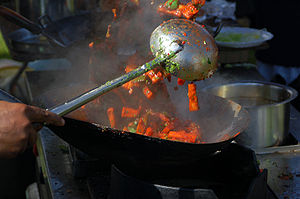
The food is stirred and tossed out very quickly using wooden or metal cooking utensils. Some chefs will lift the wok to the side to let the flame light the oil or add a dash of wine spirit to give the food extra flavor. Using this method, many dishes can be cooked extremely quickly (within a minute).
Some dishes that require more time are cooked by adding a few dashes of water after the stirring. Then the wok is covered with a lid. As soon as steam starts to come out from under the lid, the dish is ready. In this case, the food is stir fried on high heat for flavor
Flavor
Flavor or flavour is the sensory impression of a food or other substance, and is determined mainly by the chemical senses of taste and smell. The "trigeminal senses", which detect chemical irritants in the mouth and throat as well as temperature and texture, are also very important to the overall...
and then steamed to ensure that it is fully cooked.
Bao technique
The wok is heated to a dull red glow. With the wok hot, the oil, seasonings, and meats are added in rapid succession with no pause in between. The food is continually tossed, stopping for several seconds only to add other ingredients such as various seasonings, broths, or vegetables. When the food is deemed to be cooked it is poured and ladled out of the wok. The wok must then be quickly rinsed to prevent food residues from charring and burning to the wok bottom because of residual heat.The main ingredients are usually cut to smaller pieces to aid in cooking. As well, a larger amount of cooking fat with a high smoke point
Smoke point
The smoke point generally refers to the temperature at which a cooking fat or oil begins to break down to glycerol and free fatty acids, and produce bluish smoke. The glycerol is then further broken down to acrolein which is a component of the smoke. It is the presence of the acrolein that causes...
, such as lard
Lard
Lard is pig fat in both its rendered and unrendered forms. Lard was commonly used in many cuisines as a cooking fat or shortening, or as a spread similar to butter. Its use in contemporary cuisine has diminished because of health concerns posed by its saturated-fat content and its often negative...
and/or peanut oil
Peanut oil
Peanut oil is an organic material oil derived from peanuts, noted to have the aroma and taste of its parent legume....
, is often used in bao.