
Home      Discussion      Topics      Dictionary      Almanac
Signup       Login
Cookware and bakeware

Cookware and bakeware

Overview
Cookware and bakeware are types of food preparation containers commonly found in the kitchen
Kitchen
A kitchen is a room or part of a room used for cooking and food preparation.In the West, a modern residential kitchen is typically equipped with a stove, a sink with hot and cold running water, a refrigerator and kitchen cabinets arranged according to a modular design. Many households have a...

. Cookware comprises cooking vessels, such as saucepans and frying pans, intended for use on a stove or range cooktop. Bakeware comprises cooking vessels intended for use inside an oven. Some utensils are both cookware and bakeware.
Discussion
Ask a question about 'Cookware and bakeware'
Start a new discussion about 'Cookware and bakeware'
Answer questions from other users
Full Discussion Forum
 
Unanswered Questions
Encyclopedia
Cookware and bakeware are types of food preparation containers commonly found in the kitchen
Kitchen
A kitchen is a room or part of a room used for cooking and food preparation.In the West, a modern residential kitchen is typically equipped with a stove, a sink with hot and cold running water, a refrigerator and kitchen cabinets arranged according to a modular design. Many households have a...

. Cookware comprises cooking vessels, such as saucepans and frying pans, intended for use on a stove or range cooktop. Bakeware comprises cooking vessels intended for use inside an oven. Some utensils are both cookware and bakeware.

History


The history of cooking vessels before the development of pottery is minimal due to the limited archaeological evidence. It has been possible to extrapolate likely developments based on methods used by latter peoples. Among the first of the techniques believed to be used by stone age
Stone Age
The Stone Age is a broad prehistoric period, lasting about 2.5 million years , during which humans and their predecessor species in the genus Homo, as well as the earlier partly contemporary genera Australopithecus and Paranthropus, widely used exclusively stone as their hard material in the...

 civilizations were improvements to basic roasting
Roasting
Roasting is a cooking method that uses dry heat, whether an open flame, oven, or other heat source. Roasting usually causes caramelization or Maillard browning of the surface of the food, which is considered by some as a flavor enhancement. Roasting uses more indirect, diffused heat , and is...

. In addition to exposing food to direct heat from either an open fire or hot embers it is possible to cover the food with clay or large leaves before roasting to preserve moisture in the cooked result. Examples of similar techniques are still in use in many modern cuisines.

Of greater difficulty was finding a method to boil water. For people without access to natural heated water sources, such as hot springs, heated stones could be placed in a water-filled vessel to raise its temperature (for example, a leaf-lined pit or the stomach
Stomach
The stomach is a muscular, hollow, dilated part of the alimentary canal which functions as an important organ of the digestive tract in some animals, including vertebrates, echinoderms, insects , and molluscs. It is involved in the second phase of digestion, following mastication .The stomach is...

 from animals killed by hunters). In many locations the shells of turtle
Turtle
Turtles are reptiles of the order Testudines , characterised by a special bony or cartilaginous shell developed from their ribs that acts as a shield...

s or large mollusks provided a source for waterproof cooking vessels. Bamboo
Bamboo
Bamboo is a group of perennial evergreens in the true grass family Poaceae, subfamily Bambusoideae, tribe Bambuseae. Giant bamboos are the largest members of the grass family....

 tubes sealed at the end with clay provided a usable container in Asia, while the inhabitants of the Tehuacan
Tehuacán
Tehuacán is the second largest city in the Mexican state of Puebla, nestled in the Southeast Valley of Tehuacán, bordering the states of Oaxaca and Veracruz. The 2010 census reported a population of 248,716 in the city and 274,906 in its surrounding municipality of the same name, of which it serves...

 Valley began carving large stone bowls that were permanently set into a hearth as early as 7000 BC.

According to Frank Hamilton Cushing, native American cooking basket
Basket
A basket is a container which is traditionally constructed from stiff fibres, which can be made from a range of materials, including wood splints, runners, and cane. While most baskets are made from plant materials, other materials such as horsehair, baleen, or metal wire can be used. Baskets are...

s used by the Zuni (Zuñi) developed from mesh casings woven to stabilize gourd water vessels. He reported witnessing cooking basket use by Havasupai in 1881. Roasting baskets covered with clay would be filled with wood coals
Charcoal
Charcoal is the dark grey residue consisting of carbon, and any remaining ash, obtained by removing water and other volatile constituents from animal and vegetation substances. Charcoal is usually produced by slow pyrolysis, the heating of wood or other substances in the absence of oxygen...

 and the product to be roasted. When the thus hardened clay separated from the basket, it would become a usable clay roasting pan in itself. This indicates a steady progression from use of woven gourd casings to waterproof cooking baskets to pottery. Other than in many other cultures, native Americans used and still use the heat source inside the cookware. Cooking baskets are filled with hot stones and roasting pans with wood coals.
Native Americans, both in the East and in the West, would form a basket from large leaves to boil water, according to historian and novelist Louis L'Amour
Louis L'Amour
Louis Dearborn L'Amour was an American author. His books consisted primarily of Western fiction novels , however he also wrote historical fiction , science fiction , nonfiction , as well as poetry and short-story collections. Many of his stories were made into movies...

. As long as the flames did not reach above the level of water in the basket, the leaves would not burn through.

The development of pottery
Pottery
Pottery is the material from which the potteryware is made, of which major types include earthenware, stoneware and porcelain. The place where such wares are made is also called a pottery . Pottery also refers to the art or craft of the potter or the manufacture of pottery...

 allowed for the creation of fireproof cooking vessels in a variety of shapes and sizes. Coating the earthenware with some type of plant gum, and later ceramic glazes, converted the porous container into a waterproof vessel. The earthenware cookware could then be suspended over a fire through use of a tripod or other apparatus, or even be placed directly into a low fire or coal bed as in the case of the pipkin
Pipkin
A pipkin is an earthenware cooking pot used for cooking over direct heat from coals or a wood fire. It has a handle and three feet. Late medieval and postmedieval pipkins had a hollow handle in order to insert a stick in it for manipulation.- External links :...

. Ceramics (including stoneware
Stoneware
Stoneware is a vitreous or semi-vitreous ceramic ware with a fine texture. Stoneware is made from clay that is then fired in a kiln, whether by an artisan to make homeware, or in an industrial kiln for mass-produced or specialty products...

 and glass
Glass
Glass is an amorphous solid material. Glasses are typically brittle and optically transparent.The most familiar type of glass, used for centuries in windows and drinking vessels, is soda-lime glass, composed of about 75% silica plus Na2O, CaO, and several minor additives...

) conduct poorly, however, so ceramic pots must cook over relatively low heats and over long periods of time (most modern ceramic pots will crack if used on the stovetop, and are only intended for the oven). Even after metal pots have come into widespread use, earthenware
Earthenware
Earthenware is a common ceramic material, which is used extensively for pottery tableware and decorative objects.-Types of earthenware:Although body formulations vary between countries and even between individual makers, a generic composition is 25% ball clay, 28% kaolin, 32% quartz, and 15%...

 pots are still preferred among the less well-off, globally, due to their low production cost.

The development of bronze
Bronze
Bronze is a metal alloy consisting primarily of copper, usually with tin as the main additive. It is hard and brittle, and it was particularly significant in antiquity, so much so that the Bronze Age was named after the metal...

 and iron
Iron
Iron is a chemical element with the symbol Fe and atomic number 26. It is a metal in the first transition series. It is the most common element forming the planet Earth as a whole, forming much of Earth's outer and inner core. It is the fourth most common element in the Earth's crust...

 metalworking skills allowed for cookware made from metal to be manufactured, although adoption of the new cookware was slow due to the much higher cost. After the development of metal cookware there was little new development in cookware, with the standard Medieval kitchen utilizing a cauldron and a shallow earthenware pan for most cooking tasks, with a spit employed for roasting.

By the 17th century, it was common for a Western kitchen to contain a number of skillets, baking pans, a kettle and several pots, along with a variety of pot hooks and trivets. In the American colonies, these items would commonly be produced by a local blacksmith
Blacksmith
A blacksmith is a person who creates objects from wrought iron or steel by forging the metal; that is, by using tools to hammer, bend, and cut...

 from iron while brass or copper vessels were common in Europe
Europe
Europe is, by convention, one of the world's seven continents. Comprising the westernmost peninsula of Eurasia, Europe is generally 'divided' from Asia to its east by the watershed divides of the Ural and Caucasus Mountains, the Ural River, the Caspian and Black Seas, and the waterways connecting...

 and Asia
Asia
Asia is the world's largest and most populous continent, located primarily in the eastern and northern hemispheres. It covers 8.7% of the Earth's total surface area and with approximately 3.879 billion people, it hosts 60% of the world's current human population...

. Improvements in metallurgy during the 19th and 20th centuries allowed for pots and pans from metals such as steel, stainless steel and aluminum to be economically produced.

Metal


Metal pots are made from a narrow range of metals because pots and pan
Frying pan
A frying pan, frypan, or skillet is a flat-bottomed pan used for frying, searing, and browning foods. It is typically in diameter with relatively low sides that flare outwards, a long handle, and no lid. Larger pans may have a small grab handle opposite the main handle...

s need to conduct
Heat conduction
In heat transfer, conduction is a mode of transfer of energy within and between bodies of matter, due to a temperature gradient. Conduction means collisional and diffusive transfer of kinetic energy of particles of ponderable matter . Conduction takes place in all forms of ponderable matter, viz....

 heat well, but also need to be chemically unreactive so that they do not alter the flavor of the food. Most materials that are conductive enough to heat evenly are too reactive to use in food preparation. In some cases (copper pots, for example), a pot may be made out of a more reactive metal, and then tinned or clad with another.

Aluminium


Aluminium is a lightweight metal with very good thermal conductivity. It is resistant to many forms of corrosion. Aluminum is commonly available in sheet, cast, or anodized forms, and may be physically combined with other metals (see below).

Sheet aluminium is spun or stamped into form. Due to the softness of the metal it may be alloyed with magnesium, copper, or bronze to increase its strength. Sheet aluminum is commonly used for baking sheets, pie plates, and cake or muffin pans. Deep or shallow pots may be formed from sheet aluminium.

Cast aluminum can produce a thicker product than sheet aluminum, and is appropriate for irregular shapes and thicknesses. Due to the microscopic pores caused by the casting process, cast aluminum has a lower thermal conductivity than sheet aluminium, and is more expensive. Accordingly, cast aluminium cookware has become less common. It is used for Dutch ovens, heavyweight baking pans such as bundt pans, and wares such as ladles or handles where low thermal conductivity is desired.

Anodized aluminium has had the naturally occurring layer of aluminum oxide thickened by an electrolytic process to create a surface that is hard and non-reactive. It is used for sauté pans, stockpots, roasters, and Dutch ovens.

Uncoated and un-anodized aluminum can react with acidic foods to change the taste of the food. Sauces containing egg yolks, or vegetables such as asparagus or artichokes may cause oxidation of non-anodized aluminum.

Aluminum exposure has been suggested as a risk factor for neurodegenerative diseases such as Alzheimer's disease
Alzheimer's disease
Alzheimer's disease also known in medical literature as Alzheimer disease is the most common form of dementia. There is no cure for the disease, which worsens as it progresses, and eventually leads to death...

. The Rondeau, Commenges et al. article cited below states "These findings support the hypothesis that aluminum in drinking water is a risk factor for AD." (Alzheimer's disease)". The Alzheimer's Association states that "studies have failed to confirm any role for aluminum in causing Alzheimer's. [Today] few [experts] believe that everyday sources of aluminum pose any threat."
According to Dr. Morton Walker on page 98 of his 1994 book Toxic Metal Syndrome: How Metal Poisonings Can Affect Your Brain, the Alzhhimer's Association has accepted funding from major players in the aluminium industry.

Copper


In classical Western cooking, pots are formed with thick copper
Copper
Copper is a chemical element with the symbol Cu and atomic number 29. It is a ductile metal with very high thermal and electrical conductivity. Pure copper is soft and malleable; an exposed surface has a reddish-orange tarnish...

 sheets with a thin inner layer of tin
Tin
Tin is a chemical element with the symbol Sn and atomic number 50. It is a main group metal in group 14 of the periodic table. Tin shows chemical similarity to both neighboring group 14 elements, germanium and lead and has two possible oxidation states, +2 and the slightly more stable +4...

. The copper provides the best thermal conductivity of common metals and therefore results in even heat
Heat
In physics and thermodynamics, heat is energy transferred from one body, region, or thermodynamic system to another due to thermal contact or thermal radiation when the systems are at different temperatures. It is often described as one of the fundamental processes of energy transfer between...

ing. Copper is reactive with acidic foods, discovered with the discovery of tomatoes in the new world and subsequent introduction to old world copper pots. The tin lining prevents the copper from reacting with acid
Acid
An acid is a substance which reacts with a base. Commonly, acids can be identified as tasting sour, reacting with metals such as calcium, and bases like sodium carbonate. Aqueous acids have a pH of less than 7, where an acid of lower pH is typically stronger, and turn blue litmus paper red...

ic foods. The products resulting from the reaction causes copper toxicity
Copper toxicity
Copper toxicity refers to the consequences of an excess of copper in the body. Copper toxicity can occur from eating acid food that has been cooked in un-coated copper cookware, or from exposure to excess copper in drinking water or other environmental sources....

. The lead-free and cadmium-free tin lining is susceptible to tin pest
Tin pest
Tin pest is an autocatalytic, allotropic transformation of the element tin, which causes deterioration of tin objects at low temperatures. Tin pest has also been called tin disease, tin blight or tin leprosy ....

. In some cases unlined copper is desirable, for instance in the preparation of meringues and foams. Copper pots are expensive and require retinning, and when made with thick copper plates are heavy. With modern metallurgical techniques, such as cladding
Cladding (metalworking)
Cladding is the bonding together of dissimilar metals. It is distinct from welding or gluing as a method to fasten the metals together. Cladding is often achieved by extruding two metals through a die as well as pressing or rolling sheets together under high pressure.The United States Mint uses...

, copper is incorporated into the constructions of cookware, often as an enclosed heat spreading disk (see below).

Cast Iron


Cast iron cookware is slow to heat, but once at temperature provides even heating. Cast iron can also withstand very high temperatures, making cast iron pans ideal for searing
Searing
Searing is a technique used in grilling, baking, braising, roasting, sautéing, etc., in which the surface of the food is cooked at high temperature so a caramelized crust forms. Similar techniques, browning and blackening, are typically used to sear all sides of a particular piece of meat, fish,...

. Being a reactive material, cast iron can have chemical reaction
Chemical reaction
A chemical reaction is a process that leads to the transformation of one set of chemical substances to another. Chemical reactions can be either spontaneous, requiring no input of energy, or non-spontaneous, typically following the input of some type of energy, such as heat, light or electricity...

s with high acid foods such as wine
Wine
Wine is an alcoholic beverage, made of fermented fruit juice, usually from grapes. The natural chemical balance of grapes lets them ferment without the addition of sugars, acids, enzymes, or other nutrients. Grape wine is produced by fermenting crushed grapes using various types of yeast. Yeast...

 or tomato
Tomato
The word "tomato" may refer to the plant or the edible, typically red, fruit which it bears. Originating in South America, the tomato was spread around the world following the Spanish colonization of the Americas, and its many varieties are now widely grown, often in greenhouses in cooler...

es. In addition, some foods (such as spinach
Spinach
Spinach is an edible flowering plant in the family of Amaranthaceae. It is native to central and southwestern Asia. It is an annual plant , which grows to a height of up to 30 cm. Spinach may survive over winter in temperate regions...

) cooked on bare cast iron will turn black.

Cast iron
Cast iron
Cast iron is derived from pig iron, and while it usually refers to gray iron, it also identifies a large group of ferrous alloys which solidify with a eutectic. The color of a fractured surface can be used to identify an alloy. White cast iron is named after its white surface when fractured, due...

 is a porous material that rusts easily. As a result, it typically requires seasoning before use. Seasoning creates a thin layer of oxidized fat
Fat
Fats consist of a wide group of compounds that are generally soluble in organic solvents and generally insoluble in water. Chemically, fats are triglycerides, triesters of glycerol and any of several fatty acids. Fats may be either solid or liquid at room temperature, depending on their structure...

 over the iron that coats and protects the surface, and prevents sticking.

Enameled cast iron cookware was developed by Le Creuset
Le Creuset
Le Creuset is a French cookware manufacturer best known for its colorful enameled cast iron casseroles, which the company calls "French Ovens", or "Dutch Ovens"...

. In 1934, Le Creuset also solved the problem of excessive evaporation and scorching when using the cast iron Dutch ovens during cooking, by creating the enameled cast iron doufeu.

Stainless Steel


Stainless steel is an iron alloy containing a minimum of 11.5% chromium. Blends containing 18% chromium with either 8% nickel,called 18/8, or with 10% nickel, called 18/10, are commonly used for kitchen equipment. Stainless steel's virtues are resistance to corrosion, non-reactivity with either alkaline or acidic foods, and resistance to scratching and denting. Stainless steel's drawbacks for cooking use is that it is a relatively poor heat conductor and contains chromium
Chromium toxicity
Chromium toxicity refers to the toxic effects of chromium.Water insoluble chromium compounds and chromium metal are not considered a health hazard, while the toxicity and carcinogenic properties of chromium have been known for a long time...

; a toxic metal considered unsafe when ingested as metal particles. Since the material does not adequately spread the heat itself, stainless steel cookware is generally made with a disk of copper or aluminum in or on the base to conduct the heat across the base.

Carbon Steel


Carbon steel cookware can be rolled or hammered into very thin sheets of material, while still maintaining high strength and heat resistance. This allows for rapid and high heating. Carbon steel does not conduct
Thermal conductivity
In physics, thermal conductivity, k, is the property of a material's ability to conduct heat. It appears primarily in Fourier's Law for heat conduction....

 heat as well as other materials, but this may be an advantage for woks and paella
Paella
Paella is a Valencian rice dish that originated in its modern form in the mid-19th century near lake Albufera, a lagoon in Valencia, on the east coast of Spain. Many non-Spaniards view paella as Spain's national dish, but most Spaniards consider it to be a regional Valencian dish...

 pans, where one portion of the pan is intentionally kept at a different temperature than the rest. Like cast iron, carbon steel must be seasoned before use. Rub a fat (lard
Lard
Lard is pig fat in both its rendered and unrendered forms. Lard was commonly used in many cuisines as a cooking fat or shortening, or as a spread similar to butter. Its use in contemporary cuisine has diminished because of health concerns posed by its saturated-fat content and its often negative...

 is recommended) on the cooking surface only and heat the cookware over the stovetop. The process can be repeated if needed. Over time, the cooking surface will become dark and nonstick. Carbon steel will very easily get rusted if not seasoned and it should be stored seasoned to avoid rust during storage. However, such a rust is not a threat to humans' health, because it is from rust from iron, but will shorten quickly the life of the cookware. Carbon steel is often used for woks and crêpe
Crêpe
A crêpe or crepe , is a type of very thin pancake, usually made from wheat flour or buckwheat flour . The word is of French origin, deriving from the Latin crispa, meaning "curled". While crêpes originate from Brittany, a region in the northwest of France, their consumption is widespread in France...

 pans.

Non-stick


Steel or aluminum cooking pans can be coated with a substance such as polytetrafluoroethylene
Polytetrafluoroethylene
Polytetrafluoroethylene is a synthetic fluoropolymer of tetrafluoroethylene that finds numerous applications. PTFE is most well known by the DuPont brand name Teflon....

 (PTFE) in order to minimize food sticking to the pan surface.

There are advantages and disadvantages to such a coating. Coated pans are easier to clean than most non-coated pans, and require little or no additional oil or fat to prevent sticking.

On the other hand, some sticking is needed to cause sucs to form, so a non-stick pan cannot be used where e.g. a pan sauce is desired. And non-stick pans must not be overheated (see below). Nonstick coatings tend to degrade over time. In order to preserve the coating, it is important never to use metal implements or harsh scouring pads or chemical abrasives when cleaning.

There is a potential danger in the use of PTFE-based coatings: while decomposition of the coating does not occur at normal cooking temperatures (below about 465 °F/240 °C), overheating can produce decomposition products that are toxic to humans and fatal to birds. Unfortunately, overheating is relatively easy. Fortunately, there are alternatives such as seasoned
Seasoned pan
Seasoning is the process of treating the surface of a metal saucepan, wok, cast-iron cookware or other cooking vessel to create a stick-resistant coating...

 or enameled cast iron.
The main difference in quality levels of the coatings is in the formulas of the liquid coating, the thickness of each layer and the number of layers used. Higher quality nonsticks use powdered ceramic or titanium mixed in with the nonstick to strengthen them and to make them more resistant to abrasion and deterioration. Some nonstick coatings contain hardening agents. Some coatings are high enough in quality that they pass the strict standards of the National Sanitation Foundation for approval for restaurant use.

Enameled cast iron


Enameled cast iron cooking vessels are made of cast iron covered with a porcelain surface. This creates a piece that has the heat distribution and retention properties of cast iron combined with a non-reactive, low-stick surface.

Enamel over steel


The enamel over steel technique creates a piece that has the heat distribution of carbon steel and a non-reactive, low-stick surface. Such pots are much lighter than most other pots of similar size, are cheaper to make than stainless steel pots, and do not have the rust and reactivity issues of cast iron or carbon steel. Enamel over steel is ideal for large stockpots and for other large pans used mostly for water-based cooking. Because of its light weight and easy cleanup, enamel over steel is also popular for cookware used while camping.

Clad aluminum or copper


Cladding is a technique for fabricating pans with a layer of heat conducting material, such as copper or aluminum, covered by a non-reactive material, such as stainless steel. Rather than just a heat-distributing disk on the base, the copper or aluminum extends over the entire pan.

Aluminum pans are typically clad on both their inside and the outside surfaces, providing both a stainless cooking surface and a stainless surface to contact the cooktop. Copper is typically clad on its interior surface only, leaving the more attractive copper exposed on the outside of the pan.

Some high-end cookware uses a dual-clad process, with a thin stainless layer on the cooking surface, a thick core of aluminum to provide structure and heat diffusion, and a thin layer of copper on the outside of the pot that provides additional diffusion and the "look" of a copper pot. This provides much of the functionality of tinned-copper pots for a fraction of the price.

Non-metallic cookware


Non-metal
Metal
A metal , is an element, compound, or alloy that is a good conductor of both electricity and heat. Metals are usually malleable and shiny, that is they reflect most of incident light...

lic cookware can be used in both conventional and microwave oven
Microwave oven
A microwave oven is a kitchen appliance that heats food by dielectric heating, using microwave radiation to heat polarized molecules within the food...

s. Non-metallic cookware typically can't be used on the stovetop, but some kinds of ceramic cookware, for example Corningware
Corningware
CorningWare was originally a brand name for a unique pyroceramic glass cookware resistant to thermal shock, that was first introduced in 1958 by Corning Glass Works. CorningWare is notable for the fact that it can be used directly on the stovetop.- History :In 1953, Dr. S...

 and Pyroflam, are an exception.

Ceramics: Glaze
Ceramic glaze
Glaze is a layer or coating of a vitreous substance which has been fired to fuse to a ceramic object to color, decorate, strengthen or waterproof it.-Use:...

d ceramics, such as porcelain
Porcelain
Porcelain is a ceramic material made by heating raw materials, generally including clay in the form of kaolin, in a kiln to temperatures between and...

, provide a nonstick cooking surface. Some unglazed ceramics, such as terra cotta
Terra cotta
Terracotta, Terra cotta or Terra-cotta is a clay-based unglazed ceramic, although the term can also be applied to glazed ceramics where the fired body is porous and red in color...

, have a porous surface that can hold water or other liquids during the cooking process, adding moisture in the form of steam to the food. Historically some glazes used on ceramic
Ceramic
A ceramic is an inorganic, nonmetallic solid prepared by the action of heat and subsequent cooling. Ceramic materials may have a crystalline or partly crystalline structure, or may be amorphous...

 articles have contained high levels of lead
Lead
Lead is a main-group element in the carbon group with the symbol Pb and atomic number 82. Lead is a soft, malleable poor metal. It is also counted as one of the heavy metals. Metallic lead has a bluish-white color after being freshly cut, but it soon tarnishes to a dull grayish color when exposed...

, which can possess health risks.

Glass: Borosilicate glass
Borosilicate glass
Borosilicate glass is a type of glass with the main glass-forming constituents silica and boron oxide. Borosilicate glasses are known for having very low coefficients of thermal expansion , making them resistant to thermal shock, more so than any other common glass...

, such as Pyrex
Pyrex
Pyrex is a brand name for glassware, introduced by Corning Incorporated in 1915.Originally, Pyrex was made from borosilicate glass. In the 1940s the composition was changed for some products to tempered soda-lime glass, which is the most common form of glass used in glass bakeware in the US and has...

, is safe at oven temperatures. The clear glass also allows for the food to be seen during the cooking process. However, it can't be used on the stovetop as it cannot cope with stove's temperatures.

Glass-ceramic :Glass ceramic is used to make products such as Corningware in the USA and Pyroflam in Europe, which have many of the best properties of both glass and ceramic cookware. While Pyrex can shatter if taken between extremes of temperature too rapidly, glass-ceramics can be taken directly from deep freeze to the stove top. Their near-zero coefficient of thermal expansion makes them almost entirely immune to thermal shock
Thermal shock
Thermal shock is the name given to cracking as a result of rapid temperature change. Glass and ceramic objects are particularly vulnerable to this form of failure, due to their low toughness, low thermal conductivity, and high thermal expansion coefficients...

.

Silicone: Silicone
Silicone
Silicones are inert, synthetic compounds with a variety of forms and uses. Typically heat-resistant and rubber-like, they are used in sealants, adhesives, lubricants, medical applications , cookware, and insulation....

 bakeware is light, flexible, and able to withstand sustained temperatures of 675 °F (360 °C). It melts around 930°F (500°C), depending upon the fillers used. Its flexibility is advantageous in removing baked goods from the pan. This rubbery material is not to be confused with the silicone resin
Silicone resin
Silicone resins are a type of silicone material which is formed by branched, cage-like oligosiloxanes with the general formula of RnSiXmOy, where R is a non reactive substituent, usually Me or Ph, and X is a functional group H, OH, Cl or OR...

 used to make hard, shatterproof children's dishware, which is not suitable for baking.

Types of cookware and bakeware


The size and shape of a cooking vessel is typically determined by how it will be used. Cooking vessels are typically referred to as "pots" and "pans," but there is great variation in their actual shapes. Most cooking vessels are roughly cylindrical.

Cookware


  • Braising pans and roasting pans (also known as braisers and roasters) are large, wide and shallow, to provide space to cook a roast (chicken
    Chicken
    The chicken is a domesticated fowl, a subspecies of the Red Junglefowl. As one of the most common and widespread domestic animals, and with a population of more than 24 billion in 2003, there are more chickens in the world than any other species of bird...

    , beef
    Beef
    Beef is the culinary name for meat from bovines, especially domestic cattle. Beef can be harvested from cows, bulls, heifers or steers. It is one of the principal meats used in the cuisine of the Middle East , Australia, Argentina, Brazil, Europe and the United States, and is also important in...

    , or pork
    Pork
    Pork is the culinary name for meat from the domestic pig , which is eaten in many countries. It is one of the most commonly consumed meats worldwide, with evidence of pig husbandry dating back to 5000 BC....

    ). They typically have two loop or tab handles, and may have a cover. Roasters are usually made of heavy gauge metal so that they may be used safely on a cooktop following roasting in an oven. Unlike most other cooking vessels, roasters are usually oblong
    Rectangle
    In Euclidean plane geometry, a rectangle is any quadrilateral with four right angles. The term "oblong" is occasionally used to refer to a non-square rectangle...

     or oval
    Oval
    An oval is any curve resembling an egg or an ellipse, such as a Cassini oval. The term does not have a precise mathematical definition except in one area oval , but it may also refer to:* A sporting arena of oval shape** a cricket field...

    . There is no sharp boundary between braisers and roasters - the same pan, with or without a cover, can be used for both functions. In Europe, a clay roaster is still popular because it allows roasting without adding grease or liquids. This helps preserve flavor and nutrients. Having to soak the pot in water for 15 minutes before use is a notable drawback.

  • Casserole pans (for making casserole
    Casserole
    A casserole, from the French for "saucepan", is a large, deep dish used both in the oven and as a serving vessel. The word casserole is also used for the food cooked and served in such a vessel, with the cookware itself called a casserole dish or casserole pan...

    s) resemble roasters and Dutch ovens, and many recipes can be used interchangeably between them. Depending on their material, casseroles can be used in the oven or on the stovetop. Casseroles are commonly made of glazed ceramics or pyrex.

  • Dutch oven
    Dutch oven
    A Dutch oven is a thick-walled cooking pot with a tight-fitting lid. Dutch ovens have been used as cooking vessels for hundreds of years....

    s are heavy, relatively deep pots with a heavy lid, designed to re-create oven conditions on the stovetop (or campfire). They can be used for stew
    Stew
    A stew is a combination of solid food ingredients that have been cooked in liquid and served in the resultant gravy. Ingredients in a stew can include any combination of vegetables , meat, especially tougher meats suitable for slow-cooking, such as beef. Poultry, sausages, and seafood are also used...

    s, braised meats
    Braising
    Braising , is a combination cooking method using both moist and dry heat; typically the food is first seared at a high temperature and then finished in a covered pot with a variable amount of liquid, resulting in a particular flavour...

    , soups, and a large variety of other dishes that benefit from low heat, slow cooking. Dutch ovens are typically made from cast iron
    Cast iron cookware
    Cast iron is used for cookware because it has excellent heat retention properties and can be produced and formed with a relatively low level of technology. Seasoning is used to protect bare cast iron from rust and to create a non-stick surface.-History:...

    , and are measured by volume.

  • A Wonder Pot
    Wonder Pot
    Wonder Pot is an Israeli invention for baking on a stovetop rather than in an oven. The three-part invention includes an aluminium pot shaped like a Bundt pan, a hooded cover perforated with venting holes, and a thick, round, slightly domed metal disc with a center hole that is placed between the...

    is an Israeli invention that acts as a dutch oven but is made of aluminum. It consists of three parts: an aluminum pot shaped like a Bundt pan, a hooded cover perforated with venting holes, and a thick, round, metal disc with a center hole that is placed between the Wonder Pot and the flame to disperse heat.

  • Frying pans, frypans, or skillets provide a large flat heating surface and shallow sides, and are best for pan frying
    Pan frying
    Pan frying is a form of frying characterized by the use of minimal cooking oil or fat ; typically using just enough oil to lubricate the pan...

    . Frypans with a gentle, rolling slope are sometimes called omelette
    Omelette
    In cuisine, an omelette or omelet is a dish made from beaten eggs quickly cooked with butter or oil in a frying pan, sometimes folded around a filling such as cheese, vegetables, meat , or some combination of the above...

     pans
    . Grill pans are frypans that are ribbed, to let fat drain away from the food being cooked. Frypans and grill pans are generally measured by diameter (20–30 cm).
  • Spiders are skillets with three thin legs to keep them above an open fire. Ordinary flat-bottomed skillets are also sometimes called spiders, though the term has fallen out of general use.

  • Griddle
    Griddle
    A griddle is a cooking device consisting of a broad flat surface that can be heated using a variety of means, and is used in both residential and commercial applications for a variety of cooking operations. Most commonly, the griddle consists of a flat metal plate, but in the non-industrialized...

    s
    are flat plates of metal used for frying, grilling, and making pan breads (such as pancakes, injera
    Injera
    Injera is a yeast-risen flatbread with a unique, slightly spongy texture. Traditionally made out of teff flour, it is a national dish in Ethiopia and Eritrea...

    , tortillas, chapatis, and crepes). Traditional iron griddles are circular, with a semicircular hoop fixed to opposite edges of the plate and rising above it to form a central handle. Rectangular griddles that cover two stove
    Stove
    A stove is an enclosed heated space. The term is commonly taken to mean an enclosed space in which fuel is burned to provide heating, either to heat the space in which the stove is situated or to heat the stove itself, and items placed on it...

     burners are now also common, as are griddles that have a ribbed area that can be used like a grill pan. Some have multiple square metal grooves enabling the contents to have a defined pattern, similar to a waffle maker. Like frypans, round griddles are generally measured by diameter
    Diameter
    In geometry, a diameter of a circle is any straight line segment that passes through the center of the circle and whose endpoints are on the circle. The diameters are the longest chords of the circle...

     (20–30 cm).

  • In Scotland
    Scotland
    Scotland is a country that is part of the United Kingdom. Occupying the northern third of the island of Great Britain, it shares a border with England to the south and is bounded by the North Sea to the east, the Atlantic Ocean to the north and west, and the North Channel and Irish Sea to the...

    , griddles are referred to as girdles. In some Spanish
    Spanish language
    Spanish , also known as Castilian , is a Romance language in the Ibero-Romance group that evolved from several languages and dialects in central-northern Iberia around the 9th century and gradually spread with the expansion of the Kingdom of Castile into central and southern Iberia during the...

     speaking countries, a similar pan is referred to as a comal
    Comal (cookware)
    A comal is a smooth, flat griddle typically used in Mexico to cook tortillas, toast spices, sear meat, and generally prepare food. Similar cookware is called a budare in South America. Some comals are concave and made of "barro" . These are still made and used by the indigenous peoples of Mexico...

    . Crepe
    Crêpe
    A crêpe or crepe , is a type of very thin pancake, usually made from wheat flour or buckwheat flour . The word is of French origin, deriving from the Latin crispa, meaning "curled". While crêpes originate from Brittany, a region in the northwest of France, their consumption is widespread in France...

     pans are similar to griddles, but are usually smaller, and made of a thinner metal.

  • Both griddles and frypans can be found in electric versions. These may be permanently attached to a heat source, similar to a hot plate
    Hot plate
    A hot plate is a portable self-contained tabletop small appliance that features one, two or more gas burners or electric heating elements. A hot plate can be used as a stand alone appliance, but is often used as a substitute for one of the burners from an oven range or the cook top of a stove...

    .

  • Saucepans (or just "pots") are vessels with vertical sides about the same height as their diameter, used for simmering or boiling
    Boiling
    Boiling is the rapid vaporization of a liquid, which occurs when a liquid is heated to its boiling point, the temperature at which the vapor pressure of the liquid is equal to the pressure exerted on the liquid by the surrounding environmental pressure. While below the boiling point a liquid...

    . Saucepans generally have one long handle. Larger pots of the same shape generally have two handles close to the sides of the pot (so they can be lifted with both hands), and are called sauce-pots or soup
    Soup
    Soup is a generally warm food that is made by combining ingredients such as meat and vegetables with stock, juice, water, or another liquid. Hot soups are additionally characterized by boiling solid ingredients in liquids in a pot until the flavors are extracted, forming a broth.Traditionally,...

     pots
    (3–12 liters). Saucepans and saucepots are measured by volume (usually 1–8 L
    Litér
    - External links :*...

    ). While saucepots often resemble Dutch ovens in shape, they do not have the same heat capacity characteristics. Very small saucepans used for heating milk are referred to as milk pans, such saucepans usually have a lip for pouring the heated milk.

  • Ironically, the saucepan is not the ideal vessel to use for making sauce
    Sauce
    In cooking, a sauce is liquid, creaming or semi-solid food served on or used in preparing other foods. Sauces are not normally consumed by themselves; they add flavor, moisture, and visual appeal to another dish. Sauce is a French word taken from the Latin salsus, meaning salted...

    s. It is more efficient to use saucepans with sloping sides, called Windsor pans, or saucepans with rounded sides, called sauciers. These provide quicker evaporation than straight sided pans, and make it easier to stir a sauce while reducing.

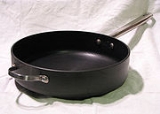
  • Sauté pans, used for sauteing, have a large surface area and low sides to permit steam to escape and allow the cook to toss the food. The word "sauté" comes from the French verb "sauter", meaning to jump. Saute pans often have straight vertical sides, but may also have flared or rounded sides.

  • Stockpot
    Stockpot
    Stockpot is a generic name for one of the most common types of cooking pot used worldwide. A stockpot is traditionally used to make stock or broth, which can be the basis for cooking more complex recipes...

    s
    are large pots with sides at least as tall as their diameter. This allows stock
    Stock (food)
    Stock is a flavoured water preparation. It forms the basis of many dishes, particularly soups and sauces.- Preparation :Stock is made by simmering various ingredients in water, including some or all of the following...

     to simmer for extended periods of time without reducing too much. Stockpots are typically measured in volume (6-36 L). Stock pots come in a large variety of sizes to meet any need from cooking for a family to preparing food for a banquet. A specific type of stockpot exists for lobsters, and an all-metal stockpot usually called a caldero is used in Hispanic cultures to make rice.

  • Woks are wide, roughly bowl
    Bowl (vessel)
    A bowl is a common open-top container used in many cultures to serve food, and is also used for drinking and storing other items. They are typically small and shallow, although some, such as punch bowls and salad bowls, are larger and often intended to serve many people.Bowls have existed for...

    -shaped vessels with one or two handles at or near the rim. This shape allows a small pool of cooking oil
    Cooking oil
    Cooking oil is purified fat of plant origin, which is usually liquid at room temperature ....

     in the center of the wok to be heated to a high heat using relatively little fuel, while the outer areas of the wok are used to keep food warm after it has been fried in the oil. In the Western world
    Western world
    The Western world, also known as the West and the Occident , is a term referring to the countries of Western Europe , the countries of the Americas, as well all countries of Northern and Central Europe, Australia and New Zealand...

    , woks are typically used only for stir-frying, but they can actually be used for anything from steaming to deep frying
    Deep frying
    Deep frying is a cooking method in which food is submerged in hot oil or fat. This is normally performed with a deep fryer or chip pan; industrially, a pressure fryer or vacuum fryer may be used....

    .

Bakeware


Bakeware is designed for use in the oven
Oven
An oven is a thermally insulated chamber used for the heating, baking or drying of a substance. It is most commonly used for cooking. Kilns, and furnaces are special-purpose ovens...

 (for baking), and encompasses a variety of different styles of baking pans as cake pans, pie pans, and loaf pans
Bread pan
A bread pan is a kitchen utensil in the form of a container in which bread is baked. Its function is to shape bread while it is rising during baking. The most common shape of the bread pan is the loaf - a convenient form from which usable slices of bread may be cut. The bread pan is made from a...

.
  • Cake pans include square pans, round pans, and speciality pans such as angel food cake pans and springform pans often used for baking cheesecake
    Cheesecake
    Cheesecake is a dessert consisting of a topping made of soft, fresh cheese, usually on a crust or base made from biscuit , pastry or sponge cake. They may be baked or unbaked...

    .
  • Sheet pan
    Sheet pan
    Sheet pans, baking trays or baking sheets are flat, rectangular metal pans used in an oven. They are primarily used for baking flat products such as cookies, sheet cakes, and swiss rolls....

    s
    , cookie
    Cookie
    In the United States and Canada, a cookie is a small, flat, baked treat, usually containing fat, flour, eggs and sugar. In most English-speaking countries outside North America, the most common word for this is biscuit; in many regions both terms are used, while in others the two words have...

     sheets
    , and jelly-roll
    Swiss roll
    A Swiss roll or jelly roll is a type of sponge cake roll. The thin cake is made of eggs, flour and sugar and baked in a very shallow rectangular baking tray, called a sheet pan. The cake is removed from the pan and spread with jam or buttercream, rolled up, and served in circular slices.The...

     pans
    are bakeware with large flat bottoms.
  • Pie pans are flat-bottomed flare-sided pans specifically designed for baking pies.

List of cookware and bakeware

  • Baking pan
  • Beanpot
    Beanpot
    The Beanpot refers primarily to a men's ice hockey tournament among the four major college hockey schools of the Boston, Massachusetts area, held annually since the 1952-53 season. The tournament gives the winner bragging rights over its cross-town rivals, and the quest for this highly sought-after...

  • Chip pan
    Chip pan
    A chip pan is a deep-sided cooking pan used for deep-frying. Chip pans are named for their traditional use in frying chips ....

  • Cookie sheet
  • Cooking pot
  • Crepe pan
  • Double boiler
    Double boiler
    A double boiler, also known as a bain Marie, is a stove top apparatus used to cook delicate sauces such as beurre blanc, to melt chocolate without burning or seizing, or cook any other thick liquid or porridge that would normally burn if not stirred constantly. It consists of an upper vessel...

  • Doufeu
  • Dutch oven
    Dutch oven
    A Dutch oven is a thick-walled cooking pot with a tight-fitting lid. Dutch ovens have been used as cooking vessels for hundreds of years....

  • Frying pan (also called Skillet)
  • Griddle (also called Tawa in Hindi)
  • Karahi
    Karahi
    A karahi is a type of thick, circular, and deep cooking pot used in Indian, Pakistani, Bangladeshi and Nepalese cuisine. Karahi are traditionally made out of cast iron, and look like woks with rounded bottoms...

  • Kettle
    Kettle
    A kettle, sometimes called a tea kettle or teakettle, is a small kitchen appliance used for boiling water. Kettles can be heated either by placing on a stove, or by their own electric heating element.- Stovetop kettles :...

  • Pressure cooker
  • Ramekin
    Ramekin
    A ramekin or ramequin, also known as a bouillon bowl, is a small glazed ceramic or glass serving bowl used for the preparation and serving of various food dishes...

  • Roasting pan
    Roasting pan
    A roasting pan is a piece of cookware used for roasting meat in an oven, either with or without vegetables or other ingredients. A roasting pan may be used with a rack that sits inside the pan and lets the meat sit above the fat and juice drippings....

  • Roasting rack
  • Saucepan (described in current article)
  • Saucier (described in current article)
  • Sauté pan
  • Splayed Sauté pan
  • Soufflé dish
  • Springform pan
    Springform pan
    A springform pan is a type of bakeware that features sides that can be removed from the base. Springform refers to the construction style of this pan. The base and the sides are separate pieces that are held together when the base is aligned with a groove that rings the bottom of the walls. The pan...

  • Stockpot
    Stockpot
    Stockpot is a generic name for one of the most common types of cooking pot used worldwide. A stockpot is traditionally used to make stock or broth, which can be the basis for cooking more complex recipes...

  • Tajine
    Tajine
    A tajine, or tagine , is a dish from North Africa, that is named after the special earthenware pot in which it is cooked. A similar dish, known as tavvas, is found in the cuisine of Cyprus. The traditional tajine pot is formed entirely of a heavy clay, which is sometimes painted or glazed...

  • Tube pan [types include angel food cake pan and Bundt cake
    Bundt cake
    A bundt cake is a dessert cake that is baked in a bundt pan, shaping it into a distinctive ridged ring. The d in "bundt" is assimilated into the t. The term is used chiefly in North America....

     (Gugelhupf) pan]
  • Wok
    Wok
    A wok is a versatile round-bottomed cooking vessel originating in China. It is used especially in East and Southeast Asia.Woks are most often used for stir frying, but can also be used in other Chinese cooking techniques, such as in steaming, deep frying, braising, stewing, smoking, or making soup...

  • Wonder Pot

See also

  • Bakeware
  • Cauldron
    Cauldron
    A cauldron or caldron is a large metal pot for cooking and/or boiling over an open fire, with a large mouth and frequently with an arc-shaped hanger.- Etymology :...

  • Stoneware
    Stoneware
    Stoneware is a vitreous or semi-vitreous ceramic ware with a fine texture. Stoneware is made from clay that is then fired in a kiln, whether by an artisan to make homeware, or in an industrial kiln for mass-produced or specialty products...

  • Gastronorm sizes
    Gastronorm sizes
    Gastronorm sizes are standard sizes of containers used in the catering industry specified in the EN 631 standards:* GN1/9 : 108 × 176 mm* GN1/6 : 176 × 162 mm* GN1/4 : 265 × 163 mm* GN1/3 : 325 × 176 mm* GN1/2 : 325 × 265 mm* GN2/3 : 354 × 325 mm...

     (standard sizes of container)
  • Kitchenware
    Kitchenware
    Kitchenware include utensils, appliances, dishes, cookware, and so on for use in the kitchen.-See also:*Cookware and bakeware*Dishware*Drinkware*List of eating utensils*List of food preparation utensils*List of Japanese cooking utensils...

  • Kitchenware Brands
  • List of food preparation utensils
  • Pottery
    Pottery
    Pottery is the material from which the potteryware is made, of which major types include earthenware, stoneware and porcelain. The place where such wares are made is also called a pottery . Pottery also refers to the art or craft of the potter or the manufacture of pottery...

  • Pressure cooking
    Pressure cooking
    Pressure cooking is a method of cooking in a sealed vessel that does not permit air or liquids to escape below a preset pressure. Because the boiling point of water increases as the pressure increases, the pressure built up inside the cooker allows the liquid in the pot to rise to a higher...

  • Kappabashi-dori
    Kappabashi-dori
    Kappabashi-dori, also known just as Kappabashi or Kitchen Town, is a street in Tokyo between Ueno and Asakusa which is almost entirely populated with shops supplying the restaurant trade...

  • Food storage
    Food storage
    Food storage is both a traditional domestic skill and is important industrially. Food is stored by almost every human society and by many animals...

  • Food preparation