


Igor Smirnov

Encyclopedia
Igor Nikolaevich Smirnov , (born October 23, 1941) is the President
of the internationally unrecognized Pridnestrovian Moldovan Republic, also known as Transnistria
. He has held this post since 1990.
, Russian SFSR during World War II
. He was the son of Nikolai Stepanovich Smirnov, a worker within the Soviet Communist Party apparatus and Zinaida Grigor’evna Smirnova, a journalist and newspaper editor. As the Party promoted Nikolai Stepanovich to ever more important positions, the family moved from Petropavlosk to the Ukrainian SSR
, where the Red Army
had recently expelled the Nazi German
military. The Smirnovs initially benefited from Nikolai Stepanovich’s successes—he reached the position of First Secretary
of the Golopristanskiy Raion
(district) committee in Soviet Ukraine.
However, in the summer of 1952 Nikolai Stepanovich was arrested for irregularities in supply distribution among the Raion’s collective farms. He was sentenced to fifteen years in the Soviet forced labor camps with a following period of five years’ internal exile. As the family of an enemy of the people
, life was difficult for Zinaida Grigor’evna and her three sons, Vladimir, Oleg, and Igor. In the wake of Joseph Stalin
’s death in 1953, Nikolai Stepanovich was released together with many Soviet inmates. The Smirnov family was reunited in central Russia near the Ural Mountains
, where Nikolai Stepanovich directed a primary school and Zinaida Grigor’evna worked as the editor of a local Komsomol
newspaper.
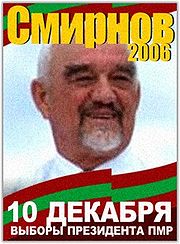
to work on the construction of a new hydroelectric power station in the town of Nova Kakhovka
in the Kherson Oblast
.
Smirnov displayed a great enthusiasm for Soviet life, pursuing higher education in the evenings and weekends after work and participating in a number of athletic and cultural activities. He met and married a young engineer named Zhannetta Nikolaevna Lotnik in the early 1960s and served in the Red Army from 1963-1966 as a Second Lieutenant. In 1963, Smirnov joined the Communist Party of the Soviet Union
and served as a Komsomol
organizer (komsorg) after returning to civilian life.
Once back from the military, Smirnov also continued the correspondence courses he had begun in the early 1960s, receiving a degree from the Zaporizhia
Machine-Building Institute in 1974. Meanwhile, he worked his way up from the shop floor to be an assistant director of one of the shops of the Novaia Kakhovska Machine-Building Factory. With his college diploma, Smirnov continued to be promoted. He soon became the shop director, then assistant to the factory’s chief industrial upgrades and new technologies engineer and finally an assistant director.
While he was not made director in 1987 when that position’s erstwhile occupant retired, he was given the directorship of the “Elektromash” Electronics Concern in the nearby Moldova
n city of Tiraspol
. Fatefully, the boy from the Soviet Far East accepted this position near the USSR’s Western border. It would be just over two years before Smirnov led the city’s municipal government as the chairman of the Tiraspol city soviet and just under three before he held the most powerful position in the embryonic — and unrecognized — Pridnestrovian Moldovan Soviet Socialist Republic.
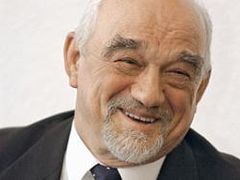
debated the merits of introducing Moldovan
as the official language of the republic—at first with Russian as a second official language and later without—the republic was divided over the issue of nationalizing Moldova. One side believed that Moldova should be independent from the Kremlin
and turned into a nation-state
, possibly in a union with Romania
where a virtually identical language
is spoken. The other believed that Moldova should remain a part of the supranationalist
USSR, possibly in a post-communist, but still united country.
Smirnov and many of his colleagues were suspicious of the possibility of language laws from the very beginning — they suspected this to be the first step towards “nationalization” of the republic at the expense of “their country,” the Soviet Union. However, in August 1989, when it was leaked that Moldovan would be made the only official language, Smirnov and other industrial workers in Tiraspol banded together to create the United Work Collective Council
(OSTK— Объединенный Совет трудовых коллективов) and called an immediate strike that eventually led to the shutdown of most major industrial activity (concentrated in the Transnistrian region) throughout the SSR.
, the OSTK re-examined its tactics. Smirnov and others saw the upcoming Moldovan elections
as an opportunity to effect change through different means. Smirnov won two seats in the elections of February 1990, the 32nd district seat for the city soviet (municipal government) of Tiraspol and the 125th district seat for the Supreme Soviet
of MSSR (republican government) in 1990 Moldovan parliamentary election
. Once in the city soviet, Smirnov ran for chairmanship of that body. In a dramatic demonstration of how much the Communist Party’s power had waned, Smirnov beat his challenger, the First Secretary of the city’s Party Committee, Leonid Tsurkan, by a 2-to-1 margin. From this time forward, Tiraspol was an OSTK-controlled city.
Things did not go quite as smoothly for Igor Smirnov in the Moldovan Supreme Soviet. The OSTK candidates, mostly from Transnistria in the country’s eastern periphery, were a small fraction of the body’s overall membership—approximately 15 percent. In May 1990, these Transnistrian Supreme Soviet deputies were attacked and beaten by pro-independence protesters and quickly left the body for their homes in the East. Unable to affect the course of events in Chişinău, these deputies acted to establish their own Soviet republic, a republic that would remain a part of the Soviet Union and not secede with the rest of the Moldova. Many Moldovans reacted with outrage at this infringement of their sovereignty and the Soviet central government publicly rebuked the separatists for making the situation worse and pushing Moldova further toward independence
.
(PMSSR) and deputies elected him to chair the Provisional Supreme Soviet of the PMSSR.
In his new role as chairman of the PMSSR Supreme Soviet, and later, president of the Pridnestrovian Moldovan Republic (PMR), Smirnov worked to gain recognition for the state. While this was never a likely outcome, Smirnov was successful at securing the cooperation of a locally stationed Red Army unit; as the conflict grew increasingly violent at the end of 1991 and going into 1992, Red Army leaders and enlisted men, often themselves from Transnistria, gave moral support, weapons and ammunition to PMR separatists. Eventually a number of Red Army soldiers joined the PMR Army.
In December 1991 Smirnov beat Grigorii Marakutsa, his successor as chairman of the PMSSR Supreme Soviet and another challenger in an election for president of the Pridnestrovian Moldovan Soviet Socialist Republic. He won with 64% of the vote.
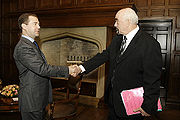 The Pridnestrovian Moldovan Republic has held three further presidential elections since the first in 1991.
Igor Smirnov has won all by a wide margin. On December 23, 1996
, he took 72% of the vote against 20% for Vladimir Malakhov and on December 9, 2001
, he took 81.9% of the vote against 6.7% for Tom Zenovich
and 4.6% for Alexander Radchenko
. On December 10, 2006
, Smirnov was re-elected for a third time with 82.4% of the vote. His Communist Party
opponent, Nadezhda Bondarenko got only 8.1% of the vote. Andrey Safonov
, owner and editor of the Opposition newspaper Novaia gazeta got 3.9% and Renewal Party
MP Peter Tomaily
, standing as an independent candidate, got 2.1%. 1.6% voted for "none of the above" and 1.9% of the ballot papers were blank or spoiled. Turnout was 66.1%. None of these elections were recognized by the international community, which does not recognize the legality of the Transnistrian authorities and called for democratic elections for a self-governing territory within the boundaries of Moldova
.
Smirnov has announced that he will retire from politics when the Pridnestrovian Moldovan Republic obtains international recognition as a sovereign state and has called this goal his life's work.
Igor Smirnov usually drives around Transnistria in a Skoda
and without bodyguards.
The Vice President of the PMR is currently Aleksandr Ivanovich Korolyov.
President
A president is a leader of an organization, company, trade union, university, or country.Etymologically, a president is one who presides, who sits in leadership...
of the internationally unrecognized Pridnestrovian Moldovan Republic, also known as Transnistria
Transnistria
Transnistria is a breakaway territory located mostly on a strip of land between the Dniester River and the eastern Moldovan border to Ukraine...
. He has held this post since 1990.
Childhood
Igor Smirnov was born in Petropavlovsk-KamchatskyPetropavlovsk-Kamchatsky
Petropavlovsk-Kamchatsky is the main city and the administrative, industrial, scientific, and cultural center of Kamchatka Krai, Russia. Population: .-History:It was founded by Danish navigator Vitus Bering, in the service of the Russian Navy...
, Russian SFSR during World War II
World War II
World War II, or the Second World War , was a global conflict lasting from 1939 to 1945, involving most of the world's nations—including all of the great powers—eventually forming two opposing military alliances: the Allies and the Axis...
. He was the son of Nikolai Stepanovich Smirnov, a worker within the Soviet Communist Party apparatus and Zinaida Grigor’evna Smirnova, a journalist and newspaper editor. As the Party promoted Nikolai Stepanovich to ever more important positions, the family moved from Petropavlosk to the Ukrainian SSR
Ukrainian SSR
The Ukrainian Soviet Socialist Republic or in short, the Ukrainian SSR was a sovereign Soviet Socialist state and one of the fifteen constituent republics of the Soviet Union lasting from its inception in 1922 to the breakup in 1991...
, where the Red Army
Red Army
The Workers' and Peasants' Red Army started out as the Soviet Union's revolutionary communist combat groups during the Russian Civil War of 1918-1922. It grew into the national army of the Soviet Union. By the 1930s the Red Army was among the largest armies in history.The "Red Army" name refers to...
had recently expelled the Nazi German
Nazi Germany
Nazi Germany , also known as the Third Reich , but officially called German Reich from 1933 to 1943 and Greater German Reich from 26 June 1943 onward, is the name commonly used to refer to the state of Germany from 1933 to 1945, when it was a totalitarian dictatorship ruled by...
military. The Smirnovs initially benefited from Nikolai Stepanovich’s successes—he reached the position of First Secretary
General secretary
-International intergovernmental organizations:-International nongovernmental organizations:-Sports governing bodies:...
of the Golopristanskiy Raion
Raion
A raion is a type of administrative unit of several post-Soviet countries. The term, which is from French rayon 'honeycomb, department,' describes both a type of a subnational entity and a division of a city, and is commonly translated in English as "district"...
(district) committee in Soviet Ukraine.
However, in the summer of 1952 Nikolai Stepanovich was arrested for irregularities in supply distribution among the Raion’s collective farms. He was sentenced to fifteen years in the Soviet forced labor camps with a following period of five years’ internal exile. As the family of an enemy of the people
Enemy of the people
The term enemy of the people is a fluid designation of political or class opponents of the group using the term. The term implies that the "enemies" in question are acting against society as a whole. It is similar to the notion of "enemy of the state". The term originated in Roman times as ,...
, life was difficult for Zinaida Grigor’evna and her three sons, Vladimir, Oleg, and Igor. In the wake of Joseph Stalin
Joseph Stalin
Joseph Vissarionovich Stalin was the Premier of the Soviet Union from 6 May 1941 to 5 March 1953. He was among the Bolshevik revolutionaries who brought about the October Revolution and had held the position of first General Secretary of the Communist Party of the Soviet Union's Central Committee...
’s death in 1953, Nikolai Stepanovich was released together with many Soviet inmates. The Smirnov family was reunited in central Russia near the Ural Mountains
Ural Mountains
The Ural Mountains , or simply the Urals, are a mountain range that runs approximately from north to south through western Russia, from the coast of the Arctic Ocean to the Ural River and northwestern Kazakhstan. Their eastern side is usually considered the natural boundary between Europe and Asia...
, where Nikolai Stepanovich directed a primary school and Zinaida Grigor’evna worked as the editor of a local Komsomol
Komsomol
The Communist Union of Youth , usually known as Komsomol , was the youth division of the Communist Party of the Soviet Union. The Komsomol in its earliest form was established in urban centers in 1918. During the early years, it was a Russian organization, known as the Russian Communist Union of...
newspaper.
Professional life
In 1959, Igor Smirnov began work at the Zlatoust Metallurgical Factory at the age of eighteen. Soon, however, he moved back to UkraineUkraine
Ukraine is a country in Eastern Europe. It has an area of 603,628 km², making it the second largest contiguous country on the European continent, after Russia...
to work on the construction of a new hydroelectric power station in the town of Nova Kakhovka
Nova Kakhovka
Nova Kakhovka is a city in the Kherson Oblast of southern Ukraine, recognized as the Monument of Architecture, and was part of the Great Construction Projects of Communism....
in the Kherson Oblast
Kherson Oblast
Kherson Oblast is an oblast in southern Ukraine, just north of Crimea. Its administrative center is Kherson. The area of the region is 29000 km², its population is 1.12 million.Important cities in the oblast include:...
.
Smirnov displayed a great enthusiasm for Soviet life, pursuing higher education in the evenings and weekends after work and participating in a number of athletic and cultural activities. He met and married a young engineer named Zhannetta Nikolaevna Lotnik in the early 1960s and served in the Red Army from 1963-1966 as a Second Lieutenant. In 1963, Smirnov joined the Communist Party of the Soviet Union
Communist Party of the Soviet Union
The Communist Party of the Soviet Union was the only legal, ruling political party in the Soviet Union and one of the largest communist organizations in the world...
and served as a Komsomol
Komsomol
The Communist Union of Youth , usually known as Komsomol , was the youth division of the Communist Party of the Soviet Union. The Komsomol in its earliest form was established in urban centers in 1918. During the early years, it was a Russian organization, known as the Russian Communist Union of...
organizer (komsorg) after returning to civilian life.
Once back from the military, Smirnov also continued the correspondence courses he had begun in the early 1960s, receiving a degree from the Zaporizhia
Zaporizhia
Zaporizhia or Zaporozhye [formerly Alexandrovsk ] is a city in southeastern Ukraine, situated on the banks of the Dnieper River. It is the administrative center of the Zaporizhia Oblast...
Machine-Building Institute in 1974. Meanwhile, he worked his way up from the shop floor to be an assistant director of one of the shops of the Novaia Kakhovska Machine-Building Factory. With his college diploma, Smirnov continued to be promoted. He soon became the shop director, then assistant to the factory’s chief industrial upgrades and new technologies engineer and finally an assistant director.
While he was not made director in 1987 when that position’s erstwhile occupant retired, he was given the directorship of the “Elektromash” Electronics Concern in the nearby Moldova
Moldova
Moldova , officially the Republic of Moldova is a landlocked state in Eastern Europe, located between Romania to the West and Ukraine to the North, East and South. It declared itself an independent state with the same boundaries as the preceding Moldavian Soviet Socialist Republic in 1991, as part...
n city of Tiraspol
Tiraspol
Tiraspol is the second largest city in Moldova and is the capital and administrative centre of the unrecognized Pridnestrovian Moldavian Republic . The city is located on the eastern bank of the Dniester River...
. Fatefully, the boy from the Soviet Far East accepted this position near the USSR’s Western border. It would be just over two years before Smirnov led the city’s municipal government as the chairman of the Tiraspol city soviet and just under three before he held the most powerful position in the embryonic — and unrecognized — Pridnestrovian Moldovan Soviet Socialist Republic.
The strike campaign
As communist states began to collapse at the end of the 1980s, people in some areas of the Soviet Union began to demand sovereignty for separate national identities. As the citizens of the Moldavian SSRMoldavian SSR
The Moldavian Soviet Socialist Republic , commonly abbreviated to Moldavian SSR or MSSR, was one of the 15 republics of the Soviet Union...
debated the merits of introducing Moldovan
Moldovan language
Moldovan is one of the names of the Romanian language as spoken in the Republic of Moldova, where it is official. The spoken language of Moldova is closer to the dialects of Romanian spoken in northeastern Romania, and the two countries share the same literary standard...
as the official language of the republic—at first with Russian as a second official language and later without—the republic was divided over the issue of nationalizing Moldova. One side believed that Moldova should be independent from the Kremlin
Moscow Kremlin
The Moscow Kremlin , sometimes referred to as simply The Kremlin, is a historic fortified complex at the heart of Moscow, overlooking the Moskva River , Saint Basil's Cathedral and Red Square and the Alexander Garden...
and turned into a nation-state
Nation-state
The nation state is a state that self-identifies as deriving its political legitimacy from serving as a sovereign entity for a nation as a sovereign territorial unit. The state is a political and geopolitical entity; the nation is a cultural and/or ethnic entity...
, possibly in a union with Romania
Romania
Romania is a country located at the crossroads of Central and Southeastern Europe, on the Lower Danube, within and outside the Carpathian arch, bordering on the Black Sea...
where a virtually identical language
Romanian language
Romanian Romanian Romanian (or Daco-Romanian; obsolete spellings Rumanian, Roumanian; self-designation: română, limba română ("the Romanian language") or românește (lit. "in Romanian") is a Romance language spoken by around 24 to 28 million people, primarily in Romania and Moldova...
is spoken. The other believed that Moldova should remain a part of the supranationalist
Proletarian internationalism
Proletarian internationalism, sometimes referred to as international socialism, is a Marxist social class concept based on the view that capitalism is now a global system, and therefore the working class must act as a global class if it is to defeat it...
USSR, possibly in a post-communist, but still united country.
Smirnov and many of his colleagues were suspicious of the possibility of language laws from the very beginning — they suspected this to be the first step towards “nationalization” of the republic at the expense of “their country,” the Soviet Union. However, in August 1989, when it was leaked that Moldovan would be made the only official language, Smirnov and other industrial workers in Tiraspol banded together to create the United Work Collective Council
United Work Collective Council
The United Work Collective Council is an organization which led a political movement for the independence of Transnistria from the Republic of Moldova.-Work Collective Councils:...
(OSTK— Объединенный Совет трудовых коллективов) and called an immediate strike that eventually led to the shutdown of most major industrial activity (concentrated in the Transnistrian region) throughout the SSR.
Entry into politics
When the strike campaign, from August 16 to September 22, 1989, failed to produce much of an effect in ChişinăuChisinau
Chișinău is the capital and largest municipality of Moldova. It is also its main industrial and commercial centre and is located in the middle of the country, on the river Bîc...
, the OSTK re-examined its tactics. Smirnov and others saw the upcoming Moldovan elections
Moldovan parliamentary election, 1990
A parliamentary election took place in Moldova in February-March 1990.- Results :Elections to the Moldovan Supreme Soviet were held in February-March 1990; while the Communist Party of Moldova was the only one registered for this contest, opposition candidates were allowed to run as individuals....
as an opportunity to effect change through different means. Smirnov won two seats in the elections of February 1990, the 32nd district seat for the city soviet (municipal government) of Tiraspol and the 125th district seat for the Supreme Soviet
Supreme Soviet
The Supreme Soviet of the Soviet Union was the Supreme Soviet in the Soviet Union and the only one with the power to pass constitutional amendments...
of MSSR (republican government) in 1990 Moldovan parliamentary election
Moldovan parliamentary election, 1990
A parliamentary election took place in Moldova in February-March 1990.- Results :Elections to the Moldovan Supreme Soviet were held in February-March 1990; while the Communist Party of Moldova was the only one registered for this contest, opposition candidates were allowed to run as individuals....
. Once in the city soviet, Smirnov ran for chairmanship of that body. In a dramatic demonstration of how much the Communist Party’s power had waned, Smirnov beat his challenger, the First Secretary of the city’s Party Committee, Leonid Tsurkan, by a 2-to-1 margin. From this time forward, Tiraspol was an OSTK-controlled city.
Things did not go quite as smoothly for Igor Smirnov in the Moldovan Supreme Soviet. The OSTK candidates, mostly from Transnistria in the country’s eastern periphery, were a small fraction of the body’s overall membership—approximately 15 percent. In May 1990, these Transnistrian Supreme Soviet deputies were attacked and beaten by pro-independence protesters and quickly left the body for their homes in the East. Unable to affect the course of events in Chişinău, these deputies acted to establish their own Soviet republic, a republic that would remain a part of the Soviet Union and not secede with the rest of the Moldova. Many Moldovans reacted with outrage at this infringement of their sovereignty and the Soviet central government publicly rebuked the separatists for making the situation worse and pushing Moldova further toward independence
Independence of Moldova
The Independence of Moldova was officially recognized on March 2, 1992, when Moldova gained membership of the United Nations. The nation had declared its independence from the Soviet Union on August 27, 1991, and was a co-founder of the post-Soviet Commonwealth of Independent States...
.
Proclamation of independence
Igor Smirnov emerged as a leader of the OSTK on a regional level as Transnistrian politicians and activists worked towards sovereignty from the Moldovan SSR in the summer and fall of 1990. When the First All-region Congress of Transnistrian Deputies created a self-contained Transnistrian economic zone in June 1990, Smirnov was elected chair of a coordinating council charged with carrying momentum forward to sovereignty. A second congress held on September 2 proclaimed the creation of the Pridnestrovian Moldavian Soviet Socialist RepublicPridnestrovian Moldavian Soviet Socialist Republic
The Pridnestrovian Moldavian Soviet Socialist Republic was created on the eastern periphery of the Moldavian Soviet Socialist Republic in 1990 by pro-Soviet separatists who hoped to remain within the Soviet Union when it became clear that the MSSR would achieve independence from the USSR...
(PMSSR) and deputies elected him to chair the Provisional Supreme Soviet of the PMSSR.
In his new role as chairman of the PMSSR Supreme Soviet, and later, president of the Pridnestrovian Moldovan Republic (PMR), Smirnov worked to gain recognition for the state. While this was never a likely outcome, Smirnov was successful at securing the cooperation of a locally stationed Red Army unit; as the conflict grew increasingly violent at the end of 1991 and going into 1992, Red Army leaders and enlisted men, often themselves from Transnistria, gave moral support, weapons and ammunition to PMR separatists. Eventually a number of Red Army soldiers joined the PMR Army.
In December 1991 Smirnov beat Grigorii Marakutsa, his successor as chairman of the PMSSR Supreme Soviet and another challenger in an election for president of the Pridnestrovian Moldovan Soviet Socialist Republic. He won with 64% of the vote.
Smirnov after the war
Igor Smirnov has won all by a wide margin. On December 23, 1996
Transnistrian presidential election, 1996
Presidential elections were held in the breakaway republic of Transnistria on 22 December, 1996. They were won by the incumbent Igor Smirnov, who has ruled Transnistria since 1991...
, he took 72% of the vote against 20% for Vladimir Malakhov and on December 9, 2001
Transnistrian presidential election, 2001
Presidential elections were held in the breakaway republic of Transnistria on 9 December, 2001. They were won by the incumbent Igor Smirnov, who has ruled Transnistria since 1991. The other candidates were Tom Zenovich, mayor of Bender , and Alexander Radchenko of the Power to the People party,...
, he took 81.9% of the vote against 6.7% for Tom Zenovich
Tom Zenovich
Tom Zenovich is a politician and former presidential candidate from Transnistria, a break-away region of Moldova. Prior to his presidential run in 2001 he was mayor of Bender, Transnistria's second largest city....
and 4.6% for Alexander Radchenko
Alexander Radchenko
Alexander Radchenko , an ethnic Ukrainian, is a politician and human rights activist in Transnistria. A former Soviet military officer, he is today the editor of a small opposition newspaper in Tiraspol called Man and His Rights...
. On December 10, 2006
Transnistrian presidential election, 2006
The 2006 presidential election in Transnistria was held on December 10 of that year. Incumbent President Igor Smirnov won despite opposition having stiffened during the final weeks of the campaign...
, Smirnov was re-elected for a third time with 82.4% of the vote. His Communist Party
Pridnestrovie Communist Party
The Pridnestrovie Communist Party is a Marxist-Leninist political party in Transnistria....
opponent, Nadezhda Bondarenko got only 8.1% of the vote. Andrey Safonov
Andrey Safonov
Andrey Safonov is a politician from Transnistria. He lives in Bender, Transnistria's second largest city.- Biography :He ran for president against incumbent president Igor Smirnov in the election held on December 10, 2006, and came in third place with 3.9% of the vote.He is a former teacher of...
, owner and editor of the Opposition newspaper Novaia gazeta got 3.9% and Renewal Party
Renewal (Transnistria)
Renewal or Renovation , a pro-business political party in Transnistria. Since the legislative elections of 2005 it is the majority party in the Transnistrian Parliament but in opposition to the current PMR President Igor Smirnov.It was founded as a political NGO in 2000 and campaigned under its...
MP Peter Tomaily
Peter Tomaily
Peter Tomaily is a free market politician in Transnistria and a member of the Transnistrian parliament for the opposition party Renewal....
, standing as an independent candidate, got 2.1%. 1.6% voted for "none of the above" and 1.9% of the ballot papers were blank or spoiled. Turnout was 66.1%. None of these elections were recognized by the international community, which does not recognize the legality of the Transnistrian authorities and called for democratic elections for a self-governing territory within the boundaries of Moldova
Moldova
Moldova , officially the Republic of Moldova is a landlocked state in Eastern Europe, located between Romania to the West and Ukraine to the North, East and South. It declared itself an independent state with the same boundaries as the preceding Moldavian Soviet Socialist Republic in 1991, as part...
.
Smirnov has announced that he will retire from politics when the Pridnestrovian Moldovan Republic obtains international recognition as a sovereign state and has called this goal his life's work.
Igor Smirnov usually drives around Transnistria in a Skoda
Škoda Auto
Škoda Auto , more commonly known as Škoda, is an automobile manufacturer based in the Czech Republic. Škoda became a wholly owned subsidiary of the Volkswagen Group in 2000, positioned as the entry brand to the group...
and without bodyguards.
The Vice President of the PMR is currently Aleksandr Ivanovich Korolyov.
External links
- President of the Pridnestrovian Moldavian Republic (official site) (beta version)
- Igor Smirnov bio / profile
- Regions and territories: Trans-Dniester#Leaders, BBC NewsBBC NewsBBC News is the department of the British Broadcasting Corporation responsible for the gathering and broadcasting of news and current affairs. The department is the world's largest broadcast news organisation and generates about 120 hours of radio and television output each day, as well as online...
profile - Interview with Igor Smirnov: "What matters first of all is the opinion of the people who live here"
- The Permanent President, KommersantKommersantKommersant is a commerce-oriented newspaper published in Russia. , the circulation was 131,000.- History :The newspaper was initially published in 1909, and it was closed down following the Bolshevik seizure of power and the introduction of censorship in 1917.In 1989, with the onset of press...
, 11 December 2006
See also
- Politics of TransnistriaPolitics of TransnistriaPolitics of Transnistria, a de facto independent state situated de jure within the Republic of Moldova in Eastern Europe, takes place in a framework of a presidential republic, whereby the President of Transnistria is both head of state and head of government. Executive power is exercised by the...