

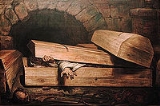
Premature burial

Encyclopedia
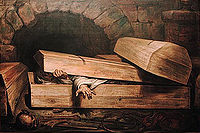
Burial
Burial is the act of placing a person or object into the ground. This is accomplished by excavating a pit or trench, placing an object in it, and covering it over.-History:...
while still alive. Animals or humans may be buried alive accidentally or intentionally. Intentional burial may occur as a form of torture
Torture
Torture is the act of inflicting severe pain as a means of punishment, revenge, forcing information or a confession, or simply as an act of cruelty. Throughout history, torture has often been used as a method of political re-education, interrogation, punishment, and coercion...
, murder
Murder
Murder is the unlawful killing, with malice aforethought, of another human being, and generally this state of mind distinguishes murder from other forms of unlawful homicide...
, or execution; it may also occur with consent of the victim as a part of a stunt
Stunt
A stunt is an unusual and difficult physical feat, or any act requiring a special skill, performed for artistic purposes in TV, theatre, or cinema...
(with the intention to escape) or as a form of suicide
Suicide
Suicide is the act of intentionally causing one's own death. Suicide is often committed out of despair or attributed to some underlying mental disorder, such as depression, bipolar disorder, schizophrenia, alcoholism, or drug abuse...
. The victim may also be buried by others in the mistaken assumption that they had died. Live burial is said to be one of the most widespread of human fears.
Physics and biology
Premature burial leads to death through one or more of the following: asphyxiation, dehydrationDehydration
In physiology and medicine, dehydration is defined as the excessive loss of body fluid. It is literally the removal of water from an object; however, in physiological terms, it entails a deficiency of fluid within an organism...
, starvation
Starvation
Starvation is a severe deficiency in caloric energy, nutrient and vitamin intake. It is the most extreme form of malnutrition. In humans, prolonged starvation can cause permanent organ damage and eventually, death...
, or (in cold climates) hypothermia
Hypothermia
Hypothermia is a condition in which core temperature drops below the required temperature for normal metabolism and body functions which is defined as . Body temperature is usually maintained near a constant level of through biologic homeostasis or thermoregulation...
. Although human survival may be briefly extended in some environments as body metabolism
Metabolism
Metabolism is the set of chemical reactions that happen in the cells of living organisms to sustain life. These processes allow organisms to grow and reproduce, maintain their structures, and respond to their environments. Metabolism is usually divided into two categories...
slows, in the absence of oxygen which is likely to be within 1-2 hours from burial time based on the consumption level, after which loss of consciousness will take place within 2 to 4 minutes and death by asphyxia within 5 to 15 minutes. Permanent brain damage through oxygen starvation is likely after a few minutes, even if the person is rescued before death. If fresh air is accessible in some way, survival is more likely to be in the order of days in the absence of serious injury.
A person trapped with air to breathe can thus last a considerable time, and burial has been used as a very cruel method of execution (as in case of Vestal Virgin
Vestal Virgin
In ancient Roman religion, the Vestals or Vestal Virgins , were priestesses of Vesta, goddess of the hearth. The College of the Vestals and its well-being was regarded as fundamental to the continuance and security of Rome, as embodied by their cultivation of the sacred fire that could not be...
s who violated the oath of celibacy), lasting sufficiently long for the victim to comprehend and imagine every stage of what is happening (being trapped in total darkness with very limited or no movement) and to experience great psychological and physical torment including panic and extreme claustrophobia
Claustrophobia
Claustrophobia is the fear of having no escape and being closed in small spaces or rooms...
. The medical term for the irrational fear of being buried alive is taphephobia.
Unintentional
George Washington
George Washington was the dominant military and political leader of the new United States of America from 1775 to 1799. He led the American victory over Great Britain in the American Revolutionary War as commander-in-chief of the Continental Army from 1775 to 1783, and presided over the writing of...
, on his deathbed
Deathbed
A deathbed is a place where a person dies or lies in during the last few hours before death.Deathbed may also refer to:* Deathbed conversion, a religious faith conversion...
, made his servants promise not to bury him until twelve days after his death. Patients in the 1890s have been documented as accidentally being bagged, trapped in a steel box, or sent to the morgue
Morgue
A morgue or mortuary is used for the storage of human corpses awaiting identification, or removal for autopsy or disposal by burial, cremation or otherwise...
. "Safety coffin
Safety coffin
A safety coffin or security coffin is a coffin fitted with a mechanism to prevent premature burial or allow the occupant to signal that he/ she has been buried alive...
s" have been devised to prevent premature burial.
On 5 December 1882, J. G. Krichbaum received US Patent 268693 for his "Device For Life In Buried Persons". It consisted of a movable periscope-like pipe which provided air and, when rotated or pushed by the person interred, indicated to passersby that someone was buried alive. The patent text refers to "that class of devices for indicating life in buried persons", suggesting that such inventions were common at the time.
Count Karnice-Karnicki of Belgium
Belgium
Belgium , officially the Kingdom of Belgium, is a federal state in Western Europe. It is a founding member of the European Union and hosts the EU's headquarters, and those of several other major international organisations such as NATO.Belgium is also a member of, or affiliated to, many...
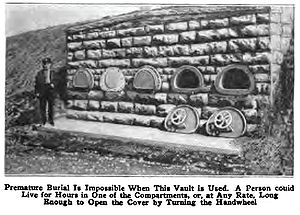
patented a rescue device in 1897, which mechanically detected chest movement to trigger a flag, lamp, bell, and fresh air. Along similar lines, in the United Kingdom, various systems were developed to save those buried alive, including breakable glass panels in the coffin lid and pulley systems which would raise flags or ring bells on the surface. Without air supply, as in the Italian model, this naturally would be useless without vigilant guards above ground. As such, undertakers were hired to stay in the graveyard at night to watch out for such signals. In 1890, a family designed and built a burial vault at the Wildwood Cemetery in Williamsport, Pennsylvania
Williamsport, Pennsylvania
Williamsport is a city in and the county seat of Lycoming County, Pennsylvania in the United States. In 2009, the population was estimated at 29,304...
, with an internal hatch to allow the victim of accidental premature burial to escape. The vault had an air supply and was lined in felt to protect a panic-stricken victim from self-inflicted injury before escape. Bodies were to be removed from the casket before interment.
As a means of execution
Vestal Virgin
In ancient Roman religion, the Vestals or Vestal Virgins , were priestesses of Vesta, goddess of the hearth. The College of the Vestals and its well-being was regarded as fundamental to the continuance and security of Rome, as embodied by their cultivation of the sacred fire that could not be...
convicted of violating her vows of celibacy
Celibacy
Celibacy is a personal commitment to avoiding sexual relations, in particular a vow from marriage. Typically celibacy involves avoiding all romantic relationships of any kind. An individual may choose celibacy for religious reasons, such as is the case for priests in some religions, for reasons of...
was "buried alive" by being sealed in a cave with a small amount of bread and water, ostensibly so that the goddess Vesta
Vesta (mythology)
Vesta was the virgin goddess of the hearth, home, and family in Roman religion. Vesta's presence was symbolized by the sacred fire that burned at her hearth and temples...
could save her were she truly innocent. This practice was, strictly speaking, immurement
Immurement
Immurement is a form of execution where a person is walled up within a building and left to die from starvation or dehydration. This is distinct from being buried alive, in which the victim typically dies of asphyxiation.-In legend and folklore:...
(i.e., being walled up and left to die) rather than premature burial. According to Christian
Christian
A Christian is a person who adheres to Christianity, an Abrahamic, monotheistic religion based on the life and teachings of Jesus of Nazareth as recorded in the Canonical gospels and the letters of the New Testament...
tradition, a number of saints were martyred this way, including Saint Castulus and Saint Vitalis of Milan. In medieval Italy, unrepentant murderers were buried alive. This practice is referred to in passing in canto XIX of Dante
DANTE
Delivery of Advanced Network Technology to Europe is a not-for-profit organisation that plans, builds and operates the international networks that interconnect the various national research and education networks in Europe and surrounding regions...
's Inferno.
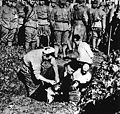
In the seventeenth and early eighteenth centuries in feudal Russia, the same mode of execution was known as "the pit" and used against women who were condemned for killing their husbands. The last known case of this occurred in 1937. During World War II, Japanese soldiers were documented to have buried Chinese civilians alive, notably during the Nanking Massacre
Nanking Massacre
The Nanking Massacre or Nanjing Massacre, also known as the Rape of Nanking, was a mass murder, genocide and war rape that occurred during the six-week period following the Japanese capture of the city of Nanjing , the former capital of the Republic of China, on December 13, 1937 during the Second...
.
Voluntary burial
On rare occasions, some people actually voluntarily arranged to be buried alive, reportedly as a demonstration of their controversial ability to survive such an event. In one story taking place around 1840, Sadhu HaridasSadhu Haridas
Sadhu Haridas was a hatha yogi and fakir of nineteenth-century India, renowned for his reputed power to control his body completely using the power of his mind, employing the energies of kundalini. His most notable feat, carried out in 1837, was to survive burial underground, without food or...
, an Indian fakir
Fakir
The fakir or faqir ; ) Derived from faqr is a Muslim Sufi ascetic in Middle East and South Asia. The Faqirs were wandering Dervishes teaching Islam and living on alms....
, is said to have been buried in the presence of a British military officer and under the supervision of the local maharajah, by being placed in a sealed bag in a wooden box in a vault. The vault was then interred, earth was flattened over the site, and crops were sown over the place for a very long time. The whole location was guarded day and night to prevent fraud, and the site was dug up twice in a ten-month period to verify the burial, before the fakir was finally dug out and slowly revived in the presence of another officer. The fakir said that his only fear during his "wonderful sleep" was to be eaten by underground worms. According to current medical science, it is not possible for a human to survive for a period of ten months without food, water, and air. According to other sources the entire burial was 40 days long. The Indian government has since made the act of voluntary premature burial illegal, because of the unintended deaths of individuals attempting to recreate this feat.
During his career, Hungarian-American magician and escapologist Harry Houdini
Harry Houdini
Harry Houdini was a Hungarian-born American magician and escapologist, stunt performer, actor and film producer noted for his sensational escape acts...
performed two variations on a "Buried Alive" stunt/escape. The first was near Santa Ana, California in 1917, and it almost cost Houdini his life. Houdini was buried, without a casket, in a pit of earth six feet deep. He became exhausted and panicky trying to dig his way to the surface and called for help. When his hand finally broke the surface, he fell unconscious and had to be pulled from the grave by his assistants. Houdini wrote in his diary that the escape was "very dangerous" and that "the weight of the earth is killing."
Houdini's second variation on Buried Alive was an endurance test designed to expose a mystical Egyptian performer who claimed to use supernatural powers to remain in a sealed casket for an hour. Houdini bettered that claim on August 5, 1926, by remaining in a sealed casket submerged in the swimming pool of New York's Hotel Shelton for an hour and a half. Houdini claimed he did not use any trickery or supernatural powers to accomplish this feat, just controlled breathing.
Myths and legends
St. OranSaint Otteran
Odran or Odhran , a descendant of Conall Gulban, is usually identified with Odhron , who preceded Saint Columba in Iona. His death is recorded in 548 and his grave was greatly revered in Iona....
was a druid
Druid
A druid was a member of the priestly class in Britain, Ireland, and Gaul, and possibly other parts of Celtic western Europe, during the Iron Age....
living on the Island of Iona
Iona
Iona is a small island in the Inner Hebrides off the western coast of Scotland. It was a centre of Irish monasticism for four centuries and is today renowned for its tranquility and natural beauty. It is a popular tourist destination and a place for retreats...
in Scotland
Scotland
Scotland is a country that is part of the United Kingdom. Occupying the northern third of the island of Great Britain, it shares a border with England to the south and is bounded by the North Sea to the east, the Atlantic Ocean to the north and west, and the North Channel and Irish Sea to the...
's Inner Hebrides
Inner Hebrides
The Inner Hebrides is an archipelago off the west coast of Scotland, to the south east of the Outer Hebrides. Together these two island chains form the Hebrides, which enjoy a mild oceanic climate. There are 36 inhabited islands and a further 43 uninhabited Inner Hebrides with an area greater than...
. He became a follower of St. Columba, who brought Christianity to Iona (and mainland Europe) from Ireland
Ireland
Ireland is an island to the northwest of continental Europe. It is the third-largest island in Europe and the twentieth-largest island on Earth...
in 563 AD. When St. Columba had repeated problems building the original Iona Abbey
Iona Abbey
Iona Abbey is located on the Isle of Iona, just off the Isle of Mull on the West Coast of Scotland. It is one of the oldest and most important religious centres in Western Europe. The abbey was a focal point for the spread of Christianity throughout Scotland and marks the foundation of a monastic...
, citing interferences from the Devil
Devil
The Devil is believed in many religions and cultures to be a powerful, supernatural entity that is the personification of evil and the enemy of God and humankind. The nature of the role varies greatly...
, St. Oran offered himself as a human sacrifice and was buried alive. He was later dug up and found to be still alive, but he uttered such words describing what of the afterlife he had seen and how it involved no heaven or hell, that he was ordered to be covered up again. The building of the abbey went ahead, untroubled, and St. Oran's chapel marks the spot where the saint was buried.
In the fourteenth through nineteenth centuries, a popular tale about premature burial in European folklore
Folklore
Folklore consists of legends, music, oral history, proverbs, jokes, popular beliefs, fairy tales and customs that are the traditions of a culture, subculture, or group. It is also the set of practices through which those expressive genres are shared. The study of folklore is sometimes called...
was the "Lady with the Ring
Lady with the Ring
The "Lady with the Ring" is a story about premature burial from European folklore. Versions of the story were popular throughout Europe in the 14th through the 19th centuries.- Central features :...
". In the story, a woman who was prematurely buried awakens to frighten a grave robber who is attempting to cut a ring off her finger.
The TV show MythBusters
MythBusters
MythBusters is a science entertainment TV program created and produced by Beyond Television Productions for the Discovery Channel. The series is screened by numerous international broadcasters, including Discovery Channel Australia, Discovery Channel Latin America, Discovery Channel Canada, Quest...
tested the myth to see if someone could survive being buried alive for two hours before being rescued. Host Jamie Hyneman
Jamie Hyneman
James Franklin "Jamie" Hyneman is an American special effects expert, best known for being the co-host of the television series MythBusters. He is also the owner of M5 Industries, the special effects workshop where MythBusters is filmed...
attempted the feat, but when his steel coffin began to bend under the weight of the earth used to cover it, the experiment was aborted. The MythBusters also tested whether someone could batter their way out of a buried coffin, and decided it was not remotely possible.
See also
- ImmurementImmurementImmurement is a form of execution where a person is walled up within a building and left to die from starvation or dehydration. This is distinct from being buried alive, in which the victim typically dies of asphyxiation.-In legend and folklore:...
- List of premature obituaries
- Lazarus syndromeLazarus syndromeLazarus syndrome or autoresuscitation after failed cardiopulmonary resuscitation is the spontaneous return of circulation after failed attempts at resuscitation. Its occurrence has been noted in medical literature at least 25 times since 1982...
, spontaneous return of circulation after failed attempts at resuscitation - Locked-in syndromeLocked-In syndromeLocked-in syndrome is a condition in which a patient is aware and awake but cannot move or communicate verbally due to complete paralysis of nearly all voluntary muscles in the body except for the eyes. Total locked-in syndrome is a version of locked-in syndrome where the eyes are paralyzed as...
, medical condition described as "the closest thing to being buried alive" - "The Premature BurialThe Premature Burial"The Premature Burial" is a horror short story on the theme of being buried alive, written by Edgar Allan Poe and published in 1844 in The Philadelphia Dollar Newspaper. Fear of being buried alive was common in this period and Poe was taking advantage of the public interest...
" and "The Fall of the House of UsherThe Fall of the House of Usher"The Fall of the House of Usher" is a short story by Edgar Allan Poe, first published in September 1839 in Burton's Gentleman's Magazine. It was slightly revised in 1840 for the collection Tales of the Grotesque and Arabesque...
" are two short stories written by Edgar Allan PoeEdgar Allan PoeEdgar Allan Poe was an American author, poet, editor and literary critic, considered part of the American Romantic Movement. Best known for his tales of mystery and the macabre, Poe was one of the earliest American practitioners of the short story and is considered the inventor of the detective...
which deal with the topic of being buried alive.
External links
- "Nightmares from the Mind of Poe" full text, summary and film information.