
All Topics  
Kara-Khanid Khanate


   Email Print
   Bookmark   Link


Kara-Khanid Khanate


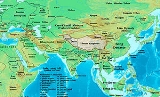
Kara-Khanid Khanate was a Turkic Khanate
Khanate

Khanate or Chanat is a Turkic language-originated word used to describe a political entity ruled by a Khan . In modern Turkish the word used is hanlik, and in Azeri, xanliq....
 founded by the Karakhanids or Qarakhanids, also called the Ilek Khanids ( ), who were a Turkic dynasty
Dynasty

A dynasty is a succession of rulers who belong to the same family for generations. A dynasty is also often called a "Royal House", e.g. the House of Saud or House of Habsburg....
. The Khanate ruled Transoxania in Central Asia
Central Asia

Central Asia is a region of Asia from the Caspian Sea in the west to central China in the east, and from southern Russia in the north to northern India in the south....
 from 840-1211. Their capitals included Kashgar
Kashgar

Kashgar or Kashi ...
, Balasagun
Balasagun

Balasagun was an ancient Soghdian city in modern-day Kyrgyzstan, located in the Chui River valley between Bishkek and Lake Issyk-Kul.Balasagun was founded by Soghdians, a people of Iranian peoples origin and the Soghdian language was still in use in this town till the 11th century....
, Uzgen
Uzgen

Uzgen is a town in Osh Province, Kyrgyzstan. It is the capital of Uzgen District. It is located at the far eastern end of the Ferghana Valley, upstream of the point where the Kara-Darya enters the valley....
 and then again Kashgar. The name of the state comprises two Turkish words, "Kara" and "Khan". "Kara" means "black" in Turkish, indicating nobility, and "Khan", actually Kagan, is a Turkish title given to the ruler of a state like Hakan
Hakan

Hakan is a common Turkey given name. The most likely meaning of the name is "ruler" from "Khan " or "Khagan".Some famous people by this name are:...
, Tanhu, Yabgu
Yabgu

Yabgu was a state office in the early Turkic peoples states, roughly equivalent to viceroy. The title carried autonomy in different degrees, and its links with the central authority of Kagan varied from economical and political subordination to superficial political deference....
, and Ilbey.

ite continuity from the first Uyghur Empire
Uyghur Empire

The Uyghur Empire was a Turkic peoples empire that existed for about a century between the mid 8th and 9th centuries. They were a tribal confederation under the Orkhon Uyghur nobility, referred to by the Chinese as :zh:???? ....
 and affinity with the Kara-Khojas, the Kara-Khanids claimed descent from the legendary Afrasiab
Afrasiab

Afrasiab , is the name of the mythical King and hero of Turan and an archenemy of Iran. It is also the name of a city, referred to Afrosiyob in Uzbek language, in old Samarkand, the second-largest city of modern Uzbekistan....
 dynasty.


Discussion
Ask a question about 'Kara-Khanid Khanate'
Start a new discussion about 'Kara-Khanid Khanate'
Answer questions from other users
Full Discussion Forum


Encyclopedia


Kara-Khanid Khanate was a Turkic Khanate
Khanate

Khanate or Chanat is a Turkic language-originated word used to describe a political entity ruled by a Khan . In modern Turkish the word used is hanlik, and in Azeri, xanliq....
 founded by the Karakhanids or Qarakhanids, also called the Ilek Khanids ( ), who were a Turkic dynasty
Dynasty

A dynasty is a succession of rulers who belong to the same family for generations. A dynasty is also often called a "Royal House", e.g. the House of Saud or House of Habsburg....
. The Khanate ruled Transoxania in Central Asia
Central Asia

Central Asia is a region of Asia from the Caspian Sea in the west to central China in the east, and from southern Russia in the north to northern India in the south....
 from 840-1211. Their capitals included Kashgar
Kashgar

Kashgar or Kashi ...
, Balasagun
Balasagun

Balasagun was an ancient Soghdian city in modern-day Kyrgyzstan, located in the Chui River valley between Bishkek and Lake Issyk-Kul.Balasagun was founded by Soghdians, a people of Iranian peoples origin and the Soghdian language was still in use in this town till the 11th century....
, Uzgen
Uzgen

Uzgen is a town in Osh Province, Kyrgyzstan. It is the capital of Uzgen District. It is located at the far eastern end of the Ferghana Valley, upstream of the point where the Kara-Darya enters the valley....
 and then again Kashgar. The name of the state comprises two Turkish words, "Kara" and "Khan". "Kara" means "black" in Turkish, indicating nobility, and "Khan", actually Kagan, is a Turkish title given to the ruler of a state like Hakan
Hakan

Hakan is a common Turkey given name. The most likely meaning of the name is "ruler" from "Khan " or "Khagan".Some famous people by this name are:...
, Tanhu, Yabgu
Yabgu

Yabgu was a state office in the early Turkic peoples states, roughly equivalent to viceroy. The title carried autonomy in different degrees, and its links with the central authority of Kagan varied from economical and political subordination to superficial political deference....
, and Ilbey.

Origins


Early history

Despite continuity from the first Uyghur Empire
Uyghur Empire

The Uyghur Empire was a Turkic peoples empire that existed for about a century between the mid 8th and 9th centuries. They were a tribal confederation under the Orkhon Uyghur nobility, referred to by the Chinese as :zh:???? ....
 and affinity with the Kara-Khojas, the Kara-Khanids claimed descent from the legendary Afrasiab
Afrasiab

Afrasiab , is the name of the mythical King and hero of Turan and an archenemy of Iran. It is also the name of a city, referred to Afrosiyob in Uzbek language, in old Samarkand, the second-largest city of modern Uzbekistan....
 dynasty. The use of the vertical Uyghur script among Muslim Turks extended well into Timurid
Timurid

Timurid may refer to:* Timur* Timurid Dynasty * Timurid Emirates...
 times in western Turkistan, and well into Manchu
Manchu

The Manchu people are a Tungusic peoples who originated in Manchuria . During their rise in the seventeenth century, with the help of Ming rebels , they conquered the Ming Dynasty and founded the Qing Dynasty, which ruled China until its abolition in 1911 after the Xinhai Revolution, which established Republic of China in its place....
 times in some enclaves in Eastern Turkistan. The Anatolia
Anatolia

Anatolia or Asia Minor is a region of Western Asia, comprising most of the modern Republic of Turkey. It is a geographic region bounded by the Black Sea to the north, the Caucasus to the northeast, the Aegean Sea to the west, the Mediterranean Sea to the south, and the Iranian plateau to the east and southeast....
n Turkish beyliks in Ilkhanid
Ilkhanate

The Ilkhanate, also spelled Il-khanate or Il Khanate , was a Mongol khanate established in Persia in the 13th century, considered a part of the Mongol Empire....
 times and early Ottoman
Ottoman Empire

The Ottoman Empire , also known by its contemporaries as the Turkish Empire or Turkey , was an empire that lasted from 1299?1923. It was Treaty of Lausanne by the Republic of Turkey, which was officially proclaimed on October 29, 1923....
 times still retained scribes trained in the vertical script in order to do transactions with the Timurids. These scribes were called "bakshy", a name possibly of Chinese origin, meaning "great scholar", one of the titles of the Confucian
Confucius

This articles talks about a Chinese thinker and social philosopher. For a food company in China with its brand name "Master Kong", please refer to Tingyi Holding Corporation....
 soldier-scholar Yelu Dashi, or of Sanskrit
Sanskrit

Sanskrit is a historical Indo-Aryan language, one of the liturgical languages of Hinduism and Buddhism, and one of the 22 official languages of India....
 origin.

The Muslim, Persianized
Persianization

Persianization or Persianisation is a process of cultural and/or linguistic change in which something non-Persian becomes Iran. People may also be Persianized/persified; an immigrant to Iran becomes Iraninized as he or she cultural assimilation to the culture....
, sedentary elements of the Kara-Khanid culture are preserved today among the Uyghur
Uyghur people

The Uyghur are a Turkic peoples of Central Asia. Many English speakers pronounce it as "wEEger" but the pronunciation "ooygOOr" is closer to native ....
,Tajik
Tajikistan

Tajikistan , officially the Republic of Tajikistan , is a mountainous landlocked country in Central Asia. Afghanistan borders to the south, Uzbekistan to the west, Kyrgyzstan to the north, and People's Republic of China to the east....
, Uzbek
Uzbekistan

Uzbekistan, officially the Republic of Uzbekistan , is a Landlocked_country#Doubly_landlocked_country country in Central Asia, formerly part of the Soviet Union....
, Afghan
Afghanistan

Afghanistan , officially the Islamic republic of Afghanistan, is a landlocked country that is located approximately in the center of Asia....
, and Hui
Hui people

The Hui people are a Ethnic groups in China, typically distinguished by their practice of Islam. Hui is the abbreviation of the full name Huihui "??"....
 nations. The nomadic elements of the two of which speak Chagatay Turkic languages.Kara-Khanid and Kara-Khitan states, the Karluk and Naiman hordes, laid the foundation for the modern Kypchak Turkic-speaking cultures of the Kazakhs
Kazakhs

The Kazakhs are a Turkic peoples of the northern parts of Central Asia ....
, Kyrgyz
Kyrgyz

The Kyrgyz are a Turkic peoples ethnic group found primarily in Kyrgyzstan....
 and Tatars
Tatars

Tatars , sometimes spelled Tartars, refers to a Turkic people ethnic group mainly inhabiting Russia, Uzbekistan, Kazakhstan, Ukraine, Kyrgyzstan, Bulgaria, Romania, Lithuania, and Poland....
.

Early migrations

A branch of the Uyghurs
Uyghur people

The Uyghur are a Turkic peoples of Central Asia. Many English speakers pronounce it as "wEEger" but the pronunciation "ooygOOr" is closer to native ....
 migrated to oasis settlements of Tarim Basin
Tarim Basin

The Tarim Basin is a large endorheic basin occupying an area of more than 400,000 km2. It is located in the Xinjiang Uyghur Autonomous Region in PRC's far west....
 and Gansu
Gansu

or , is a political divisions of China located in the northwest of the People's Republic of China. It lies between Qinghai, Inner Mongolia, and the Loess Plateau, and borders Mongolia to the north and Xinjiang to the west....
, such as Gaochang
Gaochang

Gaochang is the site of an ancient oasis city built on the northern rim of the inhospitable Taklamakan Desert in Xinjiang, China. A busy trading center, it was a stopping point for merchant traders traveling on the Silk Route....
 (Khoja) and Hami (Kumul
Kumul

For the Kumuls see Papua New Guinea national rugby league teamKumul or Hami is an oasis in Hami Prefecture, Xinjiang ; it is also the name of a modern city and the surrounding district....
) and set up a confederation of decentralized Buddhist states called Kara-Khoja. Others, occupying western Tarim Basin, Ferghana Valley, Jungaria and parts of Kazakhstan
Kazakhstan

Kazakhstan, also Kazakstan , officially the Republic of Kazakhstan, is a large Eurasian country in Central Asia and Eastern Europe. Ranked as the List of countries by area as well as the world's largest landlocked country, it has a territory of 2,727,300 km? ....
 bordering the Muslim Khwarazm Sultanate, converted to Islam no later than 10th century and built a federation with Muslim institutions called Kara-Khanlik, whose princely dynasties are called Kara-Khanids by historians.

In 999 Harun (or Hasan) Bughra Khan, grandson of the paramount tribal chief of the Uyghur-Karluk confederation, occupied Bukhara
Bukhara

Bukhara , also spelled as Bukhoro and Bokhara, from the Soghdian ?uxarak , is the Capital of the Bukhara Province of Uzbekistan. The nation's fifth-largest city, it has a population of 237,900 ....
, the Samanid
Samanid

The Samanid dynasty or Samanids was an Iranian Persian empire in Central Asia and Greater Khorasan, named after its founder Saman Khuda who converted to Sunni Islam despite being from Zoroastrianism theocratic nobility....
 capital. The Samanid domains were split up between the Ghaznavids, who gained Khorasan
Khorasan

Khorasan Khorasan is famous world wide for its saffron and Berberis#Zereshk which are produced in the southern cities of the province. Production is more than 170 tons per year....
 and Afghanistan
Afghanistan

Afghanistan , officially the Islamic republic of Afghanistan, is a landlocked country that is located approximately in the center of Asia....
, and the Karakhanids, who received Transoxania; the Oxus River thus became the boundary between the two rival empires. During this period the Kara-Khanids were converted to Islam.

Early in the 11th century the unity of the Kara-Khanid dynasty was fractured by constant internal warfare. In 1041 Muhammad 'Ayn ad-Dawlah (reigned 1041–52) took over the administration of the western branch of the family, centred at Bukhara. After the rise of the Seljuks at the end of the 11th century in Iran, the Kara-Khanids became nominal vassals of the Seljuks. Later they would serve the dual suzerainty of both the Kara-Khitans to the north and the Seljuks to the south.

With a decline in Seljuk power, the Kara-Khanids in 1140 fell under domination of the rival Turkic Karakitai confederation, centred in northern China
China

China is a Culture of China, an ancient civilization, and, depending on perspective, a national or multinational entity extending over a large area in East Asia....
. 'Uthman (reigned 1204–11) briefly reestablished the independence of the dynasty, but in 1211 the Karakhanids were defeated by the Khwarezm-Shah 'Ala' ad-Din Muhammad and the dynasty was extinguished.

Famous Kara-Khanid rulers

Aisha2
See also: Kara-Khanid rulers
Qarakhanid dynasty

The Qarakhanid dynasty was a List of Muslim dynasties Turkic peoples dynasty of Central Asia.*Satuk Bughra Khan 920-958, in 932 adopted Islam, in 940 took power over Qarluks...
Historically influential Kara-Khanid rulers include Mahmoud Tamgach of Kashgar
Kashgar

Kashgar or Kashi ...
. After the defeat of the Khitan dynasty by the Jin Dynasty (1115-1234) in Northern China, the great Khitan mandarin Yelu Dashi escaped from China with a small band of Khitan soldiers, recruited warriors from Tangut
Tangut

The Tangut , identified with the state of Western Xia, were a Qiangic languages-speaking people who moved to Northwest China sometime before the 10th century AD....
, Tibet
Tibet

Tibet is a Tibetan Plateau in Asia, north of the Himalayas, and the home to the indigenous Tibetan people and its related ethnic groups. With an average elevation of 4,900 metres , it is the highest region on Earth and has in recent decades increasingly been referred to as the "Roof of the World"....
an, Karluk, Kara-Khoja, Naiman areas and marched westward in search of asylum.

Yelu Dashi was accommodated by the hospitable Tangut Western Xia
Western Xia

The Western Xia Dynasty or the Tangut Empire was a state that existed from 1038 up to 1227 in what are now the northwestern provinces of China of Gansu, Shaanxi, and Ningxia....
 Kingdom and the Buddhist Kara-Khojas. However, he was shut out by the Muslim Kara-Khanids near Gulja and Kashgar. Enraged, he subjugated Karakhanid states one by one and set up the Kara-Khitan suzerainty in Balasagun
Balasagun

Balasagun was an ancient Soghdian city in modern-day Kyrgyzstan, located in the Chui River valley between Bishkek and Lake Issyk-Kul.Balasagun was founded by Soghdians, a people of Iranian peoples origin and the Soghdian language was still in use in this town till the 11th century....
 on the Irtysh River. Several military commanders of Kara-Khanid lineages such as the father of Osman of Khwarezm
Khwarezm

Khwarezm were a series of states centered on the Amu Darya river delta of the former Aral Sea, in Greater Iran , extending across the Ust-Urt plateau and possibly as far west as the eastern shores of the northern Caspian Sea....
, escaped from Kara-Khanid lands during the Kara-Khitan invasion. In 1244, upon the invitation of the Egyptian Mamluks, Osman of Khwarezm marched on Jerusalem and liberated the holy city, on behalf of Islam, from the Crusaders.

Kara-Khitan Invasion

The Kara-Khitan Khanate
Kara-Khitan Khanate

The Kara-Khitan Khanate, or Western Liao was a Khitan people empire in Central Asia. The dynasty was founded by Yel? Dashi, who led the remnants of the Chinese Liao Dynasty to Central Asia after fleeing from the Jurchen conquest of their homeland in North and Northeast China....
, though harsh on the Muslim Turks
Turkic peoples

The Turkic peoples are Eurasian peoples residing in northern, central and western Eurasia, and who mostly speak languages belonging to the Turkic languages....
, did not dispossess all of the Kara-Khanid domains. Instead, the Khitans (most of them were actually Naimans
Naimans

The Naimans, also Naiman Turks or Naiman Mongols, was a Mongolian name given to a group of people dwelling on the steppe of Central Asia, having diplomatic relations with the Kara-Khitai, and subservient to them until 1177....
, Tanguts and Karluks speaking the same Turkic language as the Kara-Khanids) retreated to the northern steppes and had the Kara-Khanids act as their tax-collectors and administrators on Muslim sedentary populations (the same practice was adopted by the Golden Horde
Golden Horde

The Golden Horde is a East-Slavic designation for the Mongol?later Turkic languages?Muslim khanate established in the western part of the Mongol Empire after the Mongol invasion of Rus' in the 1240s: present-day Russia, Ukraine, Moldova, Kazakhstan, and the Caucasus....
 on the Russian Steppes). The Kara-Khitans even incorporated Kara-Khanid Muslim generals such as Muhammad Tai, who surrendered to the Naiman usurper Kuchlug
Kuchlug

Kuchlug was a member of the Naiman tribe of western Mongolia. He was defeated by Genghis Khan and fled westward to the Kara-Khitan Khanate, where he became an advisor....
 at the end of the Kara-Khitan Dynasty. Kuchlug
Kuchlug

Kuchlug was a member of the Naiman tribe of western Mongolia. He was defeated by Genghis Khan and fled westward to the Kara-Khitan Khanate, where he became an advisor....
, the last ruler of the Kara-Khitan Dynasty, was especially harsh on the Muslim populations under his suzerainty. He went so far as to forcing conversions from Islam to Buddhism
Buddhism

Buddhism is a family of beliefs and practices considered by most to be a religionand is based on the teachings attributed to Siddhartha Gautama, commonly known as "The Buddha" , who was born in what is today Nepal....
, the dominant religion of the ruling Kara-Khitans. The elite Kara-Khitans and their Naiman soldiers, on an interesting note, were very often Nestorian
Nestorianism

Nestorianism is the doctrine that Christ exists as two ,persons the man Jesus and the divine Son of God, or Jesus Christ the Logos, rather than as two natures of one divine essence....
 Christians, as suggested by the Syriac names of the Gur-Khans (Emperors), who at the same time had Confucian titles and patronized Buddhist establishments. Kuchlug's Naimans were perhaps heavily Nestorian Christian. The reason for force conversions into Buddhism was perhaps due to the underdevelopment of Nestorian institutions, making it unsuitable on sedentary domination.

Downfall


In the early 13th century Kara-Khitan ruler Kuchlug, a sworn foe of Genghis Khan
Genghis Khan

Genghis Khan , born , was the founder, Khan and Khagan of the Mongol Empire, the World's largest empires contiguous empire in history....
, was crushed by the advancing Mongol army along with his Kara-Khitan military state. His vassal
Vassal

A vassal in the terminology that both preceded and accompanied the feudal of medieval Europe, is one who enters into mutual obligations with a monarch, usually of military support and mutual protection, in exchange for certain guarantees, which came to include the terrain held as a fiefdom....
s, the Kara-Khanids, offered meager resistance to the Mongols. Kuchlug put an end to eastern part of Kara-Khanid state in 1211. Also, Khwarezmian Empire
Khwarezmian Empire

The Khwarezmian dynasty, more commonly known as Khwarezm Shahs or Khwarezm-Shah dynasty was a Persianate society Sunni Muslim dynasty of Turco-Persian mamluk origin which ruled Greater Iran, first as vassals of the Seljuqs and later as independent rulers in the 11th century....
 demolished western part of the Kara-Khanid state in 1212.

Culture

It is perhaps because of the similarities between Kara-Khanid and Kara-Khoja cultures that during the Yuan
Yuan Dynasty

The Yuan Dynasty , or Great Yuan Empire was both the continuation of the Mongol Empire and the Mongol founded historical state in Mongolia and China, lasting officially from 1271 to 1368....
 and Ming
Ming Dynasty

The Ming Dynasty , or Empire of the Great Ming , was the ruling Dynasties in Chinese history of China from 1368 to 1644, following the collapse of the Mongol-led Yuan Dynasty....
 periods former Kara-Khoja and Xixia
Xixia

Xixia may refer to:*Xixia County, county in Henan, China*Western Xia kingdom in China, 1038 ? 1227...
 lands were populated by converts to Islam indistinguishable from Chagatay and Timurid lands. These Turkic Muslims under Chinese influence later adopted the Chinese language
Chinese language

Chinese or the Sinitic language is a language family consisting of language mutually unintelligible to varying degrees. Originally the indigenous languages spoken by the Han Chinese in China, it forms one of the two branches of Sino-Tibetan languages of languages....
 while still maintaining extensive trade relations with Turkestan. They were designated "Hui" in Chinese, obviously derived from "Huihui" or "Huihu", an archaic transliteration of "Uyghur". The Kara-Khanid culture started as a literate tradition, with a body of Muslim subjects recorded in the vertical Sogdian
Sogdian

Sogdian may refer to* anything pertaining to Sogdiana, an ancient civilization of Iranian peoplesand in particular to* the Sogdian language...
 script of the first Uyghur Empire
Uyghur Empire

The Uyghur Empire was a Turkic peoples empire that existed for about a century between the mid 8th and 9th centuries. They were a tribal confederation under the Orkhon Uyghur nobility, referred to by the Chinese as :zh:???? ....
.

The Islamized Karluk princely clan, the Balasaghunlu Ashinalar (the Kara-Khanids) gravitated toward the Persian Islamic cultural zone after their political autonomy and suzerainty over Central Asia was secured during the 9-10th century. As they became increasingly Persianized (to the point of adopting "Afrasiab", a Shahnameh mythical figure as the ancestor of their lineage), they settled in the more Indo-Iranian sedentary centers such as Kashgar
Kashgar

Kashgar or Kashi ...
, and became detached from the nomadic traditions of fellow Karluks, many of whom retained the Nestorian-Mahayana-Manichaean religious mixture of the former Uyghur Khanate.

Legacy


Kara-Khanid legacy is arguably the most enduring cultural heritage among coexisting cultures in Central Asia from the 9th to the 13th century. The Karluk-Uyghur dialect spoken by the nomadic tribes and turkified sedentary populations under Kara-Khanid rule branched out into two major branches of the Turkic linguistic family, the Chagatay and the Kypchak. The Kara-Khanid cultural model that combined nomadic Turkic culture with Islamic, sedentary institutions spread east into former Kara-Khoja
Khoja

The Khwajahs or officially Khojas are an ethno-religious community that are mainly concentrated in South Asia, but due to migrations over the centuries have spread to many parts of the globe....
 and Tangut
Tangut

The Tangut , identified with the state of Western Xia, were a Qiangic languages-speaking people who moved to Northwest China sometime before the 10th century AD....
 territories and west and south into the subcontinent, Khorasan (Turkmenistan, Afghanistan and Northern Iran), Golden Horde
Golden Horde

The Golden Horde is a East-Slavic designation for the Mongol?later Turkic languages?Muslim khanate established in the western part of the Mongol Empire after the Mongol invasion of Rus' in the 1240s: present-day Russia, Ukraine, Moldova, Kazakhstan, and the Caucasus....
 territories (Tataristan) and Turkey
Turkey

Turkey , known officially as the Republic of Turkey , is a Eurasian country that stretches across the Anatolian peninsula in southwest Asia and Thrace in the Balkans region of Southern Europe....
. The Chagatay , Timurid and Uzbek
Uzbek

Uzbek and Uzbekistani may refer to:* Something of, from, or related to Uzbekistan, a Landlocked_country#Doubly_landlocked_country country in Central Asia, formerly part of the Soviet Union....
 states and societies inherited most of the cultures of the Kara-Khanids and the Khwarezmians without much interruption.

See also

  • Mamluk
    Mamluk

    A mamluk was a slavery soldier who converted to Islam and served the Muslim caliphs and the Ayyubid sultans from the 9th to the 13th centuries....
    s
  • Uyghur people
    Uyghur people

    The Uyghur are a Turkic peoples of Central Asia. Many English speakers pronounce it as "wEEger" but the pronunciation "ooygOOr" is closer to native ....


External links