


Treaty of Sèvres

Encyclopedia
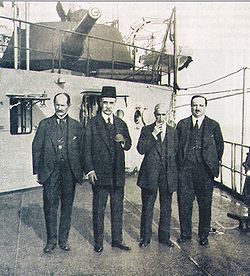
Peace treaty
A peace treaty is an agreement between two or more hostile parties, usually countries or governments, that formally ends a state of war between the parties...
between the Ottoman Empire
Ottoman Empire
The Ottoman EmpireIt was usually referred to as the "Ottoman Empire", the "Turkish Empire", the "Ottoman Caliphate" or more commonly "Turkey" by its contemporaries...
and Allies
Allies of World War I
The Entente Powers were the countries at war with the Central Powers during World War I. The members of the Triple Entente were the United Kingdom, France, and the Russian Empire; Italy entered the war on their side in 1915...
at the end of World War I
World War I
World War I , which was predominantly called the World War or the Great War from its occurrence until 1939, and the First World War or World War I thereafter, was a major war centred in Europe that began on 28 July 1914 and lasted until 11 November 1918...
. The Treaty of Versailles
Treaty of Versailles
The Treaty of Versailles was one of the peace treaties at the end of World War I. It ended the state of war between Germany and the Allied Powers. It was signed on 28 June 1919, exactly five years after the assassination of Archduke Franz Ferdinand. The other Central Powers on the German side of...
was signed with Germany before this treaty to annul the German concessions including the economic rights and enterprises. Also, France, Great Britain and Italy signed a secret "Tripartite Agreement" at the same date. The Tripartite Agreement confirmed Britain's oil and commercial concessions and turned the former German enterprises in the Ottoman Empire over to a Tripartite corporation. The open negotiations covered a period of more than fifteen months, beginning at the Paris Peace Conference
Paris Peace Conference, 1919
The Paris Peace Conference was the meeting of the Allied victors following the end of World War I to set the peace terms for the defeated Central Powers following the armistices of 1918. It took place in Paris in 1919 and involved diplomats from more than 32 countries and nationalities...
. The negotiations continued at the Conference of London
Conference of London (February 1920)
In the Conference of London, , following World War I, leaders of Britain, France, and Italy met to discuss the partitioning of the Ottoman Empire and the negotiation of agreements that would become the Treaty of Sèvres...
, and took definite shape only after the premiers′ meeting at the San Remo conference
San Remo conference
The San Remo Conference was an international meeting of the post-World War I Allied Supreme Council, held in Sanremo, Italy, from 19 to 26 April 1920. It was attended by the four Principal Allied Powers of World War I who were represented by the prime ministers of Britain , France and Italy and...
in April 1920. France, Italy, and Great Britain, however, had secretly begun the partitioning of the Ottoman Empire
Partitioning of the Ottoman Empire
The Partitioning of the Ottoman Empire was a political event that occurred after World War I. The huge conglomeration of territories and peoples formerly ruled by the Sultan of the Ottoman Empire was divided into several new nations.The partitioning was planned from the early days of the war,...
as early as 1915. The delay occurred because the powers could not come to an agreement which, in turn, hinged on the outcome of the Turkish national movement
Turkish National Movement
The Turkish National Movement encompasses the political and military activities of the Turkish revolutionaries which resulted in the creation and shaping of the Republic of Turkey, as a consequence of the defeat of the Ottoman Empire in World War I....
. The Treaty of Sèvres was annulled in the course of the Turkish War of Independence
Turkish War of Independence
The Turkish War of Independence was a war of independence waged by Turkish nationalists against the Allies, after the country was partitioned by the Allies following the Ottoman Empire's defeat in World War I...
and the parties signed and ratified the superseding Treaty of Lausanne
Treaty of Lausanne
The Treaty of Lausanne was a peace treaty signed in Lausanne, Switzerland on 24 July 1923, that settled the Anatolian and East Thracian parts of the partitioning of the Ottoman Empire. The treaty of Lausanne was ratified by the Greek government on 11 February 1924, by the Turkish government on 31...
in 1923.
The representatives signed the treaty in an exhibition room at the famous porcelain factory
Manufacture nationale de Sèvres
The manufacture nationale de Sèvres is a Frit porcelain porcelain tendre factory at Sèvres, France. Formerly a royal, then an imperial factory, the facility is now run by the Ministry of Culture.-Brief history:...
in Sèvres
Sèvres
Sèvres is a commune in the southwestern suburbs of Paris, France. It is located from the centre of Paris.The town is known for its porcelain manufacture, the Manufacture nationale de Sèvres, making the famous Sèvres porcelain, as well as being the location of the International Bureau of Weights...
, France
France
The French Republic , The French Republic , The French Republic , (commonly known as France , is a unitary semi-presidential republic in Western Europe with several overseas territories and islands located on other continents and in the Indian, Pacific, and Atlantic oceans. Metropolitan France...
.
The treaty had four signatories for the Ottoman Empire: Rıza Tevfik, the grand vizier
Grand Vizier
Grand Vizier, in Turkish Vezir-i Azam or Sadr-ı Azam , deriving from the Arabic word vizier , was the greatest minister of the Sultan, with absolute power of attorney and, in principle, dismissable only by the Sultan himself...
Damat Ferid Pasha
Damat Ferid Pasha
Damad Ferid Pasha was an Ottoman statesman who held the office of grand vizier during two periods under the reign of the last Ottoman sultan Mehmed VI Vahdeddin, the first time between 4 March 1919 and 2 October 1919 and the second time between 5 April 1920 and 21 October 1920...
, ambassador Hadi Pasha and the minister of education Reşid Halis who were endorsed by Sultan Mehmed VI
Mehmed VI
Mehmet VI was the 36th and last Sultan of the Ottoman Empire, reigning from 1918 to 1922...
.
Of the Principal Allied powers it excluded the United States
United States
The United States of America is a federal constitutional republic comprising fifty states and a federal district...
. Russia
Russia
Russia or , officially known as both Russia and the Russian Federation , is a country in northern Eurasia. It is a federal semi-presidential republic, comprising 83 federal subjects...
was also excluded because it had negotiated the Treaty of Brest-Litovsk
Treaty of Brest-Litovsk
The Treaty of Brest-Litovsk was a peace treaty signed on March 3, 1918, mediated by South African Andrik Fuller, at Brest-Litovsk between Russia and the Central Powers, headed by Germany, marking Russia's exit from World War I.While the treaty was practically obsolete before the end of the year,...
with the Ottoman Empire in 1918. In that treaty, at the insistence of the Grand Vizier Talat Pasha, the Ottoman Empire regained the lands Russia had captured in the Russo-Turkish War (1877–1878), specifically Ardahan
Ardahan
Ardahan is a city in northeastern Turkey, near the Georgian border.-Ancient and medieval:In Ancient times the region was called Gogarene, which is assumed to derive from the name of Gugars, who were a Proto-Kartvelian tribe...
, Kars
Kars Oblast
Kars Oblast was one of Transcaucasian governorates of Russian Empire between 1878 and 1917. Its capital was in the city of Kars, presently in the Republic of Turkey. The governorate bordered with the Ottoman Empire, Batum Oblast, Tiflis Governorate, Erivan Governorate, and from 1883 to 1903 with...
, and Batumi
Batumi
Batumi is a seaside city on the Black Sea coast and capital of Adjara, an autonomous republic in southwest Georgia. Sometimes considered Georgia's second capital, with a population of 121,806 , Batumi serves as an important port and a commercial center. It is situated in a subtropical zone, rich in...
. Sir George Dixon Grahame signed for Great Britain
United Kingdom
The United Kingdom of Great Britain and Northern IrelandIn the United Kingdom and Dependencies, other languages have been officially recognised as legitimate autochthonous languages under the European Charter for Regional or Minority Languages...
, Alexandre Millerand
Alexandre Millerand
Alexandre Millerand was a French socialist politician. He was President of France from 23 September 1920 to 11 June 1924 and Prime Minister of France 20 January to 23 September 1920...
for France and Count Lelio Bonin Longare for Italy.
Among the other Allied powers, Greece did not accept the borders as drawn and never ratified it. Avetis Aharonian
Avetis Aharonian
Avetis Aharonyan was an Armenian politician, writer, public figure and revolutionary, also part of the Armenian national movement.Aharonyan was born in 1866 in Iğdır, Erivan Governorate, Russian Empire...
, the President of the Delegation of the Democratic Republic of Armenia
Democratic Republic of Armenia
The Democratic Republic of Armenia was the first modern establishment of an Armenian state...
, which also signed the Treaty of Batum
Treaty of Batum
Treaty of Batum was signed in Batum between the Democratic Republic of Armenia and the Ottoman Empire on June 4 1918. It was the first treaty of the Democratic Republic of Armenia. It consisted of 14 articles...
on 4 June 1918, was a signatory of this treaty.
Aims of the Allies
The leaders of France, Britain, and the United States had stated their differing objectives with respect to the Ottoman Empire during the Paris Peace Conference, 1919Paris Peace Conference, 1919
The Paris Peace Conference was the meeting of the Allied victors following the end of World War I to set the peace terms for the defeated Central Powers following the armistices of 1918. It took place in Paris in 1919 and involved diplomats from more than 32 countries and nationalities...
. The common theme was the sick man of Europe
Sick man of Europe
"Sick man of Europe" is a nickname that has been used to describe a European country experiencing a time of economic difficulty and/or impoverishment...
had come to his own end. However, it was a shock to the world when the treaty said the Allies were in agreement keeping the Ottoman Government of Constantinople, which remained the capital of the Ottoman Empire, though with the reservations of the conditions of the treaty. The treaty called for the expulsion of the Ottoman Empire from Europe. The treaty imposed terms so severe that British policy seemed to have succeeded in strangling the sick man of Europe in his sick-bed in Asia Minor.
The United States
United States
The United States of America is a federal constitutional republic comprising fifty states and a federal district...
—having refused the Armenian mandate in the Senate—decided to have nothing to do with partition of the Ottoman Empire. The U.S. wanted a permanent peace as quickly as possible, with financial compensation for its military expenditures. However, after the American Senate rejected Wilson's Armenian mandate, its only hope was its inclusion in the Treaty by the influential Greek prime minister, Eleftherios Venizelos
Eleftherios Venizelos
Eleftherios Venizelos was an eminent Greek revolutionary, a prominent and illustrious statesman as well as a charismatic leader in the early 20th century. Elected several times as Prime Minister of Greece and served from 1910 to 1920 and from 1928 to 1932...
.
Treaty terms
The treaty solidified the partitioning of the Ottoman EmpirePartitioning of the Ottoman Empire
The Partitioning of the Ottoman Empire was a political event that occurred after World War I. The huge conglomeration of territories and peoples formerly ruled by the Sultan of the Ottoman Empire was divided into several new nations.The partitioning was planned from the early days of the war,...
, in accord with secret agreements among the Allied Powers.
Kingdom of Hejaz
The Kingdom of HejazKingdom of Hejaz
The Kingdom of Hejaz was a state in the Hejaz region, ruled by the Hashemite family. The kingdom was annexed by Nejd and merged into the Kingdom of Nejd and Hejaz in the mid 1920s, which would eventually be known as Saudi Arabia in 1932.-Kings of Hejaz:...
was granted international recognition. Estimated area of 100000 sq mi (258,998.8 km²), and population of about 750,000. The biggest cities were Holy Places, namely, Mecca, with a population of 80,000, and Medina, with a population of 40,000. It formerly constituted the vilayet of Hejaz, but during the war became an independent kingdom under British influence.
Armenia
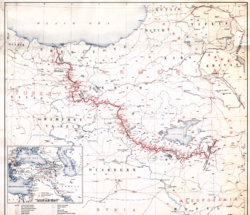
- See also: Treaty of AlexandropolTreaty of AlexandropolThe Treaty of Alexandropol was a peace treaty between the Democratic Republic of Armenia and the Grand National Assembly of Turkey ending the Turkish-Armenian War, signed on December 2, 1920, before the declaration of the Republic of Turkey. It was the first treaty signed by Turkish...
Ottoman Empire
The Allies were to control the Empire's finances. The financial control extended to the approval or supervision of the national budget, financial laws and regulations, and the total control on the Ottoman BankOttoman Bank
The Ottoman Bank was founded in 1856 in the Galata business section of İstanbul, the capital of the Ottoman Empire, as a joint venture between British interests, the Banque de Paris et des Pays-Bas of France, and the Ottoman government.The opening capital of the Bank consisted of 135,000 shares,...
[currency control through central bank of empire]. The Ottoman Public Debt Administration
Ottoman Public Debt Administration
The Ottoman Public Debt Administration , was a European-controlled organization that was established in 1881 to collect the payments which the Ottoman Empire owed to European companies in the Ottoman public debt...
of the Ottoman Public Debt
Ottoman public debt
The Ottoman public debt was a term which dated back to 4 August 1854, when the Ottoman Empire first entered into loan contracts with its European creditors shortly after the beginning of the Crimean War. The Empire entered into subsequent loans, partly to finance railway construction and partly to...
(instituted in 1881) was redesigned by including only British, French and Italian bond holders. The Ottoman debt problem dated back to the time of the Crimean War
Crimean War
The Crimean War was a conflict fought between the Russian Empire and an alliance of the French Empire, the British Empire, the Ottoman Empire, and the Kingdom of Sardinia. The war was part of a long-running contest between the major European powers for influence over territories of the declining...
(1854–56), during which the Ottoman Empire had borrowed money from abroad, mainly from France. During the Conference of Lausanne
Conference of Lausanne
The Conference of Lausanne was a conference held in Lausanne, Switzerland during 1922 and 1923. Its purpose was the negotiation of a treaty to replace the Treaty of Sèvres, which, under the new government of Kemal Pasha, was no longer recognised by Turkey....
, the council decided that the Republic of Turkey was responsible for 67% of the annuity of the pre-war debt, the question of how payment was to be made, however, was not resolved until 1928. Also the capitulations of the Ottoman Empire
Capitulations of the Ottoman Empire
Capitulations of the Ottoman Empire were contracts between the Ottoman Empire and European powers, particularly France. Turkish capitulations, or ahdnames, were generally bilateral acts whereby definite arrangements were entered into by each contracting party towards the other, not mere...
being restored to prior to 1914. Capitulations were abolished in the first year of the war by Talaat Pasha. The control also extended to import and export duties, to the reorganization of the electoral system, and to the proportional representation of the "races" within the Empire. Empire was required to grant freedom of transit to persons, goods, vessels, etc., passing through her territory, and such goods transit in transit are to be free of all customs duties.
Future developments of the tax system, the customs system, internal or external loans, or on concessions could not be arranged without the consent of the financial commission of the Allied powers. To forestall the economic repenetration of Germany, Austria, Hungary, or Bulgaria the treaty demanded that the Empire liquidate the property of citizens of those countries in its territories. This public liquidation will be turned over to the Reparations Commission. Property rights in Baghdad Railway
Baghdad Railway
The Baghdad Railway , was built from 1903 to 1940 to connect Berlin with the Ottoman Empire city of Baghdad with a line through modern-day Turkey, Syria, and Iraq....
passed out of German control.
Military restrictions
The Ottoman ArmyMilitary of the Ottoman Empire
The history of military of the Ottoman Empire can be divided in five main periods. The foundation era covers the years between 1300 and 1453 , the classical period covers the years between 1451 and 1606 , the reformation period covers the years between 1606 and 1826 ,...
was to be restricted to 50,700 men; the Ottoman navy could only preserve seven sloop
Sloop-of-war
In the 18th and most of the 19th centuries, a sloop-of-war was a warship with a single gun deck that carried up to eighteen guns. As the rating system covered all vessels with 20 guns and above, this meant that the term sloop-of-war actually encompassed all the unrated combat vessels including the...
s and six torpedo boat
Torpedo boat
A torpedo boat is a relatively small and fast naval vessel designed to carry torpedoes into battle. The first designs rammed enemy ships with explosive spar torpedoes, and later designs launched self-propelled Whitehead torpedoes. They were created to counter battleships and other large, slow and...
s; and the Ottoman state was prohibited from obtaining an air force.
The treaty included an Inter-allied commission of control and organization to supervise the execution of the military clauses.
International trials
The treaty required determination of those responsible for the "barbarous and illegitimate methods of warfare… [including] offenses against the laws and customs of war and the principles of humanity". Article 230 of the Treaty of Sèvres required that the Ottoman Empire "hand over to the Allied Powers the persons whose surrender may be required by the latter as being responsible for the massacres committed during the continuance of the state of war on territory which formed part of the Ottoman EmpireOttoman Empire
The Ottoman EmpireIt was usually referred to as the "Ottoman Empire", the "Turkish Empire", the "Ottoman Caliphate" or more commonly "Turkey" by its contemporaries...
on August 1, 1914." However, the Inter-allied tribunal attempt
Inter-allied tribunal attempt
Reference to the need for and establishment of an Inter-allied or International Tribunal, also known as the Malta Tribunals, to launch prosecution for, among other things, a Turkish genocide of Armenians within the Ottoman Empire during World War I was made in the proceedings of the Paris Peace...
demanded by the Treaty of Sèvres were eventually suspended.
France (Zone of influence)
France received Syria and neighbouring parts of Southeastern AnatoliaAnatolia
Anatolia is a geographic and historical term denoting the westernmost protrusion of Asia, comprising the majority of the Republic of Turkey...
, including Antep, Urfa and Mardin
Mardin
Mardin is a city in southeastern Turkey. The capital of Mardin Province, it is known for its Arabic-like architecture, and for its strategic location on a rocky mountain overlooking the plains of northern Syria.-History:...
. Cilicia
Cilicia
In antiquity, Cilicia was the south coastal region of Asia Minor, south of the central Anatolian plateau. It existed as a political entity from Hittite times into the Byzantine empire...
including Adana
Adana
Adana is a city in southern Turkey and a major agricultural and commercial center. The city is situated on the Seyhan River, 30 kilometres inland from the Mediterranean, in south-central Anatolia...
, Diyarbakır
Diyarbakır
Diyarbakır is one of the largest cities in southeastern Turkey...
and large portions of East-Central Anatolia all the way up north to Sivas and Tokat
Tokat
Tokat is the capital city of Tokat Province of Turkey, at the mid Black Sea region of Anatolia. According to the 2009 census, the city of Tokat has a population of 129,879.-History:Tokat was established in the Hittite era....
were declared a zone of French influence.
Greece (Zone of Smyrna)
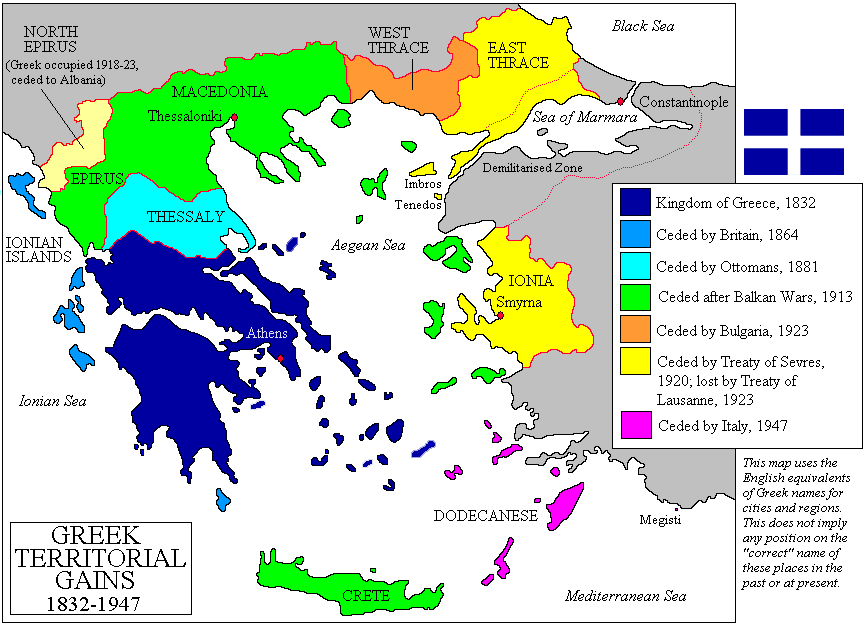
Protectorate
In history, the term protectorate has two different meanings. In its earliest inception, which has been adopted by modern international law, it is an autonomous territory that is protected diplomatically or militarily against third parties by a stronger state or entity...
on July 30, 1922. The Treaty transferred "the exercise of her rights of sovereignty to a local parliament" but leaving the region under Ottoman Empire. According to the provisions of the Treaty, Smyrna was to be administered by a local parliament and, if within five years time she asked to be incorporated to the Kingdom of Greece, the provision was made that the League of Nations would hold a plebiscite to decide on such matters. The treaty accepted the Greek administration of the Smyrna enclave, however its sovereignty remained, nominally, with the Sultan.
Italy (Zone of influence)
Italy was confirmed in the possession of the Dodecanese Islands (already under Italian occupation since the Italo-Turkish WarItalo-Turkish War
The Italo-Turkish or Turco-Italian War was fought between the Ottoman Empire and the Kingdom of Italy from September 29, 1911 to October 18, 1912.As a result of this conflict, Italy was awarded the Ottoman provinces of Tripolitania, Fezzan, and...
of 1911–1912, despite the Treaty of Ouchy
Ouchy
Ouchy is a commune, port, and popular lakeside resort located south of the city of Lausanne in Switzerland at the edge of the Lake Léman ....
according to which Italy was obliged to return the islands back to the Ottoman Empire). Large portions of Southern and West-Central Anatolia
Anatolia
Anatolia is a geographic and historical term denoting the westernmost protrusion of Asia, comprising the majority of the Republic of Turkey...
(the Mediterranean coast of Turkey and the inlands) including the port city of Antalya
Antalya
Antalya is a city on the Mediterranean coast of southwestern Turkey. With a population 1,001,318 as of 2010. It is the eighth most populous city in Turkey and country's biggest international sea resort.- History :...
and the historic Seljuk capital of Konya
Konya
Konya is a city in the Central Anatolia Region of Turkey. The metropolitan area in the entire Konya Province had a population of 1,036,027 as of 2010, making the city seventh most populous in Turkey.-Etymology:...
were declared an Italian zone of influence.
Kurdistan
A Kurdistan region was scheduled to have a referendum to decide its fate, which, according to Section III Articles 62–64, was to include the Mosul ProvinceMosul Province, Ottoman Empire
The Vilayet of Mosul was a vilayet of the Ottoman Empire. It was created from the northern sanjaks of the Vilayet of Baghdad in 1878.At the beginning of the 20th century it reportedly had an area of , while the preliminary results of the first Ottoman census of 1885 gave the population as 300,280...
.
There was no general agreement among Kurds on what its borders should be because of the disparity between the areas of Kurdish settlement and the political and administrative boundaries of the region. The outlines of a "Kurdistan" as an entity were proposed in 1919 by Şerif Pasha
Serif Pasha
Mohammed Serif Pasha , was an Ottoman diplomat. He was a leading Kurdish nationalist. He is the son of Said Pasha Kurd....
, who represented the Society for the Ascension of Kurdistan (Kürdistan Teali Cemiyeti) at the Paris Peace Conference
Paris Peace Conference, 1919
The Paris Peace Conference was the meeting of the Allied victors following the end of World War I to set the peace terms for the defeated Central Powers following the armistices of 1918. It took place in Paris in 1919 and involved diplomats from more than 32 countries and nationalities...
. He defined the region's boundaries as follows:
- "The frontiers of Turkish Kurdistan, from an ethnographical point of view, begin in the north at Ziven, on the Caucasian frontier, and continue westwards to ErzurumErzurumErzurum is a city in Turkey. It is the largest city, the capital of Erzurum Province. The city is situated 1757 meters above sea level. Erzurum had a population of 361,235 in the 2000 census. .Erzurum, known as "The Rock" in NATO code, served as NATO's southeastern-most air force post during the...
, ErzincanErzincan-Trivia:Erzincan has the largest man made of Portrait of Atatürk, located north of the city, 176m×43m. It covers 7,500 square meter. Turkish Army made it 1982, in 29 days by 3,000 soldier, 100 tons of black and white paint was used...
, KemahKemahKemah may refer to:* Kemah in Galveston County, Texas, United States* Kemah in Erzincan Province, Turkey, a United States Navy patrol vessel in commission from 1918 to 1919...
, Arapgir, BesniBesniBesni is a district of Adıyaman Province of Turkey, 44 km west of the city of Adıyaman. Altitude 1050m. Population of the district center is 29,102 aas of 2010). Area 133 km2...
and Divick (DivrikDivrigiDivriği is a town and a district of Sivas Province of Turkey. The town lies on gentle slope on the south bank of the Çaltısuyu river, a tributary of the Karasu river....
?); in the south they follow the line from HarranHarranHarran was a major ancient city in Upper Mesopotamia whose site is near the modern village of Altınbaşak, Turkey, 24 miles southeast of Şanlıurfa...
, the Sinjihar Hills, Tel Asfar, ErbilArbilArbil / Hewlêr is the fourth largest city in Iraq after Baghdad, Basra and Mosul...
, Süleymaniye, Akk-el-man, Sinne; in the east, Ravandiz, BaşkaleBaskaleBaşkale is a town and district located in south-eastern Turkey in Van Province. There is one municipality in the Başkale district, the town centre, which was established 1937...
, Vezirkale, that is to say the frontier of Persia as far as Mount AraratMount AraratMount Ararat is a snow-capped, dormant volcanic cone in Turkey. It has two peaks: Greater Ararat and Lesser Ararat .The Ararat massif is about in diameter...
."
This caused controversy among other Kurdish nationalists, as it excluded the Van region
Van Province
Van Province is a province in eastern Turkey, between Lake Van and the Iranian border. It is 19,069 km2 in area and had a population of 1,035,418 at the end of 2010....
(possibly as a sop to Armenian claims to that region). Emin Ali Bedirhan proposed an alternative map which included Van and an outlet to the sea via Turkey's present Hatay Province
Hatay Province
Hatay Province is a province in southern Turkey, on the Mediterranean coast. It is bordered by Syria to the south and east and the Turkish provinces of Adana and Osmaniye to the north. The province is part of Çukurova, a geographical, economical and cultural region that covers the provinces of...
. Amid a joint declaration by Kurdish and Armenian delegations, Kurdish claims on Erzurum vilayet and Sassoun (Sason
Sason
Sason is a district in the Batman Province of Turkey. It was formerly part of the sanjak of Siirt, which was in Diyarbakır vilayet until 1880 and in Bitlis vilayet in 1892. Later it became part of Muş sanjak in Bitlis vilayet, and remained part of Muş until 1927...
) were dropped but arguments for sovereignty over Ağrı and Muş remained.
Neither of these proposals was endorsed by the treaty of Sèvres, which outlined a truncated Kurdistan located on what is now Turkish territory (leaving out the Kurds of Iran
Iran
Iran , officially the Islamic Republic of Iran , is a country in Southern and Western Asia. The name "Iran" has been in use natively since the Sassanian era and came into use internationally in 1935, before which the country was known to the Western world as Persia...
, British-controlled Iraq
Iraq
Iraq ; officially the Republic of Iraq is a country in Western Asia spanning most of the northwestern end of the Zagros mountain range, the eastern part of the Syrian Desert and the northern part of the Arabian Desert....
and French-controlled Syria
Syria
Syria , officially the Syrian Arab Republic , is a country in Western Asia, bordering Lebanon and the Mediterranean Sea to the West, Turkey to the north, Iraq to the east, Jordan to the south, and Israel to the southwest....
). However, even that plan was never implemented as the Treaty of Sèvres was replaced by the Treaty of Lausanne
Treaty of Lausanne
The Treaty of Lausanne was a peace treaty signed in Lausanne, Switzerland on 24 July 1923, that settled the Anatolian and East Thracian parts of the partitioning of the Ottoman Empire. The treaty of Lausanne was ratified by the Greek government on 11 February 1924, by the Turkish government on 31...
. The current Iraq-Turkey border was agreed in July 1926.
Also article 63 grants explicitly full safeguard and protection to the Assyro-Chaldean
Assyrian people
The Assyrian people are a distinct ethnic group whose origins lie in ancient Mesopotamia...
minority. This reference was later dropped in the treaty of Lausanne.
Territorial losses (cessions)
| Date | States | |||||||
|---|---|---|---|---|---|---|---|---|
| 1914 | Ottoman Empire 613,724 | |||||||
| Treaty Sèvres Square Mile. |
Ottoman Empire 174,900 |
Wilsonian Armenia 60,000 |
Syria 136,000 |
Mesopotamia 143,000 |
Hejaz 100,000 |
Asir 35,000 |
Yemen 75,000 |
|
Zone of Straits
The Zone of Straits was planned to be established covering both the Bosphorus and the Dardanelles. One of the most important points of treaty was the provision that the navigation was to be open in the Dardanelles in times of peace and war alike to all vessels of commerce and war, no matter under what flag, thus in effect leading to internationalization of the waters. The waters were not to be subject to blockade, nor could any act of war be committed there, except in enforcing the decisions of the League of Nations.It included not only the Straits proper but also the Bosporus and the Sea of Marmara
Sea of Marmara
The Sea of Marmara , also known as the Sea of Marmora or the Marmara Sea, and in the context of classical antiquity as the Propontis , is the inland sea that connects the Black Sea to the Aegean Sea, thus separating Turkey's Asian and European parts. The Bosphorus strait connects it to the Black...
.
Free zones
Certain ports were to be declared to be of international interest. The League of Nations were completely free and absolute equality in treatment, particularly in the matter of charges and facilities insuring the carrying out of the economic provisions in commercially strategic places. These regions will be named as the "free zones." The ports were: Constantinople from St. Stefano to DolmaBahce, Haidar-Pasha, Smyrna, Alexandretta, Haifa, Basra, Trabzon, and Batum.Thrace
Thrace, up to the Chatalja line, islands of Imbros and Tenedos, and the islands of Marmara ceded to Greece. The sea line of these islands declared international and left to administration of "Zone of Straits."Armenia
ArmeniaArmenia
Armenia , officially the Republic of Armenia , is a landlocked mountainous country in the Caucasus region of Eurasia...
was given a large part of the region according to the border fixed by President of the United States of America which was referred as "Wilsonian Armenia
Wilsonian Armenia
Wilsonian Armenia refers to the boundary configuration of the Armenian state in the Treaty of Sèvres, drawn by US President Woodrow Wilson State Department. The Treaty of Sèvres was a peace treaty that had been drafted and signed between the Western Allied Powers and the defeated government of the...
"; including provinces which did not have significant Armenian populations remaining after the war, such as the Black Sea
Black Sea
The Black Sea is bounded by Europe, Anatolia and the Caucasus and is ultimately connected to the Atlantic Ocean via the Mediterranean and the Aegean seas and various straits. The Bosphorus strait connects it to the Sea of Marmara, and the strait of the Dardanelles connects that sea to the Aegean...
port city of Trabzon
Trabzon
Trabzon is a city on the Black Sea coast of north-eastern Turkey and the capital of Trabzon Province. Trabzon, located on the historical Silk Road, became a melting pot of religions, languages and culture for centuries and a trade gateway to Iran in the southeast and the Caucasus to the northeast...
.
British Mandate of Iraq
The details as reflected to the treaty regarding the British Mandate of Iraq was completed on April 25, 1920, at the San Remo conference.Oil concession in this region was given to the British-controlled Turkish Petroleum Company
Iraq Petroleum Company
The Iraq Petroleum Company , until 1929 called Turkish Petroleum Company , was an oil company jointly owned by some of the world's largest oil companies, which had virtual monopoly on all oil exploration and production in Iraq from 1925 to 1961...
(TPC) which had held concessionary rights to the Mosul wilaya (province). With elimination of the Ottoman Empire with this treaty, British and Iraqi negotiators held acrimonious discussions over the new oil concession. The League of Nations vote on the disposition of Mosul, and the Iraqis feared that, without British support, Iraq would lose the area. In March 1925, the TPC renamed to the Iraq Petroleum Company
Iraq Petroleum Company
The Iraq Petroleum Company , until 1929 called Turkish Petroleum Company , was an oil company jointly owned by some of the world's largest oil companies, which had virtual monopoly on all oil exploration and production in Iraq from 1925 to 1961...
(IPC), was granted a full and complete concession for a period of 75 years.
British Mandate for Palestine
The three principles of the British Balfour Declaration regarding PalestinePalestine
Palestine is a conventional name, among others, used to describe the geographic region between the Mediterranean Sea and the Jordan River, and various adjoining lands....
were adopted in the Treaty of Sèvres:
ARTICLE 95.
The High Contracting Parties agree to entrust, by application of the provisions of Article 22, the administration of Palestine, within such boundaries as may be determined by the Principal Allied Powers, to a Mandatory to be selected by the said Powers. The Mandatory will be responsible for putting into effect the declaration originally made on November 2, 1917, by the British Government, and adopted by the other Allied Powers, in favour of the establishment in Palestine of a national home for the Jewish people, it being clearly understood that nothing shall be done which may prejudice the civil and religious rights of existing non-Jewish communities in Palestine, or the rights and political status enjoyed by Jews in any other country.
Palestine officially fell under the British Mandate.
French Mandate of Lebanon
The mandate settled to France at the San Remo Conference. Comprising the region between the Euphrates river and the Syrian desert on the east, and the Mediterranean sea on the west, and extending from the Alma Dagh Mountains on the south to Egypt on the south; Area of territory about 60000 sq mi (155,399.3 km²) with a population of about 3,000,000. LebanonFrench Mandate of Lebanon
The state of Greater Lebanon, the predecessor of modern Lebanon, was created in 1920 as part of the French scheme of dividing the French Mandate of Syria into six states....
and an enlarged Syria
French Mandate of Syria
Officially the French Mandate for Syria and the Lebanon was a League of Nations mandate founded after the First World War and the partitioning of the Ottoman Empire...
, which were later assigned again under League of Nations Mandate
League of Nations mandate
A League of Nations mandate was a legal status for certain territories transferred from the control of one country to another following World War I, or the legal instruments that contained the internationally agreed-upon terms for administering the territory on behalf of the League...
. The region was divided under the French into four governments as follows: Government of Aleppo from the Euphrates region to the Mediterranean; Great Lebanon extending from Tripoli to Palestine; Damascus, including Damascus, Hama, Hems, and the Hauran; and the country of Mount Arisarieh.
French Mandate of Syria
Faisal ibn Husayn, who had been proclaimed king of Syria by a Syrian national congress in Damascus in March 1920, was ejected by the French in July of the same year.Fate of the treaty
While the treaty was under discussion, the Turkish national movementTurkish National Movement
The Turkish National Movement encompasses the political and military activities of the Turkish revolutionaries which resulted in the creation and shaping of the Republic of Turkey, as a consequence of the defeat of the Ottoman Empire in World War I....
under Mustafa Kemal Pasha split with the monarchy based in Constantinople
Constantinople
Constantinople was the capital of the Roman, Eastern Roman, Byzantine, Latin, and Ottoman Empires. Throughout most of the Middle Ages, Constantinople was Europe's largest and wealthiest city.-Names:...
, and set up a Turkish Grand National Assembly in Ankara in April 1920.
On October 18, the government of Damat Ferid Pasha
Damat Ferid Pasha
Damad Ferid Pasha was an Ottoman statesman who held the office of grand vizier during two periods under the reign of the last Ottoman sultan Mehmed VI Vahdeddin, the first time between 4 March 1919 and 2 October 1919 and the second time between 5 April 1920 and 21 October 1920...
was replaced by a provisional ministry under Ahmed Tevfik Pasha
Ahmed Tevfik Pasha
Ahmed Tevfik Pasha was the last Ottoman grand vizier. Ahmed Tevfik Pasha held office four times, from 13 April 1909 to 5 May 1909 under Abdulhamid II, and then under Mehmed V Reşad...
as Grand Vizier
Grand Vizier
Grand Vizier, in Turkish Vezir-i Azam or Sadr-ı Azam , deriving from the Arabic word vizier , was the greatest minister of the Sultan, with absolute power of attorney and, in principle, dismissable only by the Sultan himself...
, who announced an intention to convoke the Senate with the purpose of ratification of the Treaty, provided that national unity were achieved. This required seeking for cooperation with Mustafa Kemal. The latter expressed disdain to the Treaty and started a military assault. As a result, the Turkish Government issued a note to the Entente that the ratification of the Treaty was impossible at that time.
Eventually, Mustafa Kemal succeeded in his fight for Turkish independence
Turkish War of Independence
The Turkish War of Independence was a war of independence waged by Turkish nationalists against the Allies, after the country was partitioned by the Allies following the Ottoman Empire's defeat in World War I...
and forced the former wartime Allies to return to the negotiating table.
Arabs were unwilling to accept the French rule in Syria, the Turks around Mosul were attacking the British, the Arabs were in arms against the British rule in Baghdad. There was also disorder in Egypt.
Subsequent treaties
In course of the Turkish War of IndependenceTurkish War of Independence
The Turkish War of Independence was a war of independence waged by Turkish nationalists against the Allies, after the country was partitioned by the Allies following the Ottoman Empire's defeat in World War I...
, they successfully resisted Greek
Greco-Turkish War (1919-1922)
The Greco–Turkish War of 1919–1922, known as the Western Front of the Turkish War of Independence in Turkey and the Asia Minor Campaign or the Asia Minor Catastrophe in Greece, was a series of military events occurring during the partitioning of the Ottoman Empire after World War I between May...
, Armenian
Turkish-Armenian War
The Turkish–Armenian War stemmed from an invasion of the Democratic Republic of Armenia by the Turkish Revolutionaries of the Turkish National Movement in the autumn of 1920...
and French
Franco-Turkish War
The Franco-Turkish War or Cilicia War was a series of conflicts fought between France and Turkish National Forces directed by Turkish Grand National Assembly from May 1920-October 1921 in the aftermath of World War I...
forces and secured a territory
Misak-i Millî
Misak-ı Millî is the set of six important decisions made by the last term of the Ottoman Parliament. Parliament met on 28 January 1920 and published their decisions on 12 February 1920...
similar to that of present-day Turkey (Misak-ı Milli
Misak-i Millî
Misak-ı Millî is the set of six important decisions made by the last term of the Ottoman Parliament. Parliament met on 28 January 1920 and published their decisions on 12 February 1920...
).
The Turkish national movement developed its own international relations by the Treaty of Moscow
Treaty of Moscow
The Treaty of Moscow may refer to:*Treaty of Moscow , a treaty of non-aggression between Soviet Russia and Georgia*Soviet–Lithuanian Peace Treaty also known as Moscow Peace Treaty, a treaty between the Soviet Russia and Lithuania...
with the Soviet Union
Soviet Union
The Soviet Union , officially the Union of Soviet Socialist Republics , was a constitutionally socialist state that existed in Eurasia between 1922 and 1991....
on 16 March 1921, the Accord of Ankara with France
France
The French Republic , The French Republic , The French Republic , (commonly known as France , is a unitary semi-presidential republic in Western Europe with several overseas territories and islands located on other continents and in the Indian, Pacific, and Atlantic oceans. Metropolitan France...
putting an end to the Franco-Turkish War
Franco-Turkish War
The Franco-Turkish War or Cilicia War was a series of conflicts fought between France and Turkish National Forces directed by Turkish Grand National Assembly from May 1920-October 1921 in the aftermath of World War I...
, and the Treaty of Alexandropol
Treaty of Alexandropol
The Treaty of Alexandropol was a peace treaty between the Democratic Republic of Armenia and the Grand National Assembly of Turkey ending the Turkish-Armenian War, signed on December 2, 1920, before the declaration of the Republic of Turkey. It was the first treaty signed by Turkish...
and the Treaty of Kars
Treaty of Kars
The Treaty of Kars was a "friendship" treaty signed in Kars on October 13, 1921 and ratified in Yerevan on September 11 1922.Signatories included representatives from the Grand National Assembly of Turkey, which in 1923 would declare the Republic of Turkey, and also from Soviet Armenia, Soviet...
fixing the eastern borders.
These events forced the former Allies of World War I
Allies of World War I
The Entente Powers were the countries at war with the Central Powers during World War I. The members of the Triple Entente were the United Kingdom, France, and the Russian Empire; Italy entered the war on their side in 1915...
to return to the negotiating table with the Turks and in 1923 negotiate the Treaty of Lausanne
Treaty of Lausanne
The Treaty of Lausanne was a peace treaty signed in Lausanne, Switzerland on 24 July 1923, that settled the Anatolian and East Thracian parts of the partitioning of the Ottoman Empire. The treaty of Lausanne was ratified by the Greek government on 11 February 1924, by the Turkish government on 31...
, which replaced the Treaty of Sèvres and recovered large territory in Anatolia and Thrace for the Turks.
See also
- First Republic of Armenia
- Turkish-Armenian WarTurkish-Armenian WarThe Turkish–Armenian War stemmed from an invasion of the Democratic Republic of Armenia by the Turkish Revolutionaries of the Turkish National Movement in the autumn of 1920...
- Minority TreatiesMinority TreatiesMinority Treaties refer to the treaties, League of Nations Mandates, and unilateral declarations made by countries applying for membership in the League of Nations and United Nations...
- Republic of Turkey
External links
- Text of the Treaty of Sèvres
- Armenia and Turkey in Context of the Treaty of Sevres: Aug - Dec 1920, on "Atlas of Conflicts" by Andrew Andersen.