


Tour de France

Encyclopedia
The Tour de France is an annual bicycle race
held in France
and nearby countries. First staged in 1903, the race covers more than 3600 kilometres (2,236.9 mi) and lasts three weeks. As the best known and most prestigious of cycling's three "Grand Tours"
, the Tour de France attracts riders and teams from around the world. The race is broken into day-long segments, called stages. Individual times to finish each stage are aggregated to determine the overall winner at the end of the race. The rider with the lowest aggregate time at the end of each day wears a yellow jersey
. The course changes every year, but the race has always finished in Paris
. Since 1975, the climax of the final stage has been along the Champs-Élysées
.
The shortest Tour was in 1904 at 2420 kilometres (1,503.7 mi), the longest in 1926 at 5745 kilometres (3,569.8 mi).
The three weeks usually include two rest days, sometimes used to transport riders from a finish in one town to the start in another. The race alternates between clockwise and anticlockwise circuits of France. The first anticlockwise circuit was in 1913. The New York Times
said the "Tour de France is arguably the most physiologically demanding of athletic events." The effort was compared to "running a marathon
several days a week for nearly three weeks", while the total elevation of the climbs was compared to "climbing three Everests."
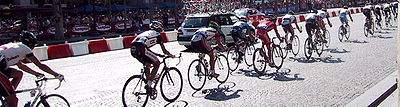 The number of teams usually varies between 20 and 22, with nine riders in each. Entry is by invitation to teams chosen by the race organiser, the Amaury Sport Organisation
. Team members help each other and are followed by managers and mechanics in cars.
Riders are judged by the time each has taken throughout the race, a ranking known as the general classification. There may be time deductions for finishing well in a daily stage or being first to pass an intermediate point. It is possible to win without winning a stage, as Alberto Contador
did in 2010
; this has occurred six other times. There are subsidiary competitions (see below), some with distinctive jerseys for the best rider.
Riders normally start together each day, with the first over the line winning, but some days are ridden against the clock by individuals or teams. The overall winner is usually a master of the mountains and of these time trials. Most stages are in mainland France, although since the 1960s it has become common to visit nearby countries. Stages can be flat, undulating or mountainous. Since 1975 the finish has been on the Champs-Élysées
in Paris; from 1903 to 1967 the race finished at the Parc des Princes
stadium in western Paris and from 1968 to 1974 at the Piste Municipale
south of the capital.
, a cause célèbre
which divided France at the end of the 19th century over the innocence of Alfred Dreyfus
, a soldier convicted – though later exonerated – of selling military secrets to the Germans. Opinions became heated and there were demonstrations by both sides. One was what the historian Eugen Weber
called "an absurd political shindig" at the Auteuil
horse-race course in Paris in 1899. Among those involved was Comte Jules-Albert de Dion, the owner of the De Dion-Bouton
car works, who believed Dreyfus was guilty. De Dion served 15 days in jail and was fined 100 francs for his role at Auteuil, which included striking Émile Loubet
, the president of France, on the head with a walking stick
.
The incident at Auteuil, said Weber, was "tailor-made for the sporting press." The first and the largest daily sports newspaper in France was Le Vélo
, which sold 80,000 copies a day. Its editor, Pierre Giffard
, thought Dreyfus innocent. He reported the arrest in a way that displeased de Dion, who was so angry that he joined other anti-Dreyfusards such as Adolphe Clément
and Édouard Michelin
and opened a rival daily sports paper, L'Auto.
The new newspaper appointed Henri Desgrange
as editor. He was a prominent cyclist and owner with Victor Goddet of the velodrome
at the Parc des Princes
. De Dion knew him through his cycling reputation, through the books and cycling articles that he had written, and through press articles he had written for the Clément tyre company.
. Desgrange had poached him from Giffard's paper. Lefèvre suggested a six-day race of the sort popular on the track but all around France. Long-distance cycle races were a popular means to sell more newspapers, but nothing of the length that Lefèvre suggested had been attempted. If it succeeded, it would help L'Auto match its rival and perhaps put it out of business. It could, as Desgrange said, "nail Giffard's beak shut."
Desgrange and Lefèvre discussed it after lunch. Desgrange was doubtful but the paper's financial director, Victor Goddet, was enthusiastic. He handed Desgrange the keys to the company safe and said: "Take whatever you need." L'Auto announced the race on 19 January 1903.
. The plan was a five-stage race from 31 May to 5 July, starting in Paris and stopping in Lyon, Marseille, Bordeaux and Nantes before returning to Paris. Toulouse was added later to break the long haul across southern France
from the Mediterranean to the Atlantic. Stages would go through the night and finish next afternoon, with rest days before riders set off again. But this proved too daunting and the costs too great for most and only 15 entered. Desgrange had never been wholly convinced and he came close to dropping the idea. Instead, he cut the length to 19 days, changed the dates to 1 July to 19 July, and offered a daily allowance of five francs to any rider in the first 50 who had won less than 200 francs and who had averaged at least 20 km/h on all the stages. That was what a rider would have expected to earn each day had he worked in a factory. He also cut the entry fee from 20 to 10 francs and set the first prize at 12,000 francs and the prize for each day's winner at 3,000 francs. The winner would thereby win six times what most workers earned in a year. That attracted between 60 and 80 entrants – the higher number may have included serious inquiries and some who dropped out – among them not just professionals but amateurs, some unemployed, some simply adventurous.
Desgrange seems not to have forgotten the Dreyfus Affair
that launched his race and raised the passions of his backers. He announced his new race on 1 July 1903 by citing the writer Émile Zola
, whose open letter in which every paragraph started" J'accuse ..." led to Dreyfus's acquittal. Establishing the florid style which he used henceforth, Desgrange wrote:
He continued:
The first Tour de France started almost outside the Café Reveil-Matin at the junction of the Melun and Corbeil roads in the village of Montgeron. It was waved away by the starter, Georges Abran, at 3:16 p.m. on 1 July 1903. L'Auto – which hadn't featured the race on its front page that morning – reported:
Among the competitors were the eventual winner, Maurice Garin
, his well-built rival Hippolyte Aucouturier
, the German favourite Josef Fischer
, and a collection of adventurers including one competing as "Samson".
The race finished on the edge of Paris at Ville d'Avray, outside the Restaurant du Père Auto, before a ceremonial ride into Paris and several laps of the Parc des Princes. Garin dominated the race, winning the first and last two stages, at 25.68 km/h. The last rider, Millocheau, finished 64h 47m 22s behind him.
The leading riders, including the winner Maurice Garin, were disqualified, although it took the Union Vélocipèdique de France until 30 November to make the decision. McGann says the UVF waited so long "well aware of the passions aroused by the race."
Desgrange's opinion of the fighting and cheating showed in the headline of his reaction in L'Auto: THE END. He wrote:
Desgrange's despair did not last. By the following spring he was planning another Tour, longer at 11 stages rather than six -and this time all in daylight to make any cheating more obvious. Stages in 1905 began between 3am and 7:30am.
The race captured the imagination. L'Auto's circulation rose from 25,000 to 65,000; by 1908 it was a quarter of a million, and during the 1923 Tour 500,000. The record claimed by Desgrange was 854,000 during the 1933 Tour. Le Vélo went out of business in 1904.
Desgrange stood against the use of multiple gears and for many years insisted riders use wooden rims, fearing the heat of braking while coming down mountains would melt the glue that held the tyres (they were finally allowed in 1937).
From 1936 there were as many as three stages in a single day.
His dream was a race of individuals. He invited teams but until 1925 forbade their members to pace each other. He then went the other way and from 1927 to 1929 ran the Tour as a giant team time-trial, with teams starting separately with members pacing each other. He demanded that riders mend their bicycles without help and that they use the same bicycle from start to end. Exchanging a damaged bicycle for another was allowed only in 1923.
In 1903, Desgrange allowed riders who dropped out one day to continue the next for daily prizes but not the overall prize. In 1928, he allowed teams who had lost members to replace them halfway through the race.
Above all, Desgrange conducted a campaign against the sponsors, bicycle factories, which he was sure were undermining the spirit of a Tour de France of individuals. In 1930 he insisted that competitors ride plain yellow bicycles that he would provide, without a maker's name.
There was no place for individuals in the post-1930s teams and so Desgrange created regional teams, generally from France, to take in riders who would not otherwise have qualified. The original touriste-routiers mostly disappeared but some were absorbed into regional teams.
team contrived to get Maurice De Waele
to win even though he was sick, he said "My race has been won by a corpse" and in 1930 admitted only teams representing their country or region.
National teams contested the Tour until 1961. The teams were of different sizes. Some nations had more than one team and some were mixed in with others to make up the number. National teams caught the public imagination but had a snag: that riders might normally have been in rival trade teams the rest of the season. The loyalty of riders was sometimes questionable, within and between teams.
The Tour returned to trade teams in 1962, although with further problems. Doping had become a problem and tests were introduced for riders. Riders went on strike near Bordeaux
in 1966 and the organisers suspected sponsors provoked them. The Tour returned to national teams for 1967 and 1968 as "an experiment". The author Geoffrey Nicholson identified a further reason: opposition to closure of roads by a race criticised as crassly commercial. He said:
The Tour returned to trade teams in 1969 with a suggestion that national teams could come back every few years. This never happened.
A succession of doping scandals in the 1960s, culminating in the death of Tom Simpson
in 1967, led the Union Cycliste Internationale
to limit daily and overall distances and to impose rest days. It was then impossible to follow the frontiers, and the Tour increasingly zig-zagged across the country, sometimes with unconnected days' races linked by train, while still maintaining some sort of loop. The modern Tour typically has 21 daily stages and not more than 3500 km (2,174.8 mi). The shortest and longest Tours were 2428 and 5745 km (1,508.7 and 3,569.8 mi) in 1904 and 1926, respectively.
The procession of often colourfully decorated trucks and cars became known as the publicity caravan. It formalised a situation which had already arisen, companies having started to follow the race. The first to sign to precede the Tour was the chocolate company, Menier
, one of those which had followed the race. Its head of publicity, Paul Thévenin, had first put the idea to Desgrange. It paid 50,000 old francs. Preceding the race was more attractive to advertisers because spectators gathered by the road long before the race or could be attracted from their houses. Advertisers following the race found that many who had watched the race had already gone home.
Menier handed out tons of chocolate in that first year of preceding the race, as well as 500,000 policemen's hats printed with the company's name. The success led to the caravan's existence being formalised the following year.
The caravan was at its height between 1930 and the mid-1960s, before television and especially television advertising was established in France. Advertisers competed to attract public attention. Motorcycle acrobats performed for the Cinzano
apéritif company and a toothpaste maker, and an accordionist, Yvette Horner, became one of the most popular sights as she performed on the roof of a Citroën Traction Avant . The modern Tour restricts the excesses to which advertisers are allowed to go but at first anything was allowed. The writer Pierre Bost lamented: "This caravan of 60 gaudy trucks singing across the countryside the virtues of an apéritif, a make of underpants or a dustbin is a shameful spectacle. It bellows, it plays ugly music, it's sad, it's ugly, it smells of vulgarity and money."
Advertisers pay the Société du Tour de France approximately €150,000 to place three vehicles in the caravan. Some have more. On top of that come the more considerable costs of the commercial samples that are thrown to the crowd and the cost of accommodating the drivers and the staff – frequently students – who throw them. The vehicles also have to be decorated on the morning of each stage and, because they must return to ordinary highway standards, disassembled after each stage. Numbers vary but there are normally around 250 vehicles each year. Their order on the road is established by contract, the leading vehicles belonging to the largest sponsors.
The procession sets off two hours before the start and then regroups to precede the riders by an hour and a half. It spreads 20–25 km and takes 40 minutes to pass at between 20 and 60 km/h. Vehicles travel in groups of five. Their position is logged by GPS and from an aircraft and organised on the road by the caravan director – Jean-Pierre Lachaud – an assistant, three motorcyclists, two radio technicians and a breakdown and medical crew. Six motorcyclists from the Garde Républicaine, the élite of the gendarmerie, ride with them.
The advertisers distribute publicity material to the crowd. The number of items has been estimated at 11 million, each person in the procession giving out 3,000 to 5,000 items a day. The bank, GAN, gave out 170,000 caps, 80,000 badges, 60,000 plastic bags and 535,000 copies of its race newspaper in 1994. Together, they weighed 32 tons.
Spectators have died in collisions with the caravan (see below).
and all the stage winners, were disqualified for various reasons including illegal use of cars and trains.
In 1907 Emile Georget
was placed last in the day's results after changing his bicycle outside a permitted area. Edmond Gentil, sponsor of the rival Alcyon
team, withdrew all his riders in protest at what he considered too light a penalty. They included Louis Trousselier, the winner in 1905.
In 1912 and in 1913 Octave Lapize
withdrew all his La Française team in protest at what he saw as the collusion of Belgian riders.
In 1913 as well, Odile Defraye
pulled out of the race with painful legs and took the whole Alcyon team with him.
In 1920 half the field pulled out at Les Sables d'Olonne in protest at Desgrange's style of management.
In 1925 the threat of a strike ended Desgrange's plan that riders should all eat exactly the same amount of food each day.
In 1937 Sylvère Maes
of Belgium withdrew all his national team after he considered his French rival, Roger Lapébie
, had been punished too lightly for being towed uphill by car.
In 1950 the two Italian teams went home after the leader of the first team, Gino Bartali
, thought a spectator had threatened him with a knife.
In 1950 much of the field got off their bikes and ran into the Mediterranean at Ste-Maxime. The summer had been unusually hot and some riders were said to have ridden into the sea without dismounting. All involved were penalised by the judges.
In 1966 riders went on strike near Bordeaux after drug tests the previous evening.
In 1968 journalists went on strike for a day after Félix Lévitan had accused them of watching "with tired eyes", his response to the writers' complaint that the race was dull.
In 1978 they rode slowly all day and then walked across the line at Valence d'Agen in protest at having to get up early to ride more than one stage in a day.
In 1982 striking steel workers halted the team time trial.
In 1987 photographers went on strike, saying cars carrying the Tour's guests were getting in their way.
In 1988 the race went on strike in a protest concerning a drugs test on Pedro Delgado
.
In 1990 the organisers learned of a blockade by farmers in the Limoges area and diverted the race before it got there.
In 1991 riders refused to race for 40 minutes because a rider, Urs Zimmerman, was penalised for driving from one stage finish to the start of the next instead of flying.
In 1991 the PDM team went home after its riders fell ill one by one within 48 hours.
In 1992 activists of the Basque separatist movement bombed followers' cars overnight.
In 1997 Belgian sprinter Tom Steels
was expelled from the race for throwing his drinking bottle at another rider in a bunch sprint at Marennes
.
In 1998
:
In 1999 demonstrating firemen stopped the race and pelted it with stink bombs.
In 2006 Floyd Landis
was stripped of his title after testing positive
for synthetic testosterone.
In 2007
:
In 2008 Riccardo Ricco was kicked out of the race after testing positive for CERA
In 2008 Moisés Dueñas Nevado was kicked out of the race after testing positive for Erythropoietin
In 2008 Manuel Beltrán was kicked out of the race after testing positive for EPO
In 2010 lead out man Mark Renshaw
(HTC-Columbia) was disqualified after using his head to move another rider, Julian Dean
, as well as his blocking of Garmin-Transitions rider Tyler Farrar
.
In 2011 Alexandr Kolobnev
left the race after testing positive for hydrochlorothiazide
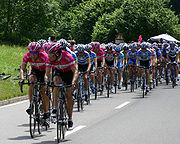 The first organiser was Henri Desgrange, although daily running of the 1903 race was by Lefèvre. He followed riders by train and bicycle. In 1936 Desgrange had a prostate operation. At the time, two operations were needed; the Tour de France was due to fall between them. Desgrange persuaded his surgeon to let him follow the race. The second day proved too much and, in a fever at Charleville
, he retired to his château at Beauvallon. Desgrange died at home on the Mediterranean coast on 16 August 1940. The race was taken over by his deputy, Jacques Goddet
.
War interrupted the Tour. The German Propaganda Staffel wanted it to be run and offered facilities otherwise denied, in the hope of maintaining a sense of normality. They offered to open the borders between German-occupied France in the north and nominally independent Vichy France
in the south but Goddet refused.
 In 1944, L'Auto was closed – its doors nailed shut – and its belongings, including the Tour, sequestrated by the state for publishing articles too close to the Germans. Rights to the Tour were therefore owned by the government. Jacques Goddet was allowed to publish another daily sports paper, L'Équipe, but there was a rival candidate to run the Tour: a consortium of Sports and Miroir Sprint. Each organised a candidate race. L'Équipe and Le Parisien Libéré had La Course du Tour de France and Sports and Miroir Sprint had La Ronde de France. Both were five stages, the longest the government would allow because of shortages. L'Équipes race was better organised and appealed more to the public because it featured national teams which had been successful before the war, when French cycling was at a high. L'Équipe was given the right to organise the 1947 Tour de France
.
L'Équipes finances were never sound and Goddet accepted an advance by Émilion Amaury, who had supported his bid to run the post-war Tour. Amaury was a newspaper magnate whose condition was that his sports editor, Félix Lévitan
should join Goddet for the Tour. The two worked together, Goddet running the sporting side and Lévitan the financial.
Lévitan began to recruit sponsors, sometimes accepting prizes in kind if he could not get cash. He introduced the finish of the Tour at the Avenue des Champs-Élysées
in 1975. He left the Tour on 17 March 1987 after losses by the Tour of America, in which he was involved. The claim was that it had been cross-financed by the Tour de France. Lévitan insisted he was innocent but the lock to his office was changed and his job was over. Goddet retired the following year. They were replaced in 1988 by Jean-Pierre Courcol, the director of L'Équipe, then in 1989 by Jean-Pierre Carenso and then by Jean-Marie Leblanc
, who in 1989 had been race director. The former television presenter Christian Prudhomme
– he commentated on the Tour among other events – replaced Leblanc in 2005, having been assistant director for two years.
Current race director Prudhomme works for the Société du Tour de France, a subsidiary of Amaury Sport Organisation
(ASO), which since 1993 has been part of the media group Amaury Group that owns L'Équipe. It employs around 70 people full time, in an office facing but not connected to L'Équipe in the Issy-les-Moulineaux
area of outer western Paris. That number expands to about 220 during the race itself, not including 500 contractors employed to move barriers, erect stages, signpost the route and other work.
, territory annexed by the German Empire
in 1871 after the Franco-Prussian War
. Passage was secured through a meeting at Metz
between Desgrange's collaborator, Alphonse Steinès, and the German governor. The race passed to the waving of local people, the race director Victor Breyer wrote, but not without trouble at the border. L'Auto reported the difference between the German and French border controls:
The Germans let not only the competitors pass without problem but all the officials and their cars and the amateur enthusiasts who rode with them. "It is distressing," L'Auto said, "to find that it's only the French who can't grasp the simple idea ... of allowing the best representatives of French energy [to cross the border]." The paper offered to start a public appeal to provide better clothes for its frontier officials.
No teams from Italy, Germany or Spain rode in 1939 because of tensions preceding the Second World War. Henri Desgrange planned a Tour for 1940, after war had started but before France had been invaded. The route, approved by military authorities, included a route along the Maginot Line
. Teams would have been drawn from military units in France, including the British, who would have been organised by a journalist, Bill Mills. Then the Germans invaded and the race was not held again until 1947 (see Tour de France during the Second World War
). The first German team after the war was in 1960, although individual Germans had ridden in mixed teams. The Tour has since started in Germany three times: in Cologne in 1965, in Frankfurt in 1980 and in West Berlin on the city's 750th anniversary in 1987. Plans to enter East Germany
that year were abandoned.
.
Jean-Marie Leblanc, when he was organiser, said the island had never asked for a stage start there. It would be difficult to find accommodation for 4,000 people, he said. The spokesman of the Corsican nationalist party Party of the Corsican Nation, François Alfonsi
, said: "The organisers must be afraid of terrorist attacks [attentats]. If they are really thinking of a possible terrorist action, they are wrong. Our movement, which is nationalist and in favour of self-government [autonomiste] would be delighted if the Tour came to Corsica.".
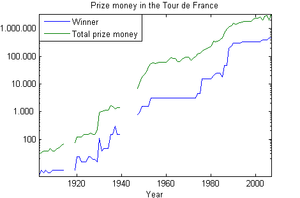 Prize money has always been awarded. From 20,000 old francs
the first year,
prize money has increased each year, although from 1976 to 1987 the first prize was an apartment offered by a race sponsor. The first prize in 1988 was a car, a studio-apartment, a work of art and 500,000 francs in cash. Prizes only in cash returned in 1990.
Prizes and bonuses are awarded for daily placings and final placings at the end of the race. In 2009, the winner received €450,000, while each of the 21 stage winners won €8,000 (€10,000 for the team time-trial stage). The winners of the points classification and mountains classification each win €25,000, the young rider competition and the combativity prize €20,000, and €50,000 for the winner of the team classification
(calculated by adding the cumulative times of the best three riders in each team).
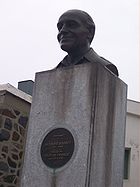
The Souvenir Henri Desgrange
, in memory of the founder of the Tour, is awarded to the first rider over the col du Galibier where his monument stands, or to the first rider over the highest col in the Tour. In 2008 it was awarded for traversing the col de la Bonette
. A similar award is made at the summit of the col du Tourmalet, at the memorial to Jacques Goddet, Desgrange's successor.
has yellow, green, and polka-dot jerseys with the same meaning as the Tour. The Giro d'Italia
differs in awarding the leader a pink jersey, being organised by La Gazzetta dello Sport
, which has pink pages.
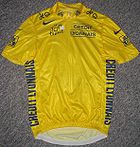
 The yellow jersey (maillot jaune) is worn by the general classification
leader. This is decided by totalling the time each rider takes on the daily stages. The rider with the lowest overall time at the end of each stage receives a ceremonial yellow bicycling jersey and the right to start the next stage of the Tour, usually the next day, in the yellow jersey.
The rider to receive the yellow jersey after the last stage in Paris, is the overall winner of the Tour.
The winner of the first Tour wore not a yellow jersey but a green armband. The yellow was first awarded formally to Eugène Christophe
, for the stage from Grenoble
on 19 July 1919. However, at the age of 67 the Belgian rider Philippe Thys
(who won in 1913, 1914 and 1920) recalled in the Belgian magazine Champions et Vedettes that he was awarded a yellow jersey in 1913 when Henri Desgrange
asked him to wear a coloured jersey. Thys declined, saying making himself more visible would encourage others to ride against him. He said:
He spoke of the next year, when "I won the first stage and was beaten by a tyre by Bossus in the second. On the following stage, the yellow jersey passed to Georget after a crash." The Tour historian Jacques Augendre called Thys "a valorous rider ... well-known for his intelligence" and said his claim "seems free from all suspicion". But: "No newspaper mentions a yellow jersey before the war. Being at a loss for witnesses, we can't solve this enigma."
The first rider to wear the yellow jersey from start to finish was Ottavio Bottecchia
of Italy in 1924. Nicolas Frantz
(1928) and Romain Maes
(1935) are the only two other riders who have done the same. The first company to pay a daily prize to the wearer of the yellow jersey – known as the "rent" – was a wool company, Sofil, in 1948. The greatest number of riders to wear the yellow jersey in a day is three: Nicolas Frantz
, André Leducq
and Victor Fontan
shared equal time for a day in 1929 and there was no rule to split them.
One rider has won seven times:
Four riders have won five times:
Four riders have won three times:
Seven riders have won the Tour de France and the Giro d'Italia
in the same year:
The youngest Tour de France winner was Henri Cornet
, aged 19 in 1904
. Next youngest was Romain Maes
, 21 in 1935
. The oldest winner was Firmin Lambot
, aged 36 in 1922
. Next oldest were Henri Pélissier
(1923
), Gino Bartali
(1948
), and Cadel Evans
(2011
), all 34. Gino Bartali
holds the longest time span between titles, having earned his first and last Tour victories 10 years apart (in 1938 and 1948).
Riders from France have won most (36), followed by Belgium (18), Spain (13), the United States (10), Italy (9), Luxembourg (4), Switzerlandand the Netherlands (2 each) and Australia, Denmark, Germany and Ireland (1 each).
See also List of Tour de France winners
 The green jersey (maillot vert) is given to the leader of the points classification. At the end of each stage, points are earned by the riders who finish first, second, etc. More points are given for flat stages and fewer for mountain stages. The points competition began in 1953, to mark the 50th anniversary. It was called the Grand Prix du Cinquentenaire and was won by Fritz Schaer
of Switzerland. The first sponsor was La Belle Jardinière. The current sponsor is Pari Mutuel Urbain, a state betting company. Currently, the points classification is calculated by adding up the points collected in the stage and subtracting penalty points. Points are rewarded for a high finishing position in a stage or at an intermediate sprint.
In case of a tie, the leader is determined by the number of stage wins, then the number of intermediate sprint victories, and finally, the rider's standing in the general classification.
One rider has won the points competition six times:
One rider has won the points competition four times:
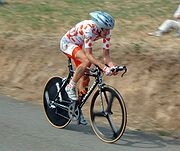
 The King of the Mountains
wears a white jersey with red dots (maillot à pois rouges), inspired by a jersey that one of the organisers, Félix Lévitan, had seen at the Vélodrome d'Hiver
in Paris in his youth. The competition gives points to the first to top designated hills and mountains.
The best climber was first recognised in 1933, prizes were given from 1934, and the jersey was introduced in 1975. The first to wear the mountain jersey was Lucien Van Impe
, who earned the honour en route to his third mountains title.
The first Tour de France included one mountain pass – the Ballon d'Alsace
in the Vosges
– but several lesser cols. The first was the col des Echarmeaux, on the opening stage from Paris to Lyon, on what is now the old road from Autun to Lyon. The stage from Lyon to Marseille included the col de la République, also known as the col du Grand Bois, at the edge of St-Etienne. True mountains, however, were not included until the Pyrenees
in 1910
. In that year the race rode, or more walked, first the col d'Aubisque
and then the nearby Tourmalet. Desgrange once more stayed away. Both climbs were mule tracks, a demanding challenge on heavy, ungeared bikes ridden by men with spare tyres around their shoulders and their food, clothing and tools in bags hung from their handlebars. The assistant organiser, Victor Breyer, stood at the summit of the Aubisque with the colleague who had proposed including the Pyrenees, Alphonse Steinès. Breyer wrote of the first man to reach them:
Desgrange was confident enough after the Pyrenees to include the Alps
in 1911.
The highest climb in the race was the Col Agnel
in the 2011 Tour de France
, reaching 2744 m. The highest mountain finish in the Tour was at the Col du Galibier
in the 2011 edition
.
The difficulty of a climb is established by its steepness, length and its position on the course. The easiest are graded 4, most of the hardest as 1 and the exceptional (such as the Tourmalet) as beyond classification, or hors catégorie
. Notable hors catégorie peaks include the Col du Tourmalet
, Mont Ventoux
, Col du Galibier
, the climb to the ski resort of Hautacam
, and Alpe d'Huez
. In 2011, the attributed points were changed:
Climbs rated "hors catégorie
" (HC): 20, 16, 12, 8, 4 and 2 points awarded for first 6 riders to reach the summit.
Category 1: 10, 8, 6, 4, 2 and 1 points awarded for first 6 riders to reach the summit.
Category 2: 5, 3, 2 and 1 points awarded for first 4 riders to reach the summit.
Category 3: 2 and 1 points awarded for first 2 riders to reach the summit.
Category 4: 1 points awarded for first rider to reach the summit.
Points awarded are doubled for finishes that are of category two or above.
One rider has been King of the Mountains seven times:
Two riders have been King of the Mountains six times:
 Between 1975 and 1989, and since 2000, there has been a competition for young riders. The rider aged under 26 who places highest in the GC gets to wear a white jersey (le maillot blanc).
Since the young rider classification was introduced in 1975, it has been won by 29 different cyclists. Of those, five cyclists also won the general classification during their careers (Fignon, LeMond, Pantani, Ullrich and Contador). On three occasions a cyclist has won the young rider classification and the general classification in the same year — Fignon in 1983, Ullrich in 1997 and Contador in 2007.
Two riders have won three times:
goes to the rider who most animates the day, usually by trying to break clear of the field. The most combative rider wears a number printed white-on-red instead of black-on-white next day. An award goes to the most aggressive rider throughout the Tour. Already in 1908 a sort of combativity award was offered, when Sports Populaires and L'Education Physique created Le Prix du Courage, 100 francs and a silver gilt medal for "the rider having finished the course, even if unplaced, who is particularly distinguished for the energy he has used." The modern competition started in 1958. In 1959, a Super Combativity award for the most combative cyclist of the Tour was awarded. It was initially not rewarded every year, but since 1981 it has been given annually.
The team classification
is assessed by adding the time of each team's best three riders each day. The competition does not have its own jersey but since 2006 the leading team has worn numbers printed black-on-yellow. Until 1990, the leading team would wear yellow caps. The best national teams are France and Belgium, with 10 wins each. From 1973 up to 1988, there was also a team classification based on points (stage classification); members of the leading team would wear green caps.
, which from 1984 awarded a red jersey for points awarded to the first three to pass intermediate points during the stage. These sprints also scored points towards the points classification and bonuses towards the general classification. The intermediate sprints classification with its red jersey was abolished in 1989, but the intermediate sprints have remained, offering points for the points classification and, until 2007, time bonuses for the general classification.
From 1968 there was a combination classification, scored on a points system based on standings in the general, points and mountains classifications. The design was originally white, then a patchwork with areas resembling each individual jersey design. This was also abolished in 1989.
and in past years sometimes carried a small red light beneath his saddle
. Such was sympathy that he could command higher fees in the races that previously followed the Tour. In 1939 and 1948 the organisers excluded the last rider every day, to encourage more competitive racing.
Riders are permitted to touch, but not push or nudge, each other. The first to cross the line wins. On flat stages or stages with low hills, which generally predominate in the first week, this leads to spectacular mass sprints.
All riders in a group finish in the same time as the lead rider. This avoids dangerous mass sprints. It is not unusual for the entire field to finish in a group, taking time to cross the line but being credited with the same time. Since 2005, when riders fall or crash within the final 3 kilometres of a stage with a flat finish, they are awarded the same time as the group they were in. This change encourages riders to sprint to the finish for points awards without fear of losing time to the group. The final kilometre has been indicated since 1906 by a red triangle – the flamme rouge – above the road.
Time bonuses for the first three at intermediate sprints and stage finishes were discontinued with the 2008 race.
Stages in the mountains often cause major shifts in the general classification. On ordinary stages, most riders can stay in the peloton to the finish; during mountain stages, it is not uncommon for riders to lose 30 minutes or to be eliminated after finishing outside the time limit.
The first photo-finish was in 1955.
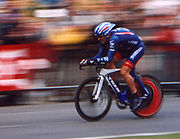 Riders in a time trial compete individually against the clock, each starting at a different time. The first time trial was between La Roche-sur-Yon and Nantes (80 km) in 1934. The first stage in modern Tours is often a short trial, a prologue, to decide who wears yellow on the opening day. The first prologue was in 1967. The 1988 event, at La Baule, was called "la préface".
There are usually two or three time trials. One may be a team time trial
. The final time trial has sometimes been the final stage, more recently often the penultimate stage.
The launch ramp, a sloping start pad for riders, was first used in 1965, at Cologne.
(TTT) is a race against the clock in which each team rides alone. The time is that of the fifth rider of each team: riders more than a bike-length behind their team's fifth rider are awarded their own times. The TTT has been criticised for favouring strong teams and handicapping strong riders in weak teams. After a four-year absence, the TTT returned in 2009
but was not included in 2010. It was reintroduced into the 2011 Tour.
The prologue stage in 1971
was a team time trial. The 1939
TTT crossed the Iseran mountain pass between Bonneval and Bourg-St-Maurice.
 The race has finished since 1975 with laps of the Champs-Élysées. This stage rarely challenges the leader because it is flat and the leader usually has too much time in hand to be denied. But in 1987, Pedro Delgado
broke away on the Champs to challenge the 40-second lead held by Stephen Roche
. He and Roche finished in the peloton and Roche won the Tour.
In 1989 the last stage was a time trial. Greg LeMond
overtook Laurent Fignon
to win by eight seconds, the closest margin in the Tour's history.
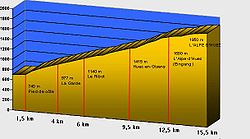
The climb of Alpe d'Huez
is a favourite, providing a stage in most Tours. In 2004, a time trial ended at Alpe d'Huez. Riders complained about abusive spectators and the stage may not be repeated. Mont Ventoux is often claimed to be the hardest in the Tour because of the harsh conditions. Another notable mountain stage frequently featured during the Tour climbs the Col du Tourmalet. Col du Galibier
is the most visited mountain in the Tour. The 2011 Tour de France
stage to Galibier marked the 100th anniversary of the mountain in the Tour and also boasted the highest finish altitude ever: 2,645 m. Some mountain stages have become memorable because of the weather. An example is a stage in 1996 Tour de France
from Val-d'Isère to Sestriere
. A snowstorm at the start area led to a shortening of the stage from 190 to just 46 km.
To host a stage start or finish brings prestige and business to a town. The prologue and first stage are particularly prestigious. Usually one town will host the prologue (too short to go between towns) and the start of stage 1. In 2007 director Christian Prudhomme
said that "in general, for a period of five years we have the Tour start outside France three times and within France twice."
The first time papers other than L'Auto were allowed was 1921, when 15 press cars were allowed for regional and foreign reporters.
The Tour was shown first on cinema newsreels a day or more after the event. The first live radio broadcast was in 1929, when Jean Antoine and Alex Virot of the newspaper L'Intransigeant broadcast for Radio Cité. They used telephone lines. In 1932 they broadcast the sound of riders crossing the col d'Aubisque in the Pyrenees on 12 July, using a recording machine and transmitting the sound later.
The first television pictures were shown a day after a stage. The national TV channel used two 16mm cameras, a Jeep and a motorbike. Film was flown or taken by train to Paris. It was edited there and shown the following day.
The first live broadcast, and the second of any sport in France, was the finish at the Parc des Princes in Paris on 25 July 1948. Rik van Steenbergen
of Belgium led in the bunch after a stage of 340 km from Nancy. The first live coverage from the side of the road was from the Aubisque on 8 July 1958. Proposals to cover the whole race were abandoned in 1962 after objections from regional newspapers which feared the competition. The dispute was settled but not in time and the first complete coverage was the following year.
The leading television commentator in France was a former rider, Robert Chapatte
. At first he was the only commentator. He was joined in following seasons by an analyst for the mountain stages and by a commentator following the competitors by motorcycle.
Broadcasting in France was largely a state monopoly until 1982, when the socialist president François Mitterrand
allowed private broadcasters and denationalised the leading television channel. Competition between channels raised the broadcasting fees paid to the organisers from 1.5 per cent of the race budget in 1960 to more than a third by the end of the century. Broadcasting time also increased as channels competed to secure the rights. The two largest channels to stay in public ownership, Antenne 2 and FR3, combined to offer more coverage than its private rival, Télévision France. The two stations, renamed France 2 and France 3, still hold the domestic rights and provide pictures for broadcasters around the world.
The stations use a staff of 300 with four helicopters, two aircraft, two motorcycles, 35 other vehicles including trucks, and 20 podium cameras.
Domestic television covers the most important stages of the Tour, such as those in the mountains, from midmorning until early evening. Coverage typically starts with a survey of the day's route, interviews along the road, discussions of the difficulties and tactics ahead, and a 30-minute archive feature. The biggest stages are shown live from start to end, followed by interviews with riders and others and features such an edited version of the stage seen from beside a team manager following and advising riders from his car.
Radio covers the race in updates throughout the day, particularly on the national news channel, France-Info, and some stations provide continuous commentary on long wave.
The combination of unprecedented rigorous doping controls and almost no positive tests helped restore fans' confidence in the 2009 Tour de France. This led directly to an increase in global popularity of the event. The most watched stage of 2009 was stage 20, from Montélimar to Mont Ventoux in Provence, with a global total audience of 44 million, making it the 12th most watched sporting event in the world in 2009.
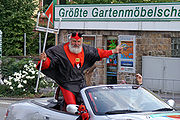 The Tour is important for fans in Europe. Millions line the route, some having camped a week to get the best view. The journalist Pierre Chany
wrote:
 The Tour de France appealed from the start not just for the distance and its demands but because it played to a wish for national unity, a call to what Maurice Barrès
called the France "of earth and deaths" or what Georges Vigarello called "the image of a France united by its earth."
The image had been started by the 1877 travel/school book Le Tour de la France par deux enfants
.A school book written by Augustine Fouillée under the name G. Bruno and published in 1877, it sold six million by 1900, seven million by 1914 and 8,400,000 by 1976. It was used in schools until the 1950s and is still available. It told of two boys, André and Julien, who "in a thick September fog left the town of Phalsbourg in Lorraine
to see France at a time when few people had gone far beyond their nearest town."
The book sold six million copies by the time of the first Tour de France, the biggest selling book of 19th century France (other than the Bible). It stimulated a national interest in France, making it "visible and alive", as its preface said. There had already been a car race called the Tour de France but it was the publicity behind the cycling race, and Desgrange's drive to educate and improve the population, that inspired the French to know more of their country.
The academic historians Jean-Luc Boeuf and Yves Léonard say most people in France had little idea of the shape of their country until L'Auto began publishing maps of the race. They wrote:
Eugen Weber, in the foreword to Tour de France: 1903–2003 says:
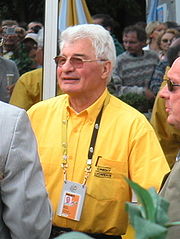 The Tour de France has also given the language a word for a popular but persistent loser. Raymond Poulidor
never won the Tour de France but was more popular than his rival, Jacques Anquetil
, who won five times and unfailingly beat him. Poulidor is now associated with bad luck or a hard life, as an article by Jacques Marseille showed in Le Figaro when it was headlined "This country is suffering from a Poulidor Complex".
had a hit with Tour de France
in 1983 – described as a minimalistic "melding of man and machine" – and produced an album, Tour de France Soundtracks
in 2003, the centenary of the Tour.
In films, the Tour was background for Cinq Tulipes Rouges (1949) by Jean Stelli, in which five riders are murdered. La Course en Tête (1974) followed Eddy Merckx and was selected for the Cannes Film Festival
. A burlesque in 1967, Les Cracks by Alex Joffé, with Bourvil et Monique Tarbès, also featured him. Patrick Le Gall made Chacun son Tour (1996). The comedy, Le Vélo de Ghislain Lambert (2001), featured the Tour of 1974.
In 2005, three films chronicled a team. The German Höllentour, translated as Hell on Wheels, recorded 2003 from the perspective of Team Telekom. The film was directed by Pepe Danquart, who won an Academy Award for live-action short film in 1993 for Black Rider (Schwarzfahrer). The Danish film Overcoming by Tómas Gislason recorded the 2004 Tour from the perspective of Team CSC
.
Wired to Win : Surviving the Tour de France chronicles Française des Jeux riders Baden Cooke
and Jimmy Caspar in 2003. By following their quest for the points classification, won by Cooke, the film looks at the working of the brain. The film, made for IMAX theaters, appeared in December 2005. It was directed by Bayley Silleck, who was nominated for an Academy Award for documentary short subject in 1996 for Cosmic Voyage
.
A fan, Scott Coady, followed the 2000 Tour with a handheld video camera to make The Tour Baby!, which raised $160,000 to benefit the Lance Armstrong Foundation
, and made a 2005 sequel,Tour Baby Deux!.
Vive Le Tour by Louis Malle
is an 18-minute short of 1962. The 1965 Tour was filmed by Claude Lelouch in Pour un Maillot Jaune. This 30-minute documentary has no narration and relies on sights and sounds of the Tour.
In fiction, the 2001 animated feature Les Triplettes de Belleville (The Triplets of Belleville) ties into the Tour de France.
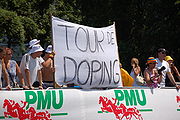 Allegations of doping have plagued the Tour almost since 1903. Early riders consumed alcohol
and used ether
, to dull the pain. Over the years they began to increase performance and the Union Cycliste Internationale
and governments enacted policies to combat the practice.
In 1924, Henri Pélissier
and his brother Charles
told the journalist Albert Londres
they used strychnine
, cocaine
, chloroform
, aspirin
, "horse ointment" and other drugs. The story was published in Le Petit Parisien
under the title Les Forçats de la Route ('The Convicts of the Road')
On 13 July 1967, British cyclist Tom Simpson
died climbing Mont Ventoux
after taking amphetamine
. In 1998, the "Tour of Shame", Willy Voet
, soigneur for the Festina
team, was arrested with erythropoietin
(EPO), growth hormone
s, testosterone
and amphetamine. Police raided team hotels and found products in possession of TVM
. Riders went on strike. After mediation by director Jean-Marie Leblanc
, police limited their tactics and riders continued. Some riders had abandoned and only 96 finished the race. It became clear in a trial that management and health officials of the Festina team had organised the doping.
Further measures were introduced by race organisers and the UCI
, including more frequent testing and tests for blood doping
(transfusions
and EPO
use). This would lead the UCI to becoming a particularly interested party in an International Olympic Committee
initiative, the World Anti-Doping Agency
(WADA), created in 1999. In 2002, the wife of Raimondas Rumšas
, third in the 2002 Tour de France
, was arrested after EPO
and anabolic steroids were found in her car. Rumšas, who had not failed a test, was not penalised. In 2004, Philippe Gaumont
said doping was endemic to his Cofidis
team. Fellow Cofidis rider David Millar
confessed to EPO
after his home was raided. In the same year, Jesus Manzano
, a rider with the Kelme team, alleged he had been forced by his team to use banned substances.
Doping controversy has surrounded Lance Armstrong
, although he has never been formally accused of doping. In August 2005, one month after Armstrong's seventh consecutive victory, L'Équipe published documents it said showed Armstrong had used EPO in the 1999 race. At the same Tour, Armstrong's urine showed traces of a glucocorticosteroid hormone, although below the positive threshold. He said he had used skin cream containing triamcinolone
to treat saddle sores
. Armstrong said he had received permission from the UCI to use this cream.
The 2006 Tour
had been plagued by the Operación Puerto doping case
before it began, favourites such as Jan Ullrich
and Ivan Basso
banned by their teams a day before the start. Seventeen riders were implicated. American rider Floyd Landis
, who finished the Tour as holder of the overall lead, had tested positive for testosterone
after he won stage 17, but this was not confirmed until some two weeks after the race finished. On 30 June 2008 Landis lost his appeal to the Court of Arbitration for Sport
, and Óscar Pereiro was named as winner.
On 24 May 2007, Erik Zabel
admitted using EPO during the first week of the 1996 Tour, when he won the points classification. Following his plea that other cyclists admit to drugs, former winner Bjarne Riis
admitted in Copenhagen
on 25 May 2007 that he used EPO regularly from 1993 to 1998, including when he won the 1996 Tour. His admission meant the top three in 1996 were all linked to doping, two admitting cheating.
On 24 July 2007 Alexander Vinokourov
tested positive for a blood transfusion (blood doping
) after winning a time trial, prompting his Astana team to pull out and police to raid the team's hotel. Next day
Cristian Moreni
tested positive for testosterone
. His Cofidis team pulled out.
The same day, leader Michael Rasmussen
was removed for "violating internal team rules" by missing random tests on 9 May and 28 June. Rasmussen claimed to have been in Mexico. The Italian journalist Davide Cassani
told Danish television he had seen Rasmussen in Italy. The alleged lying prompted his firing by Rabobank.
On 11 July 2008 Manuel Beltrán
tested positive for EPO after the first stage.
On 17 July 2008, Ricardo Riccò tested positive for continuous erythropoiesis receptor activator
, a variant of EPO, after the fourth stage.
In October 2008, it was revealed that Ricco's teammate and Stage 10 winner Leonardo Piepoli
, as well as Stefan Schumacher
– who won both time trials – and Bernhard Kohl
– third on general classification and King of the Mountains – had tested positive.
After winning the 2010 Tour de France
, it was announced that Alberto Contador
had tested positive for low levels of clenbuterol
on the 21 July rest day. On 26 January 2011, the Spanish Cycling Federation proposed a 1 year ban, but reversed its ruling on 15 February and cleared Contador to race. Despite a pending appeal by the UCI
, Contador finished 5th overall in the 2011 Tour de France
.
Another seven fatal accidents have occurred:
, won the combination classification, combativity award, the points competition, and the Tour in the same year – Eddy Merckx
in 1969, which was also the first year he participated.
The most appearances have been by Joop Zoetemelk
and George Hincapie
with 16. Five riders, Lucien Van Impe
(one Tour win), Guy Nulens, Christophe Moreau
, Viatcheslav Ekimov
and Stuart O'Grady
have made 15 appearances; Van Impe and Ekimov finished all 15 whereas Nulens and O'Grady abandoned twice. Hincapie holds the mark for most consecutive finishes with fifteen, having completed all but his very first.
René Pottier
, Roger Lapébie
, Sylvère Maes
and Fausto Coppi
all won the Tour de France the last time they started the race.
Twice the Tour was won by a racer who never wore the yellow jersey until the race was over. In 1947, Jean Robic
overturned a three minute deficit on a 257 km final stage into Paris. In 1968, Jan Janssen
of the Netherlands secured his win in the individual time trial on the last day.
The Tour has been won three times by racers who lead the general classification on the first stage and holding the lead all the way to Paris. Maurice Garin
did it during the Tour's very first edition, 1903; he repeated the feat the next year, but the results were nullified by the officials as a response to widespread cheating. Ottavio Bottechia completed a GC start-to-finish sweep in 1924. And in 1928, Nicolas Frantz held the GC for the entire race, and at the end, the podium consisted solely of members of his racing team. While no one has equalled this feat since '28, four times a racer has taken over the GC lead on the second stage and carried that lead all the way to Paris.
In the early years of the Tour, cyclists rode individually, and were sometimes forbidden to ride together. This led to large gaps between the winner and the number two. Since the cyclists now tend to stay together in a peloton
, the margins of the winner have become smaller, as the difference usually originates from time trials, breakaways or on mountain top finishes, or from being left behind the peloton. In the table below, the ten smallest margins between the winner and the second placed cyclists at the end of the Tour are given. The largest margin, by comparison, remains that of the first Tour in 1903: 2h 49m 45s between Maurice Garin and Lucien Pothier
. The nine smallest margins between first and second placed riders are as follows:
Three riders have won 8 stages in a single year: (1930
, in addition to seven 2nd places) (1970
, 1974
) (1976
, in addition to four 2nd and two 3rd places)
1903: 25.7,
1905: 27.1,
1910: 29.1,
1919: 24.1,
1925: 24.8,
1930: 28.0,
1935: 30.7,
1939: 32.0,
1947: 31.4,
1950: 32.7,
1955: 34.4,
1960: 37.2,
1965: 35.9,
1970: 35.6,
1975: 34.9,
1980: 35.1,
1985: 36.2,
1990: 38.6,
1995: 39.2,
2000: 39.6,
2005: 41.5,
2010: 39.6.
Min.: 1919 Tour de France
, max.: 2005 Tour de France
.
at 50.4 km/h. The fastest full-length time-trial is David Zabriskie
's opening stage of 2005, Fromentine – Noirmoutier-en-l'Ile (19 km) at 54.7 km/h. Chris Boardman
rode faster during the 1994 prologue stage, Lille-Euralille (7.2 km), with 55.2 km/h. The fastest stage win was by the 2005 Discovery Channel team in a team time-trial. It completed the 67.5 km between Tours and Blois at 57.3 km/h.
Fastest climb of Alpe d'Huez
: Marco Pantani
in 1997 Tour de France
by 23.1 km/h.
in the 1947 Tour de France
. In the stage Carcassone-Luchon, he stayed away for 253 km. It was one of seven breakaways longer than 200 km, the last being Thierry Marie
's 234 km escape in 1991. Bourlon finished 16 m 30s ahead. This is one of the biggest time gaps but not the greatest. That record belongs to José-Luis Viejo, who beat the peloton by 22 m 50s in the 1976 stage Montgenèvre-Manosque. He was the fourth and most recent rider to win a stage by more than 20 minutes.
:Category:Tour de France by year
Bicycle racing
Bicycle racing is a competition sport in which various types of bicycles are used. There are several categories of bicycle racing including road bicycle racing, cyclo-cross, mountain bike racing, track cycling, BMX, bike trials, and cycle speedway. Bicycle racing is recognised as an Olympic sport...
held in France
France
The French Republic , The French Republic , The French Republic , (commonly known as France , is a unitary semi-presidential republic in Western Europe with several overseas territories and islands located on other continents and in the Indian, Pacific, and Atlantic oceans. Metropolitan France...
and nearby countries. First staged in 1903, the race covers more than 3600 kilometres (2,236.9 mi) and lasts three weeks. As the best known and most prestigious of cycling's three "Grand Tours"
Grand Tour (cycling)
In road bicycle racing, a Grand Tour refers to one of the three major European professional cycling stage races:* Tour de France – Tour of France , held in July* Giro d'Italia – Tour of Italy , held in May...
, the Tour de France attracts riders and teams from around the world. The race is broken into day-long segments, called stages. Individual times to finish each stage are aggregated to determine the overall winner at the end of the race. The rider with the lowest aggregate time at the end of each day wears a yellow jersey
Yellow jersey
The general classification in the Tour de France is the most important classification, the one by which the winner of the Tour de France is determined. Since 1919, the leader of the general classification wears the yellow jersey .-History:...
. The course changes every year, but the race has always finished in Paris
Paris
Paris is the capital and largest city in France, situated on the river Seine, in northern France, at the heart of the Île-de-France region...
. Since 1975, the climax of the final stage has been along the Champs-Élysées
Champs-Élysées
The Avenue des Champs-Élysées is a prestigious avenue in Paris, France. With its cinemas, cafés, luxury specialty shops and clipped horse-chestnut trees, the Avenue des Champs-Élysées is one of the most famous streets and one of the most expensive strip of real estate in the world. The name is...
.
Description
The tour typically has 21 days of racing and covers 3200 kilometres (1,988.4 mi).The shortest Tour was in 1904 at 2420 kilometres (1,503.7 mi), the longest in 1926 at 5745 kilometres (3,569.8 mi).
The three weeks usually include two rest days, sometimes used to transport riders from a finish in one town to the start in another. The race alternates between clockwise and anticlockwise circuits of France. The first anticlockwise circuit was in 1913. The New York Times
The New York Times
The New York Times is an American daily newspaper founded and continuously published in New York City since 1851. The New York Times has won 106 Pulitzer Prizes, the most of any news organization...
said the "Tour de France is arguably the most physiologically demanding of athletic events." The effort was compared to "running a marathon
Marathon
The marathon is a long-distance running event with an official distance of 42.195 kilometres , that is usually run as a road race...
several days a week for nearly three weeks", while the total elevation of the climbs was compared to "climbing three Everests."
Amaury Sport Organisation
The Amaury Sport Organisation is part of the French media group, EPA . It organises sporting events including the Tour de France and Paris–Nice professional cycle road races, and the Dakar Rally...
. Team members help each other and are followed by managers and mechanics in cars.
Riders are judged by the time each has taken throughout the race, a ranking known as the general classification. There may be time deductions for finishing well in a daily stage or being first to pass an intermediate point. It is possible to win without winning a stage, as Alberto Contador
Alberto Contador
Alberto Contador Velasco is a Spanish professional road bicycle racer for UCI ProTeam . He was the winner of the 2007 Tour de France with the team. With the Astana team he has won the 2008 Giro d'Italia, the 2008 Vuelta a España, the 2009 Tour de France, the 2010 Tour de France and won 2011 Giro...
did in 2010
2010 Tour de France
The 2010 Tour de France was the 97th edition of the Tour de France cycle race, one of cycling's Grand Tours. It started on with an 8.9 km prologue time trial in Rotterdam, the first start in the Netherlands since 1996...
; this has occurred six other times. There are subsidiary competitions (see below), some with distinctive jerseys for the best rider.
Riders normally start together each day, with the first over the line winning, but some days are ridden against the clock by individuals or teams. The overall winner is usually a master of the mountains and of these time trials. Most stages are in mainland France, although since the 1960s it has become common to visit nearby countries. Stages can be flat, undulating or mountainous. Since 1975 the finish has been on the Champs-Élysées
Champs-Élysées
The Avenue des Champs-Élysées is a prestigious avenue in Paris, France. With its cinemas, cafés, luxury specialty shops and clipped horse-chestnut trees, the Avenue des Champs-Élysées is one of the most famous streets and one of the most expensive strip of real estate in the world. The name is...
in Paris; from 1903 to 1967 the race finished at the Parc des Princes
Parc des Princes
The Parc des Princes is an all-seater football stadium located in the southwest of Paris, France. The venue, with a seating capacity of 48,712 spectators, has been the home of French football club Paris Saint-Germain since 1974. The current Parc des Princes was inaugurated on 4 June 1972, endowed...
stadium in western Paris and from 1968 to 1974 at the Piste Municipale
Vélodrome de Vincennes
The Vélodrome de Vincennes is a stadium in Vincennes, near Paris, France.Initially built as a velodrome in 1894, it became the main stadium for the 1900 Summer Olympics; Events that took place in the Velodrome at the 1900 Summer Olympics included cycling, cricket, rugby union, football and...
south of the capital.
Origins
The roots of the Tour de France can be traced to the Dreyfus AffairDreyfus Affair
The Dreyfus affair was a political scandal that divided France in the 1890s and the early 1900s. It involved the conviction for treason in November 1894 of Captain Alfred Dreyfus, a young French artillery officer of Alsatian Jewish descent...
, a cause célèbre
Cause célèbre
A is an issue or incident arousing widespread controversy, outside campaigning and heated public debate. The term is particularly used in connection with celebrated legal cases. It is a French phrase in common English use...
which divided France at the end of the 19th century over the innocence of Alfred Dreyfus
Alfred Dreyfus
Alfred Dreyfus was a French artillery officer of Jewish background whose trial and conviction in 1894 on charges of treason became one of the most tense political dramas in modern French and European history...
, a soldier convicted – though later exonerated – of selling military secrets to the Germans. Opinions became heated and there were demonstrations by both sides. One was what the historian Eugen Weber
Eugen Weber
Eugen Joseph Weber was a Romanian-born American historian with a special focus on Western Civilization and the Western Tradition....
called "an absurd political shindig" at the Auteuil
Auteuil-Neuilly-Passy
Auteuil and Passy are part of the 16th arrondissement of Paris. They are located near the Bois de Boulogne and the suburb of Neuilly-sur-Seine too....
horse-race course in Paris in 1899. Among those involved was Comte Jules-Albert de Dion, the owner of the De Dion-Bouton
De Dion-Bouton
De Dion-Bouton was a French automobile manufacturer and railcar manufacturer operating from 1883 to 1932. The company was founded by the Marquis Jules-Albert de Dion, Georges Bouton and his brother-in-law Charles Trépardoux....
car works, who believed Dreyfus was guilty. De Dion served 15 days in jail and was fined 100 francs for his role at Auteuil, which included striking Émile Loubet
Émile Loubet
Émile François Loubet was a French politician and the 8th President of France.-Early life:He was born the son of a peasant proprietor and mayor of Marsanne . Admitted to the Parisian bar in 1862, he took his doctorate in law the next year...
, the president of France, on the head with a walking stick
Walking stick
A walking stick is a device used by many people to facilitate balancing while walking.Walking sticks come in many shapes and sizes, and can be sought by collectors. Some kinds of walking stick may be used by people with disabilities as a crutch...
.
The incident at Auteuil, said Weber, was "tailor-made for the sporting press." The first and the largest daily sports newspaper in France was Le Vélo
Le Vélo
-External links:*...
, which sold 80,000 copies a day. Its editor, Pierre Giffard
Pierre Giffard
Pierre Giffard was a French journalist, a pioneer of modern political reporting, a newspaper publisher and a prolific sports organiser...
, thought Dreyfus innocent. He reported the arrest in a way that displeased de Dion, who was so angry that he joined other anti-Dreyfusards such as Adolphe Clément
Adolphe Clément
Gustave Adolphe Clément-Bayard was a French entrepreneur...
and Édouard Michelin
Edouard Michelin
Édouard Michelin was a French industrialist. He was born in Clermont-Ferrand, France. Édouard and his elder brother André served as co-directors of the Michelin company....
and opened a rival daily sports paper, L'Auto.
The new newspaper appointed Henri Desgrange
Henri Desgrange
Henri Desgrange was a French bicycle racer and sports journalist. He set 12 world track cycling records, including the hour record of 35.325 kilometres on 11 May 1893. He was the first organiser of the Tour de France.-Origins:Henri Desgrange was one of two brothers, twins...
as editor. He was a prominent cyclist and owner with Victor Goddet of the velodrome
Velodrome
A velodrome is an arena for track cycling. Modern velodromes feature steeply banked oval tracks, consisting of two 180-degree circular bends connected by two straights...
at the Parc des Princes
Parc des Princes
The Parc des Princes is an all-seater football stadium located in the southwest of Paris, France. The venue, with a seating capacity of 48,712 spectators, has been the home of French football club Paris Saint-Germain since 1974. The current Parc des Princes was inaugurated on 4 June 1972, endowed...
. De Dion knew him through his cycling reputation, through the books and cycling articles that he had written, and through press articles he had written for the Clément tyre company.
Birth
L'Auto was not the success its backers wanted. Stagnating sales lower than the rival it was intended to surpass led to a crisis meeting on 20 November 1902 on the middle floor of L'Autos office at 10 Rue du Faubourg Montmartre, Paris. The last to speak was the most junior there, the chief cycling journalist, a 26-year-old named Géo LefèvreGéo Lefèvre
Géo Lefèvre was a French sports journalist and the originator of the idea for the Tour de France.He suggested the idea for the Tour at a meeting with Henri Desgrange, editor of the daily newspaper L'Auto as a way to boost circulation. Desgrange recruited Lefèvre from the rival daily sports paper,...
. Desgrange had poached him from Giffard's paper. Lefèvre suggested a six-day race of the sort popular on the track but all around France. Long-distance cycle races were a popular means to sell more newspapers, but nothing of the length that Lefèvre suggested had been attempted. If it succeeded, it would help L'Auto match its rival and perhaps put it out of business. It could, as Desgrange said, "nail Giffard's beak shut."
Desgrange and Lefèvre discussed it after lunch. Desgrange was doubtful but the paper's financial director, Victor Goddet, was enthusiastic. He handed Desgrange the keys to the company safe and said: "Take whatever you need." L'Auto announced the race on 19 January 1903.
First Tour de France
The first Tour de France was staged in 19031903 Tour de France
The 1903 Tour de France was the first Tour de France, a cycling race set up and sponsored by the newspaper , ancestor of the current daily, . It ran from 1 July to 19 July in six stages over , and was won by Maurice Garin....
. The plan was a five-stage race from 31 May to 5 July, starting in Paris and stopping in Lyon, Marseille, Bordeaux and Nantes before returning to Paris. Toulouse was added later to break the long haul across southern France
Southern France
Southern France , colloquially known as le Midi is defined geographical area consisting of the regions of France that border the Atlantic Ocean south of the Gironde, Spain, the Mediterranean, and Italy...
from the Mediterranean to the Atlantic. Stages would go through the night and finish next afternoon, with rest days before riders set off again. But this proved too daunting and the costs too great for most and only 15 entered. Desgrange had never been wholly convinced and he came close to dropping the idea. Instead, he cut the length to 19 days, changed the dates to 1 July to 19 July, and offered a daily allowance of five francs to any rider in the first 50 who had won less than 200 francs and who had averaged at least 20 km/h on all the stages. That was what a rider would have expected to earn each day had he worked in a factory. He also cut the entry fee from 20 to 10 francs and set the first prize at 12,000 francs and the prize for each day's winner at 3,000 francs. The winner would thereby win six times what most workers earned in a year. That attracted between 60 and 80 entrants – the higher number may have included serious inquiries and some who dropped out – among them not just professionals but amateurs, some unemployed, some simply adventurous.
Desgrange seems not to have forgotten the Dreyfus Affair
Dreyfus Affair
The Dreyfus affair was a political scandal that divided France in the 1890s and the early 1900s. It involved the conviction for treason in November 1894 of Captain Alfred Dreyfus, a young French artillery officer of Alsatian Jewish descent...
that launched his race and raised the passions of his backers. He announced his new race on 1 July 1903 by citing the writer Émile Zola
Émile Zola
Émile François Zola was a French writer, the most important exemplar of the literary school of naturalism and an important contributor to the development of theatrical naturalism...
, whose open letter in which every paragraph started" J'accuse ..." led to Dreyfus's acquittal. Establishing the florid style which he used henceforth, Desgrange wrote:
He continued:
The first Tour de France started almost outside the Café Reveil-Matin at the junction of the Melun and Corbeil roads in the village of Montgeron. It was waved away by the starter, Georges Abran, at 3:16 p.m. on 1 July 1903. L'Auto – which hadn't featured the race on its front page that morning – reported:
Among the competitors were the eventual winner, Maurice Garin
Maurice Garin
Maurice-Francois Garin was a road bicycle racer best known for winning the inaugural Tour de France in 1903, and for being stripped of his title in the second Tour in 1904 along with eight others, for cheating.-Origins:Garin was born the son of Maurice Clément Garin and Maria Teresa...
, his well-built rival Hippolyte Aucouturier
Hippolyte Aucouturier
Hippolyte Aucouturier was a French professional road bicycle racer. Aucouturier, a professional between 1900 and 1908, won two stages at the first Tour de France in 1903 and won three stages and finished second in the 1905 Tour de France. He also won Paris–Roubaix twice, in 1903 and 1904...
, the German favourite Josef Fischer
Josef Fischer (cyclist)
Josef Fischer was a German road bicycle racer. He is best known for winning the first edition of Paris–Roubaix in 1896 and Bordeaux–Paris in 1900.- Major achievements :189618991900...
, and a collection of adventurers including one competing as "Samson".
The race finished on the edge of Paris at Ville d'Avray, outside the Restaurant du Père Auto, before a ceremonial ride into Paris and several laps of the Parc des Princes. Garin dominated the race, winning the first and last two stages, at 25.68 km/h. The last rider, Millocheau, finished 64h 47m 22s behind him.
'Last' Tour
Such was the passion that the first Tour created in spectators and riders that Desgrange said the second would be the last. Cheating was rife and riders were beaten up by rival fans as they neared the top of the col de la République, sometimes called the col du Grand Bois, outside St-Étienne. The historian Bill McGann said:The leading riders, including the winner Maurice Garin, were disqualified, although it took the Union Vélocipèdique de France until 30 November to make the decision. McGann says the UVF waited so long "well aware of the passions aroused by the race."
Desgrange's opinion of the fighting and cheating showed in the headline of his reaction in L'Auto: THE END. He wrote:
Desgrange's despair did not last. By the following spring he was planning another Tour, longer at 11 stages rather than six -and this time all in daylight to make any cheating more obvious. Stages in 1905 began between 3am and 7:30am.
The race captured the imagination. L'Auto's circulation rose from 25,000 to 65,000; by 1908 it was a quarter of a million, and during the 1923 Tour 500,000. The record claimed by Desgrange was 854,000 during the 1933 Tour. Le Vélo went out of business in 1904.
Early rules
Desgrange and his Tour invented bicycle stage racing. Desgrange experimented with judging by elapsed time and then from 1906 to 1912 by points for placings each day. He allowed riders to have personal pacers on the last stage in 1903 and on the first and last stages in 1905.Desgrange stood against the use of multiple gears and for many years insisted riders use wooden rims, fearing the heat of braking while coming down mountains would melt the glue that held the tyres (they were finally allowed in 1937).
From 1936 there were as many as three stages in a single day.
His dream was a race of individuals. He invited teams but until 1925 forbade their members to pace each other. He then went the other way and from 1927 to 1929 ran the Tour as a giant team time-trial, with teams starting separately with members pacing each other. He demanded that riders mend their bicycles without help and that they use the same bicycle from start to end. Exchanging a damaged bicycle for another was allowed only in 1923.
In 1903, Desgrange allowed riders who dropped out one day to continue the next for daily prizes but not the overall prize. In 1928, he allowed teams who had lost members to replace them halfway through the race.
Above all, Desgrange conducted a campaign against the sponsors, bicycle factories, which he was sure were undermining the spirit of a Tour de France of individuals. In 1930 he insisted that competitors ride plain yellow bicycles that he would provide, without a maker's name.
Touriste-routiers and regionals
The first Tours were open to whoever wanted to compete. Most riders were in teams which looked after them. The private entrants were called touriste-routiers – tourists of the road – from 1923 and were allowed to take part provided they make no demands on the organisers. Some of the Tour's most colourful characters have been touriste-routiers. One finished each day's race and then performed acrobatic tricks in the street to raise the price of a hotel.There was no place for individuals in the post-1930s teams and so Desgrange created regional teams, generally from France, to take in riders who would not otherwise have qualified. The original touriste-routiers mostly disappeared but some were absorbed into regional teams.
National teams
The first Tours were for individuals and members of sponsored teams. There were two classes of race, one for the aces, the other for the rest, with different rules. By the end of the 1920s, however, Desgrange believed he could not beat what he believed were the underhand tactics of bike factories. When the AlcyonAlcyon
The Alcyon was a French bicycle, automobile and motorcycle manufacturer between 1890 and 1957.- Origins :Alcyon originated from about 1890 when Edmond Gentil started the manufacture of bicycles in Neuilly, Seine. In 1902, this was complemented by motorcycle production and in 1906, the first cars...
team contrived to get Maurice De Waele
Maurice De Waele
Maurice De Waele was a Belgian professional road bicycle racer.De Waele placed 2nd in the 1927 Tour, an hour and fifty eight minutes Nicolas Frantz and 3rd in 1928, again won by Frantz. However, he is most famous for winning the 1929 Tour de France...
to win even though he was sick, he said "My race has been won by a corpse" and in 1930 admitted only teams representing their country or region.
National teams contested the Tour until 1961. The teams were of different sizes. Some nations had more than one team and some were mixed in with others to make up the number. National teams caught the public imagination but had a snag: that riders might normally have been in rival trade teams the rest of the season. The loyalty of riders was sometimes questionable, within and between teams.
Return of trade teams
Riders in national teams wore the colours of their country and a small cloth panel on their chest that named the team for which they normally rode. Sponsors were always unhappy about releasing their riders into anonymity for the biggest race of the year and the situation became critical at the start of the 1960s. Sales of bicycles had fallen and bicycle factories were closing. There was a risk, the trade said, that the industry would die if factories were not allowed the publicity of the Tour de France.The Tour returned to trade teams in 1962, although with further problems. Doping had become a problem and tests were introduced for riders. Riders went on strike near Bordeaux
Bordeaux
Bordeaux is a port city on the Garonne River in the Gironde department in southwestern France.The Bordeaux-Arcachon-Libourne metropolitan area, has a population of 1,010,000 and constitutes the sixth-largest urban area in France. It is the capital of the Aquitaine region, as well as the prefecture...
in 1966 and the organisers suspected sponsors provoked them. The Tour returned to national teams for 1967 and 1968 as "an experiment". The author Geoffrey Nicholson identified a further reason: opposition to closure of roads by a race criticised as crassly commercial. He said:
The Tour returned to trade teams in 1969 with a suggestion that national teams could come back every few years. This never happened.
Distances
The Tour originally ran around the perimeter of France. Cycling was an endurance sport and the organisers realised the sales they would achieve by creating supermen of their competitors. Night riding was dropped after the second Tour in 1904, when there had been persistent cheating when judges could not see riders. That reduced the daily and overall distance but the emphasis remained on endurance. Desgrange said his ideal race would be so hard that only one rider would make it to Paris.A succession of doping scandals in the 1960s, culminating in the death of Tom Simpson
Tom Simpson
Tom Simpson was the most successful English road racing cyclist of the post-war years. He infamously died of exhaustion on the slopes of Mont Ventoux during the 13th stage of the Tour de France in 1967...
in 1967, led the Union Cycliste Internationale
Union Cycliste Internationale
Union Cycliste Internationale is the world governing body for sports cycling and oversees international competitive cycling events. The UCI is based in Aigle, Switzerland....
to limit daily and overall distances and to impose rest days. It was then impossible to follow the frontiers, and the Tour increasingly zig-zagged across the country, sometimes with unconnected days' races linked by train, while still maintaining some sort of loop. The modern Tour typically has 21 daily stages and not more than 3500 km (2,174.8 mi). The shortest and longest Tours were 2428 and 5745 km (1,508.7 and 3,569.8 mi) in 1904 and 1926, respectively.
Advertising caravan
The Tour changed in 1930 to a competition largely between teams representing their countries rather than the companies which sponsored them. The costs of accommodating riders fell to the organisers instead of the sponsors and Henri Desgrange raised the money by allowing advertisers to precede the race.The procession of often colourfully decorated trucks and cars became known as the publicity caravan. It formalised a situation which had already arisen, companies having started to follow the race. The first to sign to precede the Tour was the chocolate company, Menier
Menier Chocolate
The Menier Chocolate company was a chocolate manufacturing business founded in 1816 as a pharmaceutical manufacturer in Paris, France at a time when chocolate was used as a medicinal product and was only one part of the overall business....
, one of those which had followed the race. Its head of publicity, Paul Thévenin, had first put the idea to Desgrange. It paid 50,000 old francs. Preceding the race was more attractive to advertisers because spectators gathered by the road long before the race or could be attracted from their houses. Advertisers following the race found that many who had watched the race had already gone home.
Menier handed out tons of chocolate in that first year of preceding the race, as well as 500,000 policemen's hats printed with the company's name. The success led to the caravan's existence being formalised the following year.
The caravan was at its height between 1930 and the mid-1960s, before television and especially television advertising was established in France. Advertisers competed to attract public attention. Motorcycle acrobats performed for the Cinzano
Cinzano
Cinzano is an Italian brand of vermouth, a brand owned since 1999 by Gruppo Campari. It comes in four versions:*Cinzano Rosso, which is amber-coloured;*Cinzano Bianco, which is white and drier than Rosso, yet still considered a sweet vermouth;...
apéritif company and a toothpaste maker, and an accordionist, Yvette Horner, became one of the most popular sights as she performed on the roof of a Citroën Traction Avant . The modern Tour restricts the excesses to which advertisers are allowed to go but at first anything was allowed. The writer Pierre Bost lamented: "This caravan of 60 gaudy trucks singing across the countryside the virtues of an apéritif, a make of underpants or a dustbin is a shameful spectacle. It bellows, it plays ugly music, it's sad, it's ugly, it smells of vulgarity and money."
Advertisers pay the Société du Tour de France approximately €150,000 to place three vehicles in the caravan. Some have more. On top of that come the more considerable costs of the commercial samples that are thrown to the crowd and the cost of accommodating the drivers and the staff – frequently students – who throw them. The vehicles also have to be decorated on the morning of each stage and, because they must return to ordinary highway standards, disassembled after each stage. Numbers vary but there are normally around 250 vehicles each year. Their order on the road is established by contract, the leading vehicles belonging to the largest sponsors.
The procession sets off two hours before the start and then regroups to precede the riders by an hour and a half. It spreads 20–25 km and takes 40 minutes to pass at between 20 and 60 km/h. Vehicles travel in groups of five. Their position is logged by GPS and from an aircraft and organised on the road by the caravan director – Jean-Pierre Lachaud – an assistant, three motorcyclists, two radio technicians and a breakdown and medical crew. Six motorcyclists from the Garde Républicaine, the élite of the gendarmerie, ride with them.
The advertisers distribute publicity material to the crowd. The number of items has been estimated at 11 million, each person in the procession giving out 3,000 to 5,000 items a day. The bank, GAN, gave out 170,000 caps, 80,000 badges, 60,000 plastic bags and 535,000 copies of its race newspaper in 1994. Together, they weighed 32 tons.
Spectators have died in collisions with the caravan (see below).
Strikes, exclusions and disqualifications
In 1904 twelve riders, including winner Maurice GarinMaurice Garin
Maurice-Francois Garin was a road bicycle racer best known for winning the inaugural Tour de France in 1903, and for being stripped of his title in the second Tour in 1904 along with eight others, for cheating.-Origins:Garin was born the son of Maurice Clément Garin and Maria Teresa...
and all the stage winners, were disqualified for various reasons including illegal use of cars and trains.
In 1907 Emile Georget
Émile Georget
Émile Georget was a French road racing cyclist. Born in Bossay-sur-Claise, he was the younger brother of cyclist Léon Georget.He died at Châtellerault.- Tour de France :...
was placed last in the day's results after changing his bicycle outside a permitted area. Edmond Gentil, sponsor of the rival Alcyon
Alcyon
The Alcyon was a French bicycle, automobile and motorcycle manufacturer between 1890 and 1957.- Origins :Alcyon originated from about 1890 when Edmond Gentil started the manufacture of bicycles in Neuilly, Seine. In 1902, this was complemented by motorcycle production and in 1906, the first cars...
team, withdrew all his riders in protest at what he considered too light a penalty. They included Louis Trousselier, the winner in 1905.
In 1912 and in 1913 Octave Lapize
Octave Lapize
Octave Lapize was a French professional road racing cyclist and track cyclist.Most famous for winning the 1910 Tour de France and a bronze medal at the 1908 Summer Olympics in the men's 100 kilometres, he was a three-time winner of one-day classics, Paris–Roubaix and Paris–Brussels.In his first...
withdrew all his La Française team in protest at what he saw as the collusion of Belgian riders.
In 1913 as well, Odile Defraye
Odile Defraye
Odile Defraye was a Belgian road racing cyclist who won three stages and the overall title of the 1912 Tour de France, which was the last tour decided by a points system instead of overall best time...
pulled out of the race with painful legs and took the whole Alcyon team with him.
In 1920 half the field pulled out at Les Sables d'Olonne in protest at Desgrange's style of management.
In 1925 the threat of a strike ended Desgrange's plan that riders should all eat exactly the same amount of food each day.
In 1937 Sylvère Maes
Sylvère Maes
Sylvère Maes was a Belgian cyclist, who is most famous for winning the Tour de France in 1936 and 1939.- Palmarès :1932...
of Belgium withdrew all his national team after he considered his French rival, Roger Lapébie
Roger Lapébie
Roger Lapébie was a French racing cyclist who won the 1937 Tour de France. In addition, Lapébie won the 1934 and 1937 editions of the Critérium National. He was born at Bayonne, Aquitaine, and died in Pessac....
, had been punished too lightly for being towed uphill by car.
In 1950 the two Italian teams went home after the leader of the first team, Gino Bartali
Gino Bartali
Gino Bartali, Cavaliere di Gran Croce OMRI was the most renowned Italian cyclist before the Second World War, having won the Giro d'Italia twice and the Tour de France in 1938...
, thought a spectator had threatened him with a knife.
In 1950 much of the field got off their bikes and ran into the Mediterranean at Ste-Maxime. The summer had been unusually hot and some riders were said to have ridden into the sea without dismounting. All involved were penalised by the judges.
In 1966 riders went on strike near Bordeaux after drug tests the previous evening.
In 1968 journalists went on strike for a day after Félix Lévitan had accused them of watching "with tired eyes", his response to the writers' complaint that the race was dull.
In 1978 they rode slowly all day and then walked across the line at Valence d'Agen in protest at having to get up early to ride more than one stage in a day.
In 1982 striking steel workers halted the team time trial.
In 1987 photographers went on strike, saying cars carrying the Tour's guests were getting in their way.
In 1988 the race went on strike in a protest concerning a drugs test on Pedro Delgado
Pedro Delgado
Pedro Delgado Robledo , also known as Perico, is a Spanish former professional road bicycle racer. He won the 1988 Tour de France, as well as the Vuelta a España in 1985 and 1989....
.
In 1990 the organisers learned of a blockade by farmers in the Limoges area and diverted the race before it got there.
In 1991 riders refused to race for 40 minutes because a rider, Urs Zimmerman, was penalised for driving from one stage finish to the start of the next instead of flying.
In 1991 the PDM team went home after its riders fell ill one by one within 48 hours.
In 1992 activists of the Basque separatist movement bombed followers' cars overnight.
In 1997 Belgian sprinter Tom Steels
Tom Steels
Tom Steels is a former Belgian professional road bicycle racer, specialising in sprint finishes and one-day races...
was expelled from the race for throwing his drinking bottle at another rider in a bunch sprint at Marennes
Marennes
Marennes may refer to two communes in France:*Marennes, Charente-Maritime, in the Poitou-Charentes region*Marennes, Rhône, in the Rhône-Alpes region...
.
In 1998
Festina affair
The Festina Affair refers to the events that surrounded several doping scandals, doping investigations and confessions by riders to doping that occurred during and after the 1998 Tour de France. The affair began when a large haul of doping products was found in a car of the Festina cycling team...
:
- The Festina team was disqualified after revelations of organised doping within the team.
- After this discovery, the race stopped in protest at what the riders saw as heavy-handed investigation of this and other doping allegations.
In 1999 demonstrating firemen stopped the race and pelted it with stink bombs.
In 2006 Floyd Landis
Floyd Landis
Floyd Landis is an American retired cyclist who after initially being awarded victory in the 2006 Tour de France was stripped of his title for a doping offense. He was an all-around rider, with special skills in climbing and time-trialing, and is also known to be a very fast descender.Landis...
was stripped of his title after testing positive
Floyd Landis doping case
The Floyd Landis doping case is a doping scandal that featured Floyd Landis, the initial winner of the 2006 Tour de France. After a meltdown in Stage 16, where he had lost ten minutes, Landis came back, superhumanly, if suspiciously in Stage 17 riding solo and passing his whole team...
for synthetic testosterone.
In 2007
Doping at the 2007 Tour de France
The 2007 Tour de France was affected by a series of scandals and speculations related to doping. By the end of the Tour, two cyclists were dismissed for testing positive, the wearer of the yellow jersey was voluntarily retired by his team for lying about his whereabouts and missing doping tests...
:
- Team Astana abandoned the race after Alexander VinokourovAlexander VinokourovAlexander Nikolaevich Vinokourov, also written Alexandre Vinokourov, is an ethnically Russian Kazakhstani professional road bicycle racer who currently competes with the UCI ProTeam Astana...
was caught doping, and the CofidisCofidis (cycling team)Cofidis, Le Crédit en Ligne is a French professional road bicycle racing team sponsored by a money-lending company, Cofidis. It was started in 1996 by Cyrille Guimard the former manager of Bernard Hinault, Greg LeMond and Laurent Fignon of the Renault-Elf team of the 1980s...
team withdrew the next day following Cristian MoreniCristian MoreniCristian Moreni is an Italian road racing cyclist who rode for Cofidis, le Crédit par Téléphone in the UCI ProTour....
failing a drug test - Michael RasmussenMichael RasmussenMichael Rasmussen is a Danish professional road bicycle racer who rides for the Danish team Christina Watches-Onfone. In the 2007 Tour de France, Rasmussen, while in the yellow jersey, had his contract terminated by his team and was removed from the Tour...
was removed by his team, Rabobank, while wearing the yellow jersey for lying about his whereabouts during a team training session in Mexico.
In 2008 Riccardo Ricco was kicked out of the race after testing positive for CERA
In 2008 Moisés Dueñas Nevado was kicked out of the race after testing positive for Erythropoietin
In 2008 Manuel Beltrán was kicked out of the race after testing positive for EPO
In 2010 lead out man Mark Renshaw
Mark Renshaw
Mark Renshaw is an Australian racing cyclist with UCI ProTeam , who is considered one of the best lead-out men in the world.- Early career :...
(HTC-Columbia) was disqualified after using his head to move another rider, Julian Dean
Julian Dean
Julian Dean is a road racing cyclist who rides for . Dean rode in the 2008 Tour de France, 2007 Tour de France, 2006 Tour de France and the 2004 Tour de France, finishing all four times. In 2008, he finished 9th in the points classification...
, as well as his blocking of Garmin-Transitions rider Tyler Farrar
Tyler Farrar
Tyler Farrar is an American professional road racing cyclist since 2003.-Cycling career:Farrar started racing at 13, and rode for in 2003, in 2004, and in 2006 and 2007. In April 2006 he crashed near the finish of the Circuit de la Sarthe and broke his collarbone and missed most of the season...
.
In 2011 Alexandr Kolobnev
Alexandr Kolobnev
Alexandr Viktorovich Kolobnev is a Russian professional road bicycle racer on the UCI ProTour with , currently suspended after his A sample revealed doping products.-Career:...
left the race after testing positive for hydrochlorothiazide
Hydrochlorothiazide
Hydrochlorothiazide, abbreviated HCTZ, HCT, or HZT, is a first-line diuretic drug of the thiazide class that acts by inhibiting the kidneys' ability to retain water. This reduces the volume of the blood, decreasing blood return to the heart and thus cardiac output and, by other mechanisms, is...
Organisers
Charleville-Mézières
Charleville-Mézières is a commune in northern France, capital of the Ardennes department in the Champagne-Ardenne region. Charleville-Mézières is located on the banks of the Meuse River.-History:...
, he retired to his château at Beauvallon. Desgrange died at home on the Mediterranean coast on 16 August 1940. The race was taken over by his deputy, Jacques Goddet
Jacques Goddet
Jacques Goddet was a French sports journalist and director of the Tour de France from 1936 to 1986....
.
War interrupted the Tour. The German Propaganda Staffel wanted it to be run and offered facilities otherwise denied, in the hope of maintaining a sense of normality. They offered to open the borders between German-occupied France in the north and nominally independent Vichy France
Vichy France
Vichy France, Vichy Regime, or Vichy Government, are common terms used to describe the government of France that collaborated with the Axis powers from July 1940 to August 1944. This government succeeded the Third Republic and preceded the Provisional Government of the French Republic...
in the south but Goddet refused.
1947 Tour de France
The 1947 Tour de France was the 34th Tour de France, taking place from 25 June to 20 July 1947. The total race distance was 21 stages over 4,640 km, ridden at an average speed of 31.412 km/h...
.
L'Équipes finances were never sound and Goddet accepted an advance by Émilion Amaury, who had supported his bid to run the post-war Tour. Amaury was a newspaper magnate whose condition was that his sports editor, Félix Lévitan
Félix Lévitan
Félix Lévitan was the third organiser of the Tour de France, a role he shared for much of the time with Jacques Goddet...
should join Goddet for the Tour. The two worked together, Goddet running the sporting side and Lévitan the financial.
Lévitan began to recruit sponsors, sometimes accepting prizes in kind if he could not get cash. He introduced the finish of the Tour at the Avenue des Champs-Élysées
Champs-Élysées
The Avenue des Champs-Élysées is a prestigious avenue in Paris, France. With its cinemas, cafés, luxury specialty shops and clipped horse-chestnut trees, the Avenue des Champs-Élysées is one of the most famous streets and one of the most expensive strip of real estate in the world. The name is...
in 1975. He left the Tour on 17 March 1987 after losses by the Tour of America, in which he was involved. The claim was that it had been cross-financed by the Tour de France. Lévitan insisted he was innocent but the lock to his office was changed and his job was over. Goddet retired the following year. They were replaced in 1988 by Jean-Pierre Courcol, the director of L'Équipe, then in 1989 by Jean-Pierre Carenso and then by Jean-Marie Leblanc
Jean-Marie Leblanc
Jean-Marie Leblanc is a French retired professional road bicycle racer who was general director of the Tour de France from 1989 to 2005, when he reached pensionable age and was succeeded by Christian Prudhomme.He became a professional in 1966 and rode until 1971...
, who in 1989 had been race director. The former television presenter Christian Prudhomme
Christian Prudhomme
Christian Prudhomme is a French sports journalist and general director of the Tour de France since 2005.-Pre-Tour career:...
– he commentated on the Tour among other events – replaced Leblanc in 2005, having been assistant director for two years.
Current race director Prudhomme works for the Société du Tour de France, a subsidiary of Amaury Sport Organisation
Amaury Sport Organisation
The Amaury Sport Organisation is part of the French media group, EPA . It organises sporting events including the Tour de France and Paris–Nice professional cycle road races, and the Dakar Rally...
(ASO), which since 1993 has been part of the media group Amaury Group that owns L'Équipe. It employs around 70 people full time, in an office facing but not connected to L'Équipe in the Issy-les-Moulineaux
Issy-les-Moulineaux
Issy-les-Moulineaux is a commune in the southwestern suburban area of Paris, France. It is located from the centre of Paris. On 1 January 2003, Issy-les-Moulineaux became part of the Communauté d'agglomération Arc de Seine along with the other communes of Chaville, Meudon, Vanves and Ville-d'Avray...
area of outer western Paris. That number expands to about 220 during the race itself, not including 500 contractors employed to move barriers, erect stages, signpost the route and other work.
Politics
The first three Tours stayed within France. The 1906 race went into Alsace-LorraineAlsace-Lorraine
The Imperial Territory of Alsace-Lorraine was a territory created by the German Empire in 1871 after it annexed most of Alsace and the Moselle region of Lorraine following its victory in the Franco-Prussian War. The Alsatian part lay in the Rhine Valley on the west bank of the Rhine River and east...
, territory annexed by the German Empire
German Empire
The German Empire refers to Germany during the "Second Reich" period from the unification of Germany and proclamation of Wilhelm I as German Emperor on 18 January 1871, to 1918, when it became a federal republic after defeat in World War I and the abdication of the Emperor, Wilhelm II.The German...
in 1871 after the Franco-Prussian War
Franco-Prussian War
The Franco-Prussian War or Franco-German War, often referred to in France as the 1870 War was a conflict between the Second French Empire and the Kingdom of Prussia. Prussia was aided by the North German Confederation, of which it was a member, and the South German states of Baden, Württemberg and...
. Passage was secured through a meeting at Metz
Metz
Metz is a city in the northeast of France located at the confluence of the Moselle and the Seille rivers.Metz is the capital of the Lorraine region and prefecture of the Moselle department. Located near the tripoint along the junction of France, Germany, and Luxembourg, Metz forms a central place...
between Desgrange's collaborator, Alphonse Steinès, and the German governor. The race passed to the waving of local people, the race director Victor Breyer wrote, but not without trouble at the border. L'Auto reported the difference between the German and French border controls:
The Germans let not only the competitors pass without problem but all the officials and their cars and the amateur enthusiasts who rode with them. "It is distressing," L'Auto said, "to find that it's only the French who can't grasp the simple idea ... of allowing the best representatives of French energy [to cross the border]." The paper offered to start a public appeal to provide better clothes for its frontier officials.
No teams from Italy, Germany or Spain rode in 1939 because of tensions preceding the Second World War. Henri Desgrange planned a Tour for 1940, after war had started but before France had been invaded. The route, approved by military authorities, included a route along the Maginot Line
Maginot Line
The Maginot Line , named after the French Minister of War André Maginot, was a line of concrete fortifications, tank obstacles, artillery casemates, machine gun posts, and other defences, which France constructed along its borders with Germany and Italy, in light of its experience in World War I,...
. Teams would have been drawn from military units in France, including the British, who would have been organised by a journalist, Bill Mills. Then the Germans invaded and the race was not held again until 1947 (see Tour de France during the Second World War
Tour de France during the Second World War
The Tour de France was not held during the Second World War because the organisers refused German requests. Although a 1940 Tour de France had been announced earlier, the outbreak of the war made it impossible for it to be held...
). The first German team after the war was in 1960, although individual Germans had ridden in mixed teams. The Tour has since started in Germany three times: in Cologne in 1965, in Frankfurt in 1980 and in West Berlin on the city's 750th anniversary in 1987. Plans to enter East Germany
German Democratic Republic
The German Democratic Republic , informally called East Germany by West Germany and other countries, was a socialist state established in 1949 in the Soviet zone of occupied Germany, including East Berlin of the Allied-occupied capital city...
that year were abandoned.
Corsica
The Tour de France has visited every region of European France except CorsicaCorsica
Corsica is an island in the Mediterranean Sea. It is located west of Italy, southeast of the French mainland, and north of the island of Sardinia....
.
Jean-Marie Leblanc, when he was organiser, said the island had never asked for a stage start there. It would be difficult to find accommodation for 4,000 people, he said. The spokesman of the Corsican nationalist party Party of the Corsican Nation, François Alfonsi
François Alfonsi
François Alfonsi is a French politician, Member of the European Parliament elected in the 2009 European election for the South-East France constituency and Mayor of Osani....
, said: "The organisers must be afraid of terrorist attacks [attentats]. If they are really thinking of a possible terrorist action, they are wrong. Our movement, which is nationalist and in favour of self-government [autonomiste] would be delighted if the Tour came to Corsica.".
Prizes
French franc
The franc was a currency of France. Along with the Spanish peseta, it was also a de facto currency used in Andorra . Between 1360 and 1641, it was the name of coins worth 1 livre tournois and it remained in common parlance as a term for this amount of money...
the first year,
prize money has increased each year, although from 1976 to 1987 the first prize was an apartment offered by a race sponsor. The first prize in 1988 was a car, a studio-apartment, a work of art and 500,000 francs in cash. Prizes only in cash returned in 1990.
Prizes and bonuses are awarded for daily placings and final placings at the end of the race. In 2009, the winner received €450,000, while each of the 21 stage winners won €8,000 (€10,000 for the team time-trial stage). The winners of the points classification and mountains classification each win €25,000, the young rider competition and the combativity prize €20,000, and €50,000 for the winner of the team classification
Team classification
The team classification is a prize given in the Tour de France to the best team in the race. It has been awarded since 1930, and the calculation has changed throughout the years.-Calculation:...
(calculated by adding the cumulative times of the best three riders in each team).
The Souvenir Henri Desgrange
Henri Desgrange
Henri Desgrange was a French bicycle racer and sports journalist. He set 12 world track cycling records, including the hour record of 35.325 kilometres on 11 May 1893. He was the first organiser of the Tour de France.-Origins:Henri Desgrange was one of two brothers, twins...
, in memory of the founder of the Tour, is awarded to the first rider over the col du Galibier where his monument stands, or to the first rider over the highest col in the Tour. In 2008 it was awarded for traversing the col de la Bonette
Col de la Bonette
Col de la Bonette is a high mountain pass in the French Alps, near the border with Italy. It is situated within the Mercantour National Park on the border of the departments of Alpes-Maritimes and Alpes-de-Haute-Provence...
. A similar award is made at the summit of the col du Tourmalet, at the memorial to Jacques Goddet, Desgrange's successor.
Classification jerseys
Riders aim to win overall but there are three further competitions: points, mountains and for the best young rider. The leader of each wears a distinctive jersey. A rider who leads more than one competition wears the jersey of the most prestigious. The abandoned jersey is worn by the second in the competition. The Tour's colours have been adopted by other races and have meaning within cycling generally. For example, the Tour of BritainTour of Britain
The Tour of Britain is a cycle race, conducted over several stages, in which participants race from place to place across parts of Great Britain....
has yellow, green, and polka-dot jerseys with the same meaning as the Tour. The Giro d'Italia
Giro d'Italia
The Giro d'Italia , also simply known as The Giro, is a long distance road bicycle racing stage race for professional cyclists held over three weeks in May/early June in and around Italy. The Giro is one of the three Grand Tours , and is part of the UCI World Ranking calendar...
differs in awarding the leader a pink jersey, being organised by La Gazzetta dello Sport
La Gazzetta dello Sport
La Gazzetta dello Sport is an Italian newspaper dedicated to coverage of various sports. It was first published on April 3, 1896, allowing it to cover the first modern Olympic Games held in Athens...
, which has pink pages.
Overall leader
General Classification
The general classification in bicycle racing is the category that tracks overall times for bicycle riders in multi-stage bicycle races...
leader. This is decided by totalling the time each rider takes on the daily stages. The rider with the lowest overall time at the end of each stage receives a ceremonial yellow bicycling jersey and the right to start the next stage of the Tour, usually the next day, in the yellow jersey.
The rider to receive the yellow jersey after the last stage in Paris, is the overall winner of the Tour.
The winner of the first Tour wore not a yellow jersey but a green armband. The yellow was first awarded formally to Eugène Christophe
Eugene Christophe
Eugène Christophe was a French road bicycle racer and pioneer of cyclo-cross. He was a professional from 1904 until 1926. In 1919 he became the first rider to wear the yellow jersey of the Tour de France .Eugène Christophe rode 11 Tours de France and finished eight...
, for the stage from Grenoble
Grenoble
Grenoble is a city in southeastern France, at the foot of the French Alps where the river Drac joins the Isère. Located in the Rhône-Alpes region, Grenoble is the capital of the department of Isère...
on 19 July 1919. However, at the age of 67 the Belgian rider Philippe Thys
Philippe Thys
Philippe Thys was a Belgian cyclist and three times winner of the Tour de France.-Professional career:...
(who won in 1913, 1914 and 1920) recalled in the Belgian magazine Champions et Vedettes that he was awarded a yellow jersey in 1913 when Henri Desgrange
Henri Desgrange
Henri Desgrange was a French bicycle racer and sports journalist. He set 12 world track cycling records, including the hour record of 35.325 kilometres on 11 May 1893. He was the first organiser of the Tour de France.-Origins:Henri Desgrange was one of two brothers, twins...
asked him to wear a coloured jersey. Thys declined, saying making himself more visible would encourage others to ride against him. He said:
- He then made his argument from another direction. Several stages later, it was my team manager at PeugeotPeugeotPeugeot is a major French car brand, part of PSA Peugeot Citroën, the second largest carmaker based in Europe.The family business that precedes the current Peugeot company was founded in 1810, and manufactured coffee mills and bicycles. On 20 November 1858, Emile Peugeot applied for the lion...
, (Alphonse) Baugé, who urged me to give in. The yellow jersey would be an advertisement for the company and, that being the argument, I was obliged to concede. So a yellow jersey was bought in the first shop we came to. It was just the right size, although we had to cut a slightly larger hole for my head to go through."C'était en 1913. J'étais leader du classement général. Une nuit, Desgrange rêva d'un maillot couleur or et me proposa de le porter. Je refusais, car je me sentais déjà le point de mire de tous. Il insista, mais je me montrais intraitable. Têtu, H.D. revint à la charge par la tangente. En effet, quelques étapes plus loin, ce fut mon directeur sportif de la marque Peugeot, M. Baugé, qui me conseilla de céder. On acheta donc dans le premier magasin venu, un maillot jaune. Il était juste aux dimensions nécessaires. Trop juste même, puisqu'il fallut découper une encolure plus grande pour le passage de la tête et c'est ainsi que je fis plusieurs étapes en décolleté de grande dame. Ce qui ne m'empêcha pas de gagner mon premier Tour!"
He spoke of the next year, when "I won the first stage and was beaten by a tyre by Bossus in the second. On the following stage, the yellow jersey passed to Georget after a crash." The Tour historian Jacques Augendre called Thys "a valorous rider ... well-known for his intelligence" and said his claim "seems free from all suspicion". But: "No newspaper mentions a yellow jersey before the war. Being at a loss for witnesses, we can't solve this enigma."
The first rider to wear the yellow jersey from start to finish was Ottavio Bottecchia
Ottavio Bottecchia
Ottavio Bottecchia was an Italian cyclist and the first Italian winner of the Tour de France. He was found dead by the roadside; the reason remains a mystery.-Origins:...
of Italy in 1924. Nicolas Frantz
Nicolas Frantz
Nicolas Frantz , born in Mamer, Luxembourg, was a bicycle racer with 60 professional racing victories over his 12-year career . He rode for the Thomann team in 1923 and then for Alcyon-Dunlop from 1924 to 1931. He won the Tour de France in 1927 and 1928.Nicolas Frantz was the son of a prosperous...
(1928) and Romain Maes
Romain Maes
Romain Maes was a Belgian cyclist who won the 1935 Tour de France after wearing the yellow jersey of leadership from beginning to end....
(1935) are the only two other riders who have done the same. The first company to pay a daily prize to the wearer of the yellow jersey – known as the "rent" – was a wool company, Sofil, in 1948. The greatest number of riders to wear the yellow jersey in a day is three: Nicolas Frantz
Nicolas Frantz
Nicolas Frantz , born in Mamer, Luxembourg, was a bicycle racer with 60 professional racing victories over his 12-year career . He rode for the Thomann team in 1923 and then for Alcyon-Dunlop from 1924 to 1931. He won the Tour de France in 1927 and 1928.Nicolas Frantz was the son of a prosperous...
, André Leducq
André Leducq
André Leducq was a French cyclist who won the 1930 and 1932 Tour de France.-Career:...
and Victor Fontan
Victor Fontan
Victor Fontan was a French cyclist who led the 1929 Tour de France but dropped out after knocking at doors at night to ask for another bicycle. His plight led to a change of rules to prevent its happening again...
shared equal time for a day in 1929 and there was no rule to split them.
One rider has won seven times:
- Lance ArmstrongLance ArmstrongLance Edward Armstrong is an American former professional road racing cyclist who won the Tour de France a record seven consecutive times, after having survived testicular cancer. He is also the founder and chairman of the Lance Armstrong Foundation for cancer research and support...
in 19991999 Tour de FranceThe 1999 Tour de France was the 86th Tour de France, taking place from July 3 to July 25, 1999. It was won by Lance Armstrong, his first of 7 consecutive wins, the most in Tour history. There were no French stage winners for the first time since the 1926 Tour de France.The 1999 edition of Tour de...
, 20002000 Tour de FranceThe 2000 Tour de France was the 87th Tour de France, and took place from July 1 to July 23, 2000. It was won by American cyclist Lance Armstrong. The Tour started with an individual time trial in Futuroscope and ended traditionally in Paris. The distance travelled was 3662.5 km...
, 20012001 Tour de FranceThe 2001 Tour de France was particularly difficult, having contained a 67-km long team time trial, two individual time trials and five mountain-top finishes on consecutive days, the second of which being the Chamrousse special category climb time trial. Thus, all the high-mountain stages were...
, 20022002 Tour de FranceThe 2002 Tour de France started in Luxembourg on July 6, 2002, and ended in Paris on July 28. France was visited counter-clockwise, so the Pyrenees were there before the Alps...
, 20032003 Tour de FranceThe 2003 Tour de France started and ended in Paris. Lasting from July 5 to July 27 the race covered 3,427.5 km , proceeding clockwise in twenty stages around France, including six major mountain stages...
, 20042004 Tour de FranceThe 2004 Tour de France was the 91st, taking place from July 3 to July 25, 2004. It consisted of 20 stages over 3391 km.Lance Armstrong became the first to win six Tours de France. Armstrong had been favored to win, his competitors seen as being German Jan Ullrich, Spaniards Roberto Heras and...
, and 20052005 Tour de FranceThe 2005 Tour de France was the 92nd Tour de France, taking place from July 2 to July 24, 2005. It comprised 21 stages over 3592.5 km, the winner's average speed was 41.654 km/h. The first stages were held in the département of the Vendée, for the third time in 12 years. The 2005 Tour was...
(seven consecutive years).
Four riders have won five times:
- Jacques AnquetilJacques AnquetilJacques Anquetil was a French road racing cyclist and the first cyclist to win the Tour de France five times, in 1957 and from 1961 to 1964...
in 19571957 Tour de FranceThe 1957 Tour de France was the 44th Tour de France, taking place June 27 to July 20, 1957. It was composed of 22 stages over 4665 km, ridden at an average speed of 34.250 km/h....
, 19611961 Tour de FranceThe 1961 Tour de France was the 48th running of the Tour de France. It meandered through France from 25 June to 16 July 1961. It consisted of 21 stages, a total of , which was ridden at an average speed of . Out of the 132 riders who started the tour, 72 managed to complete the tour's tough course...
, 19621962 Tour de FranceThe 1962 Tour de France was the 49th Tour de France, taking place June 24 to July 15, 1962. It was composed of 22 stages over 4274 km, ridden at an average speed of 37.306 km/h. After more than 30 years, the Tour was again contested by trade teams...
, 19631963 Tour de FranceThe 1963 Tour de France was the 50th Tour de France, taking place June 23 to July 14, 1963. The total race distance was 21 stages over 4137 km, with riders averaging 37.092 km/h...
and 19641964 Tour de FranceThe 1964 Tour de France was the 51st Tour de France, taking place June 22 to July 14, 1964. The total race distance was 22 stages over 4504 km, with riders averaging 35.419 km/h. Stages 3, 10 and 22 were all two part stages with one the first half being a regular stage and the second half...
; - Eddy MerckxEddy MerckxEdouard Louis Joseph, Baron Merckx , better known as Eddy Merckx, is a Belgian former professional cyclist. The French magazine Vélo called him "the most accomplished rider that cycling has ever known." The American publication, VeloNews, called him the greatest and most successful cyclist of all...
in 19691969 Tour de FranceThe 1969 Tour de France was the 56th Tour de France, taking place June 28 to July 20, 1969. It consisted of 22 stages over 4110 km , ridden at an average speed of 35.409 km/h...
, 19701970 Tour de FranceThe 1970 Tour de France was the 57th Tour de France, taking place June 27 to July 19, 1970. It consisted of 23 stages over 4366 km, ridden at an average speed of 35.589 km/h....
, 19711971 Tour de FranceThe 1971 Tour de France was the 58th Tour de France, taking place June 26 to July 18, 1971. It consisted of 22 stages over , ridden at an average speed of ....
, 19721972 Tour de FranceThe 1972 Tour de France was the 59th Tour de France, taking place July 1 to July 22, 1972. It consisted of 20 stages over 3846.6 km, ridden at an average speed of 35.371 km/h. The long awaited clash between Eddy Merckx and Luis Ocaña after Ocaña crashed on Col de Menté in the 1971 Tour de...
and 19741974 Tour de FranceThe 1974 Tour de France was the 61st Tour de France, taking place June 27 to July 21, 1974. It consisted of 22 stages over 4098 km, ridden at an average speed of 35.241 km/h...
; - Bernard HinaultBernard HinaultBernard Hinault is a former French cyclist known for five victories in the Tour de France. He is one of only five cyclists to have won all three Grand Tours, and the only cyclist to have won each more than once. He won the Tour de France in 1978, 1979, 1981, 1982 and 1985...
in 19781978 Tour de FranceThe 1978 Tour de France was the 65th Tour de France, taking place June 29 to July 23, 1978. The total race distance was 22 stages over 3908 km, with riders averaging 36.084 km/h...
, 19791979 Tour de FranceThe 1979 Tour de France was the 66th Tour de France, taking place June 27 to July 22, 1979. The total race distance was 24 stages over 3765 km, with riders averaging 36.513 km/h. It was the only tour to finish at L'Alpe d'Huez twice. It was won by Bernard Hinault, who also won the points...
, 19811981 Tour de FranceThe 1981 Tour de France was the 68th Tour de France, taking place June 25 to July 19, 1981. The total race distance was 24 stages over 3753 km, with riders averaging 38.96 km/h....
, 19821982 Tour de FranceThe 1982 Tour de France was the 69th Tour de France, taking place July 2 to July 25, 1982. The total race distance was 22 stages over 2179 miles , with riders averaging 23.649 mph...
and 19851985 Tour de FranceThe 1985 Tour de France was the 72nd Tour de France, taking place June 28 to July 21, 1985, over 4109 km in 22 stages and a prologue.Bernard Hinault would attempt to equal the records of Jacques Anquetil and Eddy Merckx who had each won the Tour de France five times. Hinault was unable to...
; - Miguel IndurainMiguel IndurainMiguel Ángel Indurain Larraya is a retired Spanish road racing cyclist. He won five consecutive Tour de Frances from 1991 and 1995, the first to do so, and the fourth athlete to win five times. He won the Giro d'Italia twice, becoming one of only seven people in history to achieve the Giro Tour...
in 19911991 Tour de FranceThe 1991 Tour de France was the 78th Tour de France, taking place July 6 to July 28, 1991. The total race distance was 22 stages over 3914 km, with riders averaging 38.747 km/h.-Stages:-General classification:-External links:* *...
, 19921992 Tour de FranceThe 1992 Tour de France was the 79th Tour de France, taking place July 4 to July 26, 1992. The total race distance was 21 stages over 3983 km, with riders averaging 39.504 km/h...
, 19931993 Tour de FranceThe 1993 Tour de France was the 80th Tour de France, taking place July 3 to July 25, 1993. It consisted of 20 stages, over 3714.3 km, ridden at an average speed of 38.709 km/h....
, 19941994 Tour de FranceThe 1994 Tour de France was the 81st Tour de France and included two stages in England , Stage 4, Dover to Brighton and Stage 5, around Portsmouth. It took place July 2 to July 24, 1994...
and 19951995 Tour de FranceThe 1995 Tour de France was the 82nd Tour de France, taking place July 1 to July 23, 1995. It was Miguel Indurain's fifth and final victory in the Tour. On the fifteenth stage Italian rider Fabio Casartelli died after an accident on the Col de Portet d'Aspet....
(the first to do so in five consecutive years).
Four riders have won three times:
- Philippe ThysPhilippe ThysPhilippe Thys was a Belgian cyclist and three times winner of the Tour de France.-Professional career:...
in 19131913 Tour de FranceThe 1913 Tour de France was the 11th Tour de France, taking place June 29 to July 27, 1913. The total distance was and the average speed of the riders was . The competition was won by the Belgian Philippe Thys, after in the crucial sixth stage Eugène Christophe broke his bicycle and lost several...
, 19141914 Tour de FranceThe 1914 Tour de France was the 12th Tour de France, taking place June 28 to July 26, 1914. The total distance was and the average speed of the riders was . It was won by the Belgian cyclist Philippe Thys....
, and 19201920 Tour de FranceThe 1920 Tour de France was the 14th Tour de France, taking place from June 27 to July 27, 1920. It consisted of 15 stages over , ridden at an average speed of . It was won by Belgian Philippe Thys, making him the first cyclist to win the Tour de France three times...
; - Louison BobetLouison BobetLouis 'Louison' Bobet was a French professional road racing cyclist. He was the first great French rider of the post-war period and the first rider to win the Tour de France in three successive years, from 1953 to 1955...
in 19531953 Tour de FranceThe 1953 Tour de France was the 40th Tour de France, taking place from July 3 to July 26, 1953. It consisted of 22 stages over 4479 km, ridden at an average speed of 34.593 km/h....
, 19541954 Tour de FranceThe 1954 Tour de France was the 41st Tour de France, taking place from July 8 to August 1, 1954. It consisted of 23 stages over 4656 km, ridden at an average speed of 33.229 km/h....
, and 19551955 Tour de FranceThe 1955 Tour de France was the 42nd Tour de France, taking place from July 7 to July 30, 1955. It consisted of 22 stages over 4495 km, ridden at an average speed of 34.446 km/h....
; - Greg LeMondGreg LeMondGregory James LeMond is a former professional road bicycle racer from the United States and a three-time winner of the Tour de France. He was born in Lakewood, California and raised in Reno, Nevada....
in 19861986 Tour de FranceThe 1986 Tour de France was the 73rd Tour de France, taking place July 4 to July 27, 1986. The total race distance was 4094 km, distributed over 23 stages and a prologue. It was won by Greg LeMond, the first American to win the Tour...
, 19891989 Tour de FranceThe 1989 Tour de France was the 76th Tour de France, a race of 21 stages and a prologue, over 3285 km in total. In the closest tour in history, Greg LeMond was behind by 50 seconds at the start of the final stage, a time trial into Paris. LeMond rode for an average speed of 54.55 km/h ,...
, and 19901990 Tour de FranceThe 1990 Tour de France was the 77th Tour de France, taking place June 30 to July 22, 1990. The total race distance was 21 stages over 3504 km, with riders averaging 38.62 km/h...
. - Alberto ContadorAlberto ContadorAlberto Contador Velasco is a Spanish professional road bicycle racer for UCI ProTeam . He was the winner of the 2007 Tour de France with the team. With the Astana team he has won the 2008 Giro d'Italia, the 2008 Vuelta a España, the 2009 Tour de France, the 2010 Tour de France and won 2011 Giro...
20072007 Tour de FranceThe 2007 Tour de France, the 94th running of the race, took place from 7 July to 29 July 2007. The Tour began with a prologue in London, and ended with the traditional finish in Paris. Along the way, the route also passed through Belgium and Spain...
, 20092009 Tour de FranceThe 2009 Tour de France was the 96th edition of the Tour de France, one of cycling's Grand Tours. It started on 4 July in the principality of Monaco with a individual time trial which included a section of the Circuit de Monaco...
, and 20102010 Tour de FranceThe 2010 Tour de France was the 97th edition of the Tour de France cycle race, one of cycling's Grand Tours. It started on with an 8.9 km prologue time trial in Rotterdam, the first start in the Netherlands since 1996...
.
Seven riders have won the Tour de France and the Giro d'Italia
Giro d'Italia
The Giro d'Italia , also simply known as The Giro, is a long distance road bicycle racing stage race for professional cyclists held over three weeks in May/early June in and around Italy. The Giro is one of the three Grand Tours , and is part of the UCI World Ranking calendar...
in the same year:
- Eddy MerckxEddy MerckxEdouard Louis Joseph, Baron Merckx , better known as Eddy Merckx, is a Belgian former professional cyclist. The French magazine Vélo called him "the most accomplished rider that cycling has ever known." The American publication, VeloNews, called him the greatest and most successful cyclist of all...
three times, in 1970, 1972, 1974 - Fausto CoppiFausto CoppiAngelo Fausto Coppi, , was the dominant international cyclist of the years each side of the Second World War. His successes earned him the title Il Campionissimo, or champion of champions...
twice, in 1949, 1952 - Bernard HinaultBernard HinaultBernard Hinault is a former French cyclist known for five victories in the Tour de France. He is one of only five cyclists to have won all three Grand Tours, and the only cyclist to have won each more than once. He won the Tour de France in 1978, 1979, 1981, 1982 and 1985...
twice, in 1982, 1985 - Miguel IndurainMiguel IndurainMiguel Ángel Indurain Larraya is a retired Spanish road racing cyclist. He won five consecutive Tour de Frances from 1991 and 1995, the first to do so, and the fourth athlete to win five times. He won the Giro d'Italia twice, becoming one of only seven people in history to achieve the Giro Tour...
twice, in 1992, 1993 - Jacques AnquetilJacques AnquetilJacques Anquetil was a French road racing cyclist and the first cyclist to win the Tour de France five times, in 1957 and from 1961 to 1964...
once, in 1964 - Stephen RocheStephen RocheStephen Roche is a retired professional road racing cyclist. In a 13-year professional career, he peaked in 1987, becoming only the second cyclist to win the Triple Crown of victories in the Tour de France and the Giro d'Italia stage races, plus the World road race championship...
once, in 1987 - Marco PantaniMarco PantaniMarco Pantani was an Italian road racing cyclist, widely considered one of the best climbers in professional road bicycle racing...
once, in 1998
The youngest Tour de France winner was Henri Cornet
Henri Cornet
Henri Jardry called Henri Cornet was a French cyclist who won the 1904 Tour de France. He is its youngest winner, just short of his 20th birthday.-Background:...
, aged 19 in 1904
1904 Tour de France
The 1904 Tour de France was the second Tour de France, held from 2 July to 24 July. With a route similar to its previous edition, 1903 Tour de France winner Maurice Garin seemed to have repeated his win by a small margin over Lucien Pothier, while Hippolyte Aucouturier won four of the six stages...
. Next youngest was Romain Maes
Romain Maes
Romain Maes was a Belgian cyclist who won the 1935 Tour de France after wearing the yellow jersey of leadership from beginning to end....
, 21 in 1935
1935 Tour de France
The 1935 Tour de France was the 29th Tour de France, taking place July 4 to July 28, 1935. It consisted of 21 stages over 4,338 km, ridden at an average speed of 30.650 km/h. Although the French team was favourite, Belgian Romain Maes took the lead in the first stage, and never gave it away...
. The oldest winner was Firmin Lambot
Firmin Lambot
Firmin Lambot was a Belgian bicycle racer who twice won the Tour de France.Born in the small town of Florennes, Lambot worked as a saddler. He worked 12 hours a day, starting at 6am. He bought his first bicycle at 17 and began riding 50 km a day to and from work. His first race was in a local...
, aged 36 in 1922
1922 Tour de France
The 1922 Tour de France was the 16th Tour de France, taking place June 25 to July 23, 1922. The 1922 Tour consisted of 15 stages covering a total of . The race was won by the Belgian cyclist Firmin Lambot...
. Next oldest were Henri Pélissier
Henri Pélissier
Henri Pélissier was a French racing cyclist from Paris and champion of the 1923 Tour de France. In addition to his 29 career victories, he was known for his long-standing feud with Tour founder Henri Desgrange and for protesting against the conditions endured by riders in the early years of the Tour...
(1923
1923 Tour de France
The 1923 Tour de France was the 17th Tour de France, taking place June 24 to July 22, 1923. It consisted of 15 stages over 5386 km, ridden at an average speed of 24.233 km/h. The race was won by Henri Pélissier with a convincing half hour lead to his next opponent, Italian Ottavio...
), Gino Bartali
Gino Bartali
Gino Bartali, Cavaliere di Gran Croce OMRI was the most renowned Italian cyclist before the Second World War, having won the Giro d'Italia twice and the Tour de France in 1938...
(1948
1948 Tour de France
The 1948 Tour de France was the 35th Tour de France, taking place June 30 to July 25, 1948. It consisted of 21 stages over 4,922 km, ridden at an average speed of 33.443 km/h....
), and Cadel Evans
Cadel Evans
Cadel Lee Evans is an Australian professional racing cyclist and winner of the 2011 Tour de France. Early in his career, Evans was a champion mountain biker, winning the World Cup in 1998 and 1999 and placing seventh in the men's cross-country mountain bike race at the 2000 Summer Olympics in...
(2011
2011 Tour de France
-Pre-race favourites:2010 winner Alberto Contador was suspended from cycling during a doping investigation from September 2010 to February 2011, during which time 2010 runner-up Andy Schleck was regarded as the favourite. When the suspension was lifted, Contador declared his desire to compete in...
), all 34. Gino Bartali
Gino Bartali
Gino Bartali, Cavaliere di Gran Croce OMRI was the most renowned Italian cyclist before the Second World War, having won the Giro d'Italia twice and the Tour de France in 1938...
holds the longest time span between titles, having earned his first and last Tour victories 10 years apart (in 1938 and 1948).
Riders from France have won most (36), followed by Belgium (18), Spain (13), the United States (10), Italy (9), Luxembourg (4), Switzerlandand the Netherlands (2 each) and Australia, Denmark, Germany and Ireland (1 each).
See also List of Tour de France winners
Points classification
Fritz Schaer
Fritz Schär was a Swiss cyclist who in 1953 won the first green jersey ever in the Tour de France. He also finished third in the general classification in the 1954 Tour de France....
of Switzerland. The first sponsor was La Belle Jardinière. The current sponsor is Pari Mutuel Urbain, a state betting company. Currently, the points classification is calculated by adding up the points collected in the stage and subtracting penalty points. Points are rewarded for a high finishing position in a stage or at an intermediate sprint.
| Type | 1st | 2nd | 3rd | 4th | 5th | 6th | 7th | 8th | 9th | 10th | 11th | 12th | 13th | 14th | 15th | |
|---|---|---|---|---|---|---|---|---|---|---|---|---|---|---|---|---|
 |
"flat" stage finish | 45 | 35 | 30 | 26 | 22 | 20 | 18 | 16 | 14 | 12 | 10 | 8 | 6 | 4 | 2 |
 |
"medium mountain" stage finish | 30 | 25 | 22 | 19 | 17 | 15 | 13 | 11 | 9 | 7 | 6 | 5 | 4 | 3 | 2 |
 |
"high mountain" stage finish | 20 | 17 | 15 | 13 | 11 | 10 | 9 | 8 | 7 | 6 | 5 | 4 | 3 | 2 | 1 |
 |
prologue/individual time trial | 20 | 17 | 15 | 13 | 11 | 10 | 9 | 8 | 7 | 6 | 5 | 4 | 3 | 2 | 1 |
| intermediate sprint | 20 | 17 | 15 | 13 | 11 | 10 | 9 | 8 | 7 | 6 | 5 | 4 | 3 | 2 | 1 | |
In case of a tie, the leader is determined by the number of stage wins, then the number of intermediate sprint victories, and finally, the rider's standing in the general classification.
One rider has won the points competition six times:
- Erik ZabelErik ZabelErik Zabel is a former German professional road bicycle racer who last raced with Milram. With over 200 professional wins he is considered by some one of the greatest German cyclists and best cycling sprinters of history...
19961996 Tour de FranceThe 1996 Tour de France was the 83rd Tour de France, starting on June 29 and ending on July 21, featuring 19 regular stages, 2 individual time trials, a prologue and a rest day ....
, 19971997 Tour de FranceThe 1997 Tour de France was the 84th Tour de France, it took place July 5–27, 1997. Jan Ullrich's victory margin, of 9' 09" was the largest margin of victory since Laurent Fignon won the 1984 Tour de France by 10' 32"...
, 19981998 Tour de FranceThe 1998 Tour de France, also called the Tour du Dopage , was marred by doping scandals throughout known as the Festina affair, starting with the arrest of Willy Voet, a soigneur in the French Festina team. Voet was traveling into France when he was arrested and found with large quantities of...
, 19991999 Tour de FranceThe 1999 Tour de France was the 86th Tour de France, taking place from July 3 to July 25, 1999. It was won by Lance Armstrong, his first of 7 consecutive wins, the most in Tour history. There were no French stage winners for the first time since the 1926 Tour de France.The 1999 edition of Tour de...
, 20002000 Tour de FranceThe 2000 Tour de France was the 87th Tour de France, and took place from July 1 to July 23, 2000. It was won by American cyclist Lance Armstrong. The Tour started with an individual time trial in Futuroscope and ended traditionally in Paris. The distance travelled was 3662.5 km...
, 20012001 Tour de FranceThe 2001 Tour de France was particularly difficult, having contained a 67-km long team time trial, two individual time trials and five mountain-top finishes on consecutive days, the second of which being the Chamrousse special category climb time trial. Thus, all the high-mountain stages were...
(consecutive years)
One rider has won the points competition four times:
- Sean KellySeán Kelly (cyclist)John James 'Sean' Kelly is an Irish former professional road bicycle racer. He was one of the most successful road cyclists of the 1980s, and one of the finest classics riders of all time. From turning professional in 1977 until his retirement in 1994, he won nine monument classics, and 193...
19821982 Tour de FranceThe 1982 Tour de France was the 69th Tour de France, taking place July 2 to July 25, 1982. The total race distance was 22 stages over 2179 miles , with riders averaging 23.649 mph...
, 19831983 Tour de FranceThe 1983 Tour de France was the 70th Tour de France, run from 1 to 22 July 1982 in 22 stages and a prologue, over a total distance of 3862 km., won by French rider Laurent Fignon. Sean Kelly of Ireland won the green jersey, and Lucien Van Impe of Belgium won the polka dot jersey...
, 19851985 Tour de FranceThe 1985 Tour de France was the 72nd Tour de France, taking place June 28 to July 21, 1985, over 4109 km in 22 stages and a prologue.Bernard Hinault would attempt to equal the records of Jacques Anquetil and Eddy Merckx who had each won the Tour de France five times. Hinault was unable to...
, 19891989 Tour de FranceThe 1989 Tour de France was the 76th Tour de France, a race of 21 stages and a prologue, over 3285 km in total. In the closest tour in history, Greg LeMond was behind by 50 seconds at the start of the final stage, a time trial into Paris. LeMond rode for an average speed of 54.55 km/h ,...
King of the Mountains
King of the Mountains
The King of the Mountains is the title given to the best climber in a cycling road race; usually and officially known as the Mountains classification...
wears a white jersey with red dots (maillot à pois rouges), inspired by a jersey that one of the organisers, Félix Lévitan, had seen at the Vélodrome d'Hiver
Vélodrome d'hiver
The Vélodrome d'Hiver , colloquially Vel' d'Hiv, was an indoor bicycle racing cycle track and stadium on rue Nélaton, not far from the Eiffel Tower in Paris. As well as track cycling, it was used for ice hockey, wrestling, boxing, roller-skating, circuses, spectaculars, and demonstrations...
in Paris in his youth. The competition gives points to the first to top designated hills and mountains.
The best climber was first recognised in 1933, prizes were given from 1934, and the jersey was introduced in 1975. The first to wear the mountain jersey was Lucien Van Impe
Lucien Van Impe
Lucien van Impe was a Belgian cyclist from 1969 to 1987. He excelled mainly as a climber in multiple-day races such as the Tour de France...
, who earned the honour en route to his third mountains title.
The first Tour de France included one mountain pass – the Ballon d'Alsace
Ballon d'Alsace
Ballon d'Alsace is a mountain at the border of Alsace, Lorraine, and Franche-Comté. From its top, views include the Vosges, the Rhine valley, and the Black Forest.A road leads over a pass near the peak at ....
in the Vosges
Vosges
Vosges is a French department, named after the local mountain range. It contains the hometown of Joan of Arc, Domrémy.-History:The Vosges department is one of the original 83 departments of France, created on February 9, 1790 during the French Revolution. It was made of territories that had been...
– but several lesser cols. The first was the col des Echarmeaux, on the opening stage from Paris to Lyon, on what is now the old road from Autun to Lyon. The stage from Lyon to Marseille included the col de la République, also known as the col du Grand Bois, at the edge of St-Etienne. True mountains, however, were not included until the Pyrenees
Pyrenees
The Pyrenees is a range of mountains in southwest Europe that forms a natural border between France and Spain...
in 1910
1910 Tour de France
The 1910 Tour de France was the 8th Tour de France, taking place 3 July to 31 July 1910. It consisted of 15 stages over , ridden at an average speed of 28.680 km/h. It was the first Tour to enter the Pyrenees mountains. Two main candidates for the victory were 1909 winner François Faber, a...
. In that year the race rode, or more walked, first the col d'Aubisque
Col d'Aubisque
The Col d'Aubisque is a mountain pass in the Pyrenees 30 km south of Tarbes and Pau in the department of the Pyrénées-Atlantiques , in the Aquitaine region of France....
and then the nearby Tourmalet. Desgrange once more stayed away. Both climbs were mule tracks, a demanding challenge on heavy, ungeared bikes ridden by men with spare tyres around their shoulders and their food, clothing and tools in bags hung from their handlebars. The assistant organiser, Victor Breyer, stood at the summit of the Aubisque with the colleague who had proposed including the Pyrenees, Alphonse Steinès. Breyer wrote of the first man to reach them:
Desgrange was confident enough after the Pyrenees to include the Alps
Alps
The Alps is one of the great mountain range systems of Europe, stretching from Austria and Slovenia in the east through Italy, Switzerland, Liechtenstein and Germany to France in the west....
in 1911.
The highest climb in the race was the Col Agnel
Col Agnel
Col Agnel is a mountain pass in the Cottian Alps, west of Monte Viso between France and Italy which links the Queyras valley with Pontechianale in the province of Cuneo, Piedmont....
in the 2011 Tour de France
2011 Tour de France
-Pre-race favourites:2010 winner Alberto Contador was suspended from cycling during a doping investigation from September 2010 to February 2011, during which time 2010 runner-up Andy Schleck was regarded as the favourite. When the suspension was lifted, Contador declared his desire to compete in...
, reaching 2744 m. The highest mountain finish in the Tour was at the Col du Galibier
Col du Galibier
Col du Galibier is a mountain pass in the southern region of the French Dauphiné Alps near Grenoble. It is the ninth highest paved road in the Alps and the sixth highest mountain pass. It is often the highest point of the Tour de France....
in the 2011 edition
2011 Tour de France
-Pre-race favourites:2010 winner Alberto Contador was suspended from cycling during a doping investigation from September 2010 to February 2011, during which time 2010 runner-up Andy Schleck was regarded as the favourite. When the suspension was lifted, Contador declared his desire to compete in...
.
The difficulty of a climb is established by its steepness, length and its position on the course. The easiest are graded 4, most of the hardest as 1 and the exceptional (such as the Tourmalet) as beyond classification, or hors catégorie
Hors Categorie
Hors catégorie is a French term used in cycle races to designate a climb that is "beyond categorization", an incredibly tough climb. Most climbs in cycling are designated from Category 1 to Category 4 , based on both steepness and length...
. Notable hors catégorie peaks include the Col du Tourmalet
Col du Tourmalet
Col du Tourmalet is the highest road in the central Pyrenees in the department of Hautes-Pyrénées in France. Sainte-Marie-de-Campan is at the foot on the eastern side and the ski station La Mongie two-thirds of the way up. Luz-Saint-Sauveur is at the bottom of the western side.Tourmalet is also a...
, Mont Ventoux
Mont Ventoux
Mont Ventoux is a mountain in the Provence region of southern France, located some 20 km northeast of Carpentras, Vaucluse. On the north side, the mountain borders the Drôme département. It is the largest mountain in the region and has been nicknamed the "Giant of Provence", or "The Bald...
, Col du Galibier
Col du Galibier
Col du Galibier is a mountain pass in the southern region of the French Dauphiné Alps near Grenoble. It is the ninth highest paved road in the Alps and the sixth highest mountain pass. It is often the highest point of the Tour de France....
, the climb to the ski resort of Hautacam
Hautacam
Hautacam is a ski resort in the Pyrenees. It is situated in the Hautes-Pyrénées department, in the Midi-Pyrénées region. The winter sports station lies at a height of 1560 meters...
, and Alpe d'Huez
Alpe d'Huez
L'Alpe d'Huez is a ski resort at . It is a mountain pasture in the Central French Alps, in the commune of Huez, in the Isère département in the Rhône-Alpes region.-Tour de France:L'Alpe d'Huez is one of the main mountains in the Tour de France...
. In 2011, the attributed points were changed:
Climbs rated "hors catégorie
Hors Categorie
Hors catégorie is a French term used in cycle races to designate a climb that is "beyond categorization", an incredibly tough climb. Most climbs in cycling are designated from Category 1 to Category 4 , based on both steepness and length...
" (HC): 20, 16, 12, 8, 4 and 2 points awarded for first 6 riders to reach the summit.
Category 1: 10, 8, 6, 4, 2 and 1 points awarded for first 6 riders to reach the summit.
Category 2: 5, 3, 2 and 1 points awarded for first 4 riders to reach the summit.
Category 3: 2 and 1 points awarded for first 2 riders to reach the summit.
Category 4: 1 points awarded for first rider to reach the summit.
Points awarded are doubled for finishes that are of category two or above.
One rider has been King of the Mountains seven times:
- Richard VirenqueRichard VirenqueRichard VirenqueRichard Virenque's name is pronounced Ree-shah Vee-rahnk. Virenque considers himself a man of the South but pronounces his name in standard French. Confusion is caused by the southern habit of pronouncing "en" as "ang" or "eng", making it Vee-rank. But Virenque says Vee-rahnk or...
in 19941994 Tour de FranceThe 1994 Tour de France was the 81st Tour de France and included two stages in England , Stage 4, Dover to Brighton and Stage 5, around Portsmouth. It took place July 2 to July 24, 1994...
, 19951995 Tour de FranceThe 1995 Tour de France was the 82nd Tour de France, taking place July 1 to July 23, 1995. It was Miguel Indurain's fifth and final victory in the Tour. On the fifteenth stage Italian rider Fabio Casartelli died after an accident on the Col de Portet d'Aspet....
, 19961996 Tour de FranceThe 1996 Tour de France was the 83rd Tour de France, starting on June 29 and ending on July 21, featuring 19 regular stages, 2 individual time trials, a prologue and a rest day ....
, 19971997 Tour de FranceThe 1997 Tour de France was the 84th Tour de France, it took place July 5–27, 1997. Jan Ullrich's victory margin, of 9' 09" was the largest margin of victory since Laurent Fignon won the 1984 Tour de France by 10' 32"...
, 19991999 Tour de FranceThe 1999 Tour de France was the 86th Tour de France, taking place from July 3 to July 25, 1999. It was won by Lance Armstrong, his first of 7 consecutive wins, the most in Tour history. There were no French stage winners for the first time since the 1926 Tour de France.The 1999 edition of Tour de...
, 20032003 Tour de FranceThe 2003 Tour de France started and ended in Paris. Lasting from July 5 to July 27 the race covered 3,427.5 km , proceeding clockwise in twenty stages around France, including six major mountain stages...
, 20042004 Tour de FranceThe 2004 Tour de France was the 91st, taking place from July 3 to July 25, 2004. It consisted of 20 stages over 3391 km.Lance Armstrong became the first to win six Tours de France. Armstrong had been favored to win, his competitors seen as being German Jan Ullrich, Spaniards Roberto Heras and...
.
Two riders have been King of the Mountains six times:
- Federico BahamontesFederico BahamontesFederico Martín Bahamontes is a Spanish former professional road racing cyclist.-Biography:Bahamontes was born in Santo Domingo-Caudilla , of Cuban descent. His family was devastated during the Spanish civil war and Bahamontes' father, Julián, took the family to Madrid as refugees...
in 19541954 Tour de FranceThe 1954 Tour de France was the 41st Tour de France, taking place from July 8 to August 1, 1954. It consisted of 23 stages over 4656 km, ridden at an average speed of 33.229 km/h....
, 19581958 Tour de FranceThe 1958 Tour de France was the 45th Tour de France, taking place June 26 to July 19, 1958. The total race distance was 24 stages over 4,319 km, at an average speed of 36.919 km/h....
, 19591959 Tour de FranceThe 1959 Tour de France was the 46th Tour de France, taking place between 25 June and 18 July 1959. The race featured 120 riders, of which 65 finished. The Tour included 22 stages over 4,391 km, and the winner had an average speed of 35.474 km/h....
, 19621962 Tour de FranceThe 1962 Tour de France was the 49th Tour de France, taking place June 24 to July 15, 1962. It was composed of 22 stages over 4274 km, ridden at an average speed of 37.306 km/h. After more than 30 years, the Tour was again contested by trade teams...
, 19631963 Tour de FranceThe 1963 Tour de France was the 50th Tour de France, taking place June 23 to July 14, 1963. The total race distance was 21 stages over 4137 km, with riders averaging 37.092 km/h...
, 19641964 Tour de FranceThe 1964 Tour de France was the 51st Tour de France, taking place June 22 to July 14, 1964. The total race distance was 22 stages over 4504 km, with riders averaging 35.419 km/h. Stages 3, 10 and 22 were all two part stages with one the first half being a regular stage and the second half...
. - Lucien Van ImpeLucien Van ImpeLucien van Impe was a Belgian cyclist from 1969 to 1987. He excelled mainly as a climber in multiple-day races such as the Tour de France...
in 19711971 Tour de FranceThe 1971 Tour de France was the 58th Tour de France, taking place June 26 to July 18, 1971. It consisted of 22 stages over , ridden at an average speed of ....
, 19721972 Tour de FranceThe 1972 Tour de France was the 59th Tour de France, taking place July 1 to July 22, 1972. It consisted of 20 stages over 3846.6 km, ridden at an average speed of 35.371 km/h. The long awaited clash between Eddy Merckx and Luis Ocaña after Ocaña crashed on Col de Menté in the 1971 Tour de...
, 19751975 Tour de FranceThe 1975 Tour de France was the 62nd Tour de France, taking place June 26 to July 20, 1975. It consisted of 22 stages over 3999 km, ridden at an average speed of 34.899 km/h. Eddy Merckx was attempting to win his sixth Tour de France, but became a victim of violence. Many Frenchmen were...
, 19771977 Tour de FranceThe 1977 Tour de France was the 64th Tour de France, taking place June 30 to July 24, 1977. The total race distance was 22 stages over 4096 km, with riders averaging 35.419 km/h....
, 19811981 Tour de FranceThe 1981 Tour de France was the 68th Tour de France, taking place June 25 to July 19, 1981. The total race distance was 24 stages over 3753 km, with riders averaging 38.96 km/h....
, 19831983 Tour de FranceThe 1983 Tour de France was the 70th Tour de France, run from 1 to 22 July 1982 in 22 stages and a prologue, over a total distance of 3862 km., won by French rider Laurent Fignon. Sean Kelly of Ireland won the green jersey, and Lucien Van Impe of Belgium won the polka dot jersey...
.
Best young rider
Since the young rider classification was introduced in 1975, it has been won by 29 different cyclists. Of those, five cyclists also won the general classification during their careers (Fignon, LeMond, Pantani, Ullrich and Contador). On three occasions a cyclist has won the young rider classification and the general classification in the same year — Fignon in 1983, Ullrich in 1997 and Contador in 2007.
Two riders have won three times:
- Jan UllrichJan UllrichJan Ullrich is a German former professional road bicycle racer. In 1997, he was the first German to win the Tour de France. He went on to take five second places and a fourth in 2004 and third in 2005. He is considered one of the best time-trialists in the history of the sport...
in 19961996 Tour de FranceThe 1996 Tour de France was the 83rd Tour de France, starting on June 29 and ending on July 21, featuring 19 regular stages, 2 individual time trials, a prologue and a rest day ....
, 19971997 Tour de FranceThe 1997 Tour de France was the 84th Tour de France, it took place July 5–27, 1997. Jan Ullrich's victory margin, of 9' 09" was the largest margin of victory since Laurent Fignon won the 1984 Tour de France by 10' 32"...
, 19981998 Tour de FranceThe 1998 Tour de France, also called the Tour du Dopage , was marred by doping scandals throughout known as the Festina affair, starting with the arrest of Willy Voet, a soigneur in the French Festina team. Voet was traveling into France when he was arrested and found with large quantities of...
. In these years however, this classification did not have its own jersey. - Andy SchleckAndy SchleckAndy Raymond Schleck is a Luxembourgish professional road bicycle racer for UCI ProTour team . He is the younger brother of Fränk Schleck, who also rides for . Their father Johny Schleck rode the Tour de France and Vuelta a España between 1965 and 1974...
in 20082008 Tour de FranceThe 2008 Tour de France was the 95th Tour de France. The event took place from 5–27 July 2008. Starting in the French city of Brest, the tour entered Italy on the 15th stage and returned to France during the 16th, heading for Paris, its regular final destination, which was reached in the 21st stage...
, 20092009 Tour de FranceThe 2009 Tour de France was the 96th edition of the Tour de France, one of cycling's Grand Tours. It started on 4 July in the principality of Monaco with a individual time trial which included a section of the Circuit de Monaco...
, 20102010 Tour de FranceThe 2010 Tour de France was the 97th edition of the Tour de France cycle race, one of cycling's Grand Tours. It started on with an 8.9 km prologue time trial in Rotterdam, the first start in the Netherlands since 1996...
.
Miscellaneous categories
The prix de la combativitéCombativity award
The combativity award, , is a prize given in the Tour de France. It favours constant attackers and since 1981 the winner of the award has not won the whole Tour.- History :...
goes to the rider who most animates the day, usually by trying to break clear of the field. The most combative rider wears a number printed white-on-red instead of black-on-white next day. An award goes to the most aggressive rider throughout the Tour. Already in 1908 a sort of combativity award was offered, when Sports Populaires and L'Education Physique created Le Prix du Courage, 100 francs and a silver gilt medal for "the rider having finished the course, even if unplaced, who is particularly distinguished for the energy he has used." The modern competition started in 1958. In 1959, a Super Combativity award for the most combative cyclist of the Tour was awarded. It was initially not rewarded every year, but since 1981 it has been given annually.
The team classification
Team classification
The team classification is a prize given in the Tour de France to the best team in the race. It has been awarded since 1930, and the calculation has changed throughout the years.-Calculation:...
is assessed by adding the time of each team's best three riders each day. The competition does not have its own jersey but since 2006 the leading team has worn numbers printed black-on-yellow. Until 1990, the leading team would wear yellow caps. The best national teams are France and Belgium, with 10 wins each. From 1973 up to 1988, there was also a team classification based on points (stage classification); members of the leading team would wear green caps.
Historical jerseys
There has been an intermediate sprints classificationIntermediate sprints classification in the Tour de France
The red jersey was awarded to the leader of the intermediate sprints classification in the Tour de France. The competition was first calculated in 1971, but the jersey was only awarded from 1984...
, which from 1984 awarded a red jersey for points awarded to the first three to pass intermediate points during the stage. These sprints also scored points towards the points classification and bonuses towards the general classification. The intermediate sprints classification with its red jersey was abolished in 1989, but the intermediate sprints have remained, offering points for the points classification and, until 2007, time bonuses for the general classification.
From 1968 there was a combination classification, scored on a points system based on standings in the general, points and mountains classifications. The design was originally white, then a patchwork with areas resembling each individual jersey design. This was also abolished in 1989.
Lanterne rouge
The rider who has taken most time is called the lanterne rougeLanterne rouge
The Lanterne Rouge is the competitor in last place in a cycling race such as the Tour de France. The phrase comes from the French "Red Lantern" and refers to the red lantern hung on the caboose of a railway train, which conductors would look for in order to make sure none of the couplings had...
and in past years sometimes carried a small red light beneath his saddle
Saddle
A saddle is a supportive structure for a rider or other load, fastened to an animal's back by a girth. The most common type is the equestrian saddle designed for a horse, but specialized saddles have been created for camels and other creatures...
. Such was sympathy that he could command higher fees in the races that previously followed the Tour. In 1939 and 1948 the organisers excluded the last rider every day, to encourage more competitive racing.
Mass-start stages
Riders in most stages start together. The first kilometres, the départ fictif, are a rolling start without racing. The real start, the départ réel is announced by the Tour director waving a white flag.Riders are permitted to touch, but not push or nudge, each other. The first to cross the line wins. On flat stages or stages with low hills, which generally predominate in the first week, this leads to spectacular mass sprints.
All riders in a group finish in the same time as the lead rider. This avoids dangerous mass sprints. It is not unusual for the entire field to finish in a group, taking time to cross the line but being credited with the same time. Since 2005, when riders fall or crash within the final 3 kilometres of a stage with a flat finish, they are awarded the same time as the group they were in. This change encourages riders to sprint to the finish for points awards without fear of losing time to the group. The final kilometre has been indicated since 1906 by a red triangle – the flamme rouge – above the road.
Time bonuses for the first three at intermediate sprints and stage finishes were discontinued with the 2008 race.
Stages in the mountains often cause major shifts in the general classification. On ordinary stages, most riders can stay in the peloton to the finish; during mountain stages, it is not uncommon for riders to lose 30 minutes or to be eliminated after finishing outside the time limit.
The first photo-finish was in 1955.
Individual time trials
There are usually two or three time trials. One may be a team time trial
Team time trial
A team time trial is a road-based bicycle race in which teams of cyclists race against the clock .Teams start at equal intervals, usually two, three or four minutes apart...
. The final time trial has sometimes been the final stage, more recently often the penultimate stage.
The launch ramp, a sloping start pad for riders, was first used in 1965, at Cologne.
Team time trial
A team time trialTime trial
In many racing sports an athlete will compete in a time trial against the clock to secure the fastest time. In cycling, for example, a time trial can be a single track cycling event, or an individual or team time trial on the road, and either or both of the latter may form components of...
(TTT) is a race against the clock in which each team rides alone. The time is that of the fifth rider of each team: riders more than a bike-length behind their team's fifth rider are awarded their own times. The TTT has been criticised for favouring strong teams and handicapping strong riders in weak teams. After a four-year absence, the TTT returned in 2009
2009 Tour de France
The 2009 Tour de France was the 96th edition of the Tour de France, one of cycling's Grand Tours. It started on 4 July in the principality of Monaco with a individual time trial which included a section of the Circuit de Monaco...
but was not included in 2010. It was reintroduced into the 2011 Tour.
The prologue stage in 1971
1971 Tour de France
The 1971 Tour de France was the 58th Tour de France, taking place June 26 to July 18, 1971. It consisted of 22 stages over , ridden at an average speed of ....
was a team time trial. The 1939
1939 Tour de France
The 1939 Tour de France was the 33rd Tour de France, taking place from 10 to 30 July 1939. The total distance was 4,224 km and the average speed of the riders was 31.986 km/h....
TTT crossed the Iseran mountain pass between Bonneval and Bourg-St-Maurice.
Notable stages
Pedro Delgado
Pedro Delgado Robledo , also known as Perico, is a Spanish former professional road bicycle racer. He won the 1988 Tour de France, as well as the Vuelta a España in 1985 and 1989....
broke away on the Champs to challenge the 40-second lead held by Stephen Roche
Stephen Roche
Stephen Roche is a retired professional road racing cyclist. In a 13-year professional career, he peaked in 1987, becoming only the second cyclist to win the Triple Crown of victories in the Tour de France and the Giro d'Italia stage races, plus the World road race championship...
. He and Roche finished in the peloton and Roche won the Tour.
In 1989 the last stage was a time trial. Greg LeMond
Greg LeMond
Gregory James LeMond is a former professional road bicycle racer from the United States and a three-time winner of the Tour de France. He was born in Lakewood, California and raised in Reno, Nevada....
overtook Laurent Fignon
Laurent Fignon
Laurent Patrick Fignon was a French professional road bicycle racer. He won the Tour de France in 1983 and in 1984. He missed winning it a third time, in 1989, by 8 seconds, the closest margin ever to decide the tour. He also won the Giro d'Italia in 1989, after having been the runner-up in 1984,...
to win by eight seconds, the closest margin in the Tour's history.
The climb of Alpe d'Huez
Alpe d'Huez
L'Alpe d'Huez is a ski resort at . It is a mountain pasture in the Central French Alps, in the commune of Huez, in the Isère département in the Rhône-Alpes region.-Tour de France:L'Alpe d'Huez is one of the main mountains in the Tour de France...
is a favourite, providing a stage in most Tours. In 2004, a time trial ended at Alpe d'Huez. Riders complained about abusive spectators and the stage may not be repeated. Mont Ventoux is often claimed to be the hardest in the Tour because of the harsh conditions. Another notable mountain stage frequently featured during the Tour climbs the Col du Tourmalet. Col du Galibier
Col du Galibier
Col du Galibier is a mountain pass in the southern region of the French Dauphiné Alps near Grenoble. It is the ninth highest paved road in the Alps and the sixth highest mountain pass. It is often the highest point of the Tour de France....
is the most visited mountain in the Tour. The 2011 Tour de France
2011 Tour de France
-Pre-race favourites:2010 winner Alberto Contador was suspended from cycling during a doping investigation from September 2010 to February 2011, during which time 2010 runner-up Andy Schleck was regarded as the favourite. When the suspension was lifted, Contador declared his desire to compete in...
stage to Galibier marked the 100th anniversary of the mountain in the Tour and also boasted the highest finish altitude ever: 2,645 m. Some mountain stages have become memorable because of the weather. An example is a stage in 1996 Tour de France
1996 Tour de France
The 1996 Tour de France was the 83rd Tour de France, starting on June 29 and ending on July 21, featuring 19 regular stages, 2 individual time trials, a prologue and a rest day ....
from Val-d'Isère to Sestriere
Sestriere
Sestriere is an alpine village in Italy, a comune of the Province of Turin. It is from the French border. Its name derives from Latin: ad petram sistrariam, that is at sixty Roman miles from Turin....
. A snowstorm at the start area led to a shortening of the stage from 190 to just 46 km.
To host a stage start or finish brings prestige and business to a town. The prologue and first stage are particularly prestigious. Usually one town will host the prologue (too short to go between towns) and the start of stage 1. In 2007 director Christian Prudhomme
Christian Prudhomme
Christian Prudhomme is a French sports journalist and general director of the Tour de France since 2005.-Pre-Tour career:...
said that "in general, for a period of five years we have the Tour start outside France three times and within France twice."
Broadcasting
The Tour was first followed only by journalists from L'Auto, the organisers. The race was founded to increase sales of a floundering newspaper and its editor, Desgrange, saw no reason to allow rival publications to profit.The first time papers other than L'Auto were allowed was 1921, when 15 press cars were allowed for regional and foreign reporters.
The Tour was shown first on cinema newsreels a day or more after the event. The first live radio broadcast was in 1929, when Jean Antoine and Alex Virot of the newspaper L'Intransigeant broadcast for Radio Cité. They used telephone lines. In 1932 they broadcast the sound of riders crossing the col d'Aubisque in the Pyrenees on 12 July, using a recording machine and transmitting the sound later.
The first television pictures were shown a day after a stage. The national TV channel used two 16mm cameras, a Jeep and a motorbike. Film was flown or taken by train to Paris. It was edited there and shown the following day.
The first live broadcast, and the second of any sport in France, was the finish at the Parc des Princes in Paris on 25 July 1948. Rik van Steenbergen
Rik Van Steenbergen
Rik Van Steenbergen was a Belgian racing cyclist, considered to be one of the best among the great number of successful Belgian cyclists.-Early life:...
of Belgium led in the bunch after a stage of 340 km from Nancy. The first live coverage from the side of the road was from the Aubisque on 8 July 1958. Proposals to cover the whole race were abandoned in 1962 after objections from regional newspapers which feared the competition. The dispute was settled but not in time and the first complete coverage was the following year.
The leading television commentator in France was a former rider, Robert Chapatte
Robert Chapatte
Robert Chapatte was a former Tour de France rider, the voice of the race on television and radio and the inventor of Chapatte's Law.- Racing career :...
. At first he was the only commentator. He was joined in following seasons by an analyst for the mountain stages and by a commentator following the competitors by motorcycle.
Broadcasting in France was largely a state monopoly until 1982, when the socialist president François Mitterrand
François Mitterrand
François Maurice Adrien Marie Mitterrand was the 21st President of the French Republic and ex officio Co-Prince of Andorra, serving from 1981 until 1995. He is the longest-serving President of France and, as leader of the Socialist Party, the only figure from the left so far elected President...
allowed private broadcasters and denationalised the leading television channel. Competition between channels raised the broadcasting fees paid to the organisers from 1.5 per cent of the race budget in 1960 to more than a third by the end of the century. Broadcasting time also increased as channels competed to secure the rights. The two largest channels to stay in public ownership, Antenne 2 and FR3, combined to offer more coverage than its private rival, Télévision France. The two stations, renamed France 2 and France 3, still hold the domestic rights and provide pictures for broadcasters around the world.
The stations use a staff of 300 with four helicopters, two aircraft, two motorcycles, 35 other vehicles including trucks, and 20 podium cameras.
Domestic television covers the most important stages of the Tour, such as those in the mountains, from midmorning until early evening. Coverage typically starts with a survey of the day's route, interviews along the road, discussions of the difficulties and tactics ahead, and a 30-minute archive feature. The biggest stages are shown live from start to end, followed by interviews with riders and others and features such an edited version of the stage seen from beside a team manager following and advising riders from his car.
Radio covers the race in updates throughout the day, particularly on the national news channel, France-Info, and some stations provide continuous commentary on long wave.
The combination of unprecedented rigorous doping controls and almost no positive tests helped restore fans' confidence in the 2009 Tour de France. This led directly to an increase in global popularity of the event. The most watched stage of 2009 was stage 20, from Montélimar to Mont Ventoux in Provence, with a global total audience of 44 million, making it the 12th most watched sporting event in the world in 2009.
Culture
Pierre Chany
Pierre Chany was a French cycling journalist. He covered the Tour de France 49 times and was for a long time the main cycling writer for the daily newspaper, L'Équipe.- Biography :...
wrote:
Maurice Barrès
Maurice Barrès was a French novelist, journalist, and socialist politician and agitator known for his nationalist and antisemitic views....
called the France "of earth and deaths" or what Georges Vigarello called "the image of a France united by its earth."
The image had been started by the 1877 travel/school book Le Tour de la France par deux enfants
Le Tour de la France par deux enfants
Le Tour de la France par deux enfants is a French novel/geography/travel/school book. It was written by Augustine Fouillée who used the pseudonym of G. Bruno. She was the wife of Alfred Jules Émile Fouillée...
.A school book written by Augustine Fouillée under the name G. Bruno and published in 1877, it sold six million by 1900, seven million by 1914 and 8,400,000 by 1976. It was used in schools until the 1950s and is still available. It told of two boys, André and Julien, who "in a thick September fog left the town of Phalsbourg in Lorraine
Lorraine (région)
Lorraine is one of the 27 régions of France. The administrative region has two cities of equal importance, Metz and Nancy. Metz is considered to be the official capital since that is where the regional parliament is situated...
to see France at a time when few people had gone far beyond their nearest town."
The book sold six million copies by the time of the first Tour de France, the biggest selling book of 19th century France (other than the Bible). It stimulated a national interest in France, making it "visible and alive", as its preface said. There had already been a car race called the Tour de France but it was the publicity behind the cycling race, and Desgrange's drive to educate and improve the population, that inspired the French to know more of their country.
The academic historians Jean-Luc Boeuf and Yves Léonard say most people in France had little idea of the shape of their country until L'Auto began publishing maps of the race. They wrote:
Eugen Weber, in the foreword to Tour de France: 1903–2003 says:
Raymond Poulidor
Raymond Poulidor , is a former professional bicycle racer. He was known as the eternal second, because he finished the Tour de France in second place three times, and in third place five times, including his final Tour at the age of 40...
never won the Tour de France but was more popular than his rival, Jacques Anquetil
Jacques Anquetil
Jacques Anquetil was a French road racing cyclist and the first cyclist to win the Tour de France five times, in 1957 and from 1961 to 1964...
, who won five times and unfailingly beat him. Poulidor is now associated with bad luck or a hard life, as an article by Jacques Marseille showed in Le Figaro when it was headlined "This country is suffering from a Poulidor Complex".
Arts
The Tour has inspired several popular songs in France, notably P'tit gars du Tour (1932), Les Tours de France (1936) and Faire le Tour de France (1950). KraftwerkKraftwerk
Kraftwerk is an influential electronic music band from Düsseldorf, Germany. The group was formed by Ralf Hütter and Florian Schneider in 1970, and was fronted by them until Schneider's departure in 2008...
had a hit with Tour de France
Tour de France (song)
"Tour de France" is a song by Kraftwerk. It was first issued in June 1983, peaking at #22 in the UK singles chart. It is notable for the use of sampled voices and mechanical sounds associated with cycling that were used to supplement a simple electro-percussion pattern – an approach Kraftwerk have...
in 1983 – described as a minimalistic "melding of man and machine" – and produced an album, Tour de France Soundtracks
Tour de France Soundtracks
Note: The 2003 Japanese CD release of this album also contains the video of the single "Tour de France 2003" as enhanced content.-Promotional version:...
in 2003, the centenary of the Tour.
In films, the Tour was background for Cinq Tulipes Rouges (1949) by Jean Stelli, in which five riders are murdered. La Course en Tête (1974) followed Eddy Merckx and was selected for the Cannes Film Festival
Cannes Film Festival
The Cannes International Film Festival , is an annual film festival held in Cannes, France, which previews new films of all genres including documentaries from around the world. Founded in 1946, it is among the world's most prestigious and publicized film festivals...
. A burlesque in 1967, Les Cracks by Alex Joffé, with Bourvil et Monique Tarbès, also featured him. Patrick Le Gall made Chacun son Tour (1996). The comedy, Le Vélo de Ghislain Lambert (2001), featured the Tour of 1974.
In 2005, three films chronicled a team. The German Höllentour, translated as Hell on Wheels, recorded 2003 from the perspective of Team Telekom. The film was directed by Pepe Danquart, who won an Academy Award for live-action short film in 1993 for Black Rider (Schwarzfahrer). The Danish film Overcoming by Tómas Gislason recorded the 2004 Tour from the perspective of Team CSC
Team CSC
Team Saxo Bank-SunGard is a professional cycling team from Denmark. It competes in the UCI ProTour. The team is owned and managed by former Tour de France winner Bjarne Riis, under the management of his company Riis Cycling. The sponsor is a Danish investment bank.Founded for 1998 Team home – Jack...
.
Wired to Win : Surviving the Tour de France chronicles Française des Jeux riders Baden Cooke
Baden Cooke
Baden Cooke is an Australian professional racing cyclist for UCI ProTour team .Cooke began competitive cycling at 11. He completed secondary school at Galen College in Wangaratta, Victoria....
and Jimmy Caspar in 2003. By following their quest for the points classification, won by Cooke, the film looks at the working of the brain. The film, made for IMAX theaters, appeared in December 2005. It was directed by Bayley Silleck, who was nominated for an Academy Award for documentary short subject in 1996 for Cosmic Voyage
Cosmic Voyage
Cosmic Voyage is a 1996 short documentary produced in the IMAX format, directed by Bayley Silleck, produced by Jeffrey Marvin, and narrated by Morgan Freeman. The film was presented by the Smithsonian Institution's National Air and Space Museum,...
.
A fan, Scott Coady, followed the 2000 Tour with a handheld video camera to make The Tour Baby!, which raised $160,000 to benefit the Lance Armstrong Foundation
Lance Armstrong Foundation
The Lance Armstrong Foundation is a United States 501 nonprofit organization that provides support for people affected by cancer, founded in 1997 by cancer survivor and champion cyclist Lance Armstrong. The LAF states that its mission is 'to inspire and empower' cancer sufferers and their families...
, and made a 2005 sequel,Tour Baby Deux!.
Vive Le Tour by Louis Malle
Louis Malle
Louis Malle was a French film director, screenwriter, and producer. He worked in both French cinema and Hollywood. His films include Ascenseur pour l'échafaud , Atlantic City , and Au revoir, les enfants .- Early years in France :Malle was born into a wealthy industrialist family in Thumeries,...
is an 18-minute short of 1962. The 1965 Tour was filmed by Claude Lelouch in Pour un Maillot Jaune. This 30-minute documentary has no narration and relies on sights and sounds of the Tour.
In fiction, the 2001 animated feature Les Triplettes de Belleville (The Triplets of Belleville) ties into the Tour de France.
Doping
Ethanol
Ethanol, also called ethyl alcohol, pure alcohol, grain alcohol, or drinking alcohol, is a volatile, flammable, colorless liquid. It is a psychoactive drug and one of the oldest recreational drugs. Best known as the type of alcohol found in alcoholic beverages, it is also used in thermometers, as a...
and used ether
Diethyl ether
Diethyl ether, also known as ethyl ether, simply ether, or ethoxyethane, is an organic compound in the ether class with the formula . It is a colorless, highly volatile flammable liquid with a characteristic odor...
, to dull the pain. Over the years they began to increase performance and the Union Cycliste Internationale
Union Cycliste Internationale
Union Cycliste Internationale is the world governing body for sports cycling and oversees international competitive cycling events. The UCI is based in Aigle, Switzerland....
and governments enacted policies to combat the practice.
In 1924, Henri Pélissier
Henri Pélissier
Henri Pélissier was a French racing cyclist from Paris and champion of the 1923 Tour de France. In addition to his 29 career victories, he was known for his long-standing feud with Tour founder Henri Desgrange and for protesting against the conditions endured by riders in the early years of the Tour...
and his brother Charles
Charles Pélissier
Charles Pélissier was a French racing cyclist, professional between 1922 and 1939, who won 16 stages in the Tour de France. The number of eight stages won in the 1930 Tour de France is still a record, shared with Eddy Merckx and Freddy Maertens...
told the journalist Albert Londres
Albert Londres
Albert Londres was a French journalist and writer. One of the inventors of investigative journalism, he criticized abuses of colonialism such as forced labour. Albert Londres gave his name to a journalism prize for Francophone journalists.- Biography :Londres was born in Vichy in 1884...
they used strychnine
Strychnine
Strychnine is a highly toxic , colorless crystalline alkaloid used as a pesticide, particularly for killing small vertebrates such as birds and rodents. Strychnine causes muscular convulsions and eventually death through asphyxia or sheer exhaustion...
, cocaine
Cocaine
Cocaine is a crystalline tropane alkaloid that is obtained from the leaves of the coca plant. The name comes from "coca" in addition to the alkaloid suffix -ine, forming cocaine. It is a stimulant of the central nervous system, an appetite suppressant, and a topical anesthetic...
, chloroform
Chloroform
Chloroform is an organic compound with formula CHCl3. It is one of the four chloromethanes. The colorless, sweet-smelling, dense liquid is a trihalomethane, and is considered somewhat hazardous...
, aspirin
Aspirin
Aspirin , also known as acetylsalicylic acid , is a salicylate drug, often used as an analgesic to relieve minor aches and pains, as an antipyretic to reduce fever, and as an anti-inflammatory medication. It was discovered by Arthur Eichengrun, a chemist with the German company Bayer...
, "horse ointment" and other drugs. The story was published in Le Petit Parisien
Le Petit Parisien
Le Petit Parisien was a prominent French newspaper during the French Third Republic. It was published between 1876 and 1944, and its circulation was over 2 million after the First World War.-Publishing:...
under the title Les Forçats de la Route ('The Convicts of the Road')
On 13 July 1967, British cyclist Tom Simpson
Tom Simpson
Tom Simpson was the most successful English road racing cyclist of the post-war years. He infamously died of exhaustion on the slopes of Mont Ventoux during the 13th stage of the Tour de France in 1967...
died climbing Mont Ventoux
Mont Ventoux
Mont Ventoux is a mountain in the Provence region of southern France, located some 20 km northeast of Carpentras, Vaucluse. On the north side, the mountain borders the Drôme département. It is the largest mountain in the region and has been nicknamed the "Giant of Provence", or "The Bald...
after taking amphetamine
Amphetamine
Amphetamine or amfetamine is a psychostimulant drug of the phenethylamine class which produces increased wakefulness and focus in association with decreased fatigue and appetite.Brand names of medications that contain, or metabolize into, amphetamine include Adderall, Dexedrine, Dextrostat,...
. In 1998, the "Tour of Shame", Willy Voet
Willy Voet
Willy Voet is a Belgian sports physiotherapist. He is most widely known for his involvement in the Festina affair in the 1998 Tour de France ....
, soigneur for the Festina
Festina
thumb|right|Festina watchesFestina is a watch company. It was founded in 1902 in La Chaux-de-Fonds, Switzerland.The manufacture's motto was Festina Lente . In 1984, Spanish industrialist Miguel Rodriguez, already owner of Lotus watches bought Festina and created the group Festina Lotus S.A....
team, was arrested with erythropoietin
Erythropoietin
Erythropoietin, or its alternatives erythropoetin or erthropoyetin or EPO, is a glycoprotein hormone that controls erythropoiesis, or red blood cell production...
(EPO), growth hormone
Growth hormone
Growth hormone is a peptide hormone that stimulates growth, cell reproduction and regeneration in humans and other animals. Growth hormone is a 191-amino acid, single-chain polypeptide that is synthesized, stored, and secreted by the somatotroph cells within the lateral wings of the anterior...
s, testosterone
Testosterone
Testosterone is a steroid hormone from the androgen group and is found in mammals, reptiles, birds, and other vertebrates. In mammals, testosterone is primarily secreted in the testes of males and the ovaries of females, although small amounts are also secreted by the adrenal glands...
and amphetamine. Police raided team hotels and found products in possession of TVM
TVM (cycling team)
TVM was a Dutch road bicycle racing team. It folded in 2000, two years after suffering a doping scandal. Farm Frites continued as a sponsor in 2001 with the new team, .-Names:-Riders:...
. Riders went on strike. After mediation by director Jean-Marie Leblanc
Jean-Marie Leblanc
Jean-Marie Leblanc is a French retired professional road bicycle racer who was general director of the Tour de France from 1989 to 2005, when he reached pensionable age and was succeeded by Christian Prudhomme.He became a professional in 1966 and rode until 1971...
, police limited their tactics and riders continued. Some riders had abandoned and only 96 finished the race. It became clear in a trial that management and health officials of the Festina team had organised the doping.
Further measures were introduced by race organisers and the UCI
Union Cycliste Internationale
Union Cycliste Internationale is the world governing body for sports cycling and oversees international competitive cycling events. The UCI is based in Aigle, Switzerland....
, including more frequent testing and tests for blood doping
Blood doping
Blood doping is the practice of boosting the number of red blood cells in the bloodstream in order to enhance athletic performance. Because such blood cells carry oxygen from the lungs to the muscles, a higher concentration in the blood can improve an athlete’s aerobic capacity and...
(transfusions
Blood transfusion
Blood transfusion is the process of receiving blood products into one's circulation intravenously. Transfusions are used in a variety of medical conditions to replace lost components of the blood...
and EPO
Erythropoietin
Erythropoietin, or its alternatives erythropoetin or erthropoyetin or EPO, is a glycoprotein hormone that controls erythropoiesis, or red blood cell production...
use). This would lead the UCI to becoming a particularly interested party in an International Olympic Committee
International Olympic Committee
The International Olympic Committee is an international corporation based in Lausanne, Switzerland, created by Pierre de Coubertin on 23 June 1894 with Demetrios Vikelas as its first president...
initiative, the World Anti-Doping Agency
World Anti-Doping Agency
The World Anti-Doping Agency , , is an independent foundation created through a collective initiative led by the International Olympic Committee . It was set up on November 10, 1999 in Lausanne, Switzerland, as a result of what was called the "Declaration of Lausanne", to promote, coordinate and...
(WADA), created in 1999. In 2002, the wife of Raimondas Rumšas
Raimondas Rumšas
-External links:...
, third in the 2002 Tour de France
2002 Tour de France
The 2002 Tour de France started in Luxembourg on July 6, 2002, and ended in Paris on July 28. France was visited counter-clockwise, so the Pyrenees were there before the Alps...
, was arrested after EPO
Erythropoietin
Erythropoietin, or its alternatives erythropoetin or erthropoyetin or EPO, is a glycoprotein hormone that controls erythropoiesis, or red blood cell production...
and anabolic steroids were found in her car. Rumšas, who had not failed a test, was not penalised. In 2004, Philippe Gaumont
Philippe Gaumont
Philippe Gaumont is a former French professional road racing cyclist. He is notorious for having confessed to extensive doping and explaining a lot of the tricks of the trade.-Racing results:...
said doping was endemic to his Cofidis
Cofidis
Cofidis is a French company, one of the Otto Group's financial services providers.Founded in 1982 by 3 Suisses International in cooperation with Cetelem, Cofidis specializes in the consumer credit business of the 3 Suisses Group....
team. Fellow Cofidis rider David Millar
David Millar
David Millar is a British road racing cyclist riding for . He has won three stages of the Tour de France, two of the Vuelta a España and one Stage of the Giro d'Italia. He was the British national road champion and the national time trial champion, both in 2007...
confessed to EPO
Erythropoietin
Erythropoietin, or its alternatives erythropoetin or erthropoyetin or EPO, is a glycoprotein hormone that controls erythropoiesis, or red blood cell production...
after his home was raided. In the same year, Jesus Manzano
Jesús Manzano
Jesús María Manzano Ruano is a former Spanish professional road racing cyclist. He is famous as the whistleblower of systematic doping within his cycling team and his statements led the Guardia Civil to conduct the Operación Puerto investigation around the sport doctor Eufemiano Fuentes.-Cycling...
, a rider with the Kelme team, alleged he had been forced by his team to use banned substances.
Doping controversy has surrounded Lance Armstrong
Lance Armstrong
Lance Edward Armstrong is an American former professional road racing cyclist who won the Tour de France a record seven consecutive times, after having survived testicular cancer. He is also the founder and chairman of the Lance Armstrong Foundation for cancer research and support...
, although he has never been formally accused of doping. In August 2005, one month after Armstrong's seventh consecutive victory, L'Équipe published documents it said showed Armstrong had used EPO in the 1999 race. At the same Tour, Armstrong's urine showed traces of a glucocorticosteroid hormone, although below the positive threshold. He said he had used skin cream containing triamcinolone
Triamcinolone
Triamcinolone is a long-acting synthetic corticosteroid given orally, by injection, inhalation, or as a topical ointment or cream....
to treat saddle sores
Saddle sores
A saddle sore in humans is a skin ailment on the buttocks due to, or exacerbated by, cycling on a bicycle saddle or horse riding. It often develops in three stages: skin abrasion, folliculitis , and finally abscess....
. Armstrong said he had received permission from the UCI to use this cream.
The 2006 Tour
2006 Tour de France
The 2006 Tour de France was the 93rd Tour de France, taking place from July 1 to July 23, 2006. It was won by Óscar Pereiro following the disqualification of apparent winner Floyd Landis....
had been plagued by the Operación Puerto doping case
Operación Puerto doping case
Operación Puerto is the code name of a Spanish Police operation against the doping network of Doctor Eufemiano Fuentes, started in May 2006, which resulted in a scandal that involved several of the world most famous cyclists at the time.Media attention has focused on the small number of...
before it began, favourites such as Jan Ullrich
Jan Ullrich
Jan Ullrich is a German former professional road bicycle racer. In 1997, he was the first German to win the Tour de France. He went on to take five second places and a fourth in 2004 and third in 2005. He is considered one of the best time-trialists in the history of the sport...
and Ivan Basso
Ivan Basso
Ivan Basso is an Italian professional road bicycle racer who is currently racing with UCI ProTeam . Basso, nicknamed Ivan the Terrible, is among the best mountain riders in the professional field in the 21st century, and is considered one of the strongest stage race riders...
banned by their teams a day before the start. Seventeen riders were implicated. American rider Floyd Landis
Floyd Landis
Floyd Landis is an American retired cyclist who after initially being awarded victory in the 2006 Tour de France was stripped of his title for a doping offense. He was an all-around rider, with special skills in climbing and time-trialing, and is also known to be a very fast descender.Landis...
, who finished the Tour as holder of the overall lead, had tested positive for testosterone
Testosterone
Testosterone is a steroid hormone from the androgen group and is found in mammals, reptiles, birds, and other vertebrates. In mammals, testosterone is primarily secreted in the testes of males and the ovaries of females, although small amounts are also secreted by the adrenal glands...
after he won stage 17, but this was not confirmed until some two weeks after the race finished. On 30 June 2008 Landis lost his appeal to the Court of Arbitration for Sport
Court of Arbitration for Sport
The Court of Arbitration for Sport is an international arbitration body set up to settle disputes related to sport. Its headquarters are in Lausanne and its courts are located in New York, Sydney and Lausanne, Switzerland...
, and Óscar Pereiro was named as winner.
On 24 May 2007, Erik Zabel
Erik Zabel
Erik Zabel is a former German professional road bicycle racer who last raced with Milram. With over 200 professional wins he is considered by some one of the greatest German cyclists and best cycling sprinters of history...
admitted using EPO during the first week of the 1996 Tour, when he won the points classification. Following his plea that other cyclists admit to drugs, former winner Bjarne Riis
Bjarne Riis
Bjarne Lykkegård Riis , nicknamed The Eagle from Herning , is a Danish former professional road bicycle racer who placed first in the 1996 Tour de France, and is now the team owner and manager of Danish UCI ProTour outfit Team Saxo Bank Sungard...
admitted in Copenhagen
Copenhagen
Copenhagen is the capital and largest city of Denmark, with an urban population of 1,199,224 and a metropolitan population of 1,930,260 . With the completion of the transnational Øresund Bridge in 2000, Copenhagen has become the centre of the increasingly integrating Øresund Region...
on 25 May 2007 that he used EPO regularly from 1993 to 1998, including when he won the 1996 Tour. His admission meant the top three in 1996 were all linked to doping, two admitting cheating.
On 24 July 2007 Alexander Vinokourov
Alexander Vinokourov
Alexander Nikolaevich Vinokourov, also written Alexandre Vinokourov, is an ethnically Russian Kazakhstani professional road bicycle racer who currently competes with the UCI ProTeam Astana...
tested positive for a blood transfusion (blood doping
Blood doping
Blood doping is the practice of boosting the number of red blood cells in the bloodstream in order to enhance athletic performance. Because such blood cells carry oxygen from the lungs to the muscles, a higher concentration in the blood can improve an athlete’s aerobic capacity and...
) after winning a time trial, prompting his Astana team to pull out and police to raid the team's hotel. Next day
Cristian Moreni
Cristian Moreni
Cristian Moreni is an Italian road racing cyclist who rode for Cofidis, le Crédit par Téléphone in the UCI ProTour....
tested positive for testosterone
Testosterone
Testosterone is a steroid hormone from the androgen group and is found in mammals, reptiles, birds, and other vertebrates. In mammals, testosterone is primarily secreted in the testes of males and the ovaries of females, although small amounts are also secreted by the adrenal glands...
. His Cofidis team pulled out.
The same day, leader Michael Rasmussen
Michael Rasmussen
Michael Rasmussen is a Danish professional road bicycle racer who rides for the Danish team Christina Watches-Onfone. In the 2007 Tour de France, Rasmussen, while in the yellow jersey, had his contract terminated by his team and was removed from the Tour...
was removed for "violating internal team rules" by missing random tests on 9 May and 28 June. Rasmussen claimed to have been in Mexico. The Italian journalist Davide Cassani
Davide Cassani
Davide Cassani is a former road cyclist from Italy. He now works as a cycling commentator on Italian television.He was born in Faenza. In 1982 he made his professional debut with Termolan-Galli...
told Danish television he had seen Rasmussen in Italy. The alleged lying prompted his firing by Rabobank.
On 11 July 2008 Manuel Beltrán
Manuel Beltrán
Manuel Beltrán Martinez is a professional road bicycle racer from Spain. Beltrán won his first professional race at the 1997 Giro d'Italia, winning stage 19. His finishes in the Tour de France are somewhat misleading as he was a lieutenant for his team leader...
tested positive for EPO after the first stage.
On 17 July 2008, Ricardo Riccò tested positive for continuous erythropoiesis receptor activator
Methoxy polyethylene glycol-epoetin beta
Methoxy polyethylene glycol-epoetin beta is the active ingredient of a drug marketed by Hoffmann-La Roche under the brand name Mircera. Mircera is a long-acting erythropoietin receptor activator indicated for the treatment of patients with anaemia associated with chronic kidney disease. It is the...
, a variant of EPO, after the fourth stage.
In October 2008, it was revealed that Ricco's teammate and Stage 10 winner Leonardo Piepoli
Leonardo Piepoli
Leonardo Piepoli is an Italian professional road racing cyclist. He most recently rode for on the UCI ProTour, but had his contract suspended in July 2008 during the Tour de France amid allegations of the use of the blood boosting drug EPO in the team.-Career:He is a record four-time winner of the...
, as well as Stefan Schumacher
Stefan Schumacher
Stefan Schumacher is a German professional road racing cyclist.-Career:First professionally employed with Team Telekom in 2002, he was released the following year...
– who won both time trials – and Bernhard Kohl
Bernhard Kohl
thumb|Bernhard Kohl wears the polka dot jersey of theTour the France at the city centre criterium inWels on 30 July 2008Bernhard Kohl is an Austrian former professional road bicycle racer and recognized climbing specialist...
– third on general classification and King of the Mountains – had tested positive.
After winning the 2010 Tour de France
2010 Tour de France
The 2010 Tour de France was the 97th edition of the Tour de France cycle race, one of cycling's Grand Tours. It started on with an 8.9 km prologue time trial in Rotterdam, the first start in the Netherlands since 1996...
, it was announced that Alberto Contador
Alberto Contador
Alberto Contador Velasco is a Spanish professional road bicycle racer for UCI ProTeam . He was the winner of the 2007 Tour de France with the team. With the Astana team he has won the 2008 Giro d'Italia, the 2008 Vuelta a España, the 2009 Tour de France, the 2010 Tour de France and won 2011 Giro...
had tested positive for low levels of clenbuterol
Clenbuterol
Clenbuterol is a sympathomimetic amine used by sufferers of breathing disorders as a decongestant and bronchodilator. People with chronic breathing disorders such as asthma use this as a bronchodilator to make breathing easier...
on the 21 July rest day. On 26 January 2011, the Spanish Cycling Federation proposed a 1 year ban, but reversed its ruling on 15 February and cleared Contador to race. Despite a pending appeal by the UCI
UCI
UCI usually refers to the Union Cycliste Internationale, the world governing body for the sport of cycling.UCI may also refer to:* United Cinemas International* United Kennel Clubs International...
, Contador finished 5th overall in the 2011 Tour de France
2011 Tour de France
-Pre-race favourites:2010 winner Alberto Contador was suspended from cycling during a doping investigation from September 2010 to February 2011, during which time 2010 runner-up Andy Schleck was regarded as the favourite. When the suspension was lifted, Contador declared his desire to compete in...
.
Deaths
Cyclists who have died during the Tour de France:- 1910: French racer Adolphe Helière drowned at the French RivieraFrench RivieraThe Côte d'Azur, pronounced , often known in English as the French Riviera , is the Mediterranean coastline of the southeast corner of France, also including the sovereign state of Monaco...
during a rest day. - 1935: Spanish racer Francisco Cepeda plunged down a ravine on the Col du GalibierCol du GalibierCol du Galibier is a mountain pass in the southern region of the French Dauphiné Alps near Grenoble. It is the ninth highest paved road in the Alps and the sixth highest mountain pass. It is often the highest point of the Tour de France....
. - 1967: 13 July, Stage 13: Tom SimpsonTom SimpsonTom Simpson was the most successful English road racing cyclist of the post-war years. He infamously died of exhaustion on the slopes of Mont Ventoux during the 13th stage of the Tour de France in 1967...
died of heart failure during the ascent of Mont Ventoux. AmphetamineAmphetamineAmphetamine or amfetamine is a psychostimulant drug of the phenethylamine class which produces increased wakefulness and focus in association with decreased fatigue and appetite.Brand names of medications that contain, or metabolize into, amphetamine include Adderall, Dexedrine, Dextrostat,...
s were found in Simpson's jersey and blood. - 1995: 18 July, Stage 15: Fabio CasartelliFabio CasartelliFabio Casartelli was an Italian cyclist and an Olympic gold medalist who died in a crash on the descent of the Col de Portet d'Aspet, France, during the 15th stage of the 1995 Tour de France.He was born in Como, Italy....
crashed at 88 km/h (55 mph) while descending the Col de Portet d'AspetCol de Portet d'AspetThe Col de Portet d'Aspet is a mountain pass in the central Pyrenees in the department of Haute-Garonne in France. It is situated on the D618 road between Aspet and St. Girons. At , it connects the Ger and Bouigane valleys, on the slopes of the Pic de Paloumère .-Details of climb:Starting from...
.
Another seven fatal accidents have occurred:
- 1934: A motorcyclist giving a demonstration in the velodrome of La Roche Sur Yon, to entertain the crowd before the cyclists arrived, died after he crashed at high speed.
- 1957: 14 July: Motorcycle rider Rene Wagter and passenger Alex Virot, a journalist for Radio LuxembourgRadio Luxembourg (French)Radio Luxembourg - 1933-1939 and 1951- is the name of a Long Wave commercial radio station that began broadcasting from the Grand Duchy of Luxembourg in 1933 as a daytime and evening service in the French language from Monday to Saturday and until 12 Noon on Sundays.The station closed down at the...
, went off a mountain road near Ax-les-ThermesAx-les-ThermesAx-les-Thermes is a commune in the Ariège department in the Midi-Pyrénées region in southwestern France.It lies at the confluence of the Ariège River with three tributaries, 26 miles SSE of Foix by rail...
. - 1958: An official, Constant Wouters, died after an accident with sprinter André DarrigadeAndré DarrigadeAndré Darrigade was a French professional road bicycle racer between 1951 and 1966. Darrigade, a road sprinter won the 1959 World Championship and 22 stages of the Tour de France. Five of those were on the first day. The record has never been equalled.-Origins:André Darrigade was born at Narosse,...
at the Parc des PrincesParc des PrincesThe Parc des Princes is an all-seater football stadium located in the southwest of Paris, France. The venue, with a seating capacity of 48,712 spectators, has been the home of French football club Paris Saint-Germain since 1974. The current Parc des Princes was inaugurated on 4 June 1972, endowed...
. - 1964: Twenty people died when a supply van hit a bridge in the DordogneDordogneDordogne is a départment in south-west France. The départment is located in the region of Aquitaine, between the Loire valley and the High Pyrénées named after the great river Dordogne that runs through it...
region, resulting in the highest tour-related death toll. - 2000: A 12-year-old from GinasservisGinasservisGinasservis is a commune in the Var department in the Provence-Alpes-Côte d'Azur region in southeastern France.-References:*...
, known as Phillippe, was hit by a car in the Tour de France publicity caravan. - 2002: A seven-year-old boy, Melvin Pompele, died near RetjonsRetjonsRetjons is a commune in the Landes department in Aquitaine in south-western France....
after running in front of the caravan. - 2009: 18 July, Stage 14: A spectator in her 60s was struck and killed by a police motorcycle while crossing a road along the route near WittelsheimWittelsheimWittelsheim is a commune in the Haut-Rhin department in Alsace in north-eastern France.-References:*...
.
Statistics
One rider has been King of the MountainsKing of the Mountains
The King of the Mountains is the title given to the best climber in a cycling road race; usually and officially known as the Mountains classification...
, won the combination classification, combativity award, the points competition, and the Tour in the same year – Eddy Merckx
Eddy Merckx
Edouard Louis Joseph, Baron Merckx , better known as Eddy Merckx, is a Belgian former professional cyclist. The French magazine Vélo called him "the most accomplished rider that cycling has ever known." The American publication, VeloNews, called him the greatest and most successful cyclist of all...
in 1969, which was also the first year he participated.
The most appearances have been by Joop Zoetemelk
Joop Zoetemelk
Hendrik Gerardus Jozef "Joop" Zoetemelk is a retired professional racing cyclist from the Netherlands who has emigrated to France. He started the Tour de France 16 times and finished every time, a record. He won the race in 1980 and also came eighth, fifth, fourth and second...
and George Hincapie
George Hincapie
George Hincapié Garcés is an American professional road bicycle racer currently riding for UCI ProTeam . Hincapie resides in Greenville, South Carolina...
with 16. Five riders, Lucien Van Impe
Lucien Van Impe
Lucien van Impe was a Belgian cyclist from 1969 to 1987. He excelled mainly as a climber in multiple-day races such as the Tour de France...
(one Tour win), Guy Nulens, Christophe Moreau
Christophe Moreau
Christophe Moreau is a French former professional road racing cyclist. For many years Moreau was the primary French contender for the general classification in the Tour de France: he finished in the top 12 in the GC five times and finished the race as best Frenchman in 2000, 2003, 2004 and 2005...
, Viatcheslav Ekimov
Viatcheslav Ekimov
Viatcheslav Vladimirovich Ekimov , nicknamed Eki, is a Russian former professional racing cyclist...
and Stuart O'Grady
Stuart O'Grady
Stuart O'Grady OAM , nicknamed Stuey, is an Australian professional road bicycle racer on UCI ProTeam , who started as a track cyclist. He and Graeme Brown won a gold medal in Men's Madison at the 2004 Summer Olympics...
have made 15 appearances; Van Impe and Ekimov finished all 15 whereas Nulens and O'Grady abandoned twice. Hincapie holds the mark for most consecutive finishes with fifteen, having completed all but his very first.
René Pottier
René Pottier
René Pottier was a French racing cyclistPottier won Bordeaux–Paris in 1903 before turning professional. He came second in Paris–Roubaix 1905 and Bordeaux–Paris 1905, then third in 1906’s Paris–Roubaix, before winning the Tour de France in 1906.He was considered the finest climber of the Tour...
, Roger Lapébie
Roger Lapébie
Roger Lapébie was a French racing cyclist who won the 1937 Tour de France. In addition, Lapébie won the 1934 and 1937 editions of the Critérium National. He was born at Bayonne, Aquitaine, and died in Pessac....
, Sylvère Maes
Sylvère Maes
Sylvère Maes was a Belgian cyclist, who is most famous for winning the Tour de France in 1936 and 1939.- Palmarès :1932...
and Fausto Coppi
Fausto Coppi
Angelo Fausto Coppi, , was the dominant international cyclist of the years each side of the Second World War. His successes earned him the title Il Campionissimo, or champion of champions...
all won the Tour de France the last time they started the race.
Twice the Tour was won by a racer who never wore the yellow jersey until the race was over. In 1947, Jean Robic
Jean Robic
Jean Robic was a French road racing cyclist, who won the 1947 Tour de France. Robic was a professional cyclist from 1943 to 1961. His diminutive stature and appearance was encapsulated in the nickname the hobgoblin of the Brittany moor...
overturned a three minute deficit on a 257 km final stage into Paris. In 1968, Jan Janssen
Jan Janssen
Johannes Adrianus Janssen, known as Jan Janssen is a Dutch former professional cyclist . He was world champion and winner of the Tour de France and the Vuelta a España. He was the first Dutch rider to win the Tour de France.Janssen was born at Nootdorp, a small town near Rotterdam and Delft...
of the Netherlands secured his win in the individual time trial on the last day.
The Tour has been won three times by racers who lead the general classification on the first stage and holding the lead all the way to Paris. Maurice Garin
Maurice Garin
Maurice-Francois Garin was a road bicycle racer best known for winning the inaugural Tour de France in 1903, and for being stripped of his title in the second Tour in 1904 along with eight others, for cheating.-Origins:Garin was born the son of Maurice Clément Garin and Maria Teresa...
did it during the Tour's very first edition, 1903; he repeated the feat the next year, but the results were nullified by the officials as a response to widespread cheating. Ottavio Bottechia completed a GC start-to-finish sweep in 1924. And in 1928, Nicolas Frantz held the GC for the entire race, and at the end, the podium consisted solely of members of his racing team. While no one has equalled this feat since '28, four times a racer has taken over the GC lead on the second stage and carried that lead all the way to Paris.
In the early years of the Tour, cyclists rode individually, and were sometimes forbidden to ride together. This led to large gaps between the winner and the number two. Since the cyclists now tend to stay together in a peloton
Peloton
The peloton , field, bunch or pack is the large main group of riders in a road bicycle race. Riders in a group save energy by riding close near other riders...
, the margins of the winner have become smaller, as the difference usually originates from time trials, breakaways or on mountain top finishes, or from being left behind the peloton. In the table below, the ten smallest margins between the winner and the second placed cyclists at the end of the Tour are given. The largest margin, by comparison, remains that of the first Tour in 1903: 2h 49m 45s between Maurice Garin and Lucien Pothier
Lucien Pothier
Lucien Pothier was a successful early twentieth century French racing cyclist who participated in the 1903 Tour de France and finished second....
. The nine smallest margins between first and second placed riders are as follows:
| Winning margin | Year | Opponents |
|---|---|---|
| 8" | 1989 1989 Tour de France The 1989 Tour de France was the 76th Tour de France, a race of 21 stages and a prologue, over 3285 km in total. In the closest tour in history, Greg LeMond was behind by 50 seconds at the start of the final stage, a time trial into Paris. LeMond rode for an average speed of 54.55 km/h ,... |
Greg LeMond – Laurent Fignon |
| 23" | 2007 2007 Tour de France The 2007 Tour de France, the 94th running of the race, took place from 7 July to 29 July 2007. The Tour began with a prologue in London, and ended with the traditional finish in Paris. Along the way, the route also passed through Belgium and Spain... |
Alberto Contador – Cadel Evans |
| 32" | 2006 2006 Tour de France The 2006 Tour de France was the 93rd Tour de France, taking place from July 1 to July 23, 2006. It was won by Óscar Pereiro following the disqualification of apparent winner Floyd Landis.... |
Óscar Pereiro – Andreas Klöden |
| 38" | 1968 1968 Tour de France The 1968 Tour de France was the 55th Tour de France, taking place June 27 to July 21, 1968. It consisted of 22 stages over 4684.8 km, ridden at an average speed of 34.894 km/h... |
Jan Janssen – Herman Van Springel |
| 39" | 2010 2010 Tour de France The 2010 Tour de France was the 97th edition of the Tour de France cycle race, one of cycling's Grand Tours. It started on with an 8.9 km prologue time trial in Rotterdam, the first start in the Netherlands since 1996... |
Alberto Contador – Andy Schleck |
| 40" | 1987 1987 Tour de France The 1987 Tour de France was the 74th Tour de France, taking place from July 1 to July 26, 1987. It consisted of 25 stages over 4231 km, ridden at an average speed of 36.645 km/h... |
Stephen Roche – Pedro Delgado |
| 48" | 1977 1977 Tour de France The 1977 Tour de France was the 64th Tour de France, taking place June 30 to July 24, 1977. The total race distance was 22 stages over 4096 km, with riders averaging 35.419 km/h.... |
Bernard Thévenet – Hennie Kuiper |
| 55" | 1964 1964 Tour de France The 1964 Tour de France was the 51st Tour de France, taking place June 22 to July 14, 1964. The total race distance was 22 stages over 4504 km, with riders averaging 35.419 km/h. Stages 3, 10 and 22 were all two part stages with one the first half being a regular stage and the second half... |
Jacques Anquetil – Raymond Poulidor |
| 58" | 2008 2008 Tour de France The 2008 Tour de France was the 95th Tour de France. The event took place from 5–27 July 2008. Starting in the French city of Brest, the tour entered Italy on the 15th stage and returned to France during the 16th, heading for Paris, its regular final destination, which was reached in the 21st stage... |
Carlos Sastre – Cadel Evans |
Stage wins
32 riders have won 10 or more stages: (including half-stages, excluding Team Time Trials). Riders who are still active are indicated in bold.| Rank | Name | Country | Wins |
|---|---|---|---|
| 1 | Eddy Merckx Eddy Merckx Edouard Louis Joseph, Baron Merckx , better known as Eddy Merckx, is a Belgian former professional cyclist. The French magazine Vélo called him "the most accomplished rider that cycling has ever known." The American publication, VeloNews, called him the greatest and most successful cyclist of all... |
34 | |
| 2 | Bernard Hinault Bernard Hinault Bernard Hinault is a former French cyclist known for five victories in the Tour de France. He is one of only five cyclists to have won all three Grand Tours, and the only cyclist to have won each more than once. He won the Tour de France in 1978, 1979, 1981, 1982 and 1985... |
28 | |
| 3 | André Leducq André Leducq André Leducq was a French cyclist who won the 1930 and 1932 Tour de France.-Career:... |
25 | |
| 4 | Lance Armstrong Lance Armstrong Lance Edward Armstrong is an American former professional road racing cyclist who won the Tour de France a record seven consecutive times, after having survived testicular cancer. He is also the founder and chairman of the Lance Armstrong Foundation for cancer research and support... |
22 | |
| André Darrigade André Darrigade André Darrigade was a French professional road bicycle racer between 1951 and 1966. Darrigade, a road sprinter won the 1959 World Championship and 22 stages of the Tour de France. Five of those were on the first day. The record has never been equalled.-Origins:André Darrigade was born at Narosse,... |
22 | ||
| 6 | Mark Cavendish Mark Cavendish Mark Cavendish MBE is a Manx professional road racing cyclist who rides for UCI ProTeam until the end of this season when the team is dissolved. He will join Team Sky at the start of the 2012 season... |
20 | |
| Nicolas Frantz Nicolas Frantz Nicolas Frantz , born in Mamer, Luxembourg, was a bicycle racer with 60 professional racing victories over his 12-year career . He rode for the Thomann team in 1923 and then for Alcyon-Dunlop from 1924 to 1931. He won the Tour de France in 1927 and 1928.Nicolas Frantz was the son of a prosperous... |
20 | ||
| 8 | François Faber François Faber François Faber was a Luxembourgian/French racing cyclist. He was born in France. He was the first foreigner to win the Tour de France in 1909, and his record of winning 5 consecutive stages still stands... |
19 | |
| 9 | Jean Alavoine Jean Alavoine Jean Alavoine was a French professional cyclist, who won 17 stages in the Tour de France - only 8 riders have won more stages - and wore the yellow jersey for 5 days. In Daniel Marszalek's list of best road riders in history, he is ranked 96th.... |
17 | |
| 10 | Jacques Anquetil Jacques Anquetil Jacques Anquetil was a French road racing cyclist and the first cyclist to win the Tour de France five times, in 1957 and from 1961 to 1964... |
16 | |
| René Le Greves René Le Grèves René Le Grèves was a French professional road bicycle racer. As an amateur cyclist, he won the silver medal at the 1932 Summer Olympics in Team pursuit... |
16 | ||
| Charles Pelissier Charles Pélissier Charles Pélissier was a French racing cyclist, professional between 1922 and 1939, who won 16 stages in the Tour de France. The number of eight stages won in the 1930 Tour de France is still a record, shared with Eddy Merckx and Freddy Maertens... |
16 | ||
| 13 | Freddy Maertens Freddy Maertens Freddy Maertens is a Belgian former professional racing cyclist and twice World Road Race Champion.- Career :... |
15 | |
| 14 | Philippe Thys Philippe Thys Philippe Thys was a Belgian cyclist and three times winner of the Tour de France.-Professional career:... |
13 | |
| Louis Trousselier | 13 | ||
| 16 | Gino Bartali Gino Bartali Gino Bartali, Cavaliere di Gran Croce OMRI was the most renowned Italian cyclist before the Second World War, having won the Giro d'Italia twice and the Tour de France in 1938... |
12 | |
| Mario Cipollini Mario Cipollini Mario Cipollini , often abbreviated to "Cipo", is a retired Italian professional road cyclist most noted for his sprinting ability, the longevity of his dominance and his colourful personality. His nicknames include Il Re Leone and Super Mario... |
12 | ||
| Miguel Indurain Miguel Indurain Miguel Ángel Indurain Larraya is a retired Spanish road racing cyclist. He won five consecutive Tour de Frances from 1991 and 1995, the first to do so, and the fourth athlete to win five times. He won the Giro d'Italia twice, becoming one of only seven people in history to achieve the Giro Tour... |
12 | ||
| Robbie McEwen Robbie McEwen Robbie McEwen is an Australian professional road bicycle racer, for on the UCI ProTour, specializing in sprint finishes... |
12 | ||
| Erik Zabel Erik Zabel Erik Zabel is a former German professional road bicycle racer who last raced with Milram. With over 200 professional wins he is considered by some one of the greatest German cyclists and best cycling sprinters of history... |
12 | ||
| 21 | Jean Aerts Jean Aerts Jean Aerts was a Belgian road bicycle racer who specialized as a sprinter. Aerts became the first man to win both the world amateur and professional road race championships... |
11 | |
| Louison Bobet Louison Bobet Louis 'Louison' Bobet was a French professional road racing cyclist. He was the first great French rider of the post-war period and the first rider to win the Tour de France in three successive years, from 1953 to 1955... |
11 | ||
| Raffaele Di Paco Raffaele di Paco Raffaele di Paco was an Italian road racing cyclist, who won five stages in the 1931 Tour de France four stages in the 1932 Tour de France and two stages in the 1935 Tour de France, and wore the yellow jersey for a total of four days in 1931. One of these, after stage 5, he shared the lead with... |
11 | ||
| 24 | Maurice Archambaud Maurice Archambaud Maurice Archambaud was a French professional cyclist from 1932 to 1944. His short stature earned him the nickname of le nabot, or "the dwarf", but colossal thighs made him an exceptional rider.... |
10 | |
| Charly Gaul Charly Gaul Charly Gaul was a professional cyclist. He was a national cyclo-cross champion, an accomplished time triallist and a better climber. His ability earned him the nickname of The Angel of the Mountains in the 1958 Tour de France, which he won with four stage victories... |
10 | ||
| Walter Godefroot Walter Godefroot Walter Godefroot is a retired Belgian professional road bicycle racer and former directeur sportif of , later known as T-Mobile Team, professional team.... |
10 | ||
| Gerrie Knetemann Gerrie Knetemann Gerrie Knetemann was a Dutch road bicycle racer who won the 1978 World Championship.... |
10 | ||
| Antonin Magne Antonin Magne Antonin Magne was a French cyclist who won the Tour de France in 1931 and 1934. He raced as a professional from 1927 to 1939 and then became a team manager... |
10 | ||
| Henri Pelissier Henri Pélissier Henri Pélissier was a French racing cyclist from Paris and champion of the 1923 Tour de France. In addition to his 29 career victories, he was known for his long-standing feud with Tour founder Henri Desgrange and for protesting against the conditions endured by riders in the early years of the Tour... |
10 | ||
| Jan Raas Jan Raas Jan Raas is a Dutch former professional cyclist whose 115 wins include the 1979 World Road Race Championship in Valkenburg, he also won the Ronde van Vlaanderen in 1979 and 1983, Paris–Roubaix in 1982 and Milan – San Remo in 1977. He won ten stages in the Tour de France... |
10 | ||
| Joop Zoetemelk Joop Zoetemelk Hendrik Gerardus Jozef "Joop" Zoetemelk is a retired professional racing cyclist from the Netherlands who has emigrated to France. He started the Tour de France 16 times and finished every time, a record. He won the race in 1980 and also came eighth, fifth, fourth and second... |
10 | ||
| Thor Hushovd Thor Hushovd Thor Hushovd is a Norwegian professional road bicycle racer riding . He has signed for from 2012 onwards. He is known for sprinting and time trialing and is the 2010 Norwegian and world road champion. He is the first Norwegian to lead the Tour de France, and first Scandinavian to win the road... |
10 |
Three riders have won 8 stages in a single year: (1930
1930 Tour de France
The 1930 Tour de France was the 24th Tour de France, taking place from 2 to 27 July 1930. It consisted of 21 stages over 4,822 km, ridden at an average speed of 28.000 km/h....
, in addition to seven 2nd places) (1970
1970 Tour de France
The 1970 Tour de France was the 57th Tour de France, taking place June 27 to July 19, 1970. It consisted of 23 stages over 4366 km, ridden at an average speed of 35.589 km/h....
, 1974
1974 Tour de France
The 1974 Tour de France was the 61st Tour de France, taking place June 27 to July 21, 1974. It consisted of 22 stages over 4098 km, ridden at an average speed of 35.241 km/h...
) (1976
1976 Tour de France
The 1976 Tour de France was the 63rd Tour de France, taking place June 24 to July 18, 1976. The total race distance was 22 stages over 4017 km, with riders averaging 34.518 km/h.It was won by mountain specialist Lucien Van Impe...
, in addition to four 2nd and two 3rd places)
Stage towns
Some cities and towns have hosted 25 or more stage starts and finishes:- Paris – 135 (most recent finish: 2011)
- BordeauxBordeauxBordeaux is a port city on the Garonne River in the Gironde department in southwestern France.The Bordeaux-Arcachon-Libourne metropolitan area, has a population of 1,010,000 and constitutes the sixth-largest urban area in France. It is the capital of the Aquitaine region, as well as the prefecture...
– 80 (most recent: 2010) - Pau – 62 (most recent: 2011)
- Luchon – 50 (most recent: 2006)
- MetzMetzMetz is a city in the northeast of France located at the confluence of the Moselle and the Seille rivers.Metz is the capital of the Lorraine region and prefecture of the Moselle department. Located near the tripoint along the junction of France, Germany, and Luxembourg, Metz forms a central place...
– 40 (most recent: 2002) - GrenobleGrenobleGrenoble is a city in southeastern France, at the foot of the French Alps where the river Drac joins the Isère. Located in the Rhône-Alpes region, Grenoble is the capital of the department of Isère...
– 38 (most recent: 2011) - PerpignanPerpignan-Sport:Perpignan is a rugby stronghold: their rugby union side, USA Perpignan, is a regular competitor in the Heineken Cup and seven times champion of the Top 14 , while their rugby league side plays in the engage Super League under the name Catalans Dragons.-Culture:Since 2004, every year in the...
– 36 (most recent: 2009) - CaenCaenCaen is a commune in northwestern France. It is the prefecture of the Calvados department and the capital of the Basse-Normandie region. It is located inland from the English Channel....
– 35 (most recent: 2006) - NiceNiceNice is the fifth most populous city in France, after Paris, Marseille, Lyon and Toulouse, with a population of 348,721 within its administrative limits on a land area of . The urban area of Nice extends beyond the administrative city limits with a population of more than 955,000 on an area of...
– 35 (most recent: 1981) - BriançonBriançonBriançon a commune in the Hautes-Alpes department in the Provence-Alpes-Côte d'Azur region in southeastern France. It is a sub-prefecture of the department....
– 34 (most recent: 2009) - MarseilleMarseilleMarseille , known in antiquity as Massalia , is the second largest city in France, after Paris, with a population of 852,395 within its administrative limits on a land area of . The urban area of Marseille extends beyond the city limits with a population of over 1,420,000 on an area of...
– 34 (most recent: 2009) - BayonneBayonneBayonne is a city and commune in south-western France at the confluence of the Nive and Adour rivers, in the Pyrénées-Atlantiques department, of which it is a sub-prefecture...
– 32 (most recent: 2003) - NantesNantesNantes is a city in western France, located on the Loire River, from the Atlantic coast. The city is the 6th largest in France, while its metropolitan area ranks 8th with over 800,000 inhabitants....
– 30 (most recent: 2008) - BelfortBelfortBelfort is a commune in the Territoire de Belfort department in Franche-Comté in northeastern France and is the prefecture of the department. It is located on the Savoureuse, on the strategically important natural route between the Rhine and the Rhône – the Belfort Gap or Burgundian Gate .-...
– 29 (most recent: 2000) - MontpellierMontpellier-Neighbourhoods:Since 2001, Montpellier has been divided into seven official neighbourhoods, themselves divided into sub-neighbourhoods. Each of them possesses a neighbourhood council....
– 29 (most recent: 2011) - BrestBrest, FranceBrest is a city in the Finistère department in Brittany in northwestern France. Located in a sheltered position not far from the western tip of the Breton peninsula, and the western extremity of metropolitan France, Brest is an important harbour and the second French military port after Toulon...
– 28 (most recent: 2008) - L'Alpe d'Huez – 26 (most recent: 2011)
- ToulouseToulouseToulouse is a city in the Haute-Garonne department in southwestern FranceIt lies on the banks of the River Garonne, 590 km away from Paris and half-way between the Atlantic Ocean and the Mediterranean Sea...
– 25 (most recent: 2008) - RoubaixRoubaixRoubaix is a commune in the Nord department in northern France. It is located between the cities of Lille and Tourcoing.The Gare de Roubaix railway station offers connections to Lille, Tourcoing, Antwerp, Ostend and Paris.-Culture:...
– 25 (most recent: 1994)
Overall speed
Year: Km/h...1903: 25.7,
1905: 27.1,
1910: 29.1,
1919: 24.1,
1925: 24.8,
1930: 28.0,
1935: 30.7,
1939: 32.0,
1947: 31.4,
1950: 32.7,
1955: 34.4,
1960: 37.2,
1965: 35.9,
1970: 35.6,
1975: 34.9,
1980: 35.1,
1985: 36.2,
1990: 38.6,
1995: 39.2,
2000: 39.6,
2005: 41.5,
2010: 39.6.
Min.: 1919 Tour de France
1919 Tour de France
The 1919 Tour de France was the 13th Tour de France, taking place from 29 June to 27 July 1919 over a total distance of . It was the first Tour de France after World War I, and was won by Firmin Lambot...
, max.: 2005 Tour de France
2005 Tour de France
The 2005 Tour de France was the 92nd Tour de France, taking place from July 2 to July 24, 2005. It comprised 21 stages over 3592.5 km, the winner's average speed was 41.654 km/h. The first stages were held in the département of the Vendée, for the third time in 12 years. The 2005 Tour was...
.
Stage speeds
The fastest massed-start stage was in 1999 from Laval to Blois (194.5 km), won by Mario CipolliniMario Cipollini
Mario Cipollini , often abbreviated to "Cipo", is a retired Italian professional road cyclist most noted for his sprinting ability, the longevity of his dominance and his colourful personality. His nicknames include Il Re Leone and Super Mario...
at 50.4 km/h. The fastest full-length time-trial is David Zabriskie
David Zabriskie
David Zabriskie is a professional road bicycle racer from the United States who rides for . His main strength is individual time trials and his career highlights include stage wins in all three Grand Tour stage races and winning the US National Time Trial Championship six times...
's opening stage of 2005, Fromentine – Noirmoutier-en-l'Ile (19 km) at 54.7 km/h. Chris Boardman
Chris Boardman
Christopher "Chris" Boardman MBE is a former English racing cyclist who won an individual pursuit gold medal at the 1992 Summer Olympics and broke the world hour record three times, as well as winning three stages and wearing the yellow jersey on three separate occasions at the Tour de France...
rode faster during the 1994 prologue stage, Lille-Euralille (7.2 km), with 55.2 km/h. The fastest stage win was by the 2005 Discovery Channel team in a team time-trial. It completed the 67.5 km between Tours and Blois at 57.3 km/h.
Fastest climb of Alpe d'Huez
Alpe d'Huez
L'Alpe d'Huez is a ski resort at . It is a mountain pasture in the Central French Alps, in the commune of Huez, in the Isère département in the Rhône-Alpes region.-Tour de France:L'Alpe d'Huez is one of the main mountains in the Tour de France...
: Marco Pantani
Marco Pantani
Marco Pantani was an Italian road racing cyclist, widely considered one of the best climbers in professional road bicycle racing...
in 1997 Tour de France
1997 Tour de France
The 1997 Tour de France was the 84th Tour de France, it took place July 5–27, 1997. Jan Ullrich's victory margin, of 9' 09" was the largest margin of victory since Laurent Fignon won the 1984 Tour de France by 10' 32"...
by 23.1 km/h.
Successful breakaways
The longest successful post-war breakaway by a single rider was by Albert BourlonAlbert Bourlon
Albert Bourlon is a former French professional road bicycle racer. He was born in Sancergues. In 1947, Bourlon won the 14th stage of the Tour de France. Almost directly from the start, he broke away, and rode solo for , the longest solo in post-war Tour de France history.- Palmarès :1947- External...
in the 1947 Tour de France
1947 Tour de France
The 1947 Tour de France was the 34th Tour de France, taking place from 25 June to 20 July 1947. The total race distance was 21 stages over 4,640 km, ridden at an average speed of 31.412 km/h...
. In the stage Carcassone-Luchon, he stayed away for 253 km. It was one of seven breakaways longer than 200 km, the last being Thierry Marie
Thierry Marie
Thierry Marie is a former French cyclist. Marie had a very good prologue: he won the Tour de France prologue three times in his career, and because of that he wore the yellow jersey in those three years, for seven days in total.- Major victories :1985198719881989- Tour de France :*1985 - 67th*1986...
's 234 km escape in 1991. Bourlon finished 16 m 30s ahead. This is one of the biggest time gaps but not the greatest. That record belongs to José-Luis Viejo, who beat the peloton by 22 m 50s in the 1976 stage Montgenèvre-Manosque. He was the fourth and most recent rider to win a stage by more than 20 minutes.
See also
- Giro d'ItaliaGiro d'ItaliaThe Giro d'Italia , also simply known as The Giro, is a long distance road bicycle racing stage race for professional cyclists held over three weeks in May/early June in and around Italy. The Giro is one of the three Grand Tours , and is part of the UCI World Ranking calendar...
- Vuelta a EspañaVuelta a EspañaThe Vuelta a España is a three-week road bicycle racing stage race that is one of the three "Grand Tours" of Europe and part of the UCI World Ranking calendar. The race lasts three weeks and attracts cyclists from around the world. The race is broken into day-long segments, called stages...
- Grand TourGrand Tour (cycling)In road bicycle racing, a Grand Tour refers to one of the three major European professional cycling stage races:* Tour de France – Tour of France , held in July* Giro d'Italia – Tour of Italy , held in May...
- List of Tour de France winners
- La Grande Boucle Féminine Internationale
- List of doping cases in cycling
:Category:Tour de France by year
External links
- Tour de France official website
- Past winners of the Tour and their Bicycles