
All Topics  
Strychnine


   Email Print
   Bookmark   Link


Strychnine


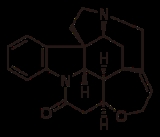
Strychnine ( (British, U.S.), or (U.S.)) is a very toxic (LD50
LD50

In toxicology, the median lethal dose, LD50 , or LCt50 of a toxic substance or radiation is the Dose required to kill half the members of a tested population....
 = 10 mg approx.), colorless crystalline alkaloid
Alkaloid

Alkaloids are naturally occurring chemical compounds containing base nitrogen atoms. The name derives from the word alkaline and was used to describe any nitrogen-containing base....
 used as a pesticide
Pesticide

A pesticide is a substance or mixture of substances used to kill a pest .A pesticide may be a chemical substance, biological agent , antimicrobial, disinfectant or device used against any pest ....
, particularly for killing small vertebrate
Vertebrate

Vertebrates are members of the subphylum Vertebrata, chordates with Vertebras or Vertebral columns. The grouping sometimes includes the hagfish, which have no vertebrae, but are genetically quite closely related to lampreys, which do have vertebrae....
s such as bird
Bird

Birds are wing, Bipedalismal, endothermic , vertebrate animals that lay egg . There are around 10,000 living species, making them the most numerous tetrapod vertebrates....
s and rodent
Rodent

Rodentia is an Order of mammals also known as rodents, characterised by two continuously growing Incisors#The_Rodent_incisor in the upper and lower jaws which must be kept short by gnawing....
s. Strychnine causes muscular convulsion
Convulsion

A convulsion is a medical condition where body muscles contract and relax rapidly and repeatedly, resulting in an uncontrolled shaking of the body....
s and eventually death through asphyxia
Asphyxia

Asphyxia is a condition of severely deficient supply of oxygen to the body that arises from being unable to breathe normally. An example of asphyxia is choking....
 or sheer exhaustion. The most common source is from the seeds of the Strychnos nux vomica
Strychnine tree

The Strychnine tree also known as Nux vomica, is an evergreen tree native to southeast Asia, a member of family Loganiaceae. It is a medium-sized tree growing in open habitats....
 tree. Strychnine is one of the most bitter substances known. Its taste is detectable in concentrations as low as 1 ppm.

chnine acts as a blocker or antagonist
Receptor antagonist

A receptor antagonist is a type of receptor ligand or drug that does not provoke a biological response itself upon binding to a Receptor , but blocks or dampens agonist-mediated responses....
 at the inhibitory or strychnine-sensitive glycine receptor
Glycine receptor

The glycine receptor, or GlyR, is the receptor for the amino acid neurotransmitter glycine. It is one of the most widely distributed inhibitory receptors in the central nervous system and has important roles in a variety of physiological processes, especially in mediating inhibitory neurotransmission in the spinal cord and brain ste...
 (GlyR), a ligand
Ligand

In chemistry, a ligand is either an atom, ion, or molecule that bonds to a central metal, generally involving formal donation of one or more of its electrons....
-gated chloride
Chloride

The chloride ion is formed when the chemical element chlorine picks up one electron to form an anion Cl−....
 channel in the spinal cord
Spinal cord

The spinal cord is a long, thin, tubular bundle of neuron and glia that extends from the brain. The brain and spinal cord together make up the central nervous system....
 and the brain
Brain

The brain is the center of the nervous system in all vertebrate, and most invertebrate, animals. Some primitive animals such as cnidarian and echinoderm have a decentralized nervous system without a brain, while sponges lack any nervous system at all....
.

Although it is best known as a poison, small doses of strychnine were once used in medications as a stimulant
Stimulant

Stimulant drugs are drugs that temporarily increase alertness and awareness. They usually have increased side-effects with increased effectiveness, and the more powerful variants are therefore often prescription medicines or illegal drugs....
, a laxative
Laxative

Laxatives are foods, compounds, or drugs taken to induce bowel movements or to loosen the stool, most often taken to treat constipation. Certain stimulant, lubricant, and saline laxatives are used to evacuate the Colon for rectum and bowel examinations, and may be supplemented by enemas in that circumstance....
 and as a treatment for other stomach ailments.


Discussion
Ask a question about 'Strychnine'
Start a new discussion about 'Strychnine'
Answer questions from other users
Full Discussion Forum


Encyclopedia


Strychnine ( (British, U.S.), or (U.S.)) is a very toxic (LD50
LD50

In toxicology, the median lethal dose, LD50 , or LCt50 of a toxic substance or radiation is the Dose required to kill half the members of a tested population....
 = 10 mg approx.), colorless crystalline alkaloid
Alkaloid

Alkaloids are naturally occurring chemical compounds containing base nitrogen atoms. The name derives from the word alkaline and was used to describe any nitrogen-containing base....
 used as a pesticide
Pesticide

A pesticide is a substance or mixture of substances used to kill a pest .A pesticide may be a chemical substance, biological agent , antimicrobial, disinfectant or device used against any pest ....
, particularly for killing small vertebrate
Vertebrate

Vertebrates are members of the subphylum Vertebrata, chordates with Vertebras or Vertebral columns. The grouping sometimes includes the hagfish, which have no vertebrae, but are genetically quite closely related to lampreys, which do have vertebrae....
s such as bird
Bird

Birds are wing, Bipedalismal, endothermic , vertebrate animals that lay egg . There are around 10,000 living species, making them the most numerous tetrapod vertebrates....
s and rodent
Rodent

Rodentia is an Order of mammals also known as rodents, characterised by two continuously growing Incisors#The_Rodent_incisor in the upper and lower jaws which must be kept short by gnawing....
s. Strychnine causes muscular convulsion
Convulsion

A convulsion is a medical condition where body muscles contract and relax rapidly and repeatedly, resulting in an uncontrolled shaking of the body....
s and eventually death through asphyxia
Asphyxia

Asphyxia is a condition of severely deficient supply of oxygen to the body that arises from being unable to breathe normally. An example of asphyxia is choking....
 or sheer exhaustion. The most common source is from the seeds of the Strychnos nux vomica
Strychnine tree

The Strychnine tree also known as Nux vomica, is an evergreen tree native to southeast Asia, a member of family Loganiaceae. It is a medium-sized tree growing in open habitats....
 tree. Strychnine is one of the most bitter substances known. Its taste is detectable in concentrations as low as 1 ppm.

Pharmacology

Strychnine acts as a blocker or antagonist
Receptor antagonist

A receptor antagonist is a type of receptor ligand or drug that does not provoke a biological response itself upon binding to a Receptor , but blocks or dampens agonist-mediated responses....
 at the inhibitory or strychnine-sensitive glycine receptor
Glycine receptor

The glycine receptor, or GlyR, is the receptor for the amino acid neurotransmitter glycine. It is one of the most widely distributed inhibitory receptors in the central nervous system and has important roles in a variety of physiological processes, especially in mediating inhibitory neurotransmission in the spinal cord and brain ste...
 (GlyR), a ligand
Ligand

In chemistry, a ligand is either an atom, ion, or molecule that bonds to a central metal, generally involving formal donation of one or more of its electrons....
-gated chloride
Chloride

The chloride ion is formed when the chemical element chlorine picks up one electron to form an anion Cl−....
 channel in the spinal cord
Spinal cord

The spinal cord is a long, thin, tubular bundle of neuron and glia that extends from the brain. The brain and spinal cord together make up the central nervous system....
 and the brain
Brain

The brain is the center of the nervous system in all vertebrate, and most invertebrate, animals. Some primitive animals such as cnidarian and echinoderm have a decentralized nervous system without a brain, while sponges lack any nervous system at all....
.

Although it is best known as a poison, small doses of strychnine were once used in medications as a stimulant
Stimulant

Stimulant drugs are drugs that temporarily increase alertness and awareness. They usually have increased side-effects with increased effectiveness, and the more powerful variants are therefore often prescription medicines or illegal drugs....
, a laxative
Laxative

Laxatives are foods, compounds, or drugs taken to induce bowel movements or to loosen the stool, most often taken to treat constipation. Certain stimulant, lubricant, and saline laxatives are used to evacuate the Colon for rectum and bowel examinations, and may be supplemented by enemas in that circumstance....
 and as a treatment for other stomach ailments. A 1934 drug guide for nurses described it as "among the most valuable and widely prescribed drugs". Strychnine's stimulant effects also led to its use historically for enhancing performance in sports. Because of its high toxicity and tendency to cause convulsions, the use of strychnine in medicine was eventually abandoned once safer alternatives became available.

The dosage for medical use was cited as between "1/60th grain
Grain (measure)

In many cultures, a grain is a Physical unit of measurement of mass that is based upon the mass of a single seed of a typical cereal. Historically, in Europe, the average masses of wheat and barley grain were used to define units of mass....
–1/10th grain", which is between 1.1 milligrams and 6.4 milligrams in modern measures. Normally the maximum dosage used was 3.2 mg, half of a "full dose". A lethal dose was cited as 1/2 a grain (32 mg), but people have been known to die from as little as 5 mg of strychnine.

Total synthesis


The first total synthesis of this molecule was reported by R. B. Woodward and his coworkers in 1954. In 1963, a complete paper was published by him and his coworkers.

See also

  • avicide
    Avicide

    An avicide is any substance which can be used to kill birds.Commonly used avicides include strychnine, DRC-1339 and CPTH , and 4-Aminopyridine ....
  • Strychnine poisoning
    Strychnine poisoning

    Strychnine poisoning can be fatal to humans and can occur by inhalation, swallowing or absorption through eyes or mouth. It produces some of the most dramatic and painful symptoms of any known toxic reaction....
  • A Study in Scarlet
    A Study in Scarlet

    A Study in Scarlet is a detective Mystery fiction novel written by British author Sir Arthur Conan Doyle, which was first published in 1887....