


Time signature

Encyclopedia
Western culture
Western culture, sometimes equated with Western civilization or European civilization, refers to cultures of European origin and is used very broadly to refer to a heritage of social norms, ethical values, traditional customs, religious beliefs, political systems, and specific artifacts and...
musical notation
Musical notation
Music notation or musical notation is any system that represents aurally perceived music, through the use of written symbols.-History:...
to specify how many beat
Beat (music)
The beat is the basic unit of time in music, the pulse of the mensural level . In popular use, the beat can refer to a variety of related concepts including: tempo, meter, rhythm and groove...
s are in each measure
Bar (music)
In musical notation, a bar is a segment of time defined by a given number of beats of a given duration. Typically, a piece consists of several bars of the same length, and in modern musical notation the number of beats in each bar is specified at the beginning of the score by the top number of a...
and which note value
Note value
In music notation, a note value indicates the relative duration of a note, using the color or shape of the note head, the presence or absence of a stem, and the presence or absence of flags/beams/hooks/tails....
constitutes one beat.
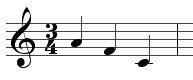
In a musical score, the time signature appears at the beginning of the piece, as a time symbol or stacked numerals (such as or ) immediately following the key signature
Key signature
In musical notation, a key signature is a series of sharp or flat symbols placed on the staff, designating notes that are to be consistently played one semitone higher or lower than the equivalent natural notes unless otherwise altered with an accidental...
(or immediately following the clef
Clef
A clef is a musical symbol used to indicate the pitch of written notes. Placed on one of the lines at the beginning of the staff, it indicates the name and pitch of the notes on that line. This line serves as a reference point by which the names of the notes on any other line or space of the staff...
if the piece is in C major
C major
C major is a musical major scale based on C, with pitches C, D, E, F, G, A, and B. Its key signature has no flats/sharps.Its relative minor is A minor, and its parallel minor is C minor....
, A minor
A minor
A minor is a minor scale based on A, consisting of the pitches A, B, C, D, E, F, and G. The harmonic minor scale raises the G to G...
, or a modal subset
Musical mode
In the theory of Western music since the ninth century, mode generally refers to a type of scale. This usage, still the most common in recent years, reflects a tradition dating to the middle ages, itself inspired by the theory of ancient Greek music.The word encompasses several additional...
). A mid-score time signature, usually immediately following a barline, indicates a change of meter.
There are various types of time signatures, depending on whether the music follows simple rhythms or involves unusual shifting tempos, including: simple (such as or ), compound (e.g., or ), complex (e.g., or ), mixed (e.g., & or or ), additive (e.g., , fractional (e.g.), irrational meters (e.g., or ), or other meters.
Simple time signatures
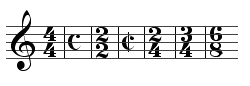
- the lower numeral indicates the note valueNote valueIn music notation, a note value indicates the relative duration of a note, using the color or shape of the note head, the presence or absence of a stem, and the presence or absence of flags/beams/hooks/tails....
which represents one beatBeat (music)The beat is the basic unit of time in music, the pulse of the mensural level . In popular use, the beat can refer to a variety of related concepts including: tempo, meter, rhythm and groove...
(the "beat unit"); - the upper numeral indicates how many such beats there are in a barBar (music)In musical notation, a bar is a segment of time defined by a given number of beats of a given duration. Typically, a piece consists of several bars of the same length, and in modern musical notation the number of beats in each bar is specified at the beginning of the score by the top number of a...
.
For instance, means two quarter-note (crotchet) beats; means three eighth-note (quaver) beats.
The most common simple time signatures are , , and .
Notational variations in simple time
A semicircle, or , is sometimes used for time, also called common time or imperfect time. The symbol is derived from a broken circle used in music notation from the 14th through 16th centuries, where a full circle represented what today would be written in or time, and was called tempus perfectum (perfect time). The symbol , a "semicircle" with a vertical line through is also a carry-over from the notational practice of late-Medieval and Renaissance music, where it signified tempus imperfectum diminutum (diminished imperfect time)—more precisely, a doubling of the speed, or proportio dupla, in duple meter. In modern notation, it is used in place of and is called "alla breve" or, colloquially, "cut time" or "cut common time".Compound time signatures
In compound meter, subdivisions of the main beat (the upper number) are split into three, not two, equal parts, so that a dotted noteDotted note
In Western musical notation, a dotted note is a note with a small dot written after it. The dot increases the duration of the basic note by half of its original value. If the basic note lasts 2 beats, the corresponding dotted note lasts 3 beats...
(half again longer than a regular note) becomes the beat unit. Compound time signatures are named as if they were simple time signatures in which the one-third part of the beat unit is the beat, so the top number is commonly 6, 9 or 12 (multiples of 3). The lower number is most commonly an 8 (an eighth-note): as in or .
An example
: A simple signature, comprising three quarter notes. It has a basic feel of:-
- one two three (as in a waltz)
- Each quarter note might comprise two eighth-notes (quavers) giving a total of six such notes, but it still retains that three-in-a-bar "feel":
- one and two and three and
: Theoretically, this can be thought of as the same as the six-quaver form of above with the only difference being that the eighth note is selected as the one-beat unit. But whereas the six quavers in had been in three groups of two, is practically understood to mean that they are in two groups of three, with a two-in-a-bar feel:
-
- one and a, two and a
Beat and time
Time signatures indicating two beats per bar (whether it is simple or compound) are called duple time; those with three beats to the bar are triple time. To the ear, a bar may seem like one singular beat. For example, a fast waltz, notated in time, may be described as being "one in a bar". Terms such as quadruple (4), quintuple (5), and so on are also occasionally used.Actual beat divisions
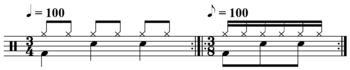
As mentioned above although indicated by the score as a time the actual beat division used can be the whole bar particularly in faster tempos. Correspondingly in slow tempo the beat indicated by the time signature could in actual performance be divided into smaller units.Interchangeability, rewriting meters

Connotation
A connotation is a commonly understood subjective cultural or emotional association that some word or phrase carries, in addition to the word's or phrase's explicit or literal meaning, which is its denotation....
s. Firstly and perhaps most importantly a smaller note value in the beat unit implies a more complex notation which can affect the ease of performance; secondly the beaming affects the choice of actual beat divisions mentioned above - it would for example be more natural to use the quarter note/crotchet as a beat unit in or than the eight/quaver in or ; thirdly the time signatures are and have traditionally been associated with different styles of music, e.g. it would seem strange to notate a rock tune in or .
Stress and meter
For all meters, the first beat (the downbeat, ignoring any anacrusisAnacrusis
In poetry, an anacrusis is the lead-in syllables, collectively, that precede the first full measure.In music, it is the note or sequence of notes which precedes the first downbeat in a bar. In the latter sense an anacrusis is often called a pickup, pickup note, or pickup measure, referring to the...
) is usually stressed (though not always, for example in reggae
Reggae
Reggae is a music genre first developed in Jamaica in the late 1960s. While sometimes used in a broader sense to refer to most types of Jamaican music, the term reggae more properly denotes a particular music style that originated following on the development of ska and rocksteady.Reggae is based...
where the offbeats
Beat (music)
The beat is the basic unit of time in music, the pulse of the mensural level . In popular use, the beat can refer to a variety of related concepts including: tempo, meter, rhythm and groove...
are stressed); in time signatures with four groups in the bar (such as and ), the third beat is often also stressed, though to a lesser degree. This gives a regular pattern of stressed and unstressed beats, although notes on the "stressed" beats are not necessarily louder or more important.
Most frequent time signatures
| Simple time signatures | ||
|---|---|---|
| (quadruple) | common time: widely used in most forms of Western popular music. Most common time signature in rock, blues, country, rap, funk, and pop |  |
| (duple) | alla breve, cut time: used for march March (music) A march, as a musical genre, is a piece of music with a strong regular rhythm which in origin was expressly written for marching to and most frequently performed by a military band. In mood, marches range from the moving death march in Wagner's Götterdämmerung to the brisk military marches of John... es and fast orchestral music. Frequently occurs in musical theater. Sometimes called "in 2", but may be notated in 4. |
|
| (quadruple) | never found in early music (which did not use numeric time signatures), and rare since 1600, although Brahms and other composers used it occasionally. | |
| (duple) | used for polka Polka The polka is a Central European dance and also a genre of dance music familiar throughout Europe and the Americas. It originated in the middle of the 19th century in Bohemia... s or marches March (music) A march, as a musical genre, is a piece of music with a strong regular rhythm which in origin was expressly written for marching to and most frequently performed by a military band. In mood, marches range from the moving death march in Wagner's Götterdämmerung to the brisk military marches of John... |
 |
| (triple) | used for waltz Waltz (music) A waltz, or valse from the French term, is a piece of music in triple meter, most often written in time signature but sometimes in 3/8 or 3/2... es, minuet Minuet A minuet, also spelled menuet, is a social dance of French origin for two people, usually in 3/4 time. The word was adapted from Italian minuetto and French menuet, and may have been from French menu meaning slender, small, referring to the very small steps, or from the early 17th-century popular... s, scherzi Scherzo A scherzo is a piece of music, often a movement from a larger piece such as a symphony or a sonata. The scherzo's precise definition has varied over the years, but it often refers to a movement which replaces the minuet as the third movement in a four-movement work, such as a symphony, sonata, or... , country & western ballads, R&B, sometimes used in pop. |
 |
| (triple) | also used for the above, but usually suggests higher tempo or shorter hypermeter. | |
| Compound time signatures | ||
| (duple) | double jig Jig The Jig is a form of lively folk dance, as well as the accompanying dance tune, originating in England in the 16th century and today most associated with Irish dance music and Scottish country dance music... s, polkas, sega Sega music Sega music or Séga is the major music of the Mascarene Islands: Mauritius, Réunion and Rodrigues as well as of the Seychelles. Sega is similar to the Réunionnais music genre maloya. Another form of dance similar to the sega is the Seychellois moutya. Sega music originated among the slave... , salegy Salegy Salegy is a popular music genre from Madagascar. This Sub-Saharan African folk music originated in the northwestern coastal areas of Madagascar, an island in the Indian Ocean near the southeastern coast of Africa. Salegy is the genre of Malagasy music that has gained the widest recognition and... , tarantella Tarantella The term tarantella groups a number of different southern Italian couple folk dances characterized by a fast upbeat tempo, usually in 6/8 time , accompanied by tambourines. It is among the most recognized of traditional Italian music. The specific dance name varies with every region, for instance... , marches March (music) A march, as a musical genre, is a piece of music with a strong regular rhythm which in origin was expressly written for marching to and most frequently performed by a military band. In mood, marches range from the moving death march in Wagner's Götterdämmerung to the brisk military marches of John... , barcarolle Barcarolle A barcarole is a folk song sung by Venetian gondoliers, or a piece of music composed in that style... s, Irish jigs, loure Loure The loure, also known as the gigue lente or slow gigue, is a French Baroque dance, probably originating in Normandy and named after the sound of the instrument of the same name .... s, and some rock music. |
 |
| (triple) | "compound triple time", used in triple ("slip") jigs, otherwise occurring rarely (The Ride of the Valkyries, Tchaikovsky's Fourth Symphony Symphony No. 4 (Tchaikovsky) Pyotr Ilyich Tchaikovsky's Symphony No. 4 in F minor, Op. 36, was written between 1877 and 1878. The symphony's first performance was at a Russian Musical Society concert in Saint Petersburg on February 10 /February 22 1878, with Nikolai Rubinstein as conductor.- Form :The symphony is in four... , and the final movement of the Bach violin concerto in A minor (BWV 1041) Violin Concerto in A minor (Bach) The Violin Concerto in A minor, BWV 1041, was composed by Johann Sebastian Bach in 1748.-Structure and analysis:The piece has three movements:#Allegro moderato#Andante — with an ostinato style theme#Allegro assai... are familiar examples. Prélude à l'après-midi d'un faune Prélude à l'après-midi d'un faune Prélude à l'après-midi d'un faune , commonly known by its English title Prelude to the Afternoon of a Faun, is a symphonic poem for orchestra by Claude Debussy, approximately 10 minutes in duration... 's opening bars are in ) |
 |
| (quadruple) | also common in slower blues Blues Blues is the name given to both a musical form and a music genre that originated in African-American communities of primarily the "Deep South" of the United States at the end of the 19th century from spirituals, work songs, field hollers, shouts and chants, and rhymed simple narrative ballads... (where it is known as shuffle) and doo-wop Doo-wop The name Doo-wop is given to a style of vocal-based rhythm and blues music that developed in African American communities in the 1940s and achieved mainstream popularity in the 1950s and early 1960s. It emerged from New York, Philadelphia, Chicago, Baltimore, Newark, Pittsburgh, Cincinnati and... ; also used more recently in rock music. Can also be heard in some jigs like "The Irish Washerwoman The Irish Washerwoman The Irish Washerwoman is a traditional Irish jig whose melody is familiar to many people in the British Isles and North America. It repeats its refrain several times, sometimes by gradually increasing in tempo until being played very fast before coming to a sudden stop. The tune has lyrics, but is... ". |
|
Complex time signatures
Signatures that do not fit into the usual duple or triple categories are known as "complex", "asymmetric", "irregular", "unusual", or "odd" although these are broad terms, and usually a more specific description is appropriate. Most often these can be recognised by the upper number being 5, 7, or some larger number other than 9 or 12. Although these more complex meters were and are common in some non-Western music, they were rarely used in formal written Western music until the 19th century. The first deliberate quintuple meter pieces were "apparently published in Spain between 1516 and 1520", although other authorities reckon the Delphic HymnsDelphic Hymns
The Delphic Hymns are two musical compositions from Ancient Greece, which survive in substantial fragments. They were long regarded as being dated circa 138 BCE and 128 BCE, respectively, but recent scholarship has shown it likely they were both written for performance at the Athenian...
to Apollo
Apollo
Apollo is one of the most important and complex of the Olympian deities in Greek and Roman mythology...
(one by Athenaeus entirely in quintuple meter, the other by Limenius
Limenius
Limenius was an Athenian musician and the creator of the Second Delphic Hymn in 128 BC. He is the earliest known composer in recorded history for a surviving piece of music...
predominantly so), carved on the exterior walls of the Athenian Treasury
Athenian Treasury
The Athenian Treasury at Delphi was constructed by the Athenians to house dedications made by their city and citizens to the sanctuary of Apollo. The entire treasury, including its sculptural decoration, is built of Parian marble; its date of construction is disputed, scholarly opinion ranging...
at Delphi
Delphi
Delphi is both an archaeological site and a modern town in Greece on the south-western spur of Mount Parnassus in the valley of Phocis.In Greek mythology, Delphi was the site of the Delphic oracle, the most important oracle in the classical Greek world, and a major site for the worship of the god...
in 128 BC, are probably earlier. The third Larghetto movement of Chopin's Piano Sonata No. 1 (1828) is an early, but by no means the earliest, example of time in solo piano music. Reicha's Fugue 20 from his 36 Fugues
36 Fugues (Reicha)
36 Fugues, sometimes assigned opus number 36, is a cycle of fugues for piano composed by Anton Reicha. It was first published by the composer in 1803 and served as an illustration of a nouveau système Reicha invented for fugue composition...
, published in 1803, is for piano and is in . The waltz
Waltz
The waltz is a ballroom and folk dance in time, performed primarily in closed position.- History :There are several references to a sliding or gliding dance,- a waltz, from the 16th century including the representations of the printer H.S. Beheim...
-like second movement of Tchaikovsky's Pathétique Symphony
Symphony No. 6 (Tchaikovsky)
The Symphony No. 6 in B minor, Op. 74, Pathétique is Pyotr Ilyich Tchaikovsky's final completed symphony, written between February and the end of August 1893. The composer led the first performance in Saint Petersburg on 16/28 October of that year, nine days before his death...
, often described as a "limping waltz", is a notable example of time in orchestral music. Examples from the 20th century include Holst's "Mars, the Bringer of War", from the orchestral suite The Planets
The Planets
The Planets, Op. 32, is a seven-movement orchestral suite by the English composer Gustav Holst, written between 1914 and 1916. Each movement of the suite is named after a planet of the Solar System and its corresponding astrological character as defined by Holst...
, and the ending of Stravinsky's
Igor Stravinsky
Igor Fyodorovich Stravinsky ; 6 April 1971) was a Russian, later naturalized French, and then naturalized American composer, pianist, and conductor....
Firebird
The Firebird
The Firebird is a 1910 ballet created by the composer Igor Stravinsky and choreographer Michel Fokine. The ballet is based on Russian folk tales of the magical glowing bird of the same name that is both a blessing and a curse to its captor....
.
Examples from the Western popular music tradition include Radiohead
Radiohead
Radiohead are an English rock band from Abingdon, Oxfordshire, formed in 1985. The band consists of Thom Yorke , Jonny Greenwood , Ed O'Brien , Colin Greenwood and Phil Selway .Radiohead released their debut single "Creep" in 1992...
's "15 Step" and "Paranoid Android
Paranoid Android
"Paranoid Android" is a song by English alternative rock band Radiohead, featured on their 1997 third studio album OK Computer. The lyrics of the darkly humorous song were written primarily by singer Thom Yorke, following an unpleasant experience in a Los Angeles bar...
" (includes ). Progressive rock
Progressive rock
Progressive rock is a subgenre of rock music that developed in the late 1960s and early 1970s as part of a "mostly British attempt to elevate rock music to new levels of artistic credibility." John Covach, in Contemporary Music Review, says that many thought it would not just "succeed the pop of...
also made frequent use of unusual time signatures, the best known examples being the use of shifting meters in The Beatles
The Beatles
The Beatles were an English rock band, active throughout the 1960s and one of the most commercially successful and critically acclaimed acts in the history of popular music. Formed in Liverpool, by 1962 the group consisted of John Lennon , Paul McCartney , George Harrison and Ringo Starr...
' "Strawberry Fields Forever
Strawberry Fields Forever
"Strawberry Fields Forever" is a song by The Beatles, written by John Lennon and attributed to the Lennon–McCartney songwriting partnership. It was inspired by Lennon's memories of playing in the garden of a Salvation Army house named "Strawberry Field" near his childhood home."Strawberry Fields...
" (1966) and the use of quintuple meter in their "Within You, Without You" (1967).
The jazz
Jazz
Jazz is a musical style that originated at the beginning of the 20th century in African American communities in the Southern United States. It was born out of a mix of African and European music traditions. From its early development until the present, jazz has incorporated music from 19th and 20th...
composition "Take Five
Take Five
"Take Five" is a jazz piece written by Paul Desmond and performed by The Dave Brubeck Quartet on their 1959 album Time Out. Recorded at Columbia's 30th Street Studios in New York City on June 25, July 1, and August 18, 1959, this piece became one of the group's best-known records, famous for its...
", written in time was one of a number of irregular-meter experiments of The Dave Brubeck Quartet
The Dave Brubeck Quartet
The Dave Brubeck Quartet is an American jazz quartet, founded in 1951 by Dave Brubeck and originally featuring Paul Desmond on saxophone and Brubeck on piano...
, which also produced compositions in ("Eleven Four"), ("Unsquare Dance
Unsquare Dance
"Unsquare Dance" is an iconic musical piece written by the American jazz composer Dave Brubeck in 1961.Written in 7/8 time, the piece is a typical example of Brubeck's exploration of time signatures. According to Brubeck, it was written during a single trip from his home to the recording studio,...
"), and ("Blue Rondo à la Turk
Blue Rondo à la Turk
"Blue Rondo à la Turk" is a jazz standard composition by Dave Brubeck. It appeared on the album Time Out in 1959. It is written in 9/8 and swing 4/4.-History:Brubeck heard the unusual "1-2/1-2/1-2/1-2-3" rhythm performed by Turkish musicians on the street...
"), expressed as , this last being a good example of a work in a signature which, despite appearing to be merely compound triple, is actually more complex.
However, such time signatures are only considered unusual from a Western point of view. In contrast, for example, Bulgarian dances
Bulgarian dances
Bulgarian folk dances are intimately related to the music of Bulgaria. This distinctive feature of Balkan folk music is the asymmetrical meter, built up around various combinations of 'quick' and 'slow' beats...
use such meters extensively, including forms with 5, 7, 9, 11, 13, 15, 22, 25 and other numbers of beats per measure. These rhythms are notated as additive rhythm
Additive rhythm
In music, additive and divisive are terms used to distinguish two types of both rhythm and meter.A divisive rhythm is a rhythm in which a larger period of time is divided into smaller rhythmic units or, conversely, some integer unit is regularly multiplied into larger, equal units; this can be...
s based on simple units, usually 2, 3 and 4 beats, though the notation fails to describe the metric
Meter (music)
Meter or metre is a term that music has inherited from the rhythmic element of poetry where it means the number of lines in a verse, the number of syllables in each line and the arrangement of those syllables as long or short, accented or unaccented...
"time bending" taking place; or as compound meters, for example the Bulgarian Sedi Donka
Music of Thrace
Music of Thrace is the music of Thrace, a region in Southeastern Europe spread over southern Bulgaria , northeastern Greece , and European Turkey ....
, consisting of 25 beats divided 7+7+11, where 7 is subdivided 3+2+2 and 11 is subdivided 2+2+3+2+2 or 4+3+4. See Variants below.
Mixed meters
While time signatures usually express a regular pattern of beat stresses continuing through a piece (or at least a section), sometimes composers place a different time signature at the beginning of each bar, resulting in music with an extremely irregular rhythmic feel. In this case the time signatures are an aid to the performers, and not necessarily an indication of meterMeter (music)
Meter or metre is a term that music has inherited from the rhythmic element of poetry where it means the number of lines in a verse, the number of syllables in each line and the arrangement of those syllables as long or short, accented or unaccented...
. The Promenade from Mussorgsky's Pictures at an Exhibition
Pictures at an Exhibition
Pictures at an Exhibition is a suite in ten movements composed for piano by Russian composer Modest Mussorgsky in 1874.The suite is Mussorgsky's most famous piano composition, and has become a showpiece for virtuoso pianists...
(1874) is a good example:

Burt Bacharach
Burt Bacharach
Burt F. Bacharach is an American pianist, composer and music producer. He is known for his popular hit songs and compositions from the mid-1950s through the 1980s, with lyrics written by Hal David. Many of their hits were produced specifically for, and performed by, Dionne Warwick...
's song "Promises, Promises
Promises, Promises
Promises, Promises is a musical based on the 1960 film The Apartment. The music is by Burt Bacharach, lyrics by Hal David, and book by Neil Simon. Musical numbers for the original Broadway production were choreographed by Michael Bennett; Robert Moore directed and David Merrick produced...
" likewise features a constantly changing meter. The Beatles
The Beatles
The Beatles were an English rock band, active throughout the 1960s and one of the most commercially successful and critically acclaimed acts in the history of popular music. Formed in Liverpool, by 1962 the group consisted of John Lennon , Paul McCartney , George Harrison and Ringo Starr...
' All You Need is Love
All You Need Is Love
"All You Need Is Love" is a song written by John Lennon and credited to Lennon–McCartney. It was first performed by The Beatles on Our World, the first live global television link. Watched by 400 million in 26 countries, the programme was broadcast via satellite on 25 June 1967...
varies from to in different places.
Igor Stravinsky's The Rite of Spring
The Rite of Spring
The Rite of Spring, original French title Le sacre du printemps , is a ballet with music by Igor Stravinsky; choreography by Vaslav Nijinsky; and concept, set design and costumes by Nicholas Roerich...
(1913) is famous for its "savage" rhythms:
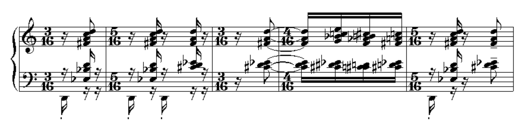
In such cases, a common convention followed by some composers (e.g., Olivier Messiaen
Olivier Messiaen
Olivier Messiaen was a French composer, organist and ornithologist, one of the major composers of the 20th century. His music is rhythmically complex ; harmonically and melodically it is based on modes of limited transposition, which he abstracted from his early compositions and improvisations...
's La Nativité du Seigneur
La Nativité du Seigneur
La Nativité du Seigneur is a work for organ, written by the French composer Olivier Messiaen in 1935....
and Quatuor pour la fin du temps
Quatuor pour la fin du temps
Quatuor pour la fin du temps, also known by its English title Quartet for the End of Time, is a piece of chamber music by the French composer Olivier Messiaen. It was premiered in 1941...
) is simply to omit the time signature. Charles Ives
Charles Ives
Charles Edward Ives was an American modernist composer. He is one of the first American composers of international renown, though Ives' music was largely ignored during his life, and many of his works went unperformed for many years. Over time, Ives came to be regarded as an "American Original"...
's Concord Sonata has measure bars for the first two measures only, then is entirely unbarred for the rest of the piece. Interestingly, it contains the shortest note written up to then, a "256th" note with six flags marked "play as quickly as you can" above the staff. This same small value had been in use only since 1728, when Georg Philipp Telemann
Georg Philipp Telemann
Georg Philipp Telemann was a German Baroque composer and multi-instrumentalist. Almost completely self-taught in music, he became a composer against his family's wishes. After studying in Magdeburg, Zellerfeld, and Hildesheim, Telemann entered the University of Leipzig to study law, but eventually...
used it in the "Lilliputian Chaconne" from his Intrada, nebst burlesquer Suite (the so-called "Gulliver Suite") for two violins.
Some pieces have no time signature, as there is no discernible meter. This is commonly known as free time
Free time (music)
Free time is a type of musical meter free from musical time and time signature. It is used when a piece of music has no discernible beat. Instead, the rhythm is intuitive and free-flowing. There are five ways in which a piece is indicated to be in free time:...
. Sometimes one is provided (usually ) so that the performer finds the piece easier to read, and simply has 'free time' written as a direction. Sometimes the word FREE is written downwards on the staff to indicate the piece is in free time. Erik Satie
Erik Satie
Éric Alfred Leslie Satie was a French composer and pianist. Satie was a colourful figure in the early 20th century Parisian avant-garde...
wrote many compositions which are ostensibly in free time, but actually follow an unstated and unchanging simple time signature throughout. Later composers have made more effective use of this device, writing music which is almost devoid of any discernible regularity of pulse.
If two time signatures alternate repeatedly, sometimes the two signatures will be placed together at the beginning of the piece or section, as in this example, the chorus from the song "America"
America (West Side Story song)
"America" is a well-known song from the musical West Side Story. Leonard Bernstein composed the music; Stephen Sondheim wrote the song's lyrics...
from West Side Story: in this case, it alternates between (in two) in the first measure of each pair and (in three) in the second measure.

Additive meters
To indicate more complex patterns of stresses, such as additive rhythmAdditive rhythm
In music, additive and divisive are terms used to distinguish two types of both rhythm and meter.A divisive rhythm is a rhythm in which a larger period of time is divided into smaller rhythmic units or, conversely, some integer unit is regularly multiplied into larger, equal units; this can be...
s, more complex time signatures can be used. For example, the signature

which can be written (3+2+3)/8, means that there are 8 quaver beats in the bar, divided as the first of a group of three eighth notes (quavers) is to be stressed, then the first of a group of two, then first of a group of three again. The stress pattern is usually counted as one-two-three-one-two-one-two-three. This kind of time signature is commonly used to notate folk and non-Western types of music. In classical music, Béla Bartók
Béla Bartók
Béla Viktor János Bartók was a Hungarian composer and pianist. He is considered one of the most important composers of the 20th century and is regarded, along with Liszt, as Hungary's greatest composer...
and Olivier Messiaen
Olivier Messiaen
Olivier Messiaen was a French composer, organist and ornithologist, one of the major composers of the 20th century. His music is rhythmically complex ; harmonically and melodically it is based on modes of limited transposition, which he abstracted from his early compositions and improvisations...
have used such time signatures in their works. The first movement of Maurice Ravel
Maurice Ravel
Joseph-Maurice Ravel was a French composer known especially for his melodies, orchestral and instrumental textures and effects...
's Piano Trio in A Minor is written in , in which the beats are likewise subdivided into 3 + 2 + 3 to reflect Basque
Basque music
The strict classification of Basque music remains a controversial issue, complicated in part by the growing diversification of such music, but by and large it is made in the Basque Country, it reflects traits related to that society/tradition and it is devised by people from the Basque...
dance rhythms.
Romanian musicologist Constantin Brăiloiu
Constantin Brăiloiu
Constantin Brăiloiu was a Romanian composer and internationally known ethnomusicologist.He was born in Bucharest. He studied in Bucharest , Vienna , Vevey and Lausanne as well as Paris...
had a special interest in compound time signatures, developed while studying the traditional music of certain regions in his country. While investigating the origins of such unusual meters, he learned that they were even more characteristic of the traditional music of neighboring peoples (e.g., the Bulgarians). He suggested that such timings can be regarded as compounds of simple two-beat and three-beat meters, where an accent falls on every first beat, even though, for example in Bulgarian music
Bulgarian dances
Bulgarian folk dances are intimately related to the music of Bulgaria. This distinctive feature of Balkan folk music is the asymmetrical meter, built up around various combinations of 'quick' and 'slow' beats...
, beat lengths of 1, 2, 3, 4 are used in the metric description. In addition, when focusing only on the stressed beats, the simple time signatures themselves will count as beats in a slower, compound time. However, there are two different-length beats in this resulting compound time, a one half-again longer than the short beat (or conversely, the short beat is 2/3 the value of the long). This type of meter is called aksak (the Turkish word for "limping"), "impeded", "jolting", or "shaking", and is described as an "irregular bichronic rhythm". A certain amount of confusion for Western musicians is inevitable, since a measure they would likely regard as , for example, is a three-beat measure in aksak, with one long and two short beats (with subdivisions of 2+2+3, 2+3+2, or 3+2+2).
Folk music may make use of metric time bends, so that the proportions of the performed metric beat time lengths differ from the exact proportions indicated by the metric. Depending on playing style of the same meter, the time bend can vary from non-existent to considerable; in the latter case, some musicologists may want to assign a different meter. For example, the Bulgarian tune Eleno Mome
Bulgarian dances
Bulgarian folk dances are intimately related to the music of Bulgaria. This distinctive feature of Balkan folk music is the asymmetrical meter, built up around various combinations of 'quick' and 'slow' beats...
is written as 7=2+2+1+2, 13=4+4+2+3, 12=3+4+2+3, but an actual performance (e.g., Smithsonian Eleno Mome) may be closer to 4+4+2+3.5. The Macedonian 3+2+2+3+2
Leventikos
Leventikos , also known as Litós , Kucano, Nešo, and Bufskoto Oro, is a dance of western Macedonia, mainly performed by ethnic Macedonians and Greeks in the town of Florina, Greece and in the Resen and Bitola regions in the neighbouring Republic of Macedonia.The meter varies: one is 12 = 3+2+2+3+2...
meter is even more complicated, with heavier time bends, and the use of quadruples on the threes; the metric beat time proportions may vary with the speed at which the tune is being played. The Swedish Boda Polska
Polska (dance)
The polska is a family of music and dance forms shared by the Nordic countries: called polsk in Denmark, polska in Sweden and Finland and by several names in Norway in different regions and/or for different variants - including pols, rundom, springleik, and springar...
(Polska from the parish Boda) has a typical elongated second beat. In Western classical music, metric time bend is used in the performance of the Viennese Waltz
Viennese Waltz
Viennese Waltz is the genre of a ballroom dance. At least three different meanings are recognized. In the historically first sense, the name may refer to several versions of the waltz, including the earliest waltzes done in ballroom dancing, danced to the music of Viennese Waltz.What is now called...
. Most Western music uses metric ratios of 2:1, 3:1, or 4:1 (two-, three- or four-beat time signatures)—in other words, integer ratios which determine all beats to be of equal time length; so relative to that, 3:2 and 4:3 ratios correspond to very distinctive metric rhythm profiles—complex accentuation is used in Western music, but not as a part of the metric accentuation, instead viewed as syncopation
Syncopation
In music, syncopation includes a variety of rhythms which are in some way unexpected in that they deviate from the strict succession of regularly spaced strong and weak but also powerful beats in a meter . These include a stress on a normally unstressed beat or a rest where one would normally be...
.
Brăiloiu borrowed a term from Turkish
Music of Turkey
The music of Turkey includes diverse elements ranging from Central Asian folk music and has many copies and references of Byzantine music, Greek music, Ottoman music, Persian music, Balkan music, as well as more modern European and American popular music influences...
medieval music theory: aksak (Turkish
Turkish language
Turkish is a language spoken as a native language by over 83 million people worldwide, making it the most commonly spoken of the Turkic languages. Its speakers are located predominantly in Turkey and Northern Cyprus with smaller groups in Iraq, Greece, Bulgaria, the Republic of Macedonia, Kosovo,...
for crippled). Such compound time signatures fall under the aksak rhythm category that he introduced along with a couple more that should describe the rhythm figures in traditional music. (Aksak is sometimes spelled as aksaac, because there isn't an exact transliteration from medieval Turkish into the Latin alphabet.) The term Brăiloiu revived had moderate success worldwide, but in Eastern Europe it is still frequently used. However, aksak rhythm figures are to be found not only in a few European countries but on all continents, featuring various combinations of the two and three sequences. Yet the longest were found in Bulgaria; the shortest aksak rhythm figures would be the five-beat timing, comprising a two and a three (which can be also ordered as three followed by two).
Other variants
Some composers have used fractional beats: for example, the time signature appears in Carlos ChávezCarlos Chávez
Carlos Antonio de Padua Chávez y Ramírez was a Mexican composer, conductor, music theorist, educator, journalist, and founder and director of the Mexican Symphonic Orchestra. He was influenced by native Mexican cultures. Of his six Symphonies, his Symphony No...
's Piano Sonata No. 3 (1928) IV, m. 1.

Carl Orff
Carl Orff was a 20th-century German composer, best known for his cantata Carmina Burana . In addition to his career as a composer, Orff developed an influential method of music education for children.-Early life:...
proposed replacing the lower number of the time signature with the actual note value, as shown at right. This system eliminates the need for compound time signatures (described above), which are confusing to beginners. While this notation has not been adopted by music publishers generally (except in Orff's own compositions), it is used extensively in music education textbooks. Similarly, American composers George Crumb
George Crumb
George Crumb is an American composer of contemporary classical music. He is noted as an explorer of unusual timbres, alternative forms of notation, and extended instrumental and vocal techniques. Examples include seagull effect for the cello , metallic vibrato for the piano George Crumb (born...
and Joseph Schwantner
Joseph Schwantner
Joseph C. Schwantner is a Pulitzer Prize winning American composer and educator and a member of the American Academy of Arts and Letters. He was awarded the 1970 Charles Ives Prize....
, among others, have used this system in many of their works.
Another possibility is to extend the barline where a time change is to take place above the top instrument's line in a score and to write the time signature there, and there only, saving the ink and effort that would have been spent writing it in each instrument's staff. Henryk Górecki
Henryk Górecki
Henryk Mikołaj Górecki was a composer of contemporary classical music. He studied at the State Higher School of Music in Katowice between 1955 and 1960. In 1968, he joined the faculty and rose to provost before resigning in 1979. Górecki became a leading figure of the Polish avant-garde during...
's Beatus Vir is an example of this. Alternatively, music in a large score sometimes has time signatures written as very long, thin numbers covering the whole height of the score rather than replicating it on each staff; this is an aid to the conductor, who can see signature changes more easily.
Irrational meters
These are time signatures, used for so-called irrational measure lengths, which have a denominator which is not a power of two (1, 2, 4, 8, 16, 32, etc.). These are "based on beats expressed in terms of fractions of full beats in the prevailing tempo," for example or . For example, where implies a bar construction of four quarter-parts of a whole note (i.e., four quarter notes), implies a bar construction of four third-parts of it. These signatures are only of utility when juxtaposed with other signatures with varying denominators; a piece written entirely in , say, could be more legibly written out in .Metric modulation
Metric modulation
In music a metric modulation is a change from one time signature/tempo to another, wherein a note value from the first is made equivalent to a note value in the second, like a pivot...
is "a somewhat distant analogy". It is arguable whether the use of these signatures makes metric relationships clearer or more obscure to the musician; it is always possible to write a passage using non-"irrational" signatures by specifying a relationship between some note length in the previous bar and some other in the succeeding one. Sometimes, successive metric relationships between bars are so convoluted that the pure use of irrational signatures would quickly render the notation extremely hard to penetrate. Good examples, written entirely in conventional signatures with the aid of between-bar specified metric relationships, occur a number of times in John Adams
John Coolidge Adams
John Coolidge Adams is a Pulitzer Prize-winning American composer with strong roots in minimalism. His best-known works include Short Ride in a Fast Machine , On the Transmigration of Souls , a choral piece commemorating the victims of the September 11, 2001 attacks , and Shaker...
' opera Nixon in China
Nixon in China (opera)
Nixon in China is an opera in three acts by John Adams, with a libretto by Alice Goodman. Adams' first opera, it was inspired by the 1972 visit to China by US President Richard Nixon. The work premiered at the Houston Grand Opera on October 22, 1987, in a production by Peter Sellars with...
(1987), where the sole use of "irrational" signatures would quickly produce massive numerators and denominators.
Historically, this device has been prefigured wherever composers have written tuplets; for example, a bar consisting of 3 triplet crotchets could arguably more sensibly be written as a bar of . Henry Cowell
Henry Cowell
Henry Cowell was an American composer, music theorist, pianist, teacher, publisher, and impresario. His contribution to the world of music was summed up by Virgil Thomson, writing in the early 1950s:...
's piano
Piano
The piano is a musical instrument played by means of a keyboard. It is one of the most popular instruments in the world. Widely used in classical and jazz music for solo performances, ensemble use, chamber music and accompaniment, the piano is also very popular as an aid to composing and rehearsal...
piece "Fabric" (1920) throughout employs separate divisions of the bar (anything from 1 to 9) for the three contrapuntal parts, using a scheme of shaped noteheads to make the differences visually clear, but the pioneering of these signatures is largely due to Brian Ferneyhough
Brian Ferneyhough
Brian John Peter Ferneyhough is an English composer. His music is characterized by the extensive use of complex rhythmic tuplet notation which features in all his works...
, who says that he "find[s] that such 'irrational' measures serve as a useful buffer between local changes of event density and actual changes of base tempo
Tempo
In musical terminology, tempo is the speed or pace of a given piece. Tempo is a crucial element of any musical composition, as it can affect the mood and difficulty of a piece.-Measuring tempo:...
". Thomas Adès
Thomas Adès
Thomas Adès is a British composer, pianist and conductor.-Biography:Adès studied piano with Paul Berkowitz and later composition with Robert Saxton at Guildhall School of Music and Drama, London...
has also made extensive use of them, for example in his piano work "Traced Overhead" (1996), the second movement of which contains, among more conventional meters, bars in such signatures as , and . His "Piano Quintet" (2000) makes such extensive use of these, including different lines juxtaposed with varying meters, that an alternate form of notation is not immediately obvious, or arguably desirable. A gradual process of diffusion into less rarefied musical circles seems to be underway, hence for example, John Pickard's work "Eden", commissioned for the 2005 finals of the National Brass Band Championships of Great Britain, which contains bars of .
Notationally, rather than using Cowell's elaborate series of notehead shapes, the same convention has been invoked as when normal tuplets are written; for example, one beat in is written as a normal quarter note, four quarter notes complete the bar, but the whole bar lasts only 4/5 of a reference whole note
Whole note
thumb|right|250px|Figure 1. A whole note and a whole rest.In music, a whole note or semibreve is a note represented by a hollow oval note head, like a half note , and no note stem . Its length is equal to four beats in 4/4 time...
, and a beat 1/5 of one (or 4/5 of a normal quarter note). This is notated in exactly the same way that one would write if one were writing the first four quarter notes of five quintuplet quarter notes.
The term "irrational" is not being used here in its mathematical sense: an irrational number
Irrational number
In mathematics, an irrational number is any real number that cannot be expressed as a ratio a/b, where a and b are integers, with b non-zero, and is therefore not a rational number....
is one that cannot be written as a ratio of whole numbers, which all these signatures obviously are. Nevertheless, the term appears to be established now, although at least one such piece with a truly irrational signature already exists: one of Conlon Nancarrow
Conlon Nancarrow
Conlon Nancarrow was a United States-born composer who lived and worked in Mexico for most of his life. He became a Mexican citizen in 1955.Nancarrow is best remembered for the pieces he wrote for the player piano...
's "Studies for Player Piano" contains a canon where one part is augmented in the ratio √42:1 (approximately 6.48:1).
Mensural time signatures
In the 15th and 16th centuries, a period in which mensural notationMensural notation
Mensural notation is the musical notation system which was used in European music from the later part of the 13th century until about 1600."Mensural" refers to the ability of this system to notate complex rhythms with great exactness and flexibility...
was used, there were four basic "mensuration signs", which determined the proportion between the two main units of rhythm. There were no measure
Bar (music)
In musical notation, a bar is a segment of time defined by a given number of beats of a given duration. Typically, a piece consists of several bars of the same length, and in modern musical notation the number of beats in each bar is specified at the beginning of the score by the top number of a...
or bar lines in music of this period; these signs, the ancestors of modern time signatures, indicate the ratio of duration between different note value
Note value
In music notation, a note value indicates the relative duration of a note, using the color or shape of the note head, the presence or absence of a stem, and the presence or absence of flags/beams/hooks/tails....
s. The relation between the breve
Double whole note
In music, a double whole note or breve is a note lasting twice as long as a whole note...
and the semibreve was called tempus, and the relation between the semibreve and the minim was called prolatio. Unlike modern notation, the duration ratios between these different values was not always 2:1; it could be either 2:1 or 3:1, and that is what, amongst other things, these mensuration signs indicated. A ratio of 3:1 was called complete, perhaps a reference to the Trinity
Trinity
The Christian doctrine of the Trinity defines God as three divine persons : the Father, the Son , and the Holy Spirit. The three persons are distinct yet coexist in unity, and are co-equal, co-eternal and consubstantial . Put another way, the three persons of the Trinity are of one being...
, and a ratio of 2:1 was called incomplete.
A circle used as a mensuration sign indicated tempus perfectum (a circle being a symbol of completeness), while an incomplete circle, resembling a letter C, indicated tempus imperfectum. Assuming the breve to be a beat, this corresponds to the modern concepts of triple meter
Meter (music)
Meter or metre is a term that music has inherited from the rhythmic element of poetry where it means the number of lines in a verse, the number of syllables in each line and the arrangement of those syllables as long or short, accented or unaccented...
and duple meter
Meter (music)
Meter or metre is a term that music has inherited from the rhythmic element of poetry where it means the number of lines in a verse, the number of syllables in each line and the arrangement of those syllables as long or short, accented or unaccented...
, respectively. In either case, a dot in the center indicated prolatio perfecta while the absence of such a dot indicated prolatio imperfecta, corresponding to simple meter
Meter (music)
Meter or metre is a term that music has inherited from the rhythmic element of poetry where it means the number of lines in a verse, the number of syllables in each line and the arrangement of those syllables as long or short, accented or unaccented...
and compound meter
Meter (music)
Meter or metre is a term that music has inherited from the rhythmic element of poetry where it means the number of lines in a verse, the number of syllables in each line and the arrangement of those syllables as long or short, accented or unaccented...
.
A rough equivalence of these signs to modern meters would be:
-
 corresponds to meter;
 -
 corresponds to meter;
 -
 corresponds to meter;
 -
 corresponds to meter.
N.B.: in modern compound meters the beat is a dotted note value, such as a dotted quarter, because the ratios of the modern note value hierarchy are always 2:1. Dotted notes were never used in this way in the mensural period; the main beat unit was always a simple (undotted) note value.
Proportions
Another set of signs in mensural notationMensural notation
Mensural notation is the musical notation system which was used in European music from the later part of the 13th century until about 1600."Mensural" refers to the ability of this system to notate complex rhythms with great exactness and flexibility...
specified the metric proportions of one section to another, similar to a metric modulation
Metric modulation
In music a metric modulation is a change from one time signature/tempo to another, wherein a note value from the first is made equivalent to a note value in the second, like a pivot...
. A few common signs are shown:
-
 tempus imperfectum diminutum, 1:2 proportion (twice as fast);
 -
 tempus perfectum diminutum, 1:2 proportion (twice as fast);
 -
 or just
  proportio tripla, 1:3 proportion (three times as fast, similar to triplets).
Often the ratio was expressed as two numbers, one above the other, looking similar to a modern time signature, although it could have values such as , which a conventional time signature could not.
Some proportional signs were not used consistently from one place or century to another. In addition, certain composers delighted in creating "puzzle" compositions which were intentionally difficult to decipher.
In particular, when the sign
was encountered, the tactus (beat) changed from the usual semibreve to the breveDouble whole note
In music, a double whole note or breve is a note lasting twice as long as a whole note...
, a circumstance called alla breve. This term has been sustained to the present day, and although now it means the beat is a minim (half note), in contradiction to the literal meaning of the phrase, it still indicates that the beat has changed to a longer note value.
External links
- Grateful Dead songs with unusual time signatures (Grateful DeadGrateful DeadThe Grateful Dead was an American rock band formed in 1965 in the San Francisco Bay Area. The band was known for its unique and eclectic style, which fused elements of rock, folk, bluegrass, blues, reggae, country, improvisational jazz, psychedelia, and space rock, and for live performances of long...
) - Odd Time Obsessed Internet Radio - dedicated to "odd" meters
- audio clips of many time signatures, and Bounce Metronome Pro - a program that can play all the time signatures mentioned in this article, even the truly irrational ones like