

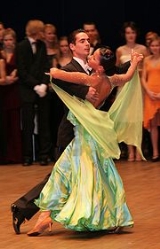
Viennese Waltz

Encyclopedia
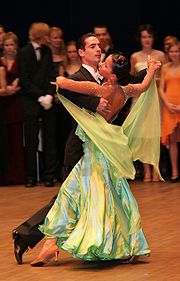
Ballroom dance
Ballroom dance refers to a set of partner dances, which are enjoyed both socially and competitively around the world. Because of its performance and entertainment aspects, ballroom dance is also widely enjoyed on stage, film, and television....
. At least three different meanings are recognized. In the historically first sense, the name may refer to several versions of the waltz
Waltz
The waltz is a ballroom and folk dance in time, performed primarily in closed position.- History :There are several references to a sliding or gliding dance,- a waltz, from the 16th century including the representations of the printer H.S. Beheim...
, including the earliest waltzes done in ballroom dancing, danced to the music of Viennese Waltz.
What is now called the Viennese waltz is the original form of the waltz. It was the first ballroom dance performed in the closed hold or "waltz" position. The dance that is popularly known as the waltz is actually the English or slow waltz, danced at approximately 90 beats per minute with 3 beats to the bar (the international standard of 30 measures per minute), while the Viennese Waltz is danced at about 180 beats (58-60 measures) a minute. To this day however, in Germany, Austria, Scandinavia, and France, the words Walzer (German for "waltz"), vals (Danish, Norwegian, and Swedish for "waltz"), and valse (French for "waltz") still implicitly refer to the original dance and not the slow waltz.
The Viennese Waltz is a rotary dance where the dancers are constantly turning either toward the leader's right (natural) or toward the leader's left (reverse), interspersed with non-rotating change steps to switch between the direction of rotation. A true Viennese waltz consists only of turns and change steps. Other moves such as the fleckerls, American-style figures and side sway or underarm turns are modern inventions and are not normally danced at the annual balls in Vienna. Furthermore, in a properly danced Viennese Waltz, couples do not pass, but turn continuously left and right while travelling counterclockwise around the floor following each other.
As the Waltz evolved, some of the versions that were done at about the original fast tempo came to be called specifically "Viennese Waltz" to distinguish them from the slower waltzes. In the modern ballroom dance, two versions of Viennese Waltz are recognized: International Style and American Style.
Today the Viennese Waltz is a ballroom
Ballroom dance
Ballroom dance refers to a set of partner dances, which are enjoyed both socially and competitively around the world. Because of its performance and entertainment aspects, ballroom dance is also widely enjoyed on stage, film, and television....
and partner dance
Partner dance
Partner dances are dances whose basic choreography involves coordinated dancing of two partners, as opposed to individuals dancing alone or individually in a non-coordinated manner, and as opposed to groups of people dancing simultaneously in a coordinated manner.In the year 1023 the German poet...
that is part of the International Standard division of contemporary ballroom dance.
Most people associate Viennese Waltz with "The Blue Danube
The Blue Danube
The Blue Danube is the common English title of An der schönen blauen Donau, Op. 314 , a waltz by the Austrian composer Johann Strauss II, composed in 1866...
".
Early history
The Viennese Waltz, so called to distinguish it from the WaltzWaltz
The waltz is a ballroom and folk dance in time, performed primarily in closed position.- History :There are several references to a sliding or gliding dance,- a waltz, from the 16th century including the representations of the printer H.S. Beheim...
and the French Waltz, is the oldest of the current ballroom dances. It emerged in the second half of the 18th century from the German dance
German Dance
A German dance is a dance of German origin. German dance is an example of the exchange and the relationship among the Courtly Dance, the social dance, and the folk dance.-Origins:...
and the Ländler
Ländler
The ländler is a folk dance in 3/4 time which was popular in Austria, south Germany and German Switzerland at the end of the 18th century.It is a dance for couples which strongly features hopping and stamping...
in Austria
Austria
Austria , officially the Republic of Austria , is a landlocked country of roughly 8.4 million people in Central Europe. It is bordered by the Czech Republic and Germany to the north, Slovakia and Hungary to the east, Slovenia and Italy to the south, and Switzerland and Liechtenstein to the...
and was both popular and subject to criticism. The Waltzen, as written in a magazine from 1799, is performed by dancers who held on to their long gowns to prevent them from dragging or being stepped on. The dancers would lift their dresses and hold them high like cloaks and this would bring both their bodies under one cover. This action also required the dancers' bodies to be very close together and this closeness also attracted moral disparagement. Wolf published a pamphlet against the dance entitled "Proof that Waltzing is the Main Source of Weakness of the Body and Mind of our Generation" in 1797. But even when faced with all this negativity, it became very popular in Vienna. Large dance halls like the Zum Sperl in 1807 and the Apollo in 1808 were opened to provide space for thousands of dancers. The dance reached and spread to England sometime before 1812. It was introduced as the German Waltz and became a huge hit. It gained ground due to the Congress of Vienna
Congress of Vienna
The Congress of Vienna was a conference of ambassadors of European states chaired by Klemens Wenzel von Metternich, and held in Vienna from September, 1814 to June, 1815. The objective of the Congress was to settle the many issues arising from the French Revolutionary Wars, the Napoleonic Wars,...
at the beginning of the 19th century and the famous compositions by Josef Lanner
Josef Lanner
Joseph Lanner was an Austrian dance music composer. He was best remembered as one of the earliest Viennese composers to reform the waltz from a simple peasant dance to something that even the highest society could enjoy, either as an accompaniment to the dance, or for the music's own sake...
, Johann Strauss I
Johann Strauss I
Johann Strauss I , born in Vienna, was an Austrian Romantic composer famous for his waltzes, and for popularizing them alongside Joseph Lanner, thereby setting the foundations for his sons to carry on his musical dynasty...
and his son, Johann Strauss II
Johann Strauss II
Johann Strauss II , also known as Johann Baptist Strauss or Johann Strauss, Jr., the Younger, or the Son , was an Austrian composer of light music, particularly dance music and operettas. He composed over 500 waltzes, polkas, quadrilles, and other types of dance music, as well as several operettas...
.
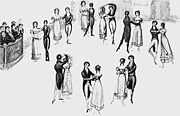
Ländler
The ländler is a folk dance in 3/4 time which was popular in Austria, south Germany and German Switzerland at the end of the 18th century.It is a dance for couples which strongly features hopping and stamping...
and the Allemande
Allemande
An allemande is one of the most popular instrumental dance forms in Baroque music, and a standard element of a suite...
. The hold was at times semi-closed, and at times side by side. Arms are intertwined and circling movements were made under raised arms. No couple in Wilson's plate are shown in close embrace, but some are in closed hold facing each other. There was another significant difference from our present technique. The feet were turned out and the rise of foot during the dance was much more pronounced than it is today. This can be seen quite clearly in the figure, and such a style imposes its limitations on how the dance can be performed.
To understand why Quirey says "The advent of the Waltz in polite society was quite simply the greatest change in dance form and dancing manners that has happened in our history" we need to realize that all European social dances before the waltz were communal sequence dances. Communal, because all the dancers on the floor took part in a pre-set pattern (often chosen by a Master of Ceremony). Dancers separately, and as couples, faced outwards to the spectators as much as they faced inwards. Thus all present took part as dancers or as onlookers. This was the way with the country dance and all previous popular dances. With the waltz, couples were independent of each other, and were turned towards each other (though not in close contact). Lord Byron wrote a furious letter, which precedes his poem The Waltz, in which he decries the anti-social nature of the dance, with the couple "like two cockchafers spitted on the same bodkin."
Later history
In the 1920s, in Germany, the Viennese Waltz became outdated as more modern and dynamic dances emerged. In England the Viennese Waltz acclimatized, there BostonBoston (dance)
Boston, in reference to a dance, may have one of the following meanings.*The Boston, an original name of the American Waltz.Arguably, the dances below are variations of The Boston.*Walking Boston*American Boston*French Boston*Philadelphia Boston...
and later Waltz
Waltz
The waltz is a ballroom and folk dance in time, performed primarily in closed position.- History :There are several references to a sliding or gliding dance,- a waltz, from the 16th century including the representations of the printer H.S. Beheim...
were preferred.
At the beginning of the 1935s the Viennese Waltz had its comeback as a folk dance
Folk dance
The term folk dance describes dances that share some or all of the following attributes:*They are dances performed at social functions by people with little or no professional training, often to traditional music or music based on traditional music....
in Germany
Germany
Germany , officially the Federal Republic of Germany , is a federal parliamentary republic in Europe. The country consists of 16 states while the capital and largest city is Berlin. Germany covers an area of 357,021 km2 and has a largely temperate seasonal climate...
and Austria. The former military officer Karl von Mirkowitsch made it acceptable both for society and ballroom, and since 1932 the Viennese Waltz has been present on ballroom dance floors. About the same time, the Viennese Waltz had its comeback as a folk dance in The Greater Cleveland Ohio U.S.A. Area, due to the population of Slovenians (60,000 - 80,000) settled in the area. Slovenia
Slovenia
Slovenia , officially the Republic of Slovenia , is a country in Central and Southeastern Europe touching the Alps and bordering the Mediterranean. Slovenia borders Italy to the west, Croatia to the south and east, Hungary to the northeast, and Austria to the north, and also has a small portion of...
, situated south of Austria
Austria
Austria , officially the Republic of Austria , is a landlocked country of roughly 8.4 million people in Central Europe. It is bordered by the Czech Republic and Germany to the north, Slovakia and Hungary to the east, Slovenia and Italy to the south, and Switzerland and Liechtenstein to the...
, was influenced in its folk dance by the Viennese Waltz. Frankie Yankovic, a Slovenian from Cleveland Ohio traveled the world playing his version ("Cleveland Style" as per Polka Hall of Fame, Euclid Ohio) of the Viennese Waltzes. His Blue Skirt Waltz went Platinum 1949. Even today, there are many opportunities to waltz every week in The Greater Cleveland Area. In 1951 Paul Krebs, a dance teacher from Nürnberg, combined the traditional Austrian Waltz with the English style of waltzing and had great success at the dance festival in Blackpool
Blackpool
Blackpool is a borough, seaside town, and unitary authority area of Lancashire, in North West England. It is situated along England's west coast by the Irish Sea, between the Ribble and Wyre estuaries, northwest of Preston, north of Liverpool, and northwest of Manchester...
in the same year. Since then the Viennese Waltz is one of the five International Standard ballroom dances; in 1963 it was added to the Welttanzprogramm which is the fundament of European dancing schools.
The Viennese Waltz has always been a symbol of political and public sentiments. It was called the Marseillaise of the heart (Eduard Hanslick
Eduard Hanslick
Eduard Hanslick was a Bohemian-Austrian music critic.-Biography:Hanslick was born in Prague, the son of Joseph Adolph Hanslick, a bibliographer and music teacher from a German-speaking family, and one of his piano pupils, the daughter of a Jewish merchant from Vienna...
, a critic from Vienna in the past century) and was supposed to have saved Vienna the revolution
Revolution
A revolution is a fundamental change in power or organizational structures that takes place in a relatively short period of time.Aristotle described two types of political revolution:...
(sentence of a biographer of the composer Johann Strauss I
Johann Strauss I
Johann Strauss I , born in Vienna, was an Austrian Romantic composer famous for his waltzes, and for popularizing them alongside Joseph Lanner, thereby setting the foundations for his sons to carry on his musical dynasty...
), while Strauss I himself was called the Napoleon
Napoleon I of France
Napoleon Bonaparte was a French military and political leader during the latter stages of the French Revolution.As Napoleon I, he was Emperor of the French from 1804 to 1815...
Autrichien (Heinrich Laube
Heinrich Laube
Heinrich Laube , German dramatist, novelist and theatre-director, was born at Sprottau in Prussian Silesia.-Life:He studied theology at Halle and Breslau , and settled in Leipzig in 1832...
, poet from the north of Germany).
Technique and styles
The Viennese Waltz is a rotary dance where the dancers are constantly turning either in a clockwise (natural) or anti-clockwise (reverse) direction interspersed with non-rotating change steps to switch between the direction of rotation. A true Viennese waltz consists only of turns and change steps. Other moves such as the fleckerls, American-style figures and side sway or underarm turns are modern inventions and are not normally danced at the annual balls in Vienna. Furthermore, in a properly danced Viennese Waltz, couples do not pass, but turn continuously left and right while travelling counterclockwise around the floor following each other.The competitive style Viennese Waltz has a reduced amount of steps: Change Steps
Closed and Open Changes
Closed Change and Open Change are basic dance steps in the waltz, performed in closed position.The Closed Change is known as the Box Step in some other dances....
, Passing Changes, Hesitations, Hovers, the Contra Check, Natural and reverse turns
Natural and reverse turns
A natural turn is a dance step in which the partners turn around each other clockwise. Its near-mirror counterpart is the reverse turn, which is turning to the counterclockwise....
.
International Style Viennese Waltz
International Style Viennese Waltz is danced in closed positionClosed position
In partner dancing, closed position is a category of positions in which partners hold each other while facing at least approximately toward each other....
. The syllabus is limited to natural and reverse turns
Natural and reverse turns
A natural turn is a dance step in which the partners turn around each other clockwise. Its near-mirror counterpart is the reverse turn, which is turning to the counterclockwise....
, Changes
Closed and Open Changes
Closed Change and Open Change are basic dance steps in the waltz, performed in closed position.The Closed Change is known as the Box Step in some other dances....
, Fleckerl
Fleckerl
A fleckerl is a dance step, most commonly found in the Viennese Waltz. Unlike the natural and reverse turns, the fleckerl does not move forwards along the dance floor but instead rotates on the spot....
s, Contra Check, Left Whisk
Whisk (ballroom dance)
The whisk is a ballroom dance step used in the Waltz or Viennese Waltz. It is one of several ways to get into promenade position and is used to turn dancers around corners or change their direction on the dance floor. It is often performed after a complete reverse turn.-Footwork:The basic whisk is...
, and canter time Pivot
Pivot turn
The term pivot turn or simply pivot refers to certain turning dance steps which may differ in different dance styles, with common character that the turn is a rotational movement of the whole body around one's own vertical axis, as if around a pivot. During the turn the foot swivels on the floor...
s (Canter Pivots).