

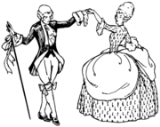
Minuet

Encyclopedia
.png)
Social dance
Social dance is a major category or classification of danceforms or dance styles, where sociability and socializing are the primary focuses of the dancing...
of French
France
The French Republic , The French Republic , The French Republic , (commonly known as France , is a unitary semi-presidential republic in Western Europe with several overseas territories and islands located on other continents and in the Indian, Pacific, and Atlantic oceans. Metropolitan France...
origin for two people, usually in 3/4 time
Time signature
The time signature is a notational convention used in Western musical notation to specify how many beats are in each measure and which note value constitutes one beat....
. The word was adapted from Italian
Italian language
Italian is a Romance language spoken mainly in Europe: Italy, Switzerland, San Marino, Vatican City, by minorities in Malta, Monaco, Croatia, Slovenia, France, Libya, Eritrea, and Somalia, and by immigrant communities in the Americas and Australia...
minuetto and French
French language
French is a Romance language spoken as a first language in France, the Romandy region in Switzerland, Wallonia and Brussels in Belgium, Monaco, the regions of Quebec and Acadia in Canada, and by various communities elsewhere. Second-language speakers of French are distributed throughout many parts...
menuet, and may have been from French menu meaning slender, small, referring to the very small steps, or from the early 17th-century popular group dances called branle à mener or amener.
The term also describes the musical form
Musical form
The term musical form refers to the overall structure or plan of a piece of music, and it describes the layout of a composition as divided into sections...
which accompanied the dance, and subsequently developed more fully, often with a longer structure called the minuet and trio.
Dance
The name may refer to the short steps, pas menus, taken in the dance, or else be derived from the branle à mener or amener, popular group dances in early 17th-century France (Little 2001). The minuet was traditionally said to have descended from the bransle de Poitou, though there is no evidence making a clear connection between these two dances. The earliest treatise to mention the possible connection of the name to the expression pas menus is Gottfried Taubert's Rechtschaffener Tantzmeister, published in Leipzig in 1717, but this source does not describe the steps as being particularly small or dainty (Russell 2006, 140–41). At the period when it was most fashionable it was slow, soft, ceremonious, and graceful.Rhythm and form
The name is also given to a musical composition written in the same time and rhythmRhythm
Rhythm may be generally defined as a "movement marked by the regulated succession of strong and weak elements, or of opposite or different conditions." This general meaning of regular recurrence or pattern in time may be applied to a wide variety of cyclical natural phenomena having a periodicity or...
, but when not accompanying an actual dance the pace was quicker. Stylistically refined minuets, apart from the social dance context , were introduced—to opera
Opera
Opera is an art form in which singers and musicians perform a dramatic work combining text and musical score, usually in a theatrical setting. Opera incorporates many of the elements of spoken theatre, such as acting, scenery, and costumes and sometimes includes dance...
at first—by Jean-Baptiste Lully
Jean-Baptiste Lully
Jean-Baptiste de Lully was an Italian-born French composer who spent most of his life working in the court of Louis XIV of France. He is considered the chief master of the French Baroque style. Lully disavowed any Italian influence in French music of the period. He became a French subject in...
, who included no less than 92 of them in his theatrical works (Little 2001) and in the late 17th century the minuet was adopted into the suite
Suite
In music, a suite is an ordered set of instrumental or orchestral pieces normally performed in a concert setting rather than as accompaniment; they may be extracts from an opera, ballet , or incidental music to a play or film , or they may be entirely original movements .In the...
, such as some of the suites of Johann Sebastian Bach
Johann Sebastian Bach
Johann Sebastian Bach was a German composer, organist, harpsichordist, violist, and violinist whose sacred and secular works for choir, orchestra, and solo instruments drew together the strands of the Baroque period and brought it to its ultimate maturity...
and George Frideric Händel
George Frideric Handel
George Frideric Handel was a German-British Baroque composer, famous for his operas, oratorios, anthems and organ concertos. Handel was born in 1685, in a family indifferent to music...
. Among Italian composers, the minuet was often considerably quicker and livelier, and was sometimes written in 3/8 or 6/8 time. Initially, before its adoption in contexts other than social dance, the minuet was usually in binary form
Binary form
Binary form is a musical form in two related sections, both of which are usually repeated. Binary is also a structure used to choreograph dance....
, with two sections of usually eight bars
Bar (music)
In musical notation, a bar is a segment of time defined by a given number of beats of a given duration. Typically, a piece consists of several bars of the same length, and in modern musical notation the number of beats in each bar is specified at the beginning of the score by the top number of a...
each, but the second section eventually expanded, resulting in a kind of ternary form
Ternary form
Ternary form, sometimes called song form, is a three-part musical form, usually schematicized as A-B-A. The first and third parts are musically identical, or very nearly so, while the second part in some way provides a contrast with them...
. On a larger scale, two such minuets were often combined, so that the first minuet was followed by a second one, and finally by a repetition of the first. The second (or middle) minuet usually provided some form of contrast, by means of different key and orchestration.
Minuet and trio
Around Lully's time, it became a common practice to score this middle section for a trioTrio (music)
Trio is generally used in any of the following ways:* A group of three musicians playing the same or different musical instrument.* The performance of a piece of music by three people.* The contrasting section of a piece in ternary form...
(such as two oboe
Oboe
The oboe is a double reed musical instrument of the woodwind family. In English, prior to 1770, the instrument was called "hautbois" , "hoboy", or "French hoboy". The spelling "oboe" was adopted into English ca...
s and a bassoon
Bassoon
The bassoon is a woodwind instrument in the double reed family that typically plays music written in the bass and tenor registers, and occasionally higher. Appearing in its modern form in the 19th century, the bassoon figures prominently in orchestral, concert band and chamber music literature...
, as is common in Lully). As a result, this middle section came to be called trio, even when no trace of such an orchestration remains. The overall structure is called rounded binary or minuet form (Rosen 1988, 29):
A :||: B A or A'
I(->V) :||: V(or other closely related
Closely related key
In music, a closely related key is one sharing many common tones with an original key, as opposed to a distantly related key...
) I
The minuet and trio eventually became the standard third movement in the four-movement classical symphony
Symphony
A symphony is an extended musical composition in Western classical music, scored almost always for orchestra. A symphony usually contains at least one movement or episode composed according to the sonata principle...
, Johann Stamitz
Johann Stamitz
Jan Václav Antonín Stamic was a Czech composer and violinist. Johann was the father of Carl Stamitz and Anton Stamitz, also composers...
being the first to employ it thus with regularity. A livelier form of the minuet later developed into the scherzo
Scherzo
A scherzo is a piece of music, often a movement from a larger piece such as a symphony or a sonata. The scherzo's precise definition has varied over the years, but it often refers to a movement which replaces the minuet as the third movement in a four-movement work, such as a symphony, sonata, or...
(which was generally also coupled with a trio). This term came into existence approximately from Beethoven
Ludwig van Beethoven
Ludwig van Beethoven was a German composer and pianist. A crucial figure in the transition between the Classical and Romantic eras in Western art music, he remains one of the most famous and influential composers of all time.Born in Bonn, then the capital of the Electorate of Cologne and part of...
onwards, but the form itself can be traced back to Haydn
Joseph Haydn
Franz Joseph Haydn , known as Joseph Haydn , was an Austrian composer, one of the most prolific and prominent composers of the Classical period. He is often called the "Father of the Symphony" and "Father of the String Quartet" because of his important contributions to these forms...
. An example of the true form of the minuet is to be found in Don Giovanni
Don Giovanni
Don Giovanni is an opera in two acts with music by Wolfgang Amadeus Mozart and with an Italian libretto by Lorenzo Da Ponte. It was premiered by the Prague Italian opera at the Teatro di Praga on October 29, 1787...
.
A famous example of a more recent instrumental work in minuet form is Ignacy Jan Paderewski
Ignacy Jan Paderewski
Ignacy Jan Paderewski GBE was a Polish pianist, composer, diplomat, politician, and the second Prime Minister of the Republic of Poland.-Biography:...
's Minuet in G
Minuet in G (Paderewski)
The Minuet in G, Op. 14/1, is a short piano composition by Ignacy Jan Paderewski, which became world-famous, overshadowing his more major works such as the Symphony in B minor "Polonia", the Piano Concerto in A minor, and the opera Manru....
.
Further reading
- Caplin, William Earl. 1998. Classical Form: A Theory of Formal Functions for the Instrumental Music of Haydn, Mozart, and Beethoven. New York: Oxford University Press. ISBN 0195104803 (cloth); ISBN 019514399X (pbk). (pp. 220ff).
- Elson, Louis Charles. 1908. The Theory of Music as Applied to the Teaching and Practice of Voice and Instruments, 21st edition. Boston: New England Conservatory of Music. (pp. 157ff).
External links
- Example of a Minuet Choreography: "Menuet à deux pour un homme et une femme", Raoul Auger Feuillet: Recueil de Dances (1704)