

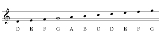
Clef

Encyclopedia

Musical notation
Music notation or musical notation is any system that represents aurally perceived music, through the use of written symbols.-History:...
used to indicate the pitch
Pitch (music)
Pitch is an auditory perceptual property that allows the ordering of sounds on a frequency-related scale.Pitches are compared as "higher" and "lower" in the sense associated with musical melodies,...
of written note
Note
In music, the term note has two primary meanings:#A sign used in musical notation to represent the relative duration and pitch of a sound;#A pitched sound itself....
s. Placed on one of the lines at the beginning of the staff
Staff (music)
In standard Western musical notation, the staff, or stave, is a set of five horizontal lines and four spaces that each represent a different musical pitch—or, in the case of a percussion staff, different percussion instruments. Appropriate music symbols, depending upon the intended effect,...
, it indicates the name and pitch of the notes on that line. This line serves as a reference point by which the names of the notes on any other line or space of the staff may be determined. Only one clef that references a note in a space rather than on a line has ever been used.
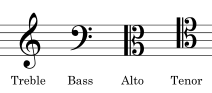
There are three types of clef used in modern music notation: F, C, and G. Each type of clef assigns a different reference note to the line on which it is placed.
| Clef | Name | Note | Line |
|---|---|---|---|
 |
G-clef | G4 | encircled by the curl of the clef. |
 |
C-clef | Middle C Middle C C or Do is the first note of the fixed-Do solfège scale. Its enharmonic is B.-Middle C:Middle C is designated C4 in scientific pitch notation because of the note's position as the fourth C key on a standard 88-key piano keyboard... (C4) |
that passes through the center of the clef. |
 |
F-clef | F3 | between the two dots of the clef. |
Once one of these clefs has been placed on one of the lines of the staff, the other lines and spaces can be read in relation to it.
The use of three different clefs makes it possible to write music for all instruments and voices, even though they may have very different tessitura
Tessitura
In music, the term tessitura generally describes the most musically acceptable and comfortable range for a given singer or, less frequently, musical instrument; the range in which a given type of voice presents its best-sounding texture or timbre...
s (that is, even though some sound much higher or lower than others). This would be difficult to do with only one clef, since the modern staff
Staff (music)
In standard Western musical notation, the staff, or stave, is a set of five horizontal lines and four spaces that each represent a different musical pitch—or, in the case of a percussion staff, different percussion instruments. Appropriate music symbols, depending upon the intended effect,...
has only five lines, and the number of pitches that can be represented on the staff, even with ledger lines, is not nearly equal to the number of notes the orchestra can produce. The use of different clefs for different instruments and voices allows each part to be written comfortably on the staff with a minimum of ledger lines. To this end, the G-clef is used for high parts, the C-clef for middle parts, and the F-clef for low parts - with the important exception of transposing parts, which are written at a different pitch than they sound, often even in a different octave.
Placement on the staff
In order to facilitate writing for different tessituras, any of the clefs may theoretically be placed on any of the lines of the staff. The further down on the staff a clef is placed, the higher the tessitura it is for; conversely, the higher up the clef, the lower the tessitura.Since there are five lines of the staff, and three clefs, it might seem that there would be fifteen possible clefs. Six of these, however, are redundant clefs (for example, a G-clef on the third line would be exactly the same as a C-clef on the first line). That leaves nine possible distinct clefs, all of which have been used historically: the G-clef on the two bottom lines, the F-clef on the three top lines, and the C-clef on any line of the staff except the topmost, earning the name of "movable C-clef". (The C-clef on the topmost line is redundant because it is exactly equivalent to the F-clef on the third line; both options have been used.)
Each of these clefs has a different name based on the tessitura for which it is best suited.

Individual clefs
Here follows a complete list of the clefs, along with a list of instruments and voice parts notated with them. Each clef is shown in its proper position on the staff, followed by its reference note.An obelus (†)
Dagger (typography)
A dagger, or obelisk. is a typographical symbol or glyph. The term "obelisk" derives from Greek , which means "little obelus"; from meaning "roasting spit"...
after the name of a clef indicates that that clef is now obsolete.
French violin clef†
When the G-clef is placed on the first line of the staff, it is called the French clef or French violin clef.This clef is no longer used. Formerly, it was used by the flute and violin, especially in parts published in France in the seventeenth and eighteenth centuries. Its placement causes the note names on the staff to be identical to those of the bass staff, although the pitches are two octaves higher.
Baritone clef†
When the F-clef is placed on the third line, it is called the baritone clef.This clef is no longer used. Previously, it was used to write the baritone part in vocal music.
Sub-bass clef†
When the F-clef is placed on the fifth line, it is called the sub-bass clef. The use of this clef gives the same note names as the treble clef, but the actual notes are two octaves lower.This clef is no longer used. Formerly, it was used to write low bass parts (e.g. in the works of Heinrich Schütz
Heinrich Schütz
Heinrich Schütz was a German composer and organist, generally regarded as the most important German composer before Johann Sebastian Bach and often considered to be one of the most important composers of the 17th century along with Claudio Monteverdi...
).
Baritone clef†
In the past, the C-clef was occasionally placed on the fifth line and called the baritone clef, like the baritone F-clef on the third line, to which it is exactly equivalent. Because of this equivalency, it was rarely used in the past; the baritone F-clef was used instead.Mezzo-soprano clef†
When the C-clef is placed on the second line of the staff, it is called the mezzo-soprano clef.This clef is no longer used. Formerly, it was used in vocal music to write mezzo-soprano parts.
Soprano clef†
When the C-clef occurs on the first line of the staff, it is called the soprano clef.This clef is no longer used. Formerly, it was used in vocal music to write soprano parts.
Octave clefs
Guitar
The guitar is a plucked string instrument, usually played with fingers or a pick. The guitar consists of a body with a rigid neck to which the strings, generally six in number, are attached. Guitars are traditionally constructed of various woods and strung with animal gut or, more recently, with...
; it has also been used for the tenor
Tenor
The tenor is a type of male singing voice and is the highest male voice within the modal register. The typical tenor voice lies between C3, the C one octave below middle C, to the A above middle C in choral music, and up to high C in solo work. The low extreme for tenors is roughly B2...
voice. To avoid ambiguity, modified clefs are sometimes used, especially in the context of choral
Choir
A choir, chorale or chorus is a musical ensemble of singers. Choral music, in turn, is the music written specifically for such an ensemble to perform.A body of singers who perform together as a group is called a choir or chorus...
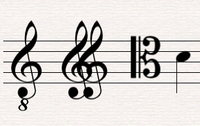
writing; of those shown, the C clef on the third space, easily confused with the tenor clef, is the rarest.
This is most often found in tenor parts in SATB
SATB
In music, SATB is an initialism for soprano, alto, tenor, bass, defining the voices required by a chorus or choir to perform a particular musical work...
settings, in which a treble clef is written with an eight below it, indicating that the pitches sound an octave below the written value. As the true tenor clef has generally fallen into disuse in vocal writings, this "octave-dropped" treble clef is often called the tenor clef. The same clef is sometimes used for the baritone horn. In some scores, the same concept is construed by using a double clef—two G-clefs overlapping one another.
At the other end of the spectrum, treble clefs with an 8 positioned above the clef may be used in piccolo, penny whistle, soprano recorder, and other high woodwind parts and is sometimes known (informally) as the "sopranino clef".
The F clef can also be notated with an octave marker. The F clef notated an octave down is sometimes used for contrabass instruments such as the double bass and contrabassoon
Contrabassoon
The contrabassoon, also known as the double bassoon or double-bassoon, is a larger version of the bassoon, sounding an octave lower...
and, as the traditional subbass clef has fallen into disuse, that term is sometimes used to describe this clef. The F clef notated an octave up is used for bass recorder
Recorder
The recorder is a woodwind musical instrument of the family known as fipple flutes or internal duct flutes—whistle-like instruments which include the tin whistle. The recorder is end-blown and the mouth of the instrument is constricted by a wooden plug, known as a block or fipple...
and sometimes, though seldom, used for countertenor parts and called the countertenor clef, as it is easy for a bass or baritone to read while singing the part in falsetto
Falsetto
Falsetto is the vocal register occupying the frequency range just above the modal voice register and overlapping with it by approximately one octave. It is produced by the vibration of the ligamentous edges of the vocal folds, in whole or in part...
. However, both of these are extremely rare (and in fact the countertenor clef is largely intended to be humorous as with the works of P.D.Q. Bach). The unmodified bass clef is so common that performers of instruments and voice parts whose ranges lie below the staff simply learn the number of ledger lines for each note through common use, and if a line's true notes lie significantly above the bass clef the composer or publisher will often simply write the part in either the true treble clef or notated an octave down.
Neutral clef

Percussion instrument
A percussion instrument is any object which produces a sound when hit with an implement or when it is shaken, rubbed, scraped, or otherwise acted upon in a way that sets the object into vibration...
with no precise pitch. With the exception of some common drum-kit and marching percussion layouts, the keying of lines and spaces to instruments is not standardized, so a legend or indications above the staff are necessary to indicate what is to be played. Percussion instruments with identifiable pitches do not use the neutral clef, and timpani (notated in bass clef) and mallet percussion (noted in treble clef or on a grand staff) are usually notated on different staves than unpitched percussion.
Staves with a neutral clef do not always have five lines. Commonly, percussion staves only have one line, although other configurations can be used.
The neutral clef is sometimes used when non-percussion instruments play non-pitched extended techniques, such as hitting the body of a violin, violoncello or acoustic guitar, or when a vocal choir is instructed to clap, stomp, or snap, but more often the rhythms are written with X marks in the instrument's normal staff with a note placed above as to the appropriate rhythmic action.
Tablature

Tablature
Tablature is a form of musical notation indicating instrument fingering rather than musical pitches....
in place of ordinary notes. In this case, a TAB-sign is often written instead of a clef. The number of lines of the staff is not necessarily five: one line is used for each string of the instrument (so, for standard six-stringed guitars, six lines would be used, four lines for the traditional bass guitar). Numbers on the lines show on which fret the string should be played. This Tab-sign, like the Percussion clef, is not a clef in the true sense, but rather a symbol employed instead of a clef.
History
The clefs developed at the same time as the staff, in the 10th century. Originally, instead of a special clef symbol, the reference line of the staff was simply labeled with the name of the note it was intended to bear: F and c (written as a small letter, since the capital C represented a note an octave lower) and, more rarely, g. These were the most often-used 'clefs', or litteræ-clavis (key-letters), in Gregorian chant notation. Over time the shapes of these letters became stylized, leading to their current versions.Many other clefs were used, particularly in the early period of chant notation, including most of the notes from the low Γ (gamma, the note written today on the bottom line of the bass clef) up to the G above middle C, written with a small letter g, and including two forms of lowercase b (for the note just below middle C): round for B, and square for B. In order of frequency of use, these clefs were: F, c, f, C, D, a, g, e, Γ, B, and the round/square b.
In the polyphonic period up to 1600, unusual clefs were used occasionally for parts with extremely high or low written tessituras. For very low bass parts, the Γ clef is found on the middle, fourth, or fifth lines of the staff (e.g., in Pierre de La Rue
Pierre de La Rue
Pierre de la Rue , called Piersson, was a Franco-Flemish composer and singer of the Renaissance. A member of the same generation as Josquin des Prez, and a long associate of the Habsburg-Burgundian musical chapel, he ranks with Agricola, Brumel, Compère, Isaac, Obrecht, and Weerbeke as one of the...
’s Requiem and in a mid-16th-century dance book published by the Hessen brothers); for very high parts, the high-D clef (d), and the even higher ff clef (e.g., in the Mulliner Book) were used to represent the notes written on the fourth and top lines of the treble clef, respectively.
Varying shapes of different clefs persisted until very recent times. The F-clef was, until as late as the 1970s in some cases (such as hymnals), written like this:

In printed music from the 16th and 17th centuries, the C clef often assumed a square form, like this 1639 tenor clef (the written note is a low E): .
The C-clef was formerly written in a more angular way, sometimes still used, or an even more simplified K-shape, when writing the clef by hand.

The flourish at the top of the G-clef probably derives from a cursive S for "sol", the name for "G" in solfege
Solfege
In music, solfège is a pedagogical solmization technique for the teaching of sight-singing in which each note of the score is sung to a special syllable, called a solfège syllable...
.
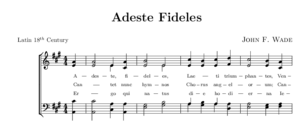
In more modern publications, four part harmony
Harmony
In music, harmony is the use of simultaneous pitches , or chords. The study of harmony involves chords and their construction and chord progressions and the principles of connection that govern them. Harmony is often said to refer to the "vertical" aspect of music, as distinguished from melodic...
on parallel staves is usually written more simply as:
- Soprano = treble clef (
2nd line G clef) - Alto = treble clef
- Tenor = treble clef with an "8" below or a double treble clef
- Bass = bass clef (
4th F clef)
This may be reduced to two staves, the soprano/alto staff with a treble clef, and tenor/bass staff marked with the bass clef.
Further uses
Clef combinations played a role in the modal system toward the end of the 16th century, and it has been suggested certain clef combinations in the polyphonic music of 16th-century vocal polyphony are reserved for authentic (odd-numbered) modes, and others for plagal (even-numbered) modes, but the precise implications have been the subject of much scholarly debate.Music can be transposed at sight if a different clef is mentally substituted for the written one. For example, to play an A-clarinet part, a B♭-clarinet player may mentally substitute tenor clef for the written treble clef. Concert-pitch music in bass clef can be read on a E♭ instrument as if it were in treble clef. (Notes will not always sound in the correct octave). The written key signature must always be adjusted to the correct key for the instrument being played.
Further reading
- Read, Gardner. 1964. Music Notation: A Manual of Modern Practice. Boston: Alleyn and Bacon, Inc. Second edition, Boston: Alleyn and Bacon, Inc., 1969., reprinted as A Crescendo Book, New York: Taplinger Pub. Co., 1979. ISBN 0800854594 (cloth), ISBN 0800854535 (pbk).