


Thai Chinese

Encyclopedia
The Thai Chinese are an overseas Chinese
community who live in Thailand
. Thailand is home to the largest, oldest, most prominent, and most integrated overseas Chinese community in the world with a population of approximately 9.5 million people. Most Thai Chinese have been in Thailand for five generations or more; the Thai-Chinese have been deeply ingrained into all elements of Thai society for the past 400 years. The present Thai royal family, the Chakri Dynastry, was founded by King Rama I who himself was partly Chinese. His predecessor, King Taksin
of Thonburi dynastry, was the son of Chinese immigrant from Guangdong
Province and was born with a Chinese name. Nearly all of Thai Chinese identify themselves as being Thai due to the highly successful integration of Chinese communities into Thai society. In addition, over half of ethnic Thais (the rest are southern Thai who are mostly of Malay descent) are descendants of people who migrated from southern China approximately 1,000 years ago and are directly associated, racially, culturally, and linguistically, with China's modern day ethnic minority group, the Dai people
.
Official statistics in 1987 shows that about 15% of Thailand's population claim to be of Chinese ethnicity. However, it is estimated that at least 30% - 40% (21 - 27 million people) of Thai population are of Chinese descent when taking into account people of mixed ancestry. The community is the best-integrated overseas Chinese community in the world and any type of racial conflict is close to non-existent. Contrary to its neighboring countries, Chinese culture and tradition are highly regarded and celebrated in Thailand as part of Thai culture itself. Nearly all of Chinese Thai are fully integrated. Unlike most other overseas Chinese communities, Thai Chinese consider themselves as being Thai rather Chinese and have little interest or knowledge of their Chinese roots. Up until 1980s, Thailand's have long restricted the use of Chinese names to gain citizenship and prohibited the teaching of Chinese language as to fully integrate Chinese immigrants into Thai society. As the result, more than 99% of Thai Chinese have only Thai names and no knowledge of Chinese language. Extensive intermarriages with the Thais
, especially in the past has resulted in many people who claim Chinese ethnicity with Thai ancestry, or mixed. People of Chinese descent are concentrated in the coastal areas of Thailand, principally Bangkok
. They are well-represented in all levels of Thai society and play a leading role in business and politics. The current prime minister is of Chinese descent as were a majority of the previous prime ministers. More than 80% of top 40 richest people in Thailand are Thai of full or partly Chinese descent. It is estimated that roughly 4% (~400,000 individuals) of Thai Chinese family are USD millionaire (USD 1 million or more of liquid financial assets such as cash and stocks).
Thai-Chinese run businesses are now the largest investor in China among all overseas Chinese community worldwide. Examples of these include. Charoen Pokphand
(CP Group), a Thai conglomerate with US$25 billion in annual sales founded by a Thai-Chinese Chearavanont family, is currently the single largest foreign investor in China with hundreds of businesses from agricultural food products, to retail and leisure, to industrial manufacturing and employing more than 150,000 people in China. It is known in China under the well-known household names such as the "Chia Tai Group" and "Zheng Da Ji Tuan". CP Group also owns and operates CP Lotus, one of the largest foreign invested hypermarket operators with 74 stores and 7 distribution centers throughout 30 cities across China. One of CP Group's flagship businesses in China is a USD400mm Super Brand Mall, the largest mall in the Shanghai's most exclusive area of Pudong business district. Reignwood Pine Valley, China's most exclusive golf and country clubs, are founded and owned by a Thai-Chinese business tycoon, Chanchai Rouyrungruen (operator of Red Bull drink business in China). It is cited as the most popular course in Asia and has held many international golf tournaments including Johnnie Walker Golf Tournament and visited by former US President Bill Clinton. In 2008, Mr. Chanchai became the first owner of corporate Jet in the Chinese mainland. Saha-Union, Thailand's leading industrial group, have so far invested over USD 1.5 billion in China, and operating over 11 power plants in three of China's provinces. With over other 30 businesses in China, the company employs approximately 7,000 Chinese workers. Central Group
, Thailand's largest operator of shopping centers (and owner of Italy's leading department store, La Rinascente
) with US$3.5 billion in annual sales founded by a Thai-Chinese Chirathivat family, have recently opened three new large scale department stores in China.
Slightly more than half of the ethnic Chinese population in Thailand trace their ancestry to the Chaozhou
prefecture in eastern Guangdong
. This is evidenced by the prevalence of the Minnan Chaozhou dialect among the Chinese in Thailand. A minority trace their ancestry to Hakka
and Hainanese immigrants.
Nearly all ethnic Chinese in Thailand speaks only Thai language
, but an extremely small number (mostly elders) are also conversant in Chinese with varying degrees of fluency. The Teochew dialect of Chinese is used as a commercial lingua franca among a very few elderly Chinese business circles, principally in Chinatown of Bangkok
.
The proficiency of the Thai language among the ethnic Chinese is attributed to the fact that Thai is a compulsory subject in all schools, while students from a handful of Chinese-medium schools (fewer than 0.1% of all schools) are more proficient in Chinese than those from other schools in general.
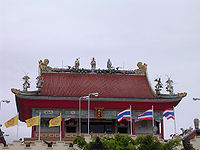 The first-generation Chinese immigrants were followers of Mahayana Buddhism and Taoism
. Theravada Buddhism has since become the religion of many ethnic Chinese in Thailand, especially among the assimilated Chinese. Very often, many Chinese in Thailand combine practices of Chinese folk religion with Theravada Buddhism. Major Chinese festivals such as Chinese New Year
, Mid-Autumn Festival
and Qingming
are widely celebrated especially in Bangkok, Phuket, and other parts of Thailand where there are large Chinese populations.
The Chinese in Phuket
are noted for their nine-day vegetarian festival between September and October. During the festive season, devotees will abstain from meat and Mortification of the flesh
by Chinese mediums are also commonly seen, and the rites and rituals seen are devoted to the veneration of Tua Pek Kong
. Such idiosyncratic traditions were developed during the 19th century in Phuket by the local Chinese with influences from Thai culture.
In the north, there are some Chinese people
who practice Islam
. They belong to a group of Chinese people
, known as Chin Ho
. Most of the Chinese Muslim are descended from Hui people
who live in Yunnan, China
. There are currently seven Chinese mosques in Chiang Mai
, one of them is Baan Haw Mosque
, a well known mosque in the north.
dates back many centuries. Chinese traders in Thailand, mostly from Fujian and Guangdong, began arriving in Ayutthaya
by at least the thirteenth century. According to the Chronicles of Ayutthaya, it was mentioned that King Ekathotsarot (r. 1605-1610) had been "concerned solely with ways of enriching his treasury," and was "greatly inclined toward strangers and foreign nations," especially Portugal
, Spain
, the Philippines
, China
, and Japan
.
Ayutthaya was under almost constant Burmese threat from the 16th century onwards, and Qianlong, the Emperor of Qing
was alarmed by the Burmese military might. From 1766-1769, Qianlong sent his armies four times to subdue the Burmese, but all four invasions failed. Ayutthaya thus fell to the Burmese in 1767. The Chinese efforts diverted the attention of Burma's Siam army, General Taksin
, who was the son of a Chinese immigrant, took advantage of the situation by organizing his force and attacking them. Taksin actively encouraged Chinese immigration and trade. Settlers principally from Chaozhou
prefecture came in large numbers.
The Chinese population in Thailand jumped from 230,000 in 1825 to 792,000 by 1910. By 1932, approximately 12.2% of the population of Thailand was Chinese.
However, early Chinese immigration consisted almost entirely of Chinese men who married Thai women. Children of such intermarriages were aptly called Sino-Thai or known as Luk-jin (ลูกจีน) in Thai. This tradition of Chinese-Thai intermarriage declined when large numbers of Chinese women began to emigrate into Thailand in the early 20th century.
 The corruption of the Qing Dynasty
and the massive population increase in China, along with very high taxes, caused many men to leave China for Thailand in search of work. If successful, they sent money back to their families in China. Many Chinese prospered under the "tax farming" system, whereby private individuals were sold the right to collect taxes at a price below the value of the tax revenues.
In the late 19th century, when Thailand was busy defending its independence from the colonial powers, Chinese bandits from Yunnan Province began raids into the country in the Haw wars
. Thai nationalist attitudes at all levels were accordingly colored by anti-Chinese sentiment. Members of the Chinese community had long dominated domestic commerce and had served as agents for the royal trade monopolies. With the rise of European economic influence, however, many Chinese shifted to the opium traffic and tax collecting, both of which were despised occupations. In addition, Chinese millers and rice traders were blamed for an economic recession that gripped Siam for nearly a decade after 1905. Accusations of bribery of officials, wars between the Chinese secret societies, and use of violent tactics to collect taxes served to foster Thai resentment against the Chinese at a time when the community was expanding rapidly due to immigration.
By 1910, nearly 10 percent of Thailand's population was Chinese. Moreover, the new arrivals frequently came in families and resisted assimilation. Chinese nationalism, encouraged by Sun Yat-sen
, the leader of the Chinese revolution, had also begun to develop, parallel with Thai nationalism. The Chinese community even supported a separate school system for its children.
Legislation by King Rama VI (1910-1925)
that required the adoption of Thai surnames was largely directed at easing tensions with Chinese community by encouraging assimilation. Thai Chinese had to choose between forsaking their Chinese identity or being regarded as foreigners. Most opted to become Thai.
A number of ethnic Chinese families left Burma between 1930 and 1950 and settled in the Ratchaburi
and Kanchanaburi Province
s of Western Thailand. A few of the ethnic Chinese families in that area had already emigrated from Burma in the 19th century. Ethnic Chinese families can be recognized by the shrines in their homes and shops, which are mostly located straight on the ground and painted in red, decorated with gold tinsel and small red lamps.
The Chinese in Thailand also suffered discrimination between the 1930s to 1950s under the military dictatorship of Prime Minister Plaek Pibulsonggram
, (in spite of being part-Chinese himself). State corporations took over commodities such as rice, tobacco and petroleum, and Chinese businesses found themselves subject to a range of new taxes and controls.
Nevertheless, the Chinese were still encouraged to become Thai citizens, and by 1970 it was estimated that more than 90 percent of the Chinese born in Thailand
had done so. When diplomatic relations were established with China in the 1970s, resident Chinese not born in Thailand were offered the chance of becoming Thai citizens. The remaining permanent resident Chinese alien population was then estimated at less than 200,000.
(also commonly spelled as Teochiu), 16% Hakka
and 11% Hainanese. The Cantonese
and Hokkien
each constitute 7% of the Chinese population, and 3% belong to other Chinese dialect groups.
The Teochews mainly settled around Chao Phraya River
in Bangkok
. Many of them worked in government sectors, while others were involved in trade. During the reign of King Taksin, some influential Teochew traders were granted certain privileges. These prominent traders were called "Royal Chinese" (Jin-luang in Thai).
The Hokkiens constitute the largest dialect group among the Chinese in Songkhla
and Phuket
, while the Hakkas
are mainly concentrated in Chiang Mai
, Phuket, and Central Western provinces. The Hakka own many private banks in Thailand, notably Kasikorn Bank
.
A large number of Thai Chinese are the descendants of intermarriages between Chinese immigrants and Thais, while there are others who are of predominantly or solely of Chinese descent. People who are of mainly Chinese descent are descendants of immigrants who relocated to Thailand as well as other parts of Nanyang
(the Chinese term for Southeast Asia used at the time) in the early to mid 20th century due to famine and civil war in the southern Chinese provinces of Guangdong
(Teochew, Cantonese, Hainan, Hakka groups) and Fujian
(Hokkien, Hakka). Among the ethnic Chinese, assimilation and adoption of Thai culture tends to take place among the Chinese who have a significant amount of Thai ancestry.
In the southern Thai provinces, notably the Chinese community in Phuket Province
, the assimilated group is known as Peranakan
s. These people share a similar culture and identity with the Peranakan Chinese in neighboring Indonesia
, Singapore
, and Malaysia. Ethnic Chinese in the Malay-dominated provinces in the south used Malay
, rather than Thai as their lingua franca, and occasionally intermarry with the local Malays.
Substantial numbers of Chinese people of (mainly) Yunnan
ese descent can be found in villages around Chiang Rai Province
. These are descendants of Kuomintang
soldiers who fought against the Chinese Communist
soldiers in the 1940s, before fleeing to the northern regions and settling among the local people. The Chinese Muslim community, also known as Haw
or Hui settled in parts of northern Thailand during the years of the Panthay Rebellion, who eventually formed a distinct community in Chiangmai by the late 1890s.
's name, Archa (horse) is the translation of the Chinese surname Ma
(馬). Another example is Sondhi Limthongkul
, where Lim
is the Hainanese pronunciation of the Chinese surname Lin
(林). Many Thai Chinese adopted long surnames to mimic the royal names formerly given to high officials by the kings. Ethnic Thais tend to have shorter surnames, though many have now changed them to longer ones. Thai Chinese generally adopted Thai surnames to assist in assimilating into society. When choosing a surname, they would often combine auspicious Thai words with their original Chinese surname.
Overseas Chinese
Overseas Chinese are people of Chinese birth or descent who live outside the Greater China Area . People of partial Chinese ancestry living outside the Greater China Area may also consider themselves Overseas Chinese....
community who live in Thailand
Thailand
Thailand , officially the Kingdom of Thailand , formerly known as Siam , is a country located at the centre of the Indochina peninsula and Southeast Asia. It is bordered to the north by Burma and Laos, to the east by Laos and Cambodia, to the south by the Gulf of Thailand and Malaysia, and to the...
. Thailand is home to the largest, oldest, most prominent, and most integrated overseas Chinese community in the world with a population of approximately 9.5 million people. Most Thai Chinese have been in Thailand for five generations or more; the Thai-Chinese have been deeply ingrained into all elements of Thai society for the past 400 years. The present Thai royal family, the Chakri Dynastry, was founded by King Rama I who himself was partly Chinese. His predecessor, King Taksin
Taksin
Taksin ; was the only King of the Thonburi Kingdom...
of Thonburi dynastry, was the son of Chinese immigrant from Guangdong
Guangdong
Guangdong is a province on the South China Sea coast of the People's Republic of China. The province was previously often written with the alternative English name Kwangtung Province...
Province and was born with a Chinese name. Nearly all of Thai Chinese identify themselves as being Thai due to the highly successful integration of Chinese communities into Thai society. In addition, over half of ethnic Thais (the rest are southern Thai who are mostly of Malay descent) are descendants of people who migrated from southern China approximately 1,000 years ago and are directly associated, racially, culturally, and linguistically, with China's modern day ethnic minority group, the Dai people
Dai people
The Dai peoples is one of several ethnic groups living in the Xishuangbanna Dai Autonomous Prefecture and the Dehong Dai and Jingpo Autonomous Prefecture , but by extension can apply to groups in Laos, Vietnam, Thailand, and Burma when Dai is used to mean specifically Tai Lue, Chinese Shan or even...
.
Official statistics in 1987 shows that about 15% of Thailand's population claim to be of Chinese ethnicity. However, it is estimated that at least 30% - 40% (21 - 27 million people) of Thai population are of Chinese descent when taking into account people of mixed ancestry. The community is the best-integrated overseas Chinese community in the world and any type of racial conflict is close to non-existent. Contrary to its neighboring countries, Chinese culture and tradition are highly regarded and celebrated in Thailand as part of Thai culture itself. Nearly all of Chinese Thai are fully integrated. Unlike most other overseas Chinese communities, Thai Chinese consider themselves as being Thai rather Chinese and have little interest or knowledge of their Chinese roots. Up until 1980s, Thailand's have long restricted the use of Chinese names to gain citizenship and prohibited the teaching of Chinese language as to fully integrate Chinese immigrants into Thai society. As the result, more than 99% of Thai Chinese have only Thai names and no knowledge of Chinese language. Extensive intermarriages with the Thais
Thai people
The Thai people, or Siamese, are the main ethnic group of Thailand and are part of the larger Tai ethnolinguistic peoples found in Thailand and adjacent countries in Southeast Asia as well as southern China. Their language is the Thai language, which is classified as part of the Kradai family of...
, especially in the past has resulted in many people who claim Chinese ethnicity with Thai ancestry, or mixed. People of Chinese descent are concentrated in the coastal areas of Thailand, principally Bangkok
Bangkok
Bangkok is the capital and largest urban area city in Thailand. It is known in Thai as Krung Thep Maha Nakhon or simply Krung Thep , meaning "city of angels." The full name of Bangkok is Krung Thep Mahanakhon Amon Rattanakosin Mahintharayutthaya Mahadilok Phop Noppharat Ratchathani Burirom...
. They are well-represented in all levels of Thai society and play a leading role in business and politics. The current prime minister is of Chinese descent as were a majority of the previous prime ministers. More than 80% of top 40 richest people in Thailand are Thai of full or partly Chinese descent. It is estimated that roughly 4% (~400,000 individuals) of Thai Chinese family are USD millionaire (USD 1 million or more of liquid financial assets such as cash and stocks).
Thai-Chinese run businesses are now the largest investor in China among all overseas Chinese community worldwide. Examples of these include. Charoen Pokphand
Charoen Pokphand
The Charoen Pokphand Group is a transnational conglomerate that consists of three core businesses that operate in the agribusiness and food, retail and distribution, and the telecommunications industries with investment in 15 countries. Founded in 1921, the CP Group currently employs over 280,000...
(CP Group), a Thai conglomerate with US$25 billion in annual sales founded by a Thai-Chinese Chearavanont family, is currently the single largest foreign investor in China with hundreds of businesses from agricultural food products, to retail and leisure, to industrial manufacturing and employing more than 150,000 people in China. It is known in China under the well-known household names such as the "Chia Tai Group" and "Zheng Da Ji Tuan". CP Group also owns and operates CP Lotus, one of the largest foreign invested hypermarket operators with 74 stores and 7 distribution centers throughout 30 cities across China. One of CP Group's flagship businesses in China is a USD400mm Super Brand Mall, the largest mall in the Shanghai's most exclusive area of Pudong business district. Reignwood Pine Valley, China's most exclusive golf and country clubs, are founded and owned by a Thai-Chinese business tycoon, Chanchai Rouyrungruen (operator of Red Bull drink business in China). It is cited as the most popular course in Asia and has held many international golf tournaments including Johnnie Walker Golf Tournament and visited by former US President Bill Clinton. In 2008, Mr. Chanchai became the first owner of corporate Jet in the Chinese mainland. Saha-Union, Thailand's leading industrial group, have so far invested over USD 1.5 billion in China, and operating over 11 power plants in three of China's provinces. With over other 30 businesses in China, the company employs approximately 7,000 Chinese workers. Central Group
Central Group
The Central Group of Companies is a family-owned conglomerate holding company in Thailand that is involved in retailing, real estate, hotels and restaurants...
, Thailand's largest operator of shopping centers (and owner of Italy's leading department store, La Rinascente
La Rinascente
La Rinascente is a Thai owned Italian retailer operating upscale department stores in the area of clothing, household and beauty products, founded in Milan in 1865 by Luigi and Ferdinando Bocconi....
) with US$3.5 billion in annual sales founded by a Thai-Chinese Chirathivat family, have recently opened three new large scale department stores in China.
Slightly more than half of the ethnic Chinese population in Thailand trace their ancestry to the Chaozhou
Chaozhou
Chaozhou is a city in eastern Guangdong province of the People's Republic of China. It borders Shantou to the south, Jieyang to the southwest, Meizhou to the northwest, the province of Fujian to the east, and the South China Sea to the southeast...
prefecture in eastern Guangdong
Guangdong
Guangdong is a province on the South China Sea coast of the People's Republic of China. The province was previously often written with the alternative English name Kwangtung Province...
. This is evidenced by the prevalence of the Minnan Chaozhou dialect among the Chinese in Thailand. A minority trace their ancestry to Hakka
Hakka people
The Hakka , sometimes Hakka Han, are Han Chinese who speak the Hakka language and have links to the provincial areas of Guangdong, Jiangxi, Guangxi, Sichuan, Hunan and Fujian in China....
and Hainanese immigrants.
Nearly all ethnic Chinese in Thailand speaks only Thai language
Thai language
Thai , also known as Central Thai and Siamese, is the national and official language of Thailand and the native language of the Thai people, Thailand's dominant ethnic group. Thai is a member of the Tai group of the Tai–Kadai language family. Historical linguists have been unable to definitively...
, but an extremely small number (mostly elders) are also conversant in Chinese with varying degrees of fluency. The Teochew dialect of Chinese is used as a commercial lingua franca among a very few elderly Chinese business circles, principally in Chinatown of Bangkok
Bangkok
Bangkok is the capital and largest urban area city in Thailand. It is known in Thai as Krung Thep Maha Nakhon or simply Krung Thep , meaning "city of angels." The full name of Bangkok is Krung Thep Mahanakhon Amon Rattanakosin Mahintharayutthaya Mahadilok Phop Noppharat Ratchathani Burirom...
.
The proficiency of the Thai language among the ethnic Chinese is attributed to the fact that Thai is a compulsory subject in all schools, while students from a handful of Chinese-medium schools (fewer than 0.1% of all schools) are more proficient in Chinese than those from other schools in general.
Religion
Taoism
Taoism refers to a philosophical or religious tradition in which the basic concept is to establish harmony with the Tao , which is the mechanism of everything that exists...
. Theravada Buddhism has since become the religion of many ethnic Chinese in Thailand, especially among the assimilated Chinese. Very often, many Chinese in Thailand combine practices of Chinese folk religion with Theravada Buddhism. Major Chinese festivals such as Chinese New Year
Chinese New Year
Chinese New Year – often called Chinese Lunar New Year although it actually is lunisolar – is the most important of the traditional Chinese holidays. It is an all East and South-East-Asia celebration...
, Mid-Autumn Festival
Mid-Autumn Festival
The Mid-Autumn Festival , also known as the Moon Festival or Mooncake Festival or Zhongqiu Festival, is a popular lunar harvest festival celebrated by Chinese and Vietnamese people. A description of the festival first appeared in Rites of Zhou, a written collection of rituals of the Western Zhou...
and Qingming
Qingming
Traditional East Asian lunisolar calendars divide a year into 24 solar terms . Qīngmíng or Chīngmíng or Seimei is the 5th solar term. It begins when the Sun reaches the celestial longitude of 15° and ends when it reaches the longitude of 30°...
are widely celebrated especially in Bangkok, Phuket, and other parts of Thailand where there are large Chinese populations.
The Chinese in Phuket
Phuket City
Phuket is a city located in the southeast of Phuket Island, Thailand. It is the capital of the Phuket Province, covering all of the island. As of 2007 the city has a population of 75,573 people...
are noted for their nine-day vegetarian festival between September and October. During the festive season, devotees will abstain from meat and Mortification of the flesh
Mortification of the flesh
Mortification of the flesh literally means "putting the flesh to death". The term is primarily used in religious and spiritual contexts. The institutional and traditional terminology of this practice in Catholicism is corporal mortification....
by Chinese mediums are also commonly seen, and the rites and rituals seen are devoted to the veneration of Tua Pek Kong
Tua Pek Kong
Tua Pek Kong , literally means "Grand Uncle", is one of the pantheon of Malaysian Chinese Gods. It was believed the date Tua Pek Kong arrived in Penang was 40 years before Francis Light in 1746.Tua Pek Kong was a man named Zhang Li from the Hakka clan...
. Such idiosyncratic traditions were developed during the 19th century in Phuket by the local Chinese with influences from Thai culture.
In the north, there are some Chinese people
Chinese people
The term Chinese people may refer to any of the following:*People with Han Chinese ethnicity ....
who practice Islam
Islam
Islam . The most common are and . : Arabic pronunciation varies regionally. The first vowel ranges from ~~. The second vowel ranges from ~~~...
. They belong to a group of Chinese people
Chinese people
The term Chinese people may refer to any of the following:*People with Han Chinese ethnicity ....
, known as Chin Ho
Chin Haw
Chin Haw or Chin Ho are Chinese people who migrated to Thailand via Burma or Laos. Most of them were from Yunnan, the southern province of China.- Migration :...
. Most of the Chinese Muslim are descended from Hui people
Hui people
The Hui people are an ethnic group in China, defined as Chinese speaking people descended from foreign Muslims. They are typically distinguished by their practice of Islam, however some also practice other religions, and many are direct descendants of Silk Road travelers.In modern People's...
who live in Yunnan, China
Yunnan
Yunnan is a province of the People's Republic of China, located in the far southwest of the country spanning approximately and with a population of 45.7 million . The capital of the province is Kunming. The province borders Burma, Laos, and Vietnam.Yunnan is situated in a mountainous area, with...
. There are currently seven Chinese mosques in Chiang Mai
Chiang Mai
Chiang Mai sometimes written as "Chiengmai" or "Chiangmai", is the largest and most culturally significant city in northern Thailand. It is the capital of Chiang Mai Province , a former capital of the Kingdom of Lanna and was the tributary Kingdom of Chiang Mai from 1774 until 1939. It is...
, one of them is Baan Haw Mosque
Baan Haw Mosque
Hedaytul Islam Mosque , located at Night Bazaar in Chiang Mai, is one of the biggest mosques in the province, and also one of the seven Chinese mosques in Chiang Mai.-History:...
, a well known mosque in the north.
History
The history of Chinese immigration to ThailandThailand
Thailand , officially the Kingdom of Thailand , formerly known as Siam , is a country located at the centre of the Indochina peninsula and Southeast Asia. It is bordered to the north by Burma and Laos, to the east by Laos and Cambodia, to the south by the Gulf of Thailand and Malaysia, and to the...
dates back many centuries. Chinese traders in Thailand, mostly from Fujian and Guangdong, began arriving in Ayutthaya
Ayutthaya kingdom
Ayutthaya was a Siamese kingdom that existed from 1350 to 1767. Ayutthaya was friendly towards foreign traders, including the Chinese, Vietnamese , Indians, Japanese and Persians, and later the Portuguese, Spanish, Dutch and French, permitting them to set up villages outside the walls of the...
by at least the thirteenth century. According to the Chronicles of Ayutthaya, it was mentioned that King Ekathotsarot (r. 1605-1610) had been "concerned solely with ways of enriching his treasury," and was "greatly inclined toward strangers and foreign nations," especially Portugal
Portugal
Portugal , officially the Portuguese Republic is a country situated in southwestern Europe on the Iberian Peninsula. Portugal is the westernmost country of Europe, and is bordered by the Atlantic Ocean to the West and South and by Spain to the North and East. The Atlantic archipelagos of the...
, Spain
Spain
Spain , officially the Kingdom of Spain languages]] under the European Charter for Regional or Minority Languages. In each of these, Spain's official name is as follows:;;;;;;), is a country and member state of the European Union located in southwestern Europe on the Iberian Peninsula...
, the Philippines
Philippines
The Philippines , officially known as the Republic of the Philippines , is a country in Southeast Asia in the western Pacific Ocean. To its north across the Luzon Strait lies Taiwan. West across the South China Sea sits Vietnam...
, China
China
Chinese civilization may refer to:* China for more general discussion of the country.* Chinese culture* Greater China, the transnational community of ethnic Chinese.* History of China* Sinosphere, the area historically affected by Chinese culture...
, and Japan
Japan
Japan is an island nation in East Asia. Located in the Pacific Ocean, it lies to the east of the Sea of Japan, China, North Korea, South Korea and Russia, stretching from the Sea of Okhotsk in the north to the East China Sea and Taiwan in the south...
.
Ayutthaya was under almost constant Burmese threat from the 16th century onwards, and Qianlong, the Emperor of Qing
Qing Dynasty
The Qing Dynasty was the last dynasty of China, ruling from 1644 to 1912 with a brief, abortive restoration in 1917. It was preceded by the Ming Dynasty and followed by the Republic of China....
was alarmed by the Burmese military might. From 1766-1769, Qianlong sent his armies four times to subdue the Burmese, but all four invasions failed. Ayutthaya thus fell to the Burmese in 1767. The Chinese efforts diverted the attention of Burma's Siam army, General Taksin
Taksin
Taksin ; was the only King of the Thonburi Kingdom...
, who was the son of a Chinese immigrant, took advantage of the situation by organizing his force and attacking them. Taksin actively encouraged Chinese immigration and trade. Settlers principally from Chaozhou
Chaozhou
Chaozhou is a city in eastern Guangdong province of the People's Republic of China. It borders Shantou to the south, Jieyang to the southwest, Meizhou to the northwest, the province of Fujian to the east, and the South China Sea to the southeast...
prefecture came in large numbers.
The Chinese population in Thailand jumped from 230,000 in 1825 to 792,000 by 1910. By 1932, approximately 12.2% of the population of Thailand was Chinese.
However, early Chinese immigration consisted almost entirely of Chinese men who married Thai women. Children of such intermarriages were aptly called Sino-Thai or known as Luk-jin (ลูกจีน) in Thai. This tradition of Chinese-Thai intermarriage declined when large numbers of Chinese women began to emigrate into Thailand in the early 20th century.
Qing Dynasty
The Qing Dynasty was the last dynasty of China, ruling from 1644 to 1912 with a brief, abortive restoration in 1917. It was preceded by the Ming Dynasty and followed by the Republic of China....
and the massive population increase in China, along with very high taxes, caused many men to leave China for Thailand in search of work. If successful, they sent money back to their families in China. Many Chinese prospered under the "tax farming" system, whereby private individuals were sold the right to collect taxes at a price below the value of the tax revenues.
In the late 19th century, when Thailand was busy defending its independence from the colonial powers, Chinese bandits from Yunnan Province began raids into the country in the Haw wars
Haw wars
The Haw Wars , so called in Thai, were fought against Chinese quasi-military forces invading parts of Tonkin and Thailand between the years 1865 and 1890.-Invasion of the flags:...
. Thai nationalist attitudes at all levels were accordingly colored by anti-Chinese sentiment. Members of the Chinese community had long dominated domestic commerce and had served as agents for the royal trade monopolies. With the rise of European economic influence, however, many Chinese shifted to the opium traffic and tax collecting, both of which were despised occupations. In addition, Chinese millers and rice traders were blamed for an economic recession that gripped Siam for nearly a decade after 1905. Accusations of bribery of officials, wars between the Chinese secret societies, and use of violent tactics to collect taxes served to foster Thai resentment against the Chinese at a time when the community was expanding rapidly due to immigration.
By 1910, nearly 10 percent of Thailand's population was Chinese. Moreover, the new arrivals frequently came in families and resisted assimilation. Chinese nationalism, encouraged by Sun Yat-sen
Sun Yat-sen
Sun Yat-sen was a Chinese doctor, revolutionary and political leader. As the foremost pioneer of Nationalist China, Sun is frequently referred to as the "Father of the Nation" , a view agreed upon by both the People's Republic of China and the Republic of China...
, the leader of the Chinese revolution, had also begun to develop, parallel with Thai nationalism. The Chinese community even supported a separate school system for its children.
Legislation by King Rama VI (1910-1925)
Vajiravudh
Phra Bat Somdet Phra Poramentharamaha Vajiravudh Phra Mongkut Klao Chao Yu Hua , or Phra Bat Somdet Phra Ramathibodi Si Sintharamaha Vajiravudh Phra Mongkut Klao Chao Yu Hua , or Rama VI was the sixth monarch of Siam under the House of Chakri, ruling from 1910 until his death...
that required the adoption of Thai surnames was largely directed at easing tensions with Chinese community by encouraging assimilation. Thai Chinese had to choose between forsaking their Chinese identity or being regarded as foreigners. Most opted to become Thai.
A number of ethnic Chinese families left Burma between 1930 and 1950 and settled in the Ratchaburi
Ratchaburi Province
Ratchaburi is one of the central provinces of Thailand. Neighboring provinces are Kanchanaburi, Nakhon Pathom,Samut Sakhon, Samut Songkhram and Phetchaburi...
and Kanchanaburi Province
Kanchanaburi Province
- History :Archaeology found in Kanchanaburi dates back to the 4th century which proves of trade with surrounding countries even in that time. Very little is also historically known about the actual Khmer influence in Kanchanaburi but there is evidence of their occupation with Prasat Muang Singh –...
s of Western Thailand. A few of the ethnic Chinese families in that area had already emigrated from Burma in the 19th century. Ethnic Chinese families can be recognized by the shrines in their homes and shops, which are mostly located straight on the ground and painted in red, decorated with gold tinsel and small red lamps.
The Chinese in Thailand also suffered discrimination between the 1930s to 1950s under the military dictatorship of Prime Minister Plaek Pibulsonggram
Plaek Pibulsonggram
Field Marshal Plaek Pibunsongkhram , often known as Phibun Songkhram or simply Phibun in English, was Prime Minister and virtual military dictator of Thailand from 1938 to 1944 and 1948 to 1957.- Early years :...
, (in spite of being part-Chinese himself). State corporations took over commodities such as rice, tobacco and petroleum, and Chinese businesses found themselves subject to a range of new taxes and controls.
Nevertheless, the Chinese were still encouraged to become Thai citizens, and by 1970 it was estimated that more than 90 percent of the Chinese born in Thailand
Thailand
Thailand , officially the Kingdom of Thailand , formerly known as Siam , is a country located at the centre of the Indochina peninsula and Southeast Asia. It is bordered to the north by Burma and Laos, to the east by Laos and Cambodia, to the south by the Gulf of Thailand and Malaysia, and to the...
had done so. When diplomatic relations were established with China in the 1970s, resident Chinese not born in Thailand were offered the chance of becoming Thai citizens. The remaining permanent resident Chinese alien population was then estimated at less than 200,000.
Dialect groups
The vast majority of the Thai Chinese belong to various southern Chinese dialect groups. Of these, 56% are TeochewTeochew people
The Chaozhou people are Han people, native to the Chaoshan region of eastern Guangdong province of China who speak the Teochew dialect. Today, most Teochew people live outside China in Southeast Asia especially in Singapore, Thailand, and Malaysia. They can also be found almost anywhere in the...
(also commonly spelled as Teochiu), 16% Hakka
Hakka people
The Hakka , sometimes Hakka Han, are Han Chinese who speak the Hakka language and have links to the provincial areas of Guangdong, Jiangxi, Guangxi, Sichuan, Hunan and Fujian in China....
and 11% Hainanese. The Cantonese
Cantonese people
The Cantonese people are Han people whose ancestral homes are in Guangdong, China. The term "Cantonese people" would then be synonymous with the Bun Dei sub-ethnic group, and is sometimes known as Gwong Fu Jan for this narrower definition...
and Hokkien
Hoklo people
The Hoklo people are Han Chinese people whose traditional Ancestral homes are in southern Fujian of South China...
each constitute 7% of the Chinese population, and 3% belong to other Chinese dialect groups.
The Teochews mainly settled around Chao Phraya River
Chao Phraya River
The Chao Phraya is a major river in Thailand, with its low alluvial plain forming the centre of the country. It runs through Bangkok, the capital city, and then empties into the Gulf of Thailand.-Etymology:...
in Bangkok
Bangkok
Bangkok is the capital and largest urban area city in Thailand. It is known in Thai as Krung Thep Maha Nakhon or simply Krung Thep , meaning "city of angels." The full name of Bangkok is Krung Thep Mahanakhon Amon Rattanakosin Mahintharayutthaya Mahadilok Phop Noppharat Ratchathani Burirom...
. Many of them worked in government sectors, while others were involved in trade. During the reign of King Taksin, some influential Teochew traders were granted certain privileges. These prominent traders were called "Royal Chinese" (Jin-luang in Thai).
The Hokkiens constitute the largest dialect group among the Chinese in Songkhla
Songkhla
Songkhla is a city in the Songkhla Province of southern Thailand, near the border with Malaysia. As of 2006 it had a population of 75,048...
and Phuket
Phuket Province
Phuket , formerly known as Thalang and, in Western sources, Junk Ceylon , is one of the southern provinces of Thailand...
, while the Hakkas
Hakka people
The Hakka , sometimes Hakka Han, are Han Chinese who speak the Hakka language and have links to the provincial areas of Guangdong, Jiangxi, Guangxi, Sichuan, Hunan and Fujian in China....
are mainly concentrated in Chiang Mai
Chiang Mai
Chiang Mai sometimes written as "Chiengmai" or "Chiangmai", is the largest and most culturally significant city in northern Thailand. It is the capital of Chiang Mai Province , a former capital of the Kingdom of Lanna and was the tributary Kingdom of Chiang Mai from 1774 until 1939. It is...
, Phuket, and Central Western provinces. The Hakka own many private banks in Thailand, notably Kasikorn Bank
Kasikorn Bank
Kasikornbank Public Company Limited formerly known as the Thai Farmers Bank was established on 8 June 1945 by Choti Lamsam, with registered capital of Baht 5 million and has been listed on the Stock Exchange of Thailand since 1976...
.
A large number of Thai Chinese are the descendants of intermarriages between Chinese immigrants and Thais, while there are others who are of predominantly or solely of Chinese descent. People who are of mainly Chinese descent are descendants of immigrants who relocated to Thailand as well as other parts of Nanyang
Nanyang (geographical region)
Nanyang is the Chinese name for the geographical region south of China, particularly Southeast Asia. Literally meaning "Southern Ocean", it came into common usage in self-reference to the large ethnic Chinese migrant population in Southeast Asia, to be more precise, in Singapore, the Philippines,...
(the Chinese term for Southeast Asia used at the time) in the early to mid 20th century due to famine and civil war in the southern Chinese provinces of Guangdong
Guangdong
Guangdong is a province on the South China Sea coast of the People's Republic of China. The province was previously often written with the alternative English name Kwangtung Province...
(Teochew, Cantonese, Hainan, Hakka groups) and Fujian
Fujian
' , formerly romanised as Fukien or Huguing or Foukien, is a province on the southeast coast of mainland China. Fujian is bordered by Zhejiang to the north, Jiangxi to the west, and Guangdong to the south. Taiwan lies to the east, across the Taiwan Strait...
(Hokkien, Hakka). Among the ethnic Chinese, assimilation and adoption of Thai culture tends to take place among the Chinese who have a significant amount of Thai ancestry.
In the southern Thai provinces, notably the Chinese community in Phuket Province
Phuket Province
Phuket , formerly known as Thalang and, in Western sources, Junk Ceylon , is one of the southern provinces of Thailand...
, the assimilated group is known as Peranakan
Peranakan
Peranakan Chinese and Baba-Nyonya are terms used for the descendants of late 15th and 16th-century Chinese immigrants to the Indonesian archipelago of Nusantara during the Colonial era....
s. These people share a similar culture and identity with the Peranakan Chinese in neighboring Indonesia
Indonesia
Indonesia , officially the Republic of Indonesia , is a country in Southeast Asia and Oceania. Indonesia is an archipelago comprising approximately 13,000 islands. It has 33 provinces with over 238 million people, and is the world's fourth most populous country. Indonesia is a republic, with an...
, Singapore
Singapore
Singapore , officially the Republic of Singapore, is a Southeast Asian city-state off the southern tip of the Malay Peninsula, north of the equator. An island country made up of 63 islands, it is separated from Malaysia by the Straits of Johor to its north and from Indonesia's Riau Islands by the...
, and Malaysia. Ethnic Chinese in the Malay-dominated provinces in the south used Malay
Malay language
Malay is a major language of the Austronesian family. It is the official language of Malaysia , Indonesia , Brunei and Singapore...
, rather than Thai as their lingua franca, and occasionally intermarry with the local Malays.
Substantial numbers of Chinese people of (mainly) Yunnan
Yunnan
Yunnan is a province of the People's Republic of China, located in the far southwest of the country spanning approximately and with a population of 45.7 million . The capital of the province is Kunming. The province borders Burma, Laos, and Vietnam.Yunnan is situated in a mountainous area, with...
ese descent can be found in villages around Chiang Rai Province
Chiang Rai Province
Chiang Rai is the northernmost province of Thailand. Neighbouring provinces are Phayao, Lampang and Chiang Mai. In the north it borders Shan State of Myanmar and Bokeo of Laos.-Geography:...
. These are descendants of Kuomintang
Kuomintang
The Kuomintang of China , sometimes romanized as Guomindang via the Pinyin transcription system or GMD for short, and translated as the Chinese Nationalist Party is a founding and ruling political party of the Republic of China . Its guiding ideology is the Three Principles of the People, espoused...
soldiers who fought against the Chinese Communist
Communist Party of China
The Communist Party of China , also known as the Chinese Communist Party , is the founding and ruling political party of the People's Republic of China...
soldiers in the 1940s, before fleeing to the northern regions and settling among the local people. The Chinese Muslim community, also known as Haw
Chin Haw
Chin Haw or Chin Ho are Chinese people who migrated to Thailand via Burma or Laos. Most of them were from Yunnan, the southern province of China.- Migration :...
or Hui settled in parts of northern Thailand during the years of the Panthay Rebellion, who eventually formed a distinct community in Chiangmai by the late 1890s.
Surnames
Thai Chinese can often be recognized by having a surname containing the original Chinese name or its translation. In former prime minister Banharn Silpa-ArchaBanharn Silpa-Archa
Banharn Silpa-archa was the 21st Prime Minister of Thailand, from 13 July 1995 to 24 November 1996. He has been a veteran Sino-Thai Member of Parliament since 1976 as the elected representative of Suphanburi province...
's name, Archa (horse) is the translation of the Chinese surname Ma
Ma (surname)
Ma is one of the most common Chinese family names. As of 2006, it ranks as the 14th most common Chinese surname in Mainland China and the most common surname within the Chinese Muslim community, specifically the Hui people, Dongxiang people, and Salar people...
(馬). Another example is Sondhi Limthongkul
Sondhi Limthongkul
Sondhi Limthongkul is a Thai media mogul and leader of the right-wing People's Alliance for Democracy . He was elected for leader of the New Politics Party ....
, where Lim
Lin (surname)
Lín Lin is the second most common surname in Taiwan at 9% of the population, second only to Chen. In mainland China , Lin is generally less common.-Name origin:...
is the Hainanese pronunciation of the Chinese surname Lin
Lin (surname)
Lín Lin is the second most common surname in Taiwan at 9% of the population, second only to Chen. In mainland China , Lin is generally less common.-Name origin:...
(林). Many Thai Chinese adopted long surnames to mimic the royal names formerly given to high officials by the kings. Ethnic Thais tend to have shorter surnames, though many have now changed them to longer ones. Thai Chinese generally adopted Thai surnames to assist in assimilating into society. When choosing a surname, they would often combine auspicious Thai words with their original Chinese surname.
External links
Associations
- The Chinese Association in Thailand (Chong Hua)
- Teochew Association of Thailand
- Hakka Association of Thailand Thai Hainan Trade association of Thailand
- Fujian Association of Thailand