
All Topics  
Speed limit


   Email Print
   Bookmark   Link


Speed limit


A road speed limit is the maximum speed allowed by law
LAW

LAW may refer to:* Anti-tank warfare, e.g. the US Army M72 LAW or the British Army LAW 80*Palestinian Society for the Protection of Human Rights ...
 for road vehicles. Speed limits are commonly set and enforced by the legislative bodies
Legislature

Legislature is a type of representative deliberative assembly with the power to create and change laws. The law created by a legislature is called legislation or statutory law....
 of nations or provincial governments, such as countries within the world.

In addition to setting an explicit maximum speed limit, most governments also enforce speed limits that are related to driving conditions; for example, requiring drivers to adjust their speed when driving in fog
Fog

Fog is a cloud bank that is in contact with the ground. A cloud may be considered partly fog; for example, the part of a cloud that is suspended in the air above the ground is not considered fog, whereas the part of the cloud that comes in contact with higher ground is considered fog....
 or heavy rain
Rain

Rain is liquid precipitation . On Earth, it is the condensation of atmospheric water vapor into droplet heavy enough to fall, often making it to the surface....
.


Discussion
Ask a question about 'Speed limit'
Start a new discussion about 'Speed limit'
Answer questions from other users
Full Discussion Forum


Recent Posts


Encyclopedia


A road speed limit is the maximum speed allowed by law
LAW

LAW may refer to:* Anti-tank warfare, e.g. the US Army M72 LAW or the British Army LAW 80*Palestinian Society for the Protection of Human Rights ...
 for road vehicles. Speed limits are commonly set and enforced by the legislative bodies
Legislature

Legislature is a type of representative deliberative assembly with the power to create and change laws. The law created by a legislature is called legislation or statutory law....
 of nations or provincial governments, such as countries within the world.

In addition to setting an explicit maximum speed limit, most governments also enforce speed limits that are related to driving conditions; for example, requiring drivers to adjust their speed when driving in fog
Fog

Fog is a cloud bank that is in contact with the ground. A cloud may be considered partly fog; for example, the part of a cloud that is suspended in the air above the ground is not considered fog, whereas the part of the cloud that comes in contact with higher ground is considered fog....
 or heavy rain
Rain

Rain is liquid precipitation . On Earth, it is the condensation of atmospheric water vapor into droplet heavy enough to fall, often making it to the surface....
. California Vehicle Code section 22350 is typical; it states that "No person shall drive a vehicle upon a highway at a speed greater than is reasonable... and in no event at a speed which endangers the safety of persons or property." This "basic rule", or similar legal language, applies even where no maximum speed limit is in place (such as formerly in the U.S. state of Montana
Speed limits in the United States

Speed limits in the United States are set by each U.S. state or Territories of the United States. Speed limits in the United States vary according to the type of road and land use....
). Some roads also have "minimum speed limits", where slow speeds are considered to impede traffic flow or be dangerous.

The first speed limit was the 10mph (16.1km/h) limit introduced by the Locomotive Act
Locomotive Act

The Locomotive Act is a reference to the Locomotives Act 1865 introduced by the Parliament of the United Kingdom as one of a series of measures to control the use of mechanically propelled vehicles on British public highways during the latter part of the 19th century....
 of 1861 (or "Red Flag Act") in the United Kingdom
United Kingdom

The United Kingdom of Great Britain and Northern Ireland, commonly known as the United Kingdom , the UK or Britain,is a sovereign state located off the northwestern coast of continental Europe....
 (automobiles were in those days termed “light locomotives”). In 1865, the revised Locomotive Act reduced the speed limit to in the country and in towns. The 1865 Act required a man with a red flag or lantern to walk ahead of each vehicle, enforce a walking pace, and warn horse riders and horse drawn traffic of the approach of a self-propelled machine. The replacement of the "Red Flag Act" by the Locomotive Act of 1896, and the increase of the speed limit to has been commemorated each year since 1927 by the London to Brighton Veteran Car Run
London to Brighton Veteran Car Run

The London to Brighton Veteran Car Run is the longest-running motoring event in the world. The first run was in 1896, and has taken place most years since then....
.

The Isle of Man
Isle of Man

The Isle of Man , or Mann , is a self-governing Crown dependency, located in the Irish Sea at the geographical centre of the British Isles....
 is the only place in the world that does not have a general speed limit. In Germany
Germany

Germany , officially the Federal Republic of Germany , is a country in Central Europe. It is bordered to the north by the North Sea, Denmark, and the Baltic Sea; to the east by Poland and the Czech Republic; to the south by Austria and Switzerland; and to the west by France, Luxembourg, Belgium, and the Netherlands....
, 57% of the autobahn
Autobahn

is the German language word for a major high-speed road restricted to motor vehicles capable of driving at least and having full control of access, similar to a motorway or freeway in English-speaking countries....
 system remains free from speed limits. The highest posted speed limit in the world is 150 km/h (94 mph).

Speed limits in specific countries


Safety and efficacy


Essential physics

The kinetic energy
Kinetic energy

The kinetic energy of an object is the extra energy which it possesses due to its motion. It is defined as the mechanical work needed to accelerate a body of a given mass from rest to its current velocity....
 involved in a motor vehicle collision is proportional to the square of the speed at impact
Collision

A collision is an isolated event in which two or more bodies exert relatively strong forces on each other for a relatively short time....
. The probability of a fatality is, for typical collision speeds, empirically correlated to the fourth power of the speed difference at impact, rising much faster than kinetic energy.

To illustrate these statistics, suppose two vehicles crash into a massive, fixed object, and one vehicle’s speed is 10% greater than the other vehicle. The faster vehicle will release 21% more energy, and its occupants will experience a 46% higher probability of a fatality.

It should be noted that crashes with dramatic, sudden speed changes that terminate almost all velocity are atypical. These kinds of crashes include head on collisions or collisions with massive, fixed objects like trees or concrete bridge piers.

Devices such as crash attenuators, barriers
Jersey barrier

A Jersey barrier or Jersey wall separates lanes of traffic with a goal of minimizing vehicle crossover in the case of accidents. They have also come into use as a means to keep car bombs away from perceived targets....
, or wide medians can reduce crash severity. The highest degree of mitigation is found on freeways (which are limited access highways and may be called motorways, Autobahn
Autobahn

is the German language word for a major high-speed road restricted to motor vehicles capable of driving at least and having full control of access, similar to a motorway or freeway in English-speaking countries....
s, Interstates or other national names), which are internationally documented
Road-traffic safety

Road traffic safety aims to reduce the harm resulting from crashes of road vehicles. Harm from road traffic crashes is greater than that from all other transportation modes combined....
 as being the safest roads per mile travelled despite their higher speeds, due to designing out of most conflict opportunities as well as restricted access.

Speed limits, actual speeds, and aggregate safety

The 1998 report Synthesis of Safety Research Related to Speed and Speed Management sponsored by the Federal Highway Administration
Federal Highway Administration

The Federal Highway Administration is a division of the United States Department of Transportation that specializes in highway transportation. The agency's major activities are grouped into two "programs," the Federal-aid Highway Program and the Federal Lands Highway Program....
 found, "on freeways and other high-speed roads, speed limit increases generally lead to higher speeds and crashes." Increasing a speed limit by 4 mph (6 km/h) would increase the average speed by 1 mph (1.6 km/h) and increase injury accidents by 5%. The report cautions that "changing speed limits on low and moderate speed roads appears to have little or no effect on speed and thus little or no effect on crashes." The report noted that traffic calming significantly reduced speeds and injuries in treated areas but that the decrease may be due to reduced traffic volumes. The report also suggests that "variable speed limits that adjust with traffic and environmental conditions could provide potential benefits" as most of the speed related crashes involve speed too fast for conditions.

The report noted the landmark study (D. Solomon, "Accidents on Main Rural Highways Related to Speed, Driver, and Vehicle", Federal Highway Administration, Washington, DC, July 1964) that observed a "U-shaped curve" -- subsequently referred to as the Solomon curve
Solomon curve

File:Solomon_Curve.pngThe Solomon curve is the graphical representation of the research conducted by David Solomon in the late 1950s and published in 1964....
 -- of crash probability versus speed, where crash rates were lowest for travel speeds near the mean speed of traffic, and increased with greater deviations above and below the mean. Subsequent research has found that "The occurrence of a large number of crashes involving turning maneuver partly explains the increased risk for motorists traveling slower than average and confirms the importance of safety programs involving turn lanes, access control, grade separation, and other measures to reduce conflicts resulting from large differences in travel speeds."

A 1994 study by Jeremy Jackson and Roger Blackman showed, consistent with the risk homeostasis
Risk homeostasis

Risk homeostasis is a hypothesis about risk, developed by Gerald J.S. Wilde, a professor emeritus of psychology at Queen's University, Kingston, Kingston, Ontario, Canada....
 theory, that although increased speed limits and reduced speeding fines significantly increased driving speed, there was no effect on accident frequency, with the 24 participants maintaining the same level of risk and risky behaviour. It also showed that an increased accident cost caused large and significant reductions in accident frequency but no change in speed choice. The abstract states that the results suggest that regulation of specific risky behaviors such as speed choice may have little influence on accident rates.

Speed and crash factors

Some safety factors are not always under the full control of the driver, such as driver alertness and distractions, road conditions, weather, daylight availability, actions and alertness of other drivers, and wildlife. While these factors are not directly related to vehicle speed, the effects of these factors can be more severe with more speed. For example, a deer running across the road has no consequences to a parked vehicle but could have disastrous consequences for a vehicle traveling at 100 mph (160 km/h). This suggests that lower speeds can reduce the frequency and severity of crashes; lower speeds can give the driver more time to respond appropriately in the face of unexpected dangers, and it can reduce the severity of a crash should one happen. However, since the efficacy of speed limits in restraining driver speed is subject to debate, it is not clear how well speed limits can ameliorate these other factors.

Another view is that, while speed can play a part of the causal chain which leads to crashes, speed's role is mostly to magnify the consequences of other unsafe acts. This viewpoint is reinforced by the fact that speed is rarely the sole crash factor. In many cases, removing the other crash factors, such as a right of way violation, would have absolutely prevented the collision. While reducing the speed could have a beneficial effect on the severity and probability of the crash, it usually cannot guarantee crash prevention.

Most "speed-related" crashes involve speed such as limited visibility or reduced road traction, rather than in excess of the posted speed limit. Most speed-related crashes occur on with relatively low speed limits. However, most speed-related traffic citations involve speeds in . Variable speed limits
Speed limit

A road speed limit is the maximum speed allowed by law for road vehicles. Speed limits are commonly set and enforced by the legislature of nations or provincial governments, such as countries within the world....
 (q.v.) offer some potential to reduce speed-related crashes, but due to the high cost of implementation exist primarily on motorways. Speed-related crashes can occur on high speed limit roads at low speeds, e.g., below ; for example, .

Roads without speed limits

In some jurisdictions, public roads have no speed limits:
  • The German intercity Autobahn
    Autobahn

    is the German language word for a major high-speed road restricted to motor vehicles capable of driving at least and having full control of access, similar to a motorway or freeway in English-speaking countries....
    , two-thirds of which have only advisory limits (Richtgeschwindigkeit
    Richtgeschwindigkeit

    The Richtgeschwindigkeit is a legal term in Germany describing the advisory speed limit for roads without a mandatory speed limit.Exceeding the advised speed is neither a felony nor a misdemeanour....
    ). However, a driver must always be able to stop the car within the line of sight, which actually imposes an implicit situational speed limit, although this is almost never enforced.


  • The Isle of Man
    Isle of Man

    The Isle of Man , or Mann , is a self-governing Crown dependency, located in the Irish Sea at the geographical centre of the British Isles....
     has no speed limit on many rural roads. A 2004 proposal for 70 and 60 mph (112 and 96 km/h) speed limits was very unpopular, although measured travel speeds
    Isle of Man

    The Isle of Man , or Mann , is a self-governing Crown dependency, located in the Irish Sea at the geographical centre of the British Isles....
     are often low.


Montana
Montana

Montana is a U.S. state in the Western United States. The western third of the state contains numerous mountain ranges; other 'island' ranges are found in the central third of the state, for a total of 77 named ranges of the Rocky Mountains....
 has had a speed limit since June 1999 (see Montana Speed Limit
Speed limits in the United States

Speed limits in the United States are set by each U.S. state or Territories of the United States. Speed limits in the United States vary according to the type of road and land use....
). Montana's fatality rate reached its lowest when there was no speed law, from January to May 1999. Fatalities doubled after a speed limit was enforced. Australia
Australia

Australia, officially the Commonwealth of Australia, is a country in the southern hemisphere comprising the Australia of the world's smallest continent, the major island of Tasmania, and numerous list of islands of Australia in the Indian Ocean and Pacific Oceans....
's Northern Territory
Northern Territory

The Northern Territory is a federal states and territories of Australia of Australia, occupying much of the centre of the mainland continent, as well as the central northern regions....
 had no blanket speed limits outside major towns until January 2007, when rural speed limits were reduced to 110 km/h or 130 km/h.

Prior to the (now defunct) 1974 national 55 mph (88 km/h) speed limit in the U.S., German Autobahns had a higher fatality rate than U.S. Interstates; however, a few years later, the Autobahn rate fell below that of (then) 55 mph (88 km/h) limited U.S. Interstates. IRTAD records show the U.S. rate remains higher than that on the largely unrestricted German Autobahn network. While the fatality rate on the UK's 70 mph (112 km/h) speed-limited motorways is about half of Germany's, the 62 mph (100 km/h) limit in rule-conscious Japan corresponds to a motorway fatality rate greater than Germany's. However, simple comparisons of fatality rates between countries neglect to account for differences in traffic density, quality of medical care, technical conditions of the vehicles involved, and Smeed's law
Smeed's law

Smeed's Law, named after Reuben Smeed who first proposed the relationship in 1949, is an empirical rule relating traffic fatalities to traffic congestion as measured by the proxy of motor vehicle registrations and List of countries by population....
.

The unprecedented experience of East German motorization after the opening of the border in November 1989 is instructive. Prior to German reunification
German reunification

German reunification took place twice after 1945: first in 1957, the Saarland was permitted to join the Federal Republic of Germany, and again on 3 October 1990, when the five re-established states of the German Democratic Republic joined the Germany , and Berlin was united into a single city-state....
 in 1990, the "available cars
Trabant

The Trabant is an automobile produced by former East Germany auto maker HQM Sachsenring GmbH in Zwickau, Sachsen-Anhalt. It was the most common vehicle in East Germany, and was also exported to countries both inside and outside the communist bloc....
 were technically outdated and had small engines. Accidents were prevented by restrictive traffic regulation." Within two years after the opening, motorized traffic increased by 54% and annual traffic deaths doubled, despite "interim arrangements [which] involved the continuation of the speed limit of 100 km/h on Autobahns and of 80 km/h outside cities and a blood alcohol limit of 0.0‰". An extensive program of the four Es (enforcement, education, engineering, and emergency response) brought the number of traffic deaths back to pre-unification levels after ten years while traffic regulations were raised to western standards (e.g., 130 km/h freeway advisory limit, 100 km/h on other rural roads, and 0.5 milligrams BAC
Blood alcohol content

Blood alcohol content or blood alcohol concentration is the concentration of ethanol in a person's blood. BAC is most commonly used as a metric of Drunkenness for legal or medical purposes....
).

Factors in setting speed limits

Traffic engineers observe that the majority of drivers drive in a safe and reasonable manner, as demonstrated by consistently favorable driving records. A report from the British Columbia Ministry of Transportation
British Columbia Ministry of Transportation

The British Columbia Ministry of Transportation and Infrastructure is the British Columbia government ministry responsible for transport infrastructure and law in the Canadian province of British Columbia....
 includes in its summary the finding that the incidence of crashes depends more on variations in speed between vehicles than on absolute speed, and that the likelihood of a crash happening is significantly higher if vehicles are traveling at speeds slower or faster than the mean speed of traffic.

Speed limits are most frequently set through statutes. Speed limits can usually be lowered, or sometimes raised, from the legislated speed limit through a process called speed zoning. Common factors influencing speed zoning are:
  • 85th percentile speed
  • Design speed.
  • Road features.
  • Crash records.
  • Administrative judgment.
  • Engineering judgment.
  • Political influences.


Fuel efficiency sometimes affects speed limit selection. The United States once had a maximum speed limit of
National Maximum Speed Law

The National Maximum Speed Law in the United States was a provision of the 1974 Emergency Highway Energy Conservation Act that prohibited speed limits higher than 55 mph ....
 to reduce fuel consumption. The law was widely disregarded by motorists and delivered a minimal fuel consumption reduction.

Less commonly, speed limits are reduced to address local air quality issues or other factors affecting environmental quality
Environmental quality

Environmental quality is a set of properties and characteristics of the environment, either generalized or local, as they impinge on human beings and other organisms....
. An example are "environmental speed limits
Speed limits in the United States

Speed limits in the United States are set by each U.S. state or Territories of the United States. Speed limits in the United States vary according to the type of road and land use....
" in the United States.

Design speed


In the United States the design speed is officially defined as "a selected speed used to determine the various geometric design features of the roadway", according to the 2001 American Association of State Highway and Transportation Officials
American Association of State Highway and Transportation Officials

AASHTO, the American Association of State Highway and Transportation Officials, is a standards setting body which publishes specifications, test quality control and guidelines which are used in highway design and construction throughout the United States....
 highway design manual, commonly referred to as the "Green Book." Previous versions of the Green Book referred to design speed as the "maximum safe speed that can be maintained over a specific section of highway when conditions are so favorable that the design features of the highway govern"; however the 2001 edition removed the term "safe" in order to avoid the implication that speeds greater than the design speed were necessarily "unsafe."

Safe operating speeds can exceed the design speed. Example reasons include:
  1. A design speed is not a representative speed of an entire roadway. Rather, the road's design speed is limited by its most restrictive feature, such as a curve, bottleneck, or hill.
  2. Actual roadway design may exceed the design specifications.
  3. Current parameters for determining the design speed assumes the capacity of outdated automotive technology.
  4. The stated design speed for a given road is usually not changed. Therefore, the design speed on older roads, which were calculated with older methodologies, may not factor in improved automotive technology which can maintain designed safety at higher travel speeds.


In commonly accepted engineering practice, design speed is considered a "first guess" at an appropriate speed limit.

85th percentile rule

Traffic engineers may rely on the 85th percentile rule to establish speed limits. The speed limit should be set to the speed that separates the bottom 85% of vehicle speeds from the top 15%. The 85th percentile is slightly greater than a speed that is one standard deviation
Standard deviation

In statistics, standard deviation is a simple measure of the variability or statistical dispersion of a data set. A low standard deviation indicates that all of the data points are very close to the same value , while high standard deviation indicates that the data are ?spread out? over a large range of values....
 above the mean of a normal distribution
Normal distribution

The normal distribution, also called the Gaussian distribution, is an important family of continuous probability distributions, applicable in many fields....
.

The theory is that traffic laws that reflect the behavior of the majority of motorists may have better compliance than laws that arbitrarily criminalize the majority of motorists and encourage violations. The latter kinds of laws lack public support and often fail to bring about desirable changes in driving behavior. An example is United States's old 55 mph (88 km/h) speed limit
National Maximum Speed Law

The National Maximum Speed Law in the United States was a provision of the 1974 Emergency Highway Energy Conservation Act that prohibited speed limits higher than 55 mph ....
 that was removed in part because of notoriously low compliance
National Maximum Speed Law

The National Maximum Speed Law in the United States was a provision of the 1974 Emergency Highway Energy Conservation Act that prohibited speed limits higher than 55 mph ....
.

Most U.S. jurisdictions report using the 85th percentile speed as the basis for their speed limits, so the 85th-percentile speed and speed limits should be closely matched. However, a review of available speed studies demonstrates that the posted speed limit is almost always set well below the 85th-percentile speed by as much as (13 to 19 km/h). Some reasons for this include:
  • Political or bureaucratic resistance to higher limits.
  • Statutes that restrict jurisdictions from posting higher limits.


Signage

Zeichen 274
Natspeedlimit
Most public roads in most places are legally assigned a default maximum speed limit. The relevance of default speed limits to road users varies; in some places, authorities always post a sign
Sign

A sign is an entity which signifies another entity. A natural sign is an entity which bears a causal relation to the signified entity, as thunder is a sign of storm....
 stating the maximum speed limit(s) of a given road with a numerical value which may or may not be the default speed limit. In other places, default speed limits that are relevant to road users may be indicated by a non-numeric sign, a lack of speed limit signs, the presence of streetlights, or the physical arrangement of the road. If a default limit applies everywhere within one country or state, it is known as a national or state speed limit. Different default speed limits usually apply to urban street
Street

A street is a public thoroughfare in the built environment. It is a public parcel of landform adjoining buildings in an urban area context, on which people may freely assemble, interact, and move about....
s, rural highway
Highway

A highway is a main road intended for travel by the public between important destinations, such as city and towns. Highway designs vary widely and can range from a two-lane road without margins to a multi-lane, grade separated freeway....
s, and freeway
Freeway

A freeway is a type of road designed for Road safety#Motorway high-speed operation of motor vehicles through the elimination of at-grade intersections....
like roads and these values may also vary according to the type of vehicle. A posted limit that is lower than a default speed limit is generally given precedence. A posted speed limit differing from the default speed limit is typically a linear speed limit and only applies to that road, and not necessarily any intersecting roads. Zonal speed limits apply on all roads beyond the sign that defines them.

The start of a different speed limit is usually marked numerically by posting a speed limit sign. Speed limit signs often appear near border
Border

Borders define geography boundaries of political geography or legal jurisdictions, such as governments, states or Subnational entity. They may foster the setting up of buffer zones....
s and road intersections, and in some cases, especially the U.S., speed limit reminder signs appear at regular intervals. In the European Union
European Union

The European Union is an economic and political union of 27 European Union member state, located primarily in Europe. It was established by the Treaty of Maastricht on 1 November 1993 upon the foundations of the pre-existing European Economic Community....
, large signposts showing the national (default) speed limits of the respective country are usually erected immediately after border crossing
Border control

Border controls are measures used by a country to monitor or regulate its borders.The control of the flow of many people, animals and goods across a border may be controlled by government Customs services....
s, with a repeater sign some 200 to 500 metres (about 650 to 1,650 ft) after the first sign. The same practice is followed in many American states.

Design of speed limit signage varies between countries. Many nations, some of which are not contracting parties, but especially those in much of Europe use signage which conforms to the standards set forth in the Vienna Convention on Road Signs and Signals
Vienna Convention on Road Signs and Signals

The Vienna Convention on Road Signs and Signals is an international treaty designed to increase road safety and aid international road traffic by standardising the signing system for road traffic in use internationally....
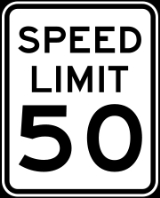
. Thus a value in black text circumscribed in red on a white background is fairly common all around the world. In the U.S. the signs are usually rectangular with the words "SPEED LIMIT" (in Canada, "MAXIMUM") and the values in black on a white background, the color scheme for night speed limit signs can be polarized and with differing text. The U.S. Federal Highway Administration's Manual on Uniform Traffic Control Devices
Manual on Uniform Traffic Control Devices

The Manual on Uniform Traffic Control Devices is a document issued by the Federal Highway Administration of the United States Department of Transportation to specify the standards by which traffic signs, road markings , and traffic light are designed, installed, and used....
 provides guidelines for the appearance of speed limit signs. Australia
Australia

Australia, officially the Commonwealth of Australia, is a country in the southern hemisphere comprising the Australia of the world's smallest continent, the major island of Tasmania, and numerous list of islands of Australia in the Indian Ocean and Pacific Oceans....
n signs are rectangular but have a red circle like the Conventional signs, Sometimes, speed limits are also painted on the road surface as a reminder.

The design of minimum speed signage also varies between countries. Most countries use blue circles based on the obligatory signs of the Vienna Convention on Road Signs and Signals. A Japan
Japan

Japan is an island country in East Asia. Located in the Pacific Ocean, it lies to the east of the Sea of Japan, People's Republic of China, North Korea, South Korea and Russia, stretching from the Sea of Okhotsk in the north to the East China Sea and Taiwan in the south....
ese minimum speed sign has the same design as a maximum speed sign but with a horizontal line below the number. In the U.S they are also identical to their respective maximum speed limit signs with the exception of the text "MINIMUM SPEED".

Variable speed limits

Variable Speed Limit
Recently some jurisdictions have begun experimenting with variable speed limits which change with road congestion and other factors (this is distinct from France's reduction of limits during adverse weather). One example is on Britain's M25 motorway
M25 motorway

To see information about the M25 motorway under construction in Ireland, see N25 road.The M25 motorway, also known as the M25 corridor, is a 117 mile beltway which encircles Greater London, United Kingdom....
, which circumnavigates London. On the most heavily-traveled 22 km section (junction 10 to 16) of the M25 variable speed limits combined with automated enforcement have been in force since 1995. Initial results indicated savings in journey times, smoother-flowing traffic, and a fall in the number of accidents, so the implementation was made permanent in 1997. Further trials on the M25 have been thus far proved inconclusive. From December 2008 the upgraded section of the M1
M1 motorway

The M1 is a major north?south motorway in England primarily connecting London to Leeds, where it joins the A1 road near Aberford. While the M1 is considered to be the first inter-urban motorway to be completed in the United Kingdom, the first road to be built to motorway standard in the country was the Preston Bypass route, which later bec...
 between the M25 and Luton will have the facility for variable speed limits.

In Germany
Germany

Germany , officially the Federal Republic of Germany , is a country in Central Europe. It is bordered to the north by the North Sea, Denmark, and the Baltic Sea; to the east by Poland and the Czech Republic; to the south by Austria and Switzerland; and to the west by France, Luxembourg, Belgium, and the Netherlands....
, the first experiments with variable signs took place in 1965 on A8
Bundesautobahn 8

Bundesautobahn 8 is an Autobahn that runs 497 km from the Luxembourg border through southern Germany to Austrian border near Salzburg....
 Munich
Munich

Munich is the capital city of Bavaria, Germany. Munich is located on the River Isar north of the Northern Limestone Alps. Munich is the third largest city in Germany, after Berlin and Hamburg....
-Salzburg
Salzburg

is the List of cities and towns in Austria#List of cities and towns by population size in Austria and the capital city of the states of Austria of Salzburg ....
 with signs that were operated manually. Beginning in the 1970s, more and more advanced Streckenbeeinflussungsanlagen (linear control systems) were put into service. Modern motorway control system
Speed limit

A road speed limit is the maximum speed allowed by law for road vehicles. Speed limits are commonly set and enforced by the legislature of nations or provincial governments, such as countries within the world....
s can work without human intervention using various types of sensors to measure traffic flow and weather conditions. By 2007, 1200 km (10 %) of German motorways will be equipped with such systems.

In 2006, Austria
Austria

Austria , officially the Republic of Austria , is a landlocked country in Central Europe. It borders both Germany and the Czech Republic to the north, Slovakia and Hungary to the east, Slovenia and Italy to the south, and Switzerland and Liechtenstein to the west....
 began experimenting with a 160 km/h (100 mph) speed limit on a of Autobahn
Autobahn

is the German language word for a major high-speed road restricted to motor vehicles capable of driving at least and having full control of access, similar to a motorway or freeway in English-speaking countries....
 as part of their program of variable speed limit, using the slogan "flexibility with responsibility."

New Zealand
New Zealand

New Zealand is an island country in the south-western Pacific Ocean comprising two main landmasses , and numerous Islands of New Zealand, most notably Stewart Island/Rakiura and the Chatham Islands....
 has had variable speed limits since 2001. The first installation was on the Ngauranga Gorge, a steep section of dual carriageway on SH1 north of the capital, Wellington
Wellington

Wellington is the Capital of New Zealand, situated at the southwestern tip of the North Island between Cook Strait and the Rimutaka Range. The Wellington Urban Area is the major population centre of the southern North Island and ranks as New Zealand's third most populous Urban areas of New Zealand with residents....
. The speed limit is normally 80 km/h. The downhill section is monitored by a fixed speed camera.

In The Netherlands, much of the dense motorway network is equipped with variable speed regulation systems. The electronic signage is commonly posted every 500 metres. The system keeps track of all traffic movement and lowers the speed limit if it detects the start of traffic congestion. When activated the speed limit can be set at 90, 70, or 50  km/h according to the level of expected traffic congestion.

Variable speed limits are used on some stretches of highway in the United States
United States

The United States of America is a Federal government constitutional republic comprising U.S. state and a federal district. The country is situated mostly in central North America, where its Contiguous United States and Washington, D.C., the Capital districts and territories, lie between the Pacific Ocean and Atlantic Oceans, Borders of the U...
. This has not, however, been implemented on a national basis. On Interstate 90
Interstate 90

Interstate 90 is the longest Interstate Highway in the United States at . It is the northernmost coast-to-coast interstate. Its western terminus is in Seattle, Washington, at 4th Avenue S....
 at Snoqualmie Pass
Snoqualmie Pass

Snoqualmie Pass is a mountain pass that carries Interstate 90 in Washington through the Cascade Range in the United States of America state of Washington....
, Washington
Washington

Washington is a U.S. state in the Pacific Northwest region of the United States. Washington was carved out of the western part of Washington Territory which had been ceded by Britain in 1846 by the Oregon Treaty as settlement of the Oregon Boundary Dispute....
, (near Seattle) variable speed limits are used to slow traffic in severe winter weather. This is also done on other mountain passes in Washington. Variable speed limit signs, in combination with variable message signs, have been in use since the 1960s on the New Jersey Turnpike
New Jersey Turnpike

The New Jersey Turnpike is a toll road in New Jersey and is one of the most heavily traveled highways in the United States . A majority of the mainline as well as the entirety of both extensions and spurs are part of the Interstate Highway System....
, where officials can adjust the speed limit according to weather, traffic conditions, and construction. Other roadways with variable speed limits include the Pulaski Skyway
Pulaski Skyway

The General Pulaski Skyway is a series of cantilever truss bridges in the North Jersey of the U.S. state of New Jersey. The highway carries four lanes of U.S....
 in New Jersey, I-495 in Delaware
Interstate 495 (Delaware)

Interstate 495 in Delaware is a six-lane bypass of Interstate 95 in Delaware around the city of Wilmington, Delaware. Built in the mid-1970s and opened as the "Wilmington Bypass", the highway became, between 1978 and 1982, the route of I-95 around Wilmington, while the original highway through the city, redesignated as Interstate 895 , was...
, and the Missouri part of the I-270/I-255
Interstate 255

Interstate 255 is a bypass route of Interstate 55 near St. Louis, Missouri, Missouri and with Interstate 270 , it forms a loop route around the city....
 loop around St. Louis.

In Catalonia
Catalonia

Catalonia , is an Autonomous Community in northeast Spain.Catalonia covers an area of 32,114 km? and has an official population of 7,210,508. It borders France and Andorra to the north, Aragon to the west, the Valencian Community to the south, and the Mediterranean Sea to the east ....
, the Generalitat Autonomous Government is to begin applying variable speed limits in the Barcelona metropolitan area in March, 2009.

Units of measurement


Most countries use metric
Metric system

The metric system is an international decimalised systems of measurement, founded by France in 1791, that is the common system of Unit of measurement used by most of the world....
 units (kilometres per hour
Kilometres per hour

The kilometre per hour is a physical unit of both speed and velocity . The unit symbol is km/h or km?h-1; however, the colloquial abbreviations "kph" and "kmph" are sometimes also used in English-speaking countries, in analogy to mph, although these are not in accordance with international scientific standards....
) rather than the customary units (miles per hour
Miles per hour

The mile per hour is a physical unit of speed, expressing the number of Mile covered per hour.It is currently the Unit of measurement used for speed limits, and speeds, on roads in the United Kingdom and United States....
).

Occasionally, different units of speed measurement are used on each side of a border. For example, Northern Ireland
Northern Ireland

conventional_long_name = Northern Ireland|native_name= Tuaisceart ?ireannNorlin Airlann|motto =|image_map = Europe location N-IRL2.png...
 (part of the UK
United Kingdom

The United Kingdom of Great Britain and Northern Ireland, commonly known as the United Kingdom , the UK or Britain,is a sovereign state located off the northwestern coast of continental Europe....
) uses values calculated in miles per hour (mph) for speed limits and miles for distance, whereas the Republic of Ireland
Republic of Ireland

Ireland is an Island country in north-western Europe. The modern Sovereignty state occupies about five-sixths of the island of Ireland, which was partitioned by the British on 3 May 1921....
 uses kilometres per hour (km/h) for speed limits and kilometres for distance. The UK and the United States
United States

The United States of America is a Federal government constitutional republic comprising U.S. state and a federal district. The country is situated mostly in central North America, where its Contiguous United States and Washington, D.C., the Capital districts and territories, lie between the Pacific Ocean and Atlantic Oceans, Borders of the U...
 are the only major nations still using the customary (imperial) units system.

The U.S. has shown no intention to convert to SI units, and reverted to imperial units in states that had both imperial and SI systems such as California and Arizona. However, Ohio, South Dakota, Maine, and Vermont (especially near the Canadian border) still have some SI distances and speeds on their exit distance and speed limit signs (such as / 110 km/h, or 3 miles / 5 km to next exit). When entering Canada
Canada

Canada is a country occupying most of northern North America, extending from the Atlantic Ocean in the east to the Pacific Ocean in the west and northward into the Arctic Ocean....
, signs are posted reminding drivers that metric signage is in use. Conversely upon entering the U.S. from Canada, some drivers are shown a metric speed limit sign. Some exit distance signs on Interstates in New Hampshire are marked with the distance in miles followed by the distance in kilometres shown in parentheses. Houston, Texas has some signs in both SI and imperial units near its airports and downtown. Delaware Route 1 and Interstate 19
Interstate 19

Interstate 19 is an List of intrastate Interstate Highways Interstate Highway located entirely within the state of Arizona. I-19 runs from Nogales, Arizona, at the U.S.-Mexico border to Tucson, Arizona, at Interstate 10 ....
 have exits numbered by kilometer - I-19 also has kilometer posts.

Opposition

Speed limits and their enforcement have been opposed by some motorists since their inception. Britain's first motoring organisation, the AA
The Automobile Association

The Automobile Association is a United Kingdom company providing car insurance, breakdown cover, loans and motoring advice. It was a former motoring association that became a private limited company in 1999, and is owned by two private equity firms....
, was formed in 1905, initially to warn members about speed trap
Speed trap

The term speed trap can refer to a point where a speed limit is strictly enforced by police. It may also refer to locations where a road-rule enforcement camera is posted....
s.

In more recent times, other organizations, such as the Association of British Drivers
Association of British Drivers

The Association of British Drivers , founded in 1992, is a United Kingdom motorists' advocacy group."The Association of British Drivers" is the sole operating name of "Pro-Motor", a company limited by guarantee and registered in the United Kingdom....
, Safe Speed
Safe Speed

Safe Speed is a United Kingdom pressure group. Safe Speed primarily campaigns against speed cameras, arguing that abiding by a speed limit does not guarantee safe driving, and that motoring laws can be more appropriately and proportionately enforced without the use of these devices....
, the North American National Motorists Association
National Motorists Association

The National Motorists Association is a for-profit corporation in the United States that advocates a libertarian point of view on issues related to traffic laws....
, and German Auto Club ("ADAC
ADAC

The ADAC is Germany's and Europe's largest automobile club, with 15,290,614 members in August 2005. It was founded on May 24, 1903 as "Deutsche Motorradfahrer-Vereinigung" and was renamed in 1911....
"), seek to ban or discredit certain speed limits as well as other measures, such as automated camera enforcement. The debate over speed limit enforcement has become a large part of the road safety and environmental policy debate in some countries.

Organizations critical of speed limits and strict enforcement point to:

  • An "undetectable correlation" between speed limits and safety. The German Auto Club concludes an autobahn speed limit is unnecessary since there are numerous countries with a general highway speed limit having worse safety records than Germany; for examples, Belgium, Austria, Slovenia, Czech Republic, and the United States.
  • Inconclusive results from most speed limit studies. For example, a 1972 OECD Road Research Group report entitled 'Speed Limits Outside Built-Up Areas' reviewed most international studies to that date. They concluded that "because of the weaknesses in the research designs of many investigations, scientifically well-established conclusions cannot be drawn." "Indeed, some of the speed limit changes were more in the nature of administrative exercises than scientifically designed experiments and the methods of analysis in these cases were deficient from the statistical point of view." The Group stated that "speed limit policies should be based on reliable research work and generally accepted scientific evidence." They proposed an international co-operative experiment to overcome weaknesses in prior studies. However, the 1973-1974 oil price crisis
    1973 oil crisis

    The 1973 oil crisis started on October 15, 1973, when the members of Organization of Arab Petroleum Exporting Countries or the OAPEC proclaimed an oil embargo "in response to the U.S....
     intervened, and widespread blanket speed limits became more common without exacting study. More recently, a review of the effect of speed on vehicle crash rates noted that the studies and evidence are
  • Misleading definition of to combine the concepts of:
    • crashes that occur often at relatively low speeds, but excessive for adverse conditions, such as low visibility
    • citations that are issued for travel in excess of the posted speed limit
In Australia for instance, Government & Police attribute speed as the main cause in 30% of crashes, even though speeding is a cause in only 20% of those cases (or 6% of total cases). This is due to an extremely wide-ranging definition of speed, in order to explain fixed speed cameras and zero-discretion traffic policing .
  • Surprisingly broad range for 'speed-related' fatalities as a percentage of total traffic fatalties, suggesting that categorizing accidents as 'speed-related' is highly subjective. Among the U.S. States, the range is .
  • "Evidence that suggests the net effect of [higher motorway] speed limits may be positive on a system wide basis [by shifting more traffic to these safer roads]." This statement from 1998 U.S. Federal is based on the published, peer-reviewed work of Charles A. Lave et al., e.g.,
  • Motorists generally pick reasonable speeds for conditions, even on motorways. For example, the 75 mph (120 km/h) speed limit in the U.S. State of South Dakota has good compliance: the average speed is less than or equal to the posted limit almost a decade after it was increased.


  • "When speed limits are set artificially low, tailgating, weaving and speed variance (the problem of some cars traveling significantly faster than others) make roads less safe".


Enforcement


Prior to the invention of radar
Radar

Radar is a system that uses electromagnetic radiation waves to identify the range, altitude, direction, or speed of both moving and fixed objects such as aircraft, ships, motor vehicles, weather formations, and terrain....
, speed limits were normally enforced by clocking vehicles traveling through speed traps. This is done by timing how long it takes for the automobile to pass between two fixed landmarks along a roadway, from which the vehicle's average speed can be determined. Setting up a speed trap that could provide legally satisfactory evidence was usually time consuming, however, and early speed traps were often difficult to hide. As a result, organizations such as The Automobile Association
The Automobile Association

The Automobile Association is a United Kingdom company providing car insurance, breakdown cover, loans and motoring advice. It was a former motoring association that became a private limited company in 1999, and is owned by two private equity firms....
 could often keep fairly accurate records of speed trap locations.

In the early 21st century, police used radar, laser rangefinders, aircraft, and automated devices. Officers also used a method called pacing: following a car for a certain time to establish speed using the calibrated speedometer of the patrol car.

In several countries, notably the Netherlands
Netherlands

The Netherlands is a country that is part of the Kingdom of the Netherlands. It is a parliamentary democratic constitutional monarchy. The Netherlands is located in North-West Europe, and bordered by the North Sea to the north and west, Belgium to the south, and Germany to the east....
 and the United Kingdom
United Kingdom

The United Kingdom of Great Britain and Northern Ireland, commonly known as the United Kingdom , the UK or Britain,is a sovereign state located off the northwestern coast of continental Europe....
, an increase in automated speed enforcement has resulted in a significant increase in the number of fake, stolen, tampered with, or incorrectly registered number plates
Vehicle registration plate

A vehicle registration plate is a metal or plastic plate attached to a motor vehicle or Trailer for official identification purposes. The registration identifier is a numeric or alphanumeric code that uniquely identifies the vehicle within the issuing region's database....
. In France, the use of automated enforcement has been credited with contributing to a substantial reduction in fatalities. Most Western European countries now use automated enforcement on at least some roads.

Speed limit policy can affect enforcement. According to the AASHTO
American Association of State Highway and Transportation Officials

AASHTO, the American Association of State Highway and Transportation Officials, is a standards setting body which publishes specifications, test quality control and guidelines which are used in highway design and construction throughout the United States....
, "experience has ... shown that speed limits set arbitrarily below the reasonable and prudent speed perceived by the public are difficult to enforce, produce noncompliance, encourage disrespect for the law, create unnecessary antagonism toward law enforcement officers, and divert traffic to lesser routes".

Tolerance


Speed limit enforcement often begins at a small amount above the speed limit. For example, speeding citations for 1 unit (mph or km/h) above the limit are rare. In certain cases, such as Houston, Texas
Houston, Texas

Houston is the fourth-largest city in the United States of America and the largest city within the state of Texas. As of the 2007 U.S. Census estimate, the city has a population of 2.2 million within an area of 600 square miles ....
, only 1% of speeding citations are for less than 10 mph (16 km/h) above the speed limit.

In the United States, speeding enforcement tolerance is usually up to the discretion of the arresting officer. A small tolerance is almost always allowed, even where traffic signs advise "NO TOLERANCE". Some states (such as Pennsylvania) have official tolerances. Per state law, one cannot be cited by an officer using a radar/laser gun for traveling less than over a speed limit of less than or for traveling less than over a speed limit of or greater.

In Taiwan, even though the Regulations on Establishing Traffic Signs and Indicating Lines (zh:??????????????) define the speed limit signs to show absolute limits, police agencies have generally agreed a tolerance of up to 10 km/h. A notable exception was the Hsuehshan Tunnel
Hsuehshan Tunnel

The Hsuehshan Tunnel, Syueshan Tunnel,, or Sueshan Tunnel or "Snow Mountain" tunnel, is the World's longest tunnels in Taiwan, located on the Taipei-Yilan Freeway ....
 opened on June 16, 2006 with automated speeding cameras. After the "zero tolerance" on speeding created controversy, effective 00:00 (UTC+8) on September 16, 2006, a tolerance of 10 km/h has been allowed as on other Taiwanese roads.

In Hong Kong and Poland, there is a tolerance of 10 km/h over the posted speed limit.

In the United Kingdom ACPO
Association of Chief Police Officers

The Association of Chief Police Officers , established in 1948, is the lead organisation for developing police policy in England, Wales and Northern Ireland ....
 guidelines recommend a tolerance level of the speed limit "+10% +2 mph" (e.g., a tolerance level in a zone of 35 mph). However, each police force or safety camera partnership has the ability to use its discretion when setting the levels at which drivers will be prosecuted.

In the Netherlands drivers can get a fine for driving 4 km/h over the speed limit, after applying a 3 or 4 km/h correction factor to compensate for measuring errors. Police officers are usually not allowed to use their discretion when setting the speeding threshold during enforcement activities by photo radar.

Road safety improvements in the Australian state of Victoria are largely attributed by the state government to infrastructure improvements and speed management including tougher tolerances and enforcement. Low level speeding is targeted because of the overall population effects. This is best explained by the recent Auditor General's independent review which cites:

The relative risk of casualty crash involvement for vehicles travelling only a few km/h above the speed limit is lower than for those travelling a greater amount above the limit. However the contribution of “low level speeders” to the total number of casualty crashes is high because of the high number of motorists travelling at these speeds. Therefore, “low level speeding” represents a substantial risk across the road network.


Victoria has some of the tightest speeding tolerances in Australia, with 3 km/h if the speed is under 100 km/h, or 3% if over 100 km/h. This is despite the fact that the Australian Design Rules only stipulate that a car's speedometer must be accurate within a 10% tolerance.

In Germany, a 3 km/h tolerance (4km/h when speeding over 100km/h) in favor of the offender is always deducted. Fines for speeding depend on how high above the speed limit the measured speed is and where the offense occurred. Speeding in built-up areas invariably carries higher fines than outside city limits. While fines for minor offenses tend to be moderate, speeds in excess of 20 km/h above the limit in built-up areas and 30 km/h on other roads result in distinctly higher fines and points on the driver's license, and, depending on the speed at which the offender was clocked, may lead to a driving ban of at least one month.

In New Zealand, the speed limit is not enforced up to 11 km/h over the posted limit, unless the speed was considered dangerous for the road. The tolerance is reduced to 4 km/h within 250 metres of schools.

Evading enforcement


Methods for evading enforcement of speed limits have entered popular culture. Among the most familiar techniques is to purchase a radar detector
Radar detector

A radar detector, sometimes called a fuzz buster, is a passive electronic device used by motorists to determine if their speed is being monitored by law enforcement agencies via a radar unit, and thereby, potentially avoiding prosecution for speeding....
 to seek out police radar signals before one enters an enforcement zone. Observers have pointed out a small-scale arms race
Arms race

The term arms race, in its original usage, describes a competition between two or more parties for real or apparent military supremacy. Each party competes to produce larger numbers of weapons, greater armies, or superior military technology in a technological escalation....
 ensues, as speeders buy radar detectors of greater technology and police purchase equipment that is harder to detect. Such detectors are illegal in certain jurisdictions. Speeders can also alter their traffic behavior according to known police stakeout positions.

See also

  • Design speed
    Design speed

    The design speed of a road is the maximum speed at which a motor vehicle can be operated safely on that road in perfect conditions.The precise definition, according to the AASHTO Green Book, is "the maximum safe speed that can be maintained over a specified...
  • Operating speed
    Operating speed

    The operating speed of a road is the speed at which motor vehicles generally operate on that road.The precise definition of "operating speed", however, is open to debate....
  • Road-rule enforcement camera
    Road-rule enforcement camera

    A traffic enforcement camera is a system, including a camera and a vehicle-monitoring device, used to detect and identify vehicles disobeying a speed limit or some other road legal requirement....
  • Road-traffic safety
    Road-traffic safety

    Road traffic safety aims to reduce the harm resulting from crashes of road vehicles. Harm from road traffic crashes is greater than that from all other transportation modes combined....
  • Solomon curve
    Solomon curve

    File:Solomon_Curve.pngThe Solomon curve is the graphical representation of the research conducted by David Solomon in the late 1950s and published in 1964....
  • Traffic violations reciprocity
    Traffic Violations Reciprocity

    Under traffic violations reciprocity agreements, non-resident drivers are treated like residents when they are stopped for a traffic offense that occurs in another jurisdiction....
  • Train speed limit (United States)


External links

  • Governments
    • A comprehensive UK report into the effects of speeding.
    • A major research report into the psychology of the speeding driver.
  • Motorists' and other groups
    • A U.S. organization arguing for 85th percentile limits.
    • A UK road safety organisation which campaigns for lower speed limits.
    • An Austrian project that aim at more flexible speed limits and also higher speed limits for a better traffic control and safer driving.
  • Other links
    • pigradar.com
    • The United States' Transportation Research Board (TRB) National Cooperative Highway Research Program (NCHRP): 2003.
    • C. Lave and P. Elias, Accident Analysis and Prevention, Vol. 26, No. 1, 1994.
    • , United States Publication No. FHWA-RD-97-084, January 1997.
    • , Final Report 551, Arizona Dept of Transportation, October 2004.
    • , Transportation Research Board, 1998.
    • Why we can't drive safely at high speed
    • Technology is being developed to assist (or in some cases, force) drivers keep to the speed limits.