

Subprime mortgage crisis

Encyclopedia
The U.S. subprime mortgage crisis was one of the first indicators of the late-2000s financial crisis
, characterized by a rise in subprime
mortgage delinquencies and foreclosures, and the resulting decline of securities backed by said mortgages.
The ratio of lower-quality subprime mortgages originated rose from the historical 8% or lower range to approximately 20% from 2004-2006, with much higher ratios in some parts of the U.S. A high percentage of these subprime mortgages, over 90% in 2006 for example, were adjustable-rate mortgages. These two changes were part of a broader trend of lowered lending standards and higher-risk mortgage products. Further, U.S. households had become increasingly indebted, with the ratio of debt to disposable personal income rising from 77% in 1990 to 127% at the end of 2007, much of this increase mortgage-related.
After U.S. house sales prices peaked in mid-2006 and began their steep decline forthwith, refinancing
became more difficult. As adjustable-rate mortgages began to reset at higher interest rates (causing higher monthly payments), mortgage delinquencies soared. Securities backed with mortgages, including subprime mortgages, widely held by financial firms, lost most of their value. Global investors also drastically reduced purchases of mortgage-backed debt and other securities as part of a decline in the capacity and willingness of the private financial system to support lending. Concerns about the soundness of U.S. credit and financial markets led to tightening credit around the world and slowing economic growth in the U.S. and Europe.
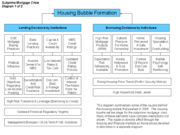
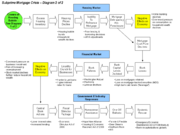 The immediate cause or trigger of the crisis was the bursting of the United States housing bubble
which peaked in approximately 2005–2006. High default rates on "subprime" and adjustable rate mortgage
s (ARM), began to increase quickly thereafter. An increase in loan incentives such as easy initial terms and a long-term trend of rising housing prices had encouraged borrowers to assume difficult mortgages in the belief they would be able to quickly refinance at more favorable terms. Additionally, the economic incentives provided to the originators of subprime mortgages, along with outright fraud, increased the number of subprime mortgages provided to consumers who would have otherwise qualified for conforming loans. However, once interest rate
s began to rise and housing prices started to drop moderately in 2006–2007 in many parts of the U.S., refinancing became more difficult. Defaults
and foreclosure
activity increased dramatically as easy initial terms expired, home prices failed to go up as anticipated, and ARM interest rates reset higher. Falling prices also resulted in 23% of U.S. homes worth less than the mortgage loan by September 2010, providing a financial incentive for borrowers to enter foreclosure. The ongoing foreclosure epidemic, of which subprime loans are one part, that began in late 2006 in the U.S. continues to be a key factor in the global economic crisis, because it drains wealth from consumers and erodes the financial strength of banking institutions.
In the years leading up to the crisis, significant amounts of foreign money flowed into the U.S. from fast-growing economies in Asia and oil-producing countries. This inflow of funds combined with low U.S. interest rates from 2002–2004 contributed to easy credit conditions, which fueled both housing and credit bubbles. Loans of various types (e.g., mortgage, credit card, and auto) were easy to obtain and consumers assumed an unprecedented debt load. As part of the housing and credit booms, the amount of financial agreements called mortgage-backed securities (MBS), which derive their value from mortgage payments and housing prices, greatly increased. Such financial innovation
enabled institutions and investors around the world to invest in the U.S. housing market. As housing prices declined, major global financial institutions that had borrowed and invested heavily in MBS reported significant losses. Defaults and losses on other loan types also increased significantly as the crisis expanded from the housing market to other parts of the economy. Total losses are estimated in the trillions of U.S. dollars globally.
While the housing and credit bubbles were growing, a series of factors caused the financial system to become increasingly fragile. Policymakers did not recognize the increasingly important role played by financial institutions such as investment banks and hedge funds, also known as the shadow banking system
. Some experts believe these institutions had become as important as commercial (depository) banks in providing credit to the U.S. economy, but they were not subject to the same regulations. These institutions as well as certain regulated banks had also assumed significant debt burdens while providing the loans described above and did not have a financial cushion sufficient to absorb large loan defaults or MBS losses. These losses impacted the ability of financial institutions to lend, slowing economic activity. Concerns regarding the stability of key financial institutions drove central banks to take action to provide funds to encourage lending and to restore faith in the commercial paper
markets, which are integral to funding business operations. Governments also bailed out key financial institutions, assuming significant additional financial commitments.
The risks to the broader economy created by the housing market downturn and subsequent financial market crisis were primary factors in several decisions by central banks around the world to cut interest rates and governments to implement economic stimulus packages. Effects on global stock markets due to the crisis have been dramatic. Between 1 January and 11 October 2008, owners of stocks in U.S. corporations had suffered about $8 trillion in losses, as their holdings declined in value from $20 trillion to $12 trillion. Losses in other countries have averaged about 40%. Losses in the stock markets and housing value declines place further downward pressure on consumer spending, a key economic engine. Leaders of the larger developed and emerging nations met in November 2008 and March 2009 to formulate strategies for addressing the crisis. A variety of solutions
have been proposed by government officials, central bankers, economists, and business executives. In the U.S., the Dodd–Frank Wall Street Reform and Consumer Protection Act was signed into law in July 2010 to address some of the causes of the crisis.
than loans to prime borrowers. If a borrower is delinquent in making timely mortgage payments to the loan servicer (a bank or other financial firm), the lender may take possession of the property, in a process called foreclosure
.
The value of American subprime mortgages was estimated at $1.3 trillion as of March 2007,
with over 7.5 million first-lien
subprime mortgages outstanding. Between 2004–2006 the share of subprime mortgages relative to total originations ranged from 18%–21%, versus less than 10% in 2001–2003 and during 2007. In the third quarter of 2007, subprime ARMs making up only 6.8% of USA mortgages outstanding also accounted for 43% of the foreclosures which began during that quarter. By October 2007, approximately 16% of subprime adjustable rate mortgages (ARM) were either 90-days delinquent or the lender had begun foreclosure
proceedings, roughly triple the rate of 2005. By January 2008, the delinquency rate had risen to 21% and by May 2008 it was 25%.
The value of all outstanding residential mortgages, owed by U.S. households to purchase residences housing at most four families, was US$9.9 trillion as of year-end 2006, and US$10.6 trillion as of midyear 2008. During 2007, lenders had begun foreclosure proceedings on nearly 1.3 million properties, a 79% increase over 2006. This increased to 2.3 million in 2008, an 81% increase vs. 2007, and again to 2.8 million in 2009, a 21% increase vs. 2008.
By August 2008, 9.2% of all U.S. mortgages outstanding were either delinquent or in foreclosure. By September 2009, this had risen to 14.4%.
Between August 2007 and October 2008, 936,439 USA residences completed foreclosure. Foreclosures are concentrated in particular states both in terms of the number and rate of foreclosure filings. Ten states accounted for 74% of the foreclosure filings during 2008; the top two (California and Florida) represented 41%. Nine states were above the national foreclosure rate average of 1.84% of households.
, factors which emerged over a number of years. Causes proposed include the inability of homeowners to make their mortgage payments (due primarily to adjustable-rate mortgages resetting, borrowers overextending, predatory lending
, and speculation
), overbuilding during the boom period, risky mortgage products, high personal and corporate debt levels, financial products that distributed and perhaps concealed the risk of mortgage default, bad monetary and housing policies, international trade imbalances
, and inappropriate government regulation. Three important catalysts of the subprime crisis were the influx of moneys from the private sector, the banks entering into the mortgage bond market and the predatory lending practices of the mortgage lenders, specifically the adjustable-rate mortgage, 2–28 loan
, that mortgage lenders sold directly or indirectly via mortgage brokers. On Wall Street and in the financial industry, moral hazard
lay at the core of many of the causes.
In its "Declaration of the Summit on Financial Markets and the World Economy," dated 15 November 2008, leaders of the Group of 20 cited the following causes:
During May 2010, Warren Buffett
and Paul Volcker
separately described questionable assumptions or judgments underlying the U.S. financial and economic system that contributed to the crisis. These assumptions included: 1) Housing prices would not fall dramatically; 2) Free and open financial markets supported by sophisticated financial engineering would most effectively support market efficiency and stability, directing funds to the most profitable and productive uses; 3) Concepts embedded in mathematics and physics could be directly adapted to markets, in the form of various financial models used to evaluate credit risk; 4) Economic imbalances, such as large trade deficits and low savings rates indicative of over-consumption, were sustainable; and 5) Stronger regulation of the shadow banking system
and derivatives markets was not needed.
The U.S. Financial Crisis Inquiry Commission
reported its findings in January 2011. It concluded that "the
crisis was avoidable and was caused by: Widespread failures in financial regulation, including the Federal Reserve’s failure to stem the
tide of toxic mortgages; Dramatic breakdowns in corporate governance including too many financial firms acting
recklessly and taking on too much risk; An explosive mix of excessive borrowing and risk by households and Wall Street that put the
financial system on a collision course with crisis; Key policy makers ill prepared for the crisis, lacking a full understanding of the financial system
they oversaw; and systemic breaches in accountability and ethics at all levels.“

 Low interest rates and large inflows of foreign funds created easy credit conditions for a number of years prior to the crisis, fueling a housing market boom and encouraging debt-financed consumption. The USA home ownership rate increased from 64% in 1994 (about where it had been since 1980) to an all-time high of 69.2% in 2004. Subprime lending was a major contributor to this increase in home ownership rates and in the overall demand for housing, which drove prices higher.
Between 1997 and 2006, the price of the typical American house increased by 124%. During the two decades ending in 2001, the national median home price ranged from 2.9 to 3.1 times median household income. This ratio rose to 4.0 in 2004, and 4.6 in 2006. This housing bubble resulted in quite a few homeowners refinancing their homes at lower interest rates, or financing consumer spending by taking out second mortgage
s secured by the price appreciation. USA household debt as a percentage of annual disposable personal income was 127% at the end of 2007, versus 77% in 1990.
While housing prices were increasing, consumers were saving less and both borrowing and spending more. Household debt grew from $705 billion at yearend 1974, 60% of disposable personal income, to $7.4 trillion at yearend 2000, and finally to $14.5 trillion in midyear 2008, 134% of disposable personal income. During 2008, the typical USA household owned 13 credit cards, with 40% of households carrying a balance, up from 6% in 1970.
Free cash used by consumers from home equity extraction doubled from $627 billion in 2001 to $1,428 billion in 2005 as the housing bubble built, a total of nearly $5 trillion dollars over the period. U.S. home mortgage debt relative to GDP increased from an average of 46% during the 1990s to 73% during 2008, reaching $10.5 trillion. From 2001 to 2007, U.S. mortgage debt almost doubled, and the amount of mortgage debt per household rose more than 63%, from $91,500 to $149,500, with essentially stagnant wages.
This credit and house price explosion led to a building boom and eventually to a surplus of unsold homes, which caused U.S. housing prices to peak and begin declining in mid-2006. Easy credit, and a belief that house prices would continue to appreciate, had encouraged many subprime borrowers to obtain adjustable-rate mortgages. These mortgages enticed borrowers with a below market interest rate for some predetermined period, followed by market interest rates for the remainder of the mortgage's term. Borrowers who would not be able to make the higher payments once the initial grace period ended, were planning to refinance their mortgages after a year or two of appreciation. But refinancing became more difficult, once house prices began to decline in many parts of the USA. Borrowers who found themselves unable to escape higher monthly payments by refinancing began to default.
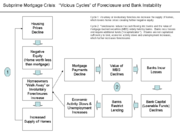
As more borrowers stop paying their mortgage payments (this is an on-going crisis), foreclosures and the supply of homes for sale increases. This places downward pressure on housing prices, which further lowers homeowners' equity
. The decline in mortgage payments also reduces the value of mortgage-backed securities, which erodes the net worth and financial health of banks. This vicious cycle is at the heart of the crisis.
By September 2008, average U.S. housing prices had declined by over 20% from their mid-2006 peak. This major and unexpected decline in house prices means that many borrowers have zero or negative equity
in their homes, meaning their homes were worth less than their mortgages. As of March 2008, an estimated 8.8 million borrowers — 10.8% of all homeowners — had negative equity in their homes, a number that is believed to have risen to 12 million by November 2008. By September 2010, 23% of all U.S. homes were worth less than the mortgage loan. Borrowers in this situation have an incentive to default on their mortgages as a mortgage is typically nonrecourse debt
secured against the property. Economist Stan Leibowitz argued in the Wall Street Journal that although only 12% of homes had negative equity, they comprised 47% of foreclosures during the second half of 2008. He concluded that the extent of equity in the home was the key factor in foreclosure, rather than the type of loan, credit worthiness of the borrower, or ability to pay.
Increasing foreclosure rates increases the inventory of houses offered for sale. The number of new homes sold in 2007 was 26.4% less than in the preceding year. By January 2008, the inventory of unsold new homes was 9.8 times the December 2007 sales volume, the highest value of this ratio since 1981. Furthermore, nearly four million existing homes were for sale, of which almost 2.9 million were vacant. This overhang of unsold homes lowered house prices. As prices declined, more homeowners were at risk of default or foreclosure. House prices are expected to continue declining until this inventory of unsold homes (an instance of excess supply) declines to normal levels. A report in January 2011 stated that U.S. home values dropped by 26 percent from their peak in June 2006 to November 2010, more than the 25.9 percent drop between 1928 to 1933 when the Great Depression
occurred.
's chief economist at the time, stated that the 2006 decline in investment buying was expected: "Speculators left the market in 2006, which caused investment sales to fall much faster than the primary market."
Housing prices nearly doubled between 2000 and 2006, a vastly different trend from the historical appreciation at roughly the rate of inflation. While homes had not traditionally been treated as investments subject to speculation, this behavior changed during the housing boom. Media widely reported condominiums being purchased while under construction, then being "flipped" (sold) for a profit without the seller ever having lived in them. Some mortgage companies identified risks inherent in this activity as early as 2005, after identifying investors assuming highly leveraged positions in multiple properties.
Nicole Gelinas of the Manhattan Institute
described the negative consequences of not adjusting tax and mortgage policies to the shifting treatment of a home from conservative inflation hedge to speculative investment. Economist Robert Shiller
argued that speculative bubbles are fueled by "contagious optimism, seemingly impervious to facts, that often takes hold when prices are rising. Bubbles are primarily social phenomena; until we understand and address the psychology that fuels them, they're going to keep forming." Keynesian economist Hyman Minsky
described how speculative borrowing contributed to rising debt and an eventual collapse of asset values.
Warren Buffett
testified to the Financial Crisis Inquiry Commission
: "There was the greatest bubble I've ever seen in my life...The entire American public eventually was caught up in a belief that housing prices could not fall dramatically."
s. Subprime mortgages amounted to $35 billion (5% of total originations) in 1994, 9% in 1996, $160 billion (13%) in 1999, and $600 billion (20%) in 2006. A study by the Federal Reserve found that the average difference between subprime and prime mortgage interest rates (the "subprime markup") declined significantly between 2001 and 2007. The combination of declining risk premiums and credit standards is common to boom and bust credit cycle
s.
In addition to considering higher-risk borrowers, lenders had offered increasingly risky loan options and borrowing incentives. In 2005, the median down payment for first-time home buyers was 2%, with 43% of those buyers making no down payment whatsoever. By comparison, China has down payment requirements that exceed 20%, with higher amounts for non-primary residences.
 The mortgage qualification guidelines began to change. At first, the stated income, verified assets (SIVA) loans came out. Proof of income was no longer needed. Borrowers just needed to "state" it and show that they had money in the bank. Then, the no income, verified assets (NIVA) loans came out. The lender no longer required proof of employment. Borrowers just needed to show proof of money in their bank accounts. The qualification guidelines kept getting looser in order to produce more mortgages and more securities. This led to the creation of NINA. NINA is an abbreviation of No Income No Assets (sometimes referred to as Ninja loans). Basically, NINA loans are official loan products and let you borrow money without having to prove or even state any owned assets. All that was required for a mortgage was a credit score.
Another example is the interest-only adjustable-rate mortgage (ARM), which allows the homeowner to pay just the interest (not principal) during an initial period. Still another is a "payment option" loan, in which the homeowner can pay a variable amount, but any interest not paid is added to the principal. Nearly one in 10 mortgage borrowers in 2005 and 2006 took out these “option ARM” loans, which meant they could choose to make payments so low that their mortgage balances rose every month. An estimated one-third of ARMs originated between 2004 and 2006 had "teaser" rates below 4%, which then increased significantly after some initial period, as much as doubling the monthly payment.
The proportion of subprime ARM loans made to people with credit scores high enough to qualify for conventional mortgages with better terms increased from 41% in 2000 to 61% by 2006. However, there are many factors other than credit score that affect lending. In addition, mortgage brokers in some cases received incentives from lenders to offer subprime ARM's even to those with credit ratings that merited a conforming (i.e., non-subprime) loan.
Mortgage underwriting standards declined precipitously during the boom period. The use of automated loan approvals allowed loans to be made without appropriate review and documentation. In 2007, 40% of all subprime loans resulted from automated underwriting. The chairman of the Mortgage Bankers Association claimed that mortgage brokers, while profiting from the home loan boom, did not do enough to examine whether borrowers could repay. Mortgage fraud
by lenders and borrowers increased enormously.
The Financial Crisis Inquiry Commission
reported in January 2011 that many mortgage lenders took eager borrowers’ qualifications on faith, often with a "willful disregard" for a borrower’s ability to pay. Nearly 25% of all mortgages made in the first half of 2005 were "interest-only" loans. During the same year, 68% of “option ARM” loans originated by Countrywide Financial
and Washington Mutual
had low- or no-documentation requirements.
So why did lending standards decline? In a Peabody Award
winning program, NPR correspondents argued that a "Giant Pool of Money" (represented by $70 trillion in worldwide fixed income investments) sought higher yields than those offered by U.S. Treasury bonds early in the decade. Further, this pool of money had roughly doubled in size from 2000 to 2007, yet the supply of relatively safe, income generating investments had not grown as fast. Investment banks on Wall Street answered this demand with financial innovation
such as the mortgage-backed security
(MBS) and collateralized debt obligation
(CDO), which were assigned safe ratings by the credit rating agencies. In effect, Wall Street connected this pool of money to the mortgage market in the U.S., with enormous fees accruing to those throughout the mortgage supply chain, from the mortgage broker selling the loans, to small banks that funded the brokers, to the giant investment banks behind them. By approximately 2003, the supply of mortgages originated at traditional lending standards had been exhausted. However, continued strong demand for MBS and CDO began to drive down lending standards, as long as mortgages could still be sold along the supply chain. Eventually, this speculative bubble proved unsustainable. NPR described it this way:
warned of an "epidemic" in mortgage fraud, an important credit risk of nonprime mortgage lending, which, they said, could lead to "a problem that could have as much impact as the S&L crisis".
The Financial Crisis Inquiry Commission
reported in January 2011 that: "...mortgage fraud...flourished in an environment of collapsing lending standards and lax regulation. The number of suspicious activity reports—reports of possible financial crimes filed by depository banks and their affiliates—related to mortgage fraud grew 20-fold between 1996 and 2005 and then more than doubled again between 2005 and 2009. One study places the losses resulting from fraud on mortgage loans made between 2005 and 2007 at $112 billion. Lenders made loans that they knew borrowers could not afford and that could cause massive losses to investors in mortgage securities."
New York State prosecutors are examining whether eight banks hoodwinked credit ratings agencies, to inflate the grades of subprime-linked investments. The Securities and Exchange Commission, the Justice Department
, the United States attorney’s office and more are examining how banks created, rated, sold and traded mortgage securities that turned out to be some of the worst investments ever devised. As of 2010, virtually all of the investigations, criminal as well as civil, are in their early stages.
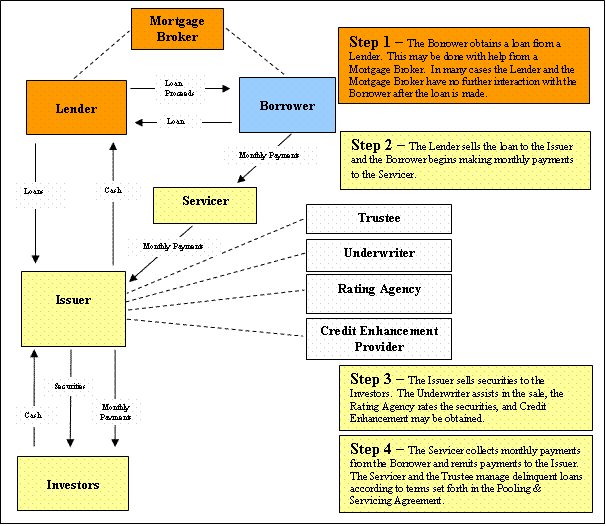
The traditional mortgage model involved a bank originating a loan to the borrower/homeowner and retaining the credit (default) risk. With the advent of securitization
, the traditional model has given way to the "originate to distribute" model, in which banks essentially sell the mortgages and distribute credit risk to investors through mortgage-backed securities
and collateralized debt obligations (CDO). Securitization meant that those issuing mortgages were no longer required to hold them to maturity. By selling the mortgages to investors, the originating banks replenished their funds, enabling them to issue more loans and generating transaction fees. This created a moral hazard
in which an increased focus on processing mortgage transactions was incentivized but ensuring their credit quality was not.
Key laws/regulations were changed, which allowed this to happen. Theses laws were encouraged by [need PAC and lobby sources] and eventually pass into law by [need list of congressmen]. Specific laws include [need sources here]. Canada, in contrast, did not implement these same general changes over the last 20 years and their housing market has remained stable outside of the general economic forces.
Securitization accelerated in the mid-1990s. The total amount of mortgage-backed securities issued almost tripled between 1996 and 2007, to $7.3 trillion. The securitized share of subprime mortgages (i.e., those passed to third-party investors via MBS) increased from 54% in 2001, to 75% in 2006. A sample of 735 CDO deals originated between 1999 and 2007 showed that subprime and other less-than-prime mortgages represented an increasing percentage of CDO assets, rising from 5% in 2000 to 36% in 2007. American homeowners, consumers, and corporations owed roughly $25 trillion during 2008. American banks retained about $8 trillion of that total directly as traditional mortgage loans. Bondholders and other traditional lenders provided another $7 trillion. The remaining $10 trillion came from the securitization markets. The securitization markets started to close down in the spring of 2007 and nearly shut-down in the fall of 2008. More than a third of the private credit markets thus became unavailable as a source of funds. In February 2009, Ben Bernanke
stated that securitization markets remained effectively shut, with the exception of conforming mortgages, which could be sold to Fannie Mae and Freddie Mac.
A more direct connection between securitization and the subprime crisis relates to a fundamental fault in the way that underwriters, rating agencies and investors modeled
the correlation
of risks among loans in securitization pools. Correlation modeling—determining how the default risk of one loan in a pool is statistically related to the default risk for other loans—was based on a "Gaussian copula" technique developed by statistician David X. Li
. This technique, widely adopted as a means of evaluating the risk associated with securitization transactions, used what turned out to be an overly simplistic approach to correlation. Unfortunately, the flaws in this technique did not become apparent to market participants until after many hundreds of billions of dollars of ABSs
and CDOs
backed by subprime loans had been rated and sold. By the time investors stopped buying subprime-backed securities—which halted the ability of mortgage originators to extend subprime loans—the effects of the crisis were already beginning to emerge.
Nobel laureate Dr. A. Michael Spence wrote: "Financial innovation, intended to redistribute and reduce risk, appears mainly to have hidden it from view. An important challenge going forward is to better understand these dynamics as the analytical underpinning of an early warning system with respect to financial instability."
 Credit rating agencies are now under scrutiny for having given investment-grade ratings to MBS
s based on risky subprime mortgage loans. These high ratings enabled these MBS to be sold to investors, thereby financing the housing boom. These ratings were believed justified because of risk reducing practices, such as credit default insurance and equity investors willing to bear the first losses. However, there are also indications that some involved in rating subprime-related securities knew at the time that the rating process was faulty.
Critics allege that the rating agencies suffered from conflicts of interest, as they were paid by investment banks and other firms that organize and sell structured securities to investors. On 11 June 2008, the SEC proposed rules designed to mitigate perceived conflicts of interest between rating agencies and issuers of structured securities. On 3 December 2008, the SEC approved measures to strengthen oversight of credit rating agencies, following a ten-month investigation that found "significant weaknesses in ratings practices," including conflicts of interest.
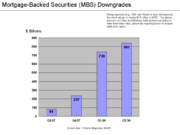
Between Q3 2007 and Q2 2008, rating agencies lowered the credit ratings on $1.9 trillion in mortgage backed securities. Financial institutions felt they had to lower the value of their MBS and acquire additional capital so as to maintain capital ratios. If this involved the sale of new shares of stock, the value of the existing shares was reduced. Thus ratings downgrades lowered the stock prices of many financial firms.
The Financial Crisis Inquiry Commission
reported in January 2011 that: "The three credit rating agencies were key enablers of
the financial meltdown. The mortgage-related securities at the heart of the crisis could not have been marketed and sold without their seal of approval. Investors relied on them, often blindly. In some cases, they were obligated to use them, or regulatory
capital standards were hinged on them. This crisis could not have happened without the rating agencies. Their ratings helped the market soar and their downgrades through 2007 and 2008 wreaked havoc across markets and firms." The Report further stated that ratings were incorrect because of "flawed computer models, the pressure from financial firms that paid for the ratings, the relentless drive for market share, the lack of resources to do the job despite record profits, and the absence of meaningful public oversight."
 Both government failed regulation and deregulation contributed to the crisis. In testimony before Congress both the Securities and Exchange Commission (SEC) and Alan Greenspan
conceded failure in allowing the self-regulation of investment banks.
Increasing home ownership has been the goal of several presidents including Roosevelt, Reagan, Clinton and George W. Bush
. In 1982, Congress passed the Alternative Mortgage Transactions Parity Act (AMTPA), which allowed non-federally chartered housing creditors to write adjustable-rate mortgages. Among the new mortgage loan types created and gaining in popularity in the early 1980s were adjustable-rate, option adjustable-rate, balloon-payment and interest-only mortgages. These new loan types are credited with replacing the long standing practice of banks making conventional fixed-rate, amortizing mortgages. Among the criticisms of banking industry deregulation that contributed to the savings and loan crisis
was that Congress failed to enact regulations that would have prevented exploitations by these loan types. Subsequent widespread abuses of predatory lending occurred with the use of adjustable-rate mortgages. Approximately 90% of subprime mortgages issued in 2006 were adjustable-rate mortgages.
In 1995, the GSEs like Fannie Mae began receiving government tax incentives for purchasing mortgage backed securities which included loans to low income borrowers. Thus began the involvement of the Fannie Mae and Freddie Mac with the subprime market.
In 1996, HUD set a goal for Fannie Mae and Freddie Mac that at least 42% of the mortgages they purchase be issued to borrowers whose household income was below the median in their area. This target was increased to 50% in 2000 and 52% in 2005. From 2002 to 2006, as the U.S. subprime market grew 292% over previous years, Fannie Mae and Freddie Mac combined purchases of subprime securities rose from $38 billion to around $175 billion per year before dropping to $90 billion per year, which included $350 billion of Alt-A
securities. Fannie Mae had stopped buying Alt-A products in the early 1990s because of the high risk of default.
By 2008, the Fannie Mae and Freddie Mac owned, either directly or through mortgage pools they sponsored, $5.1 trillion in residential mortgages, about half the total U.S. mortgage market. The GSE have always been highly leveraged, their net worth as of 30 June 2008 being a mere US$114 billion. When concerns arose in September 2008 regarding the ability of the GSE to make good on their guarantees, the Federal government was forced to place the companies into a conservatorship, effectively nationalizing them at the taxpayers' expense.
The Financial Crisis Inquiry Commission
reported in 2011 that Fannie & Freddie "contributed to the crisis, but were not a primary cause." GSE mortgage securities essentially maintained their value throughout the crisis and did not contribute to the significant financial firm losses that were central to the financial crisis. The GSEs participated in the expansion of subprime and other risky mortgages, but they followed rather than led Wall Street and other lenders into subprime lending.
The Glass-Steagall Act
was enacted after the Great Depression
. It separated commercial bank
s and investment banks, in part to avoid potential conflicts of interest between the lending activities of the former and rating activities of the latter. Economist Joseph Stiglitz criticized the repeal of the Act. He called its repeal the "culmination of a $300 million lobbying
effort by the banking and financial services industries...spearheaded in Congress by Senator Phil Gramm
." He believes it contributed to this crisis because the risk-taking culture of investment banking dominated the more conservative commercial banking culture, leading to increased levels of risk-taking and leverage during the boom period. The Federal government bailout of thrifts
during the savings and loan crisis
of the late 1980s may have encouraged other lenders to make risky loans, and thus given rise to moral hazard
.
Conservatives and Libertarians have also debated the possible effects of the Community Reinvestment Act
(CRA), with detractors claiming that the Act encouraged lending to uncreditworthy borrowers, and defenders claiming a thirty year history of lending without increased risk. Detractors also claim that amendments to the CRA in the mid-1990s, raised the amount of mortgages issued to otherwise unqualified low-income borrowers, and allowed the securitization of CRA-regulated mortgages, even though a fair number of them were subprime.
Federal Reserve Governor Randall Kroszner
and Federal Deposit Insurance Corporation
Chairman Sheila Bair have stated their belief that the CRA was not to blame for the crisis.
Economist Paul Krugman
argued in January 2010 that the simultaneous growth of the residential and commercial real estate pricing bubbles undermines the case made by those who argue that Fannie Mae, Freddie Mac, CRA or predatory lending were primary causes of the crisis. In other words, bubbles in both markets developed even though only the residential market was affected by these potential causes.
The Financial Crisis Inquiry Commission
reported in January 2011 that "the CRA was not a significant factor in subprime lending or the crisis. Many subprime lenders were not subject to the CRA. Research indicates only 6% of high-cost loans—a proxy for subprime loans—had any connection to the law. Loans made by CRA-regulated lenders in the neighborhoods in which they were required to lend were half as likely to default as similar loans made in the same neighborhoods by independent mortgage originators not subject to the law."
The George W. Bush administration was accused of blocking ongoing state investigations into predatory lending practices as the bubble continued to grow. However, when George W. Bush called for an investigation and more controls on Fannie Mae and Freddie Mac, Congressman Barney Frank vocally objected, saying "These two entities -- Fannie Mae and Freddie Mac -- are not facing any kind of financial crisis."
 Central bank
s manage monetary policy and may target the rate of inflation. They have some authority over commercial bank
s and possibly other financial institutions. They are less concerned with avoiding asset price bubbles, such as the housing bubble and dot-com bubble
. Central banks have generally chosen to react after such bubbles burst so as to minimize collateral damage to the economy, rather than trying to prevent or stop the bubble itself. This is because identifying an asset bubble and determining the proper monetary policy to deflate it are matters of debate among economists.
Some market observers have been concerned that Federal Reserve actions could give rise to moral hazard
. A Government Accountability Office
critic said that the Federal Reserve Bank of New York
's rescue of Long-Term Capital Management
in 1998 would encourage large financial institutions to believe that the Federal Reserve would intervene on their behalf if risky loans went sour because they were “too big to fail.”
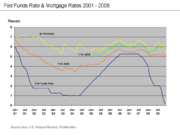
A contributing factor to the rise in house prices was the Federal Reserve's lowering of interest rates early in the decade. From 2000 to 2003, the Federal Reserve lowered the federal funds rate
target from 6.5% to 1.0%. This was done to soften the effects of the collapse of the dot-com bubble
and of the September 2001 terrorist attacks, and to combat the perceived risk of deflation. The Fed believed that interest rates could be lowered safely primarily because the rate of inflation
was low; it disregarded other important factors. Richard W. Fisher, President and CEO of the Federal Reserve Bank of Dallas
, said that the Fed's interest rate policy during the early 2000s was misguided, because measured inflation in those years was below true inflation, which led to a monetary policy that contributed to the housing bubble. According to Ben Bernanke
, now chairman of the Federal Reserve, it was capital or savings pushing into the United States, due to a world wide "saving glut", which kept long term interest rates low independently of Central Bank action.
The Fed then raised the Fed funds rate significantly between July 2004 and July 2006. This contributed to an increase in 1-year and 5-year ARM rates, making ARM interest rate resets more expensive for homeowners. This may have also contributed to the deflating of the housing bubble, as asset prices generally move inversely to interest rates and it became riskier to speculate in housing.
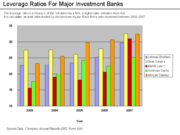 The Financial Crisis Inquiry Commission
reported in January 2011 that: "From 1978 to 2007, the amount of debt held by the financial sector soared from $3 trillion to $36 trillion, more than doubling as a share of gross domestic product. The very nature of many Wall Street firms changed—from relatively staid private partnerships to publicly traded corporations taking greater and more diverse kinds of risks. By 2005, the 10 largest U.S. commercial banks held 55% of the industry’s assets, more than double the level held in 1990. On the eve of the crisis in 2006, financial sector profits constituted 27% of all corporate profits in the United States, up from 15% in 1980."
Many financial institutions, investment banks in particular, issued large amounts of debt during 2004–2007, and invested the proceeds in mortgage-backed securities (MBS), essentially betting that house prices would continue to rise, and that households would continue to make their mortgage payments. Borrowing at a lower interest rate and investing the proceeds at a higher interest rate is a form of financial leverage. This is analogous to an individual taking out a second mortgage on his residence to invest in the stock market. This strategy proved profitable during the housing boom, but resulted in large losses when house prices began to decline and mortgages began to default. Beginning in 2007, financial institutions and individual investors holding MBS also suffered significant losses from mortgage payment defaults and the resulting decline in the value of MBS.
A 2004 U.S. Securities and Exchange Commission (SEC) decision related to the net capital rule
allowed USA investment banks to issue substantially more debt, which was then used to purchase MBS. Over 2004–07, the top five US investment banks each significantly increased their financial leverage (see diagram), which increased their vulnerability to the declining value of MBSs. These five institutions reported over $4.1 trillion in debt for fiscal year 2007, about 30% of USA nominal GDP for 2007. Further, the percentage of subprime mortgages originated to total originations increased from below 10% in 2001–2003 to between 18–20% from 2004–2006, due in-part to financing from investment banks.
During 2008, three of the largest U.S. investment banks either went bankrupt (Lehman Brothers
) or were sold at fire sale prices to other banks (Bear Stearns
and Merrill Lynch
). These failures augmented the instability in the global financial system. The remaining two investment banks, Morgan Stanley
and Goldman Sachs
, opted to become commercial banks, thereby subjecting themselves to more stringent regulation.
In the years leading up to the crisis, the top four U.S. depository banks moved an estimated $5.2 trillion in assets and liabilities off-balance sheet into special purpose vehicles
or other entities in the shadow banking system
. This enabled them to essentially bypass existing regulations regarding minimum capital ratios, thereby increasing leverage and profits during the boom but increasing losses during the crisis. New accounting guidance will require them to put some of these assets back onto their books during 2009, which will significantly reduce their capital ratios. One news agency estimated this amount to be between $500 billion and $1 trillion. This effect was considered as part of the stress tests performed by the government during 2009.
Martin Wolf
wrote in June 2009: "...an enormous part of what banks did in the early part of this decade – the off-balance-sheet vehicles, the derivatives and the 'shadow banking system' itself – was to find a way round regulation."
The New York State Comptroller's Office has said that in 2006, Wall Street executives took home bonuses totaling $23.9 billion. "Wall Street traders were thinking of the bonus at the end of the year, not the long-term health of their firm. The whole system—from mortgage brokers to Wall Street risk managers—seemed tilted toward taking short-term risks while ignoring long-term obligations. The most damning evidence is that most of the people at the top of the banks didn't really understand how those [investments] worked."
The incentive compensation of traders was focused on fees generated from assembling financial products, rather than the performance of those products and profits generated over time. Their bonuses were heavily skewed towards cash rather than stock and not subject to "claw-back" (recovery of the bonus from the employee by the firm) in the event the MBS or CDO created did not perform. In addition, the increased risk (in the form of financial leverage) taken by the major investment banks was not adequately factored into the compensation of senior executives.
Like all swaps
and other financial derivatives, CDS may either be used to hedge
risks (specifically, to insure creditors against default) or to profit from speculation
. The volume of CDS outstanding increased 100-fold from 1998 to 2008, with estimates of the debt covered by CDS contracts, as of November 2008, ranging from US$33 to $47 trillion. CDS are lightly regulated, largely because of the Commodities Futures Modernization Act of 2000. As of 2008, there was no central clearing house
to honor CDS in the event a party to a CDS proved unable to perform his obligations under the CDS contract. Required disclosure of CDS-related obligations has been criticized as inadequate. Insurance companies such as American International Group
(AIG), MBIA, and Ambac
faced ratings downgrades because widespread mortgage defaults increased their potential exposure to CDS losses. These firms had to obtain additional funds (capital) to offset this exposure. AIG's having CDSs insuring $440 billion of MBS resulted in its seeking and obtaining a Federal government bailout. The monoline insurance companies went out of business in 2008-2009.
When investment bank Lehman Brothers
went bankrupt in September 2008, there was much uncertainty as to which financial firms would be required to honor the CDS contracts on its $600 billion of bonds outstanding.
Merrill Lynch
's large losses in 2008 were attributed in part to the drop in value of its unhedged portfolio of collateralized debt obligation
s (CDOs) after AIG
ceased offering CDS on Merrill's CDOs. The loss of confidence of trading partners in Merrill Lynch's solvency and its ability to refinance its short-term debt
led to its acquisition by the Bank of America
.
Economist Joseph Stiglitz summarized how credit default swaps contributed to the systemic meltdown: "With this complicated intertwining of bets of great magnitude, no one could be sure of the financial position of anyone else-or even of one's own position. Not surprisingly, the credit markets froze."
Author Michael Lewis
wrote that CDS enabled speculators to stack bets on the same mortgage bonds and CDO's. This is analogous to allowing many persons to buy insurance on the same house. Speculators that bought CDS insurance were betting that significant defaults would occur, while the sellers (such as AIG
) bet they would not. A theoretically infinite amount could be wagered on the same housing-related securities, provided buyers and sellers of the CDS could be found. In addition, Chicago Public Radio, Huffington Post, and ProPublica reported in April 2010 that market participants, including a hedge fund called Magnetar Capital
, encouraged the creation of CDO's containing low quality mortgages, so they could bet against them using CDS. NPR reported that Magnetar encouraged investors to purchase CDO's while simultaneously betting against them, without disclosing the latter bet. Instruments called synthetic CDO
, which are portfolios of credit default swaps, were also involved in allegations by the SEC against Goldman-Sachs in April 2010.
The Financial Crisis Inquiry Commission
reported in January 2011 that CDS contributed significantly to the crisis. Companies were able to sell protection to investors against the default of mortgage-backed securities, helping to launch and expand the market for new, complex instruments such as CDO's. This further fueled the housing bubble. They also amplified the losses from the collapse of the housing bubble by allowing multiple bets on the same securities and helped spread these bets throughout the financial system. Companies selling protection, such as AIG
, were not required to set aside sufficient capital to cover their obligations when significant defaults occurred. Because many CDS were not traded on exchanges, the obligations of key financial institutions became hard to measure, creating uncertainty in the financial system.
addressed the implications of the United States's high and rising current account
deficit, resulting from U.S. investment exceeding its savings, or imports exceeding exports. Between 1996 and 2004, the U.S. current account deficit increased by $650 billion, from 1.5% to 5.8% of GDP. The U.S. attracted a great deal of foreign investment, mainly from the emerging economies in Asia and oil-exporting nations. The balance of payments
identity
requires that a country (such as the U.S.) running a current account
deficit also have a capital account
(investment) surplus of the same amount. Foreign investors had these funds to lend, either because they had very high personal savings rates (as high as 40% in China), or because of high oil prices. Bernanke referred to this as a "saving glut" that may have pushed capital into the United States, a view differing from that of some other economists, who view such capital as having been pulled into the U.S. by its high consumption levels. In other words, a nation cannot consume more than its income unless it sells assets to foreigners, or foreigners are willing to lend to it. Alternatively, if a nation wishes to increase domestic investment in plant and equipment, it will also increase its level of imports to maintain balance if it has a floating exchange rate.
Regardless of the push or pull view, a "flood" of funds (capital
or liquidity) reached the U.S. financial market. Foreign governments supplied funds by purchasing U.S. Treasury bonds and thus avoided much of the direct impact of the crisis. American households, on the other hand, used funds borrowed from foreigners to finance consumption or to bid up the prices of housing and financial assets. Financial institutions invested foreign funds in mortgage-backed securities. American housing and financial assets dramatically declined in value after the housing bubble burst.
Economist Joseph Stiglitz wrote in October 2011 that the recession and high unemployment of the 2009-2011 period was years in the making and driven by: unsustainable consumption; high manufacturing productivity outpacing demand thereby increasing unemployment; income inequality that shifted income from those who tended to spend it (i.e., the middle class) to those who do not (i.e., the wealthy); and emerging market's buildup of reserves (to the tune of $7.6 trillion by 2011) which was not spent. These factors all led to a "massive" shortfall in aggregate demand, which was "papered over" by demand related to the housing bubble until it burst.
. These entities became critical to the credit markets underpinning the financial system, but were not subject to the same regulatory controls as depository banks. Further, these entities were vulnerable because they borrowed short-term in liquid markets to purchase long-term, illiquid and risky assets. This meant that disruptions in credit markets would make them subject to rapid deleveraging, selling their long-term assets at depressed prices. He described the significance of these entities: "In early 2007, asset-backed commercial paper conduits, in structured investment vehicles, in auction-rate preferred securities, tender option bonds and variable rate demand notes, had a combined asset size of roughly $2.2 trillion. Assets financed overnight in triparty repo grew to $2.5 trillion. Assets held in hedge funds grew to roughly $1.8 trillion. The combined balance sheets of the then five major investment banks totaled $4 trillion. In comparison, the total assets of the top five bank holding companies in the United States at that point were just over $6 trillion, and total assets of the entire banking system were about $10 trillion." He stated that the "combined effect of these factors was a financial system vulnerable to self-reinforcing asset price and credit cycles."
Nobel laureate Paul Krugman
described the run on the shadow banking system as the "core of what happened" to cause the crisis. "As the shadow banking system expanded to rival or even surpass conventional banking in importance, politicians and government officials should have realized that they were re-creating the kind of financial vulnerability that made the Great Depression possible—and they should have responded by extending regulations and the financial safety net to cover these new institutions. Influential figures should have proclaimed a simple rule: anything that does what a bank does, anything that has to be rescued in crises the way banks are, should be regulated like a bank." He referred to this lack of controls as "malign neglect."
The securitization markets supported by the shadow banking system started to close down in the spring of 2007 and nearly shut-down in the fall of 2008. More than a third of the private credit markets thus became unavailable as a source of funds. According to the Brookings Institution
, the traditional banking system does not have the capital to close this gap as of June 2009: "It would take a number of years of strong profits to generate sufficient capital to support that additional lending volume." The authors also indicate that some forms of securitization are "likely to vanish forever, having been an artifact of excessively loose credit conditions."
Economist Mark Zandi
testified to the Financial Crisis Inquiry Commission
in January 2010:
"The securitization markets also remain impaired, as investors anticipate more loan losses. Investors are also uncertain about coming legal and accounting rule changes and regulatory reforms. Private bond issuance of residential and commercial mortgage-backed securities, asset-backed securities, and CDOs peaked in 2006 at close to $2 trillion...In 2009, private issuance was less than $150 billion, and almost all of it was asset-backed issuance supported by the Federal Reserve's TALF program to aid credit card, auto and small-business lenders. Issuance of residential and commercial mortgage-backed securities and CDOs remains dormant."
The Economist
reported in March 2010: "Bear Stearns and Lehman Brothers were non-banks that were crippled by a silent run among panicky overnight "repo
" lenders, many of them money market funds uncertain about the quality of securitized collateral they were holding. Mass redemptions from these funds after Lehman's failure froze short-term funding for big firms."
The Financial Crisis Inquiry Commission
reported in January 2011: "In the early part of the 20th century, we erected a series of protections—the Federal Reserve as a lender of last resort, federal deposit insurance, ample regulations—to provide a bulwark against the panics that had regularly plagued America’s banking system in the 20th century. Yet, over the past 30-plus years, we
permitted the growth of a shadow banking system—opaque and laden with short term debt—that rivaled the size of the traditional banking system. Key components of the market—for example, the multitrillion-dollar repo lending market, off-balance-sheet entities, and the use of over-the-counter derivatives—were hidden from view, without the protections we had constructed to prevent financial meltdowns. We had a 21st-century financial system with 19th-century safeguards."
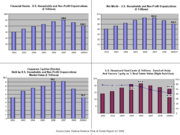 Between June 2007 and November 2008, Americans lost more than a quarter of their net worth. By early November 2008, a broad U.S. stock index, the S&P 500, was down 45 percent from its 2007 high. Housing prices had dropped 20% from their 2006 peak, with futures markets signaling a 30–35% potential drop. Total home equity in the United States, which was valued at $13 trillion at its peak in 2006, had dropped to $8.8 trillion by mid-2008 and was still falling in late 2008. Total retirement assets, Americans' second-largest household asset, dropped by 22 percent, from $10.3 trillion in 2006 to $8 trillion in mid-2008. During the same period, savings and investment assets (apart from retirement savings) lost $1.2 trillion and pension assets lost $1.3 trillion. Taken together, these losses total $8.3 trillion. Members of USA minority groups
received a disproportionate number of subprime mortgages, and so have experienced a disproportionate level of the resulting foreclosure
s. The crisis had a devastating effect on the U.S. auto industry. New vehicle sales, which peaked at 17 million in 2005, recovered to only 12 million by 2010.
 The crisis began to affect the financial sector in February 2007, when HSBC
, the world's largest (2008) bank, wrote down its holdings of subprime-related MBS by $10.5 billion, the first major subprime related loss to be reported. During 2007, at least 100 mortgage companies either shut down, suspended operations or were sold.
Top management has not escaped unscathed, as the CEOs of Merrill Lynch
and Citigroup
resigned within a week of each other in late 2007. As the crisis deepened, more and more financial firms either merged, or announced that they were negotiating seeking merger partners.
During 2007, the crisis caused panic in financial markets and encouraged investors to take their money out of risky mortgage bonds and shaky equities and put it into commodities as "stores of value". Financial speculation in commodity futures following the collapse of the financial derivatives markets has contributed to the world food price crisis
and oil price increases due to a "commodities super-cycle." Financial speculators seeking quick returns have removed trillions of dollars from equities and mortgage bonds, some of which has been invested into food and raw materials.
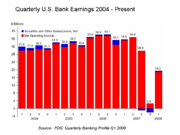
Mortgage defaults and provisions for future defaults caused profits at the 8533 USA depository institution
s insured by the Federal Deposit Insurance Corporation
to decline from $35.2 billion in 2006 Q4 to $646 million in the same quarter a year later, a decline of 98%. 2007 Q4 saw the worst bank and thrift quarterly performance since 1990. In all of 2007, insured depository institutions earned approximately $100 billion, down 31% from a record profit of $145 billion in 2006. Profits declined from $35.6 billion in 2007 Q1 to $19.3 billion in 2008 Q1, a decline of 46%.
As of August 2008, financial firms around the globe have written down their holdings of subprime related securities by US$501 billion. The IMF estimates that financial institutions around the globe will eventually have to write off $1.5 trillion of their holdings of subprime MBSs. About $750 billion in such losses had been recognized as of November 2008. These losses have wiped out much of the capital of the world banking system. Banks headquartered in nations that have signed the Basel Accords must have so many cents of capital
for every dollar of credit extended to consumers and businesses. Thus the massive reduction in bank capital just described has reduced the credit available to businesses and households.
When Lehman Brothers
and other important financial institutions failed in September 2008, the crisis hit a key point. During a two day period in September 2008, $150 billion were withdrawn from USA money fund
s. The average two day outflow had been $5 billion. In effect, the money market
was subject to a bank run
. The money market had been a key source of credit for banks (CD
s) and nonfinancial firms (commercial paper
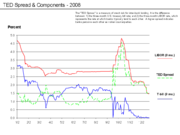
). The TED spread
(see graph above), a measure of the risk of interbank lending, quadrupled shortly after the Lehman failure. This credit freeze brought the global financial system to the brink of collapse. The response of the USA Federal Reserve, the European Central Bank
, and other central banks was immediate and dramatic. During the last quarter of 2008, these central banks purchased US$2.5 trillion of government debt and troubled private assets from banks. This was the largest liquidity injection into the credit market, and the largest monetary policy action, in world history. The governments of European nations and the USA also raised the capital of their national banking systems by $1.5 trillion, by purchasing newly issued preferred stock
in their major banks.
However, some economists state that Third-World economies, such as the Brazil
ian and Chinese
ones, will not suffer as much as those from more developed countries. However, other analysts have seen Brazil as entering their own sub-prime crisis.
The International Monetary Fund estimated that large U.S. and European banks lost more than $1 trillion on toxic assets and from bad loans from January 2007 to September 2009. These losses are expected to top $2.8 trillion from 2007–10. U.S. banks losses were forecast to hit $1 trillion and European bank losses will reach $1.6 trillion. The IMF estimated that U.S. banks were about 60 percent through their losses, but British and eurozone banks only 40 percent.
Economist Carmen Reinhart
stated in August 2011: "Debt de-leveraging [reduction] takes about seven years...And in the decade following severe financial crises, you tend to grow by 1 to 1.5 percentage points less than in the decade before, because the decade before was fueled by a boom in private borrowing, and not all of that growth was real. The unemployment figures in advanced economies after falls are also very dark. Unemployment remains anchored about five percentage points above what it was in the decade before.”
To date, various government agencies have committed or spent trillions of dollars in loans, asset purchases, guarantees, and direct spending. For a summary of U.S. government financial commitments and investments related to the crisis, see CNN – Bailout Scorecard.
s around the world, has taken several steps to address the crisis. Federal Reserve Chairman Ben Bernanke
stated in early 2008: "Broadly, the Federal Reserve's response has followed two tracks: efforts to support market liquidity
and functioning and the pursuit of our macroeconomic objectives through monetary policy."
The Fed has:
According to Ben Bernanke
, expansion of the Fed balance sheet means the Fed is electronically creating money, necessary "...because our economy is very weak and inflation is very low. When the economy begins to recover, that will be the time that we need to unwind those programs, raise interest rates, reduce the money supply, and make sure that we have a recovery that does not involve inflation."
signed into law a $168 billion economic stimulus package, mainly taking the form of income tax
rebate checks mailed directly to taxpayers. Checks were mailed starting the week of 28 April 2008. However, this rebate coincided with an unexpected jump in gasoline and food prices. This coincidence led some to wonder whether the stimulus package would have the intended effect, or whether consumers would simply spend their rebates to cover higher food and fuel prices.
On 17 February 2009, U.S. President Barack Obama
signed the American Recovery and Reinvestment Act of 2009
, an $787 billion stimulus package with a broad spectrum of spending and tax cuts. Over $75 billion of which was specifically allocated to programs which help struggling homeowners. This program is referred to as the Homeowner Affordability and Stability Plan.
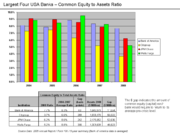 Losses on mortgage-backed securities and other assets purchased with borrowed money have dramatically reduced the capital base of financial institutions, rendering many either insolvent or less capable of lending. Governments have provided funds to banks. Some banks have taken significant steps to acquire additional capital from private sources.
The U.S. government passed the Emergency Economic Stabilization Act of 2008
(EESA or TARP) during October 2008. This law included $700 billion in funding for the "Troubled Assets Relief Program
" (TARP), which was used to lend funds to banks in exchange for dividend-paying preferred stock.
Another method of recapitalizing banks is for government and private investors to provide cash in exchange for mortgage-related assets (i.e., "toxic" or "legacy" assets), improving the quality of bank capital while reducing uncertainty regarding the financial position of banks. U.S. Treasury Secretary Timothy Geithner announced a plan during March 2009 to purchase "legacy" or "toxic" assets from banks. The Public-Private Partnership Investment Program involves government loans and guarantees to encourage private investors to provide funds to purchase toxic assets from banks.
For a summary of U.S. government financial commitments and investments related to the crisis, see CNN – Bailout Scorecard.
For a summary of TARP funds provided to U.S. banks as of December 2008, see Reuters-TARP Funds.
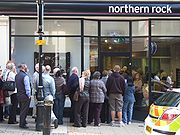 Several major financial institutions either failed, were bailed-out by governments, or merged (voluntarily or otherwise) during the crisis. While the specific circumstances varied, in general the decline in the value of mortgage-backed securities held by these companies resulted in either their insolvency
, the equivalent of bank runs as investors pulled funds from them, or inability to secure new funding in the credit markets. These firms had typically borrowed and invested large sums of money relative to their cash or equity capital, meaning they were highly leveraged and vulnerable to unanticipated credit market disruptions.
The five largest U.S. investment banks, with combined liabilities or debts of $4 trillion, either went bankrupt (Lehman Brothers
), were taken over by other companies (Bear Stearns
and Merrill Lynch
), or were bailed-out by the U.S. government (Goldman Sachs
and Morgan Stanley
) during 2008. Government-sponsored enterprises (GSE) Fannie Mae and Freddie Mac either directly owed or guaranteed nearly $5 trillion in mortgage obligations, with a similarly weak capital base, when they were placed into receivership
in September 2008. For scale, this $9 trillion in obligations concentrated in seven highly leveraged institutions can be compared to the $14 trillion size of the U.S. economy (GDP) or to the total national debt of $10 trillion in September 2008.
Major depository banks around the world had also used financial innovation
s such as structured investment vehicles to circumvent capital ratio regulations. Notable global failures included Northern Rock
, which was nationalized at an estimated cost of £87 billion ($150 billion). In the U.S., Washington Mutual
(WaMu) was seized in September 2008 by the USA Office of Thrift Supervision
(OTS). This would be followed by the shotgun wedding of Wells Fargo
& Wachovia
after it was speculated that without the merger Wachovia was also going to fail. Dozens of U.S. banks received funds as part of the TARP or $700 billion bailout. The TARP funds gained some controversy after PNC Financial Services
received TARP money, only to turn around hours later and purchase
the struggling National City Corp.
, which itself had become a victim of the subprime crisis.
As a result of the financial crisis in 2008, twenty five U.S. banks became insolvent and were taken over by the FDIC. As of August 14, 2009, an additional 77 banks became insolvent. This seven month tally surpasses the 50 banks that were seized in all of 1993, but is still much smaller than the number of failed banking institutions in 1992, 1991, and 1990. The United States has lost over 6 million jobs since the recession began in December 2007.
The FDIC deposit insurance fund, supported by fees on insured banks, fell to $13 billion in the first quarter of 2009. That is the lowest total since September, 1993.
According to some, the bailouts could be traced directly to Alan Greenspan's efforts to reflate the stock market and the economy after the tech stock bust, and specifically to a February 23, 2004 speech Mr. Greenspan made to the Mortgage Bankers Association where he suggested that the time had come to push average American borrowers into more exotic loans with variable rates, or deferred interest. This argument suggests that Mr. Greenspan sought to enlist banks to expand lending and debt to stimulate asset prices and that the Federal Reserve and US Treasury Department would back any losses that might result. As early as March 2007 some commentators predicted that a bailout of the banks would exceed $1 trillion, at a time when Ben Bernanke, Alan Greenspan and Henry Paulson all claimed that mortgage problems were "contained" to the subprime market and no bailout of the financial sector would be necessary.
). Borrowers have also been encouraged to contact their lenders to discuss alternatives.
The Economist
described the issue this way: "No part of the financial crisis has received so much attention, with so little to show for it, as the tidal wave of home foreclosures sweeping over America. Government programmes have been ineffectual, and private efforts not much better." Up to 9 million homes may enter foreclosure over the 2009–2011 period, versus one million in a typical year. At roughly U.S. $50,000 per foreclosure according to a 2006 study by the Chicago Federal Reserve Bank, 9 million foreclosures represents $450 billion in losses.
A variety of voluntary private and government-administered or supported programs were implemented during 2007–2009 to assist homeowners with case-by-case mortgage assistance, to mitigate the foreclosure crisis engulfing the U.S. One example is the Hope Now Alliance
, an ongoing collaborative effort between the US Government and private industry to help certain subprime borrowers. In February 2008, the Alliance reported that during the second half of 2007, it had helped 545,000 subprime borrowers with shaky credit, or 7.7% of 7.1 million subprime loans outstanding as of September 2007. A spokesperson for the Alliance acknowledged that much more must be done.
During late 2008, major banks and both Fannie Mae and Freddie Mac established moratoriums (delays) on foreclosures, to give homeowners time to work towards refinancing.
Critics have argued that the case-by-case loan modification
method is ineffective, with too few homeowners assisted relative to the number of foreclosures and with nearly 40% of those assisted homeowners again becoming delinquent within 8 months. In December 2008, the U.S. FDIC reported that more than half of mortgages modified during the first half of 2008 were delinquent again, in many cases because payments were not reduced or mortgage debt was not forgiven. This is further evidence that case-by-case loan modification is not effective as a policy tool.
In February 2009, economists Nouriel Roubini
and Mark Zandi
recommended an "across the board" (systemic) reduction of mortgage principal balances by as much as 20–30%. Lowering the mortgage balance would help lower monthly payments and also address an estimated 20 million homeowners that may have a financial incentive to enter voluntary foreclosure because they are "underwater" (i.e., the mortgage balance is larger than the home value).
A study by the Federal Reserve Bank of Boston indicated that banks were reluctant to modify loans. Only 3% of seriously delinquent homeowners had their mortgage payments reduced during 2008. In addition, investors who hold MBS and have a say in mortgage modification
s have not been a significant impediment; the study found no difference in the rate of assistance whether the loans were controlled by the bank or by investors. Commenting on the study, economists Dean Baker
and Paul Willen both advocated providing funds directly to homeowners instead of banks.
The L.A. Times reported the results of a study that found homeowners with high credit scores at the time of entering the mortgage are 50% more likely to "strategically default
" – abruptly and intentionally pull the plug and abandon the mortgage—compared with lower-scoring borrowers. Such strategic defaults were heavily concentrated in markets with the highest price declines. An estimated 588,000 strategic defaults occurred nationwide during 2008, more than double the total in 2007. They represented 18% of all serious delinquencies that extended for more than 60 days in the fourth quarter of 2008.
and key advisers introduced a series of regulatory proposals in June 2009. The proposals address consumer protection, executive pay, bank financial cushions or capital requirements, expanded regulation of the shadow banking system
and derivatives
, and enhanced authority for the Federal Reserve to safely wind-down systemically important institutions, among others. The Dodd–Frank Wall Street Reform and Consumer Protection Act was signed into law in July 2010 to address some of the causes of the crisis.
U.S. Treasury Secretary Timothy Geithner testified before Congress on October 29, 2009. His testimony included five elements he stated as critical to effective reform:
was looking into the possibility of fraud by mortgage financing companies Fannie Mae and Freddie Mac, Lehman Brothers
, and insurer American International Group
, among others. New York Attorney General Andrew Cuomo is suing Long Island based Amerimod, one of the nation's largest loan modification corporations for fraud, and has issued 14 subpoenas to other similar companies. The FBI also assigned more agents to mortgage-related crimes and its caseload has dramatically increased. The FBI began a probe of Countrywide Financial
in March 2008 for possible fraudulent lending practices and securities fraud.
Over 300 civil lawsuits were filed in federal courts during 2007 related to the subprime crisis. The number of filings in state courts was not quantified but is also believed to be significant.
(IMF) estimated that global losses for financial institutions would approach $1 trillion. One year later, the IMF estimated cumulative losses of banks and other financial institutions globally would exceed $4 trillion.
Francis Fukuyama
has argued that the crisis represents the end of Reaganism in the financial sector, which was characterized by lighter regulation, pared-back government, and lower taxes. Significant financial sector regulatory changes are expected as a result of the crisis.
Fareed Zakaria
believes that the crisis may force Americans and their government to live within their means. Further, some of the best minds may be redeployed from financial engineering to more valuable business activities, or to science and technology.
Roger Altman
wrote that "the crash of 2008 has inflicted profound damage on [the U.S.] financial system, its economy, and its standing in the world; the crisis is an important geopolitical setback...the crisis has coincided with historical forces that were already shifting the world's focus away from the United States. Over the medium term, the United States will have to operate from a smaller global platform – while others, especially China, will have a chance to rise faster."
GE
CEO Jeffrey Immelt has argued that U.S. trade deficits and budget deficits are unsustainable. America must regain its competitiveness through innovative products, training of production workers, and business leadership. He advocates specific national goals related to energy security or independence, specific technologies, expansion of the manufacturing job base, and net exporter status. "The world has been reset. Now we must lead an aggressive American renewal to win in the future." Of critical importance, he said, is the need to focus on technology and manufacturing. “Many bought into the idea that America could go from a technology-based, export-oriented powerhouse to a services-led, consumption-based economy — and somehow still expect to prosper,” Jeff said. “That idea was flat wrong.”
Economist Paul Krugman
wrote in 2009: "The prosperity of a few years ago, such as it was—profits were terrific, wages not so much—depended on a huge bubble in housing, which replaced an earlier huge bubble in stocks. And since the housing bubble isn’t coming back, the spending that sustained the economy in the pre-crisis years isn’t coming back either." Niall Ferguson
stated that excluding the effect of home equity extraction, the U.S. economy grew at a 1% rate during the Bush years. Microsoft
CEO Steve Ballmer
has argued that this is an economic reset at a lower level, rather than a recession, meaning that no quick recovery to pre-recession levels can be expected.
The U.S. Federal government's efforts to support the global financial system have resulted in significant new financial commitments, totaling $7 trillion by November, 2008. These commitments can be characterized as investments, loans, and loan guarantees, rather than direct expenditures. In many cases, the government purchased financial assets such as commercial paper, mortgage-backed securities, or other types of asset-backed paper, to enhance liquidity in frozen markets. As the crisis has progressed, the Fed has expanded the collateral against which it is willing to lend to include higher-risk assets.
The Economist
wrote in May 2009: "Having spent a fortune bailing out their banks, Western governments will have to pay a price in terms of higher taxes to meet the interest on that debt. In the case of countries (like Britain and America) that have trade as well as budget deficits, those higher taxes will be needed to meet the claims of foreign creditors. Given the political implications of such austerity, the temptation will be to default by stealth, by letting their currencies depreciate. Investors are increasingly alive to this danger..."
The crisis has cast doubt on the legacy of Alan Greenspan
, the Chairman of the Federal Reserve System from 1986 to January 2006. Senator Chris Dodd claimed that Greenspan created the "perfect storm
". When asked to comment on the crisis, Greenspan spoke as follows:
Late-2000s financial crisis
The late-2000s financial crisis is considered by many economists to be the worst financial crisis since the Great Depression of the 1930s...
, characterized by a rise in subprime
Subprime lending
In finance, subprime lending means making loans to people who may have difficulty maintaining the repayment schedule...
mortgage delinquencies and foreclosures, and the resulting decline of securities backed by said mortgages.
The ratio of lower-quality subprime mortgages originated rose from the historical 8% or lower range to approximately 20% from 2004-2006, with much higher ratios in some parts of the U.S. A high percentage of these subprime mortgages, over 90% in 2006 for example, were adjustable-rate mortgages. These two changes were part of a broader trend of lowered lending standards and higher-risk mortgage products. Further, U.S. households had become increasingly indebted, with the ratio of debt to disposable personal income rising from 77% in 1990 to 127% at the end of 2007, much of this increase mortgage-related.
After U.S. house sales prices peaked in mid-2006 and began their steep decline forthwith, refinancing
Refinancing
Refinancing may refer to the replacement of an existing debt obligation with a debt obligation under different terms. The terms and conditions of refinancing may vary widely by country, province, or state, based on several economic factors such as, inherent risk, projected risk, political...
became more difficult. As adjustable-rate mortgages began to reset at higher interest rates (causing higher monthly payments), mortgage delinquencies soared. Securities backed with mortgages, including subprime mortgages, widely held by financial firms, lost most of their value. Global investors also drastically reduced purchases of mortgage-backed debt and other securities as part of a decline in the capacity and willingness of the private financial system to support lending. Concerns about the soundness of U.S. credit and financial markets led to tightening credit around the world and slowing economic growth in the U.S. and Europe.
Background and timeline of events
United States housing bubble
The United States housing bubble is an economic bubble affecting many parts of the United States housing market in over half of American states. Housing prices peaked in early 2006, started to decline in 2006 and 2007, and may not yet have hit bottom as of 2011. On December 30, 2008 the...
which peaked in approximately 2005–2006. High default rates on "subprime" and adjustable rate mortgage
Adjustable rate mortgage
A variable-rate mortgage, adjustable-rate mortgage , or tracker mortgage is a mortgage loan with the interest rate on the note periodically adjusted based on an index which reflects the cost to the lender of borrowing on the credit markets. The loan may be offered at the lender's standard variable...
s (ARM), began to increase quickly thereafter. An increase in loan incentives such as easy initial terms and a long-term trend of rising housing prices had encouraged borrowers to assume difficult mortgages in the belief they would be able to quickly refinance at more favorable terms. Additionally, the economic incentives provided to the originators of subprime mortgages, along with outright fraud, increased the number of subprime mortgages provided to consumers who would have otherwise qualified for conforming loans. However, once interest rate
Interest rate
An interest rate is the rate at which interest is paid by a borrower for the use of money that they borrow from a lender. For example, a small company borrows capital from a bank to buy new assets for their business, and in return the lender receives interest at a predetermined interest rate for...
s began to rise and housing prices started to drop moderately in 2006–2007 in many parts of the U.S., refinancing became more difficult. Defaults
Default (finance)
In finance, default occurs when a debtor has not met his or her legal obligations according to the debt contract, e.g. has not made a scheduled payment, or has violated a loan covenant of the debt contract. A default is the failure to pay back a loan. Default may occur if the debtor is either...
and foreclosure
Foreclosure
Foreclosure is the legal process by which a mortgage lender , or other lien holder, obtains a termination of a mortgage borrower 's equitable right of redemption, either by court order or by operation of law...
activity increased dramatically as easy initial terms expired, home prices failed to go up as anticipated, and ARM interest rates reset higher. Falling prices also resulted in 23% of U.S. homes worth less than the mortgage loan by September 2010, providing a financial incentive for borrowers to enter foreclosure. The ongoing foreclosure epidemic, of which subprime loans are one part, that began in late 2006 in the U.S. continues to be a key factor in the global economic crisis, because it drains wealth from consumers and erodes the financial strength of banking institutions.
In the years leading up to the crisis, significant amounts of foreign money flowed into the U.S. from fast-growing economies in Asia and oil-producing countries. This inflow of funds combined with low U.S. interest rates from 2002–2004 contributed to easy credit conditions, which fueled both housing and credit bubbles. Loans of various types (e.g., mortgage, credit card, and auto) were easy to obtain and consumers assumed an unprecedented debt load. As part of the housing and credit booms, the amount of financial agreements called mortgage-backed securities (MBS), which derive their value from mortgage payments and housing prices, greatly increased. Such financial innovation
Financial innovation
There are several interpretations of the phrase financial innovation. In general, it refers to the creating and marketing of new types of securities.- Why does financial innovation occur? :...
enabled institutions and investors around the world to invest in the U.S. housing market. As housing prices declined, major global financial institutions that had borrowed and invested heavily in MBS reported significant losses. Defaults and losses on other loan types also increased significantly as the crisis expanded from the housing market to other parts of the economy. Total losses are estimated in the trillions of U.S. dollars globally.
While the housing and credit bubbles were growing, a series of factors caused the financial system to become increasingly fragile. Policymakers did not recognize the increasingly important role played by financial institutions such as investment banks and hedge funds, also known as the shadow banking system
Shadow banking system
The shadow banking system is the infrastructure and practices which support financial transactions that occur beyond the reach of existing state sanctioned monitoring and regulation. It includes entities such as hedge funds, money market funds and Structured investment vehicles...
. Some experts believe these institutions had become as important as commercial (depository) banks in providing credit to the U.S. economy, but they were not subject to the same regulations. These institutions as well as certain regulated banks had also assumed significant debt burdens while providing the loans described above and did not have a financial cushion sufficient to absorb large loan defaults or MBS losses. These losses impacted the ability of financial institutions to lend, slowing economic activity. Concerns regarding the stability of key financial institutions drove central banks to take action to provide funds to encourage lending and to restore faith in the commercial paper
Commercial paper
In the global money market, commercial paper is an unsecured promissory note with a fixed maturity of 1 to 270 days. Commercial Paper is a money-market security issued by large banks and corporations to get money to meet short term debt obligations , and is only backed by an issuing bank or...
markets, which are integral to funding business operations. Governments also bailed out key financial institutions, assuming significant additional financial commitments.
The risks to the broader economy created by the housing market downturn and subsequent financial market crisis were primary factors in several decisions by central banks around the world to cut interest rates and governments to implement economic stimulus packages. Effects on global stock markets due to the crisis have been dramatic. Between 1 January and 11 October 2008, owners of stocks in U.S. corporations had suffered about $8 trillion in losses, as their holdings declined in value from $20 trillion to $12 trillion. Losses in other countries have averaged about 40%. Losses in the stock markets and housing value declines place further downward pressure on consumer spending, a key economic engine. Leaders of the larger developed and emerging nations met in November 2008 and March 2009 to formulate strategies for addressing the crisis. A variety of solutions
Subprime mortgage crisis solutions debate
The Subprime mortgage crisis solutions debate discusses various actions and proposals by economists, government officials, journalists, and business leaders to address the subprime mortgage crisis and broader economic crisis of 2007-2010.-Overview:...
have been proposed by government officials, central bankers, economists, and business executives. In the U.S., the Dodd–Frank Wall Street Reform and Consumer Protection Act was signed into law in July 2010 to address some of the causes of the crisis.
Mortgage market
Subprime borrowers typically have weakened credit histories and reduced repayment capacity. Subprime loans have a higher risk of defaultDefault (finance)
In finance, default occurs when a debtor has not met his or her legal obligations according to the debt contract, e.g. has not made a scheduled payment, or has violated a loan covenant of the debt contract. A default is the failure to pay back a loan. Default may occur if the debtor is either...
than loans to prime borrowers. If a borrower is delinquent in making timely mortgage payments to the loan servicer (a bank or other financial firm), the lender may take possession of the property, in a process called foreclosure
Foreclosure
Foreclosure is the legal process by which a mortgage lender , or other lien holder, obtains a termination of a mortgage borrower 's equitable right of redemption, either by court order or by operation of law...
.
The value of American subprime mortgages was estimated at $1.3 trillion as of March 2007,
with over 7.5 million first-lien
Lien
In law, a lien is a form of security interest granted over an item of property to secure the payment of a debt or performance of some other obligation...
subprime mortgages outstanding. Between 2004–2006 the share of subprime mortgages relative to total originations ranged from 18%–21%, versus less than 10% in 2001–2003 and during 2007. In the third quarter of 2007, subprime ARMs making up only 6.8% of USA mortgages outstanding also accounted for 43% of the foreclosures which began during that quarter. By October 2007, approximately 16% of subprime adjustable rate mortgages (ARM) were either 90-days delinquent or the lender had begun foreclosure
Foreclosure
Foreclosure is the legal process by which a mortgage lender , or other lien holder, obtains a termination of a mortgage borrower 's equitable right of redemption, either by court order or by operation of law...
proceedings, roughly triple the rate of 2005. By January 2008, the delinquency rate had risen to 21% and by May 2008 it was 25%.
The value of all outstanding residential mortgages, owed by U.S. households to purchase residences housing at most four families, was US$9.9 trillion as of year-end 2006, and US$10.6 trillion as of midyear 2008. During 2007, lenders had begun foreclosure proceedings on nearly 1.3 million properties, a 79% increase over 2006. This increased to 2.3 million in 2008, an 81% increase vs. 2007, and again to 2.8 million in 2009, a 21% increase vs. 2008.
By August 2008, 9.2% of all U.S. mortgages outstanding were either delinquent or in foreclosure. By September 2009, this had risen to 14.4%.
Between August 2007 and October 2008, 936,439 USA residences completed foreclosure. Foreclosures are concentrated in particular states both in terms of the number and rate of foreclosure filings. Ten states accounted for 74% of the foreclosure filings during 2008; the top two (California and Florida) represented 41%. Nine states were above the national foreclosure rate average of 1.84% of households.
Causes
The crisis can be attributed to a number of factors pervasive in both housing and credit marketsBond market
The bond market is a financial market where participants can issue new debt, known as the primary market, or buy and sell debt securities, known as the Secondary market, usually in the form of bonds. The primary goal of the bond market is to provide a mechanism for long term funding of public and...
, factors which emerged over a number of years. Causes proposed include the inability of homeowners to make their mortgage payments (due primarily to adjustable-rate mortgages resetting, borrowers overextending, predatory lending
Predatory lending
Predatory lending describes unfair, deceptive, or fraudulent practices of some lenders during the loan origination process. While there are no legal definitions in the United States for predatory lending, an audit report on predatory lending from the office of inspector general of the FDIC broadly...
, and speculation
Speculation
In finance, speculation is a financial action that does not promise safety of the initial investment along with the return on the principal sum...
), overbuilding during the boom period, risky mortgage products, high personal and corporate debt levels, financial products that distributed and perhaps concealed the risk of mortgage default, bad monetary and housing policies, international trade imbalances
Balance of trade
The balance of trade is the difference between the monetary value of exports and imports of output in an economy over a certain period. It is the relationship between a nation's imports and exports...
, and inappropriate government regulation. Three important catalysts of the subprime crisis were the influx of moneys from the private sector, the banks entering into the mortgage bond market and the predatory lending practices of the mortgage lenders, specifically the adjustable-rate mortgage, 2–28 loan
Subprime lending
In finance, subprime lending means making loans to people who may have difficulty maintaining the repayment schedule...
, that mortgage lenders sold directly or indirectly via mortgage brokers. On Wall Street and in the financial industry, moral hazard
Moral hazard
In economic theory, moral hazard refers to a situation in which a party makes a decision about how much risk to take, while another party bears the costs if things go badly, and the party insulated from risk behaves differently from how it would if it were fully exposed to the risk.Moral hazard...
lay at the core of many of the causes.
In its "Declaration of the Summit on Financial Markets and the World Economy," dated 15 November 2008, leaders of the Group of 20 cited the following causes:
During May 2010, Warren Buffett
Warren Buffett
Warren Edward Buffett is an American business magnate, investor, and philanthropist. He is widely regarded as one of the most successful investors in the world. Often introduced as "legendary investor, Warren Buffett", he is the primary shareholder, chairman and CEO of Berkshire Hathaway. He is...
and Paul Volcker
Paul Volcker
Paul Adolph Volcker, Jr. is an American economist. He was the Chairman of the Federal Reserve under United States Presidents Jimmy Carter and Ronald Reagan from August 1979 to August 1987. He is widely credited with ending the high levels of inflation seen in the United States in the 1970s and...
separately described questionable assumptions or judgments underlying the U.S. financial and economic system that contributed to the crisis. These assumptions included: 1) Housing prices would not fall dramatically; 2) Free and open financial markets supported by sophisticated financial engineering would most effectively support market efficiency and stability, directing funds to the most profitable and productive uses; 3) Concepts embedded in mathematics and physics could be directly adapted to markets, in the form of various financial models used to evaluate credit risk; 4) Economic imbalances, such as large trade deficits and low savings rates indicative of over-consumption, were sustainable; and 5) Stronger regulation of the shadow banking system
Shadow banking system
The shadow banking system is the infrastructure and practices which support financial transactions that occur beyond the reach of existing state sanctioned monitoring and regulation. It includes entities such as hedge funds, money market funds and Structured investment vehicles...
and derivatives markets was not needed.
The U.S. Financial Crisis Inquiry Commission
Financial Crisis Inquiry Commission
The Commission reported its findings in January 2011. It concluded that "the crisis was avoidable and was caused by: Widespread failures in financial regulation, including the Federal Reserve’s failure to stem the...
reported its findings in January 2011. It concluded that "the
crisis was avoidable and was caused by: Widespread failures in financial regulation, including the Federal Reserve’s failure to stem the
tide of toxic mortgages; Dramatic breakdowns in corporate governance including too many financial firms acting
recklessly and taking on too much risk; An explosive mix of excessive borrowing and risk by households and Wall Street that put the
financial system on a collision course with crisis; Key policy makers ill prepared for the crisis, lacking a full understanding of the financial system
they oversaw; and systemic breaches in accountability and ethics at all levels.“
Boom and bust in the housing market
Between 1997 and 2006, the price of the typical American house increased by 124%. During the two decades ending in 2001, the national median home price ranged from 2.9 to 3.1 times median household income. This ratio rose to 4.0 in 2004, and 4.6 in 2006. This housing bubble resulted in quite a few homeowners refinancing their homes at lower interest rates, or financing consumer spending by taking out second mortgage
Second mortgage
A second mortgage typically refers to a secured loan that is subordinate to another loan against the same property.In real estate, a property can have multiple loans or liens against it. The loan which is registered with county or city registry first is called the first mortgage or first position...
s secured by the price appreciation. USA household debt as a percentage of annual disposable personal income was 127% at the end of 2007, versus 77% in 1990.
While housing prices were increasing, consumers were saving less and both borrowing and spending more. Household debt grew from $705 billion at yearend 1974, 60% of disposable personal income, to $7.4 trillion at yearend 2000, and finally to $14.5 trillion in midyear 2008, 134% of disposable personal income. During 2008, the typical USA household owned 13 credit cards, with 40% of households carrying a balance, up from 6% in 1970.
Free cash used by consumers from home equity extraction doubled from $627 billion in 2001 to $1,428 billion in 2005 as the housing bubble built, a total of nearly $5 trillion dollars over the period. U.S. home mortgage debt relative to GDP increased from an average of 46% during the 1990s to 73% during 2008, reaching $10.5 trillion. From 2001 to 2007, U.S. mortgage debt almost doubled, and the amount of mortgage debt per household rose more than 63%, from $91,500 to $149,500, with essentially stagnant wages.
This credit and house price explosion led to a building boom and eventually to a surplus of unsold homes, which caused U.S. housing prices to peak and begin declining in mid-2006. Easy credit, and a belief that house prices would continue to appreciate, had encouraged many subprime borrowers to obtain adjustable-rate mortgages. These mortgages enticed borrowers with a below market interest rate for some predetermined period, followed by market interest rates for the remainder of the mortgage's term. Borrowers who would not be able to make the higher payments once the initial grace period ended, were planning to refinance their mortgages after a year or two of appreciation. But refinancing became more difficult, once house prices began to decline in many parts of the USA. Borrowers who found themselves unable to escape higher monthly payments by refinancing began to default.
As more borrowers stop paying their mortgage payments (this is an on-going crisis), foreclosures and the supply of homes for sale increases. This places downward pressure on housing prices, which further lowers homeowners' equity
Negative equity
Negative equity occurs when the value of an asset used to secure a loan is less than the outstanding balance on the loan. In the United States, assets with negative equity are often referred to as being "underwater", and loans and borrowers with negative equity are said to be "upside down".People...
. The decline in mortgage payments also reduces the value of mortgage-backed securities, which erodes the net worth and financial health of banks. This vicious cycle is at the heart of the crisis.
By September 2008, average U.S. housing prices had declined by over 20% from their mid-2006 peak. This major and unexpected decline in house prices means that many borrowers have zero or negative equity
Negative equity
Negative equity occurs when the value of an asset used to secure a loan is less than the outstanding balance on the loan. In the United States, assets with negative equity are often referred to as being "underwater", and loans and borrowers with negative equity are said to be "upside down".People...
in their homes, meaning their homes were worth less than their mortgages. As of March 2008, an estimated 8.8 million borrowers — 10.8% of all homeowners — had negative equity in their homes, a number that is believed to have risen to 12 million by November 2008. By September 2010, 23% of all U.S. homes were worth less than the mortgage loan. Borrowers in this situation have an incentive to default on their mortgages as a mortgage is typically nonrecourse debt
Nonrecourse debt
Non-recourse debt or a non-recourse loan is a secured loan that is secured by a pledge of collateral, typically real property, but for which the borrower is not personally liable. If the borrower defaults, the lender/issuer can seize the collateral, but the lender's recovery is limited to the...
secured against the property. Economist Stan Leibowitz argued in the Wall Street Journal that although only 12% of homes had negative equity, they comprised 47% of foreclosures during the second half of 2008. He concluded that the extent of equity in the home was the key factor in foreclosure, rather than the type of loan, credit worthiness of the borrower, or ability to pay.
Increasing foreclosure rates increases the inventory of houses offered for sale. The number of new homes sold in 2007 was 26.4% less than in the preceding year. By January 2008, the inventory of unsold new homes was 9.8 times the December 2007 sales volume, the highest value of this ratio since 1981. Furthermore, nearly four million existing homes were for sale, of which almost 2.9 million were vacant. This overhang of unsold homes lowered house prices. As prices declined, more homeowners were at risk of default or foreclosure. House prices are expected to continue declining until this inventory of unsold homes (an instance of excess supply) declines to normal levels. A report in January 2011 stated that U.S. home values dropped by 26 percent from their peak in June 2006 to November 2010, more than the 25.9 percent drop between 1928 to 1933 when the Great Depression
Great Depression
The Great Depression was a severe worldwide economic depression in the decade preceding World War II. The timing of the Great Depression varied across nations, but in most countries it started in about 1929 and lasted until the late 1930s or early 1940s...
occurred.
Homeowner speculation
Speculative borrowing in residential real estate has been cited as a contributing factor to the subprime mortgage crisis. During 2006, 22% of homes purchased (1.65 million units) were for investment purposes, with an additional 14% (1.07 million units) purchased as vacation homes. During 2005, these figures were 28% and 12%, respectively. In other words, a record level of nearly 40% of homes purchased were not intended as primary residences. David Lereah, NARNational Association of Realtors
The National Association of Realtors , whose members are known as Realtors, is North America's largest trade association. representing over 1.2 million members , including NAR's institutes, societies, and councils, involved in all aspects of the residential and commercial real estate industries...
's chief economist at the time, stated that the 2006 decline in investment buying was expected: "Speculators left the market in 2006, which caused investment sales to fall much faster than the primary market."
Housing prices nearly doubled between 2000 and 2006, a vastly different trend from the historical appreciation at roughly the rate of inflation. While homes had not traditionally been treated as investments subject to speculation, this behavior changed during the housing boom. Media widely reported condominiums being purchased while under construction, then being "flipped" (sold) for a profit without the seller ever having lived in them. Some mortgage companies identified risks inherent in this activity as early as 2005, after identifying investors assuming highly leveraged positions in multiple properties.
Nicole Gelinas of the Manhattan Institute
Manhattan Institute
The Manhattan Institute for Policy Research is a conservative, market-oriented think tank established in New York City in 1978 by Antony Fisher and William J...
described the negative consequences of not adjusting tax and mortgage policies to the shifting treatment of a home from conservative inflation hedge to speculative investment. Economist Robert Shiller
Robert Shiller
Robert James "Bob" Shiller is an American economist, academic, and best-selling author. He currently serves as the Arthur M. Okun Professor of Economics at Yale University and is a Fellow at the Yale International Center for Finance, Yale School of Management...
argued that speculative bubbles are fueled by "contagious optimism, seemingly impervious to facts, that often takes hold when prices are rising. Bubbles are primarily social phenomena; until we understand and address the psychology that fuels them, they're going to keep forming." Keynesian economist Hyman Minsky
Hyman Minsky
Hyman Philip Minsky was an American economist and professor of economics at Washington University in St. Louis. His research attempted to provide an understanding and explanation of the characteristics of financial crises...
described how speculative borrowing contributed to rising debt and an eventual collapse of asset values.
Warren Buffett
Warren Buffett
Warren Edward Buffett is an American business magnate, investor, and philanthropist. He is widely regarded as one of the most successful investors in the world. Often introduced as "legendary investor, Warren Buffett", he is the primary shareholder, chairman and CEO of Berkshire Hathaway. He is...
testified to the Financial Crisis Inquiry Commission
Financial Crisis Inquiry Commission
The Commission reported its findings in January 2011. It concluded that "the crisis was avoidable and was caused by: Widespread failures in financial regulation, including the Federal Reserve’s failure to stem the...
: "There was the greatest bubble I've ever seen in my life...The entire American public eventually was caught up in a belief that housing prices could not fall dramatically."
High-risk mortgage loans and lending/borrowing practices
In the years before the crisis, the behavior of lenders changed dramatically. Lenders offered more and more loans to higher-risk borrowers, including undocumented immigrantIllegal immigration to the United States
An illegal immigrant in the United States is an alien who has entered the United States without government permission or stayed beyond the termination date of a visa....
s. Subprime mortgages amounted to $35 billion (5% of total originations) in 1994, 9% in 1996, $160 billion (13%) in 1999, and $600 billion (20%) in 2006. A study by the Federal Reserve found that the average difference between subprime and prime mortgage interest rates (the "subprime markup") declined significantly between 2001 and 2007. The combination of declining risk premiums and credit standards is common to boom and bust credit cycle
Credit cycle
The credit cycle is the expansion and contraction of access to credit over the course of the business cycle. Some economists, including Barry Eichengreen, Hyman Minsky, and other Post-Keynesian economists, and some members of the Austrian school, regard credit cycles as the fundamental process...
s.
In addition to considering higher-risk borrowers, lenders had offered increasingly risky loan options and borrowing incentives. In 2005, the median down payment for first-time home buyers was 2%, with 43% of those buyers making no down payment whatsoever. By comparison, China has down payment requirements that exceed 20%, with higher amounts for non-primary residences.
Another example is the interest-only adjustable-rate mortgage (ARM), which allows the homeowner to pay just the interest (not principal) during an initial period. Still another is a "payment option" loan, in which the homeowner can pay a variable amount, but any interest not paid is added to the principal. Nearly one in 10 mortgage borrowers in 2005 and 2006 took out these “option ARM” loans, which meant they could choose to make payments so low that their mortgage balances rose every month. An estimated one-third of ARMs originated between 2004 and 2006 had "teaser" rates below 4%, which then increased significantly after some initial period, as much as doubling the monthly payment.
The proportion of subprime ARM loans made to people with credit scores high enough to qualify for conventional mortgages with better terms increased from 41% in 2000 to 61% by 2006. However, there are many factors other than credit score that affect lending. In addition, mortgage brokers in some cases received incentives from lenders to offer subprime ARM's even to those with credit ratings that merited a conforming (i.e., non-subprime) loan.
Mortgage underwriting standards declined precipitously during the boom period. The use of automated loan approvals allowed loans to be made without appropriate review and documentation. In 2007, 40% of all subprime loans resulted from automated underwriting. The chairman of the Mortgage Bankers Association claimed that mortgage brokers, while profiting from the home loan boom, did not do enough to examine whether borrowers could repay. Mortgage fraud
Mortgage fraud
Mortgage fraud is crime in which the intent is to materially misrepresent or omit information on a mortgage loan application to obtain a loan or to obtain a larger loan than would have been obtained had the lender or borrower known the truth....
by lenders and borrowers increased enormously.
The Financial Crisis Inquiry Commission
Financial Crisis Inquiry Commission
The Commission reported its findings in January 2011. It concluded that "the crisis was avoidable and was caused by: Widespread failures in financial regulation, including the Federal Reserve’s failure to stem the...
reported in January 2011 that many mortgage lenders took eager borrowers’ qualifications on faith, often with a "willful disregard" for a borrower’s ability to pay. Nearly 25% of all mortgages made in the first half of 2005 were "interest-only" loans. During the same year, 68% of “option ARM” loans originated by Countrywide Financial
Countrywide Financial
Bank of America Home Loans is the mortgage unit of Bank of America. Bank of America Home Loans is composed of:*Mortgage Banking, which originates purchases, securitizes, and services mortgages. In 2008, Bank of America purchased the failing Countrywide Financial for $4.1 billion...
and Washington Mutual
Washington Mutual
Washington Mutual, Inc. , abbreviated to WaMu, was a savings bank holding company and the former owner of Washington Mutual Bank, which was the United States' largest savings and loan association until its collapse in 2008....
had low- or no-documentation requirements.
So why did lending standards decline? In a Peabody Award
Peabody Award
The George Foster Peabody Awards recognize distinguished and meritorious public service by radio and television stations, networks, producing organizations and individuals. In 1939, the National Association of Broadcasters formed a committee to recognize outstanding achievement in radio broadcasting...
winning program, NPR correspondents argued that a "Giant Pool of Money" (represented by $70 trillion in worldwide fixed income investments) sought higher yields than those offered by U.S. Treasury bonds early in the decade. Further, this pool of money had roughly doubled in size from 2000 to 2007, yet the supply of relatively safe, income generating investments had not grown as fast. Investment banks on Wall Street answered this demand with financial innovation
Financial innovation
There are several interpretations of the phrase financial innovation. In general, it refers to the creating and marketing of new types of securities.- Why does financial innovation occur? :...
such as the mortgage-backed security
Mortgage-backed security
A mortgage-backed security is an asset-backed security that represents a claim on the cash flows from mortgage loans through a process known as securitization.-Securitization:...
(MBS) and collateralized debt obligation
Collateralized debt obligation
Collateralized debt obligations are a type of structured asset-backed security with multiple "tranches" that are issued by special purpose entities and collateralized by debt obligations including bonds and loans. Each tranche offers a varying degree of risk and return so as to meet investor demand...
(CDO), which were assigned safe ratings by the credit rating agencies. In effect, Wall Street connected this pool of money to the mortgage market in the U.S., with enormous fees accruing to those throughout the mortgage supply chain, from the mortgage broker selling the loans, to small banks that funded the brokers, to the giant investment banks behind them. By approximately 2003, the supply of mortgages originated at traditional lending standards had been exhausted. However, continued strong demand for MBS and CDO began to drive down lending standards, as long as mortgages could still be sold along the supply chain. Eventually, this speculative bubble proved unsustainable. NPR described it this way:
Mortgage fraud
In 2004, the Federal Bureau of InvestigationFederal Bureau of Investigation
The Federal Bureau of Investigation is an agency of the United States Department of Justice that serves as both a federal criminal investigative body and an internal intelligence agency . The FBI has investigative jurisdiction over violations of more than 200 categories of federal crime...
warned of an "epidemic" in mortgage fraud, an important credit risk of nonprime mortgage lending, which, they said, could lead to "a problem that could have as much impact as the S&L crisis".
The Financial Crisis Inquiry Commission
Financial Crisis Inquiry Commission
The Commission reported its findings in January 2011. It concluded that "the crisis was avoidable and was caused by: Widespread failures in financial regulation, including the Federal Reserve’s failure to stem the...
reported in January 2011 that: "...mortgage fraud...flourished in an environment of collapsing lending standards and lax regulation. The number of suspicious activity reports—reports of possible financial crimes filed by depository banks and their affiliates—related to mortgage fraud grew 20-fold between 1996 and 2005 and then more than doubled again between 2005 and 2009. One study places the losses resulting from fraud on mortgage loans made between 2005 and 2007 at $112 billion. Lenders made loans that they knew borrowers could not afford and that could cause massive losses to investors in mortgage securities."
New York State prosecutors are examining whether eight banks hoodwinked credit ratings agencies, to inflate the grades of subprime-linked investments. The Securities and Exchange Commission, the Justice Department
United States Department of Justice
The United States Department of Justice , is the United States federal executive department responsible for the enforcement of the law and administration of justice, equivalent to the justice or interior ministries of other countries.The Department is led by the Attorney General, who is nominated...
, the United States attorney’s office and more are examining how banks created, rated, sold and traded mortgage securities that turned out to be some of the worst investments ever devised. As of 2010, virtually all of the investigations, criminal as well as civil, are in their early stages.
Securitization practices
The traditional mortgage model involved a bank originating a loan to the borrower/homeowner and retaining the credit (default) risk. With the advent of securitization
Securitization
Securitization is the financial practice of pooling various types of contractual debt such as residential mortgages, commercial mortgages, auto loans or credit card debt obligations and selling said consolidated debt as bonds, pass-through securities, or Collateralized mortgage obligation , to...
, the traditional model has given way to the "originate to distribute" model, in which banks essentially sell the mortgages and distribute credit risk to investors through mortgage-backed securities
Mortgage-backed security
A mortgage-backed security is an asset-backed security that represents a claim on the cash flows from mortgage loans through a process known as securitization.-Securitization:...
and collateralized debt obligations (CDO). Securitization meant that those issuing mortgages were no longer required to hold them to maturity. By selling the mortgages to investors, the originating banks replenished their funds, enabling them to issue more loans and generating transaction fees. This created a moral hazard
Moral hazard
In economic theory, moral hazard refers to a situation in which a party makes a decision about how much risk to take, while another party bears the costs if things go badly, and the party insulated from risk behaves differently from how it would if it were fully exposed to the risk.Moral hazard...
in which an increased focus on processing mortgage transactions was incentivized but ensuring their credit quality was not.
Key laws/regulations were changed, which allowed this to happen. Theses laws were encouraged by [need PAC and lobby sources] and eventually pass into law by [need list of congressmen]. Specific laws include [need sources here]. Canada, in contrast, did not implement these same general changes over the last 20 years and their housing market has remained stable outside of the general economic forces.
Securitization accelerated in the mid-1990s. The total amount of mortgage-backed securities issued almost tripled between 1996 and 2007, to $7.3 trillion. The securitized share of subprime mortgages (i.e., those passed to third-party investors via MBS) increased from 54% in 2001, to 75% in 2006. A sample of 735 CDO deals originated between 1999 and 2007 showed that subprime and other less-than-prime mortgages represented an increasing percentage of CDO assets, rising from 5% in 2000 to 36% in 2007. American homeowners, consumers, and corporations owed roughly $25 trillion during 2008. American banks retained about $8 trillion of that total directly as traditional mortgage loans. Bondholders and other traditional lenders provided another $7 trillion. The remaining $10 trillion came from the securitization markets. The securitization markets started to close down in the spring of 2007 and nearly shut-down in the fall of 2008. More than a third of the private credit markets thus became unavailable as a source of funds. In February 2009, Ben Bernanke
Ben Bernanke
Ben Shalom Bernanke is an American economist, and the current Chairman of the Federal Reserve, the central bank of the United States. During his tenure as Chairman, Bernanke has overseen the response of the Federal Reserve to late-2000s financial crisis....
stated that securitization markets remained effectively shut, with the exception of conforming mortgages, which could be sold to Fannie Mae and Freddie Mac.
A more direct connection between securitization and the subprime crisis relates to a fundamental fault in the way that underwriters, rating agencies and investors modeled
Mathematical model
A mathematical model is a description of a system using mathematical concepts and language. The process of developing a mathematical model is termed mathematical modeling. Mathematical models are used not only in the natural sciences and engineering disciplines A mathematical model is a...
the correlation
Correlation
In statistics, dependence refers to any statistical relationship between two random variables or two sets of data. Correlation refers to any of a broad class of statistical relationships involving dependence....
of risks among loans in securitization pools. Correlation modeling—determining how the default risk of one loan in a pool is statistically related to the default risk for other loans—was based on a "Gaussian copula" technique developed by statistician David X. Li
David X. Li
David X. Li is a quantitative analyst and a qualified actuary who in the early 2000s pioneered the use of Gaussian copula models for the pricing of collateralized debt obligations...
. This technique, widely adopted as a means of evaluating the risk associated with securitization transactions, used what turned out to be an overly simplistic approach to correlation. Unfortunately, the flaws in this technique did not become apparent to market participants until after many hundreds of billions of dollars of ABSs
Asset-backed security
An asset-backed security is a security whose value and income payments are derived from and collateralized by a specified pool of underlying assets. The pool of assets is typically a group of small and illiquid assets that are unable to be sold individually...
and CDOs
Collateralized debt obligation
Collateralized debt obligations are a type of structured asset-backed security with multiple "tranches" that are issued by special purpose entities and collateralized by debt obligations including bonds and loans. Each tranche offers a varying degree of risk and return so as to meet investor demand...
backed by subprime loans had been rated and sold. By the time investors stopped buying subprime-backed securities—which halted the ability of mortgage originators to extend subprime loans—the effects of the crisis were already beginning to emerge.
Nobel laureate Dr. A. Michael Spence wrote: "Financial innovation, intended to redistribute and reduce risk, appears mainly to have hidden it from view. An important challenge going forward is to better understand these dynamics as the analytical underpinning of an early warning system with respect to financial instability."
Inaccurate credit ratings
Mortgage-backed security
A mortgage-backed security is an asset-backed security that represents a claim on the cash flows from mortgage loans through a process known as securitization.-Securitization:...
s based on risky subprime mortgage loans. These high ratings enabled these MBS to be sold to investors, thereby financing the housing boom. These ratings were believed justified because of risk reducing practices, such as credit default insurance and equity investors willing to bear the first losses. However, there are also indications that some involved in rating subprime-related securities knew at the time that the rating process was faulty.
Critics allege that the rating agencies suffered from conflicts of interest, as they were paid by investment banks and other firms that organize and sell structured securities to investors. On 11 June 2008, the SEC proposed rules designed to mitigate perceived conflicts of interest between rating agencies and issuers of structured securities. On 3 December 2008, the SEC approved measures to strengthen oversight of credit rating agencies, following a ten-month investigation that found "significant weaknesses in ratings practices," including conflicts of interest.
Between Q3 2007 and Q2 2008, rating agencies lowered the credit ratings on $1.9 trillion in mortgage backed securities. Financial institutions felt they had to lower the value of their MBS and acquire additional capital so as to maintain capital ratios. If this involved the sale of new shares of stock, the value of the existing shares was reduced. Thus ratings downgrades lowered the stock prices of many financial firms.
The Financial Crisis Inquiry Commission
Financial Crisis Inquiry Commission
The Commission reported its findings in January 2011. It concluded that "the crisis was avoidable and was caused by: Widespread failures in financial regulation, including the Federal Reserve’s failure to stem the...
reported in January 2011 that: "The three credit rating agencies were key enablers of
the financial meltdown. The mortgage-related securities at the heart of the crisis could not have been marketed and sold without their seal of approval. Investors relied on them, often blindly. In some cases, they were obligated to use them, or regulatory
capital standards were hinged on them. This crisis could not have happened without the rating agencies. Their ratings helped the market soar and their downgrades through 2007 and 2008 wreaked havoc across markets and firms." The Report further stated that ratings were incorrect because of "flawed computer models, the pressure from financial firms that paid for the ratings, the relentless drive for market share, the lack of resources to do the job despite record profits, and the absence of meaningful public oversight."
Government policies
Alan Greenspan
Alan Greenspan is an American economist who served as Chairman of the Federal Reserve of the United States from 1987 to 2006. He currently works as a private advisor and provides consulting for firms through his company, Greenspan Associates LLC...
conceded failure in allowing the self-regulation of investment banks.
Increasing home ownership has been the goal of several presidents including Roosevelt, Reagan, Clinton and George W. Bush
George W. Bush
George Walker Bush is an American politician who served as the 43rd President of the United States, from 2001 to 2009. Before that, he was the 46th Governor of Texas, having served from 1995 to 2000....
. In 1982, Congress passed the Alternative Mortgage Transactions Parity Act (AMTPA), which allowed non-federally chartered housing creditors to write adjustable-rate mortgages. Among the new mortgage loan types created and gaining in popularity in the early 1980s were adjustable-rate, option adjustable-rate, balloon-payment and interest-only mortgages. These new loan types are credited with replacing the long standing practice of banks making conventional fixed-rate, amortizing mortgages. Among the criticisms of banking industry deregulation that contributed to the savings and loan crisis
Savings and Loan crisis
The savings and loan crisis of the 1980s and 1990s was the failure of about 747 out of the 3,234 savings and loan associations in the United States...
was that Congress failed to enact regulations that would have prevented exploitations by these loan types. Subsequent widespread abuses of predatory lending occurred with the use of adjustable-rate mortgages. Approximately 90% of subprime mortgages issued in 2006 were adjustable-rate mortgages.
In 1995, the GSEs like Fannie Mae began receiving government tax incentives for purchasing mortgage backed securities which included loans to low income borrowers. Thus began the involvement of the Fannie Mae and Freddie Mac with the subprime market.
In 1996, HUD set a goal for Fannie Mae and Freddie Mac that at least 42% of the mortgages they purchase be issued to borrowers whose household income was below the median in their area. This target was increased to 50% in 2000 and 52% in 2005. From 2002 to 2006, as the U.S. subprime market grew 292% over previous years, Fannie Mae and Freddie Mac combined purchases of subprime securities rose from $38 billion to around $175 billion per year before dropping to $90 billion per year, which included $350 billion of Alt-A
Alt-A
An Alt-A mortgage, short for Alternative A-paper, is a type of U.S. mortgage that, for various reasons, is considered riskier than A-paper, or "prime", and less risky than "subprime," the riskiest category. Alt-A interest rates, which are determined by credit risk, therefore tend to be between...
securities. Fannie Mae had stopped buying Alt-A products in the early 1990s because of the high risk of default.
By 2008, the Fannie Mae and Freddie Mac owned, either directly or through mortgage pools they sponsored, $5.1 trillion in residential mortgages, about half the total U.S. mortgage market. The GSE have always been highly leveraged, their net worth as of 30 June 2008 being a mere US$114 billion. When concerns arose in September 2008 regarding the ability of the GSE to make good on their guarantees, the Federal government was forced to place the companies into a conservatorship, effectively nationalizing them at the taxpayers' expense.
The Financial Crisis Inquiry Commission
Financial Crisis Inquiry Commission
The Commission reported its findings in January 2011. It concluded that "the crisis was avoidable and was caused by: Widespread failures in financial regulation, including the Federal Reserve’s failure to stem the...
reported in 2011 that Fannie & Freddie "contributed to the crisis, but were not a primary cause." GSE mortgage securities essentially maintained their value throughout the crisis and did not contribute to the significant financial firm losses that were central to the financial crisis. The GSEs participated in the expansion of subprime and other risky mortgages, but they followed rather than led Wall Street and other lenders into subprime lending.
The Glass-Steagall Act
Glass-Steagall Act
The Banking Act of 1933, , was a law that established the Federal Deposit Insurance Corporation in the United States and introduced banking reforms, some of which were designed to control speculation. It is most commonly known as the Glass–Steagall Act, after its legislative sponsors, Senator...
was enacted after the Great Depression
Great Depression
The Great Depression was a severe worldwide economic depression in the decade preceding World War II. The timing of the Great Depression varied across nations, but in most countries it started in about 1929 and lasted until the late 1930s or early 1940s...
. It separated commercial bank
Commercial bank
After the implementation of the Glass–Steagall Act, the U.S. Congress required that banks engage only in banking activities, whereas investment banks were limited to capital market activities. As the two no longer have to be under separate ownership under U.S...
s and investment banks, in part to avoid potential conflicts of interest between the lending activities of the former and rating activities of the latter. Economist Joseph Stiglitz criticized the repeal of the Act. He called its repeal the "culmination of a $300 million lobbying
Lobbying
Lobbying is the act of attempting to influence decisions made by officials in the government, most often legislators or members of regulatory agencies. Lobbying is done by various people or groups, from private-sector individuals or corporations, fellow legislators or government officials, or...
effort by the banking and financial services industries...spearheaded in Congress by Senator Phil Gramm
Phil Gramm
William Philip "Phil" Gramm is an American economist and politician, who has served as a Democratic Congressman , a Republican Congressman and a Republican Senator from Texas...
." He believes it contributed to this crisis because the risk-taking culture of investment banking dominated the more conservative commercial banking culture, leading to increased levels of risk-taking and leverage during the boom period. The Federal government bailout of thrifts
Savings and loan association
A savings and loan association , also known as a thrift, is a financial institution that specializes in accepting savings deposits and making mortgage and other loans...
during the savings and loan crisis
Savings and Loan crisis
The savings and loan crisis of the 1980s and 1990s was the failure of about 747 out of the 3,234 savings and loan associations in the United States...
of the late 1980s may have encouraged other lenders to make risky loans, and thus given rise to moral hazard
Moral hazard
In economic theory, moral hazard refers to a situation in which a party makes a decision about how much risk to take, while another party bears the costs if things go badly, and the party insulated from risk behaves differently from how it would if it were fully exposed to the risk.Moral hazard...
.
Conservatives and Libertarians have also debated the possible effects of the Community Reinvestment Act
Community Reinvestment Act
The Community Reinvestment Act is a United States federal law designed to encourage commercial banks and savings associations to help meet the needs of borrowers in all segments of their communities, including low- and moderate-income neighborhoods...
(CRA), with detractors claiming that the Act encouraged lending to uncreditworthy borrowers, and defenders claiming a thirty year history of lending without increased risk. Detractors also claim that amendments to the CRA in the mid-1990s, raised the amount of mortgages issued to otherwise unqualified low-income borrowers, and allowed the securitization of CRA-regulated mortgages, even though a fair number of them were subprime.
Federal Reserve Governor Randall Kroszner
Randall Kroszner
Randall S. Kroszner, Ph.D. is a former member of the Board of Governors of the Federal Reserve System of the United States. He took office on March 1, 2006 to fill an unexpired term, and stepped down on January 21, 2009. Now Kroszner is Norman R...
and Federal Deposit Insurance Corporation
Federal Deposit Insurance Corporation
The Federal Deposit Insurance Corporation is a United States government corporation created by the Glass–Steagall Act of 1933. It provides deposit insurance, which guarantees the safety of deposits in member banks, currently up to $250,000 per depositor per bank. , the FDIC insures deposits at...
Chairman Sheila Bair have stated their belief that the CRA was not to blame for the crisis.
Economist Paul Krugman
Paul Krugman
Paul Robin Krugman is an American economist, professor of Economics and International Affairs at the Woodrow Wilson School of Public and International Affairs at Princeton University, Centenary Professor at the London School of Economics, and an op-ed columnist for The New York Times...
argued in January 2010 that the simultaneous growth of the residential and commercial real estate pricing bubbles undermines the case made by those who argue that Fannie Mae, Freddie Mac, CRA or predatory lending were primary causes of the crisis. In other words, bubbles in both markets developed even though only the residential market was affected by these potential causes.
The Financial Crisis Inquiry Commission
Financial Crisis Inquiry Commission
The Commission reported its findings in January 2011. It concluded that "the crisis was avoidable and was caused by: Widespread failures in financial regulation, including the Federal Reserve’s failure to stem the...
reported in January 2011 that "the CRA was not a significant factor in subprime lending or the crisis. Many subprime lenders were not subject to the CRA. Research indicates only 6% of high-cost loans—a proxy for subprime loans—had any connection to the law. Loans made by CRA-regulated lenders in the neighborhoods in which they were required to lend were half as likely to default as similar loans made in the same neighborhoods by independent mortgage originators not subject to the law."
The George W. Bush administration was accused of blocking ongoing state investigations into predatory lending practices as the bubble continued to grow. However, when George W. Bush called for an investigation and more controls on Fannie Mae and Freddie Mac, Congressman Barney Frank vocally objected, saying "These two entities -- Fannie Mae and Freddie Mac -- are not facing any kind of financial crisis."
Policies of central banks
Central bank
A central bank, reserve bank, or monetary authority is a public institution that usually issues the currency, regulates the money supply, and controls the interest rates in a country. Central banks often also oversee the commercial banking system of their respective countries...
s manage monetary policy and may target the rate of inflation. They have some authority over commercial bank
Commercial bank
After the implementation of the Glass–Steagall Act, the U.S. Congress required that banks engage only in banking activities, whereas investment banks were limited to capital market activities. As the two no longer have to be under separate ownership under U.S...
s and possibly other financial institutions. They are less concerned with avoiding asset price bubbles, such as the housing bubble and dot-com bubble
Dot-com bubble
The dot-com bubble was a speculative bubble covering roughly 1995–2000 during which stock markets in industrialized nations saw their equity value rise rapidly from growth in the more...
. Central banks have generally chosen to react after such bubbles burst so as to minimize collateral damage to the economy, rather than trying to prevent or stop the bubble itself. This is because identifying an asset bubble and determining the proper monetary policy to deflate it are matters of debate among economists.
Some market observers have been concerned that Federal Reserve actions could give rise to moral hazard
Moral hazard
In economic theory, moral hazard refers to a situation in which a party makes a decision about how much risk to take, while another party bears the costs if things go badly, and the party insulated from risk behaves differently from how it would if it were fully exposed to the risk.Moral hazard...
. A Government Accountability Office
Government Accountability Office
The Government Accountability Office is the audit, evaluation, and investigative arm of the United States Congress. It is located in the legislative branch of the United States government.-History:...
critic said that the Federal Reserve Bank of New York
Federal Reserve Bank of New York
The Federal Reserve Bank of New York is one of the 12 Federal Reserve Banks of the United States. It is located at 33 Liberty Street, New York, NY. It is responsible for the Second District of the Federal Reserve System, which encompasses New York state, the 12 northern counties of New Jersey,...
's rescue of Long-Term Capital Management
Long-Term Capital Management
Long-Term Capital Management L.P. was a speculative hedge fund based in Greenwich, Connecticut that utilized absolute-return trading strategies combined with high leverage...
in 1998 would encourage large financial institutions to believe that the Federal Reserve would intervene on their behalf if risky loans went sour because they were “too big to fail.”
A contributing factor to the rise in house prices was the Federal Reserve's lowering of interest rates early in the decade. From 2000 to 2003, the Federal Reserve lowered the federal funds rate
Federal funds rate
In the United States, the federal funds rate is the interest rate at which depository institutions actively trade balances held at the Federal Reserve, called federal funds, with each other, usually overnight, on an uncollateralized basis. Institutions with surplus balances in their accounts lend...
target from 6.5% to 1.0%. This was done to soften the effects of the collapse of the dot-com bubble
Dot-com bubble
The dot-com bubble was a speculative bubble covering roughly 1995–2000 during which stock markets in industrialized nations saw their equity value rise rapidly from growth in the more...
and of the September 2001 terrorist attacks, and to combat the perceived risk of deflation. The Fed believed that interest rates could be lowered safely primarily because the rate of inflation
Inflation
In economics, inflation is a rise in the general level of prices of goods and services in an economy over a period of time.When the general price level rises, each unit of currency buys fewer goods and services. Consequently, inflation also reflects an erosion in the purchasing power of money – a...
was low; it disregarded other important factors. Richard W. Fisher, President and CEO of the Federal Reserve Bank of Dallas
Federal Reserve Bank of Dallas
The Federal Reserve Bank of Dallas covers the Eleventh Federal Reserve District, which includes Texas, northern Louisiana and southern New Mexico....
, said that the Fed's interest rate policy during the early 2000s was misguided, because measured inflation in those years was below true inflation, which led to a monetary policy that contributed to the housing bubble. According to Ben Bernanke
Ben Bernanke
Ben Shalom Bernanke is an American economist, and the current Chairman of the Federal Reserve, the central bank of the United States. During his tenure as Chairman, Bernanke has overseen the response of the Federal Reserve to late-2000s financial crisis....
, now chairman of the Federal Reserve, it was capital or savings pushing into the United States, due to a world wide "saving glut", which kept long term interest rates low independently of Central Bank action.
The Fed then raised the Fed funds rate significantly between July 2004 and July 2006. This contributed to an increase in 1-year and 5-year ARM rates, making ARM interest rate resets more expensive for homeowners. This may have also contributed to the deflating of the housing bubble, as asset prices generally move inversely to interest rates and it became riskier to speculate in housing.
Financial institution debt levels and incentives
Financial Crisis Inquiry Commission
The Commission reported its findings in January 2011. It concluded that "the crisis was avoidable and was caused by: Widespread failures in financial regulation, including the Federal Reserve’s failure to stem the...
reported in January 2011 that: "From 1978 to 2007, the amount of debt held by the financial sector soared from $3 trillion to $36 trillion, more than doubling as a share of gross domestic product. The very nature of many Wall Street firms changed—from relatively staid private partnerships to publicly traded corporations taking greater and more diverse kinds of risks. By 2005, the 10 largest U.S. commercial banks held 55% of the industry’s assets, more than double the level held in 1990. On the eve of the crisis in 2006, financial sector profits constituted 27% of all corporate profits in the United States, up from 15% in 1980."
Many financial institutions, investment banks in particular, issued large amounts of debt during 2004–2007, and invested the proceeds in mortgage-backed securities (MBS), essentially betting that house prices would continue to rise, and that households would continue to make their mortgage payments. Borrowing at a lower interest rate and investing the proceeds at a higher interest rate is a form of financial leverage. This is analogous to an individual taking out a second mortgage on his residence to invest in the stock market. This strategy proved profitable during the housing boom, but resulted in large losses when house prices began to decline and mortgages began to default. Beginning in 2007, financial institutions and individual investors holding MBS also suffered significant losses from mortgage payment defaults and the resulting decline in the value of MBS.
A 2004 U.S. Securities and Exchange Commission (SEC) decision related to the net capital rule
Net capital rule
The uniform net capital rule is a rule created by the U.S. Securities and Exchange Commission in 1975 to regulate directly the ability of broker-dealers to meet their financial obligations to customers and other creditors...
allowed USA investment banks to issue substantially more debt, which was then used to purchase MBS. Over 2004–07, the top five US investment banks each significantly increased their financial leverage (see diagram), which increased their vulnerability to the declining value of MBSs. These five institutions reported over $4.1 trillion in debt for fiscal year 2007, about 30% of USA nominal GDP for 2007. Further, the percentage of subprime mortgages originated to total originations increased from below 10% in 2001–2003 to between 18–20% from 2004–2006, due in-part to financing from investment banks.
During 2008, three of the largest U.S. investment banks either went bankrupt (Lehman Brothers
Lehman Brothers
Lehman Brothers Holdings Inc. was a global financial services firm. Before declaring bankruptcy in 2008, Lehman was the fourth largest investment bank in the USA , doing business in investment banking, equity and fixed-income sales and trading Lehman Brothers Holdings Inc. (former NYSE ticker...
) or were sold at fire sale prices to other banks (Bear Stearns
Bear Stearns
The Bear Stearns Companies, Inc. based in New York City, was a global investment bank and securities trading and brokerage, until its sale to JPMorgan Chase in 2008 during the global financial crisis and recession...
and Merrill Lynch
Merrill Lynch
Merrill Lynch is the wealth management division of Bank of America. With over 15,000 financial advisors and $2.2 trillion in client assets it is the world's largest brokerage. Formerly known as Merrill Lynch & Co., Inc., prior to 2009 the firm was publicly owned and traded on the New York...
). These failures augmented the instability in the global financial system. The remaining two investment banks, Morgan Stanley
Morgan Stanley
Morgan Stanley is a global financial services firm headquartered in New York City serving a diversified group of corporations, governments, financial institutions, and individuals. Morgan Stanley also operates in 36 countries around the world, with over 600 offices and a workforce of over 60,000....
and Goldman Sachs
Goldman Sachs
The Goldman Sachs Group, Inc. is an American multinational bulge bracket investment banking and securities firm that engages in global investment banking, securities, investment management, and other financial services primarily with institutional clients...
, opted to become commercial banks, thereby subjecting themselves to more stringent regulation.
In the years leading up to the crisis, the top four U.S. depository banks moved an estimated $5.2 trillion in assets and liabilities off-balance sheet into special purpose vehicles
Special purpose entity
A special purpose entity is a legal entity created to fulfill narrow, specific or temporary objectives...
or other entities in the shadow banking system
Shadow banking system
The shadow banking system is the infrastructure and practices which support financial transactions that occur beyond the reach of existing state sanctioned monitoring and regulation. It includes entities such as hedge funds, money market funds and Structured investment vehicles...
. This enabled them to essentially bypass existing regulations regarding minimum capital ratios, thereby increasing leverage and profits during the boom but increasing losses during the crisis. New accounting guidance will require them to put some of these assets back onto their books during 2009, which will significantly reduce their capital ratios. One news agency estimated this amount to be between $500 billion and $1 trillion. This effect was considered as part of the stress tests performed by the government during 2009.
Martin Wolf
Martin Wolf
Martin Wolf, CBE is a British journalist, widely considered to be one of the world's most influential writers on economics. He is associate editor and chief economics commentator at the Financial Times.-Early life:...
wrote in June 2009: "...an enormous part of what banks did in the early part of this decade – the off-balance-sheet vehicles, the derivatives and the 'shadow banking system' itself – was to find a way round regulation."
The New York State Comptroller's Office has said that in 2006, Wall Street executives took home bonuses totaling $23.9 billion. "Wall Street traders were thinking of the bonus at the end of the year, not the long-term health of their firm. The whole system—from mortgage brokers to Wall Street risk managers—seemed tilted toward taking short-term risks while ignoring long-term obligations. The most damning evidence is that most of the people at the top of the banks didn't really understand how those [investments] worked."
The incentive compensation of traders was focused on fees generated from assembling financial products, rather than the performance of those products and profits generated over time. Their bonuses were heavily skewed towards cash rather than stock and not subject to "claw-back" (recovery of the bonus from the employee by the firm) in the event the MBS or CDO created did not perform. In addition, the increased risk (in the form of financial leverage) taken by the major investment banks was not adequately factored into the compensation of senior executives.
Credit default swaps
Credit default swaps (CDS) are financial instruments used as a hedge and protection for debtholders, in particular MBS investors, from the risk of default, or by speculators to profit from default. As the net worth of banks and other financial institutions deteriorated because of losses related to subprime mortgages, the likelihood increased that those providing the protection would have to pay their counterparties. This created uncertainty across the system, as investors wondered which companies would be required to pay to cover mortgage defaults.Like all swaps
Swap (finance)
In finance, a swap is a derivative in which counterparties exchange certain benefits of one party's financial instrument for those of the other party's financial instrument. The benefits in question depend on the type of financial instruments involved...
and other financial derivatives, CDS may either be used to hedge
Hedge (finance)
A hedge is an investment position intended to offset potential losses that may be incurred by a companion investment.A hedge can be constructed from many types of financial instruments, including stocks, exchange-traded funds, insurance, forward contracts, swaps, options, many types of...
risks (specifically, to insure creditors against default) or to profit from speculation
Speculation
In finance, speculation is a financial action that does not promise safety of the initial investment along with the return on the principal sum...
. The volume of CDS outstanding increased 100-fold from 1998 to 2008, with estimates of the debt covered by CDS contracts, as of November 2008, ranging from US$33 to $47 trillion. CDS are lightly regulated, largely because of the Commodities Futures Modernization Act of 2000. As of 2008, there was no central clearing house
Clearing house (finance)
A clearing house is a financial institution that provides clearing and settlement services for financial and commodities derivatives and securities transactions...
to honor CDS in the event a party to a CDS proved unable to perform his obligations under the CDS contract. Required disclosure of CDS-related obligations has been criticized as inadequate. Insurance companies such as American International Group
American International Group
American International Group, Inc. or AIG is an American multinational insurance corporation. Its corporate headquarters is located in the American International Building in New York City. The British headquarters office is on Fenchurch Street in London, continental Europe operations are based in...
(AIG), MBIA, and Ambac
AMBAC
AMBAC may refer to:* Ambac Financial Group, a bankrupt American financial services company* Active Mass Balance Auto Control, a component of Universal Century technology in the fictional Gundam universe...
faced ratings downgrades because widespread mortgage defaults increased their potential exposure to CDS losses. These firms had to obtain additional funds (capital) to offset this exposure. AIG's having CDSs insuring $440 billion of MBS resulted in its seeking and obtaining a Federal government bailout. The monoline insurance companies went out of business in 2008-2009.
When investment bank Lehman Brothers
Lehman Brothers
Lehman Brothers Holdings Inc. was a global financial services firm. Before declaring bankruptcy in 2008, Lehman was the fourth largest investment bank in the USA , doing business in investment banking, equity and fixed-income sales and trading Lehman Brothers Holdings Inc. (former NYSE ticker...
went bankrupt in September 2008, there was much uncertainty as to which financial firms would be required to honor the CDS contracts on its $600 billion of bonds outstanding.
Merrill Lynch
Merrill Lynch
Merrill Lynch is the wealth management division of Bank of America. With over 15,000 financial advisors and $2.2 trillion in client assets it is the world's largest brokerage. Formerly known as Merrill Lynch & Co., Inc., prior to 2009 the firm was publicly owned and traded on the New York...
's large losses in 2008 were attributed in part to the drop in value of its unhedged portfolio of collateralized debt obligation
Collateralized debt obligation
Collateralized debt obligations are a type of structured asset-backed security with multiple "tranches" that are issued by special purpose entities and collateralized by debt obligations including bonds and loans. Each tranche offers a varying degree of risk and return so as to meet investor demand...
s (CDOs) after AIG
AIG
AIG is American International Group, a major American insurance corporation.AIG may also refer to:* And-inverter graph, a concept in computer theory* Answers in Genesis, a creationist organization in the U.S.* Arta Industrial Group in Iran...
ceased offering CDS on Merrill's CDOs. The loss of confidence of trading partners in Merrill Lynch's solvency and its ability to refinance its short-term debt
Money market
The money market is a component of the financial markets for assets involved in short-term borrowing and lending with original maturities of one year or shorter time frames. Trading in the money markets involves Treasury bills, commercial paper, bankers' acceptances, certificates of deposit,...
led to its acquisition by the Bank of America
Bank of America
Bank of America Corporation, an American multinational banking and financial services corporation, is the second largest bank holding company in the United States by assets, and the fourth largest bank in the U.S. by market capitalization. The bank is headquartered in Charlotte, North Carolina...
.
Economist Joseph Stiglitz summarized how credit default swaps contributed to the systemic meltdown: "With this complicated intertwining of bets of great magnitude, no one could be sure of the financial position of anyone else-or even of one's own position. Not surprisingly, the credit markets froze."
Author Michael Lewis
Michael Lewis (author)
Michael Lewis is an American non-fiction author and financial journalist. His bestselling books include The Big Short: Inside the Doomsday Machine, Liar's Poker, The New New Thing, Moneyball: The Art of Winning an Unfair Game, The Blind Side: Evolution of a Game, Panic and Home Game: An...
wrote that CDS enabled speculators to stack bets on the same mortgage bonds and CDO's. This is analogous to allowing many persons to buy insurance on the same house. Speculators that bought CDS insurance were betting that significant defaults would occur, while the sellers (such as AIG
AIG
AIG is American International Group, a major American insurance corporation.AIG may also refer to:* And-inverter graph, a concept in computer theory* Answers in Genesis, a creationist organization in the U.S.* Arta Industrial Group in Iran...
) bet they would not. A theoretically infinite amount could be wagered on the same housing-related securities, provided buyers and sellers of the CDS could be found. In addition, Chicago Public Radio, Huffington Post, and ProPublica reported in April 2010 that market participants, including a hedge fund called Magnetar Capital
Magnetar Capital
Magnetar Capital is a hedge fund based in Evanston, Illinois. Among its many activities, the firm was actively involved in the collateralized debt obligation market during the 2006–2007 period...
, encouraged the creation of CDO's containing low quality mortgages, so they could bet against them using CDS. NPR reported that Magnetar encouraged investors to purchase CDO's while simultaneously betting against them, without disclosing the latter bet. Instruments called synthetic CDO
Synthetic CDO
A Synthetic CDO is a complex financial security used to speculate or manage the risk that an obligation will not be paid...
, which are portfolios of credit default swaps, were also involved in allegations by the SEC against Goldman-Sachs in April 2010.
The Financial Crisis Inquiry Commission
Financial Crisis Inquiry Commission
The Commission reported its findings in January 2011. It concluded that "the crisis was avoidable and was caused by: Widespread failures in financial regulation, including the Federal Reserve’s failure to stem the...
reported in January 2011 that CDS contributed significantly to the crisis. Companies were able to sell protection to investors against the default of mortgage-backed securities, helping to launch and expand the market for new, complex instruments such as CDO's. This further fueled the housing bubble. They also amplified the losses from the collapse of the housing bubble by allowing multiple bets on the same securities and helped spread these bets throughout the financial system. Companies selling protection, such as AIG
AIG
AIG is American International Group, a major American insurance corporation.AIG may also refer to:* And-inverter graph, a concept in computer theory* Answers in Genesis, a creationist organization in the U.S.* Arta Industrial Group in Iran...
, were not required to set aside sufficient capital to cover their obligations when significant defaults occurred. Because many CDS were not traded on exchanges, the obligations of key financial institutions became hard to measure, creating uncertainty in the financial system.
Globalization, technology and the trade deficit
In 2005, Ben BernankeBen Bernanke
Ben Shalom Bernanke is an American economist, and the current Chairman of the Federal Reserve, the central bank of the United States. During his tenure as Chairman, Bernanke has overseen the response of the Federal Reserve to late-2000s financial crisis....
addressed the implications of the United States's high and rising current account
Current account
In economics, the current account is one of the two primary components of the balance of payments, the other being the capital account. The current account is the sum of the balance of trade , net factor income and net transfer payments .The current account balance is one of two major...
deficit, resulting from U.S. investment exceeding its savings, or imports exceeding exports. Between 1996 and 2004, the U.S. current account deficit increased by $650 billion, from 1.5% to 5.8% of GDP. The U.S. attracted a great deal of foreign investment, mainly from the emerging economies in Asia and oil-exporting nations. The balance of payments
Balance of payments
Balance of payments accounts are an accounting record of all monetary transactions between a country and the rest of the world.These transactions include payments for the country's exports and imports of goods, services, financial capital, and financial transfers...
identity
Identity (mathematics)
In mathematics, the term identity has several different important meanings:*An identity is a relation which is tautologically true. This means that whatever the number or value may be, the answer stays the same. For example, algebraically, this occurs if an equation is satisfied for all values of...
requires that a country (such as the U.S.) running a current account
Current account
In economics, the current account is one of the two primary components of the balance of payments, the other being the capital account. The current account is the sum of the balance of trade , net factor income and net transfer payments .The current account balance is one of two major...
deficit also have a capital account
Capital account
The current and capital accounts make up a country's balance of payment . Together these three accounts tell a story about the state of an economy, its economic outlook and its strategies for achieving its desired goals...
(investment) surplus of the same amount. Foreign investors had these funds to lend, either because they had very high personal savings rates (as high as 40% in China), or because of high oil prices. Bernanke referred to this as a "saving glut" that may have pushed capital into the United States, a view differing from that of some other economists, who view such capital as having been pulled into the U.S. by its high consumption levels. In other words, a nation cannot consume more than its income unless it sells assets to foreigners, or foreigners are willing to lend to it. Alternatively, if a nation wishes to increase domestic investment in plant and equipment, it will also increase its level of imports to maintain balance if it has a floating exchange rate.
Regardless of the push or pull view, a "flood" of funds (capital
Financial capital
Financial capital can refer to money used by entrepreneurs and businesses to buy what they need to make their products or provide their services or to that sector of the economy based on its operation, i.e. retail, corporate, investment banking, etc....
or liquidity) reached the U.S. financial market. Foreign governments supplied funds by purchasing U.S. Treasury bonds and thus avoided much of the direct impact of the crisis. American households, on the other hand, used funds borrowed from foreigners to finance consumption or to bid up the prices of housing and financial assets. Financial institutions invested foreign funds in mortgage-backed securities. American housing and financial assets dramatically declined in value after the housing bubble burst.
Economist Joseph Stiglitz wrote in October 2011 that the recession and high unemployment of the 2009-2011 period was years in the making and driven by: unsustainable consumption; high manufacturing productivity outpacing demand thereby increasing unemployment; income inequality that shifted income from those who tended to spend it (i.e., the middle class) to those who do not (i.e., the wealthy); and emerging market's buildup of reserves (to the tune of $7.6 trillion by 2011) which was not spent. These factors all led to a "massive" shortfall in aggregate demand, which was "papered over" by demand related to the housing bubble until it burst.
Boom and collapse of the shadow banking system
In a June 2008 speech, President of the NY Federal Reserve Bank Timothy Geithner, who later became Secretary of the Treasury, placed significant blame for the freezing of credit markets on a "run" on the entities in the "parallel" banking system, also called the shadow banking systemShadow banking system
The shadow banking system is the infrastructure and practices which support financial transactions that occur beyond the reach of existing state sanctioned monitoring and regulation. It includes entities such as hedge funds, money market funds and Structured investment vehicles...
. These entities became critical to the credit markets underpinning the financial system, but were not subject to the same regulatory controls as depository banks. Further, these entities were vulnerable because they borrowed short-term in liquid markets to purchase long-term, illiquid and risky assets. This meant that disruptions in credit markets would make them subject to rapid deleveraging, selling their long-term assets at depressed prices. He described the significance of these entities: "In early 2007, asset-backed commercial paper conduits, in structured investment vehicles, in auction-rate preferred securities, tender option bonds and variable rate demand notes, had a combined asset size of roughly $2.2 trillion. Assets financed overnight in triparty repo grew to $2.5 trillion. Assets held in hedge funds grew to roughly $1.8 trillion. The combined balance sheets of the then five major investment banks totaled $4 trillion. In comparison, the total assets of the top five bank holding companies in the United States at that point were just over $6 trillion, and total assets of the entire banking system were about $10 trillion." He stated that the "combined effect of these factors was a financial system vulnerable to self-reinforcing asset price and credit cycles."
Nobel laureate Paul Krugman
Paul Krugman
Paul Robin Krugman is an American economist, professor of Economics and International Affairs at the Woodrow Wilson School of Public and International Affairs at Princeton University, Centenary Professor at the London School of Economics, and an op-ed columnist for The New York Times...
described the run on the shadow banking system as the "core of what happened" to cause the crisis. "As the shadow banking system expanded to rival or even surpass conventional banking in importance, politicians and government officials should have realized that they were re-creating the kind of financial vulnerability that made the Great Depression possible—and they should have responded by extending regulations and the financial safety net to cover these new institutions. Influential figures should have proclaimed a simple rule: anything that does what a bank does, anything that has to be rescued in crises the way banks are, should be regulated like a bank." He referred to this lack of controls as "malign neglect."
The securitization markets supported by the shadow banking system started to close down in the spring of 2007 and nearly shut-down in the fall of 2008. More than a third of the private credit markets thus became unavailable as a source of funds. According to the Brookings Institution
Brookings Institution
The Brookings Institution is a nonprofit public policy organization based in Washington, D.C., in the United States. One of Washington's oldest think tanks, Brookings conducts research and education in the social sciences, primarily in economics, metropolitan policy, governance, foreign policy, and...
, the traditional banking system does not have the capital to close this gap as of June 2009: "It would take a number of years of strong profits to generate sufficient capital to support that additional lending volume." The authors also indicate that some forms of securitization are "likely to vanish forever, having been an artifact of excessively loose credit conditions."
Economist Mark Zandi
Mark Zandi
Mark Zandi is an Iranian American economist and co-founder of Moody's Economy.com, a widely-cited source of economic analysis.. Moody's Economy.com is part of Moody's Analytics. Prior to founding Economy.com, Zandi was a regional economist at Chase Econometrics.He was born in Atlanta, Georgia of...
testified to the Financial Crisis Inquiry Commission
Financial Crisis Inquiry Commission
The Commission reported its findings in January 2011. It concluded that "the crisis was avoidable and was caused by: Widespread failures in financial regulation, including the Federal Reserve’s failure to stem the...
in January 2010:
"The securitization markets also remain impaired, as investors anticipate more loan losses. Investors are also uncertain about coming legal and accounting rule changes and regulatory reforms. Private bond issuance of residential and commercial mortgage-backed securities, asset-backed securities, and CDOs peaked in 2006 at close to $2 trillion...In 2009, private issuance was less than $150 billion, and almost all of it was asset-backed issuance supported by the Federal Reserve's TALF program to aid credit card, auto and small-business lenders. Issuance of residential and commercial mortgage-backed securities and CDOs remains dormant."
The Economist
The Economist
The Economist is an English-language weekly news and international affairs publication owned by The Economist Newspaper Ltd. and edited in offices in the City of Westminster, London, England. Continuous publication began under founder James Wilson in September 1843...
reported in March 2010: "Bear Stearns and Lehman Brothers were non-banks that were crippled by a silent run among panicky overnight "repo
Repurchase agreement
A repurchase agreement, also known as a repo, RP, or sale and repurchase agreement, is the sale of securities together with an agreement for the seller to buy back the securities at a later date. The repurchase price should be greater than the original sale price, the difference effectively...
" lenders, many of them money market funds uncertain about the quality of securitized collateral they were holding. Mass redemptions from these funds after Lehman's failure froze short-term funding for big firms."
The Financial Crisis Inquiry Commission
Financial Crisis Inquiry Commission
The Commission reported its findings in January 2011. It concluded that "the crisis was avoidable and was caused by: Widespread failures in financial regulation, including the Federal Reserve’s failure to stem the...
reported in January 2011: "In the early part of the 20th century, we erected a series of protections—the Federal Reserve as a lender of last resort, federal deposit insurance, ample regulations—to provide a bulwark against the panics that had regularly plagued America’s banking system in the 20th century. Yet, over the past 30-plus years, we
permitted the growth of a shadow banking system—opaque and laden with short term debt—that rivaled the size of the traditional banking system. Key components of the market—for example, the multitrillion-dollar repo lending market, off-balance-sheet entities, and the use of over-the-counter derivatives—were hidden from view, without the protections we had constructed to prevent financial meltdowns. We had a 21st-century financial system with 19th-century safeguards."
Impact in the U.S.
Demographics of the United States
As of today's date, the United States has a total resident population of , making it the third most populous country in the world. It is a very urbanized population, with 82% residing in cities and suburbs as of 2008 . This leaves vast expanses of the country nearly uninhabited...
received a disproportionate number of subprime mortgages, and so have experienced a disproportionate level of the resulting foreclosure
Foreclosure
Foreclosure is the legal process by which a mortgage lender , or other lien holder, obtains a termination of a mortgage borrower 's equitable right of redemption, either by court order or by operation of law...
s. The crisis had a devastating effect on the U.S. auto industry. New vehicle sales, which peaked at 17 million in 2005, recovered to only 12 million by 2010.
Financial market impacts, 2007
HSBC
HSBC Holdings plc is a global banking and financial services company headquartered in Canary Wharf, London, United Kingdom. it is the world's second-largest banking and financial services group and second-largest public company according to a composite measure by Forbes magazine...
, the world's largest (2008) bank, wrote down its holdings of subprime-related MBS by $10.5 billion, the first major subprime related loss to be reported. During 2007, at least 100 mortgage companies either shut down, suspended operations or were sold.
Top management has not escaped unscathed, as the CEOs of Merrill Lynch
Merrill Lynch
Merrill Lynch is the wealth management division of Bank of America. With over 15,000 financial advisors and $2.2 trillion in client assets it is the world's largest brokerage. Formerly known as Merrill Lynch & Co., Inc., prior to 2009 the firm was publicly owned and traded on the New York...
and Citigroup
Citigroup
Citigroup Inc. or Citi is an American multinational financial services corporation headquartered in Manhattan, New York City, New York, United States. Citigroup was formed from one of the world's largest mergers in history by combining the banking giant Citicorp and financial conglomerate...
resigned within a week of each other in late 2007. As the crisis deepened, more and more financial firms either merged, or announced that they were negotiating seeking merger partners.
During 2007, the crisis caused panic in financial markets and encouraged investors to take their money out of risky mortgage bonds and shaky equities and put it into commodities as "stores of value". Financial speculation in commodity futures following the collapse of the financial derivatives markets has contributed to the world food price crisis
2007–2008 world food price crisis
World food prices increased dramatically in 2007 and the 1st and 2nd quarter of 2008 creating a global crisis and causing political and economical instability and social unrest in both poor and developed nations. Systemic causes for the worldwide increases in food prices continue to be the subject...
and oil price increases due to a "commodities super-cycle." Financial speculators seeking quick returns have removed trillions of dollars from equities and mortgage bonds, some of which has been invested into food and raw materials.
Mortgage defaults and provisions for future defaults caused profits at the 8533 USA depository institution
Depository institution
A depository institution is a financial institution in the United States that is legally allowed to accept monetary deposits from consumers...
s insured by the Federal Deposit Insurance Corporation
Federal Deposit Insurance Corporation
The Federal Deposit Insurance Corporation is a United States government corporation created by the Glass–Steagall Act of 1933. It provides deposit insurance, which guarantees the safety of deposits in member banks, currently up to $250,000 per depositor per bank. , the FDIC insures deposits at...
to decline from $35.2 billion in 2006 Q4 to $646 million in the same quarter a year later, a decline of 98%. 2007 Q4 saw the worst bank and thrift quarterly performance since 1990. In all of 2007, insured depository institutions earned approximately $100 billion, down 31% from a record profit of $145 billion in 2006. Profits declined from $35.6 billion in 2007 Q1 to $19.3 billion in 2008 Q1, a decline of 46%.
Financial market impacts, 2008
As of August 2008, financial firms around the globe have written down their holdings of subprime related securities by US$501 billion. The IMF estimates that financial institutions around the globe will eventually have to write off $1.5 trillion of their holdings of subprime MBSs. About $750 billion in such losses had been recognized as of November 2008. These losses have wiped out much of the capital of the world banking system. Banks headquartered in nations that have signed the Basel Accords must have so many cents of capital
Capital requirement
Capital requirement refers to -The standardized requirements in place for banks and other depository institutions, which determines how much capital is required to be held for a certain level of assets through regulatory agencies such as the Bank for International Settlements, Federal Deposit...
for every dollar of credit extended to consumers and businesses. Thus the massive reduction in bank capital just described has reduced the credit available to businesses and households.
When Lehman Brothers
Lehman Brothers
Lehman Brothers Holdings Inc. was a global financial services firm. Before declaring bankruptcy in 2008, Lehman was the fourth largest investment bank in the USA , doing business in investment banking, equity and fixed-income sales and trading Lehman Brothers Holdings Inc. (former NYSE ticker...
and other important financial institutions failed in September 2008, the crisis hit a key point. During a two day period in September 2008, $150 billion were withdrawn from USA money fund
Money fund
A money market fund is an open-ended mutual fund that invests in short-term debt securities such as US Treasury bills and commercial paper. Money market funds are widely regarded as being as safe as bank deposits yet providing a higher yield...
s. The average two day outflow had been $5 billion. In effect, the money market
Money market
The money market is a component of the financial markets for assets involved in short-term borrowing and lending with original maturities of one year or shorter time frames. Trading in the money markets involves Treasury bills, commercial paper, bankers' acceptances, certificates of deposit,...
was subject to a bank run
Bank run
A bank run occurs when a large number of bank customers withdraw their deposits because they believe the bank is, or might become, insolvent...
. The money market had been a key source of credit for banks (CD
Certificate of deposit
A certificate of Deposit is a time deposit, a financial product commonly offered to consumers in the United States by banks, thrift institutions, and credit unions....
s) and nonfinancial firms (commercial paper
Commercial paper
In the global money market, commercial paper is an unsecured promissory note with a fixed maturity of 1 to 270 days. Commercial Paper is a money-market security issued by large banks and corporations to get money to meet short term debt obligations , and is only backed by an issuing bank or...
). The TED spread
TED spread
The TED spread is the difference between the interest rates on interbank loans and on short-term U.S. government debt . TED is an acronym formed from T-Bill and ED, the ticker symbol for the Eurodollar futures contract....
(see graph above), a measure of the risk of interbank lending, quadrupled shortly after the Lehman failure. This credit freeze brought the global financial system to the brink of collapse. The response of the USA Federal Reserve, the European Central Bank
European Central Bank
The European Central Bank is the institution of the European Union that administers the monetary policy of the 17 EU Eurozone member states. It is thus one of the world's most important central banks. The bank was established by the Treaty of Amsterdam in 1998, and is headquartered in Frankfurt,...
, and other central banks was immediate and dramatic. During the last quarter of 2008, these central banks purchased US$2.5 trillion of government debt and troubled private assets from banks. This was the largest liquidity injection into the credit market, and the largest monetary policy action, in world history. The governments of European nations and the USA also raised the capital of their national banking systems by $1.5 trillion, by purchasing newly issued preferred stock
Preferred stock
Preferred stock, also called preferred shares, preference shares, or simply preferreds, is a special equity security that has properties of both an equity and a debt instrument and is generally considered a hybrid instrument...
in their major banks.
However, some economists state that Third-World economies, such as the Brazil
Brazil
Brazil , officially the Federative Republic of Brazil , is the largest country in South America. It is the world's fifth largest country, both by geographical area and by population with over 192 million people...
ian and Chinese
China
Chinese civilization may refer to:* China for more general discussion of the country.* Chinese culture* Greater China, the transnational community of ethnic Chinese.* History of China* Sinosphere, the area historically affected by Chinese culture...
ones, will not suffer as much as those from more developed countries. However, other analysts have seen Brazil as entering their own sub-prime crisis.
The International Monetary Fund estimated that large U.S. and European banks lost more than $1 trillion on toxic assets and from bad loans from January 2007 to September 2009. These losses are expected to top $2.8 trillion from 2007–10. U.S. banks losses were forecast to hit $1 trillion and European bank losses will reach $1.6 trillion. The IMF estimated that U.S. banks were about 60 percent through their losses, but British and eurozone banks only 40 percent.
Sustained effects
In Spring, 2011 there were about a million homes in foreclosure in the United States, several million more in the pipeline, and 872,000 previously foreclosed homes in the hands of banks. Sales were slow; economists estimated that it would take three years to clear the backlogged inventory. According to Mark Zandi, of Moody’s Analytics, home prices were falling and could be expected to fall further during 2011. However, the rate of new borrowers falling behind in mortgage payments had begun to decrease.Economist Carmen Reinhart
Carmen Reinhart
-External links:*...
stated in August 2011: "Debt de-leveraging [reduction] takes about seven years...And in the decade following severe financial crises, you tend to grow by 1 to 1.5 percentage points less than in the decade before, because the decade before was fueled by a boom in private borrowing, and not all of that growth was real. The unemployment figures in advanced economies after falls are also very dark. Unemployment remains anchored about five percentage points above what it was in the decade before.”
Responses
Various actions have been taken since the crisis became apparent in August 2007. In September 2008, major instability in world financial markets increased awareness and attention to the crisis. Various agencies and regulators, as well as political officials, began to take additional, more comprehensive steps to handle the crisis.To date, various government agencies have committed or spent trillions of dollars in loans, asset purchases, guarantees, and direct spending. For a summary of U.S. government financial commitments and investments related to the crisis, see CNN – Bailout Scorecard.
Federal Reserve and central banks
The central bank of the USA, the Federal Reserve, in partnership with central bankCentral bank
A central bank, reserve bank, or monetary authority is a public institution that usually issues the currency, regulates the money supply, and controls the interest rates in a country. Central banks often also oversee the commercial banking system of their respective countries...
s around the world, has taken several steps to address the crisis. Federal Reserve Chairman Ben Bernanke
Ben Bernanke
Ben Shalom Bernanke is an American economist, and the current Chairman of the Federal Reserve, the central bank of the United States. During his tenure as Chairman, Bernanke has overseen the response of the Federal Reserve to late-2000s financial crisis....
stated in early 2008: "Broadly, the Federal Reserve's response has followed two tracks: efforts to support market liquidity
Market liquidity
In business, economics or investment, market liquidity is an asset's ability to be sold without causing a significant movement in the price and with minimum loss of value...
and functioning and the pursuit of our macroeconomic objectives through monetary policy."
The Fed has:
- Lowered the target for the Federal funds rateFederal funds rateIn the United States, the federal funds rate is the interest rate at which depository institutions actively trade balances held at the Federal Reserve, called federal funds, with each other, usually overnight, on an uncollateralized basis. Institutions with surplus balances in their accounts lend...
from 5.25% to 2%, and the discount rate from 5.75% to 2.25%. This took place in six steps occurring between 18 September 2007 and 30 April 2008; In December 2008, the Fed further lowered the federal funds rate target to a range of 0–0.25% (25 basis points). - Undertaken, along with other central banks, open market operations to ensure member banks remain liquid. These are effectively short-term loans to member banks collateralized by government securities. Central banks have also lowered the interest rates (called the discount rateDiscount rateThe discount rate can mean*an interest rate a central bank charges depository institutions that borrow reserves from it, for example for the use of the Federal Reserve's discount window....
in the USA) they charge member banks for short-term loans; - Created a variety of lending facilities to enable the Fed to lend directly to banks and non-bank institutions, against specific types of collateral of varying credit quality. These include the Term Auction FacilityTerm auction facilityThe Term Auction Facility is a temporary program managed by the United States Federal Reserve designed to "address elevated pressures in short-term funding markets." Under the program the Fed auctions collateralized loans with terms of 28 and 84 days to depository institutions that are "in...
(TAF) and Term Asset-Backed Securities Loan FacilityTerm Asset-Backed Securities Loan FacilityThe Term Asset-Backed Securities Loan Facility is a program created by the U.S. Federal Reserve to spur consumer credit lending. The program was announced on November 25, 2008 and was to support the issuance of asset-backed securities collateralized by student loans, auto loans, credit card...
(TALF). - In November 2008, the Fed announced a $600 billion program to purchase the MBS of the GSE, to help lower mortgage rates.
- In March 2009, the Federal Open Market CommitteeFederal Open Market CommitteeThe Federal Open Market Committee , a committee within the Federal Reserve System, is charged under United States law with overseeing the nation's open market operations . It is the Federal Reserve committee that makes key decisions about interest rates and the growth of the United States money...
decided to increase the size of the Federal Reserve’s balance sheet further by purchasing up to an additional $750 billion of government-sponsored enterpriseGovernment-sponsored enterpriseA government-sponsored enterprise is a financial services corporation created by the United States Congress. Their function is to enhance the flow of credit to targeted sectors of the economy and to make those segments of the capital market more efficient and transparent...
mortgage-backed securities, bringing its total purchases of these securities to up to $1.25 trillion this year, and to increase its purchases of agency debtAgency debtAgency debt is a security, usually a bond, issued by a U.S. government-sponsored agency. The offerings of these agencies are backed by the government, but not guaranteed by the government since the agencies are private entities. Such agencies have been set up in order to allow certain groups of...
this year by up to $100 billion to a total of up to $200 billion. Moreover, to help improve conditions in private credit markets, the Committee decided to purchase up to $300 billion of longer-term Treasury securities during 2009.
According to Ben Bernanke
Ben Bernanke
Ben Shalom Bernanke is an American economist, and the current Chairman of the Federal Reserve, the central bank of the United States. During his tenure as Chairman, Bernanke has overseen the response of the Federal Reserve to late-2000s financial crisis....
, expansion of the Fed balance sheet means the Fed is electronically creating money, necessary "...because our economy is very weak and inflation is very low. When the economy begins to recover, that will be the time that we need to unwind those programs, raise interest rates, reduce the money supply, and make sure that we have a recovery that does not involve inflation."
Economic stimulus
On 13 February 2008, President George W. BushGeorge W. Bush
George Walker Bush is an American politician who served as the 43rd President of the United States, from 2001 to 2009. Before that, he was the 46th Governor of Texas, having served from 1995 to 2000....
signed into law a $168 billion economic stimulus package, mainly taking the form of income tax
Income tax
An income tax is a tax levied on the income of individuals or businesses . Various income tax systems exist, with varying degrees of tax incidence. Income taxation can be progressive, proportional, or regressive. When the tax is levied on the income of companies, it is often called a corporate...
rebate checks mailed directly to taxpayers. Checks were mailed starting the week of 28 April 2008. However, this rebate coincided with an unexpected jump in gasoline and food prices. This coincidence led some to wonder whether the stimulus package would have the intended effect, or whether consumers would simply spend their rebates to cover higher food and fuel prices.
On 17 February 2009, U.S. President Barack Obama
Barack Obama
Barack Hussein Obama II is the 44th and current President of the United States. He is the first African American to hold the office. Obama previously served as a United States Senator from Illinois, from January 2005 until he resigned following his victory in the 2008 presidential election.Born in...
signed the American Recovery and Reinvestment Act of 2009
American Recovery and Reinvestment Act of 2009
The American Recovery and Reinvestment Act of 2009, abbreviated ARRA and commonly referred to as the Stimulus or The Recovery Act, is an economic stimulus package enacted by the 111th United States Congress in February 2009 and signed into law on February 17, 2009, by President Barack Obama.To...
, an $787 billion stimulus package with a broad spectrum of spending and tax cuts. Over $75 billion of which was specifically allocated to programs which help struggling homeowners. This program is referred to as the Homeowner Affordability and Stability Plan.
Bank solvency and capital replenishment
The U.S. government passed the Emergency Economic Stabilization Act of 2008
Emergency Economic Stabilization Act of 2008
The Emergency Economic Stabilization Act of 2008 The Emergency Economic Stabilization Act of 2008 The Emergency Economic Stabilization Act of 2008 (Division A of , commonly referred to as a bailout of the U.S. financial system, is a law enacted in response to the subprime mortgage crisis...
(EESA or TARP) during October 2008. This law included $700 billion in funding for the "Troubled Assets Relief Program
Troubled Assets Relief Program
The Troubled Asset Relief Program is a program of the United States government to purchase assets and equity from financial institutions to strengthen its financial sector that was signed into law by U.S. President George W. Bush on October 3, 2008...
" (TARP), which was used to lend funds to banks in exchange for dividend-paying preferred stock.
Another method of recapitalizing banks is for government and private investors to provide cash in exchange for mortgage-related assets (i.e., "toxic" or "legacy" assets), improving the quality of bank capital while reducing uncertainty regarding the financial position of banks. U.S. Treasury Secretary Timothy Geithner announced a plan during March 2009 to purchase "legacy" or "toxic" assets from banks. The Public-Private Partnership Investment Program involves government loans and guarantees to encourage private investors to provide funds to purchase toxic assets from banks.
For a summary of U.S. government financial commitments and investments related to the crisis, see CNN – Bailout Scorecard.
For a summary of TARP funds provided to U.S. banks as of December 2008, see Reuters-TARP Funds.
Bailouts and failures of financial firms
Insolvency
Insolvency means the inability to pay one's debts as they fall due. Usually used to refer to a business, insolvency refers to the inability of a company to pay off its debts.Business insolvency is defined in two different ways:...
, the equivalent of bank runs as investors pulled funds from them, or inability to secure new funding in the credit markets. These firms had typically borrowed and invested large sums of money relative to their cash or equity capital, meaning they were highly leveraged and vulnerable to unanticipated credit market disruptions.
The five largest U.S. investment banks, with combined liabilities or debts of $4 trillion, either went bankrupt (Lehman Brothers
Lehman Brothers
Lehman Brothers Holdings Inc. was a global financial services firm. Before declaring bankruptcy in 2008, Lehman was the fourth largest investment bank in the USA , doing business in investment banking, equity and fixed-income sales and trading Lehman Brothers Holdings Inc. (former NYSE ticker...
), were taken over by other companies (Bear Stearns
Bear Stearns
The Bear Stearns Companies, Inc. based in New York City, was a global investment bank and securities trading and brokerage, until its sale to JPMorgan Chase in 2008 during the global financial crisis and recession...
and Merrill Lynch
Merrill Lynch
Merrill Lynch is the wealth management division of Bank of America. With over 15,000 financial advisors and $2.2 trillion in client assets it is the world's largest brokerage. Formerly known as Merrill Lynch & Co., Inc., prior to 2009 the firm was publicly owned and traded on the New York...
), or were bailed-out by the U.S. government (Goldman Sachs
Goldman Sachs
The Goldman Sachs Group, Inc. is an American multinational bulge bracket investment banking and securities firm that engages in global investment banking, securities, investment management, and other financial services primarily with institutional clients...
and Morgan Stanley
Morgan Stanley
Morgan Stanley is a global financial services firm headquartered in New York City serving a diversified group of corporations, governments, financial institutions, and individuals. Morgan Stanley also operates in 36 countries around the world, with over 600 offices and a workforce of over 60,000....
) during 2008. Government-sponsored enterprises (GSE) Fannie Mae and Freddie Mac either directly owed or guaranteed nearly $5 trillion in mortgage obligations, with a similarly weak capital base, when they were placed into receivership
Receivership
In law, receivership is the situation in which an institution or enterprise is being held by a receiver, a person "placed in the custodial responsibility for the property of others, including tangible and intangible assets and rights." The receivership remedy is an equitable remedy that emerged in...
in September 2008. For scale, this $9 trillion in obligations concentrated in seven highly leveraged institutions can be compared to the $14 trillion size of the U.S. economy (GDP) or to the total national debt of $10 trillion in September 2008.
Major depository banks around the world had also used financial innovation
Financial innovation
There are several interpretations of the phrase financial innovation. In general, it refers to the creating and marketing of new types of securities.- Why does financial innovation occur? :...
s such as structured investment vehicles to circumvent capital ratio regulations. Notable global failures included Northern Rock
Northern Rock
Northern Rock plc is a British bank, best known for becoming the first bank in 150 years to suffer a bank run after having had to approach the Bank of England for a loan facility, to replace money market funding, during the credit crisis in 2007. Having failed to find a commercial buyer for...
, which was nationalized at an estimated cost of £87 billion ($150 billion). In the U.S., Washington Mutual
Washington Mutual
Washington Mutual, Inc. , abbreviated to WaMu, was a savings bank holding company and the former owner of Washington Mutual Bank, which was the United States' largest savings and loan association until its collapse in 2008....
(WaMu) was seized in September 2008 by the USA Office of Thrift Supervision
Office of Thrift Supervision
The Office of Thrift Supervision was a United States federal agency under the Department of the Treasury that charters, supervises, and regulates all federally- and state-chartered savings banks and savings and loans associations. It was created in 1989 as a renamed version of another federal agency...
(OTS). This would be followed by the shotgun wedding of Wells Fargo
Wells Fargo
Wells Fargo & Company is an American multinational diversified financial services company with operations around the world. Wells Fargo is the fourth largest bank in the U.S. by assets and the largest bank by market capitalization. Wells Fargo is the second largest bank in deposits, home...
& Wachovia
Wachovia
Wachovia was a diversified financial services company based in Charlotte, North Carolina. Before its acquisition by Wells Fargo in 2008, Wachovia was the fourth-largest bank holding company in the United States based on total assets...
after it was speculated that without the merger Wachovia was also going to fail. Dozens of U.S. banks received funds as part of the TARP or $700 billion bailout. The TARP funds gained some controversy after PNC Financial Services
PNC Financial Services
PNC Financial Services Group, Inc. is a U.S.-based financial services corporation, with assets of approximately $264.3 billion...
received TARP money, only to turn around hours later and purchase
National City acquisition by PNC
The National City acquisition by PNC was the deal by PNC Financial Services to acquire National City Corp. on October 24, 2008 following National City's untenable loan losses during the subprime mortgage crisis...
the struggling National City Corp.
National City Corp.
National City Corporation was a regional bank holding company based in Cleveland, Ohio, USA, founded in 1845; it was once one of the ten largest banks in America in terms of deposits, mortgages and home equity lines of credit. Subsidiary National City Mortgage is credited for doing the first...
, which itself had become a victim of the subprime crisis.
As a result of the financial crisis in 2008, twenty five U.S. banks became insolvent and were taken over by the FDIC. As of August 14, 2009, an additional 77 banks became insolvent. This seven month tally surpasses the 50 banks that were seized in all of 1993, but is still much smaller than the number of failed banking institutions in 1992, 1991, and 1990. The United States has lost over 6 million jobs since the recession began in December 2007.
The FDIC deposit insurance fund, supported by fees on insured banks, fell to $13 billion in the first quarter of 2009. That is the lowest total since September, 1993.
According to some, the bailouts could be traced directly to Alan Greenspan's efforts to reflate the stock market and the economy after the tech stock bust, and specifically to a February 23, 2004 speech Mr. Greenspan made to the Mortgage Bankers Association where he suggested that the time had come to push average American borrowers into more exotic loans with variable rates, or deferred interest. This argument suggests that Mr. Greenspan sought to enlist banks to expand lending and debt to stimulate asset prices and that the Federal Reserve and US Treasury Department would back any losses that might result. As early as March 2007 some commentators predicted that a bailout of the banks would exceed $1 trillion, at a time when Ben Bernanke, Alan Greenspan and Henry Paulson all claimed that mortgage problems were "contained" to the subprime market and no bailout of the financial sector would be necessary.
Homeowner assistance
Both lenders and borrowers may benefit from avoiding foreclosure, which is a costly and lengthy process. Some lenders have offered troubled borrowers more favorable mortgage terms (i.e., refinancing, loan modification or loss mitigationLoss mitigation
Loss mitigation is used to describe a third party helping a homeowner, a division within a bank that mitigates the loss of the bank, or a firm that handles the process of negotiation between a homeowner and the homeowner's lender. Loss mitigation works to negotiate mortgage terms for the homeowner...
). Borrowers have also been encouraged to contact their lenders to discuss alternatives.
The Economist
The Economist
The Economist is an English-language weekly news and international affairs publication owned by The Economist Newspaper Ltd. and edited in offices in the City of Westminster, London, England. Continuous publication began under founder James Wilson in September 1843...
described the issue this way: "No part of the financial crisis has received so much attention, with so little to show for it, as the tidal wave of home foreclosures sweeping over America. Government programmes have been ineffectual, and private efforts not much better." Up to 9 million homes may enter foreclosure over the 2009–2011 period, versus one million in a typical year. At roughly U.S. $50,000 per foreclosure according to a 2006 study by the Chicago Federal Reserve Bank, 9 million foreclosures represents $450 billion in losses.
A variety of voluntary private and government-administered or supported programs were implemented during 2007–2009 to assist homeowners with case-by-case mortgage assistance, to mitigate the foreclosure crisis engulfing the U.S. One example is the Hope Now Alliance
Hope Now Alliance
The Hope Now Alliance is a cooperative effort between the US government, counselors, investors, and lenders to help homeowners who may not be able to pay their mortgages. Created in 2007 in response to the subprime mortgage crisis, the alliance claims to have helped over 1 million homeowners avoid...
, an ongoing collaborative effort between the US Government and private industry to help certain subprime borrowers. In February 2008, the Alliance reported that during the second half of 2007, it had helped 545,000 subprime borrowers with shaky credit, or 7.7% of 7.1 million subprime loans outstanding as of September 2007. A spokesperson for the Alliance acknowledged that much more must be done.
During late 2008, major banks and both Fannie Mae and Freddie Mac established moratoriums (delays) on foreclosures, to give homeowners time to work towards refinancing.
Critics have argued that the case-by-case loan modification
Loan modification
Loan modification, the systematic alteration of contactual mortgage loan agreements, has been practiced in the United States since the 1930s. During the Great Depression loan modification programs took place at the state level in an effort to reduce levels of loan foreclosures...
method is ineffective, with too few homeowners assisted relative to the number of foreclosures and with nearly 40% of those assisted homeowners again becoming delinquent within 8 months. In December 2008, the U.S. FDIC reported that more than half of mortgages modified during the first half of 2008 were delinquent again, in many cases because payments were not reduced or mortgage debt was not forgiven. This is further evidence that case-by-case loan modification is not effective as a policy tool.
In February 2009, economists Nouriel Roubini
Nouriel Roubini
Nouriel Roubini is an American economist. He claims to have predicted both the collapse of the United States housing market and the worldwide recession which started in 2008. He teaches at New York University's Stern School of Business and is the chairman of Roubini Global Economics, an economic...
and Mark Zandi
Mark Zandi
Mark Zandi is an Iranian American economist and co-founder of Moody's Economy.com, a widely-cited source of economic analysis.. Moody's Economy.com is part of Moody's Analytics. Prior to founding Economy.com, Zandi was a regional economist at Chase Econometrics.He was born in Atlanta, Georgia of...
recommended an "across the board" (systemic) reduction of mortgage principal balances by as much as 20–30%. Lowering the mortgage balance would help lower monthly payments and also address an estimated 20 million homeowners that may have a financial incentive to enter voluntary foreclosure because they are "underwater" (i.e., the mortgage balance is larger than the home value).
A study by the Federal Reserve Bank of Boston indicated that banks were reluctant to modify loans. Only 3% of seriously delinquent homeowners had their mortgage payments reduced during 2008. In addition, investors who hold MBS and have a say in mortgage modification
Mortgage modification
Mortgage modification is a process where the terms of a mortgage are modified outside the original terms of the contract agreed to by the lender and borrower . In general, any loan can be modified.-Background:...
s have not been a significant impediment; the study found no difference in the rate of assistance whether the loans were controlled by the bank or by investors. Commenting on the study, economists Dean Baker
Dean Baker
Dean Baker is an American macroeconomist and co-founder of the Center for Economic and Policy Research, with Mark Weisbrot. He previously was a senior economist at the Economic Policy Institute and an assistant professor of economics at Bucknell University. He has a Ph.D...
and Paul Willen both advocated providing funds directly to homeowners instead of banks.
The L.A. Times reported the results of a study that found homeowners with high credit scores at the time of entering the mortgage are 50% more likely to "strategically default
Strategic default
A strategic default is the decision by a borrower to stop making payments on a debt despite having the financial ability to make the payments....
" – abruptly and intentionally pull the plug and abandon the mortgage—compared with lower-scoring borrowers. Such strategic defaults were heavily concentrated in markets with the highest price declines. An estimated 588,000 strategic defaults occurred nationwide during 2008, more than double the total in 2007. They represented 18% of all serious delinquencies that extended for more than 60 days in the fourth quarter of 2008.
Homeowners Affordability and Stability Plan
On 18 February 2009, U.S. President Barack Obama announced a $73 billion program to help up to nine million homeowners avoid foreclosure, which was supplemented by $200 billion in additional funding for Fannie Mae and Freddie Mac to purchase and more easily refinance mortgages. The plan is funded mostly from the EESA's $700 billion financial bailout fund. It uses cost sharing and incentives to encourage lenders to reduce homeowner's monthly payments to 31 percent of their monthly income. Under the program, a lender would be responsible for reducing monthly payments to no more than 38 percent of a borrower’s income, with government sharing the cost to further cut the rate to 31 percent. The plan also involves forgiving a portion of the borrower’s mortgage balance. Companies that service mortgages will get incentives to modify loans and to help the homeowner stay current.Regulatory proposals and long-term solutions
President Barack ObamaBarack Obama
Barack Hussein Obama II is the 44th and current President of the United States. He is the first African American to hold the office. Obama previously served as a United States Senator from Illinois, from January 2005 until he resigned following his victory in the 2008 presidential election.Born in...
and key advisers introduced a series of regulatory proposals in June 2009. The proposals address consumer protection, executive pay, bank financial cushions or capital requirements, expanded regulation of the shadow banking system
Shadow banking system
The shadow banking system is the infrastructure and practices which support financial transactions that occur beyond the reach of existing state sanctioned monitoring and regulation. It includes entities such as hedge funds, money market funds and Structured investment vehicles...
and derivatives
Derivative (finance)
A derivative instrument is a contract between two parties that specifies conditions—in particular, dates and the resulting values of the underlying variables—under which payments, or payoffs, are to be made between the parties.Under U.S...
, and enhanced authority for the Federal Reserve to safely wind-down systemically important institutions, among others. The Dodd–Frank Wall Street Reform and Consumer Protection Act was signed into law in July 2010 to address some of the causes of the crisis.
U.S. Treasury Secretary Timothy Geithner testified before Congress on October 29, 2009. His testimony included five elements he stated as critical to effective reform:
- Expand the Federal Deposit Insurance CorporationFederal Deposit Insurance CorporationThe Federal Deposit Insurance Corporation is a United States government corporation created by the Glass–Steagall Act of 1933. It provides deposit insurance, which guarantees the safety of deposits in member banks, currently up to $250,000 per depositor per bank. , the FDIC insures deposits at...
bank resolution mechanism to include non-bank financial institutionsShadow banking systemThe shadow banking system is the infrastructure and practices which support financial transactions that occur beyond the reach of existing state sanctioned monitoring and regulation. It includes entities such as hedge funds, money market funds and Structured investment vehicles...
; - Ensure that a firm is allowed to fail in an orderly way and not be "rescued";
- Ensure taxpayers are not on the hook for any losses, by applying losses to the firm's investors and creating a monetary pool funded by the largest financial institutions;
- Apply appropriate checks and balances to the FDIC and Federal Reserve in this resolution process;
- Require stronger capital and liquidity positions for financial firms and related regulatory authority.
Law investigations, judicial and other responses
Significant law enforcement action and litigation is resulting from the crisis. The U.S. Federal Bureau of InvestigationFederal Bureau of Investigation
The Federal Bureau of Investigation is an agency of the United States Department of Justice that serves as both a federal criminal investigative body and an internal intelligence agency . The FBI has investigative jurisdiction over violations of more than 200 categories of federal crime...
was looking into the possibility of fraud by mortgage financing companies Fannie Mae and Freddie Mac, Lehman Brothers
Lehman Brothers
Lehman Brothers Holdings Inc. was a global financial services firm. Before declaring bankruptcy in 2008, Lehman was the fourth largest investment bank in the USA , doing business in investment banking, equity and fixed-income sales and trading Lehman Brothers Holdings Inc. (former NYSE ticker...
, and insurer American International Group
American International Group
American International Group, Inc. or AIG is an American multinational insurance corporation. Its corporate headquarters is located in the American International Building in New York City. The British headquarters office is on Fenchurch Street in London, continental Europe operations are based in...
, among others. New York Attorney General Andrew Cuomo is suing Long Island based Amerimod, one of the nation's largest loan modification corporations for fraud, and has issued 14 subpoenas to other similar companies. The FBI also assigned more agents to mortgage-related crimes and its caseload has dramatically increased. The FBI began a probe of Countrywide Financial
Countrywide Financial
Bank of America Home Loans is the mortgage unit of Bank of America. Bank of America Home Loans is composed of:*Mortgage Banking, which originates purchases, securitizes, and services mortgages. In 2008, Bank of America purchased the failing Countrywide Financial for $4.1 billion...
in March 2008 for possible fraudulent lending practices and securities fraud.
Over 300 civil lawsuits were filed in federal courts during 2007 related to the subprime crisis. The number of filings in state courts was not quantified but is also believed to be significant.
Implications
Estimates of impact have continued to climb. During April 2008, International Monetary FundInternational Monetary Fund
The International Monetary Fund is an organization of 187 countries, working to foster global monetary cooperation, secure financial stability, facilitate international trade, promote high employment and sustainable economic growth, and reduce poverty around the world...
(IMF) estimated that global losses for financial institutions would approach $1 trillion. One year later, the IMF estimated cumulative losses of banks and other financial institutions globally would exceed $4 trillion.
Francis Fukuyama
Francis Fukuyama
Yoshihiro Francis Fukuyama is an American political scientist, political economist, and author. He is a Senior Fellow at the Center on Democracy, Development and the Rule of Law at Stanford. Before that he served as a professor and director of the International Development program at the School of...
has argued that the crisis represents the end of Reaganism in the financial sector, which was characterized by lighter regulation, pared-back government, and lower taxes. Significant financial sector regulatory changes are expected as a result of the crisis.
Fareed Zakaria
Fareed Zakaria
Fareed Rafiq Zakaria is an Indian-American journalist and author. From 2000 to 2010, he was a columnist for Newsweek and editor of Newsweek International. In 2010 he became Editor-At-Large of Time magazine...
believes that the crisis may force Americans and their government to live within their means. Further, some of the best minds may be redeployed from financial engineering to more valuable business activities, or to science and technology.
Roger Altman
Roger Altman
Roger Charles Altman is an American investment banker, private equity investor and former United States Deputy Secretary of the Treasury who served under Bill Clinton.-Early life and career:...
wrote that "the crash of 2008 has inflicted profound damage on [the U.S.] financial system, its economy, and its standing in the world; the crisis is an important geopolitical setback...the crisis has coincided with historical forces that were already shifting the world's focus away from the United States. Over the medium term, the United States will have to operate from a smaller global platform – while others, especially China, will have a chance to rise faster."
GE
Gê
Gê are the people who spoke Ge languages of the northern South American Caribbean coast and Brazil. In Brazil the Gê were found in Rio de Janeiro, Minas Gerais, Bahia, Piaui, Mato Grosso, Goias, Tocantins, Maranhão, and as far south as Paraguay....
CEO Jeffrey Immelt has argued that U.S. trade deficits and budget deficits are unsustainable. America must regain its competitiveness through innovative products, training of production workers, and business leadership. He advocates specific national goals related to energy security or independence, specific technologies, expansion of the manufacturing job base, and net exporter status. "The world has been reset. Now we must lead an aggressive American renewal to win in the future." Of critical importance, he said, is the need to focus on technology and manufacturing. “Many bought into the idea that America could go from a technology-based, export-oriented powerhouse to a services-led, consumption-based economy — and somehow still expect to prosper,” Jeff said. “That idea was flat wrong.”
Economist Paul Krugman
Paul Krugman
Paul Robin Krugman is an American economist, professor of Economics and International Affairs at the Woodrow Wilson School of Public and International Affairs at Princeton University, Centenary Professor at the London School of Economics, and an op-ed columnist for The New York Times...
wrote in 2009: "The prosperity of a few years ago, such as it was—profits were terrific, wages not so much—depended on a huge bubble in housing, which replaced an earlier huge bubble in stocks. And since the housing bubble isn’t coming back, the spending that sustained the economy in the pre-crisis years isn’t coming back either." Niall Ferguson
Niall Ferguson
Niall Campbell Douglas Ferguson is a British historian. His specialty is financial and economic history, particularly hyperinflation and the bond markets, as well as the history of colonialism.....
stated that excluding the effect of home equity extraction, the U.S. economy grew at a 1% rate during the Bush years. Microsoft
Microsoft
Microsoft Corporation is an American public multinational corporation headquartered in Redmond, Washington, USA that develops, manufactures, licenses, and supports a wide range of products and services predominantly related to computing through its various product divisions...
CEO Steve Ballmer
Steve Ballmer
Steven Anthony "Steve" Ballmer is an American business magnate. He is the chief executive officer of Microsoft, having held that post since January 2000. , his personal wealth is estimated at US$13.9 billion, ranking number 19 on the Forbes 400.-Early life:Ballmer was born in Detroit, Michigan to...
has argued that this is an economic reset at a lower level, rather than a recession, meaning that no quick recovery to pre-recession levels can be expected.
The U.S. Federal government's efforts to support the global financial system have resulted in significant new financial commitments, totaling $7 trillion by November, 2008. These commitments can be characterized as investments, loans, and loan guarantees, rather than direct expenditures. In many cases, the government purchased financial assets such as commercial paper, mortgage-backed securities, or other types of asset-backed paper, to enhance liquidity in frozen markets. As the crisis has progressed, the Fed has expanded the collateral against which it is willing to lend to include higher-risk assets.
The Economist
The Economist
The Economist is an English-language weekly news and international affairs publication owned by The Economist Newspaper Ltd. and edited in offices in the City of Westminster, London, England. Continuous publication began under founder James Wilson in September 1843...
wrote in May 2009: "Having spent a fortune bailing out their banks, Western governments will have to pay a price in terms of higher taxes to meet the interest on that debt. In the case of countries (like Britain and America) that have trade as well as budget deficits, those higher taxes will be needed to meet the claims of foreign creditors. Given the political implications of such austerity, the temptation will be to default by stealth, by letting their currencies depreciate. Investors are increasingly alive to this danger..."
The crisis has cast doubt on the legacy of Alan Greenspan
Alan Greenspan
Alan Greenspan is an American economist who served as Chairman of the Federal Reserve of the United States from 1987 to 2006. He currently works as a private advisor and provides consulting for firms through his company, Greenspan Associates LLC...
, the Chairman of the Federal Reserve System from 1986 to January 2006. Senator Chris Dodd claimed that Greenspan created the "perfect storm
Perfect storm
A "perfect storm" is an expression that describes an event where a rare combination of circumstances will aggravate a situation drastically. The term is also used to describe an actual phemonenon that happens to occur in such a confluence, resulting in an event of unusual magnitude.-Origin:First ...
". When asked to comment on the crisis, Greenspan spoke as follows:
See also
- 2010 United States foreclosure crisis2010 United States foreclosure crisisThe 2010 United States foreclosure crisis, sometimes referred to as Foreclosure-gate or Foreclosuregate, is an ongoing and unresolved issue in the United States and refers to an apparently widespread epidemic of improper foreclosures initiated by large banks and other lenders...
- American CasinoAmerican Casino (documentary film)American Casino is a 2009 documentary film about the American subprime mortgage crisis. It is directed and produced by Leslie Cockburn with Andrew Cockburn as co-producer....
, documentary film about the crisis - American International GroupAmerican International GroupAmerican International Group, Inc. or AIG is an American multinational insurance corporation. Its corporate headquarters is located in the American International Building in New York City. The British headquarters office is on Fenchurch Street in London, continental Europe operations are based in...
- Bear Stearns subprime mortgage hedge fund crisis
- Collateralized debt obligation subprime mortgage crisis
- Community Reinvestment ActCommunity Reinvestment ActThe Community Reinvestment Act is a United States federal law designed to encourage commercial banks and savings associations to help meet the needs of borrowers in all segments of their communities, including low- and moderate-income neighborhoods...
- Diamond-Dybvig modelDiamond-Dybvig modelThe Diamond–Dybvig model is an influential model of bank runs and related financial crises. The model shows how banks' mix of illiquid assets and liquid liabilities may give rise to self-fulfilling panics among depositors.-Theory:The model, published in 1983 by Douglas W...
- Financial crisis of 2007–2010
- Financial Crisis Inquiry CommissionFinancial Crisis Inquiry CommissionThe Commission reported its findings in January 2011. It concluded that "the crisis was avoidable and was caused by: Widespread failures in financial regulation, including the Federal Reserve’s failure to stem the...
- Inside JobInside Job (film)Inside Job is a 2010 documentary film about the late-2000s financial crisis directed by Charles H. Ferguson. The film is described by Ferguson as being about "the systemic corruption of the United States by the financial services industry and the consequences of that systemic corruption." In five...
, documentary film about the crisis - January 2008 stock market volatility
- Late 2000s recessionLate 2000s recessionThe late-2000s recession, sometimes referred to as the Great Recession or Lesser Depression or Long Recession, is a severe ongoing global economic problem that began in December 2007 and took a particularly sharp downward turn in September 2008. The Great Recession has affected the entire world...
- List of entities involved in 2007–2008 financial crises
- List of largest U.S. bank failures (many were caused or related to this crisis)
- Long-Term Capital ManagementLong-Term Capital ManagementLong-Term Capital Management L.P. was a speculative hedge fund based in Greenwich, Connecticut that utilized absolute-return trading strategies combined with high leverage...
- Mortgage backed security
- National City acquisition by PNCNational City acquisition by PNCThe National City acquisition by PNC was the deal by PNC Financial Services to acquire National City Corp. on October 24, 2008 following National City's untenable loan losses during the subprime mortgage crisis...
, the mergerMergers and acquisitionsMergers and acquisitions refers to the aspect of corporate strategy, corporate finance and management dealing with the buying, selling, dividing and combining of different companies and similar entities that can help an enterprise grow rapidly in its sector or location of origin, or a new field or...
of PNC Financial ServicesPNC Financial ServicesPNC Financial Services Group, Inc. is a U.S.-based financial services corporation, with assets of approximately $264.3 billion...
and National City Corp.National City Corp.National City Corporation was a regional bank holding company based in Cleveland, Ohio, USA, founded in 1845; it was once one of the ten largest banks in America in terms of deposits, mortgages and home equity lines of credit. Subsidiary National City Mortgage is credited for doing the first...
after National City became a victim of the subprime crisis. - Nationalisation of Northern RockNationalisation of Northern RockIn 2008 the Northern Rock bank was nationalised by the British Government, due to financial problems caused by the subprime mortgage crisis...
- Real estate bubbleReal estate bubbleA real estate bubble or property bubble is a type of economic bubble that occurs periodically in local or global real estate markets...
- Panic of 1837Panic of 1837The Panic of 1837 was a financial crisis or market correction in the United States built on a speculative fever. The end of the Second Bank of the United States had produced a period of runaway inflation, but on May 10, 1837 in New York City, every bank began to accept payment only in specie ,...
- Panic of 1907Panic of 1907The Panic of 1907, also known as the 1907 Bankers' Panic, was a financial crisis that occurred in the United States when the New York Stock Exchange fell almost 50% from its peak the previous year. Panic occurred, as this was during a time of economic recession, and there were numerous runs on...
- Predatory lendingPredatory lendingPredatory lending describes unfair, deceptive, or fraudulent practices of some lenders during the loan origination process. While there are no legal definitions in the United States for predatory lending, an audit report on predatory lending from the office of inspector general of the FDIC broadly...
- Savings and loan crisisSavings and Loan crisisThe savings and loan crisis of the 1980s and 1990s was the failure of about 747 out of the 3,234 savings and loan associations in the United States...
of the late 1980s. - SecuritizationSecuritizationSecuritization is the financial practice of pooling various types of contractual debt such as residential mortgages, commercial mortgages, auto loans or credit card debt obligations and selling said consolidated debt as bonds, pass-through securities, or Collateralized mortgage obligation , to...
- Shadow banking systemShadow banking systemThe shadow banking system is the infrastructure and practices which support financial transactions that occur beyond the reach of existing state sanctioned monitoring and regulation. It includes entities such as hedge funds, money market funds and Structured investment vehicles...
- Subprime mortgage crisis solutions debateSubprime mortgage crisis solutions debateThe Subprime mortgage crisis solutions debate discusses various actions and proposals by economists, government officials, journalists, and business leaders to address the subprime mortgage crisis and broader economic crisis of 2007-2010.-Overview:...
- Toxic securityToxic securityToxic Security is the name applied during the aftermath of the subprime meltdown to financial instruments which cannot be readily identified as an asset or a liability. According to George Soros, "the toxic securities in question are not homogeneous."...
- Troubled Assets Relief ProgramTroubled Assets Relief ProgramThe Troubled Asset Relief Program is a program of the United States government to purchase assets and equity from financial institutions to strengthen its financial sector that was signed into law by U.S. President George W. Bush on October 3, 2008...
- United States housing bubbleUnited States housing bubbleThe United States housing bubble is an economic bubble affecting many parts of the United States housing market in over half of American states. Housing prices peaked in early 2006, started to decline in 2006 and 2007, and may not yet have hit bottom as of 2011. On December 30, 2008 the...
Other housing bubbles
- Indian property bubbleIndian property bubbleThe origins of Indian Property Market Bubble can be traced to the interest rate reductions made by the NDA coalition government in the years following 2001. Home Loan Rates fell to a historical lows of 7.5% in early 2004. This prepared the basis for the increase in real estate property prices...
- Irish property bubbleIrish property bubbleThe property bubble in the Republic of Ireland began in 2000 and peaked in 2006, as with many other western European countries, with a combination of increased speculative construction and rapidly rising prices....
- Japanese asset price bubbleJapanese asset price bubbleThe was an economic bubble in Japan from 1986 to 1991, in which real estate and stock prices were greatly inflated. The bubble's collapse lasted for more than a decade with stock prices initially bottoming in 2003, although they would descend even further amidst the global crisis in 2008. The...
- Spanish property bubbleSpanish property bubbleThe Spanish property bubble refers to the massive growth of real state prices observed, in various stages, from 1985 up to 2008 in Spain. The housing burst can be clearly divided in three periods: 1985-1991, in which the price nearly tripled, 1992-1996, in which the price remained somewhat stable,...
- Swedish banking rescueSwedish banking rescueDuring 1991 and 1992, a housing bubble in Sweden deflated, resulting in a severe credit crunch and widespread bank insolvency. The causes were similar to those of the subprime mortgage crisis of 2007-2008...
- United Kingdom housing bubble
Further reading
- Fengbo Zhang (2008): 1. Perspective on the United States Sub-prime Mortgage Crisis , 2. Accurately Forecasting Trends of the Financial Crisis , 3. Stop Arguing about Socialism versus Capitalism .
- Archaya and Richardson. Financial Stability: How to Repair a Failed System NYU Stern Project-Executive Summaries of 18 Crisis-Related Papers
- Committee for a Responsible Federal Budget "Stimulus Watch," (Updated Regularly).
- Blackburn, Robin (2008) "The Subprime Mortgage Crisis," New Left ReviewNew Left ReviewNew Left Review is a 160-page journal, published every two months from London, devoted to world politics, economy and culture. Often compared to the French-language Les Temps modernes, it is associated with Verso Books , and regularly features the essays of authorities on contemporary social...
50 (March–April). - Demyanyk, Yuliya (FRB St. Louis), and Otto Van Hemert (NYU Stern School) (2008) "Understanding the Subprime Mortgage Crisis," Working paper circulated by the Social Science Research NetworkSocial Science Research NetworkThe Social Science Research Network is a website devoted to the rapid dissemination of scholarly research in the social sciences and humanities. SSRN is viewed as particularly strong in the fields of economics, finance, accounting, management, and law. SSRN was founded in 1994 by Michael Jensen ...
. - DiMartino, D., and Duca, J. V. (2007) "The Rise and Fall of Subprime Mortgages," Federal Reserve Bank of DallasFederal Reserve Bank of DallasThe Federal Reserve Bank of Dallas covers the Eleventh Federal Reserve District, which includes Texas, northern Louisiana and southern New Mexico....
Economic Letter 2(11). - Dominique Doise, Subprime: Price of infringements/Subprime : le prix des transgressions, Revue de droit des affaires internationales (RDAI) / International Business Law Journal (IBLJ), N° 4, 2008
- Ely, Bert (2009) “Bad Rules Produce Bad Outcomes: Underlying Public-Policy Causes of the U.S. Financial Crisis,” Cato JournalCato JournalThe Cato Journal is a peer-reviewed academic journal published by the Washington, D.C.-based, libertarian think-tank, the Cato Institute, and features articles discussing politics and economy.According to the Cato Institute website, the journal is a...
29(1). - Don TapscottDon TapscottDon Tapscott is a Canadian business executive, author, consultant and speaker, specializing in business strategy, organizational transformation and the role of technology in business and society. Tapscott is chairman of business strategy think tank New Paradigm , which he founded in 1993...
, 2010. Macrowikinomics, Publisher Atlantic Books - Gold, Gerry, and Feldman, Paul (2007) A House of Cards – From fantasy finance to global crash. London, Lupus Books. ISBN 978-0-9523454-3-5
- Michael LewisMichael Lewis (author)Michael Lewis is an American non-fiction author and financial journalist. His bestselling books include The Big Short: Inside the Doomsday Machine, Liar's Poker, The New New Thing, Moneyball: The Art of Winning an Unfair Game, The Blind Side: Evolution of a Game, Panic and Home Game: An...
, "The End," Portfolio Magazine (November 11, 2008). - Liebowitz, Stan (2009) "Anatomy of a Train Wreck: Causes of the Mortgage Meltdown" in Randall Holcombe and B. W. Powell, eds., Housing America: Building out of a Crisis. Oakland CA: The Independent Institute.
- Woods, Thomas E.Thomas WoodsThomas E. "Tom" Woods, Jr. is an American historian, economist, political analyst, and New York Times-bestselling author. He has written extensively on the subjects of American history, contemporary politics, and economic theory...
(2009) MeltdownMeltdown (book)Meltdown is a 2009 book on the global financial crisis of 2007–2010 by historian Thomas Woods, with a foreword by Rep. Ron Paul. Woods is a follower of the Austrian School of economics and believes in allowing the market to freely compete in currency, which he believes would lead to mostly...
: A Free-Market Look at Why the Stock Market Collapsed, the Economy Tanked, and Government Bailouts Will Make Things Worse / Washington DC: Regnery PublishingRegnery PublishingRegnery Publishing in Washington, D.C., is a publisher which specializes in conservative books characterized on their website as "contrary to those of 'mainstream' publishers in New York." Since 1993, Regnery Publishing has been a division of Eagle Publishing, which also owns the weekly magazine...
ISBN 1-59698-587-9 - Reinhart, Carmen M., and Kenneth RogoffKenneth RogoffKenneth Saul "Ken" Rogoff is currently the Thomas D. Cabot Professor of Public Policy and Professor of Economics at Harvard University. He is also a chess Grandmaster.-Early life:...
(2008) "Is the 2007 U.S. Sub-Prime Financial Crisis So Different? An International Historical Comparison," Harvard UniversityHarvard UniversityHarvard University is a private Ivy League university located in Cambridge, Massachusetts, United States, established in 1636 by the Massachusetts legislature. Harvard is the oldest institution of higher learning in the United States and the first corporation chartered in the country...
working paper. - Stewart, James B.James B. StewartJames Bennett Stewart is an American lawyer, journalist, and author.-Life and career:Stewart was born in Quincy, Illinois. A graduate of DePauw University and Harvard Law School, James B. Stewart is a member of the Bar of New York and Bloomberg Professor of Business and Economic Journalism at the...
, "Eight Days: the battle to save the American financial system", The New YorkerThe New YorkerThe New Yorker is an American magazine of reportage, commentary, criticism, essays, fiction, satire, cartoons and poetry published by Condé Nast...
magazine, September 21, 2009. - Clark, Kenneth E.Kenneth E. ClarkKenneth E. Clark is an American mortgage executive and author of “The Story Behind the Mortgage and Housing Meltdown: The Legacy of Greed,” published in 2010...
“Legacy of Greed: The Story Behind the Mortgage and Housing Meltdown” , Publisher: Author Solutions ISBN 978-1452054391 http://www.kennetheclark.com - Zandi, MarkMark ZandiMark Zandi is an Iranian American economist and co-founder of Moody's Economy.com, a widely-cited source of economic analysis.. Moody's Economy.com is part of Moody's Analytics. Prior to founding Economy.com, Zandi was a regional economist at Chase Econometrics.He was born in Atlanta, Georgia of...
Book Excerpt: Financial Shock-Chapter 1
External links
- Financial Crisis Inquiry Commission – Homepage
- Report of Financial Crisis Inquiry Commission-January 2011
- Reuters: Times of Crisis – multimedia interactive charting the year of global change
- PBS Frontline – Inside the Meltdown
- CNN Scorecard of Bailout Funds at CNN Bailout Allocations & Payments
- Barth, Li, Lu, Phumiwasana and Yago. 2009. The Rise and Fall of the U.S. Mortgage and Credit Markets: A Comprehensive Analysis of the Market Meltdown. Amazon
- Financial Times – In depth: Subprime fall-out
- The Crisis of Credit Visualized – Infographic by Jonathan Jarvis
- The Economic Crisis: Its Origins and the Way Forward Video of lecture given by Marshall Carter, chairman of the New York Stock Exchange, at Boston University, April 15, 2009
- The True American Dream Home Ownership, the Subprime Lending Crisis, and Financial Instability by Masum Momaya – International Museum of Women
- The Financial Crisis: What Happened and Why – Lecture 2 Video of lecture given in July 2009, by Yaron Brook, professor of finance and executive director of The Ayn Rand Center for Individual Rights