


Federal Reserve Bank of New York

Encyclopedia
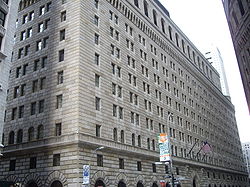
Federal Reserve System
The Federal Reserve System is the central banking system of the United States. It was created on December 23, 1913 with the enactment of the Federal Reserve Act, largely in response to a series of financial panics, particularly a severe panic in 1907...
of the United States
United States
The United States of America is a federal constitutional republic comprising fifty states and a federal district...
. It is located at 33 Liberty Street
33 Liberty Street
33 Liberty Street is the current home of the Federal Reserve Bank of New York. It is located in downtown Manhattan in New York City, New York State, USA. Built in 1924, it is where the monetary policy of the United States is executed by trading dollars and United States Treasuries...
, New York
New York City
New York is the most populous city in the United States and the center of the New York Metropolitan Area, one of the most populous metropolitan areas in the world. New York exerts a significant impact upon global commerce, finance, media, art, fashion, research, technology, education, and...
, NY. It is responsible for the Second District of the Federal Reserve System, which encompasses New York state, the 12 northern counties of New Jersey
New Jersey
New Jersey is a state in the Northeastern and Middle Atlantic regions of the United States. , its population was 8,791,894. It is bordered on the north and east by the state of New York, on the southeast and south by the Atlantic Ocean, on the west by Pennsylvania and on the southwest by Delaware...
, Fairfield County in Connecticut
Connecticut
Connecticut is a state in the New England region of the northeastern United States. It is bordered by Rhode Island to the east, Massachusetts to the north, and the state of New York to the west and the south .Connecticut is named for the Connecticut River, the major U.S. river that approximately...
, Puerto Rico
Puerto Rico
Puerto Rico , officially the Commonwealth of Puerto Rico , is an unincorporated territory of the United States, located in the northeastern Caribbean, east of the Dominican Republic and west of both the United States Virgin Islands and the British Virgin Islands.Puerto Rico comprises an...
, and the U. S. Virgin Islands.
Working within the Federal Reserve System, the New York Fed implements monetary policy, supervises and regulates financial institutions and helps maintain the nation's payment systems.
Among the other regional banks, New York Fed and its president are considered first among equals. It's current president is William C. Dudley. It is by far the largest (by assets), most active (by volume) and most influential of the 12 regional Federal Reserve Banks.
Largest regional Federal Reserve Bank
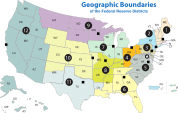
Manhattan
Manhattan is the oldest and the most densely populated of the five boroughs of New York City. Located primarily on the island of Manhattan at the mouth of the Hudson River, the boundaries of the borough are identical to those of New York County, an original county of the state of New York...
's Financial District has been the place where monetary policy in the United States is implemented, although policy is decided in Washington, D.C. by the Board of Governors
Board of governors
Board of governors is a term sometimes applied to the board of directors of a public entity or non-profit organization.Many public institutions, such as public universities, are government-owned corporations. The British Broadcasting Corporation was managed by a board of governors, though this role...
of the Federal Reserve System
Federal Reserve System
The Federal Reserve System is the central banking system of the United States. It was created on December 23, 1913 with the enactment of the Federal Reserve Act, largely in response to a series of financial panics, particularly a severe panic in 1907...
. The New York Federal reserve is a private bank
Private bank
Private banks are banks that are not incorporated. A private bank is owned by either an individual or a general partner with limited partner...
and the largest in terms of assets of the twelve regional banks. Operating in the financial capital of the U.S., the New York Fed is responsible for conducting open market operations, the buying and selling of outstanding U.S. Treasury securities
Treasury security
A United States Treasury security is government debt issued by the United States Department of the Treasury through the Bureau of the Public Debt. Treasury securities are the debt financing instruments of the United States federal government, and they are often referred to simply as Treasuries...
. The Trading Desk is the office at the Federal Reserve Bank of New York that manages the FOMC Directive to sell or buy bonds. Note that the responsibility for issuing new U.S. Treasury securities lies with the Bureau of the Public Debt
Bureau of the Public Debt
The Bureau of the Public Debt is an agency within the Fiscal Service of the United States Treasury Department. Under authority derived from Article I, section 8 of the Constitution, Public Debt is responsible for borrowing the money needed to operate the federal government, and is where donations...
. In 2003, Fedwire
Fedwire
Formally known as the Federal Reserve Wire Network, Fedwire is a Real Time Gross Settlement Funds Transfer system operated by the Federal Reserve Banks that enables financial institutions to electronically transfer funds between its more than 9,289 participants...
, the Federal Reserve's system for transferring balances between it and other banks, transferred $1.8 trillion a day in funds, of which about $1.1 trillion originated in the Second District. It transferred an additional $1.3 trillion a day in securities, of which $1.2 trillion originated in the Second District. The New York Fed is also responsible for carrying out exchange rate
Exchange rate
In finance, an exchange rate between two currencies is the rate at which one currency will be exchanged for another. It is also regarded as the value of one country’s currency in terms of another currency...
policy by buying and selling dollars at the discretion of the United States Treasury Department. The New York Federal Reserve is the only regional bank with a permanent vote on the Federal Open Market Committee
Federal Open Market Committee
The Federal Open Market Committee , a committee within the Federal Reserve System, is charged under United States law with overseeing the nation's open market operations . It is the Federal Reserve committee that makes key decisions about interest rates and the growth of the United States money...
and its president is traditionally selected as the Committee's vice chairman. The current president is William C. Dudley.
The New York Fed opened for business on November 16, 1914, under the leadership of Benjamin Strong Jr., who was previously president of the Bankers Trust Company. He led the Bank until his death in 1928. The Bank grew rapidly during the early years, bringing about the need for a new home.
The New York Fed's three-class Board of Directors, bank membership, and organization and legal status are the same in structure, for the New York region, as those of the other eleven Fed districts, which collectively cover the rest of the country.
33 Liberty Street
A public competition for design of the buildingArchitectural design competition
An architectural design competition is a special type of competition in which an organization or government body that plans to build a new building asks for architects to submit a proposed design for a building. The winning design is usually chosen by an independent panel of design professionals...
was held and the architectural firm of York and Sawyer
York and Sawyer
The architectural firm of York and Sawyer produced many outstanding structures, exemplary of Beaux-Arts architecture as it was practiced in the United States. The partners Edward York and Philip Sawyer had both trained in the office of McKim, Mead, and White...
submitted the winning design. The bank moved to its current location in 1924.
The Federal Reserve Bank of New York maintains a vault that lies 80 feet (24.4 m) below street level and 50 feet (15.2 m) below sea level, resting on Manhattan bedrock. By 1927, the vault contained 10% of the world's official gold reserves
Official gold reserves
A gold reserve is the gold held by a central bank or nation intended as a store of value and as a guarantee to redeem promises to pay depositors, note holders , or trading peers, or to secure a currency....
. Currently, it is reputedly the largest gold
Gold
Gold is a chemical element with the symbol Au and an atomic number of 79. Gold is a dense, soft, shiny, malleable and ductile metal. Pure gold has a bright yellow color and luster traditionally considered attractive, which it maintains without oxidizing in air or water. Chemically, gold is a...
repository in the world (though this cannot be confirmed as Swiss
Switzerland
Switzerland name of one of the Swiss cantons. ; ; ; or ), in its full name the Swiss Confederation , is a federal republic consisting of 26 cantons, with Bern as the seat of the federal authorities. The country is situated in Western Europe,Or Central Europe depending on the definition....
banks do not report their gold stocks) and holds approximately 7000 tonnes (7,716.2 ST) of gold bullion ($415 billion as of October 2011), more than Fort Knox
United States Bullion Depository
The United States Bullion Depository, often known as Fort Knox, is a fortified vault building located adjacent to Fort Knox, Kentucky, used to store a large portion of United States official gold reserves and occasionally other precious items belonging or entrusted to the federal government.The...
. Nearly 98% of the gold at the Federal Reserve Bank of New York is owned by the central banks of foreign nations. The rest is owned by the United States and international organizations such as the IMF. The Federal Reserve Bank does not own the gold but serves as guardian of the precious metal, which it stores at no charge to the owners, but charging a $1.75 fee (in 2008) per bar to move the gold. Moving the bars requires special footwear for the staff, to protect their feet in the case that they drop a 28 pound bar on their feet. The vault is open to tourists.
Current Board of Directors
The following people serve on the board of directors as of 2011: All terms expire December 31.Class A
| Name | Title | Term Expires |
|---|---|---|
| Charles V. Wait | President, Chief Executive Officer, and Chairman The Adirondack Trust Company Adirondack Trust Company The Adirondack Trust Company is the largest independent community Bank in Saratoga County, New York.Founded in 1901 by State Senator Edgar Brackett, it played a large role in transforming Saratoga Springs from a small "boom and bust" town into a thriving city... Saratoga Springs, New York Saratoga Springs, New York Saratoga Springs, also known as simply Saratoga, is a city in Saratoga County, New York, United States. The population was 26,586 at the 2010 census. The name reflects the presence of mineral springs in the area. While the word "Saratoga" is known to be a corruption of a Native American name, ... |
2011 |
| Jamie Dimon Jamie Dimon James "Jamie" Dimon is a business executive. He is the current chairman, president and chief executive of JPMorgan Chase, and previously served as a Class A director of the Board of Directors of the New York Federal Reserve, a three year term which started January 2007... |
Chairman and Chief Executive Officer JPMorgan Chase & Co. JPMorgan Chase & Co. JPMorgan Chase & Co. is an American multinational banking corporation of securities, investments and retail. It is the largest bank in the United States by assets and market capitalization.It is a major provider of financial services, with assets of $2 trillion and according to Forbes magazine is... New York City New York City New York is the most populous city in the United States and the center of the New York Metropolitan Area, one of the most populous metropolitan areas in the world. New York exerts a significant impact upon global commerce, finance, media, art, fashion, research, technology, education, and... |
2012 |
| Richard Carrión Richard Carrion Richard L. Carrion Rexach is the current Chairman and CEO of Popular, Inc., parent company of Banco Popular de Puerto Rico, Banco Popular North America and E-Loan.-Early life:... |
Chairman, President and Chief Executive Officer Popular, Inc. Popular, Inc. Popular, Inc., is a financial services conglomerate that has been operating in Puerto Rico for almost 115 years and in the United States for over 52 years. In recent years, it has expanded into other areas of the Caribbean and Central America. It is better known as Banco Popular, but it is also... San Juan, Puerto Rico San Juan, Puerto Rico San Juan , officially Municipio de la Ciudad Capital San Juan Bautista , is the capital and most populous municipality in Puerto Rico, an unincorporated territory of the United States. As of the 2010 census, it had a population of 395,326 making it the 46th-largest city under the jurisdiction of... |
2013 |
Class B
| Name | Title | Term Expires |
|---|---|---|
| Glenn H. Hutchins | Co-Founder and Co-Chief Executive Silver Lake | 2012 |
| Terry J. Lundgren Terry J. Lundgren Terry J. Lundgren is the CEO, Chairman of the Board, President, and Director at Macy's, Inc., the parent company of Macy's and Bloomingdale's department stores.... |
Chairman, President and Chief Executive Officer Macy's, Inc. | 2011 |
| James S. Tisch James S. Tisch James S. Tisch has been the CEO of Loews Corporation since 1999. Tisch graduated from Cornell University and received his MBA at the Wharton School of Business at the University of Pennsylvania.... |
President and Chief Executive Officer Loews Corporation Loews Corporation Loews Corporation is a holding company run by the Tisch Family whose subsidiaries are engaged in the following lines of business:*property and casualty insurance... New York, New York |
2013 |
Class C
| Name | Title | Term Expires |
|---|---|---|
| Emily K. Rafferty | President Metropolitan Museum of Art Metropolitan Museum of Art The Metropolitan Museum of Art is a renowned art museum in New York City. Its permanent collection contains more than two million works, divided into nineteen curatorial departments. The main building, located on the eastern edge of Central Park along Manhattan's Museum Mile, is one of the... New York, New York |
2011 |
| Lee C. Bollinger (Chair) |
President Columbia University Columbia University Columbia University in the City of New York is a private, Ivy League university in Manhattan, New York City. Columbia is the oldest institution of higher learning in the state of New York, the fifth oldest in the United States, and one of the country's nine Colonial Colleges founded before the... New York, New York |
2012 |
| Kathryn S. Wylde (Deputy Chair) |
President and Chief Executive Officer Partnership for New York City Partnership for New York City Partnership for New York City is an American investment fund whose president and CEO is Kathy Wylde. Nine of its board members are billionaires including Rupert Murdoch.... New York, New York |
2013 |
Former Board members
Indra K. Nooyi, Chairman and Chief Executive Officer, PepsiCoPepsiCo
PepsiCo Inc. is an American multinational corporation headquartered in Purchase, New York, United States, with interests in the manufacturing, marketing and distribution of grain-based snack foods, beverages, and other products. PepsiCo was formed in 1965 with the merger of the Pepsi-Cola Company...
. Inc., left the Board when her term expired in 2009, and Kindler now fills the seat. Bollinger's and Dimon's three-year terms were renewed in 2009. Tisch and Wylde filled partial-term vacancies, the latter for Stephen Friedman's seat, in the year.
Resignation of Stephen Friedman, Chair
Stephen Friedman resigned as Chair of the Federal Reserve Bank of New York on May 7, 2009, effective immediately. Friedman, former CEO of Goldman SachsGoldman Sachs
The Goldman Sachs Group, Inc. is an American multinational bulge bracket investment banking and securities firm that engages in global investment banking, securities, investment management, and other financial services primarily with institutional clients...
and then-chairman of Stone Point Capital, LLC, Greenwich, Conn., was criticized for seemingly benefiting from his role as Chair of the New York Fed branch due to the US Government's aid to Goldman Sachs in recent months. He had "remain[ed] on the board of Goldman even as he was supposedly regulating [Goldman]; in order to rectify the problem, he applied for, and got, a conflict of interest waiver from the government. Friedman was also supposed to divest himself of his Goldman stock after Goldman became a bankholding company, but thanks to the waiver, he was allowed to go out and buy 52,000 additional shares in his old bank, leaving him $3 million richer," as one report put it. Friedman's resignation announcement came within an hour of the government's release of the stress tests for 19 US banks. Denis Hughes, formerly Deputy Chair, was designated as Interim Chair following Friedman's resignation.
Branches
The Federal Reserve Bank of New York Buffalo BranchFederal Reserve Bank of New York Buffalo Branch
The Federal Reserve Bank of New York Buffalo Branch was a branch of the Federal Reserve Bank of New York but was closed on October 31, 2008. It was located in the Federal Reserve Building at 160 Delaware Avenue, which has now been inhabited by the New Era Cap Company since November 21, 2006.-See...
used to be the only branch of the Federal Reserve Bank of New York, but it was closed on October 31, 2008.
See also
- Economy of New York CityEconomy of New York CityThe economy of New York City is the biggest regional economy in the United States and the second largest city economy in the world after Tokyo...
- Federal Reserve ActFederal Reserve ActThe Federal Reserve Act is an Act of Congress that created and set up the Federal Reserve System, the central banking system of the United States of America, and granted it the legal authority to issue Federal Reserve Notes and Federal Reserve Bank Notes as legal tender...
- Federal Reserve SystemFederal Reserve SystemThe Federal Reserve System is the central banking system of the United States. It was created on December 23, 1913 with the enactment of the Federal Reserve Act, largely in response to a series of financial panics, particularly a severe panic in 1907...
- Federal Reserve Districts
- Federal Reserve BranchesFederal Reserve BranchesThere are 24 Federal Reserve Branches. As late as 2008, there were 25 branches, but in October 2008 the Federal Reserve Bank of New York Buffalo Branch was closed.List of Federal Reserve Branches* Boston* New York...
- Federal Reserve Bank of New York Buffalo BranchFederal Reserve Bank of New York Buffalo BranchThe Federal Reserve Bank of New York Buffalo Branch was a branch of the Federal Reserve Bank of New York but was closed on October 31, 2008. It was located in the Federal Reserve Building at 160 Delaware Avenue, which has now been inhabited by the New Era Cap Company since November 21, 2006.-See...
- Official gold reservesOfficial gold reservesA gold reserve is the gold held by a central bank or nation intended as a store of value and as a guarantee to redeem promises to pay depositors, note holders , or trading peers, or to secure a currency....
- Structure of the Federal Reserve SystemStructure of the Federal Reserve SystemThe Federal Reserve System is composed of five parts:# The presidentially appointed Board of Governors , an independent federal government agency located in Washington, D.C....
External links
- Federal Reserve Bank of New York
- "World's Greatest Treasure Cave" Popular Mechanics, January 1930, pp.34-38
- "How Uncle Sam Guards His Millions", March 1931, Popular Mechanics article showing the upgrades for gold storage at the New York Federal Reserve Bank