

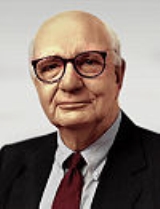
Paul Volcker

Encyclopedia
Paul Adolph Volcker, Jr. (born September 5, 1927) is an American economist
. He was the Chairman of the Federal Reserve
under United States President
s Jimmy Carter
and Ronald Reagan
from August 1979 to August 1987. He is widely credited with ending the high levels of inflation
seen in the United States in the 1970s and early 1980s. He was the Chairman of the Economic Recovery Advisory Board under President Barack Obama
from February 2009 until January 2011.
, the son of Alma Louise (née Klippel) and Paul Adolph Volcker. His grandparents were all German immigrants. Volcker grew up in Teaneck, New Jersey
, where his father was the township's first municipal manager
. As a child, he attended his mother's Lutheran
church, while his father went to an Episcopal
church. Volcker graduated from Teaneck High School
.
Volcker's undergraduate education was at Princeton University
; he graduated in 1949. He earned his M.A.
in political economy
from Harvard University
's Graduate School of Arts and Sciences
and Graduate School of Public Administration in 1951 and then attended the London School of Economics
from 1951 to 1952 as a Rotary Foundation
Ambassadorial Fellow, under the Rotary's Ambassadorial Scholarships
program.
Volcker has received honorary degrees from several educational institutions including: Hamilton College (1980), University of Notre Dame
, Princeton University
, Dartmouth College
, New York University
, University of Delaware
, Fairleigh Dickinson University
, Bryant College, Adelphi University
, Lamar University
, Bates College
(1989), Fairfield University
(1994), Northwestern University
(2004), Rensselaer Polytechnic Institute
(2005), Brown University
(2006), Georgetown University
(2007), Queen's University
at Kingston in Canada (2009), and Amherst College
(2011).
as a full-time economist. He left that position in 1957 to become a financial economist with the Chase Manhattan Bank
. In 1962, Robert Roosa
, who had been his mentor at the Federal Reserve, hired him at the Treasury Department
as director of financial analysis. In 1963, he became deputy under-secretary for monetary affairs. He returned to Chase Manhattan Bank as vice president and director of planning in 1965.
From 1969 to 1974, Mr. Volcker served as under-secretary of the Treasury for international monetary affairs. He played an important role in the decisions leading to the U.S. suspension of gold convertibility
in 1971, which resulted in the collapse of the Bretton Woods system
. In general he acted as a moderating influence on policy, advocating the pursuit of an international solution to monetary problems. After leaving the U.S. Treasury, he became president of the Federal Reserve Bank of New York from 1975 to 1979, leaving to become the chairman of the Federal Reserve in August 1979.
In 1975, Mr. Volcker also became a senior fellow in the Woodrow Wilson School of Public and International Affairs at Princeton University.
Volcker's Fed is widely credited with ending the United States' stagflation
crisis of the 1970s. Inflation
, which peaked at 13.5% in 1981, was successfully lowered to 3.2% by 1983.
Volcker raised the federal funds rate
, which had averaged 11.2% in 1979, to a peak of 20% in June 1981. The prime rate
rose to 21.5% in 1981 as well.
Volcker's Fed elicited the strongest political attacks and most widespread protests in the history of the Federal Reserve (unlike any protests experienced since 1922), due to the effects of the high interest rates on the construction and farming sectors, culminating in indebted farmers driving their tractors onto C Street NW and blockading the Eccles Building
.
Nobel laureate Joseph Stiglitz said about him in an interview:
Congressman Ron Paul
, well-known as a harsh critic of the Federal Reserve, has offered qualified praise of Volcker:
Congressman Ron Paul also said in a 2011 presidential debate that "If I had to name a Federal Reserve chairman that did a little bit of good, that would be Paul Volcker."
.
In 1996, he took up the chair of the Independent Committee of Eminent Persons (Volcker Commission
) to look into the dormant accounts of Jewish victims of the Holocaust lying in Swiss banks. This included a “massive accounting of Swiss bank records.” In the midst of a contentious process (the committee was formed by three Jewish representatives and three representatives of Swiss banks) he was able to bring about an agreement among the parties for a settlement of $1.25 billion.
In April 2004, the United Nations
assigned
Volcker to research possible corruption
in the Iraq
i Oil for Food program. In the report summarising its research, Volcker criticized Kojo Annan
, son of then-UN Secretary-General Kofi Annan
, and the Swiss
company Cotecna Inspection SA, Kojo's employer, for trying to conceal their relationship. He concluded in his March 2005 report that "there is no evidence that the selection of Cotecna in 1998 was subject to improper influence of the Secretary General in the bidding or selection process". However, while Volcker did not implicate the Secretary General in the selection process, he did cast serious doubt on Kofi Annan, whose "management performance...fell short of the standards that the United Nations Organization should strive to maintain." Volcker was a director of the United Nations Association of the United States of America
between 2000 and 2004, prior to his being appointed to the Independent Inquiry
by Kofi Annan.
As of October 2006, he is the current Chairman of the Board of Trustees of the influential Washington-based financial advisory body, the Group of Thirty
, and is a member of the Trilateral Commission
. He has had a long association with the Rockefeller family
, not only with his positions at Chase Bank and the Trilateral Commission, but also through membership of the Trust Committee of Rockefeller Group, Inc. (RGI), which he joined in 1987. That entity managed, at one time, the Rockefeller Center
on behalf of the numerous members of the Rockefeller clan. He currently serves as Chairman of the Board of Trustees of the International House in Manhattan, NY. He was a founding member of the Trilateral Commission
and is a long time member of the Bilderberg Group
.
In January 2008, he endorsed Democratic Presidential Candidate Barack Obama for President.
On April 8, 2008, he was the featured speaker at "The Economic Club of New York
" and spoke about the issues and causes of the 2008 US recession, and critiqued the 2008 US financial system and the 2008 Federal Reserve policies.
Volcker was an economic advisor to President Barack Obama
, heading the President's Economic Recovery Advisory Board
. During the financial crisis, Volcker has been extremely critical of banks, saying that their response to the financial crisis has been inadequate, and that more regulation of banks is called for. Specifically Volcker has called for a breakup of the nation's largest banks, prohibiting deposit-taking institutions from engaging in riskier activities such as proprietary trading
, private equity
, and hedge fund
investments. Volcker left the board when its charter expired on February 6, 2011, without being included in discussions on how the board would be reconstituted.
On January 21, 2010, President Barack Obama proposed bank regulations which he dubbed "The Volcker Rule
", in reference to Volcker's aggressive pursuit of these regulations. Volcker appeared with the president at the announcement. The proposed rules would prevent commercial banks from owning and investing in hedge funds and private equity, and limit the trading they do for their own accounts.
Volcker has been known to defy the stereotype of a Wall Street insider. A profile in The Week
magazine for February 5, 2010, claimed that Volcker
On April 6, 2010 at the New-York Historical Society's
Global Economic Panel, Volcker commented that the United States should consider adding a national sales tax similar to the Value Added Tax
(VAT) imposed in European Countries, stating "If, at the end of the day, we need to raise taxes, we should raise taxes".
. The World Justice Project works to lead a global, multidisciplinary effort to strengthen the rule of law
for the development of communities of opportunity and equity.
graduate who was born with cerebral palsy
, as well as four grandchildren. Over Thanksgiving, 2009, he became engaged to marry Anke Dening, a long-time assistant. They eloped in February 2010.
Volcker is an avid fly-fisherman
, having recounted, "The greatest strategic error of my adult life was to take my wife to Maine on our honeymoon on a fly-fishing trip." Volcker is also known as "Tall Paul" for his height of 6 in 7 in (2.01 m), standing exactly a foot (30 cm) taller than his wife when they first met.
|-
|-
Economist
An economist is a professional in the social science discipline of economics. The individual may also study, develop, and apply theories and concepts from economics and write about economic policy...
. He was the Chairman of the Federal Reserve
Chairman of the Federal Reserve
The Chairman of the Board of Governors of the Federal Reserve System is the head of the central banking system of the United States. Known colloquially as "Chairman of the Fed," or in market circles "Fed Chairman" or "Fed Chief"...
under United States President
President of the United States
The President of the United States of America is the head of state and head of government of the United States. The president leads the executive branch of the federal government and is the commander-in-chief of the United States Armed Forces....
s Jimmy Carter
Jimmy Carter
James Earl "Jimmy" Carter, Jr. is an American politician who served as the 39th President of the United States and was the recipient of the 2002 Nobel Peace Prize, the only U.S. President to have received the Prize after leaving office...
and Ronald Reagan
Ronald Reagan
Ronald Wilson Reagan was the 40th President of the United States , the 33rd Governor of California and, prior to that, a radio, film and television actor....
from August 1979 to August 1987. He is widely credited with ending the high levels of inflation
Inflation
In economics, inflation is a rise in the general level of prices of goods and services in an economy over a period of time.When the general price level rises, each unit of currency buys fewer goods and services. Consequently, inflation also reflects an erosion in the purchasing power of money – a...
seen in the United States in the 1970s and early 1980s. He was the Chairman of the Economic Recovery Advisory Board under President Barack Obama
Presidency of Barack Obama
The Presidency of Barack Obama began at noon EST on January 20, 2009 when he became the 44th President of the United States. Obama was a United States Senator from Illinois at the time of his victory over Arizona Senator John McCain in the 2008 presidential election...
from February 2009 until January 2011.
Early life
Volcker was born in Cape May, New JerseyCape May, New Jersey
Cape May is a city at the southern tip of Cape May Peninsula in Cape May County, New Jersey, where the Delaware Bay meets the Atlantic Ocean and is one of the country's oldest vacation resort destinations. It is part of the Ocean City Metropolitan Statistical Area. As of the 2010 United States...
, the son of Alma Louise (née Klippel) and Paul Adolph Volcker. His grandparents were all German immigrants. Volcker grew up in Teaneck, New Jersey
Teaneck, New Jersey
Teaneck is a township in Bergen County, New Jersey, and a suburb in the New York metropolitan area. As of the 2010 United States Census, the township population was 39,776, making it the second-most populous among the 70 municipalities in Bergen County....
, where his father was the township's first municipal manager
City manager
A city manager is an official appointed as the administrative manager of a city, in a council-manager form of city government. Local officials serving in this position are sometimes referred to as the chief executive officer or chief administrative officer in some municipalities...
. As a child, he attended his mother's Lutheran
Lutheranism
Lutheranism is a major branch of Western Christianity that identifies with the theology of Martin Luther, a German reformer. Luther's efforts to reform the theology and practice of the church launched the Protestant Reformation...
church, while his father went to an Episcopal
Episcopal Church (United States)
The Episcopal Church is a mainline Anglican Christian church found mainly in the United States , but also in Honduras, Taiwan, Colombia, Ecuador, Haiti, the Dominican Republic, Venezuela, the British Virgin Islands and parts of Europe...
church. Volcker graduated from Teaneck High School
Teaneck High School
Teaneck High School is a four-year comprehensive public high school, which is part of the Teaneck Public Schools district in Teaneck, New Jersey, United States...
.
Volcker's undergraduate education was at Princeton University
Princeton University
Princeton University is a private research university located in Princeton, New Jersey, United States. The school is one of the eight universities of the Ivy League, and is one of the nine Colonial Colleges founded before the American Revolution....
; he graduated in 1949. He earned his M.A.
Master of Arts (postgraduate)
A Master of Arts from the Latin Magister Artium, is a type of Master's degree awarded by universities in many countries. The M.A. is usually contrasted with the M.S. or M.Sc. degrees...
in political economy
Political economy
Political economy originally was the term for studying production, buying, and selling, and their relations with law, custom, and government, as well as with the distribution of national income and wealth, including through the budget process. Political economy originated in moral philosophy...
from Harvard University
Harvard University
Harvard University is a private Ivy League university located in Cambridge, Massachusetts, United States, established in 1636 by the Massachusetts legislature. Harvard is the oldest institution of higher learning in the United States and the first corporation chartered in the country...
's Graduate School of Arts and Sciences
Harvard Graduate School of Arts and Sciences
The Graduate School of Arts and Sciences is the academic unit responsible for many post-baccalaureate degree programs offered through the Faculty of Arts and Sciences at Harvard University...
and Graduate School of Public Administration in 1951 and then attended the London School of Economics
London School of Economics
The London School of Economics and Political Science is a public research university specialised in the social sciences located in London, United Kingdom, and a constituent college of the federal University of London...
from 1951 to 1952 as a Rotary Foundation
Rotary International
Rotary International is an organization of service clubs known as Rotary Clubs located all over the world. The stated purpose of the organization is to bring together business and professional leaders to provide humanitarian service, encourage high ethical standards in all vocations, and help...
Ambassadorial Fellow, under the Rotary's Ambassadorial Scholarships
Ambassadorial Scholarships
Ambassadorial Scholarships is the oldest program of the Rotary Foundation and probably the best-known. Since 1947, nearly 38,000 men and women from about 100 nations have studied abroad under its auspices. Today it is the world's largest privately funded international scholarships program. Nearly...
program.
Volcker has received honorary degrees from several educational institutions including: Hamilton College (1980), University of Notre Dame
University of Notre Dame
The University of Notre Dame du Lac is a Catholic research university located in Notre Dame, an unincorporated community north of the city of South Bend, in St. Joseph County, Indiana, United States...
, Princeton University
Princeton University
Princeton University is a private research university located in Princeton, New Jersey, United States. The school is one of the eight universities of the Ivy League, and is one of the nine Colonial Colleges founded before the American Revolution....
, Dartmouth College
Dartmouth College
Dartmouth College is a private, Ivy League university in Hanover, New Hampshire, United States. The institution comprises a liberal arts college, Dartmouth Medical School, Thayer School of Engineering, and the Tuck School of Business, as well as 19 graduate programs in the arts and sciences...
, New York University
New York University
New York University is a private, nonsectarian research university based in New York City. NYU's main campus is situated in the Greenwich Village section of Manhattan...
, University of Delaware
University of Delaware
The university is organized into seven colleges:* College of Agriculture and Natural Resources* College of Arts and Sciences* Alfred Lerner College of Business and Economics* College of Earth, Ocean and Environment* College of Education and Human Development...
, Fairleigh Dickinson University
Fairleigh Dickinson University
Fairleigh Dickinson University is a private university founded as a junior college in 1942. It now has several campuses located in New Jersey, Canada, and the United Kingdom.-Description:...
, Bryant College, Adelphi University
Adelphi University
Adelphi University is a private, nonsectarian university located in Garden City, in Nassau County, New York, United States. It is the oldest institution of higher education on Long Island. For the sixth year, Adelphi University has been named a “Best Buy” in higher education by the Fiske Guide to...
, Lamar University
Lamar University
Lamar University, often referred to as Lamar or LU, is a comprehensive coeducational public research university located in Beaumont, Texas, United States. Lamar confers bachelors, masters and doctoral degrees and is classified as a Doctoral Research University by the Carnegie Commission on Higher...
, Bates College
Bates College
Bates College is a highly selective, private liberal arts college located in Lewiston, Maine, in the United States. and was most recently ranked 21st in the nation in the 2011 US News Best Liberal Arts Colleges rankings. The college was founded in 1855 by abolitionists...
(1989), Fairfield University
Fairfield University
Fairfield University is a private, co-educational undergraduate and master's level teaching-oriented university located in Fairfield, Connecticut, in the New England region of the United States. It was founded by the Society of Jesus in 1942, and today is one of 28 member institutions of the...
(1994), Northwestern University
Northwestern University
Northwestern University is a private research university in Evanston and Chicago, Illinois, USA. Northwestern has eleven undergraduate, graduate, and professional schools offering 124 undergraduate degrees and 145 graduate and professional degrees....
(2004), Rensselaer Polytechnic Institute
Rensselaer Polytechnic Institute
Stephen Van Rensselaer established the Rensselaer School on November 5, 1824 with a letter to the Rev. Dr. Samuel Blatchford, in which van Rensselaer asked Blatchford to serve as the first president. Within the letter he set down several orders of business. He appointed Amos Eaton as the school's...
(2005), Brown University
Brown University
Brown University is a private, Ivy League university located in Providence, Rhode Island, United States. Founded in 1764 prior to American independence from the British Empire as the College in the English Colony of Rhode Island and Providence Plantations early in the reign of King George III ,...
(2006), Georgetown University
Georgetown University
Georgetown University is a private, Jesuit, research university whose main campus is in the Georgetown neighborhood of Washington, D.C. Founded in 1789, it is the oldest Catholic university in the United States...
(2007), Queen's University
Queen's University
Queen's University, , is a public research university located in Kingston, Ontario, Canada. Founded on 16 October 1841, the university pre-dates the founding of Canada by 26 years. Queen's holds more more than of land throughout Ontario as well as Herstmonceux Castle in East Sussex, England...
at Kingston in Canada (2009), and Amherst College
Amherst College
Amherst College is a private liberal arts college located in Amherst, Massachusetts, United States. Amherst is an exclusively undergraduate four-year institution and enrolled 1,744 students in the fall of 2009...
(2011).
Career
In 1952 he joined the staff of the Federal Reserve Bank of New YorkFederal Reserve Bank of New York
The Federal Reserve Bank of New York is one of the 12 Federal Reserve Banks of the United States. It is located at 33 Liberty Street, New York, NY. It is responsible for the Second District of the Federal Reserve System, which encompasses New York state, the 12 northern counties of New Jersey,...
as a full-time economist. He left that position in 1957 to become a financial economist with the Chase Manhattan Bank
Chase Manhattan Bank
JPMorgan Chase Bank, N.A., doing business as Chase, is a national bank that constitutes the consumer and commercial banking subsidiary of financial services firm JPMorgan Chase. The bank was known as Chase Manhattan Bank until it merged with J.P. Morgan & Co. in 2000...
. In 1962, Robert Roosa
Robert Roosa
Robert Vincent Roosa was an American economist and banker. He served as Treasury Undersecretary for Monetary Affairs during the Kennedy administration. He believed the U.S...
, who had been his mentor at the Federal Reserve, hired him at the Treasury Department
United States Department of the Treasury
The Department of the Treasury is an executive department and the treasury of the United States federal government. It was established by an Act of Congress in 1789 to manage government revenue...
as director of financial analysis. In 1963, he became deputy under-secretary for monetary affairs. He returned to Chase Manhattan Bank as vice president and director of planning in 1965.
From 1969 to 1974, Mr. Volcker served as under-secretary of the Treasury for international monetary affairs. He played an important role in the decisions leading to the U.S. suspension of gold convertibility
Convertibility
Convertibility is the quality that allows money or other financial instruments to be converted into other liquid stores of value. Convertibility is an important factor in international trade, where instruments valued in different currencies must be exchanged....
in 1971, which resulted in the collapse of the Bretton Woods system
Bretton Woods system
The Bretton Woods system of monetary management established the rules for commercial and financial relations among the world's major industrial states in the mid 20th century...
. In general he acted as a moderating influence on policy, advocating the pursuit of an international solution to monetary problems. After leaving the U.S. Treasury, he became president of the Federal Reserve Bank of New York from 1975 to 1979, leaving to become the chairman of the Federal Reserve in August 1979.
In 1975, Mr. Volcker also became a senior fellow in the Woodrow Wilson School of Public and International Affairs at Princeton University.
Chairman of the Board of Governors for the Federal Reserve System
Paul Volcker, a Democrat, was appointed Chairman of the Board of Governors for the Federal Reserve System in August 1979 by President Jimmy Carter and reappointed in 1983 by President Ronald Reagan.Volcker's Fed is widely credited with ending the United States' stagflation
Stagflation
In economics, stagflation is a situation in which the inflation rate is high and the economic growth rate slows down and unemployment remains steadily high...
crisis of the 1970s. Inflation
Inflation
In economics, inflation is a rise in the general level of prices of goods and services in an economy over a period of time.When the general price level rises, each unit of currency buys fewer goods and services. Consequently, inflation also reflects an erosion in the purchasing power of money – a...
, which peaked at 13.5% in 1981, was successfully lowered to 3.2% by 1983.
Volcker raised the federal funds rate
Federal funds rate
In the United States, the federal funds rate is the interest rate at which depository institutions actively trade balances held at the Federal Reserve, called federal funds, with each other, usually overnight, on an uncollateralized basis. Institutions with surplus balances in their accounts lend...
, which had averaged 11.2% in 1979, to a peak of 20% in June 1981. The prime rate
Prime rate
Prime rate or prime lending rate is a term applied in many countries to a reference interest rate used by banks. The term originally indicated the rate of interest at which banks lent to favored customers, i.e., those with high credibility, though this is no longer always the case...
rose to 21.5% in 1981 as well.
Volcker's Fed elicited the strongest political attacks and most widespread protests in the history of the Federal Reserve (unlike any protests experienced since 1922), due to the effects of the high interest rates on the construction and farming sectors, culminating in indebted farmers driving their tractors onto C Street NW and blockading the Eccles Building
Eccles Building
The Marriner S. Eccles Federal Reserve Board Building houses the main offices of the Board of Governors of the Federal Reserve System. It is located at 20th Street and Constitution Avenue, N.W., in Washington, D.C. The building, designed in the stripped-down classical style, was designed by Paul...
.
Nobel laureate Joseph Stiglitz said about him in an interview:
- Paul Volcker, the previous Fed Chairman known for keeping inflation under control, was fired because the Reagan administration didn't believe he was an adequate de-regulator.
Congressman Ron Paul
Ron Paul
Ronald Ernest "Ron" Paul is an American physician, author and United States Congressman who is seeking to be the Republican Party candidate in the 2012 presidential election. Paul represents Texas's 14th congressional district, which covers an area south and southwest of Houston that includes...
, well-known as a harsh critic of the Federal Reserve, has offered qualified praise of Volcker:
- Being in Congress in the late 1970s and early 1980s and serving on the House Banking Committee, I met and got to question several Federal Reserve chairmen: Arthur Burns, G. William MillerG. William MillerGeorge William Miller served as the 65th United States Secretary of the Treasury under President Carter from August 6, 1979 to January 20, 1981...
and Paul Volcker. Of the three, I had the most interaction with Volcker. He was more personable and smarter than the others, including the more recent board chairmen Alan GreenspanAlan GreenspanAlan Greenspan is an American economist who served as Chairman of the Federal Reserve of the United States from 1987 to 2006. He currently works as a private advisor and provides consulting for firms through his company, Greenspan Associates LLC...
and Ben BernankeBen BernankeBen Shalom Bernanke is an American economist, and the current Chairman of the Federal Reserve, the central bank of the United States. During his tenure as Chairman, Bernanke has overseen the response of the Federal Reserve to late-2000s financial crisis....
.
Congressman Ron Paul also said in a 2011 presidential debate that "If I had to name a Federal Reserve chairman that did a little bit of good, that would be Paul Volcker."
Post-Fed
After leaving the Federal Reserve in 1987, he became chairman of the prominent New York investment banking firm, J. Rothschild, Wolfensohn & Co., a corporate advisory and investment firm in New York, run by James D. Wolfensohn, who later became president of the World BankWorld Bank
The World Bank is an international financial institution that provides loans to developing countries for capital programmes.The World Bank's official goal is the reduction of poverty...
.
In 1996, he took up the chair of the Independent Committee of Eminent Persons (Volcker Commission
Volcker Commission
The Volcker Commission, also known as the Independent Committee of Eminent Persons , was established in 1996 to investigate the accounts lying dormant since the Second World War in various banks in Switzerland...
) to look into the dormant accounts of Jewish victims of the Holocaust lying in Swiss banks. This included a “massive accounting of Swiss bank records.” In the midst of a contentious process (the committee was formed by three Jewish representatives and three representatives of Swiss banks) he was able to bring about an agreement among the parties for a settlement of $1.25 billion.
In April 2004, the United Nations
United Nations
The United Nations is an international organization whose stated aims are facilitating cooperation in international law, international security, economic development, social progress, human rights, and achievement of world peace...
assigned
Paul Volcker Committee
The Paul Volcker Committee was formed to investigate alleged corruption and fraud in the United Nations Oil-for-Food Programme in Iraq....
Volcker to research possible corruption
Political corruption
Political corruption is the use of legislated powers by government officials for illegitimate private gain. Misuse of government power for other purposes, such as repression of political opponents and general police brutality, is not considered political corruption. Neither are illegal acts by...
in the Iraq
Iraq
Iraq ; officially the Republic of Iraq is a country in Western Asia spanning most of the northwestern end of the Zagros mountain range, the eastern part of the Syrian Desert and the northern part of the Arabian Desert....
i Oil for Food program. In the report summarising its research, Volcker criticized Kojo Annan
Kojo Annan
Kojo Annan is the only son of ex-UN Secretary-General Kofi Annan. A January 2005 article in The Sunday Times catapulted him to fame when it announced that he had confessed involvement in the UN Oil-for-Food Programme scandal; in a libel settlement eleven months later, the paper announced that it...
, son of then-UN Secretary-General Kofi Annan
Kofi Annan
Kofi Atta Annan is a Ghanaian diplomat who served as the seventh Secretary-General of the UN from 1 January 1997 to 31 December 2006...
, and the Swiss
Switzerland
Switzerland name of one of the Swiss cantons. ; ; ; or ), in its full name the Swiss Confederation , is a federal republic consisting of 26 cantons, with Bern as the seat of the federal authorities. The country is situated in Western Europe,Or Central Europe depending on the definition....
company Cotecna Inspection SA, Kojo's employer, for trying to conceal their relationship. He concluded in his March 2005 report that "there is no evidence that the selection of Cotecna in 1998 was subject to improper influence of the Secretary General in the bidding or selection process". However, while Volcker did not implicate the Secretary General in the selection process, he did cast serious doubt on Kofi Annan, whose "management performance...fell short of the standards that the United Nations Organization should strive to maintain." Volcker was a director of the United Nations Association of the United States of America
United Nations Association of the United States of America
The United Nations Association of the United States of America or UNA-USA is a nonprofit membership organization dedicated to building understanding of and support for the ideals and work of the United Nations among the American people. Its education, policy and advocacy programs emphasize the...
between 2000 and 2004, prior to his being appointed to the Independent Inquiry
Volcker Commission
The Volcker Commission, also known as the Independent Committee of Eminent Persons , was established in 1996 to investigate the accounts lying dormant since the Second World War in various banks in Switzerland...
by Kofi Annan.
As of October 2006, he is the current Chairman of the Board of Trustees of the influential Washington-based financial advisory body, the Group of Thirty
Group of Thirty
The Group of Thirty, often abbreviated to G30, is an international body of leading financiers and academics which aims to deepen understanding of economic and financial issues and to examine consequences of decisions made in the public and private sectors related to these issues...
, and is a member of the Trilateral Commission
Trilateral Commission
The Trilateral Commission is a non-governmental, non-partisan discussion group founded by David Rockefeller in July 1973 to foster closer cooperation among the United States, Europe and Japan.-History:...
. He has had a long association with the Rockefeller family
Rockefeller family
The Rockefeller family , the Cleveland family of John D. Rockefeller and his brother William Rockefeller , is an American industrial, banking, and political family of German origin that made one of the world's largest private fortunes in the oil business during the late 19th and early 20th...
, not only with his positions at Chase Bank and the Trilateral Commission, but also through membership of the Trust Committee of Rockefeller Group, Inc. (RGI), which he joined in 1987. That entity managed, at one time, the Rockefeller Center
Rockefeller Center
Rockefeller Center is a complex of 19 commercial buildings covering between 48th and 51st streets in New York City, United States. Built by the Rockefeller family, it is located in the center of Midtown Manhattan, spanning the area between Fifth Avenue and Sixth Avenue. It was declared a National...
on behalf of the numerous members of the Rockefeller clan. He currently serves as Chairman of the Board of Trustees of the International House in Manhattan, NY. He was a founding member of the Trilateral Commission
Trilateral Commission
The Trilateral Commission is a non-governmental, non-partisan discussion group founded by David Rockefeller in July 1973 to foster closer cooperation among the United States, Europe and Japan.-History:...
and is a long time member of the Bilderberg Group
Bilderberg Group
The Bilderberg Group, Bilderberg conference, or Bilderberg Club is an annual, unofficial, invitation-only conference of approximately 120 to 140 guests from North America and Western Europe, most of whom are people of influence. About one-third are from government and politics, and two-thirds from...
.
In January 2008, he endorsed Democratic Presidential Candidate Barack Obama for President.
On April 8, 2008, he was the featured speaker at "The Economic Club of New York
The Economic Club of New York
The Economic Club of New York is a non-profit and non-partisan membership organization located in New York City and founded in 1907. Its stated purpose is the promotion of the study and discussion of social, economic, and political questions....
" and spoke about the issues and causes of the 2008 US recession, and critiqued the 2008 US financial system and the 2008 Federal Reserve policies.
Volcker was an economic advisor to President Barack Obama
Barack Obama
Barack Hussein Obama II is the 44th and current President of the United States. He is the first African American to hold the office. Obama previously served as a United States Senator from Illinois, from January 2005 until he resigned following his victory in the 2008 presidential election.Born in...
, heading the President's Economic Recovery Advisory Board
President's Economic Recovery Advisory Board
The President’s Council on Jobs and Competitiveness, originally the President's Economic Recovery Advisory Board, is a panel of non-governmental experts from business, labor, academia and elsewhere that President of the United States Barack Obama created on February 6, 2009. The board reports...
. During the financial crisis, Volcker has been extremely critical of banks, saying that their response to the financial crisis has been inadequate, and that more regulation of banks is called for. Specifically Volcker has called for a breakup of the nation's largest banks, prohibiting deposit-taking institutions from engaging in riskier activities such as proprietary trading
Proprietary trading
Proprietary trading occurs when a firm trades stocks, bonds, currencies, commodities, their derivatives, or other financial instruments, with the firm's own money as opposed to its customers' money, so as to make a profit for itself...
, private equity
Private equity
Private equity, in finance, is an asset class consisting of equity securities in operating companies that are not publicly traded on a stock exchange....
, and hedge fund
Hedge fund
A hedge fund is a private pool of capital actively managed by an investment adviser. Hedge funds are only open for investment to a limited number of accredited or qualified investors who meet criteria set by regulators. These investors can be institutions, such as pension funds, university...
investments. Volcker left the board when its charter expired on February 6, 2011, without being included in discussions on how the board would be reconstituted.
On January 21, 2010, President Barack Obama proposed bank regulations which he dubbed "The Volcker Rule
Volcker Rule
The Volcker Rule is a specific section of the Dodd–Frank Wall Street Reform and Consumer Protection Act originally proposed by American economist and former United States Federal Reserve Chairman Paul Volcker to restrict United States banks from making certain kinds of speculative investments that...
", in reference to Volcker's aggressive pursuit of these regulations. Volcker appeared with the president at the announcement. The proposed rules would prevent commercial banks from owning and investing in hedge funds and private equity, and limit the trading they do for their own accounts.
Volcker has been known to defy the stereotype of a Wall Street insider. A profile in The Week
The Week
The Week, styled as THE WEEK, is a weekly news magazine.-History:It was founded in the United Kingdom by Jolyon Connell in 1995. In April 2001, the magazine began publishing an American edition; an Australian edition followed in October 2008. Dennis Publishing publishes the U.K. and Australian...
magazine for February 5, 2010, claimed that Volcker
- doesn't even buy the conventional wisdom that "financial innovation" is necessary for a healthy economy. In fact, he likes to say, "the only useful banking innovation was the invention of the ATM."
On April 6, 2010 at the New-York Historical Society's
New-York Historical Society
The New-York Historical Society is an American history museum and library located in New York City at the corner of 77th Street and Central Park West in Manhattan. Founded in 1804 as New York's first museum, the New-York Historical Society presents exhibitions, public programs and research that...
Global Economic Panel, Volcker commented that the United States should consider adding a national sales tax similar to the Value Added Tax
Value added tax
A value added tax or value-added tax is a form of consumption tax. From the perspective of the buyer, it is a tax on the purchase price. From that of the seller, it is a tax only on the "value added" to a product, material or service, from an accounting point of view, by this stage of its...
(VAT) imposed in European Countries, stating "If, at the end of the day, we need to raise taxes, we should raise taxes".
World Justice Project
Paul Volcker serves as an Honorary Co-Chair for the World Justice ProjectWorld Justice Project
-Mainstreaming:The World Justice Project holds action-oriented meetings with leaders from a range of fields to mainstream rule of law advancement and make strengthening the rule of law as fundamental to the thinking and work of all professionals as it is to lawyers...
. The World Justice Project works to lead a global, multidisciplinary effort to strengthen the rule of law
Rule of law
The rule of law, sometimes called supremacy of law, is a legal maxim that says that governmental decisions should be made by applying known principles or laws with minimal discretion in their application...
for the development of communities of opportunity and equity.
Personal life
Volcker married Barbara Bahnson, the daughter of a physician, on September 11, 1954. She died on June 14, 1998, having suffered from lifelong diabetes, as well as rheumatoid arthritis. They had two children, Janice, a nurse and a Georgetown University graduate, and James, a research assistant and a New York UniversityNew York University
New York University is a private, nonsectarian research university based in New York City. NYU's main campus is situated in the Greenwich Village section of Manhattan...
graduate who was born with cerebral palsy
Cerebral palsy
Cerebral palsy is an umbrella term encompassing a group of non-progressive, non-contagious motor conditions that cause physical disability in human development, chiefly in the various areas of body movement....
, as well as four grandchildren. Over Thanksgiving, 2009, he became engaged to marry Anke Dening, a long-time assistant. They eloped in February 2010.
Volcker is an avid fly-fisherman
Fly fishing
Fly fishing is an angling method in which an artificial 'fly' is used to catch fish. The fly is cast using a fly rod, reel, and specialized weighted line. Casting a nearly weightless fly or 'lure' requires casting techniques significantly different from other forms of casting...
, having recounted, "The greatest strategic error of my adult life was to take my wife to Maine on our honeymoon on a fly-fishing trip." Volcker is also known as "Tall Paul" for his height of 6 in 7 in (2.01 m), standing exactly a foot (30 cm) taller than his wife when they first met.
Works
- Changing Fortunes, Paul Volcker and Toyoo Gyohten, Crown, May 26, 1992, ISBN 978-1586487522
- Forbes Great Minds Of Business, Fred Smith, Peter Lynch, Andrew Grove, Paul Volcker (Author), Pleasant Rowland, John Wiley and Paul A. Volcker, Simon and Schuster Audio, October 1, 1997, ISBN 978-0671577223
- Good Intentions Corrupted: The Oil for Food Scandal And the Threat to the U.N., Paul Volcker, Jeffrey A. Meyer and Mark G. Califano, Public Affairs Gorgias Press, August 28, 2006, ISBN 978-1586484729
See also
- List of U.S. political appointments that crossed party lines
- Volcker RuleVolcker RuleThe Volcker Rule is a specific section of the Dodd–Frank Wall Street Reform and Consumer Protection Act originally proposed by American economist and former United States Federal Reserve Chairman Paul Volcker to restrict United States banks from making certain kinds of speculative investments that...
- Distinguished German-American of the YearDistinguished German-American of the YearSince 1987, the Distinguished German-American of the Year Award has provided national recognition for outstanding leadership and achievement of an American of German-speaking ancestry in business, the arts, education, science, politics, and society....
External links
- Official biography from the Federal Reserve Bank of New YorkFederal Reserve Bank of New YorkThe Federal Reserve Bank of New York is one of the 12 Federal Reserve Banks of the United States. It is located at 33 Liberty Street, New York, NY. It is responsible for the Second District of the Federal Reserve System, which encompasses New York state, the 12 northern counties of New Jersey,...
- The Independent Inquiry Committee into The United Nations' Oil-for-Food Program official website
- Interview transcript from PBSPublic Broadcasting ServiceThe Public Broadcasting Service is an American non-profit public broadcasting television network with 354 member TV stations in the United States which hold collective ownership. Its headquarters is in Arlington, Virginia....
Commanding Heights, September 26, 2000 - Time for Paul Volcker To Resign, Nile Gardiner, Ph.D., The Heritage FoundationThe Heritage FoundationThe Heritage Foundation is a conservative American think tank based in Washington, D.C. Heritage's stated mission is to "formulate and promote conservative public policies based on the principles of free enterprise, limited government, individual freedom, traditional American values, and a strong...
, April 21, 2005 - Current Economic Recovery Fragile, Corporations Undergo "Healthy Changes," Former Fed Chair Paul Volcker Says in Ubben Lecture, Paul Volcker, DePauw UniversityDePauw UniversityDePauw University in Greencastle, Indiana, USA, is a private, national liberal arts college with an enrollment of approximately 2,400 students. The school has a Methodist heritage and was originally known as Indiana Asbury University. DePauw is a member of both the Great Lakes Colleges Association...
, October 8, 2003 - Rethinking the Bright New World of Global Finance, Paul Volcker, International FinanceInternational Finance (journal)International Finance is a peer-reviewed academic journal aimed at "bridging the gap between theory and policy in macroeconomics and finance." Its founder and editor-in-chief is Benn Steil, director of international economics at the Council on Foreign Relations.- Purpose :International Finance...
, Spring 2008 - How to Reform Our Financial System, Paul Volcker, The New York TimesThe New York TimesThe New York Times is an American daily newspaper founded and continuously published in New York City since 1851. The New York Times has won 106 Pulitzer Prizes, the most of any news organization...
, January 30, 2010
|-
|-