Silicon Graphics

Encyclopedia
Silicon Graphics, Inc. was a manufacturer of high-performance computing
solutions, including computer hardware
and software
, founded in 1981 by Jim Clark
. Its initial market was 3D graphics display terminals, but its products, strategies and market positions evolved significantly over time.
Initial systems were based on the Geometry Engine that Clark and Marc Hannah had developed at Stanford University
, and were derived from Clark's broader background in computer graphics
. The Geometry Engine was the first very-large-scale integration
(VLSI) implementation of a geometry pipeline, specialized hardware that accelerated the "inner-loop" geometric computations needed to display three-dimensional
images.
SGI was headquartered in Sunnyvale, California
; it was originally incorporated as a California
corporation
in November 1981, and reincorporated as a Delaware corporation
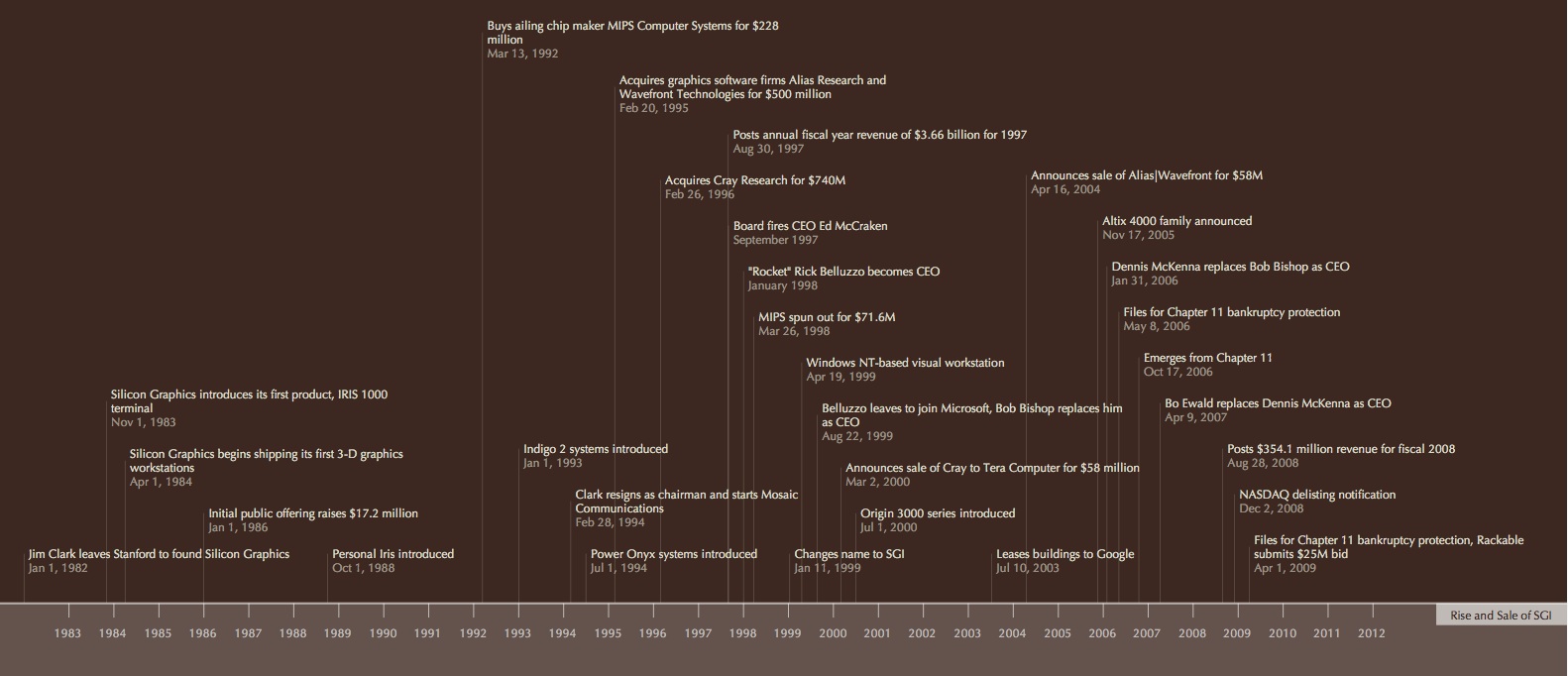
in January 1990. On April 1, 2009, SGI filed for Chapter 11
bankruptcy protection and announced that it would sell substantially all of its assets to Rackable Systems, a deal finalized on May 11, 2009, with Rackable assuming the name "Silicon Graphics International".
left his position as an electrical engineering associate professor at Stanford University
to found SGI in 1982 along with a group of seven graduate students and research staff from Stanford: Kurt Akeley
, David J. Brown
, Tom Davis, Rocky Rhodes, Marc Hannah, Herb Kuta, and Mark Grossman; and Abbey Silverstone
; and a few others. Later notable employees include Joseph DiNucci, VP of Marketing, who recruited Bob Lutz, then president of Chrysler onto SGI's board. The Mayfield Fund
venture capital
group supplied the initial funding.
family of microprocessor
s. The later IRIS 2000 and 3000 models evolved into full UNIX
workstation
s.
VAX
, to provide graphical raster display
abilities. They used 8 MHz Motorola 68000 CPUs with 768KB of RAM and had no disk drives. They booted over the network (via an Excelan
EXOS/101 Ethernet card) from their controlling computer. They used the "PM1" CPU board, which was a variant of the board that was used in Stanford University
's SUN workstation
and later in the Sun-1
workstation from Sun Microsystems
. The graphics system was composed of the GF1 Frame buffer, the UC3 "Update Controller", DC3 "Display Controller", and the BP2 bitplane. The 1000-series machines were designed around the Multibus
standard.
Later 1000-series machines, the 1400 and 1500, ran at 10 MHz and had 1.5 MB of RAM. The 1400 had a 73 MB ST-506
disk drive, while the 1500 had a 474 MB SMD-based disk drive with a Xylogics
450 disk controller. They may have used the PM2 CPU and PM2M1 RAM board from the 2000 series. The usual monitor for the 1000 series ran at 30 Hz interlaced. Six beta-test units of the 1400 workstation were produced, and the first production unit (SGI's first commercial computer) was shipped to Carnegie-Mellon University's Electronic Imaging Laboratory in 1984.
 SGI rapidly evolved its machines into workstations with its second product line — the IRIS 2000 series. SGI began using the UNIX System V
operating system
. There were five models in two product ranges, the 2000/2200/2300/2400/2500 range which used 68010 CPUs
(the PM2 CPU module), and the later "Turbo" systems, the 2300T, 2400T and 2500T, which had 68020s
(the IP2 CPU module). All used the Excelan EXOS/201 Ethernet card, the same graphics hardware (GF2 Frame Buffer, UC4 Update Controller, DC4 Display Controller, BP3 Bitplane). Their main differences were the CPU, RAM, and Weitek
Floating Point Accelerator boards, disk controllers and disk drives (both ST-506
and SMD
were available). These could be upgraded, for example from a 2400 to a 2400T. The 2500 and 2500T had a larger chassis, a standard 6' 19" EIA rack with space at the bottom for two SMD disk drives weighing approximately 150 lb each. The non-Turbo models used the Multibus
for the CPU to communicate with the floating point accelerator, while the Turbos added a ribbon cable dedicated for this. 60 Hz monitors were used for the 2000 series.
The height of the machines using Motorola CPUs was reached with the IRIS 3000 series (somewhere around 1989, models 3010/3020/3030 and 3110/3115/3120/3130, the 30s both being full-size rack machines). They used the same graphics subsystem and Ethernet as the 2000s, but could also use up to 12 "geometry engines", the first widespread use of hardware graphics accelerators. The standard monitor was a 19" 60 Hz non-interlaced unit with a tilt/swivel base; 19" 30 Hz interlaced and a 15" 60 Hz non-interlaced (with tilt/swivel base) were also available.
The IRIS 3130 and its smaller siblings were impressive for the time, being complete UNIX
workstations. The 3130 was powerful enough to support a complete 3D animation and rendering package without mainframe support. With large capacity hard drives by standards of the day (two 300 MB drives), streaming tape and Ethernet, it could be the centerpiece of an animation operation.
The line was formally discontinued in 1989, with about 3500 systems shipped of all 2000 and 3000 models combined.
microprocessors. These machines were more powerful, able to address more memory and came with powerful on-board floating-point capability. As 3D graphics became more popular in television and film during this time, these systems were responsible for establishing much of SGI's reputation.
SGI produced a broad range of MIPS-based workstations and servers during the 1990s, running SGI's version of UNIX System V, now called IRIX
. These included the massive Onyx visualization systems, the size of refrigerators and capable of supporting up to 64 processors while managing up to three streams of high resolution, fully realized 3D graphics.
In October 1991, MIPS announced the first 64-bit
MIPS microprocessor, the R4000
, which was the first commercially available 64-bit microprocessor. SGI used the R4000 in its Crimson
workstation. IRIX 6.2 was the first fully 64-bit IRIX release, including 64-bit pointers.
In the late 1990s, when much of the industry expected the Itanium
to replace both CISC
and RISC architectures in non-embedded computers, SGI announced their intent to phase out MIPS in their systems. Development of new MIPS microprocessors stopped, and the existing R12000 design was extended multiple times until 2003 to provide existing customers more time to migrate to Itanium.
In August 2006, SGI announced the end of production for MIPS/IRIX systems, and by the end of the year MIPS/IRIX products were no longer generally available from SGI.
known as IRIS Graphics Language (IRIS GL
). As more features were added over the years, IRIS GL became harder to maintain and more cumbersome to use. In 1992, SGI decided to clean up and reform IRIS GL and made the bold move of allowing the resulting OpenGL
API to be cheaply licensed by SGI's competitors, and set up an industry-wide consortium to maintain the OpenGL standard (the OpenGL Architecture Review Board).
This meant that for the first time, fast, efficient, cross-platform graphics programs could be written. To this day, OpenGL remains the only real-time 3D graphics standard to be portable across a variety of operating systems. OpenGL-ES even runs on many types of cell phone. Its main competitor (Direct3D
from Microsoft) runs only on Microsoft Windows
-based machines including the Dreamcast and Xbox
consoles.
, Digital Equipment Corporation
, MIPS Computer Systems, Groupe Bull
, Siemens
, NEC, NeTpower, Microsoft
and Santa Cruz Operation. Its intent was to introduce workstations based on the MIPS architecture
and able to run Windows NT
and SCO UNIX. The group produced the Advanced RISC Computing
(ARC) specification, but began to unravel little more than a year after its formation.
system with the fsn
three-dimensional
file system navigator appeared in the 1993 movie Jurassic Park
. One hallmark of this scene is Lex's line, "It's a Unix system! I know this."
In the movie Twister, the heroes can be seen using an SGI laptop, however the unit shown was not an actual working computer, but rather a fake laptop shell built around an SGI Corona LCD flat screen display.
The 1995 film Congo
also features an SGI laptop being used by Dr. Ross (Laura Linney
) to communicate via satellite to TraviCom HQ.
Other on-screen credits include:
For eight consecutive years (1995–2002), all films nominated for an Academy Award for Distinguished Achievement in Visual Effects were created on Silicon Graphics computer systems.
Once inexpensive PCs began to have graphics performance close to the more expensive specialized graphical workstations which were SGI's core business, SGI shifted its focus to high performance servers for digital video
and the Web. Many SGI graphics engineers left to work at other computer graphics companies such as ATI
and Nvidia
, contributing to the PC 3D graphics revolution.
, supporting several projects such as Linux and Samba, and providing some of its own previously proprietary code such as the XFS
filesystem and the Open64
compiler to the free software world.
At the same time, SGI announced a new logo consisting of only the letters “sgi” in a proprietary font called “SGI”, created by branding and design consulting firm Landor Associates
, in collaboration with designer Joe Stitzlein. The new logo drew criticism for wasting the professional goodwill associated with the previous cube logo (or "bug"). SGI continued to use the "Silicon Graphics" name for its workstation product line, and later re-adopted the cube logo for some workstation models.
in a deal totaling approximately $500 million and merged the companies into Alias|Wavefront. In June 2004 SGI sold the business, later renamed to Alias Systems Corporation
, to the private equity investment firm Accel-KKR
for $57.1 million. In October 2005, Autodesk
announced that it signed a definitive agreement to acquire Alias for $182 million in cash.
In February 1996, SGI purchased the well-known supercomputer
manufacturer Cray Research for $740 million, and began to use marketing names such as "CrayLink" for (SGI-developed) technology integrated into the SGI server line. Three months later, it sold Cray's Business Systems Division, responsible for the CS6400 SPARC/Solaris server, to Sun Microsystems
for an undisclosed amount (widely believed to be $50 million). Many of the Cray T3E
engineers designed and developed the SGI Altix and NUMAlink
technology. SGI sold the Cray brand and product lines to Tera Computer Company
on March 31, 2000 for $35 million plus one million shares. SGI also distributed its remaining interest in MIPS Technologies through a spin-off effective June 20, 2000.
In September 2000, SGI acquired the Zx10 series of Windows workstations and servers from Intergraph Computer Systems
(for a rumored $100 million). These models were rebadged as SGI systems, but discontinued in June 2001.
(see also SGI Visual Workstation
) proved to be a financial disaster, and shook customer confidence in SGI’s commitment to its own MIPS-based line.
. Funding for its own high-end processors was reduced, and it was planned that the R10000
would be the last MIPS mainstream processor. MIPS Technologies
would focus entirely on the embedded market, where it was having some success, and SGI would no longer have to fund development of a CPU that, since the failure of ARC
, found use only in their own machines.
But this plan quickly went awry. As early as 1999 it was clear the Itanium was going to be delivered very late, and then that it would have nowhere near the performance originally expected. As the production delays increased, MIPS' existing R10000-based machines grew increasingly uncompetitive. Eventually it was forced to introduce faster MIPS processors, the R12000, R14000 and R16000, which were used in a series of models from 2002 until 2006.
SGI's first Itanium-based system was the short-lived SGI 750 workstation, launched in 2001. SGI's MIPS-based systems were not to be superseded until the launch of the Itanium 2-based Altix servers and Prism
workstations some time later. Unlike the MIPS systems, which ran IRIX
, the Itanium systems used SuSE Linux Enterprise Server with SGI enhancements as their operating system
. SGI used Transitive Corporation's QuickTransit
software to allow their old MIPS/IRIX applications to run (in emulation) on the new Itanium/Linux platform.
In the server market the Itanium 2-based Altix eventually replaced the MIPS-based Origin product line. In the workstation market, the switch to Itanium was not completed before SGI exited the market.
The Altix was the most powerful computer in the world in 2006, if a "computer" is defined as a collection of hardware running under a single instance of an operating system. The Altix had 512 Itanium processors running under a single instance of Linux
. A cluster of 20 machines was then the eighth fastest supercomputer
. All faster supercomputers were clusters, but none have as many FLOPS per machine. However, more recent supercomputers are massive clusters of machines that are individually less capable. SGI acknowledged this and in 2007 moved away from the "massive NUMA
" model to efficient clusters.
processor. The first Altix XE systems were relatively low-end machines, but by December 2006 the XE systems were more capable than the Itanium machines by some measures (e.g., power consumption in FLOP/W, density in FLOP/m3, cost/FLOP). The XE1200 and XE1300 servers use a cluster architecture. This is a departure from the pure NUMA architectures of the earlier Itanium and MIPS servers.
in June 2007, SGI announced the Altix ICE 8200, a blade-based Xeon system with up to 512 Xeon cores per rack. An Altix ICE 8200 installed at New Mexico Computing Applications Center (with 14336 processors) ranked at number 3 on the TOP500
list of November 2007.
s, and the ability of clusters of Linux
- and BSD
-based PCs to take on many of the tasks of larger SGI servers, ate into SGI's core markets. The porting of Maya
to Linux
, Mac OS X
and Microsoft Windows
further eroded the low end of SGI's product line.
Further, SGI's premature announcement of its migration from MIPS to Itanium and its abortive ventures into IA-32 architecture systems (the Visual Workstation
line, the ex-Intergraph Zx10 range and the SGI 1000-series Linux servers) damaged SGI's credibility in the market.
In November 2005, SGI announced that it had been delisted from the New York Stock Exchange
because its common stock had fallen below the minimum share price for listing on the exchange. SGI's market capitalization
dwindled from a peak of over seven billion
dollars in 1995 to just $120 million at the time of delisting. In February 2006, SGI noted that it could run out of cash by the end of the year.
In January 2006, SGI hired Dennis McKenna as its new CEO and chairman of the board of directors. Mr. McKenna succeeded Robert Bishop, who remained vice chairman of the board of directors.
On May 8, 2006, SGI announced that it had filed for Chapter 11 bankruptcy protection for itself and US subsidiaries as part of a plan to reduce debt by $250 million. Two days later, the US Bankruptcy Court approved its first day motions
and its use of a $70 million financing facility provided by a group of its bondholders. Foreign subsidiaries were unaffected.
On September 6, 2006, SGI announced the end of development for the MIPS/IRIX line and the IRIX operating system. Production would end on 29 December and the last orders would be fulfilled by March 2007. Support for these products would end after December 2013.
SGI emerged from bankruptcy protection on October 17, 2006. Its stock symbol at that point, SGID.pk, was canceled, and new stock was issued on the NASDAQ exchange under the symbol SGIC. This new stock was distributed to the company's creditors, and the SGID common stockholders were left with worthless shares. At the end of that year, the company moved its headquarters from Mountain View
to Sunnyvale
. Its earlier North Shoreline headquarters is now occupied by the Computer History Museum
; the newer Amphitheater Parkway headquarters was sold to Google
. Both of these locations were award-winning designs by Studios Architecture
.
In April 2008, SGI re-entered the visualization market with the SGI Virtu
range of visualization servers and workstations, which were re-badged systems from BOXX Technologies
based on Intel Xeon
or AMD Opteron processors and Nvidia Quadro
graphics chipsets, running Red Hat Enterprise Linux
, SUSE Linux Enterprise Server
or Windows Compute Cluster Server.
, as its market value had been below the minimum $35 million requirement for 10 consecutive trading days, and also did not meet NASDAQ's alternative requirements of a minimum stockholders' equity of $2.5 million or annual net income from continuing operations of $500,000 or more.
On April 1, 2009, SGI filed for Chapter 11 again, and announced that it would sell substantially all of its assets to Rackable Systems for $25 million. The sale, ultimately for $42.5 million, was finalized on May 11, 2009; at the same time, Rackable announced their adoption of "Silicon Graphics International" as their global name and brand. The Bankruptcy court scheduled continuing proceedings and hearings for June 3 and 24, 2009, and July 22, 2009.
After the Rackable acquisition, Vizworld magazine published a series of six articles that chronicle the downfall of SGI.
visual effects studios. In fact, SGI's largest revenue
has always been generated by government and defense applications, energy, and scientific and technical computing. The rise of cheap yet powerful commodity workstations running Linux
, Windows
and Mac OS X
, and the availability of diverse professional software for them, effectively pushed SGI out of the visual effects industry in all but the most niche market
s, as studios adopted newer, cheaper technology.
s) based on the SN architecture. SN, for Scalable Node, is a technology developed by SGI in the mid-1990s that uses cache-coherent non-uniform memory access (cc-NUMA). In an SN system, processors, memory, and a bus- and memory-controller are coupled together into an entity called a node, usually on a single circuit board. Nodes are connected by a high-speed interconnect called NUMAlink
(originally branded CrayLink). There is no internal bus, and instead access between processors, memory, and I/O
devices is done through a switched fabric
of links and routers.
Thanks to the cache coherence of the distributed shared memory
, SN systems scale along several axes at once: as CPU count increases, so does memory capacity, I/O capacity, and system bisection bandwidth
. This allows the combined memory of all the nodes to be accessed under a single OS
image using standard shared-memory synchronization methods. This makes an SN system far easier to program and able to achieve higher sustained-to-peak performance than non-cache-coherent systems like conventional clusters
or massively parallel computers which require applications code to be written (or re-written) to do explicit message-passing communication between their nodes.
The first SN system, known as SN-0, was released in 1996 under the product name Origin 2000
. Based on the MIPS R10000
processor, it scaled from 2 to 128 processors and a smaller version, the Origin 200
(SN-00), scaled from 1 to 4. Later enhancements enabled systems of as large as 512 processors.
The second generation system, originally called SN-1 but later SN-MIPS, was released in July 2000, as the Origin 3000. It scaled from 4 to 512 processors, and 1,024-processor configurations were delivered by special order to some customers. A smaller, less scalable implementation followed, called Origin 300.
In November 2002, SGI announced a repackaging of its SN system, under the name Origin 3900. It quadrupled the processor area density of the SN-MIPS system, from 32 up to 128 processors per rack while moving to a "fat tree
" interconnect topology.
In January 2003, SGI announced a variant of the SN platform called the Altix 3000
(internally called SN-IA). It used Intel Itanium
2 processors and ran the Linux
operating system kernel. At the time it was released, it was the world's most scalable Linux-based computer, supporting up to 64 processors in a single system node. Nodes could be connected using the same NUMAlink
technology to form what SGI predictably termed "superclusters".
In February 2004, SGI announced general support for 128 processor nodes to be followed by 256 and 512 processor versions that year.
In April 2004, SGI announced the sale of its Alias software business for approximately $57 million.
In October 2004, SGI built the supercomputer Columbia
, which broke the world record for computer speed, for the NASA Ames Research Center. It was a cluster of 20 Altix supercomputers each with 512 Intel Itanium 2 processors running Linux, and achieved sustained speed of 42.7 trillion floating-point operations per second (teraflops
), easily topping Japan
's famed Earth Simulator
's record of 35.86 teraflops. (A week later, IBM
's upgraded Blue Gene
/L clocked in at 70.7 teraflops).
In July 2006, SGI announced an SGI Altix 4700 system with 1,024 processors and 4 TB
of memory running a single Linux system image.
, Tandem Computers
, Prime Computer
and Siemens-Nixdorf.
High-performance computing
High-performance computing uses supercomputers and computer clusters to solve advanced computation problems. Today, computer systems approaching the teraflops-region are counted as HPC-computers.-Overview:...
solutions, including computer hardware
Computer hardware
Personal computer hardware are component devices which are typically installed into or peripheral to a computer case to create a personal computer upon which system software is installed including a firmware interface such as a BIOS and an operating system which supports application software that...
and software
Computer software
Computer software, or just software, is a collection of computer programs and related data that provide the instructions for telling a computer what to do and how to do it....
, founded in 1981 by Jim Clark
James H. Clark
James H. Clark is an American entrepreneur and computer scientist. He founded several notable Silicon Valley technology companies, including Silicon Graphics, Inc., Netscape Communications Corporation, myCFO and Healtheon...
. Its initial market was 3D graphics display terminals, but its products, strategies and market positions evolved significantly over time.
Initial systems were based on the Geometry Engine that Clark and Marc Hannah had developed at Stanford University
Stanford University
The Leland Stanford Junior University, commonly referred to as Stanford University or Stanford, is a private research university on an campus located near Palo Alto, California. It is situated in the northwestern Santa Clara Valley on the San Francisco Peninsula, approximately northwest of San...
, and were derived from Clark's broader background in computer graphics
Computer graphics
Computer graphics are graphics created using computers and, more generally, the representation and manipulation of image data by a computer with help from specialized software and hardware....
. The Geometry Engine was the first very-large-scale integration
Very-large-scale integration
Very-large-scale integration is the process of creating integrated circuits by combining thousands of transistors into a single chip. VLSI began in the 1970s when complex semiconductor and communication technologies were being developed. The microprocessor is a VLSI device.The first semiconductor...
(VLSI) implementation of a geometry pipeline, specialized hardware that accelerated the "inner-loop" geometric computations needed to display three-dimensional
3D computer graphics
3D computer graphics are graphics that use a three-dimensional representation of geometric data that is stored in the computer for the purposes of performing calculations and rendering 2D images...
images.
SGI was headquartered in Sunnyvale, California
Sunnyvale, California
Sunnyvale is a city in Santa Clara County, California, United States. It is one of the major cities that make up the Silicon Valley located in the San Francisco Bay Area...
; it was originally incorporated as a California
California
California is a state located on the West Coast of the United States. It is by far the most populous U.S. state, and the third-largest by land area...
corporation
Corporation
A corporation is created under the laws of a state as a separate legal entity that has privileges and liabilities that are distinct from those of its members. There are many different forms of corporations, most of which are used to conduct business. Early corporations were established by charter...
in November 1981, and reincorporated as a Delaware corporation
Delaware corporation
The Delaware General Corporation Law is the statute governing corporate law in the state of Delaware. Delaware is well known as a corporate haven. Over 50% of U.S...
in January 1990. On April 1, 2009, SGI filed for Chapter 11
Chapter 11, Title 11, United States Code
Chapter 11 is a chapter of the United States Bankruptcy Code, which permits reorganization under the bankruptcy laws of the United States. Chapter 11 bankruptcy is available to every business, whether organized as a corporation or sole proprietorship, and to individuals, although it is most...
bankruptcy protection and announced that it would sell substantially all of its assets to Rackable Systems, a deal finalized on May 11, 2009, with Rackable assuming the name "Silicon Graphics International".
History
Early years
Dr. James H. ClarkJames H. Clark
James H. Clark is an American entrepreneur and computer scientist. He founded several notable Silicon Valley technology companies, including Silicon Graphics, Inc., Netscape Communications Corporation, myCFO and Healtheon...
left his position as an electrical engineering associate professor at Stanford University
Stanford University
The Leland Stanford Junior University, commonly referred to as Stanford University or Stanford, is a private research university on an campus located near Palo Alto, California. It is situated in the northwestern Santa Clara Valley on the San Francisco Peninsula, approximately northwest of San...
to found SGI in 1982 along with a group of seven graduate students and research staff from Stanford: Kurt Akeley
Kurt Akeley
Kurt Akeley is a computer graphics engineer.-Biography:Kurt Akeley received a B.E.E. from the University of Delaware in 1980, and an M.S.E.E. from Stanford University in 1982...
, David J. Brown
David J. Brown
David J. Brown is an American computer scientist. He was one of a small group that helped to develop the system at Stanford that later resulted in Sun Microsystems, and later was a founder Silicon Graphics in 1982.- Education :...
, Tom Davis, Rocky Rhodes, Marc Hannah, Herb Kuta, and Mark Grossman; and Abbey Silverstone
Abbey Silverstone
Abbey Silverstone is a very early member of the computer development family with a 50-year career in the computer industry that included time as VP of operations of Silicon Graphics ....
; and a few others. Later notable employees include Joseph DiNucci, VP of Marketing, who recruited Bob Lutz, then president of Chrysler onto SGI's board. The Mayfield Fund
Mayfield Fund
Mayfield Fund is one of the oldest venture capital firms in the US, focusing on early-stage to growth-stage investments in information technology companies with a focus on enterprise software, Internet consumer & media services, and communications....
venture capital
Venture capital
Venture capital is financial capital provided to early-stage, high-potential, high risk, growth startup companies. The venture capital fund makes money by owning equity in the companies it invests in, which usually have a novel technology or business model in high technology industries, such as...
group supplied the initial funding.
Motorola 680x0-based systems
SGI's first generation products, starting with the IRIS 1000 (Integrated Raster Imaging System) series of high-performance graphics terminals, were based on the Motorola 68000Motorola 68000
The Motorola 68000 is a 16/32-bit CISC microprocessor core designed and marketed by Freescale Semiconductor...
family of microprocessor
Microprocessor
A microprocessor incorporates the functions of a computer's central processing unit on a single integrated circuit, or at most a few integrated circuits. It is a multipurpose, programmable device that accepts digital data as input, processes it according to instructions stored in its memory, and...
s. The later IRIS 2000 and 3000 models evolved into full UNIX
Unix
Unix is a multitasking, multi-user computer operating system originally developed in 1969 by a group of AT&T employees at Bell Labs, including Ken Thompson, Dennis Ritchie, Brian Kernighan, Douglas McIlroy, and Joe Ossanna...
workstation
Workstation
A workstation is a high-end microcomputer designed for technical or scientific applications. Intended primarily to be used by one person at a time, they are commonly connected to a local area network and run multi-user operating systems...
s.
IRIS 1000 series
The first entries in the 1000 series (models 1000 and 1200, introduced in 1984) were graphics terminals, peripherals to be connected to a general-purpose computer such as a Digital Equipment CorporationDigital Equipment Corporation
Digital Equipment Corporation was a major American company in the computer industry and a leading vendor of computer systems, software and peripherals from the 1960s to the 1990s...
VAX
VAX
VAX was an instruction set architecture developed by Digital Equipment Corporation in the mid-1970s. A 32-bit complex instruction set computer ISA, it was designed to extend or replace DEC's various Programmed Data Processor ISAs...
, to provide graphical raster display
Raster graphics
In computer graphics, a raster graphics image, or bitmap, is a data structure representing a generally rectangular grid of pixels, or points of color, viewable via a monitor, paper, or other display medium...
abilities. They used 8 MHz Motorola 68000 CPUs with 768KB of RAM and had no disk drives. They booted over the network (via an Excelan
Excelan
Excelan was a computer networking company founded in 1982 by Kanwal Rekhi. Excelan was a manufacturer of smart Ethernet cards, until the company merged with, and was acquired by Novell in 1989. The company offered a line of Ethernet "front end processor" boards for Multibus, VMEbus, Q-Bus, Unibus,...
EXOS/101 Ethernet card) from their controlling computer. They used the "PM1" CPU board, which was a variant of the board that was used in Stanford University
Stanford University
The Leland Stanford Junior University, commonly referred to as Stanford University or Stanford, is a private research university on an campus located near Palo Alto, California. It is situated in the northwestern Santa Clara Valley on the San Francisco Peninsula, approximately northwest of San...
's SUN workstation
SUN workstation
The original SUN workstation was a modular computer system designed at Stanford University in the early 1980s.-History:The project name was derived from Stanford University Network, the campus network within Stanford....
and later in the Sun-1
Sun-1
Sun-1 was the first generation of UNIX computer workstations and servers produced by Sun Microsystems, launched in May 1982. These were based on a CPU board designed by Andy Bechtolsheim while he was a graduate student at Stanford University and funded by DARPA...
workstation from Sun Microsystems
Sun Microsystems
Sun Microsystems, Inc. was a company that sold :computers, computer components, :computer software, and :information technology services. Sun was founded on February 24, 1982...
. The graphics system was composed of the GF1 Frame buffer, the UC3 "Update Controller", DC3 "Display Controller", and the BP2 bitplane. The 1000-series machines were designed around the Multibus
Multibus
Multibus is a computer bus standard used in industrial systems. It was developed by Intel Corporation and was adopted as the IEEE 796 bus.The Multibus specification was important because it was a robust, well-thought out industry standard with a relatively large form factor so complex devices could...
standard.
Later 1000-series machines, the 1400 and 1500, ran at 10 MHz and had 1.5 MB of RAM. The 1400 had a 73 MB ST-506
ST-506
The ST-506 was the first 5.25 inch hard disk drive. Introduced in 1980 by Seagate Technology , it stored up to 5 megabytes after formatting and cost $1500. The similar 10 MB ST-412 was introduced in late 1981. Both used MFM encoding...
disk drive, while the 1500 had a 474 MB SMD-based disk drive with a Xylogics
Xylogics
Xylogics started out building disk and other controllers for DEC hardware.They also built serial terminal servers from 4-port to 72-port units.Xylogics was acquired by Bay Networks in December 1995 which in turn was acquired by Nortel in June 1998....
450 disk controller. They may have used the PM2 CPU and PM2M1 RAM board from the 2000 series. The usual monitor for the 1000 series ran at 30 Hz interlaced. Six beta-test units of the 1400 workstation were produced, and the first production unit (SGI's first commercial computer) was shipped to Carnegie-Mellon University's Electronic Imaging Laboratory in 1984.
IRIS 2000 and 3000 series
UNIX System V
Unix System V, commonly abbreviated SysV , is one of the first commercial versions of the Unix operating system. It was originally developed by American Telephone & Telegraph and first released in 1983. Four major versions of System V were released, termed Releases 1, 2, 3 and 4...
operating system
Operating system
An operating system is a set of programs that manage computer hardware resources and provide common services for application software. The operating system is the most important type of system software in a computer system...
. There were five models in two product ranges, the 2000/2200/2300/2400/2500 range which used 68010 CPUs
Motorola 68010
The Motorola MC68010 processor is a 16/32-bit microprocessor from Motorola, released in 1982. In line with the Motorola 68000 naming convention, it is usually just referred to as the 010 ....
(the PM2 CPU module), and the later "Turbo" systems, the 2300T, 2400T and 2500T, which had 68020s
Motorola 68020
The Motorola 68020 is a 32-bit microprocessor from Motorola, released in 1984. It is the successor to the Motorola 68010 and is succeeded by the Motorola 68030...
(the IP2 CPU module). All used the Excelan EXOS/201 Ethernet card, the same graphics hardware (GF2 Frame Buffer, UC4 Update Controller, DC4 Display Controller, BP3 Bitplane). Their main differences were the CPU, RAM, and Weitek
Weitek
Weitek Corporation was a chip-design company that originally concentrated on floating point units for a number of commercial CPU designs. During the early to mid-1980s, Weitek designs could be found powering a number of high-end designs and parallel processing supercomputers...
Floating Point Accelerator boards, disk controllers and disk drives (both ST-506
ST-506
The ST-506 was the first 5.25 inch hard disk drive. Introduced in 1980 by Seagate Technology , it stored up to 5 megabytes after formatting and cost $1500. The similar 10 MB ST-412 was introduced in late 1981. Both used MFM encoding...
and SMD
Storage Module Device
Storage Module Device was a family of storage devices first shipped by Control Data Corporation in December 1973 as the CDC 9760 40 MB storage module disk drive. The CDC 9762 80 MB variant was announced in June 1974 and the CDC 9764 150 MB and the CDC 9766 300 MB variants were announced in 1975...
were available). These could be upgraded, for example from a 2400 to a 2400T. The 2500 and 2500T had a larger chassis, a standard 6' 19" EIA rack with space at the bottom for two SMD disk drives weighing approximately 150 lb each. The non-Turbo models used the Multibus
Multibus
Multibus is a computer bus standard used in industrial systems. It was developed by Intel Corporation and was adopted as the IEEE 796 bus.The Multibus specification was important because it was a robust, well-thought out industry standard with a relatively large form factor so complex devices could...
for the CPU to communicate with the floating point accelerator, while the Turbos added a ribbon cable dedicated for this. 60 Hz monitors were used for the 2000 series.
The height of the machines using Motorola CPUs was reached with the IRIS 3000 series (somewhere around 1989, models 3010/3020/3030 and 3110/3115/3120/3130, the 30s both being full-size rack machines). They used the same graphics subsystem and Ethernet as the 2000s, but could also use up to 12 "geometry engines", the first widespread use of hardware graphics accelerators. The standard monitor was a 19" 60 Hz non-interlaced unit with a tilt/swivel base; 19" 30 Hz interlaced and a 15" 60 Hz non-interlaced (with tilt/swivel base) were also available.
The IRIS 3130 and its smaller siblings were impressive for the time, being complete UNIX
Unix
Unix is a multitasking, multi-user computer operating system originally developed in 1969 by a group of AT&T employees at Bell Labs, including Ken Thompson, Dennis Ritchie, Brian Kernighan, Douglas McIlroy, and Joe Ossanna...
workstations. The 3130 was powerful enough to support a complete 3D animation and rendering package without mainframe support. With large capacity hard drives by standards of the day (two 300 MB drives), streaming tape and Ethernet, it could be the centerpiece of an animation operation.
The line was formally discontinued in 1989, with about 3500 systems shipped of all 2000 and 3000 models combined.
RISC era
With the introduction of the IRIS 4D series, SGI switched to MIPSMIPS architecture
MIPS is a reduced instruction set computer instruction set architecture developed by MIPS Technologies . The early MIPS architectures were 32-bit, and later versions were 64-bit...
microprocessors. These machines were more powerful, able to address more memory and came with powerful on-board floating-point capability. As 3D graphics became more popular in television and film during this time, these systems were responsible for establishing much of SGI's reputation.
SGI produced a broad range of MIPS-based workstations and servers during the 1990s, running SGI's version of UNIX System V, now called IRIX
IRIX
IRIX is a computer operating system developed by Silicon Graphics, Inc. to run natively on their 32- and 64-bit MIPS architecture workstations and servers. It was based on UNIX System V with BSD extensions. IRIX was the first operating system to include the XFS file system.The last major version...
. These included the massive Onyx visualization systems, the size of refrigerators and capable of supporting up to 64 processors while managing up to three streams of high resolution, fully realized 3D graphics.
In October 1991, MIPS announced the first 64-bit
64-bit
64-bit is a word size that defines certain classes of computer architecture, buses, memory and CPUs, and by extension the software that runs on them. 64-bit CPUs have existed in supercomputers since the 1970s and in RISC-based workstations and servers since the early 1990s...
MIPS microprocessor, the R4000
R4000
The R4000 is a microprocessor developed by MIPS Computer Systems that implemented the MIPS III instruction set architecture . Officially announced on 1 October 1991, it was one of the first 64-bit microprocessors and the first MIPS III implementation...
, which was the first commercially available 64-bit microprocessor. SGI used the R4000 in its Crimson
SGI Crimson
The IRIS Crimson, code named Diehard2, is a Silicon Graphics computer released in the early 1990s. It was the world's first 64-bit workstation....
workstation. IRIX 6.2 was the first fully 64-bit IRIX release, including 64-bit pointers.
In the late 1990s, when much of the industry expected the Itanium
Itanium
Itanium is a family of 64-bit Intel microprocessors that implement the Intel Itanium architecture . Intel markets the processors for enterprise servers and high-performance computing systems...
to replace both CISC
CISC
CISC may refer to:*Caribbean Island Swimming Championships*Centre for Innovation and Structural Change*Chongqing Iron and Steel Company* Clean intermittent self-catheterisation, a form of urinary catheterization*Complex instruction set computing...
and RISC architectures in non-embedded computers, SGI announced their intent to phase out MIPS in their systems. Development of new MIPS microprocessors stopped, and the existing R12000 design was extended multiple times until 2003 to provide existing customers more time to migrate to Itanium.
In August 2006, SGI announced the end of production for MIPS/IRIX systems, and by the end of the year MIPS/IRIX products were no longer generally available from SGI.
IRIS GL and OpenGL
Until the second generation Onyx Reality Engine machines, SGI offered access to its high performance 3D graphics subsystems through a proprietary APIApplication programming interface
An application programming interface is a source code based specification intended to be used as an interface by software components to communicate with each other...
known as IRIS Graphics Language (IRIS GL
IRIS GL
IRIS GL was a proprietary graphics API created by Silicon Graphics for producing 2D and 3D computer graphics on their IRIX-based IRIS graphical workstations...
). As more features were added over the years, IRIS GL became harder to maintain and more cumbersome to use. In 1992, SGI decided to clean up and reform IRIS GL and made the bold move of allowing the resulting OpenGL
OpenGL
OpenGL is a standard specification defining a cross-language, cross-platform API for writing applications that produce 2D and 3D computer graphics. The interface consists of over 250 different function calls which can be used to draw complex three-dimensional scenes from simple primitives. OpenGL...
API to be cheaply licensed by SGI's competitors, and set up an industry-wide consortium to maintain the OpenGL standard (the OpenGL Architecture Review Board).
This meant that for the first time, fast, efficient, cross-platform graphics programs could be written. To this day, OpenGL remains the only real-time 3D graphics standard to be portable across a variety of operating systems. OpenGL-ES even runs on many types of cell phone. Its main competitor (Direct3D
Direct3D
Direct3D is part of Microsoft's DirectX application programming interface . Direct3D is available for Microsoft Windows operating systems , and for other platforms through the open source software Wine. It is the base for the graphics API on the Xbox and Xbox 360 console systems...
from Microsoft) runs only on Microsoft Windows
Microsoft Windows
Microsoft Windows is a series of operating systems produced by Microsoft.Microsoft introduced an operating environment named Windows on November 20, 1985 as an add-on to MS-DOS in response to the growing interest in graphical user interfaces . Microsoft Windows came to dominate the world's personal...
-based machines including the Dreamcast and Xbox
Xbox
The Xbox is a sixth-generation video game console manufactured by Microsoft. It was released on November 15, 2001 in North America, February 22, 2002 in Japan, and March 14, 2002 in Australia and Europe and is the predecessor to the Xbox 360. It was Microsoft's first foray into the gaming console...
consoles.
ACE Consortium
SGI was part of the Advanced Computing Environment initiative, formed in the early 1990s with 20 other companies, including CompaqCompaq
Compaq Computer Corporation is a personal computer company founded in 1982. Once the largest supplier of personal computing systems in the world, Compaq existed as an independent corporation until 2002, when it was acquired for US$25 billion by Hewlett-Packard....
, Digital Equipment Corporation
Digital Equipment Corporation
Digital Equipment Corporation was a major American company in the computer industry and a leading vendor of computer systems, software and peripherals from the 1960s to the 1990s...
, MIPS Computer Systems, Groupe Bull
Groupe Bull
-External links:* * — Friends, co-workers and former employees of Bull and Honeywell* *...
, Siemens
Siemens AG
Siemens AG is a German multinational conglomerate company headquartered in Munich, Germany. It is the largest Europe-based electronics and electrical engineering company....
, NEC, NeTpower, Microsoft
Microsoft
Microsoft Corporation is an American public multinational corporation headquartered in Redmond, Washington, USA that develops, manufactures, licenses, and supports a wide range of products and services predominantly related to computing through its various product divisions...
and Santa Cruz Operation. Its intent was to introduce workstations based on the MIPS architecture
MIPS architecture
MIPS is a reduced instruction set computer instruction set architecture developed by MIPS Technologies . The early MIPS architectures were 32-bit, and later versions were 64-bit...
and able to run Windows NT
Windows NT
Windows NT is a family of operating systems produced by Microsoft, the first version of which was released in July 1993. It was a powerful high-level-language-based, processor-independent, multiprocessing, multiuser operating system with features comparable to Unix. It was intended to complement...
and SCO UNIX. The group produced the Advanced RISC Computing
Advanced RISC Computing
Advanced RISC Computing is a specification promulgated by a defunct consortium of computer manufacturers , setting forth a standard MIPS RISC-based computer hardware and firmware environment....
(ARC) specification, but began to unravel little more than a year after its formation.
Entertainment industry
An SGI CrimsonSGI Crimson
The IRIS Crimson, code named Diehard2, is a Silicon Graphics computer released in the early 1990s. It was the world's first 64-bit workstation....
system with the fsn
Fsn
fsn pronounced as "fusion" is an experimental application to view a file system in 3D, made by SGI for IRIX systems....
three-dimensional
3D computer graphics
3D computer graphics are graphics that use a three-dimensional representation of geometric data that is stored in the computer for the purposes of performing calculations and rendering 2D images...
file system navigator appeared in the 1993 movie Jurassic Park
Jurassic Park (film)
Jurassic Park is a 1993 American science fiction adventure film directed by Steven Spielberg. The film is based on the novel of the same name by Michael Crichton. It stars Sam Neill, Laura Dern, Jeff Goldblum, Richard Attenborough, Martin Ferrero, and Bob Peck...
. One hallmark of this scene is Lex's line, "It's a Unix system! I know this."
In the movie Twister, the heroes can be seen using an SGI laptop, however the unit shown was not an actual working computer, but rather a fake laptop shell built around an SGI Corona LCD flat screen display.
The 1995 film Congo
Congo (film)
Congo is a 1995 action adventure film, based on the novel of the same name by Michael Crichton. It was directed by Frank Marshall and stars Laura Linney, Dylan Walsh, Tim Curry, Ernie Hudson, Adewale Akinnuoye-Agbaje, Grant Heslov, and Joe Don Baker. The film was released on June 9, 1995 by...
also features an SGI laptop being used by Dr. Ross (Laura Linney
Laura Linney
Laura Leggett Linney is an American actress of film, television, and theatre. Linney has won three Emmy Awards, two Golden Globes, and a Screen Actors Guild Award. She has been nominated for three times for an Academy Award and once for a BAFTA Award...
) to communicate via satellite to TraviCom HQ.
Other on-screen credits include:
- Johnny MnemonicJohnny Mnemonic (film)Johnny Mnemonic is a 1995 cyberpunk film, loosely based on the short story "Johnny Mnemonic" by William Gibson. The title character, a man with a cybernetic brain implant designed to store information, is played by Keanu Reeves. The film portrays Gibson's dystopian view of the future with the world...
- DisclosureDisclosure (film)Disclosure is a 1994 thriller directed by Barry Levinson, starring Michael Douglas and Demi Moore. It is based on Michael Crichton's novel of the same name.The cast also includes Donald Sutherland, Rosemary Forsyth and Dennis Miller...
- First KidFirst KidFirst Kid is a 1996 Disney comedy film directed by David Mickey Evans and stars Sinbad and Brock Pierce. It was mostly filmed in Richmond, Virginia.-Plot:...
- Jerry MaguireJerry MaguireJerry Maguire is a 1996 American romantic comedy-drama film starring Tom Cruise and Cuba Gooding, Jr. It was written, co-produced, and directed by Cameron Crowe...
- How to Make a MonsterHow to Make a Monster (2001 film)How To Make A Monster is a 2001 film starring Clea DuVall, Steven Culp, Jason Marsden and Tyler Mane. It is the third release in the Creature Features series of film remakes produced by Stan Winston. Julie Strain made a cameo appearance in the film as herself. How To Make A Monster debuted on...
- The Lawnmower Man
- Lost in SpaceLost in Space (film)Lost in Space is a 1998 American science fiction film starring Gary Oldman and William Hurt. The film was shot in London and Shepperton, and produced by New Line Cinema. The plot is adapted from the 1965–1968 CBS television series Lost In Space...
- Mission to MarsMission to MarsMission to Mars is a 2000 science fiction film directed by Brian De Palma from an original screenplay written by Jim Thomas, John Thomas, and Graham Yost. The film's story details a fictional portrayal of a manned Mars exploration mission gone awry in the year 2020...
- Men in BlackMen in Black (film)Men in Black is a 1997 science fiction comedy film directed by Barry Sonnenfeld, starring Tommy Lee Jones, Will Smith and Vincent D'Onofrio. The film was based on the Men in Black comic book series by Lowell Cunningham, originally published by Marvel Comics. The film featured the creature effects...
- The Peacemaker
- The RelicThe Relic (film)The Relic is a 1997 science fiction/horror film directed by Peter Hyams and based on the best-selling novel Relic by Douglas Preston and Lincoln Child. The film stars Penelope Ann Miller, Tom Sizemore and Linda Hunt. The original music score was composed by John Debney...
- SliverSliver (film)Sliver is a 1993 film based on the Ira Levin novel of the same name about the mysterious occurrences in a privately owned New York highrise apartment building. Phillip Noyce directed the film, from a screenplay by Joe Eszterhas...
- SphereSphere (film)Sphere is a 1998 science fiction psychological thriller film, starring Dustin Hoffman, Sharon Stone, and Samuel L. Jackson. Sphere was based on the 1986 novel of the same name by Michael Crichton, author of Jurassic Park and The Lost World...
- SwordfishSwordfish (film)Swordfish is a 2001 crime-thriller film, directed by Dominic Sena and starring John Travolta, Hugh Jackman, Halle Berry, Don Cheadle and Vinnie Jones. The film is an action thriller that was also notable for Halle Berry's first topless scene...
- ViperViper (TV series)Viper is an action-adventure TV series about a special task force set up by the federal government to fight crime in the fictional city of Metro City, California that is perpetually under siege from one crime wave after another. The weapon used by this task force is an assault vehicle that...
(TV series)
For eight consecutive years (1995–2002), all films nominated for an Academy Award for Distinguished Achievement in Visual Effects were created on Silicon Graphics computer systems.
Once inexpensive PCs began to have graphics performance close to the more expensive specialized graphical workstations which were SGI's core business, SGI shifted its focus to high performance servers for digital video
Digital video
Digital video is a type of digital recording system that works by using a digital rather than an analog video signal.The terms camera, video camera, and camcorder are used interchangeably in this article.- History :...
and the Web. Many SGI graphics engineers left to work at other computer graphics companies such as ATI
ATI Technologies
ATI Technologies Inc. was a semiconductor technology corporation based in Markham, Ontario, Canada, that specialized in the development of graphics processing units and chipsets. Founded in 1985 as Array Technologies Inc., the company was listed publicly in 1993 and was acquired by Advanced Micro...
and Nvidia
NVIDIA
Nvidia is an American global technology company based in Santa Clara, California. Nvidia is best known for its graphics processors . Nvidia and chief rival AMD Graphics Techonologies have dominated the high performance GPU market, pushing other manufacturers to smaller, niche roles...
, contributing to the PC 3D graphics revolution.
Free software
SGI was a promoter of free softwareFree software
Free software, software libre or libre software is software that can be used, studied, and modified without restriction, and which can be copied and redistributed in modified or unmodified form either without restriction, or with restrictions that only ensure that further recipients can also do...
, supporting several projects such as Linux and Samba, and providing some of its own previously proprietary code such as the XFS
XFS
XFS is a high-performance journaling file system created by Silicon Graphics, Inc. It is the default file system in IRIX releases 5.3 and onwards and later ported to the Linux kernel. XFS is particularly proficient at parallel IO due to its allocation group based design...
filesystem and the Open64
Open64
Open64 is an open source, optimizing compiler for the Itanium and x86-64 microprocessor architectures. It derives from the SGI compilers for the MIPS R10000 processor, called MIPSPro. It was initially released in 2000 as GNU GPL software under the name Pro64. The following year, University of...
compiler to the free software world.
Name and logo changes
In 1999, in an attempt to clarify their current market position as more than a graphics company, Silicon Graphics Inc. changed its corporate identity to “SGI”, although its legal name was unchanged.At the same time, SGI announced a new logo consisting of only the letters “sgi” in a proprietary font called “SGI”, created by branding and design consulting firm Landor Associates
Landor Associates
Landor Associates is a San Francisco-based brand and creative design consultancy. Founded by Walter Landor and his wife Josephine in 1941, Landor pioneered many of the research, design and consulting methodologies that are now standard in the branding industry.-Operations:Landor offers brand...
, in collaboration with designer Joe Stitzlein. The new logo drew criticism for wasting the professional goodwill associated with the previous cube logo (or "bug"). SGI continued to use the "Silicon Graphics" name for its workstation product line, and later re-adopted the cube logo for some workstation models.
Acquisition of Alias, Wavefront, Cray and Intergraph
In 1995, SGI purchased Alias Research and Wavefront TechnologiesWavefront Technologies
Wavefront Technologies was a computer graphics company that developed and sold animation software used in Hollywood motion pictures and other industries. It was founded in 1984, in Santa Barbara, California, by Bill Kovacs, Larry Barels, Mark Sylvester...
in a deal totaling approximately $500 million and merged the companies into Alias|Wavefront. In June 2004 SGI sold the business, later renamed to Alias Systems Corporation
Alias Systems Corporation
Alias Systems Corporation , headquartered in Toronto, Ontario, Canada, was a software company that produced high-end 3D graphics software. The company was formed in 1995 when Silicon Graphics bought Alias Research, which was founded in 1983, and Wavefront Technologies, founded in 1984, then merged...
, to the private equity investment firm Accel-KKR
Accel-KKR
Accel-KKR is a technology-focused private equity firm focused on control investments in middle-market companies. The firm invests primarily in software and IT-enabled businesses...
for $57.1 million. In October 2005, Autodesk
Autodesk
Autodesk, Inc. is an American multinational corporation that focuses on 3D design software for use in the architecture, engineering, construction, manufacturing, media and entertainment industries. The company was founded in 1982 by John Walker, a coauthor of the first versions of the company's...
announced that it signed a definitive agreement to acquire Alias for $182 million in cash.
In February 1996, SGI purchased the well-known supercomputer
Supercomputer
A supercomputer is a computer at the frontline of current processing capacity, particularly speed of calculation.Supercomputers are used for highly calculation-intensive tasks such as problems including quantum physics, weather forecasting, climate research, molecular modeling A supercomputer is a...
manufacturer Cray Research for $740 million, and began to use marketing names such as "CrayLink" for (SGI-developed) technology integrated into the SGI server line. Three months later, it sold Cray's Business Systems Division, responsible for the CS6400 SPARC/Solaris server, to Sun Microsystems
Sun Microsystems
Sun Microsystems, Inc. was a company that sold :computers, computer components, :computer software, and :information technology services. Sun was founded on February 24, 1982...
for an undisclosed amount (widely believed to be $50 million). Many of the Cray T3E
Cray T3E
The Cray T3E was Cray Research's second-generation massively parallel supercomputer architecture, launched in late November 1995. The first T3E was installed at the Pittsburgh Supercomputing Center in 1996. Like the previous Cray T3D, it was a fully distributed memory machine using a 3D torus...
engineers designed and developed the SGI Altix and NUMAlink
NUMAlink
NUMAlink is a system interconnect developed by SGI for use in its distributed shared memory ccNUMA computer systems. NUMAlink was originally developed by SGI for their Origin 2000 and Onyx2 systems...
technology. SGI sold the Cray brand and product lines to Tera Computer Company
Tera Computer Company
The Tera Computer Company was a manufacturer of high-performance computing software and hardware, founded in 1987 in Washington, D.C. and moved 1988 to Seattle, Washington by James Rottsolk and Burton Smith. The company's first supercomputer product, named MTA, featured interleaved multi-threading,...
on March 31, 2000 for $35 million plus one million shares. SGI also distributed its remaining interest in MIPS Technologies through a spin-off effective June 20, 2000.
In September 2000, SGI acquired the Zx10 series of Windows workstations and servers from Intergraph Computer Systems
Intergraph
Intergraph Corporation is an American software development and services company. It provides enterprise engineering and geospatially powered software to businesses, governments, and organizations around the world. Intergraph operates through two divisions: Process, Power & Marine and Security,...
(for a rumored $100 million). These models were rebadged as SGI systems, but discontinued in June 2001.
Windows workstations
Another attempt by SGI in the late 1990s to introduce its own family of Intel-based workstations running Windows NTWindows NT
Windows NT is a family of operating systems produced by Microsoft, the first version of which was released in July 1993. It was a powerful high-level-language-based, processor-independent, multiprocessing, multiuser operating system with features comparable to Unix. It was intended to complement...
(see also SGI Visual Workstation
SGI Visual Workstation
The SGI Visual Workstation was a series workstation computers manufactured by Silicon Graphics, Inc. designed to run Windows NT, Windows 2000 and Linux. The Visual Workstations are notable for their use of Intel Pentium II and Pentium III processors...
) proved to be a financial disaster, and shook customer confidence in SGI’s commitment to its own MIPS-based line.
Switch to Itanium
In 1998, SGI announced that future generations of its machines would be based not on their own MIPS processors, but the upcoming “super-chip” from Intel, codenamed "Merced" and later called ItaniumItanium
Itanium is a family of 64-bit Intel microprocessors that implement the Intel Itanium architecture . Intel markets the processors for enterprise servers and high-performance computing systems...
. Funding for its own high-end processors was reduced, and it was planned that the R10000
R10000
The R10000, code-named "T5", is a RISC microprocessor implementation of the MIPS IV instruction set architecture developed by MIPS Technologies, Inc. , then a division of Silicon Graphics, Inc. . The chief designers were Chris Rowen and Kenneth C. Yeager...
would be the last MIPS mainstream processor. MIPS Technologies
MIPS Technologies
MIPS Technologies, Inc. , formerly MIPS Computer Systems, Inc., is most widely known for developing the MIPS architecture and a series of pioneering RISC chips. MIPS provides processor architectures and cores for digital home, networking and mobile applications.MIPS Computer Systems Inc. was...
would focus entirely on the embedded market, where it was having some success, and SGI would no longer have to fund development of a CPU that, since the failure of ARC
Advanced RISC Computing
Advanced RISC Computing is a specification promulgated by a defunct consortium of computer manufacturers , setting forth a standard MIPS RISC-based computer hardware and firmware environment....
, found use only in their own machines.
But this plan quickly went awry. As early as 1999 it was clear the Itanium was going to be delivered very late, and then that it would have nowhere near the performance originally expected. As the production delays increased, MIPS' existing R10000-based machines grew increasingly uncompetitive. Eventually it was forced to introduce faster MIPS processors, the R12000, R14000 and R16000, which were used in a series of models from 2002 until 2006.
SGI's first Itanium-based system was the short-lived SGI 750 workstation, launched in 2001. SGI's MIPS-based systems were not to be superseded until the launch of the Itanium 2-based Altix servers and Prism
SGI Prism
The SGI Prism is a series of visualization systems developed and manufactured by SGI. Released in April 2005 , the Prism's basic system architecture is based on the Altix 3000 servers, but with the notable inclusion of graphics hardware....
workstations some time later. Unlike the MIPS systems, which ran IRIX
IRIX
IRIX is a computer operating system developed by Silicon Graphics, Inc. to run natively on their 32- and 64-bit MIPS architecture workstations and servers. It was based on UNIX System V with BSD extensions. IRIX was the first operating system to include the XFS file system.The last major version...
, the Itanium systems used SuSE Linux Enterprise Server with SGI enhancements as their operating system
Operating system
An operating system is a set of programs that manage computer hardware resources and provide common services for application software. The operating system is the most important type of system software in a computer system...
. SGI used Transitive Corporation's QuickTransit
QuickTransit
QuickTransit was a cross-platform virtualization program developed by Transitive Corporation. It allowed software compiled for one specific processor and operating system combination to be executed on a different processor and/or operating system architecture without source code or binary...
software to allow their old MIPS/IRIX applications to run (in emulation) on the new Itanium/Linux platform.
In the server market the Itanium 2-based Altix eventually replaced the MIPS-based Origin product line. In the workstation market, the switch to Itanium was not completed before SGI exited the market.
The Altix was the most powerful computer in the world in 2006, if a "computer" is defined as a collection of hardware running under a single instance of an operating system. The Altix had 512 Itanium processors running under a single instance of Linux
Linux
Linux is a Unix-like computer operating system assembled under the model of free and open source software development and distribution. The defining component of any Linux system is the Linux kernel, an operating system kernel first released October 5, 1991 by Linus Torvalds...
. A cluster of 20 machines was then the eighth fastest supercomputer
Supercomputer
A supercomputer is a computer at the frontline of current processing capacity, particularly speed of calculation.Supercomputers are used for highly calculation-intensive tasks such as problems including quantum physics, weather forecasting, climate research, molecular modeling A supercomputer is a...
. All faster supercomputers were clusters, but none have as many FLOPS per machine. However, more recent supercomputers are massive clusters of machines that are individually less capable. SGI acknowledged this and in 2007 moved away from the "massive NUMA
Non-Uniform Memory Access
Non-Uniform Memory Access is a computer memory design used in Multiprocessing, where the memory access time depends on the memory location relative to a processor...
" model to efficient clusters.
Switch to Xeon
Although SGI continued to market Itanium-based machines, its more recent machines were based on the Intel XeonXeon
The Xeon is a brand of multiprocessing- or multi-socket-capable x86 microprocessors from Intel Corporation targeted at the non-consumer server, workstation and embedded system markets.-Overview:...
processor. The first Altix XE systems were relatively low-end machines, but by December 2006 the XE systems were more capable than the Itanium machines by some measures (e.g., power consumption in FLOP/W, density in FLOP/m3, cost/FLOP). The XE1200 and XE1300 servers use a cluster architecture. This is a departure from the pure NUMA architectures of the earlier Itanium and MIPS servers.
in June 2007, SGI announced the Altix ICE 8200, a blade-based Xeon system with up to 512 Xeon cores per rack. An Altix ICE 8200 installed at New Mexico Computing Applications Center (with 14336 processors) ranked at number 3 on the TOP500
TOP500
The TOP500 project ranks and details the 500 most powerful known computer systems in the world. The project was started in 1993 and publishes an updated list of the supercomputers twice a year...
list of November 2007.
Decline
The addition of 3D graphic capabilities to PCPersonal computer
A personal computer is any general-purpose computer whose size, capabilities, and original sales price make it useful for individuals, and which is intended to be operated directly by an end-user with no intervening computer operator...
s, and the ability of clusters of Linux
Linux
Linux is a Unix-like computer operating system assembled under the model of free and open source software development and distribution. The defining component of any Linux system is the Linux kernel, an operating system kernel first released October 5, 1991 by Linus Torvalds...
- and BSD
Berkeley Software Distribution
Berkeley Software Distribution is a Unix operating system derivative developed and distributed by the Computer Systems Research Group of the University of California, Berkeley, from 1977 to 1995...
-based PCs to take on many of the tasks of larger SGI servers, ate into SGI's core markets. The porting of Maya
Maya (software)
Autodesk Maya , commonly shortened to Maya, is 3D computer graphics software that runs on Microsoft Windows, Mac OS and Linux, originally developed by Alias Systems Corporation and currently owned and developed by Autodesk, Inc. It is used to create interactive 3D applications, including video...
to Linux
Linux
Linux is a Unix-like computer operating system assembled under the model of free and open source software development and distribution. The defining component of any Linux system is the Linux kernel, an operating system kernel first released October 5, 1991 by Linus Torvalds...
, Mac OS X
Mac OS X
Mac OS X is a series of Unix-based operating systems and graphical user interfaces developed, marketed, and sold by Apple Inc. Since 2002, has been included with all new Macintosh computer systems...
and Microsoft Windows
Microsoft Windows
Microsoft Windows is a series of operating systems produced by Microsoft.Microsoft introduced an operating environment named Windows on November 20, 1985 as an add-on to MS-DOS in response to the growing interest in graphical user interfaces . Microsoft Windows came to dominate the world's personal...
further eroded the low end of SGI's product line.
Further, SGI's premature announcement of its migration from MIPS to Itanium and its abortive ventures into IA-32 architecture systems (the Visual Workstation
SGI Visual Workstation
The SGI Visual Workstation was a series workstation computers manufactured by Silicon Graphics, Inc. designed to run Windows NT, Windows 2000 and Linux. The Visual Workstations are notable for their use of Intel Pentium II and Pentium III processors...
line, the ex-Intergraph Zx10 range and the SGI 1000-series Linux servers) damaged SGI's credibility in the market.
In November 2005, SGI announced that it had been delisted from the New York Stock Exchange
New York Stock Exchange
The New York Stock Exchange is a stock exchange located at 11 Wall Street in Lower Manhattan, New York City, USA. It is by far the world's largest stock exchange by market capitalization of its listed companies at 13.39 trillion as of Dec 2010...
because its common stock had fallen below the minimum share price for listing on the exchange. SGI's market capitalization
Market capitalization
Market capitalization is a measurement of the value of the ownership interest that shareholders hold in a business enterprise. It is equal to the share price times the number of shares outstanding of a publicly traded company...
dwindled from a peak of over seven billion
1000000000 (number)
1,000,000,000 is the natural number following 999,999,999 and preceding 1,000,000,001.In scientific notation, it is written as 109....
dollars in 1995 to just $120 million at the time of delisting. In February 2006, SGI noted that it could run out of cash by the end of the year.
Re-emergence
In mid-2005, SGI hired Alix Partners to advise it on returning to profitability and received a new line of credit. SGI announced it was postponing its scheduled annual December stockholders meeting until March 2006. It proposed a reverse stock split to deal with the de-listing from the New York Stock Exchange.In January 2006, SGI hired Dennis McKenna as its new CEO and chairman of the board of directors. Mr. McKenna succeeded Robert Bishop, who remained vice chairman of the board of directors.
On May 8, 2006, SGI announced that it had filed for Chapter 11 bankruptcy protection for itself and US subsidiaries as part of a plan to reduce debt by $250 million. Two days later, the US Bankruptcy Court approved its first day motions
Motion (legal)
In law, a motion is a procedural device to bring a limited, contested issue before a court for decision. A motion may be thought of as a request to the judge to make a decision about the case. Motions may be made at any point in administrative, criminal or civil proceedings, although that right is...
and its use of a $70 million financing facility provided by a group of its bondholders. Foreign subsidiaries were unaffected.
On September 6, 2006, SGI announced the end of development for the MIPS/IRIX line and the IRIX operating system. Production would end on 29 December and the last orders would be fulfilled by March 2007. Support for these products would end after December 2013.
SGI emerged from bankruptcy protection on October 17, 2006. Its stock symbol at that point, SGID.pk, was canceled, and new stock was issued on the NASDAQ exchange under the symbol SGIC. This new stock was distributed to the company's creditors, and the SGID common stockholders were left with worthless shares. At the end of that year, the company moved its headquarters from Mountain View
Mountain View, California
-Downtown:Mountain View has a pedestrian-friendly downtown centered on Castro Street. The downtown area consists of the seven blocks of Castro Street from the Downtown Mountain View Station transit center in the north to the intersection with El Camino Real in the south...
to Sunnyvale
Sunnyvale, California
Sunnyvale is a city in Santa Clara County, California, United States. It is one of the major cities that make up the Silicon Valley located in the San Francisco Bay Area...
. Its earlier North Shoreline headquarters is now occupied by the Computer History Museum
Computer History Museum
The Computer History Museum is a museum established in 1996 in Mountain View, California, USA. The Museum is dedicated to preserving and presenting the stories and artifacts of the information age, and exploring the computing revolution and its impact on our lives.-History:The museum's origins...
; the newer Amphitheater Parkway headquarters was sold to Google
Google
Google Inc. is an American multinational public corporation invested in Internet search, cloud computing, and advertising technologies. Google hosts and develops a number of Internet-based services and products, and generates profit primarily from advertising through its AdWords program...
. Both of these locations were award-winning designs by Studios Architecture
Studios Architecture
STUDIOS Architecture is an international design firm that was founded in 1985 in San Francisco, California. The firm provides architecture, master planning, interior design, environmental graphic design and strategic consulting services on commercial, mixed-use, civic, and institutional projects...
.
In April 2008, SGI re-entered the visualization market with the SGI Virtu
SGI Virtu
SGI Virtu was a computer product line from Silicon Graphics dedicated to visualization, announced in April 2008. It represented a return of Silicon Graphics to the visualization market after several years of focus on high-performance computing....
range of visualization servers and workstations, which were re-badged systems from BOXX Technologies
BOXX Technologies
BOXX Technologies is a private company manufacturing high-performance computing hardware solutions focused toward the visual effects, game development, CGI animation and broadcasting markets. The company was founded in 1996 as Digital Emulsion of Phoenix, Arizona...
based on Intel Xeon
Xeon
The Xeon is a brand of multiprocessing- or multi-socket-capable x86 microprocessors from Intel Corporation targeted at the non-consumer server, workstation and embedded system markets.-Overview:...
or AMD Opteron processors and Nvidia Quadro
NVIDIA Quadro
The Nvidia Quadro series of AGP, PCI, and PCI Express graphics cards comes from the NVIDIA Corporation. Their designers aimed to accelerate CAD and DCC , and the cards are usually featured in workstations....
graphics chipsets, running Red Hat Enterprise Linux
Red Hat Enterprise Linux
Red Hat Enterprise Linux is a Linux-based operating system developed by Red Hat and targeted toward the commercial market. Red Hat Enterprise Linux is released in server versions for x86, x86-64, Itanium, PowerPC and IBM System z, and desktop versions for x86 and x86-64...
, SUSE Linux Enterprise Server
SUSE Linux Enterprise Server
SUSE Linux Enterprise Server is a Linux distribution supplied by SUSE and targeted at the business market. It is targeted for servers, mainframes, and workstations but can be installed on desktop computers for testing as well. New major versions are released at an interval of 3-4 years, while...
or Windows Compute Cluster Server.
Final bankruptcy and acquisition by Rackable Systems
In December 2008, SGI received a delisting notification from NASDAQNASDAQ
The NASDAQ Stock Market, also known as the NASDAQ, is an American stock exchange. "NASDAQ" originally stood for "National Association of Securities Dealers Automated Quotations". It is the second-largest stock exchange by market capitalization in the world, after the New York Stock Exchange. As of...
, as its market value had been below the minimum $35 million requirement for 10 consecutive trading days, and also did not meet NASDAQ's alternative requirements of a minimum stockholders' equity of $2.5 million or annual net income from continuing operations of $500,000 or more.
On April 1, 2009, SGI filed for Chapter 11 again, and announced that it would sell substantially all of its assets to Rackable Systems for $25 million. The sale, ultimately for $42.5 million, was finalized on May 11, 2009; at the same time, Rackable announced their adoption of "Silicon Graphics International" as their global name and brand. The Bankruptcy court scheduled continuing proceedings and hearings for June 3 and 24, 2009, and July 22, 2009.
After the Rackable acquisition, Vizworld magazine published a series of six articles that chronicle the downfall of SGI.
User base and core market
Conventional wisdom holds that SGI's core market has traditionally been HollywoodCinema of the United States
The cinema of the United States, also known as Hollywood, has had a profound effect on cinema across the world since the early 20th century. Its history is sometimes separated into four main periods: the silent film era, classical Hollywood cinema, New Hollywood, and the contemporary period...
visual effects studios. In fact, SGI's largest revenue
Revenue
In business, revenue is income that a company receives from its normal business activities, usually from the sale of goods and services to customers. In many countries, such as the United Kingdom, revenue is referred to as turnover....
has always been generated by government and defense applications, energy, and scientific and technical computing. The rise of cheap yet powerful commodity workstations running Linux
Linux
Linux is a Unix-like computer operating system assembled under the model of free and open source software development and distribution. The defining component of any Linux system is the Linux kernel, an operating system kernel first released October 5, 1991 by Linus Torvalds...
, Windows
Microsoft Windows
Microsoft Windows is a series of operating systems produced by Microsoft.Microsoft introduced an operating environment named Windows on November 20, 1985 as an add-on to MS-DOS in response to the growing interest in graphical user interfaces . Microsoft Windows came to dominate the world's personal...
and Mac OS X
Mac OS X
Mac OS X is a series of Unix-based operating systems and graphical user interfaces developed, marketed, and sold by Apple Inc. Since 2002, has been included with all new Macintosh computer systems...
, and the availability of diverse professional software for them, effectively pushed SGI out of the visual effects industry in all but the most niche market
Niche market
A niche market is the subset of the market on which a specific product is focusing; therefore the market niche defines the specific product features aimed at satisfying specific market needs, as well as the price range, production quality and the demographics that is intended to impact...
s, as studios adopted newer, cheaper technology.
High-end server market
SGI continued to enhance its line of servers (including some supercomputerSupercomputer
A supercomputer is a computer at the frontline of current processing capacity, particularly speed of calculation.Supercomputers are used for highly calculation-intensive tasks such as problems including quantum physics, weather forecasting, climate research, molecular modeling A supercomputer is a...
s) based on the SN architecture. SN, for Scalable Node, is a technology developed by SGI in the mid-1990s that uses cache-coherent non-uniform memory access (cc-NUMA). In an SN system, processors, memory, and a bus- and memory-controller are coupled together into an entity called a node, usually on a single circuit board. Nodes are connected by a high-speed interconnect called NUMAlink
NUMAlink
NUMAlink is a system interconnect developed by SGI for use in its distributed shared memory ccNUMA computer systems. NUMAlink was originally developed by SGI for their Origin 2000 and Onyx2 systems...
(originally branded CrayLink). There is no internal bus, and instead access between processors, memory, and I/O
I/O
I/O may refer to:* Input/output, a system of communication for information processing systems* Input-output model, an economic model of flow prediction between sectors...
devices is done through a switched fabric
Switched fabric
Switched fabric, switching fabric, or just fabric, is a network topology where network nodes connect with each other via one or more network switches . The term is popular in telecommunication, Fibre Channel storage area networks and other high-speed networks, including InfiniBand...
of links and routers.
Thanks to the cache coherence of the distributed shared memory
Distributed shared memory
Distributed Shared Memory , in Computer Architecture is a form of memory architecture where the memories can be addressed as one address space...
, SN systems scale along several axes at once: as CPU count increases, so does memory capacity, I/O capacity, and system bisection bandwidth
Bisection bandwidth
If the network is segmented into two equal parts, this is the bandwidth between the two parts. Typically, this refers to the worst-case segmentation, but being of equal parts is critical to the definition, as it refers to an actual bisection of the network....
. This allows the combined memory of all the nodes to be accessed under a single OS
Operating system
An operating system is a set of programs that manage computer hardware resources and provide common services for application software. The operating system is the most important type of system software in a computer system...
image using standard shared-memory synchronization methods. This makes an SN system far easier to program and able to achieve higher sustained-to-peak performance than non-cache-coherent systems like conventional clusters
Cluster Computing
Cluster Computing: the Journal of Networks, Software Tools and Applications is a journal for parallel processing, distributed computing systems, and computer communication networks....
or massively parallel computers which require applications code to be written (or re-written) to do explicit message-passing communication between their nodes.
The first SN system, known as SN-0, was released in 1996 under the product name Origin 2000
SGI Origin 2000
The SGI Origin 2000, code named Lego, is a family of mid-range and high-end servers developed and manufactured by SGI and introduced in 1996 to succeed the SGI Challenge and POWER Challenge. At the time of introduction, these systems ran IRIX 6.4 and later, IRIX 6.5. A variant of the Origin 2000...
. Based on the MIPS R10000
R10000
The R10000, code-named "T5", is a RISC microprocessor implementation of the MIPS IV instruction set architecture developed by MIPS Technologies, Inc. , then a division of Silicon Graphics, Inc. . The chief designers were Chris Rowen and Kenneth C. Yeager...
processor, it scaled from 2 to 128 processors and a smaller version, the Origin 200
SGI Origin 200
The SGI Origin 200, code named Speedo, is an entry-level server computer developed and manufactured by SGI, introduced in October 1996 to accompany their mid-range and high-end Origin 2000. It is based on the same architecture as the Origin 2000 but has an unrelated hardware implementation...
(SN-00), scaled from 1 to 4. Later enhancements enabled systems of as large as 512 processors.
The second generation system, originally called SN-1 but later SN-MIPS, was released in July 2000, as the Origin 3000. It scaled from 4 to 512 processors, and 1,024-processor configurations were delivered by special order to some customers. A smaller, less scalable implementation followed, called Origin 300.
In November 2002, SGI announced a repackaging of its SN system, under the name Origin 3900. It quadrupled the processor area density of the SN-MIPS system, from 32 up to 128 processors per rack while moving to a "fat tree
Fat tree
The fat tree network, invented by Charles E. Leiserson of MIT, is a universal network for provably efficient communication. Unlike an ordinary computer scientist's notion of a tree, which has "skinny" links all over, the links in a fat-tree become "fatter" as one moves up the tree towards the root...
" interconnect topology.
In January 2003, SGI announced a variant of the SN platform called the Altix 3000
Altix
Altix is a line of servers and supercomputers produced by Silicon Graphics , based on Intel processors. It succeeded the MIPS/IRIX-based Origin 3000 servers....
(internally called SN-IA). It used Intel Itanium
Itanium
Itanium is a family of 64-bit Intel microprocessors that implement the Intel Itanium architecture . Intel markets the processors for enterprise servers and high-performance computing systems...
2 processors and ran the Linux
Linux
Linux is a Unix-like computer operating system assembled under the model of free and open source software development and distribution. The defining component of any Linux system is the Linux kernel, an operating system kernel first released October 5, 1991 by Linus Torvalds...
operating system kernel. At the time it was released, it was the world's most scalable Linux-based computer, supporting up to 64 processors in a single system node. Nodes could be connected using the same NUMAlink
NUMAlink
NUMAlink is a system interconnect developed by SGI for use in its distributed shared memory ccNUMA computer systems. NUMAlink was originally developed by SGI for their Origin 2000 and Onyx2 systems...
technology to form what SGI predictably termed "superclusters".
In February 2004, SGI announced general support for 128 processor nodes to be followed by 256 and 512 processor versions that year.
In April 2004, SGI announced the sale of its Alias software business for approximately $57 million.
In October 2004, SGI built the supercomputer Columbia
Columbia (supercomputer)
Named in honor of the crew who died in the Columbia disaster, Columbia is a supercomputer built by Silicon Graphics for NASA. Its main purpose was to simulate the violent collision and merger of spiral galaxies that lead to the formation of elliptical galaxies...
, which broke the world record for computer speed, for the NASA Ames Research Center. It was a cluster of 20 Altix supercomputers each with 512 Intel Itanium 2 processors running Linux, and achieved sustained speed of 42.7 trillion floating-point operations per second (teraflops
FLOPS
In computing, FLOPS is a measure of a computer's performance, especially in fields of scientific calculations that make heavy use of floating-point calculations, similar to the older, simpler, instructions per second...
), easily topping Japan
Japan
Japan is an island nation in East Asia. Located in the Pacific Ocean, it lies to the east of the Sea of Japan, China, North Korea, South Korea and Russia, stretching from the Sea of Okhotsk in the north to the East China Sea and Taiwan in the south...
's famed Earth Simulator
Earth Simulator
The Earth Simulator , developed by the Japanese government's initiative "Earth Simulator Project", was a highly parallel vector supercomputer system for running global climate models to evaluate the effects of global warming and problems in solid earth geophysics...
's record of 35.86 teraflops. (A week later, IBM
IBM
International Business Machines Corporation or IBM is an American multinational technology and consulting corporation headquartered in Armonk, New York, United States. IBM manufactures and sells computer hardware and software, and it offers infrastructure, hosting and consulting services in areas...
's upgraded Blue Gene
Blue Gene
Blue Gene is a computer architecture project to produce several supercomputers, designed to reach operating speeds in the PFLOPS range, and currently reaching sustained speeds of nearly 500 TFLOPS . It is a cooperative project among IBM Blue Gene is a computer architecture project to produce...
/L clocked in at 70.7 teraflops).
In July 2006, SGI announced an SGI Altix 4700 system with 1,024 processors and 4 TB
Terabyte
The terabyte is a multiple of the unit byte for digital information. The prefix tera means 1012 in the International System of Units , and therefore 1 terabyte is , or 1 trillion bytes, or 1000 gigabytes. 1 terabyte in binary prefixes is 0.9095 tebibytes, or 931.32 gibibytes...
of memory running a single Linux system image.
Hardware products
Some 68k and MIPS-based models were also rebadged by other vendors, including CDCControl Data Corporation
Control Data Corporation was a supercomputer firm. For most of the 1960s, it built the fastest computers in the world by far, only losing that crown in the 1970s after Seymour Cray left the company to found Cray Research, Inc....
, Tandem Computers
Tandem Computers
Tandem Computers, Inc. was the dominant manufacturer of fault-tolerant computer systems for ATM networks, banks, stock exchanges, telephone switching centers, and other similar commercial transaction processing applications requiring maximum uptime and zero data loss. The company was founded in...
, Prime Computer
Prime Computer
Prime Computer, Inc. was a Natick, Massachusetts-based producer of minicomputers from 1972 until 1992. The alternative spellings "PR1ME" and "PR1ME Computer" were used as brand names or logos by the company.-Founders:...
and Siemens-Nixdorf.
Motorola 68k-based systems
- IRIS 1000 series graphics terminals (diskless 1000/1200, 1400/1500 with disks)
- IRIS 2000 series workstations (2000/2200/2300/2400/2500 non-Turbo and 2300T/2400T/2500T "Turbo" models)
- IRIS 3000 series workstations (3010/3020/3030 and 3110/3115/3120/3130)
Workstations
- Professional IRIS series (IRIS 4D/50/60/70/80/85)
- Personal IRIS series (IRIS 4D/20/25/30/35)
- IRIS Power Series (IRIS 4D/1x0/2x0/3x0/4x0)
- IRIS Crimson (deskside workstation/server)SGI CrimsonThe IRIS Crimson, code named Diehard2, is a Silicon Graphics computer released in the early 1990s. It was the world's first 64-bit workstation....
- IRIS Indigo series (Indigo, Indigo R4000)SGI IndigoThe Indigo, introduced as the IRIS Indigo, was a line of workstation computers developed and manufactured by Silicon Graphics, Inc. . The first Indigo, code-named "Hollywood", was introduced on 22 July 1991...
- Indigo² series (Indigo², Power Indigo², Indigo² R10000)
- Indy workstationSGI IndyThe Indy, code-named "Guinness", is a low-end workstation introduced on 12 July 1993. Developed and manufactured by Silicon Graphics Incorporated , it was the result of their attempt to obtain a share of the low-end computer-aided design market, which was dominated at the time by other workstation...
- O2/O2+ workstationSGI O2The O2 is an entry-level Unix workstation introduced in 1996 by Silicon Graphics, Inc. to replace their earlier Indy series. Like the Indy, the O2 used a single MIPS microprocessor and was intended to be used mainly for multimedia. Its larger counterpart was the SGI Octane...
- Octane workstationSGI OctaneThe Octane and the similar Octane2 are UNIX workstations marketed by SGI. Both are 2-way SMP-capable workstations, originally based on the MIPS R10000 microprocessor. Newer Octanes are based on MIPS R12000 and R14000. The Octane2 has four improvements compared to Octane, a revised power supply,...
- Octane2 workstation
- Fuel entry-level workstationSGI FuelThe SGI Fuel is a mid-range workstation developed and manufactured by Silicon Graphics, Inc. . It was introduced in January 2002, with a list price of US$11,495. Together with the entire MIPS platform, general availability for the Fuel ended on 29 December 2006...
- Tezro high-end workstationSGI TezroThe SGI Tezro was a series of high-end computer workstations sold by SGI from 2003 until 2006. It was the immediate successor to the SGI Octane line. The systems were available in both rack-mount and tower versions, and the series was released in June 2003 with a list price of $20,500...
Servers
- Challenge SSGI IndyThe Indy, code-named "Guinness", is a low-end workstation introduced on 12 July 1993. Developed and manufactured by Silicon Graphics Incorporated , it was the result of their attempt to obtain a share of the low-end computer-aided design market, which was dominated at the time by other workstation...
(desktop server) - Challenge M/Power Challenge M (desktop server)
- Challenge DMSGI ChallengeThe Challenge, code-named Eveready and Terminator , is a family of server computers and supercomputers developed and manufactured by Silicon Graphics in the early to mid-1990s that succeeded the earlier Power series systems...
(deskside server) - Challenge L/Power Challenge/Challenge 10000SGI ChallengeThe Challenge, code-named Eveready and Terminator , is a family of server computers and supercomputers developed and manufactured by Silicon Graphics in the early to mid-1990s that succeeded the earlier Power series systems...
(deskside server) - Challenge XL/Power Challenge XLSGI ChallengeThe Challenge, code-named Eveready and Terminator , is a family of server computers and supercomputers developed and manufactured by Silicon Graphics in the early to mid-1990s that succeeded the earlier Power series systems...
(rack server) - Origin 200SGI Origin 200The SGI Origin 200, code named Speedo, is an entry-level server computer developed and manufactured by SGI, introduced in October 1996 to accompany their mid-range and high-end Origin 2000. It is based on the same architecture as the Origin 2000 but has an unrelated hardware implementation...
entry-level server - Origin 2000SGI Origin 2000The SGI Origin 2000, code named Lego, is a family of mid-range and high-end servers developed and manufactured by SGI and introduced in 1996 to succeed the SGI Challenge and POWER Challenge. At the time of introduction, these systems ran IRIX 6.4 and later, IRIX 6.5. A variant of the Origin 2000...
high-end server - Origin 300 entry-level server
- Origin 350SGI Origin 350The SGI Origin 350 is a mid-range server computer developed and manufactured by SGI introduced in 2003. Their discontinuation in December 2006 brought to a close almost two decades of MIPS and IRIX computing.- Hardware :...
mid-range server - Origin 3000 high-end server
Visualization
- Onyx (deskside and rackmount systems)SGI OnyxThe SGI Onyx, code named Eveready and Terminator , is a series of visualization systems designed and manufactured by SGI, introduced in 1993 and offered in two models, deskside and rackmount. The Onyx's basic system architecture is based on the SGI Challenge servers, but with the notable inclusion...
- Power Onyx (deskside and rackmount systems)SGI OnyxThe SGI Onyx, code named Eveready and Terminator , is a series of visualization systems designed and manufactured by SGI, introduced in 1993 and offered in two models, deskside and rackmount. The Onyx's basic system architecture is based on the SGI Challenge servers, but with the notable inclusion...
- Onyx 10000 (deskside and rackmount systems)SGI OnyxThe SGI Onyx, code named Eveready and Terminator , is a series of visualization systems designed and manufactured by SGI, introduced in 1993 and offered in two models, deskside and rackmount. The Onyx's basic system architecture is based on the SGI Challenge servers, but with the notable inclusion...
- Onyx2 (deskside and rackmount systems)SGI Onyx2The SGI Onyx2, code name Kego, is a family of visualization systems developed and manufactured by SGI, introduced in 1996 to succeed the Onyx. The Onyx2's basic system architecture is based on the Origin 2000 servers, but with the notable inclusion of graphics hardware. In 2000, the Onyx2 was...
- Onyx 350 (rackmount systems)
- Onyx 3000 (rackmount systems)
- Onyx4 (rackmount systems)
- SkyWriter (rackmount systems)
Workstations
- SGI 320 Visual WorkstationSGI Visual WorkstationThe SGI Visual Workstation was a series workstation computers manufactured by Silicon Graphics, Inc. designed to run Windows NT, Windows 2000 and Linux. The Visual Workstations are notable for their use of Intel Pentium II and Pentium III processors...
(Windows NT) - SGI 540 Visual WorkstationSGI Visual WorkstationThe SGI Visual Workstation was a series workstation computers manufactured by Silicon Graphics, Inc. designed to run Windows NT, Windows 2000 and Linux. The Visual Workstations are notable for their use of Intel Pentium II and Pentium III processors...
(Windows NT) - SGI 230 WorkstationSGI Visual WorkstationThe SGI Visual Workstation was a series workstation computers manufactured by Silicon Graphics, Inc. designed to run Windows NT, Windows 2000 and Linux. The Visual Workstations are notable for their use of Intel Pentium II and Pentium III processors...
(Linux/Windows NT) - SGI 330 WorkstationSGI Visual WorkstationThe SGI Visual Workstation was a series workstation computers manufactured by Silicon Graphics, Inc. designed to run Windows NT, Windows 2000 and Linux. The Visual Workstations are notable for their use of Intel Pentium II and Pentium III processors...
(Linux/Windows NT) - SGI 550 WorkstationSGI Visual WorkstationThe SGI Visual Workstation was a series workstation computers manufactured by Silicon Graphics, Inc. designed to run Windows NT, Windows 2000 and Linux. The Visual Workstations are notable for their use of Intel Pentium II and Pentium III processors...
(Linux/Windows NT) - SGI Zx10 Visual Workstation (Windows)
- SGI Zx10 VE Visual Workstation (Windows)
Servers
- SGI Zx10 Server (Windows)
- SGI 1100 server (Linux/Windows)
- SGI 1200 server (Linux/Windows)
- SGI 1400 server (Linux/Windows)
- SGI 1450 server (Linux/Windows)
- SGI Internet Server (Linux)
- SGI Internet Server for E-commerce (Linux)
- SGI Internet Server for Messaging (Linux)
Itanium-based systems
- SGI 750 workstation
- Altix 330 entry-level server
- Altix 350SGI Altix 350The SGI Altix 350 was a server made by Silicon Graphics, Inc., and introduced in 2005. It ran Linux, rather than SGI's own Unix variant, IRIX....
mid-range server - Altix 3000 high-end server
- Altix 450 mid-range server
- Altix 4000 high-end server, capable of up to 2048 CPUs
- PrismSGI PrismThe SGI Prism is a series of visualization systems developed and manufactured by SGI. Released in April 2005 , the Prism's basic system architecture is based on the Altix 3000 servers, but with the notable inclusion of graphics hardware....
(deskside and rackmount systems)
Intel/AMD x86-64 systems
- Altix XE210 server
- Altix XE240 server
- Altix XE310 server
- Altix XE1200 cluster
- Altix XE1300 cluster
- Altix ICE 8200
- Altix ICE 8400
- Virtu VN200SGI VirtuSGI Virtu was a computer product line from Silicon Graphics dedicated to visualization, announced in April 2008. It represented a return of Silicon Graphics to the visualization market after several years of focus on high-performance computing....
visualization node - Virtu VS100SGI VirtuSGI Virtu was a computer product line from Silicon Graphics dedicated to visualization, announced in April 2008. It represented a return of Silicon Graphics to the visualization market after several years of focus on high-performance computing....
workstation - Virtu VS200SGI VirtuSGI Virtu was a computer product line from Silicon Graphics dedicated to visualization, announced in April 2008. It represented a return of Silicon Graphics to the visualization market after several years of focus on high-performance computing....
workstation - Virtu VS300SGI VirtuSGI Virtu was a computer product line from Silicon Graphics dedicated to visualization, announced in April 2008. It represented a return of Silicon Graphics to the visualization market after several years of focus on high-performance computing....
workstation - Virtu VS350SGI VirtuSGI Virtu was a computer product line from Silicon Graphics dedicated to visualization, announced in April 2008. It represented a return of Silicon Graphics to the visualization market after several years of focus on high-performance computing....
workstation
Storage systems
- InfiniteStorage 10000
- InfiniteStorage 6700
- InfiniteStorage 4600
- InfiniteStorage 4500
- InfiniteStorage 4000
- InfiniteStorage 350
- InfiniteStorage 220
- InfiniteStorage 120
Storage solutions
- InfiniteStorage NEXIS 500
- InfiniteStorage NEXIS 2000
- InfiniteStorage NEXIS 7000
- InfiniteStorage NEXIS 7000-HA
- InfiniteStorage NEXIS 9000
- InfiniteStorage Server 3500