
All Topics  
Raster graphics


   Email Print
   Bookmark   Link


Raster graphics


In computer graphics
Computer graphics

Computer graphics are graphics created by computers and, more generally, the representation and manipulation of pictorial data by a computer....
, a raster graphics image or bitmap, is a data structure
Data structure

A data structure in computer science is a way of storing data in a computer so that it can be used efficiently. It is an organization of mathematical and logical concepts of data....
 representing a generally rectangular
Rectangle

In geometry, a rectangle is a Closed set planar quadrilateral with four right angles. A rectangle with vertices ABCD would be denoted as .A rectangle with adjacent sides of lengths a and b has area ab and diagonals of equal length ....
 grid of pixel
Pixel

In digital imaging, a pixel is the smallest item of information in an image. Pixels are normally arranged in a 2-dimensional grid, and are often represented using dots, squares, or rectangles....
s, or points of color
Color

Color or colour is the visual perception property corresponding in humans to the categories called red, yellow, blue and others....
, viewable via a monitor
Computer display

A visual display unit, often called simply a monitor or display, is a piece of electrical equipment which displays images generated from the video output of devices such as computers, without producing a permanent record....
, paper
Paper

Paper is thin material mainly used for writing upon, printing upon or packaging. It is produced by pressing together moist fibers, typically cellulose pulp derived from wood, rags or grasses, and drying them into flexible sheets....
, or other display medium. Raster images are stored in image files with varying formats (see Comparison of graphics file formats
Comparison of graphics file formats

This is a comparison of ....
).

A bitmap corresponds bit
Bit

A bit is a binary numeral system numerical digit, taking a value of either 0 or 1. Binary digits are a basic unit of information Computer data storage and transmission in digital computing and digital information theory....
-for-bit with an image displayed on a screen, generally in the same format used for storage in the display's video memory, or maybe as a device-independent bitmap
Bitmap

In computer graphics, a bitmap or pixmap is a type of computer storage organization or used to store digital images. The term bitmap comes from the computer programming terminology, meaning just a map of bits, a spatially mapped bit array....
.


Discussion
Ask a question about 'Raster graphics'
Start a new discussion about 'Raster graphics'
Answer questions from other users
Full Discussion Forum


Encyclopedia


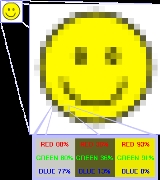
Rgb Raster Image
In computer graphics
Computer graphics

Computer graphics are graphics created by computers and, more generally, the representation and manipulation of pictorial data by a computer....
, a raster graphics image or bitmap, is a data structure
Data structure

A data structure in computer science is a way of storing data in a computer so that it can be used efficiently. It is an organization of mathematical and logical concepts of data....
 representing a generally rectangular
Rectangle

In geometry, a rectangle is a Closed set planar quadrilateral with four right angles. A rectangle with vertices ABCD would be denoted as .A rectangle with adjacent sides of lengths a and b has area ab and diagonals of equal length ....
 grid of pixel
Pixel

In digital imaging, a pixel is the smallest item of information in an image. Pixels are normally arranged in a 2-dimensional grid, and are often represented using dots, squares, or rectangles....
s, or points of color
Color

Color or colour is the visual perception property corresponding in humans to the categories called red, yellow, blue and others....
, viewable via a monitor
Computer display

A visual display unit, often called simply a monitor or display, is a piece of electrical equipment which displays images generated from the video output of devices such as computers, without producing a permanent record....
, paper
Paper

Paper is thin material mainly used for writing upon, printing upon or packaging. It is produced by pressing together moist fibers, typically cellulose pulp derived from wood, rags or grasses, and drying them into flexible sheets....
, or other display medium. Raster images are stored in image files with varying formats (see Comparison of graphics file formats
Comparison of graphics file formats

This is a comparison of ....
).

A bitmap corresponds bit
Bit

A bit is a binary numeral system numerical digit, taking a value of either 0 or 1. Binary digits are a basic unit of information Computer data storage and transmission in digital computing and digital information theory....
-for-bit with an image displayed on a screen, generally in the same format used for storage in the display's video memory, or maybe as a device-independent bitmap
Bitmap

In computer graphics, a bitmap or pixmap is a type of computer storage organization or used to store digital images. The term bitmap comes from the computer programming terminology, meaning just a map of bits, a spatially mapped bit array....
. Bitmap is technically characterized by the width and height of the image in pixels and by the number of bits per pixel (a color depth
Color depth

Color depth or bit depth, is a computer graphics term describing the number of bits used to represent the color of a single pixel in a Raster graphicsped image or video frame buffer....
, which determines the number of colors it can represent).

The printing
Printing

Printing is a process for reproducing text and image, typically with ink on paper using a printing press. It is often carried out as a large-scale industrial process, and is an essential part of publishing and transaction printing....
 and prepress
Prepress

Prepress is the term used in the printing and publishing industries for the processes and procedures that occur between the procurement of a written manuscript and original artwork, and the manufacture of a printing plate, image carrier, or forme, ready for mounting on a printing press....
 industries know raster graphics as contones (from "continuous tones") and refer to vector graphics
Vector graphics

Vector graphics is the use of geometrical Primitive s such as point s, line , curves, and shapes or polygon, which are all based upon mathematical equations, to represent s in computer graphics....
 as "line work".

The word "raster" has its origins in the Latin rastrum (a rake), which is derived from radere (to scrape), and recalls metaphorically the systematic sampling of a grid-pattern of individual pixel-spaces with a view to representing an overall image.

Resolution

Raster graphics are resolution dependent. They cannot scale to an arbitrary resolution without loss of apparent quality. This deficiency contrasts with the capabilities of vector graphics
Vector graphics

Vector graphics is the use of geometrical Primitive s such as point s, line , curves, and shapes or polygon, which are all based upon mathematical equations, to represent s in computer graphics....
, which easily scale to the quality of the device rendering
Rendering (computer graphics)

Rendering is the process of generating an image from a 3D model, by means of computer programs. The model is a description of three-dimensional objects in a strictly defined language or data structure....
 them. Raster graphics deal more practically than vector graphics with photographs and photo-realistic images, while vector graphics often serve better for typesetting
Typesetting

Typesetting involves the presentation of textual material in graphic form on paper or some other Recording medium. Before the advent of desktop publishing, typesetting of printed material was produced in print shops by compositors or typesetters working by hand, and later with machines....
 or for graphic design
Graphic design

The term graphic design can refer to a number of artistic and professional disciplines which focus on visual communication and presentation. Various methods are used to create and combine symbols, images and/or words to create a visual representation of ideas and messages....
. Modern computer-monitors typically display about 72 to 130 pixels per inch
Pixels per inch

Pixels per inch or pixel density is a measurement of the resolution of devices in various contexts; typically computer displays, s or digital photography s....
 (PPI), and some modern consumer printers can resolve 2400 dots per inch
Dots per inch

Dots per inch is a measure of spatial printing or video dot density, in particular the number of individual dots that can be placed within the span of one linear inch The DPI value tends to correlate with , but is related only indirectly....
 (DPI) or more; determining the most appropriate image resolution for a given printer-resolution can pose difficulties, since printed output may have a greater level of detail than a viewer can discern on a monitor. Typically, a resolution of 150 to 300 pixel per inch works well for 4-color process (CMYK) printing.

Raster-based image editors


Raster-based image editors, such as Photoshop and GIMP
GIMP

The GIMP is a free software, raster graphics editor used to process digital graphics and photographs. Typical uses include creating graphics and logos, resizing and cropping photos, altering colors, combining multiple images, removing unwanted image components, and converting between different image formats....
, revolve around editing pixels, unlike vector-based image editors, such as CorelDRAW
CorelDRAW

CorelDRAW is a vector graphics editor developed and marketed by Corel of Ottawa, Canada. It is also the name of Corel's Graphics Suite. Its latest version, named X4 , was released in January 2008....
, Adobe Illustrator
Adobe Illustrator

Adobe Illustrator is a vector graphics editor developed and marketed by Adobe Systems.The latest version, Illustrator CS4, is the fourteenth generation in the product line....
, or Inkscape
Inkscape

Inkscape is a free software and open source vector graphics editor application. Its stated goal is to become a powerful graphic tool while being fully compliant with the Extensible Markup Language, Scalable Vector Graphics and Cascading Style Sheets standards....
, which revolve around editing lines and shapes (vectors
Vector graphics

Vector graphics is the use of geometrical Primitive s such as point s, line , curves, and shapes or polygon, which are all based upon mathematical equations, to represent s in computer graphics....
). When an image is rendered in a raster-based image editor, the image is composed of millions of pixels. At its core, a raster image editor works by manipulating each individual pixel. Most pixel-based image editors work using RGB color model
RGB color model

The RGB color model is an additive color in which red, green, and blue light are added together in various ways to reproduce a broad array of colors....
, but some also allow the use of other color models such as CMYK color model
CMYK color model

CMYK is a subtractive color color model, used in color printing, also used to describe the printing process itself. Though it varies by print house, press operator, press manufacturer and press run, ink is typically applied in the order of the abbreviation....
.

See also


  • Dither
    Dither

    Dither is an intentionally applied form of noise, used to randomize quantization error, thereby preventing large-scale patterns such as contouring that are more objectionable than uncorrelated noise....
  • Halftone
    Halftone

    Halftone is the reprographic technique that simulates continuous tone imagery through the use of dots, varying either in size or in spacing. 'Halftone' can also be used to refer specifically to the image that is produced by this process....
  • GIS file formats
    GIS file formats

    A GIS file format is a standard of encoding geography information into a file. They are created mainly by government mapping agencies or by Geographic Information System software developers....
  • Posterization
    Posterization

    Posterization of an image occurs when a region of an image with a continuous gradation of tone is replaced with several regions of fewer tones, resulting in an abrupt change from one tone to another....
  • Raster image processor
    Raster image processor

    A raster image processor is a component used in a printing system which produces a raster graphics image also known as a bitmap. The bitmap is then sent to a printing device for output....
  • Raster scan
    Raster scan

    A Raster scan, or raster scanning, is the pattern of image detection and reconstruction in television, and is the pattern of image storage and transmission used in most computer bitmap image systems....
  • Rasterisation
    Rasterisation

    Rasterization or Rasterisation is the task of taking an image described in a vector graphics format and converting it into a raster image for output on a computer display or computer printer, or for storage in a bitmap file format....


External links

  • — a free, open source software package for generating high quality raster images