

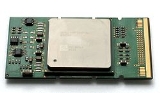
Itanium

Encyclopedia
Itanium is a family of 64-bit Intel microprocessor
s that implement the Intel Itanium architecture (formerly called IA-64). Intel markets the processors for enterprise servers and high-performance computing
systems. The architecture
originated at Hewlett-Packard
(HP), and was later jointly developed by HP and Intel.
The Itanium architecture is based on explicit instruction-level parallelism, in which the compiler
decides which instructions to execute in parallel. This contrasts with other superscalar
architectures, which depend on the processor to manage instruction dependencies at runtime. Itanium cores up to and including Tukwila execute up to six instructions per clock cycle. The first Itanium processor, codenamed Merced, was released in 2001.
Itanium-based systems have been produced by HP (the HP Integrity Servers line) and several other manufacturers. , Itanium was the fourth-most deployed microprocessor architecture for enterprise-class systems, behind x86-64
, IBM POWER
, and SPARC
.
The most recent processor, Tukwila
, originally planned for release in 2007, was released on February 8, 2010.
and CISC
processors, was disappointing. Emulation to run existing x86 applications and operating systems was particularly poor, with one benchmark in 2001 reporting that it was equivalent at best to a 100 MHz Pentium in this mode (1.1 GHz Pentiums were on the market at that time). Itanium failed to make significant inroads against x86-32 or RISC, and then suffered from the successful introduction of x86-64 based systems into the high-end server market, systems which were more compatible with the older x86 applications. Journalist John C. Dvorak
, commenting in 2009 on the history of the Itanium processor, said "This continues to be one of the great fiascos of the last 50 years" in an article titled "How the Itanium Killed the Computer Industry". Tech columnist Ashlee Vance
commented that the delays and underperformance "turned the product into a joke in the chip industry."
In an interview, Donald Knuth
said "The Itanium approach...was supposed to be so terrific—until it turned out that the wished-for compilers were basically impossible to write." A former Intel official reported that the Itanium business had become profitable for Intel in late 2009.
By 2009, the chip was almost entirely deployed on servers made by HP, which had over 95% of the Itanium server market share, making the main operating system for Itanium HP-UX
. Both Red Hat and Microsoft have announced plans to drop Itanium support in future versions of their operating systems due to lack of market interest; however, other Linux distributions including Debian are available for Itanium.
On March 22, 2011, Oracle announced discontinuation of development on Itanium. Support for existing products will continue. On March 22, 2011 Intel reaffirmed its commitment to Itanium with multiple generations of chips in development and on schedule.
AMD chose a different direction, designing the less radical x86-64
, a 64-bit extension to the existing x86 architecture, which Microsoft then supported, forcing Intel to introduce the same extension in its own x86-based processors. These designs can run existing 32-bit applications at native hardware speed, while offering support for 64-bit memory addressing and other enhancements to new applications. This architecture has now become the predominant 64-bit architecture in the desktop and portable market; although some Itanium-based workstations were initially introduced by companies such as SGI, these are no longer available.
(RISC) architectures were approaching a processing limit at one instruction per cycle
. HP researchers investigated a new architecture, later named explicitly parallel instruction computing
(EPIC), that allows the processor to execute multiple instructions in each clock cycle. EPIC implements a form of very long instruction word
(VLIW) architecture, in which a single instruction word contains multiple instructions. With EPIC, the compiler
determines in advance which instructions can be executed at the same time, so the microprocessor simply executes the instructions and does not need elaborate mechanisms to determine which instructions to execute in parallel.
The goal of this approach is twofold: to enable deeper inspection of the code at compile time to identify additional opportunities for parallel execution, and to simplify processor design and reduce energy consumption by eliminating the need for runtime scheduling circuitry.
HP believed that it was no longer cost-effective for individual enterprise systems companies such as itself to develop proprietary microprocessors, so it partnered with Intel in 1994 to develop the IA-64 architecture, derived from EPIC. Intel was willing to undertake a very large development effort on IA-64 in the expectation that the resulting microprocessor would be used by the majority of enterprise systems manufacturers. HP and Intel initiated a large joint development effort with a goal of delivering the first product, Merced, in 1998.
During development, Intel, HP, and industry analysts predicted that IA-64 would dominate in servers, workstations, and high-end desktops, and eventually supplant RISC and complex instruction set computer
(CISC) architectures for all general-purpose applications. Compaq
and Silicon Graphics
decided to abandon further development of the Alpha
and MIPS
architectures respectively in favor of migrating to IA-64.
Several groups developed operating systems for the architecture, including Microsoft Windows
, Linux
, and UNIX
variants such as HP-UX
, Solaris,
Tru64 UNIX
, and Monterey/64
(the last three were canceled before reaching the market). By 1997, it was apparent that the IA-64 architecture and the compiler were much more difficult to implement than originally thought, and the delivery of Merced began slipping.
Technical difficulties included the very high transistor counts needed to support the wide instruction words and the large caches. There were also structural problems within the project, as the two parts of the joint team used different methodologies and had slightly different priorities. Since Merced was the first EPIC processor, the development effort encountered more unanticipated problems than the team was accustomed to. In addition, the EPIC concept depends on compiler capabilities that had never been implemented before, so more research was needed.
Intel announced the official name of the processor, Itanium, on October 4, 1999. Within hours, the name Itanic had been coined on a Usenet
newsgroup, a reference to Titanic, the "unsinkable" ocean liner
that sank in 1912.
"Itanic" has since often been used by The Register
,
and others, to imply that the multibillion dollar investment in Itanium—and the early hype associated with it—would be followed by its relatively quick demise.
architecture and Sun Microsystems
' SPARC
architecture. Intel repositioned Itanium to focus on high-end business and HPC
computing, attempting to duplicate x86's successful "horizontal" market (i.e., single architecture, multiple systems vendors). The success of this initial processor version was limited to replacing PA-RISC
in HP systems, Alpha
in Compaq systems and MIPS
in SGI
systems, though IBM also delivered a supercomputer based on this processor.
POWER and SPARC remained strong, while the 32-bit x86 architecture continued to grow into the enterprise space, building on economies of scale fueled by its enormous installed base.
Only a few thousand systems using the original Merced Itanium processor were sold, due to relatively poor performance, high cost and limited software availability. Recognizing that the lack of software could be a serious problem for the future, Intel made thousands of these early systems available to independent software vendors (ISVs) to stimulate development. HP and Intel brought the next-generation Itanium 2 processor to market a year later.
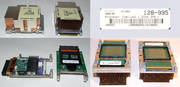 The Itanium 2 processor was released in 2002, and was marketed for enterprise servers rather than for the whole gamut of high-end computing. The first Itanium 2, code-named McKinley, was jointly developed by HP and Intel. It relieved many of the performance problems of the original Itanium processor, which were mostly caused by an inefficient memory subsystem. McKinley contained 221 million transistors (of which 25 million were for logic), measured 19.5 mm by 21.6 mm (421 mm2) and was fabricated in a 180 nm, bulk CMOS process with six layers of aluminium metallization.
In 2003, AMD
released the Opteron
, which implemented its own 64-bit architecture (x86-64
). Opteron gained rapid acceptance in the enterprise server space because it provided an easy upgrade from x86. Intel responded by implementing x86-64 in its Xeon
microprocessors in 2004.
Intel released a new Itanium 2 family member, codenamed Madison, in 2003. Madison used a 130 nm process and was the basis of all new Itanium processors until Montecito was released in June 2006.
In March 2005, Intel announced that it was working on a new Itanium processor, codenamed Tukwila
, to be released in 2007. Tukwila would have four processor cores and would replace the Itanium bus with a new Common System Interface
, which would also be used by a new Xeon processor. Later that year, Intel revised Tukwila's delivery date to late 2008.
In November 2005, the major Itanium server manufacturers joined with Intel and a number of software vendors to form the Itanium Solutions Alliance to promote the architecture and accelerate software porting. The Alliance announced that its members would invest $10 billion in Itanium solutions by the end of the decade.
In 2006, Intel delivered Montecito (marketed as the Itanium 2 9000 series), a dual-core processor that roughly doubled performance and decreased energy consumption by about 20 percent.
Intel released the Itanium 2 9100 series, codenamed Montvale, in November 2007. In May 2009 the schedule for Tukwila, its follow-on, was revised again, with release to OEMs planned for the first quarter of 2010.
The device uses a 65 nm process, includes two to four cores, up to 24 MB on-die caches, Hyper-Threading technology and integrated memory controllers. It implements double-device data correction
, which helps to fix memory errors. Tukwila also implements Intel QuickPath Interconnect (QPI) to replace the Itanium bus-based architecture. It has a peak interprocessor bandwidth of 96 GB/s and a peak memory bandwidth of 34 GB/s. With QuickPath, the processor has integrated memory controllers and interfaces the memory directly, using QPI interfaces to directly connect to other processors and I/O hubs. QuickPath is also used on Intel processors using the Nehalem microarchitecture, making it probable that Tukwila and Nehalem will be able to use the same chipsets. Tukwila incorporates four memory controllers, each of which supports multiple DDR3
DIMM
s via a separate memory controller, much like the Nehalem-based Xeon processor code-named Beckton.
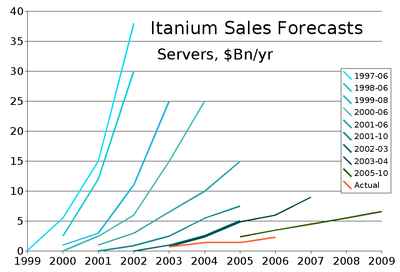
family of server processors, Itanium has never been a high-volume product for Intel. Intel does not release production numbers. One industry analyst estimated that the production rate was 200,000 processors per year in 2007.
According to Gartner Inc., the total number of Itanium servers sold by all vendors in 2007 was about 55,000. This compares with 417,000 RISC servers (spread across all RISC vendors) and 8.4 million x86 servers. From 2001 through 2007, IDC
reports that a total of 184,000 Itanium-based systems have been sold. For the combined POWER/SPARC/Itanium systems market, IDC reports that POWER captured 42% of revenue and SPARC captured 32%, while Itanium-based system revenue reached 26% in the second quarter of 2008.
According to an IDC analyst, in 2007 HP accounted for perhaps 80% of Itanium systems revenue. According to Gartner, in 2008 HP accounted for 95% of Itanium sales. HP's Itanium system sales were at an annual rate of $4.4Bn at the end of 2008, and declined to $3.5Bn by the end of 2009,
compared to a 35% decline in UNIX system revenue for Sun and an 11% drop for IBM, with an x86-64 server revenue increase of 14% during this period.
 Intel has extensively documented the Itanium instruction set
and microarchitecture
, and the technical press has provided overviews. The architecture has been renamed several times during its history. HP originally called it PA-WideWord. Intel later called it IA-64, then Itanium Processor Architecture (IPA),
before settling on Intel Itanium Architecture, but it is still widely referred to as IA-64.
It is a 64-bit register-rich explicitly parallel architecture. The base data word is 64 bits, byte-addressable. The logical address
space is 264 bytes. The architecture implements predication
, speculation
, and branch prediction. It uses a hardware register renaming
mechanism rather than simple register windowing for parameter passing. The same mechanism is also used to permit parallel execution of loops. Speculation, prediction, predication, and renaming are under control of the compiler: each instruction word includes extra bits for this. This approach is the distinguishing characteristic of the architecture.
The architecture implements 128 integer registers
, 128 floating point
registers, 64 one-bit predicates, and eight branch registers. The floating point registers are 82 bits long to preserve precision for intermediate results.
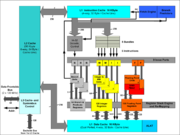
into the pipeline. When the compiler can take maximum advantage of this, the processor can execute six instructions per clock cycle. The processor has thirty functional execution units in eleven groups. Each unit can execute a particular subset of the instruction set
, and each unit executes at a rate of one instruction per cycle unless execution stalls waiting for data. While not all units in a group execute identical subsets of the instruction set, common instructions can be executed in multiple units.
The execution unit groups include:
The compiler can often group instructions into sets of six that can execute at the same time. Since the floating-point units implement a multiply–accumulate operation, a single floating point instruction can perform the work of two instructions when the application requires a multiply followed by an add: this is very common in scientific processing. When it occurs, the processor can execute four FLOP
s per cycle. For example, the 800 MHz Itanium had a theoretical rating of 3.2 GFLOPS
and the fastest Itanium 2, at 1.67 GHz, was rated at 6.67 GFLOPS.
operations without disturbing the main arithmetic logic unit
(ALU).
Main memory is accessed through a bus
to an off-chip chipset
. The Itanium 2 bus was initially called the McKinley bus, but is now usually referred to as the Itanium bus. The speed of the bus has increased steadily with new processor releases. The bus transfers 2×128 bits per clock cycle, so the 200 MHz McKinley bus transferred 6.4 GB/s, and the 533 MHz Montecito bus transfers 17.056 GB/s
architecture to permit support for legacy server applications, but performance for IA-32 code was much worse than for native code and also worse than the performance of contemporaneous x86 processors. In 2005, Intel developed the IA-32 Execution Layer
(IA-32 EL), a software emulator that provides better performance. With Montecito, Intel therefore eliminated hardware support for IA-32 code.
In 2006, with the release of Montecito
, Intel made a number of enhancements to the basic processor architecture including:
several manufacturers offer Itanium systems, including HP
, SGI
, NEC
, Fujitsu
, Hitachi
, and Groupe Bull
. In addition, Intel offers a chassis that can be used by system integrator
s to build Itanium systems. HP, the only one of the industry's top four server manufacturers to offer Itanium-based systems today, manufactures at least 80% of all Itanium systems. HP sold 7200 systems in the first quarter of 2006. The bulk of systems sold are enterprise servers and machines for large-scale technical computing, with an average selling price per system in excess of US$
200,000. A typical system uses eight or more Itanium processors.
. Enterprise server manufacturers differentiate their systems by designing and developing chipsets that interface the processor to memory, interconnections, and peripheral controllers. The chipset is the heart of the system-level architecture for each system design. Development of a chipset costs tens of millions of dollars and represents a major commitment to the use of the Itanium. IBM created a chipset in 2003, and Intel in 2002, but neither of them has developed chipsets to support newer technologies such as DDR2
or PCI Express
. Currently, modern chipsets for Itanium supporting such technologies are manufactured by HP, Fujitsu, SGI, NEC, and Hitachi.
The "Tukwila" Itanium processor model has been designed to share a common chipset with the Intel Xeon processor EX (Intel’s Xeon processor designed for four processor and larger servers). The goal is to streamline system development and reduce costs for server OEMs, many of whom develop both Itanium- and Xeon-based servers.
s:
However, Microsoft announced in 2010 that Windows Server 2008 R2 will be the last version of Windows Server to support the Itanium, and that it would also discontinue development of the Itanium versions of Visual Studio and SQL Server
.
Likewise, Red Hat Enterprise Linux
5 was the last Itanium edition of Red Hat Enterprise Linux and Canonical's Ubuntu 10.04 LTS was the last supported Ubuntu release on Itanium.
HP will not be supporting or certifying Linux on Itanium 9300 (Tukwila) servers.
Oracle Corporation
announced in March 2011 that it would drop development of application software for Itanium platforms, with the explanation that "Intel management made it clear that their strategic focus is on their x86 microprocessor and that Itanium was nearing the end of its life."
HP sells a virtualization
technology for Itanium called Integrity Virtual Machines.
To allow more software to run on the Itanium, Intel supported the development of compilers optimized for the platform, especially its own suite of compilers. Starting in November 2010, with the introduction of new product suites, the Intel Itanium Compilers were no longer bundled with the Intel x86 compilers in a single product. Intel offers Itanium tools and Intel x86 tools, including compilers, independently in different product bundles.
GCC
, Open64
and MS Visual Studio 2005 (and later)
are also able to produce machine code for Itanium. According to the Itanium Solutions Alliance over 13,000 applications were available for Itanium based systems in early 2008,
though Sun has contested Itanium application counts in the past. The ISA also supports Gelato
, an Itanium HPC user group and developer community that ports and supports open source
software for Itanium.
is a technique that allows a computer to execute binary code that was compiled for a different type of computer. Before IBM's acquisition of QuickTransit
in 2009, application binary software for IRIX
/MIPS
and Solaris
/SPARC
could run via type of emulation called "dynamic binary translation" on Linux/Itanium. Similarly, HP implemented a method to execute PA-RISC/HP-UX on the Itanium/HP-UX via emulation, to simplify migration of its PA-RISC customers to the radically different Itanium instruction set. Itanium processors can also run the mainframe environment GCOS
from Groupe Bull
and several x86 operating systems via Instruction Set Simulator
s.
(HPC) markets. Other enterprise- and HPC-focused processor lines include Oracle Corporation
's SPARC T4
, Fujitsu
's SPARC64 VII+ and IBM
's POWER7
. Measured by quantity sold, Itanium's most serious competition comes from x86-64
processors including Intel's own Xeon
line and AMD
's Opteron
line. , most servers were being shipped with x86-64 processors.
In 2005, Itanium systems accounted for about 14% of HPC systems revenue, but the percentage has declined as the industry shifts to x86-64 clusters for this application.
An October 2008 paper by Gartner on the Tukwila processor stated that "...the future roadmap for Itanium looks as strong as that of any RISC peer like Power or SPARC."
supercomputers in November 2001. The best position ever achieved by an Itanium 2 based system in the list was #2, achieved in June 2004, when Thunder (LLNL) entered the list with an Rmax of 19.94 Teraflops. In November 2004, Columbia
entered the list at #2 with 51.8 Teraflops, and there was at least one Itanium-based computer in the top 10 from then until June 2007. The peak number of Itanium-based machines on the list occurred in the November 2004 list, at 84 systems (16.8%); by June 2010, this had dropped to five systems (1%).
process technology and use a 32 nm
process technology; it will feature eight cores, have a 12-wide issue architecture, multithreading enhancements, and new instructions to take advantage of parallelism, especially in virtualization. Poulson has the world's biggest L3 cache size — 54 MB (32MB for Tukwila). L2 cache size is 6 MB, 768 kB per core. Die size is 544 mm², less than its predecessor Tukwila (698.75 mm²).
At ISSCC
2011, Intel presented a paper called, "A 32nm 3.1 Billion Transistor 12-Wide-Issue
Itanium Processor for Mission Critical Servers." Given Intel's history of disclosing details about Itanium microprocessors at ISSCC, this paper most likely refers to Poulson. Analyst David Kanter speculates that Poulson will use a new microarchitecture, with a more advanced form of multi-threading that uses as many as four threads, to improve performance for single threaded and multi-threaded workloads.
Microprocessor
A microprocessor incorporates the functions of a computer's central processing unit on a single integrated circuit, or at most a few integrated circuits. It is a multipurpose, programmable device that accepts digital data as input, processes it according to instructions stored in its memory, and...
s that implement the Intel Itanium architecture (formerly called IA-64). Intel markets the processors for enterprise servers and high-performance computing
High-performance computing
High-performance computing uses supercomputers and computer clusters to solve advanced computation problems. Today, computer systems approaching the teraflops-region are counted as HPC-computers.-Overview:...
systems. The architecture
Computer architecture
In computer science and engineering, computer architecture is the practical art of selecting and interconnecting hardware components to create computers that meet functional, performance and cost goals and the formal modelling of those systems....
originated at Hewlett-Packard
Hewlett-Packard
Hewlett-Packard Company or HP is an American multinational information technology corporation headquartered in Palo Alto, California, USA that provides products, technologies, softwares, solutions and services to consumers, small- and medium-sized businesses and large enterprises, including...
(HP), and was later jointly developed by HP and Intel.
The Itanium architecture is based on explicit instruction-level parallelism, in which the compiler
Compiler
A compiler is a computer program that transforms source code written in a programming language into another computer language...
decides which instructions to execute in parallel. This contrasts with other superscalar
Superscalar
A superscalar CPU architecture implements a form of parallelism called instruction level parallelism within a single processor. It therefore allows faster CPU throughput than would otherwise be possible at a given clock rate...
architectures, which depend on the processor to manage instruction dependencies at runtime. Itanium cores up to and including Tukwila execute up to six instructions per clock cycle. The first Itanium processor, codenamed Merced, was released in 2001.
Itanium-based systems have been produced by HP (the HP Integrity Servers line) and several other manufacturers. , Itanium was the fourth-most deployed microprocessor architecture for enterprise-class systems, behind x86-64
X86-64
x86-64 is an extension of the x86 instruction set. It supports vastly larger virtual and physical address spaces than are possible on x86, thereby allowing programmers to conveniently work with much larger data sets. x86-64 also provides 64-bit general purpose registers and numerous other...
, IBM POWER
IBM POWER
POWER is a reduced instruction set computer instruction set architecture developed by IBM. The name is an acronym for Performance Optimization With Enhanced RISC....
, and SPARC
SPARC
SPARC is a RISC instruction set architecture developed by Sun Microsystems and introduced in mid-1987....
.
The most recent processor, Tukwila
Tukwila (processor)
Tukwila is the code-name for the generation of Intel's Itanium processor family following Itanium 2 and Montecito. It was released on 8 February 2010 as the Itanium 9300 Series. While its features have not been publicly disclosed in detail, it utilizes both multiple processor cores and SMT...
, originally planned for release in 2007, was released on February 8, 2010.
High-end server market
When first released in 2001, Itanium's performance, compared to better-established RISCReduced instruction set computer
Reduced instruction set computing, or RISC , is a CPU design strategy based on the insight that simplified instructions can provide higher performance if this simplicity enables much faster execution of each instruction. A computer based on this strategy is a reduced instruction set computer...
and CISC
Complex instruction set computer
A complex instruction set computer , is a computer where single instructions can execute several low-level operations and/or are capable of multi-step operations or addressing modes within single instructions...
processors, was disappointing. Emulation to run existing x86 applications and operating systems was particularly poor, with one benchmark in 2001 reporting that it was equivalent at best to a 100 MHz Pentium in this mode (1.1 GHz Pentiums were on the market at that time). Itanium failed to make significant inroads against x86-32 or RISC, and then suffered from the successful introduction of x86-64 based systems into the high-end server market, systems which were more compatible with the older x86 applications. Journalist John C. Dvorak
John C. Dvorak
John C. Dvorak is an American columnist and broadcaster in the areas of technology and computing. His writing extends back to the 1980s, when he was a mainstay of a variety of magazines. Dvorak is also the Vice-President of Mevio and well known for his work for Tech TV...
, commenting in 2009 on the history of the Itanium processor, said "This continues to be one of the great fiascos of the last 50 years" in an article titled "How the Itanium Killed the Computer Industry". Tech columnist Ashlee Vance
Ashlee Vance
-Personal life:Born in South Africa, Vance grew up in Houston, Texas and attended St. John's School. He now works in Mountain View, California.-Print Media:...
commented that the delays and underperformance "turned the product into a joke in the chip industry."
In an interview, Donald Knuth
Donald Knuth
Donald Ervin Knuth is a computer scientist and Professor Emeritus at Stanford University.He is the author of the seminal multi-volume work The Art of Computer Programming. Knuth has been called the "father" of the analysis of algorithms...
said "The Itanium approach...was supposed to be so terrific—until it turned out that the wished-for compilers were basically impossible to write." A former Intel official reported that the Itanium business had become profitable for Intel in late 2009.
By 2009, the chip was almost entirely deployed on servers made by HP, which had over 95% of the Itanium server market share, making the main operating system for Itanium HP-UX
HP-UX
HP-UX is Hewlett-Packard's proprietary implementation of the Unix operating system, based on UNIX System V and first released in 1984...
. Both Red Hat and Microsoft have announced plans to drop Itanium support in future versions of their operating systems due to lack of market interest; however, other Linux distributions including Debian are available for Itanium.
On March 22, 2011, Oracle announced discontinuation of development on Itanium. Support for existing products will continue. On March 22, 2011 Intel reaffirmed its commitment to Itanium with multiple generations of chips in development and on schedule.
Other markets
Although remaining in development, and having attained a limited success in the niche of high-end computing, Intel had originally hoped to make Itanium a replacement for the original x86 architecture.AMD chose a different direction, designing the less radical x86-64
X86-64
x86-64 is an extension of the x86 instruction set. It supports vastly larger virtual and physical address spaces than are possible on x86, thereby allowing programmers to conveniently work with much larger data sets. x86-64 also provides 64-bit general purpose registers and numerous other...
, a 64-bit extension to the existing x86 architecture, which Microsoft then supported, forcing Intel to introduce the same extension in its own x86-based processors. These designs can run existing 32-bit applications at native hardware speed, while offering support for 64-bit memory addressing and other enhancements to new applications. This architecture has now become the predominant 64-bit architecture in the desktop and portable market; although some Itanium-based workstations were initially introduced by companies such as SGI, these are no longer available.
History
Development: 1989–2000
In 1989, HP determined that reduced instruction set computerReduced instruction set computer
Reduced instruction set computing, or RISC , is a CPU design strategy based on the insight that simplified instructions can provide higher performance if this simplicity enables much faster execution of each instruction. A computer based on this strategy is a reduced instruction set computer...
(RISC) architectures were approaching a processing limit at one instruction per cycle
Instructions Per Cycle
In computer architecture, instructions per clock is a term used to describe one aspect of a processor's performance: the average number of instructions executed for each clock cycle...
. HP researchers investigated a new architecture, later named explicitly parallel instruction computing
Explicitly Parallel Instruction Computing
Explicitly parallel instruction computing is a term coined in 1997 by the HP–Intel alliance to describe a computing paradigm that researchers had been investigating since the early 1980s. This paradigm is also called Independence architectures...
(EPIC), that allows the processor to execute multiple instructions in each clock cycle. EPIC implements a form of very long instruction word
Very long instruction word
Very long instruction word or VLIW refers to a CPU architecture designed to take advantage of instruction level parallelism . A processor that executes every instruction one after the other may use processor resources inefficiently, potentially leading to poor performance...
(VLIW) architecture, in which a single instruction word contains multiple instructions. With EPIC, the compiler
Compiler
A compiler is a computer program that transforms source code written in a programming language into another computer language...
determines in advance which instructions can be executed at the same time, so the microprocessor simply executes the instructions and does not need elaborate mechanisms to determine which instructions to execute in parallel.
The goal of this approach is twofold: to enable deeper inspection of the code at compile time to identify additional opportunities for parallel execution, and to simplify processor design and reduce energy consumption by eliminating the need for runtime scheduling circuitry.
HP believed that it was no longer cost-effective for individual enterprise systems companies such as itself to develop proprietary microprocessors, so it partnered with Intel in 1994 to develop the IA-64 architecture, derived from EPIC. Intel was willing to undertake a very large development effort on IA-64 in the expectation that the resulting microprocessor would be used by the majority of enterprise systems manufacturers. HP and Intel initiated a large joint development effort with a goal of delivering the first product, Merced, in 1998.
During development, Intel, HP, and industry analysts predicted that IA-64 would dominate in servers, workstations, and high-end desktops, and eventually supplant RISC and complex instruction set computer
Complex instruction set computer
A complex instruction set computer , is a computer where single instructions can execute several low-level operations and/or are capable of multi-step operations or addressing modes within single instructions...
(CISC) architectures for all general-purpose applications. Compaq
Compaq
Compaq Computer Corporation is a personal computer company founded in 1982. Once the largest supplier of personal computing systems in the world, Compaq existed as an independent corporation until 2002, when it was acquired for US$25 billion by Hewlett-Packard....
and Silicon Graphics
Silicon Graphics
Silicon Graphics, Inc. was a manufacturer of high-performance computing solutions, including computer hardware and software, founded in 1981 by Jim Clark...
decided to abandon further development of the Alpha
DEC Alpha
Alpha, originally known as Alpha AXP, is a 64-bit reduced instruction set computer instruction set architecture developed by Digital Equipment Corporation , designed to replace the 32-bit VAX complex instruction set computer ISA and its implementations. Alpha was implemented in microprocessors...
and MIPS
MIPS architecture
MIPS is a reduced instruction set computer instruction set architecture developed by MIPS Technologies . The early MIPS architectures were 32-bit, and later versions were 64-bit...
architectures respectively in favor of migrating to IA-64.
Several groups developed operating systems for the architecture, including Microsoft Windows
Microsoft Windows
Microsoft Windows is a series of operating systems produced by Microsoft.Microsoft introduced an operating environment named Windows on November 20, 1985 as an add-on to MS-DOS in response to the growing interest in graphical user interfaces . Microsoft Windows came to dominate the world's personal...
, Linux
Linux
Linux is a Unix-like computer operating system assembled under the model of free and open source software development and distribution. The defining component of any Linux system is the Linux kernel, an operating system kernel first released October 5, 1991 by Linus Torvalds...
, and UNIX
Unix
Unix is a multitasking, multi-user computer operating system originally developed in 1969 by a group of AT&T employees at Bell Labs, including Ken Thompson, Dennis Ritchie, Brian Kernighan, Douglas McIlroy, and Joe Ossanna...
variants such as HP-UX
HP-UX
HP-UX is Hewlett-Packard's proprietary implementation of the Unix operating system, based on UNIX System V and first released in 1984...
, Solaris,
Tru64 UNIX
Tru64 UNIX
Tru64 UNIX is a 64-bit UNIX operating system for the Alpha instruction set architecture , currently owned by Hewlett-Packard . Previously, Tru64 UNIX was a product of Compaq, and before that, Digital Equipment Corporation , where it was known as Digital UNIX .As its original name suggests, Tru64...
, and Monterey/64
Project Monterey
Project Monterey was an attempt to build a single Unix operating system that ran across a variety of 32-bit and 64-bit platforms, as well as supporting multi-processing...
(the last three were canceled before reaching the market). By 1997, it was apparent that the IA-64 architecture and the compiler were much more difficult to implement than originally thought, and the delivery of Merced began slipping.
Technical difficulties included the very high transistor counts needed to support the wide instruction words and the large caches. There were also structural problems within the project, as the two parts of the joint team used different methodologies and had slightly different priorities. Since Merced was the first EPIC processor, the development effort encountered more unanticipated problems than the team was accustomed to. In addition, the EPIC concept depends on compiler capabilities that had never been implemented before, so more research was needed.
Intel announced the official name of the processor, Itanium, on October 4, 1999. Within hours, the name Itanic had been coined on a Usenet
Usenet
Usenet is a worldwide distributed Internet discussion system. It developed from the general purpose UUCP architecture of the same name.Duke University graduate students Tom Truscott and Jim Ellis conceived the idea in 1979 and it was established in 1980...
newsgroup, a reference to Titanic, the "unsinkable" ocean liner
Ocean liner
An ocean liner is a ship designed to transport people from one seaport to another along regular long-distance maritime routes according to a schedule. Liners may also carry cargo or mail, and may sometimes be used for other purposes .Cargo vessels running to a schedule are sometimes referred to as...
that sank in 1912.
"Itanic" has since often been used by The Register
The Register
The Register is a British technology news and opinion website. It was founded by John Lettice, Mike Magee and Ross Alderson in 1994 as a newsletter called "Chip Connection", initially as an email service...
,
and others, to imply that the multibillion dollar investment in Itanium—and the early hype associated with it—would be followed by its relatively quick demise.
Itanium (Merced): 2001
By the time Itanium was released in June 2001, its performance was not superior to competing RISC and CISC processors. Itanium competed at the low-end (primarily 4-CPU and smaller systems) with servers based on x86 processors, and at the high end with IBM's POWERIBM POWER
POWER is a reduced instruction set computer instruction set architecture developed by IBM. The name is an acronym for Performance Optimization With Enhanced RISC....
architecture and Sun Microsystems
Sun Microsystems
Sun Microsystems, Inc. was a company that sold :computers, computer components, :computer software, and :information technology services. Sun was founded on February 24, 1982...
' SPARC
SPARC
SPARC is a RISC instruction set architecture developed by Sun Microsystems and introduced in mid-1987....
architecture. Intel repositioned Itanium to focus on high-end business and HPC
High-performance computing
High-performance computing uses supercomputers and computer clusters to solve advanced computation problems. Today, computer systems approaching the teraflops-region are counted as HPC-computers.-Overview:...
computing, attempting to duplicate x86's successful "horizontal" market (i.e., single architecture, multiple systems vendors). The success of this initial processor version was limited to replacing PA-RISC
PA-RISC
PA-RISC is an instruction set architecture developed by Hewlett-Packard. As the name implies, it is a reduced instruction set computer architecture, where the PA stands for Precision Architecture...
in HP systems, Alpha
DEC Alpha
Alpha, originally known as Alpha AXP, is a 64-bit reduced instruction set computer instruction set architecture developed by Digital Equipment Corporation , designed to replace the 32-bit VAX complex instruction set computer ISA and its implementations. Alpha was implemented in microprocessors...
in Compaq systems and MIPS
MIPS architecture
MIPS is a reduced instruction set computer instruction set architecture developed by MIPS Technologies . The early MIPS architectures were 32-bit, and later versions were 64-bit...
in SGI
Silicon Graphics
Silicon Graphics, Inc. was a manufacturer of high-performance computing solutions, including computer hardware and software, founded in 1981 by Jim Clark...
systems, though IBM also delivered a supercomputer based on this processor.
POWER and SPARC remained strong, while the 32-bit x86 architecture continued to grow into the enterprise space, building on economies of scale fueled by its enormous installed base.
Only a few thousand systems using the original Merced Itanium processor were sold, due to relatively poor performance, high cost and limited software availability. Recognizing that the lack of software could be a serious problem for the future, Intel made thousands of these early systems available to independent software vendors (ISVs) to stimulate development. HP and Intel brought the next-generation Itanium 2 processor to market a year later.
| Itanium processor family | ||||
|---|---|---|---|---|
 |
 |
 |
||
| Original | Version 2 | 2006 | 2008 | 2009 |
Itanium 2: 2002–2010
In 2003, AMD
Advanced Micro Devices
Advanced Micro Devices, Inc. or AMD is an American multinational semiconductor company based in Sunnyvale, California, that develops computer processors and related technologies for commercial and consumer markets...
released the Opteron
Opteron
Opteron is AMD's x86 server and workstation processor line, and was the first processor which supported the AMD64 instruction set architecture . It was released on April 22, 2003 with the SledgeHammer core and was intended to compete in the server and workstation markets, particularly in the same...
, which implemented its own 64-bit architecture (x86-64
X86-64
x86-64 is an extension of the x86 instruction set. It supports vastly larger virtual and physical address spaces than are possible on x86, thereby allowing programmers to conveniently work with much larger data sets. x86-64 also provides 64-bit general purpose registers and numerous other...
). Opteron gained rapid acceptance in the enterprise server space because it provided an easy upgrade from x86. Intel responded by implementing x86-64 in its Xeon
Xeon
The Xeon is a brand of multiprocessing- or multi-socket-capable x86 microprocessors from Intel Corporation targeted at the non-consumer server, workstation and embedded system markets.-Overview:...
microprocessors in 2004.
Intel released a new Itanium 2 family member, codenamed Madison, in 2003. Madison used a 130 nm process and was the basis of all new Itanium processors until Montecito was released in June 2006.
In March 2005, Intel announced that it was working on a new Itanium processor, codenamed Tukwila
Tukwila (processor)
Tukwila is the code-name for the generation of Intel's Itanium processor family following Itanium 2 and Montecito. It was released on 8 February 2010 as the Itanium 9300 Series. While its features have not been publicly disclosed in detail, it utilizes both multiple processor cores and SMT...
, to be released in 2007. Tukwila would have four processor cores and would replace the Itanium bus with a new Common System Interface
Common System Interface
The Intel QuickPath Interconnect is a point-to-point processor interconnect developed by Intel which replaces the Front Side Bus in Xeon, Itanium, and certain desktop platforms. It was designed to compete with HyperTransport. Intel first delivered it in November 2008 on the Intel Core i7-9xx...
, which would also be used by a new Xeon processor. Later that year, Intel revised Tukwila's delivery date to late 2008.
In November 2005, the major Itanium server manufacturers joined with Intel and a number of software vendors to form the Itanium Solutions Alliance to promote the architecture and accelerate software porting. The Alliance announced that its members would invest $10 billion in Itanium solutions by the end of the decade.
In 2006, Intel delivered Montecito (marketed as the Itanium 2 9000 series), a dual-core processor that roughly doubled performance and decreased energy consumption by about 20 percent.
Intel released the Itanium 2 9100 series, codenamed Montvale, in November 2007. In May 2009 the schedule for Tukwila, its follow-on, was revised again, with release to OEMs planned for the first quarter of 2010.
Itanium 9300 (Tukwila): 2010
The Itanium 9300 series processor, codenamed Tukwila, was released on 8 February 2010 with greater performance and memory capacity.The device uses a 65 nm process, includes two to four cores, up to 24 MB on-die caches, Hyper-Threading technology and integrated memory controllers. It implements double-device data correction
ECC memory
Error-correcting code memory is a type of computer data storage that can detect and correct the more common kinds of internal data corruption...
, which helps to fix memory errors. Tukwila also implements Intel QuickPath Interconnect (QPI) to replace the Itanium bus-based architecture. It has a peak interprocessor bandwidth of 96 GB/s and a peak memory bandwidth of 34 GB/s. With QuickPath, the processor has integrated memory controllers and interfaces the memory directly, using QPI interfaces to directly connect to other processors and I/O hubs. QuickPath is also used on Intel processors using the Nehalem microarchitecture, making it probable that Tukwila and Nehalem will be able to use the same chipsets. Tukwila incorporates four memory controllers, each of which supports multiple DDR3
DDR3 SDRAM
In computing, DDR3 SDRAM, an abbreviation for double data rate type three synchronous dynamic random access memory, is a modern kind of dynamic random access memory with a high bandwidth interface. It is one of several variants of DRAM and associated interface techniques used since the early 1970s...
DIMM
DIMM
A DIMM or dual in-line memory module, comprises a series of dynamic random-access memory integrated circuits. These modules are mounted on a printed circuit board and designed for use in personal computers, workstations and servers...
s via a separate memory controller, much like the Nehalem-based Xeon processor code-named Beckton.
Market share
In comparison with its XeonXeon
The Xeon is a brand of multiprocessing- or multi-socket-capable x86 microprocessors from Intel Corporation targeted at the non-consumer server, workstation and embedded system markets.-Overview:...
family of server processors, Itanium has never been a high-volume product for Intel. Intel does not release production numbers. One industry analyst estimated that the production rate was 200,000 processors per year in 2007.
- Please note that the following numbers are based on servers and not on processors. It is not reported how many processors or multi-core processors were built into these servers, and neither is it clear whether clustered servers were counted as a single server or not. Therefore there seems to be no valid method for reasonably determining how many processors are represented by that number of systems.
According to Gartner Inc., the total number of Itanium servers sold by all vendors in 2007 was about 55,000. This compares with 417,000 RISC servers (spread across all RISC vendors) and 8.4 million x86 servers. From 2001 through 2007, IDC
International Data Corporation
International Data Corporation is a market research and analysis firm specializing in information technology, telecommunications and consumer technology. IDC is a subsidiary of International Data Group...
reports that a total of 184,000 Itanium-based systems have been sold. For the combined POWER/SPARC/Itanium systems market, IDC reports that POWER captured 42% of revenue and SPARC captured 32%, while Itanium-based system revenue reached 26% in the second quarter of 2008.
According to an IDC analyst, in 2007 HP accounted for perhaps 80% of Itanium systems revenue. According to Gartner, in 2008 HP accounted for 95% of Itanium sales. HP's Itanium system sales were at an annual rate of $4.4Bn at the end of 2008, and declined to $3.5Bn by the end of 2009,
compared to a 35% decline in UNIX system revenue for Sun and an 11% drop for IBM, with an x86-64 server revenue increase of 14% during this period.
Architecture
Instruction set
An instruction set, or instruction set architecture , is the part of the computer architecture related to programming, including the native data types, instructions, registers, addressing modes, memory architecture, interrupt and exception handling, and external I/O...
and microarchitecture
Microarchitecture
In computer engineering, microarchitecture , also called computer organization, is the way a given instruction set architecture is implemented on a processor. A given ISA may be implemented with different microarchitectures. Implementations might vary due to different goals of a given design or...
, and the technical press has provided overviews. The architecture has been renamed several times during its history. HP originally called it PA-WideWord. Intel later called it IA-64, then Itanium Processor Architecture (IPA),
before settling on Intel Itanium Architecture, but it is still widely referred to as IA-64.
It is a 64-bit register-rich explicitly parallel architecture. The base data word is 64 bits, byte-addressable. The logical address
Logical address
In computing, a logical address is the address at which an item appears to reside from the perspective of an executing application program....
space is 264 bytes. The architecture implements predication
Branch predication
Branch predication is a strategy in computer architecture design for mitigating the costs usually associated with conditional branches, particularly branches to short sections of code...
, speculation
Speculative execution
Speculative execution in computer systems is doing work, the result of which may not be needed. This performance optimization technique is used in pipelined processors and other systems.-Main idea:...
, and branch prediction. It uses a hardware register renaming
Register renaming
In computer architecture, register renaming refers to a technique used to avoid unnecessary serialization of program operations imposed by the reuse of registers by those operations.-Problem definition:...
mechanism rather than simple register windowing for parameter passing. The same mechanism is also used to permit parallel execution of loops. Speculation, prediction, predication, and renaming are under control of the compiler: each instruction word includes extra bits for this. This approach is the distinguishing characteristic of the architecture.
The architecture implements 128 integer registers
Processor register
In computer architecture, a processor register is a small amount of storage available as part of a CPU or other digital processor. Such registers are addressed by mechanisms other than main memory and can be accessed more quickly...
, 128 floating point
Floating point
In computing, floating point describes a method of representing real numbers in a way that can support a wide range of values. Numbers are, in general, represented approximately to a fixed number of significant digits and scaled using an exponent. The base for the scaling is normally 2, 10 or 16...
registers, 64 one-bit predicates, and eight branch registers. The floating point registers are 82 bits long to preserve precision for intermediate results.
Instruction execution
Each 128-bit instruction word contains three instructions, and the fetch mechanism can read up to two instruction words per clock from the L1 cacheCPU cache
A CPU cache is a cache used by the central processing unit of a computer to reduce the average time to access memory. The cache is a smaller, faster memory which stores copies of the data from the most frequently used main memory locations...
into the pipeline. When the compiler can take maximum advantage of this, the processor can execute six instructions per clock cycle. The processor has thirty functional execution units in eleven groups. Each unit can execute a particular subset of the instruction set
Instruction set
An instruction set, or instruction set architecture , is the part of the computer architecture related to programming, including the native data types, instructions, registers, addressing modes, memory architecture, interrupt and exception handling, and external I/O...
, and each unit executes at a rate of one instruction per cycle unless execution stalls waiting for data. While not all units in a group execute identical subsets of the instruction set, common instructions can be executed in multiple units.
The execution unit groups include:
- Six general-purpose ALUs, two integer units, one shift unit
- Four data cache units
- Six multimedia units, two parallel shift units, one parallel multiply, one population countHamming weightThe Hamming weight of a string is the number of symbols that are different from the zero-symbol of the alphabet used. It is thus equivalent to the Hamming distance from the all-zero string of the same length. For the most typical case, a string of bits, this is the number of 1's in the string...
- Two 82-bit floating-point multiply–accumulate units, two SIMDSIMDSingle instruction, multiple data , is a class of parallel computers in Flynn's taxonomy. It describes computers with multiple processing elements that perform the same operation on multiple data simultaneously...
floating-point multiply–accumulate units (two 32-bit operations each) - Three branch units
The compiler can often group instructions into sets of six that can execute at the same time. Since the floating-point units implement a multiply–accumulate operation, a single floating point instruction can perform the work of two instructions when the application requires a multiply followed by an add: this is very common in scientific processing. When it occurs, the processor can execute four FLOP
Flop
- Terms :*Flop, a box office bomb in the entertainment world*Flop, as verb or noun, referring to flophouse, cheap rooms in a transients' hotel*Flop , a poker term describing the first three cards dealt to the board...
s per cycle. For example, the 800 MHz Itanium had a theoretical rating of 3.2 GFLOPS
FLOPS
In computing, FLOPS is a measure of a computer's performance, especially in fields of scientific calculations that make heavy use of floating-point calculations, similar to the older, simpler, instructions per second...
and the fastest Itanium 2, at 1.67 GHz, was rated at 6.67 GFLOPS.
Memory architecture
From 2002 to 2006, Itanium 2 processors shared a common cache hierarchy. They had 16 kB of Level 1 instruction cache and 16 kB of Level 1 data cache. The L2 cache was unified (both instruction and data) and is 256 kB. The Level 3 cache was also unified and varied in size from 1.5 MB to 24 MB. The 256 kB L2 cache contains sufficient logic to handle semaphoreSemaphore (programming)
In computer science, a semaphore is a variable or abstract data type that provides a simple but useful abstraction for controlling access by multiple processes to a common resource in a parallel programming environment....
operations without disturbing the main arithmetic logic unit
Arithmetic logic unit
In computing, an arithmetic logic unit is a digital circuit that performs arithmetic and logical operations.The ALU is a fundamental building block of the central processing unit of a computer, and even the simplest microprocessors contain one for purposes such as maintaining timers...
(ALU).
Main memory is accessed through a bus
Computer bus
In computer architecture, a bus is a subsystem that transfers data between components inside a computer, or between computers.Early computer buses were literally parallel electrical wires with multiple connections, but the term is now used for any physical arrangement that provides the same...
to an off-chip chipset
Chipset
A chipset, PC chipset, or chip set refers to a group of integrated circuits, or chips, that are designed to work together. They are usually marketed as a single product.- Computers :...
. The Itanium 2 bus was initially called the McKinley bus, but is now usually referred to as the Itanium bus. The speed of the bus has increased steadily with new processor releases. The bus transfers 2×128 bits per clock cycle, so the 200 MHz McKinley bus transferred 6.4 GB/s, and the 533 MHz Montecito bus transfers 17.056 GB/s
Architectural changes
Itanium processors released prior to 2006 had hardware support for the IA-32IA-32
IA-32 , also known as x86-32, i386 or x86, is the CISC instruction-set architecture of Intel's most commercially successful microprocessors, and was first implemented in the Intel 80386 as a 32-bit extension of x86 architecture...
architecture to permit support for legacy server applications, but performance for IA-32 code was much worse than for native code and also worse than the performance of contemporaneous x86 processors. In 2005, Intel developed the IA-32 Execution Layer
IA-32 Execution Layer
The IA-32 Execution Layer is a software emulator in the form of a software driver that improves performance of 32-bit applications running on 64-bit Intel Itanium-based systems, particularly those running Linux and Windows Server 2003...
(IA-32 EL), a software emulator that provides better performance. With Montecito, Intel therefore eliminated hardware support for IA-32 code.
In 2006, with the release of Montecito
Montecito (processor)
Montecito is the code-name of a major release of Intel's Itanium 2 Processor Family , which implements the Intel Itanium architecture on a dual-core processor. It was officially launched by Intel on July 18, 2006 as the "Dual-Core Intel Itanium 2 processor"...
, Intel made a number of enhancements to the basic processor architecture including:
- Hardware multithreading: Each processor core maintains context for two threads of execution. When one thread stalls during memory access, the other thread can execute. Intel calls this "coarse multithreading" to distinguish it from the "hyper-threadingHyper-threadingHyper-threading is Intel's term for its simultaneous multithreading implementation in its Atom, Intel Core i3/i5/i7, Itanium, Pentium 4 and Xeon CPUs....
technology" Intel integrated into some x86 and x86-64X86-64x86-64 is an extension of the x86 instruction set. It supports vastly larger virtual and physical address spaces than are possible on x86, thereby allowing programmers to conveniently work with much larger data sets. x86-64 also provides 64-bit general purpose registers and numerous other...
microprocessors. Coarse multithreading is well matched to the Intel Itanium Architecture and results in an appreciable performance gain. - Hardware support for virtualization: Intel added Intel Virtualization Technology (Intel VT-i), which provides hardware assists for core virtualization functions. Virtualization allows a software "hypervisorHypervisorIn computing, a hypervisor, also called virtual machine manager , is one of many hardware virtualization techniques that allow multiple operating systems, termed guests, to run concurrently on a host computer. It is so named because it is conceptually one level higher than a supervisory program...
" to run multiple operating system instances on the processor concurrently. - Cache enhancements: Montecito added a split L2 cache, which included a dedicated 1 MB L2 cache for instructions. The original 256 kB L2 cache was converted to a dedicated data cache. Montecito also included up to 12 MB of on-die L3 cache.
Systems
| Company | latest product | |||
|---|---|---|---|---|
| name | from | to | name | CPUs |
| Compaq Compaq Compaq Computer Corporation is a personal computer company founded in 1982. Once the largest supplier of personal computing systems in the world, Compaq existed as an independent corporation until 2002, when it was acquired for US$25 billion by Hewlett-Packard.... |
2001 | 2001 | ProLiant Proliant ProLiant is a brand of server computers that was originally developed and marketed by Compaq. After Compaq merged into Hewlett-Packard , HP continued to develop and market these servers as HP ProLiant. ProLiant systems lead the x86 server market in terms of units and revenue... 590 |
1–4 |
| IBM IBM International Business Machines Corporation or IBM is an American multinational technology and consulting corporation headquartered in Armonk, New York, United States. IBM manufactures and sells computer hardware and software, and it offers infrastructure, hosting and consulting services in areas... |
2001 | 2005 | x455 | 1–16 |
| Dell Dell Dell, Inc. is an American multinational information technology corporation based in 1 Dell Way, Round Rock, Texas, United States, that develops, sells and supports computers and related products and services. Bearing the name of its founder, Michael Dell, the company is one of the largest... |
2001 | 2005 | PowerEdge 7250 | 1–4 |
| Unisys Unisys Unisys Corporation , headquartered in Blue Bell, Pennsylvania, United States, and incorporated in Delaware, is a long established business whose core products now involves computing and networking.-History:... |
2002 | 2009 | ES7000 ES7000 The ES7000 is Unisys's x86/Windows, Linux and Solaris-based server product line. The "ES7000" brand has been used since 1999, although variants and models within the family support various processor and bus architectures. The server is marketed and positioned as a scale-up platform where scale-out... /one |
1–32 |
| HP Hewlett-Packard Hewlett-Packard Company or HP is an American multinational information technology corporation headquartered in Palo Alto, California, USA that provides products, technologies, softwares, solutions and services to consumers, small- and medium-sized businesses and large enterprises, including... |
2001 | now | Integrity HP Integrity HP Integrity is series of Hewlett-Packard server computers produced by Hewlett-Packard since 2003, based on the Itanium processor architecture... |
1–256 |
| SGI Silicon Graphics Silicon Graphics, Inc. was a manufacturer of high-performance computing solutions, including computer hardware and software, founded in 1981 by Jim Clark... |
2001 | now | Altix Altix Altix is a line of servers and supercomputers produced by Silicon Graphics , based on Intel processors. It succeeded the MIPS/IRIX-based Origin 3000 servers.... 4000 |
1–2048 |
| Hitachi Hitachi, Ltd. is a Japanese multinational conglomerate headquartered in Marunouchi 1-chome, Chiyoda, Tokyo, Japan. The company is the parent of the Hitachi Group as part of the larger DKB Group companies... |
2001 | now | BladeSymphony 1000 |
1–8 |
| Bull Groupe Bull -External links:* * — Friends, co-workers and former employees of Bull and Honeywell* *... |
2002 | now | NovaScale | 1–32 |
| NEC NEC , a Japanese multinational IT company, has its headquarters in Minato, Tokyo, Japan. NEC, part of the Sumitomo Group, provides information technology and network solutions to business enterprises, communications services providers and government.... |
2002 | now | Express5800 /1000 |
1–32 |
| Fujitsu Fujitsu is a Japanese multinational information technology equipment and services company headquartered in Tokyo, Japan. It is the world's third-largest IT services provider measured by revenues.... |
2005 | now | PRIMEQUEST | 1–32 |
| Inspur Inspur Inspur, formerly named Langchao, is a Chinese computer technology company famous for its PC server and software products.... |
2009? | now | TS10000 | 2-1024 |
several manufacturers offer Itanium systems, including HP
Hewlett-Packard
Hewlett-Packard Company or HP is an American multinational information technology corporation headquartered in Palo Alto, California, USA that provides products, technologies, softwares, solutions and services to consumers, small- and medium-sized businesses and large enterprises, including...
, SGI
Silicon Graphics
Silicon Graphics, Inc. was a manufacturer of high-performance computing solutions, including computer hardware and software, founded in 1981 by Jim Clark...
, NEC
NEC
, a Japanese multinational IT company, has its headquarters in Minato, Tokyo, Japan. NEC, part of the Sumitomo Group, provides information technology and network solutions to business enterprises, communications services providers and government....
, Fujitsu
Fujitsu
is a Japanese multinational information technology equipment and services company headquartered in Tokyo, Japan. It is the world's third-largest IT services provider measured by revenues....
, Hitachi
Hitachi, Ltd.
is a Japanese multinational conglomerate headquartered in Marunouchi 1-chome, Chiyoda, Tokyo, Japan. The company is the parent of the Hitachi Group as part of the larger DKB Group companies...
, and Groupe Bull
Groupe Bull
-External links:* * — Friends, co-workers and former employees of Bull and Honeywell* *...
. In addition, Intel offers a chassis that can be used by system integrator
System integrator
A systems integrator is a person or company that specializes in bringing together component subsystems into a whole and ensuring that those subsystems function together, a practice known as System Integration...
s to build Itanium systems. HP, the only one of the industry's top four server manufacturers to offer Itanium-based systems today, manufactures at least 80% of all Itanium systems. HP sold 7200 systems in the first quarter of 2006. The bulk of systems sold are enterprise servers and machines for large-scale technical computing, with an average selling price per system in excess of US$
United States dollar
The United States dollar , also referred to as the American dollar, is the official currency of the United States of America. It is divided into 100 smaller units called cents or pennies....
200,000. A typical system uses eight or more Itanium processors.
Chipsets
The Itanium bus interfaces to the rest of the system via a chipsetChipset
A chipset, PC chipset, or chip set refers to a group of integrated circuits, or chips, that are designed to work together. They are usually marketed as a single product.- Computers :...
. Enterprise server manufacturers differentiate their systems by designing and developing chipsets that interface the processor to memory, interconnections, and peripheral controllers. The chipset is the heart of the system-level architecture for each system design. Development of a chipset costs tens of millions of dollars and represents a major commitment to the use of the Itanium. IBM created a chipset in 2003, and Intel in 2002, but neither of them has developed chipsets to support newer technologies such as DDR2
DDR2 SDRAM
DDR2 SDRAM is a double data rate synchronous dynamic random-access memory interface. It supersedes the original DDR SDRAM specification and has itself been superseded by DDR3 SDRAM...
or PCI Express
PCI Express
PCI Express , officially abbreviated as PCIe, is a computer expansion card standard designed to replace the older PCI, PCI-X, and AGP bus standards...
. Currently, modern chipsets for Itanium supporting such technologies are manufactured by HP, Fujitsu, SGI, NEC, and Hitachi.
The "Tukwila" Itanium processor model has been designed to share a common chipset with the Intel Xeon processor EX (Intel’s Xeon processor designed for four processor and larger servers). The goal is to streamline system development and reduce costs for server OEMs, many of whom develop both Itanium- and Xeon-based servers.
Software support
, Itanium is supported by the following operating systemOperating system
An operating system is a set of programs that manage computer hardware resources and provide common services for application software. The operating system is the most important type of system software in a computer system...
s:
- Windows Server 2003Windows Server 2003Windows Server 2003 is a server operating system produced by Microsoft, introduced on 24 April 2003. An updated version, Windows Server 2003 R2, was released to manufacturing on 6 December 2005...
and Windows Server 2008 - HP-UXHP-UXHP-UX is Hewlett-Packard's proprietary implementation of the Unix operating system, based on UNIX System V and first released in 1984...
11i - OpenVMSOpenVMSOpenVMS , previously known as VAX-11/VMS, VAX/VMS or VMS, is a computer server operating system that runs on VAX, Alpha and Itanium-based families of computers. Contrary to what its name suggests, OpenVMS is not open source software; however, the source listings are available for purchase...
I64 - NonStopNonStopNonStop can refer to the line of HP Integrity NonStop computers, the line of Tandem NonStop computers that preceded them, or the NonStop OS operating system that is designed for them. NonStop systems are based on an integrated hardware/software stack...
OS - multiple GNU/Linux distributions (including DebianDebianDebian is a computer operating system composed of software packages released as free and open source software primarily under the GNU General Public License along with other free software licenses. Debian GNU/Linux, which includes the GNU OS tools and Linux kernel, is a popular and influential...
, UbuntuUbuntu (operating system)Ubuntu is a computer operating system based on the Debian Linux distribution and distributed as free and open source software. It is named after the Southern African philosophy of Ubuntu...
, GentooGentoo LinuxGentoo Linux is a computer operating system built on top of the Linux kernel and based on the Portage package management system. It is distributed as free and open source software. Unlike a conventional software distribution, the user compiles the source code locally according to their chosen...
, Red HatRed HatRed Hat, Inc. is an S&P 500 company in the free and open source software sector, and a major Linux distribution vendor. Founded in 1993, Red Hat has its corporate headquarters in Raleigh, North Carolina with satellite offices worldwide....
and Novell SuSE) - FreeBSDFreeBSDFreeBSD is a free Unix-like operating system descended from AT&T UNIX via BSD UNIX. Although for legal reasons FreeBSD cannot be called “UNIX”, as the direct descendant of BSD UNIX , FreeBSD’s internals and system APIs are UNIX-compliant...
/ia64
However, Microsoft announced in 2010 that Windows Server 2008 R2 will be the last version of Windows Server to support the Itanium, and that it would also discontinue development of the Itanium versions of Visual Studio and SQL Server
SQL Server
SQL Server may refer to:* Any database server that implements the Structured Query Language* Microsoft SQL Server, a relational database server from Microsoft* Sybase SQL Server, a relational database server developed by Sybase...
.
Likewise, Red Hat Enterprise Linux
Red Hat Enterprise Linux
Red Hat Enterprise Linux is a Linux-based operating system developed by Red Hat and targeted toward the commercial market. Red Hat Enterprise Linux is released in server versions for x86, x86-64, Itanium, PowerPC and IBM System z, and desktop versions for x86 and x86-64...
5 was the last Itanium edition of Red Hat Enterprise Linux and Canonical's Ubuntu 10.04 LTS was the last supported Ubuntu release on Itanium.
HP will not be supporting or certifying Linux on Itanium 9300 (Tukwila) servers.
Oracle Corporation
Oracle Corporation
Oracle Corporation is an American multinational computer technology corporation that specializes in developing and marketing hardware systems and enterprise software products – particularly database management systems...
announced in March 2011 that it would drop development of application software for Itanium platforms, with the explanation that "Intel management made it clear that their strategic focus is on their x86 microprocessor and that Itanium was nearing the end of its life."
HP sells a virtualization
Operating system-level virtualization
Operating system-level virtualization is a server virtualization method where the kernel of an operating system allows for multiple isolated user-space instances, instead of just one. Such instances may look and feel like a real server, from the point of view of its owner...
technology for Itanium called Integrity Virtual Machines.
To allow more software to run on the Itanium, Intel supported the development of compilers optimized for the platform, especially its own suite of compilers. Starting in November 2010, with the introduction of new product suites, the Intel Itanium Compilers were no longer bundled with the Intel x86 compilers in a single product. Intel offers Itanium tools and Intel x86 tools, including compilers, independently in different product bundles.
GCC
GNU Compiler Collection
The GNU Compiler Collection is a compiler system produced by the GNU Project supporting various programming languages. GCC is a key component of the GNU toolchain...
, Open64
Open64
Open64 is an open source, optimizing compiler for the Itanium and x86-64 microprocessor architectures. It derives from the SGI compilers for the MIPS R10000 processor, called MIPSPro. It was initially released in 2000 as GNU GPL software under the name Pro64. The following year, University of...
and MS Visual Studio 2005 (and later)
Microsoft Visual Studio
Microsoft Visual Studio is an integrated development environment from Microsoft. It is used to develop console and graphical user interface applications along with Windows Forms applications, web sites, web applications, and web services in both native code together with managed code for all...
are also able to produce machine code for Itanium. According to the Itanium Solutions Alliance over 13,000 applications were available for Itanium based systems in early 2008,
though Sun has contested Itanium application counts in the past. The ISA also supports Gelato
Gelato Federation
The Gelato Federation is a "global technical community dedicated to advancing Linux on the Intel Itanium platform through collaboration, education, and leadership." Formed in 2001, membership includes more than seventy academic and research organizations around the world, including several that...
, an Itanium HPC user group and developer community that ports and supports open source
Open source
The term open source describes practices in production and development that promote access to the end product's source materials. Some consider open source a philosophy, others consider it a pragmatic methodology...
software for Itanium.
Emulation
EmulationEmulator
In computing, an emulator is hardware or software or both that duplicates the functions of a first computer system in a different second computer system, so that the behavior of the second system closely resembles the behavior of the first system...
is a technique that allows a computer to execute binary code that was compiled for a different type of computer. Before IBM's acquisition of QuickTransit
QuickTransit
QuickTransit was a cross-platform virtualization program developed by Transitive Corporation. It allowed software compiled for one specific processor and operating system combination to be executed on a different processor and/or operating system architecture without source code or binary...
in 2009, application binary software for IRIX
IRIX
IRIX is a computer operating system developed by Silicon Graphics, Inc. to run natively on their 32- and 64-bit MIPS architecture workstations and servers. It was based on UNIX System V with BSD extensions. IRIX was the first operating system to include the XFS file system.The last major version...
/MIPS
MIPS architecture
MIPS is a reduced instruction set computer instruction set architecture developed by MIPS Technologies . The early MIPS architectures were 32-bit, and later versions were 64-bit...
and Solaris
Solaris Operating System
Solaris is a Unix operating system originally developed by Sun Microsystems. It superseded their earlier SunOS in 1993. Oracle Solaris, as it is now known, has been owned by Oracle Corporation since Oracle's acquisition of Sun in January 2010....
/SPARC
SPARC
SPARC is a RISC instruction set architecture developed by Sun Microsystems and introduced in mid-1987....
could run via type of emulation called "dynamic binary translation" on Linux/Itanium. Similarly, HP implemented a method to execute PA-RISC/HP-UX on the Itanium/HP-UX via emulation, to simplify migration of its PA-RISC customers to the radically different Itanium instruction set. Itanium processors can also run the mainframe environment GCOS
General Comprehensive Operating System
General Comprehensive Operating System is a family of operating systems oriented toward mainframe computers.The original version of GCOS was developed by General Electric from 1962; originally called GECOS...
from Groupe Bull
Groupe Bull
-External links:* * — Friends, co-workers and former employees of Bull and Honeywell* *...
and several x86 operating systems via Instruction Set Simulator
Instruction Set Simulator
An instruction set simulator is a simulation model, usually coded in a high-level programming language, which mimics the behavior of a mainframe or microprocessor by "reading" instructions and maintaining internal variables which represent the processor's registers.Instruction simulation is a...
s.
Competition
Itanium is aimed at the enterprise server and high-performance computingHigh-performance computing
High-performance computing uses supercomputers and computer clusters to solve advanced computation problems. Today, computer systems approaching the teraflops-region are counted as HPC-computers.-Overview:...
(HPC) markets. Other enterprise- and HPC-focused processor lines include Oracle Corporation
Oracle Corporation
Oracle Corporation is an American multinational computer technology corporation that specializes in developing and marketing hardware systems and enterprise software products – particularly database management systems...
's SPARC T4
SPARC T4
The SPARC T4 is a SPARC multicore microprocessor introduced in 2011 by Oracle Corporation. The processor is designed to offer high multithreaded performance , as well as high performance single threaded performance from the same chip...
, Fujitsu
Fujitsu
is a Japanese multinational information technology equipment and services company headquartered in Tokyo, Japan. It is the world's third-largest IT services provider measured by revenues....
's SPARC64 VII+ and IBM
IBM
International Business Machines Corporation or IBM is an American multinational technology and consulting corporation headquartered in Armonk, New York, United States. IBM manufactures and sells computer hardware and software, and it offers infrastructure, hosting and consulting services in areas...
's POWER7
POWER7
POWER7 is a Power Architecture microprocessor released in 2010 that succeeded the POWER6. POWER7 was developed by IBM at several sites including IBM's Rochester, MN; Austin, TX; Essex Junction, Vermont; T. J. Watson Research Center, NY; Bromont, QC and Böblingen, Germany laboratories...
. Measured by quantity sold, Itanium's most serious competition comes from x86-64
X86-64
x86-64 is an extension of the x86 instruction set. It supports vastly larger virtual and physical address spaces than are possible on x86, thereby allowing programmers to conveniently work with much larger data sets. x86-64 also provides 64-bit general purpose registers and numerous other...
processors including Intel's own Xeon
Xeon
The Xeon is a brand of multiprocessing- or multi-socket-capable x86 microprocessors from Intel Corporation targeted at the non-consumer server, workstation and embedded system markets.-Overview:...
line and AMD
Advanced Micro Devices
Advanced Micro Devices, Inc. or AMD is an American multinational semiconductor company based in Sunnyvale, California, that develops computer processors and related technologies for commercial and consumer markets...
's Opteron
Opteron
Opteron is AMD's x86 server and workstation processor line, and was the first processor which supported the AMD64 instruction set architecture . It was released on April 22, 2003 with the SledgeHammer core and was intended to compete in the server and workstation markets, particularly in the same...
line. , most servers were being shipped with x86-64 processors.
In 2005, Itanium systems accounted for about 14% of HPC systems revenue, but the percentage has declined as the industry shifts to x86-64 clusters for this application.
An October 2008 paper by Gartner on the Tukwila processor stated that "...the future roadmap for Itanium looks as strong as that of any RISC peer like Power or SPARC."
Supercomputers and high-performance computing
An Itanium-based computer first appeared on list of the TOP500TOP500
The TOP500 project ranks and details the 500 most powerful known computer systems in the world. The project was started in 1993 and publishes an updated list of the supercomputers twice a year...
supercomputers in November 2001. The best position ever achieved by an Itanium 2 based system in the list was #2, achieved in June 2004, when Thunder (LLNL) entered the list with an Rmax of 19.94 Teraflops. In November 2004, Columbia
Columbia (supercomputer)
Named in honor of the crew who died in the Columbia disaster, Columbia is a supercomputer built by Silicon Graphics for NASA. Its main purpose was to simulate the violent collision and merger of spiral galaxies that lead to the formation of elliptical galaxies...
entered the list at #2 with 51.8 Teraflops, and there was at least one Itanium-based computer in the top 10 from then until June 2007. The peak number of Itanium-based machines on the list occurred in the November 2004 list, at 84 systems (16.8%); by June 2010, this had dropped to five systems (1%).
Released processors
The Itanium processors show a progression in capability. Merced was a proof of concept. McKinley dramatically improved the memory hierarchy and allowed Itanium to become reasonably competitive. Madison, with the shift to a 130 nm process, allowed for enough cache space to overcome the major performance bottlenecks. Montecito, with a 90 nm process, allowed for a dual-core implementation and a major improvement in performance per watt. Montvale added three new features: core-level lockstep, demand-based switching and front-side bus frequency of up to 667 MHz.| Codename | process | Released | | Clock | L2 Cache Cache In computer engineering, a cache is a component that transparently stores data so that future requests for that data can be served faster. The data that is stored within a cache might be values that have been computed earlier or duplicates of original values that are stored elsewhere... / core |
L3 Cache Cache In computer engineering, a cache is a component that transparently stores data so that future requests for that data can be served faster. The data that is stored within a cache might be values that have been computed earlier or duplicates of original values that are stored elsewhere... / core |
Bus Front side bus A front-side bus is a computer communication interface often used in computers during the 1990s and 2000s.It typically carries data between the central processing unit and a memory controller hub, known as the northbridge.... |
dies Die (integrated circuit) A die in the context of integrated circuits is a small block of semiconducting material, on which a given functional circuit is fabricated.Typically, integrated circuits are produced in large batches on a single wafer of electronic-grade silicon or other semiconductor through processes such as... / device |
cores/ die Die (integrated circuit) A die in the context of integrated circuits is a small block of semiconducting material, on which a given functional circuit is fabricated.Typically, integrated circuits are produced in large batches on a single wafer of electronic-grade silicon or other semiconductor through processes such as... |
watt Watt The watt is a derived unit of power in the International System of Units , named after the Scottish engineer James Watt . The unit, defined as one joule per second, measures the rate of energy conversion.-Definition:... s/ device |
Comments |
|---|---|---|---|---|---|---|---|---|---|---|
| Itanium | ||||||||||
| Merced | 180 nm 180 nanometer The 180 nm process refers to the level of semiconductor process technology that was reached in the 1999–2000 timeframe, by most leading semiconductor companies, like Intel, Texas Instruments, IBM, and TSMC.... |
2001-06 | 733 MHz | 96 kB | none | 266 MHz | 1 | 1 | 116 | 2 MB off-die L3 cache |
| 130 | 4 MB off-die L3 cache | |||||||||
| Itanium 2 | ||||||||||
| McKinley | 180 nm 180 nanometer The 180 nm process refers to the level of semiconductor process technology that was reached in the 1999–2000 timeframe, by most leading semiconductor companies, like Intel, Texas Instruments, IBM, and TSMC.... |
2002-07-08 | 900 MHz | 256 kB | 1.5 MB | 400 MHz | 1 | 1 | 130 | HW branchlong |
| 3 MB | 130 | |||||||||
| Madison | 130 nm 130 nanometer The 130 nm process refers to the level of semiconductor process technology that was reached in the 2000–2001 timeframe, by most leading semiconductor companies, like Intel, Texas Instruments, IBM, and TSMC.... |
2003-06-30 | 1.3 GHz | 3 MB | 130 | |||||
| 4 MB | 130 | |||||||||
| 6 MB | 130 | |||||||||
| 1.4 GHz | 1.5 MB | 130 | ||||||||
| 1.4 GHz | 3 MB | 130 | ||||||||
| 2003-09-08 | 1.0 GHz | 1.5 MB | 62 | Low voltage | ||||||
| 2004-Q1 | 1.1 GHz | 4 MB | 400 MHz | 2 | 1 | 260 | 32 MB L4 | |||
| Fanwood | 2004-11-08 | 1.6 GHz | 3 MB | 533 MHz | 1 | 1 | 130 | |||
| 400 MHz | 62? | Low voltage | ||||||||
| Madison | 2004-11-08 | 1.6 GHz | 9 MB | 400 MHz | 130 | |||||
| 1.67 GHz | 6 MB | 667 MHz | 130 | |||||||
| 1.67 GHz | 9 MB | 667 MHz | 130 | |||||||
| Itanium 2 9000 series | ||||||||||
| Montecito Montecito (processor) Montecito is the code-name of a major release of Intel's Itanium 2 Processor Family , which implements the Intel Itanium architecture on a dual-core processor. It was officially launched by Intel on July 18, 2006 as the "Dual-Core Intel Itanium 2 processor"... |
90 nm 90 nanometer The 90 nm process refers to the level of CMOS process technology that was reached in the 2002–2003 timeframe, by most leading semiconductor companies, like Intel, AMD, Infineon, Texas Instruments, IBM, and TSMC.... |
2006-07-18 | 1.4 GHz | 256 kB (D)+ 1 MB (I) |
6–24 MB | 400 MHz | 1 | 2 | 104 | Virtualization, Multithread, no HW IA-32 |
| 533 MHz | ||||||||||
| Itanium 2 9100 series | ||||||||||
| Montvale | 90 nm 90 nanometer The 90 nm process refers to the level of CMOS process technology that was reached in the 2002–2003 timeframe, by most leading semiconductor companies, like Intel, AMD, Infineon, Texas Instruments, IBM, and TSMC.... |
2007-10-31 | 1.42–1.66 GHz | 256 kB (D)+ 1 MB (I) |
8–24 MB | 400–667 MHz | 1 | 1–2 | 75–104 | Core-level lockstep, demand-based switching |
| Itanium 9300 series | ||||||||||
| Tukwila Tukwila (processor) Tukwila is the code-name for the generation of Intel's Itanium processor family following Itanium 2 and Montecito. It was released on 8 February 2010 as the Itanium 9300 Series. While its features have not been publicly disclosed in detail, it utilizes both multiple processor cores and SMT... |
65 nm 65 nanometer The 65 nm process is an advanced lithographic node used in volume CMOS semiconductor fabrication. Printed linewidths can reach as low as 25 nm on a nominally 65 nm process, while the pitch between two lines may be greater than 130 nm.. For comparison, cellular ribosomes are... |
2010-02-08 | 1.33-1.73 GHz | 256 kB (D)+ 512 kB (I) |
10–24 MB | QPI with a speed of 4.8 GT/s | 1 | 2–4 | 130–185 | A new point-to-point processor interconnect, the QPI, replacing the FSB. Turbo Boost |
Future processors
, some information and speculations on future Itanium processors and roadmaps have been released.Poulson
Poulson will be the follow-on processor to Tukwila and is planned for release in 2012. According to Intel, it will skip the 45 nm45 nanometer
Per the International Technology Roadmap for Semiconductors, the 45 nm technology node should refer to the average half-pitch of a memory cell manufactured at around the 2007–2008 time frame....
process technology and use a 32 nm
32 nanometer
The 32 nm process is the step following the 45 nanometer process in CMOS semiconductor device fabrication. 32 nanometer refers to the average half-pitch of a memory cell at this technology level...
process technology; it will feature eight cores, have a 12-wide issue architecture, multithreading enhancements, and new instructions to take advantage of parallelism, especially in virtualization. Poulson has the world's biggest L3 cache size — 54 MB (32MB for Tukwila). L2 cache size is 6 MB, 768 kB per core. Die size is 544 mm², less than its predecessor Tukwila (698.75 mm²).
At ISSCC
International Solid-State Circuits Conference
International Solid-State Circuits Conference is a global forum for presentation of advances in solid-state circuits and Systems-on-a-Chip. The Conference offers a unique opportunity for engineers working at the cutting edge of IC design to maintain technical currency, and to network with leading...
2011, Intel presented a paper called, "A 32nm 3.1 Billion Transistor 12-Wide-Issue
Itanium Processor for Mission Critical Servers." Given Intel's history of disclosing details about Itanium microprocessors at ISSCC, this paper most likely refers to Poulson. Analyst David Kanter speculates that Poulson will use a new microarchitecture, with a more advanced form of multi-threading that uses as many as four threads, to improve performance for single threaded and multi-threaded workloads.
Kittson
Kittson will follow Poulson in 2014. Few details are known other than the existence of the codename and the binary and socket compatibility between Poulson, Kittson and Tukwila.Timeline
- 1989:
- HP begins investigating EPIC
- 1994:
- June: HP and Intel announce partnership
- 1995:
- September: HP, Novell, and SCO announce plans for a "high volume UNIX operating system" to deliver "64-bit networked computing on the HP/Intel architecture"
- 1996:
- October: CompaqCompaqCompaq Computer Corporation is a personal computer company founded in 1982. Once the largest supplier of personal computing systems in the world, Compaq existed as an independent corporation until 2002, when it was acquired for US$25 billion by Hewlett-Packard....
announces it will use IA-64
- October: Compaq
- 1997:
- June: IDCInternational Data CorporationInternational Data Corporation is a market research and analysis firm specializing in information technology, telecommunications and consumer technology. IDC is a subsidiary of International Data Group...
predicts IA-64 systems sales will reach $38bn/yr by 2001 - October: DellDellDell, Inc. is an American multinational information technology corporation based in 1 Dell Way, Round Rock, Texas, United States, that develops, sells and supports computers and related products and services. Bearing the name of its founder, Michael Dell, the company is one of the largest...
announces it will use IA-64 - December: Intel and Sun announce joint effort to port Solaris to IA-64
- June: IDC
- 1998:
- March: SCO admits HP/SCO Unix alliance3DA3DA was an alliance formed between The Santa Cruz Operation and Hewlett Packard in September 1995. Its purpose was to unify SCO's OpenServer product, UnixWare , and HP-UX from HP; the resulting product would then become the de facto Unix standard for both existing x86 systems and the upcoming...
is now dead - June: IDC predicts IA-64 systems sales will reach $30bn/yr by 2001
- June: Intel announces Merced will be delayed, from second half of 1999 to first half of 2000
- September: IBM announces it will build Merced-based machines
- October: Project MontereyProject MontereyProject Monterey was an attempt to build a single Unix operating system that ran across a variety of 32-bit and 64-bit platforms, as well as supporting multi-processing...
is formed to create a common UNIXUnixUnix is a multitasking, multi-user computer operating system originally developed in 1969 by a group of AT&T employees at Bell Labs, including Ken Thompson, Dennis Ritchie, Brian Kernighan, Douglas McIlroy, and Joe Ossanna...
for IA-64
- March: SCO admits HP/SCO Unix alliance
- 1999:
- February: Project TrillianProject TrillianProject Trillian was an effort by an industry consortium to port the Linux operating system to the Itanium processor. The project started in May 1999 with the goal of releasing the distribution in time for the initial release of Itanium, then scheduled for early 2000...
is formed to port LinuxLinuxLinux is a Unix-like computer operating system assembled under the model of free and open source software development and distribution. The defining component of any Linux system is the Linux kernel, an operating system kernel first released October 5, 1991 by Linus Torvalds...
to IA-64 - August: IDC predicts IA-64 systems sales will reach $25bn/yr by 2002
- October: Intel announces the Itanium name
- October: the term Itanic is first used in The Register
- February: Project Trillian
- 2000:
- February: Project TrillianProject TrillianProject Trillian was an effort by an industry consortium to port the Linux operating system to the Itanium processor. The project started in May 1999 with the goal of releasing the distribution in time for the initial release of Itanium, then scheduled for early 2000...
delivers source code - June: IDC predicts Itanium systems sales will reach $25bn/yr by 2003
- July: Sun and Intel drop Solaris-on-Itanium plans
- August: AMD releases specification for x86-64X86-64x86-64 is an extension of the x86 instruction set. It supports vastly larger virtual and physical address spaces than are possible on x86, thereby allowing programmers to conveniently work with much larger data sets. x86-64 also provides 64-bit general purpose registers and numerous other...
, a set of 64-bit extensions to Intel's own x86 architecture intended to compete with IA-64. It will eventually market this under the name "AMD64"
- February: Project Trillian
- 2001:
- June: IDC predicts Itanium systems sales will reach $15bn/yr by 2004
- June: Project MontereyProject MontereyProject Monterey was an attempt to build a single Unix operating system that ran across a variety of 32-bit and 64-bit platforms, as well as supporting multi-processing...
dies - July: Itanium is released
- October: IDC predicts Itanium systems sales will reach $12bn/yr by the end of 2004
- November: IBM's 320-processor Titan NOW Cluster at National Center for Supercomputing ApplicationsNational Center for Supercomputing ApplicationsThe National Center for Supercomputing Applications is an American state-federal partnership to develop and deploy national-scale cyberinfrastructure that advances science and engineering. NCSA operates as a unit of the University of Illinois at Urbana-Champaign but it provides high-performance...
is listed on the TOP500TOP500The TOP500 project ranks and details the 500 most powerful known computer systems in the world. The project was started in 1993 and publishes an updated list of the supercomputers twice a year...
list at position #34 - November: Compaq delays Itanium Product release due to problems with processor
- December: GelatoGelato FederationThe Gelato Federation is a "global technical community dedicated to advancing Linux on the Intel Itanium platform through collaboration, education, and leadership." Formed in 2001, membership includes more than seventy academic and research organizations around the world, including several that...
is formed
- 2002:
- March: IDC predicts Itanium systems sales will reach $5bn/yr by end 2004
- June: Itanium 2 is released
- 2003:
- April: IDC predicts Itanium systems sales will reach $9bn/yr by end 2007
- April: AMD releases OpteronOpteronOpteron is AMD's x86 server and workstation processor line, and was the first processor which supported the AMD64 instruction set architecture . It was released on April 22, 2003 with the SledgeHammer core and was intended to compete in the server and workstation markets, particularly in the same...
, the first processor with x86-64 extensions - June: Intel releases the "Madison" Itanium 2
- 2004:
- February: Intel announces it has been working on its own x86-64 implementation (which it will eventually market under the name "Intel 64")
- June: Intel releases its first processor with x86-64 extensions, a XeonXeonThe Xeon is a brand of multiprocessing- or multi-socket-capable x86 microprocessors from Intel Corporation targeted at the non-consumer server, workstation and embedded system markets.-Overview:...
processor codenamed "Nocona" - June: Thunder, a system at LLNLLawrence Livermore National LaboratoryThe Lawrence Livermore National Laboratory , just outside Livermore, California, is a Federally Funded Research and Development Center founded by the University of California in 1952...
with 4096 Itanium 2 processors, is listed on the TOP500TOP500The TOP500 project ranks and details the 500 most powerful known computer systems in the world. The project was started in 1993 and publishes an updated list of the supercomputers twice a year...
list at position #2 - November: ColumbiaColumbia (supercomputer)Named in honor of the crew who died in the Columbia disaster, Columbia is a supercomputer built by Silicon Graphics for NASA. Its main purpose was to simulate the violent collision and merger of spiral galaxies that lead to the formation of elliptical galaxies...
, an SGISilicon GraphicsSilicon Graphics, Inc. was a manufacturer of high-performance computing solutions, including computer hardware and software, founded in 1981 by Jim Clark...
AltixAltixAltix is a line of servers and supercomputers produced by Silicon Graphics , based on Intel processors. It succeeded the MIPS/IRIX-based Origin 3000 servers....
3700 with 10160 Itanium 2 processors at NASA Ames Research Center, is listed on the TOP500TOP500The TOP500 project ranks and details the 500 most powerful known computer systems in the world. The project was started in 1993 and publishes an updated list of the supercomputers twice a year...
list at position #2. - December: Itanium system sales for 2004 reach $1.4bn
- 2005:
- January: HP ports OpenVMSOpenVMSOpenVMS , previously known as VAX-11/VMS, VAX/VMS or VMS, is a computer server operating system that runs on VAX, Alpha and Itanium-based families of computers. Contrary to what its name suggests, OpenVMS is not open source software; however, the source listings are available for purchase...
to Itanium - February: IBM server design drops Itanium support
- June: An Itanium 2 sets a record SPECfpSPECfpSPECfp is a computer benchmark designed to test the floating point performance of a computer. It is managed by the Standard Performance Evaluation Corporation. SPECfp is the floating point performance testing component of the SPEC CPU testing suit. The first stander SPECfp was released in 1989 as...
2000 result of 2,801 in a Hitachi, Ltd.Hitachi, Ltd.is a Japanese multinational conglomerate headquartered in Marunouchi 1-chome, Chiyoda, Tokyo, Japan. The company is the parent of the Hitachi Group as part of the larger DKB Group companies...
Computing blade. - September: Itanium Solutions Alliance is formed
- September: Dell exits the Itanium business
- October: Itanium server sales reach $619M/quarter in the third quarter.
- October: Intel announces one-year delays for Montecito, Montvale, and Tukwila
- January: HP ports OpenVMS
- 2006:
- January: Itanium Solutions Alliance announces a $10bn collective investment in Itanium by 2010
- February: IDC predicts Itanium systems sales will reach $6.6bn/yr by 2009
- June: Intel releases the dual-core "MontecitoMontecito (processor)Montecito is the code-name of a major release of Intel's Itanium 2 Processor Family , which implements the Intel Itanium architecture on a dual-core processor. It was officially launched by Intel on July 18, 2006 as the "Dual-Core Intel Itanium 2 processor"...
" Itanium 2 9000 series
- 2007:
- April: CentOSCentOSCentOS is a free operating system based on Red Hat Enterprise Linux . It exists to provide a free enterprise class computing platform and strives to maintain 100% binary compatibility with its upstream distribution...
(RHELRed Hat Enterprise LinuxRed Hat Enterprise Linux is a Linux-based operating system developed by Red Hat and targeted toward the commercial market. Red Hat Enterprise Linux is released in server versions for x86, x86-64, Itanium, PowerPC and IBM System z, and desktop versions for x86 and x86-64...
-clone) places Itanium support on hold for the 5.0 release - October: Intel releases the "Montvale" Itanium 2 9100 series.
- November: Intel renames the family from Itanium 2 back to Itanium.
- April: CentOS
- 2009:
- December: Red Hat announces that it is dropping support for Itanium in the next release of its enterprise OS, Red Hat Enterprise Linux 6.
- 2010:
- February: Intel announces the "Tukwila" Itanium 9300 series.
- April: Microsoft announces phase-out of support for Itanium.
- October: Intel announces new releases of Intel C++ CompilerIntel C++ CompilerIntel C++ Compiler is a group of C and C++ compilers from Intel Corporation available for GNU/Linux, Mac OS X, and Microsoft Windows....
and Intel Fortran CompilerIntel Fortran CompilerIntel Fortran Compiler, also known as IFORT, is a Fortran compiler developed by Intel. It generates code for IA-32, Intel 64 processors. Compilers are available for Linux, Microsoft Windows and Mac OS X. On Windows, it is known as Intel Visual Fortran...
for x86/x64, while Itanium support is only available in older versions.
- 2011:
- March: Oracle CorporationOracle CorporationOracle Corporation is an American multinational computer technology corporation that specializes in developing and marketing hardware systems and enterprise software products – particularly database management systems...
announces that it will stop developing application software, middleware, and Oracle Linux for the Itanium. - March: Intel and HP reiterate their support of Itanium.
- April: HuaweiHuaweiHuawei is a Chinese multinational networking and telecommunications equipment and services company headquartered in Shenzhen, Guangdong, China...
and InspurInspurInspur, formerly named Langchao, is a Chinese computer technology company famous for its PC server and software products....
announce that they will develop Itanium servers.
- March: Oracle Corporation