


SGI Octane

Encyclopedia
Unix
Unix is a multitasking, multi-user computer operating system originally developed in 1969 by a group of AT&T employees at Bell Labs, including Ken Thompson, Dennis Ritchie, Brian Kernighan, Douglas McIlroy, and Joe Ossanna...
workstation
Workstation
A workstation is a high-end microcomputer designed for technical or scientific applications. Intended primarily to be used by one person at a time, they are commonly connected to a local area network and run multi-user operating systems...
s marketed by SGI
Silicon Graphics
Silicon Graphics, Inc. was a manufacturer of high-performance computing solutions, including computer hardware and software, founded in 1981 by Jim Clark...
. Both are 2-way SMP
Symmetric multiprocessing
In computing, symmetric multiprocessing involves a multiprocessor computer hardware architecture where two or more identical processors are connected to a single shared main memory and are controlled by a single OS instance. Most common multiprocessor systems today use an SMP architecture...
-capable workstations, originally based on the MIPS
MIPS architecture
MIPS is a reduced instruction set computer instruction set architecture developed by MIPS Technologies . The early MIPS architectures were 32-bit, and later versions were 64-bit...
R10000
R10000
The R10000, code-named "T5", is a RISC microprocessor implementation of the MIPS IV instruction set architecture developed by MIPS Technologies, Inc. , then a division of Silicon Graphics, Inc. . The chief designers were Chris Rowen and Kenneth C. Yeager...
microprocessor. Newer Octanes are based on MIPS R12000 and R14000. The Octane2 has four improvements compared to Octane, a revised power supply, system board and Xbow. The Octane2 also shipped with VPro graphics and supports all the VPro cards. Later revisions of the Octane also included some of the improvements introduced in the Octane2. The codenames for the Octane and Octane 2 are "Racer" and "Speedracer" respectively.
The Octane was the direct successor to the Indigo2, and itself was succeeded by the Tezro
SGI Tezro
The SGI Tezro was a series of high-end computer workstations sold by SGI from 2003 until 2006. It was the immediate successor to the SGI Octane line. The systems were available in both rack-mount and tower versions, and the series was released in June 2003 with a list price of $20,500...
, and its immediate sibling is the O2
SGI O2
The O2 is an entry-level Unix workstation introduced in 1996 by Silicon Graphics, Inc. to replace their earlier Indy series. Like the Indy, the O2 used a single MIPS microprocessor and was intended to be used mainly for multimedia. Its larger counterpart was the SGI Octane...
. SGI withdrew the Octane2 from the price book on May 26 2004, and ceased Octane2 production on June 25 2004. Support for the Octane2 ceased in June 2009.
There is a new system named Octane III which was introduced in early 2010. The Octane III is a Intel Xeon based desk-side cluster system and should not be confused with the Octane and Octane2.
System architecture overview
The Octane's system-board is designated as IP30. The system is based on SGI's XtalkXTalk
xTalk is a loosely defined family of scripting languages. The father of all xTalk languages is HyperTalk, the language used by Apple's HyperCard environment...
architecture. This means it does not use a system bus
System bus
A system bus is a single computer bus that connects the major components of a computer system. The technique was developed to reduce costs and improve modularity....
; instead it has a Crossbow ASIC
ASIC
ASIC may refer to:* Application-specific integrated circuit, an integrated circuit developed for a particular use, as opposed to a customised general-purpose device.* ASIC programming language, a dialect of BASIC...
, always referred to as Xbow, a dynamic crossbar switch
Crossbar switch
In electronics, a crossbar switch is a switch connecting multiple inputs to multiple outputs in a matrix manner....
that connects the XIO ports to the hub. One of the ports is used for the processor and memory subsystem, one is available for PCI-X
PCI-X
PCI-X, short for PCI-eXtended, is a computer bus and expansion card standard that enhances the 32-bit PCI Local Bus for higher bandwidth demanded by servers. It is a double-wide version of PCI, running at up to four times the clock speed, but is otherwise similar in electrical implementation and...
expansion and four are XIO
XIO
XIO is a packet-based, high-performance computer bus employed by the SGI Origin 2000, Octane, Altix, Fuel and Tezro machines. The XIO forms a bus between high-performance system devices and the memory controller....
slots (packet-based high-bandwidth bus, somewhat similar to HyperTransport
HyperTransport
HyperTransport , formerly known as Lightning Data Transport , is a technology for interconnection of computer processors. It is a bidirectional serial/parallel high-bandwidth, low-latency point-to-point link that was introduced on April 2, 2001...
). This makes it very similar to a single node of the Origin 200
SGI Origin 200
The SGI Origin 200, code named Speedo, is an entry-level server computer developed and manufactured by SGI, introduced in October 1996 to accompany their mid-range and high-end Origin 2000. It is based on the same architecture as the Origin 2000 but has an unrelated hardware implementation...
system.
The XIO is here and there bridged to PCI-X
PCI-X
PCI-X, short for PCI-eXtended, is a computer bus and expansion card standard that enhances the 32-bit PCI Local Bus for higher bandwidth demanded by servers. It is a double-wide version of PCI, running at up to four times the clock speed, but is otherwise similar in electrical implementation and...
, using a chip named BRIDGE. The places where it happens include the system board (for the IOC3 multi-I/O chip, two ISP1040B SCSI controllers and RAD1 audio), MENET cards (four IOC3s) and the PCI cage (used for PCI cards in Octane). The Octane uses ARCS boot firmware
Firmware
In electronic systems and computing, firmware is a term often used to denote the fixed, usually rather small, programs and/or data structures that internally control various electronic devices...
, like all contemporary SGI computer systems.
Processors overview
Here's a table of processors that have been available for Octane series.| Processor: | Cache: | Single (MHz): | Dual (MHz): |
| R10000SC R10000 The R10000, code-named "T5", is a RISC microprocessor implementation of the MIPS IV instruction set architecture developed by MIPS Technologies, Inc. , then a division of Silicon Graphics, Inc. . The chief designers were Chris Rowen and Kenneth C. Yeager... |
1MB | 175, 195, 225, 250 | 175, 195, 225, 250 |
| R12000SC | 2MB | 270, 300, 400 | 270, 300, 400 |
| R12000SCA | 2MB | 360, 400 | 360, 400 |
| R14000SCA | 2MB | 550, 600 | 550, 600 |
The Octane series has single and dual CPU modules. You cannot add a second CPU, so the only option is to replace the whole CPU module.
Memory subsystem
The Octane supports 256 MB to 8 GB of system memory, using proprietary 200-pin DIMMDIMM
A DIMM or dual in-line memory module, comprises a series of dynamic random-access memory integrated circuits. These modules are mounted on a printed circuit board and designed for use in personal computers, workstations and servers...
s. There are two system board revisions. The first revision (part number 030-0887-003) supports 2 GB of RAM, while the second (part number 030-1467-001) allows up to 8 GB. The memory subsystem has vast reserves of bandwidth that can be directly served by the Xbow router to any XIO
XIO
XIO is a packet-based, high-performance computer bus employed by the SGI Origin 2000, Octane, Altix, Fuel and Tezro machines. The XIO forms a bus between high-performance system devices and the memory controller....
card.
The Octane's memory controller is aptly named HEART. It acts as a bridge between the processor, the memory (SDRAM
SDRAM
Synchronous dynamic random access memory is dynamic random access memory that is synchronized with the system bus. Classic DRAM has an asynchronous interface, which means that it responds as quickly as possible to changes in control inputs...
) and the XIO bus.
Graphics subsystem
Graphics on the Octane are provided by a series of cards: SI, SI+T, SSI, MXI. These are updated XIOXIO
XIO is a packet-based, high-performance computer bus employed by the SGI Origin 2000, Octane, Altix, Fuel and Tezro machines. The XIO forms a bus between high-performance system devices and the memory controller....
versions of Solid Impact (SI), High Impact (SI+T) and Maximum Impact (MXI) from the SGI Indigo2 that were internally designated by SGI as 'MARDIGRAS'. The boards were accelerated and reengineered with faster geometry engine and texture modules to create their new versions: SE, SE+T, SSE, MXE. The SI/SE provides 13.5MB of framebuffer memory while the SSE and MXE have a 27MB framebuffer.
The '+T' indicates an additional high speed Rambus RDRAM-based
RDRAM
Direct Rambus DRAM or DRDRAM is a type of synchronous dynamic RAM. RDRAM was developed by Rambus inc., in the mid-1990s as a replacement for then-prevalent DIMM SDRAM memory architecture....
texture board which gives 4MB of texture memory, which is practically indispensable, though quite expensive and fragile. The SI/SE+T has one texture board while the MXI/MXE has 2 texture boards, however, the 2 boards in the MXI/MXE do not double the available texture memory to the system. It just doubles the texture performance.
Later Octanes and Octane2's support the SGI VPro
SGI VPro
VPro, also known as Odyssey, is a computer graphics architecture for Silicon Graphics workstations. First released on the Octane2, it was subsequently used on the Fuel, Tezro workstations and the Onyx visualization systems, where it was branded InfinitePerformance.VPro provides some very advanced...
graphics board series, designated 'ODYSSEY'. The first VPro series cards were the V6 and V8. The main differentiator being that the V6 has 32MB of RAM (unlike the MARDIGRAS option, framebuffer memory and texture memory come from the same pool) and V8 having 128MB. Later, the V10 (32MB) and V12 (128MB) were introduced. The main difference with the new VPro V10/V12 series is that they had double the geometry performance of the older V6/V8. V6 and V10 can have up to 8MB RAM allocated to textures (2X more than the textured-enabled MARDIGRAS options), while V8 and V12 can have up to 108MB RAM used for textures.
The VPro graphics subsystem consists of an SGI proprietary chip set and associated software. The chip set consists of the buzz ASIC, pixel blaster and jammer (PB&J) ASIC, and associated SDRAM.
The buzz ASIC is a single-chip graphics pipeline. It operates at 251 MHz and contains on-chip SRAM. The buzz ASIC has three interfaces:
- Host (16-bit, 400-MHz peer-to-peer XIO link)
- SDRAM (The SDRAM is 32 MB (V6 or V10) or 128 MB (V8 or V12); the memory bus operates at half the speed of the buzz ASIC.)
- PB&J ASIC
As with the MARDIGRAS boards, all VPro boards support the OpenGL (MARDIGRAS is OpenGL 1.1 + SGI Extensions, while VPro upgraded support to OpenGL 1.2) and OpenGL ARB imaging extensions, allowing for hardware acceleration of numerous imaging operations at real-time rates.
IMPACT Series
| Option: | Improved Option: | GEs: Geometry Engines |
REs: Raster Engines |
Texture: Texture Modules |
| SI | SE | 1 | 1 | none |
| SI+TRAM | SE+TRAM | 1 | 1 | 1 |
| SSI | SSE | 2 | 2 | none |
| MXI | MXE | 2 | 2 | 2 |
Note: Only cards with texture memory offer hardware accelerated texturing, however you can add hardware texturing to TRAMless card by adding TRAM modules to it.
VPro Series
| Model | Colour depth | Memory | Texture memory (maximum) | Geometry engine speed |
| V6 | 48-bit RGBA | 32 MB | 8 MB | Original |
| V8 | 48-bit RGBA | 128 MB | 104 MB | Original |
| V10 | 48-bit RGBA | 32 MB | 8 MB | 2× original |
| V12 | 48-bit RGBA | 128 MB | 104 MB | 2× original |
Audio subsystem
Audio hardware is standard; even without extensions they can support low-latency (3 ms input-to-output) audio streams. Alesis ADATADAT
Alesis Digital Audio Tape or ADAT is a magnetic tape format used for the simultaneous digital recording of eight analog audio or digital audio tracks at once, onto a Super VHS tape that is used by consumer VCRs.- History :...
8-channel, 24-bit optical ports are built-in, along with S/PDIF
S/PDIF
S/PDIF is a digital audio interconnect used in consumer audio equipment over relatively short distances. The signal is transmitted over either a coaxial cable with RCA connectors or a fiber optic cable with TOSLINK connectors. S/PDIF interconnects components in home theaters and other digital high...
or AES/EBU
AES/EBU
AES3 is the standard used for the transport of digital audio signals between professional audio devices. It is also known as AES/EBU and is published by the Audio Engineering Society and as part of IEC 60958. It was developed by the AES and the European Broadcasting Union and first published in...
optical and coaxial ports. This makes the Octane into a respectable digital audio workstation.
Case and expandability
The Octane cases are large (WxHxD: 30x40x35 cm) and heavy (25 kg), yet there are no internal 5.25" drive bayDrive bay
A drive bay is a standard-sized area for adding hardware to a computer. Most drive bays are fixed to the inside of a case, but some can be removed....
s, so external CD-ROM
CD-ROM
A CD-ROM is a pre-pressed compact disc that contains data accessible to, but not writable by, a computer for data storage and music playback. The 1985 “Yellow Book” standard developed by Sony and Philips adapted the format to hold any form of binary data....
drives must be connected if desired. Extensions include video I/O, audio I/O, networking, realtime video compression boards, and external storage options (through SCSI, Fibre-Channel or Firewire). Octanes can use standard PCI cards with optional PCI cardcage (which provides 2-full length and 1 half-length 5V PCI-64 slots), or a PCI to XIO adaptor (known as a 'shoehorn' which provides a single 3.3/5V 64-bit PCI slot). Older Octanes can be upgraded with VPro graphics however V10 and V12 graphics board require xbow revision 1.4 and Cherokee power supply. VPro V6 and V8 require xbow revision 1.3 and Cherokee power supply. There's distinct difference between Cherokee (747 watt) and older Lucent (623 watt) power supplies. Mounting handle is silver in the Cherokee International manufactured power supplies while the original Lucent manufactured ones have black handles.
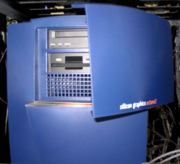
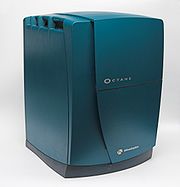
Octane skins come in three types. The original Octane has green skins with the original SGI 'cube' logo. The later model Octanes have skins of the same colour as the original, but with Octane2-style lettering and logos. Octane2 systems have blue skins with the modern lowercase letter-only SGI logo.
I/O subsystem
Octane series has two SCSISCSI
Small Computer System Interface is a set of standards for physically connecting and transferring data between computers and peripheral devices. The SCSI standards define commands, protocols, and electrical and optical interfaces. SCSI is most commonly used for hard disks and tape drives, but it...
controllers that supports Ultra Wide SCSI
SCSI
Small Computer System Interface is a set of standards for physically connecting and transferring data between computers and peripheral devices. The SCSI standards define commands, protocols, and electrical and optical interfaces. SCSI is most commonly used for hard disks and tape drives, but it...
devices. Systems can have a maximum of three internal 3.5" SCSI SCA devices, using proprietary mounting sleds that are also compatible with the Origin 2000
SGI Origin 2000
The SGI Origin 2000, code named Lego, is a family of mid-range and high-end servers developed and manufactured by SGI and introduced in 1996 to succeed the SGI Challenge and POWER Challenge. At the time of introduction, these systems ran IRIX 6.4 and later, IRIX 6.5. A variant of the Origin 2000...
, Origin 200
SGI Origin 200
The SGI Origin 200, code named Speedo, is an entry-level server computer developed and manufactured by SGI, introduced in October 1996 to accompany their mid-range and high-end Origin 2000. It is based on the same architecture as the Origin 2000 but has an unrelated hardware implementation...
and Onyx2
SGI Onyx2
The SGI Onyx2, code name Kego, is a family of visualization systems developed and manufactured by SGI, introduced in 1996 to succeed the Onyx. The Onyx2's basic system architecture is based on the Origin 2000 servers, but with the notable inclusion of graphics hardware. In 2000, the Onyx2 was...
. An external Ultra Wide SCSI port is used for connecting external devices.
Available Operating Systems
The SGI Octane with IMPACT-class graphics was first supported by IRIXIRIX
IRIX is a computer operating system developed by Silicon Graphics, Inc. to run natively on their 32- and 64-bit MIPS architecture workstations and servers. It was based on UNIX System V with BSD extensions. IRIX was the first operating system to include the XFS file system.The last major version...
version 6.4. VPro-class graphics have been supported since IRIX
IRIX
IRIX is a computer operating system developed by Silicon Graphics, Inc. to run natively on their 32- and 64-bit MIPS architecture workstations and servers. It was based on UNIX System V with BSD extensions. IRIX was the first operating system to include the XFS file system.The last major version...
version 6.5.10 for V6 and V8, with V10 and V12 graphics supported as of 6.5.11 (or 6.5.10 with a special driver patch).
Linux
Linux
Linux is a Unix-like computer operating system assembled under the model of free and open source software development and distribution. The defining component of any Linux system is the Linux kernel, an operating system kernel first released October 5, 1991 by Linus Torvalds...
runs on the Octane series, although the patch is experimental. Both IMPACT and VPro graphics are supported, and the X Window System is available on the ImpactSR series.
OpenBSD
OpenBSD
OpenBSD is a Unix-like computer operating system descended from Berkeley Software Distribution , a Unix derivative developed at the University of California, Berkeley. It was forked from NetBSD by project leader Theo de Raadt in late 1995...
has a port that runs on the Octane series as well.